
Life, 1896-10-22 · page 6 of 26
Life — October 22, 1896 — page 6: what you’re looking at
What you’re looking at
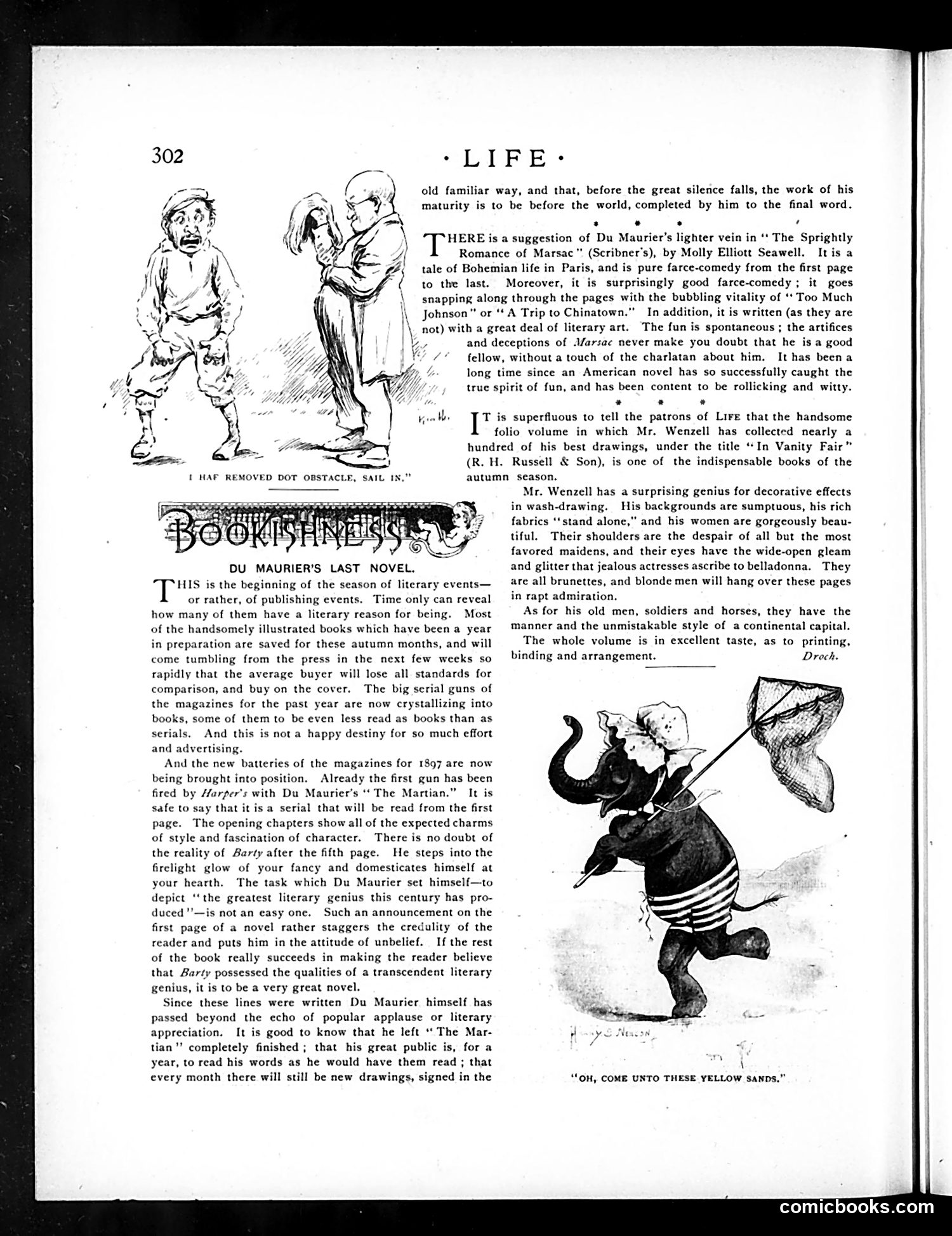
This page consists primarily of **book reviews** rather than political cartoons. The main content discusses Du Maurier's latest novel and praises a collection of drawings by Mr. Wenzel titled "In Vanity Fair." The two small **illustrations** are decorative rather than satirical: 1. Upper left: A sketch of two figures in conversation, captioned "I HAF REMOVED DOT OBSTACLE, SAIT IS" — appears to be generic character humor, possibly referencing a foreign accent. 2. Lower right: A figure jumping or leaping, captioned "OH, COME UNTO THESE YELLOW SANDS" — likely a literary reference or theatrical allusion. These are **artist samples** showcasing drawing styles rather than political commentary. The page focuses on literary and artistic merit of contemporary publications.
📄 Transcribed text from this page (OCR, searchable)
Machine-transcribed from the original scan — historical spelling and the odd misread are preserved.
*LIFE: old familiar way, and that, before the great silence falls, the work of his maturity is to be before the world, completed by him to the final word. . . . ’ HERE is a suggestion of Du Maurier’s lighter vein in ‘‘ The Sprightly Romance of Marsac” (Scribner's), by Molly Elliott Seawell. Itis a tale of Bohemian life in Paris, and is pure farce-comedy from the first page to the last. Moreover, it is surprisingly good farce-comedy ; it goes snapping along through the pages with the bubbling vitality of “* Too Much Johnson" or ‘A Trip to Chinatown.” In addition, it is written (as they are not) with a great deal of literary art. The fun is spontancous ; the artifices and deceptions of Warsae never make you doubt that he is a good fellow, without a touch of the charlatan about him. It has been a long time since an American novel has so successfully caught the true spirit of fun, and has been content to be rollicking and witty. * * * T is superfluous to tell the patrons of Lire that the handsome folio volume in which Mr. Wenzell has collected nearly a hundred of his best drawings, under the title “In Vanity Fair” (R. H. Russell & Son), is one of the indispensable books of the autumn season, Mr. Wenzell has a surprising genius for decorative effects in wash-drawing. His backgrounds are sumptuous, his rich fabrics ‘stand alone,” and his women are gorgeously beau- tiful. Their shoulders are the despair of all but the most favored maidens, and their eyes have the wide-open gleam DU MAURIER’S LAST NOVEL. and glitter that jealous actresses ascribe to belladonna. They HIS is the beginning of the season of literary events— re all brunettes, and blonde men will hang over these pages or rather, of publishing events. Time only can reveal in rapt admiration. how many of them have a literary reason for being. Most As for his old men, soldiers and horses, they have the of the handsomely illustrated books which have been a year ™anner and the unmistakable style of a continental capital. in preparation are saved for these autumn months, and will The whole volume is in excellent taste, as to printing, come tumbling from the press in the next few weeks so binding and arrangement. Droch. rapidly that the average buyer will lose all standards for ~ comparison, and buy on the cover. The big serial guns of the magazines for the past year are now crystallizing into books, some of them to be even less read as books than as serials. And this is nota happy destiny for so much effort and advertising. And the new batteries of the magazines for 1897 are now being brought into position. Already the first gun has been fired by Harper's with Du Maurier’s ‘‘ The Martian.” It is safe to say that it is a serial that will be read from the first page. The opening chapters show all of the expected charms of style and fascination of character. There is no doubt of the reality of Barty after the fifth page. He steps into the firclight glow of your fancy and domesticates himself at your hearth. The task which Du Maurier set himself—to depict ‘‘the greatest literary genius this century has pro- duced is not an easy one. Such an announcement on the first page of a novel rather staggers the credulity of the reader and puts him in the attitude of unbelief. If the rest of the book really succeeds in making the reader believe that Aarty possessed the qualities of a transcendent literary genius, it is to be a very great novel. Since these lines were written Du Maurier himself has passed beyond the echo of popular applause or literary appreciation. It is good to know that he left The Mar- tian” completely finished ; that his great public is, for a year, to read his words as he would have them read ; that every month there will still be new drawings, signed in the “OH, COME UNTO THESE YELLOW SANDS.” comicbooks.com