
Life, 1896-10-22 · page 21 of 26
Life — October 22, 1896 — page 21: what you’re looking at
What you’re looking at
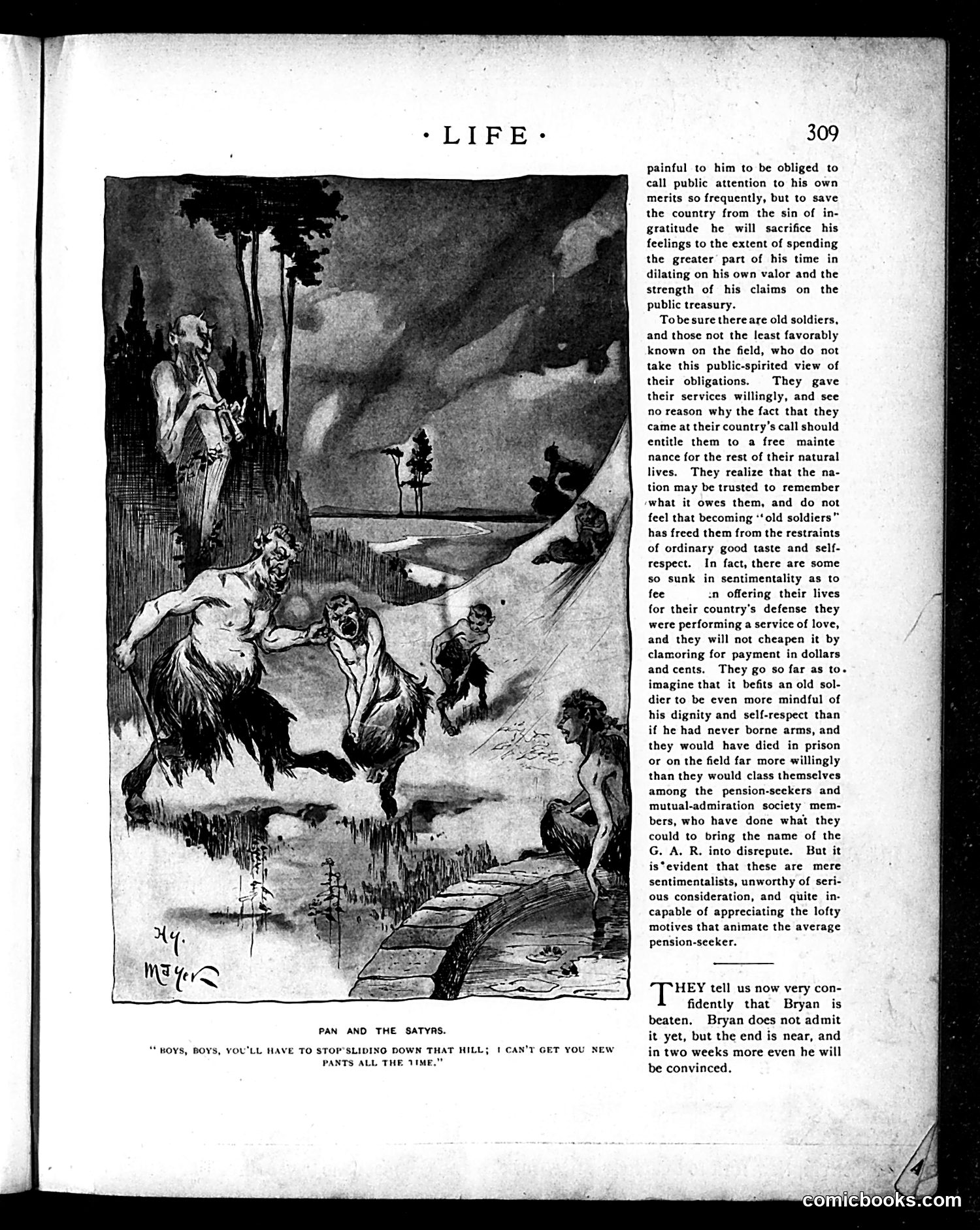
This cartoon satirizes **old soldiers seeking pensions**. Pan (the mythological goat-god, shown as an authority figure) scolds young satyrs (representing veterans) for wearing out their pants by sliding down a hill—a metaphor for their constant complaints and demands for financial support from the government. The accompanying text elaborates the satire's target: **Civil War veterans**, particularly those in the **G.A.R. (Grand Army of the Republic)**, who the author views as shamelessly leveraging their service to extract pension money rather than accepting it quietly with dignity. The piece contrasts these "pension-seekers" with idealized soldiers who served from patriotism alone and would never "cheapen" their sacrifice by demanding compensation. The final paragraph's mention of **Bryan** (likely William Jennings Bryan, the 1896 presidential candidate) appears unrelated to the pension debate and may indicate this is composite content from *Life* magazine.
📄 Transcribed text from this page (OCR, searchable)
Machine-transcribed from the original scan — historical spelling and the odd misread are preserved.
PAN AND THE SATYAS. “BOYS, BOYS, YOU'LL HAVE TO STOP’SLIDING DOWN THAT HILL; PANTS ALL THE 1IME," 1 CAN'T GET YOU NEW painful to him to be obliged to call public attention to his own merits so frequently, but to save the country from the sin of in- gratitude he will sacrifice his feelings to the extent of spending the greater part of his time in dilating on his own valor and the Strength of his claims on the public treasury. Tobe sure there are old soldiers, and those not the least favorably known on the field, who do not take this public-spirited view of their obligations. They gave their services willingly, and see no reason why the fact that they came at their country’s call should entitle them to a free mainte nance for the rest of their natural lives. They realize that the na- tion may be trusted to remember what it owes them, and do not feel that becoming ‘‘old soldiers” has freed them from the restraints of ordinary good taste and self- respect. In fact, there are some so sunk in sentimentality as to fee in offering their lives for their country’s defense they were performing a service of love, and they will not cheapen it by clamoring for payment in dollars and cents. They go so far as to imagine that it befits an old sol- dier to be even more mindful of his dignity and self-respect than if he had never borne arms, and they would have died in prison or on the field far more willingly than they would class themselves among the pension-scekers and mutual-admiration society mem- bers, who have done what they could to bring the name of the G. A. R, into disrepute. But it is*evident that these are mere sentimentalists, unworthy of seri- ous consideration, and quite in- capable of appreciating the lofty motives that animate the average pension-seeker. HEY tell us now very con- fidently that Bryan is beaten. Bryan does not admit it yet, but the end is near, and in two weeks more even he will be convinced.