
Life, 1896-10-22 · page 17 of 26
Life — October 22, 1896 — page 17: what you’re looking at
What you’re looking at
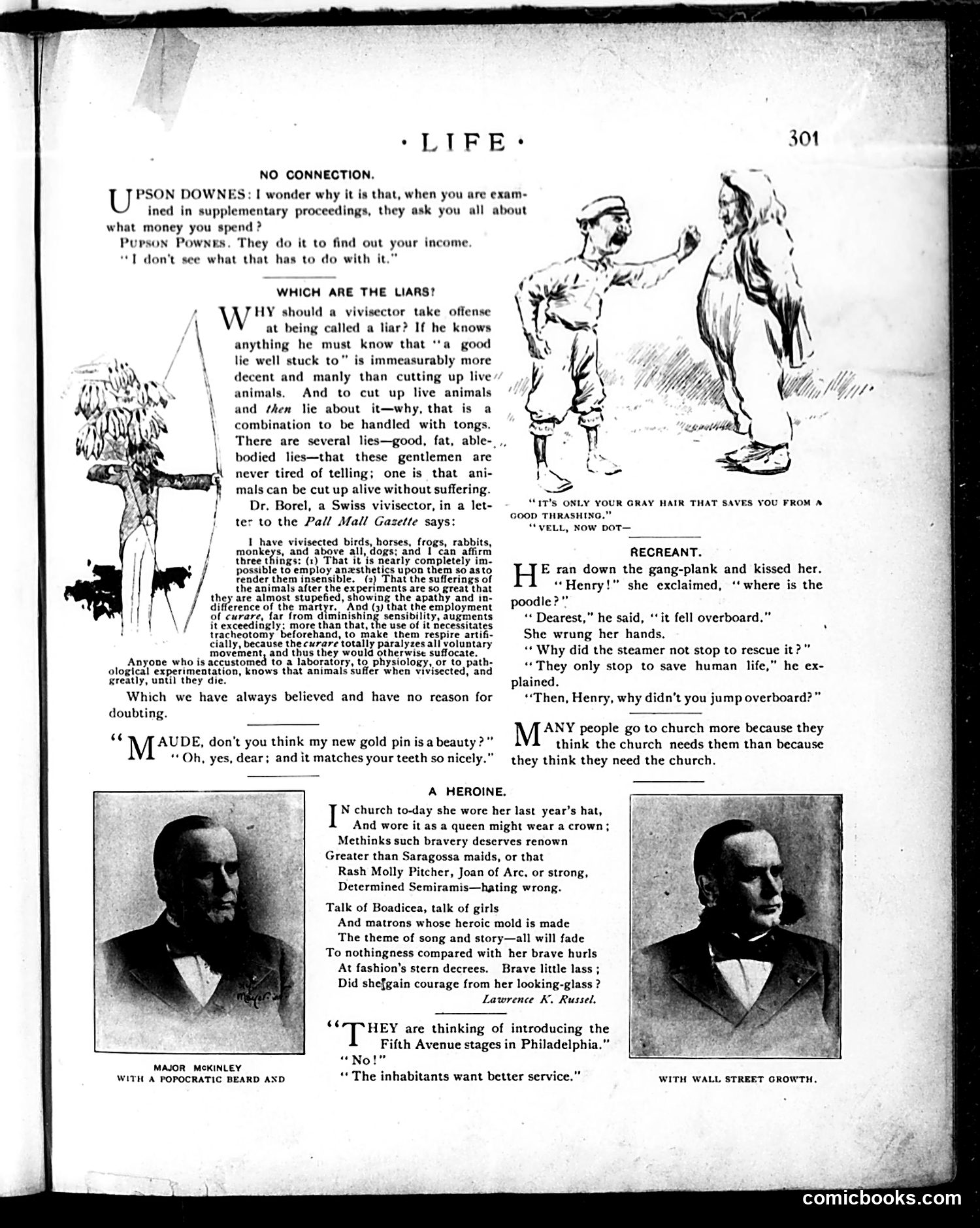
This page collects brief satirical pieces targeting different social hypocrisies: **"Which Are the Liars?"** attacks vivisectors (animal experimenters) who claim surgery on live animals causes no suffering, while quoting a Swiss vivisector's own admission that animals suffer greatly during procedures. The satire exposes the contradiction between their public claims and private knowledge. **"Recreant"** mocks upper-class priorities: a man loses his wife's poodle overboard but doesn't jump in because steamers "only stop to save human life." The humor undercuts wealthy concerns about pet dogs while accepting indifference to human life. **"A Heroine"** praises a woman wearing last year's hat to church as brave, comparing her defiance of fashion to historical heroines like Joan of Arc—satirizing both vanity culture and the triviality of "feminine courage." Two portrait photographs labeled "Major McKinley" reference political figures, though their specific meaning requires additional historical context. The page uses humor to critique animal cruelty, class priorities, and social pretension.
📄 Transcribed text from this page (OCR, searchable)
Machine-transcribed from the original scan — historical spelling and the odd misread are preserved.
*LIFE: NO CONNECTION. PSON DOWNES: I wonder why it is that, when you are exam- ined in supplementary proceedings, they ask you all about what money you spend ? Pupson Pownes. They do it to find out your income. “IT don't see what that has to do with it.” WHICH ARE THE LIARS? HY should a vivisector take offense at being called a liar? If he knows anything he must know that ‘‘a good lie well stuck to” is immeasurably more decent and manly than cutting up live y /, y yy yj animals. And to cut up live animals / Yi Mh Nghe and then lie about it—why, that is a q a tad combination to be handled with tongs. There are several lies—good, fat, able-_ : bodied lies—that these gentlemen are : never tired of telling; one is that ani- mals can be cut up alive without suffering. Dr. Borel, a Swiss vivisector, in a let- ter to the Pall Mall Gazette says: I have vivisected birds, horses, frogs, rabbits, monkeys, and above all, dogs; and I can affirm three things: (1) That it'is nearly completely im- possible to employ anzsthetics upon them so asto render them insensible. (2) That the sufferings of the animals after the experiments are so great that they are almost stupefied, showing the apathy and in- difference of the martyr. ’ And (3) that the employment of curare, far from diminishing sensibility, augments it exceedingly: more than that, the use of it necessitates tracheotomy beforehand, to make them respire artifi- cially, because thecurare'totally paralyzes all voluntary __ movement, and thus they would otherwise suffocate. Anyone who is accustomed to a laboratory, to physiology, or to path- ological experimentation, knows that animals suffer when vivisected, and greatly, until they die. “IT'S ONLY YOUR GRAY HAIR THAT SAVES YOU FROM A GOOD THRASHING.” “VELL, Now DOT— RECREANT. E ran down the gang-plank and kissed her. “Henry!” she exclaimed, ‘‘ where is the poodle?” “* Dearest,” he said, ‘‘it fell overboard.” She wrung her hands. ‘* Why did the steamer not stop to rescue it?” “They only stop to save human life,” he ex- plained. Which we have always believed and have no reason for doubting. “ AUDE, don’t you think my new gold pin is a beauty?” “Then, Henry, why didn’t you jump overboard?” ANY people go to church more because they think the church needs them than because they think they need the church. “Oh, yes, dear; and it matches your teeth so nicely.” A HEROINE. N church to-day she wore her last year’s hat, And wore it as a queen might wear a crown; Methinks such bravery deserves renown Greater than Saragossa maids, or that Rash Molly Pitcher, Joan of Arc, or strong, Determined Semiramis—hating wrong. Talk of Boadicea, talk of girls And matrons whose heroic mold is made The theme of song and story—all will fade To nothingness compared with her brave hurls At fashion’s stern decrees. Brave little lass ; Did shefgain courage from her looking-glass ? Lawrence K. Russel, oe HEY are thinking of introducing the Fifth Avenue stages in Philadelphia.” “No!” “The inhabitants want better service.” MAJOR MCKINLEY WITH A POPOCRATIC BEARD AND WITH WALL STREET GROWTH. -comicbooks.com