
A complete issue · 20 pages · 1896
Life — May 7, 1896
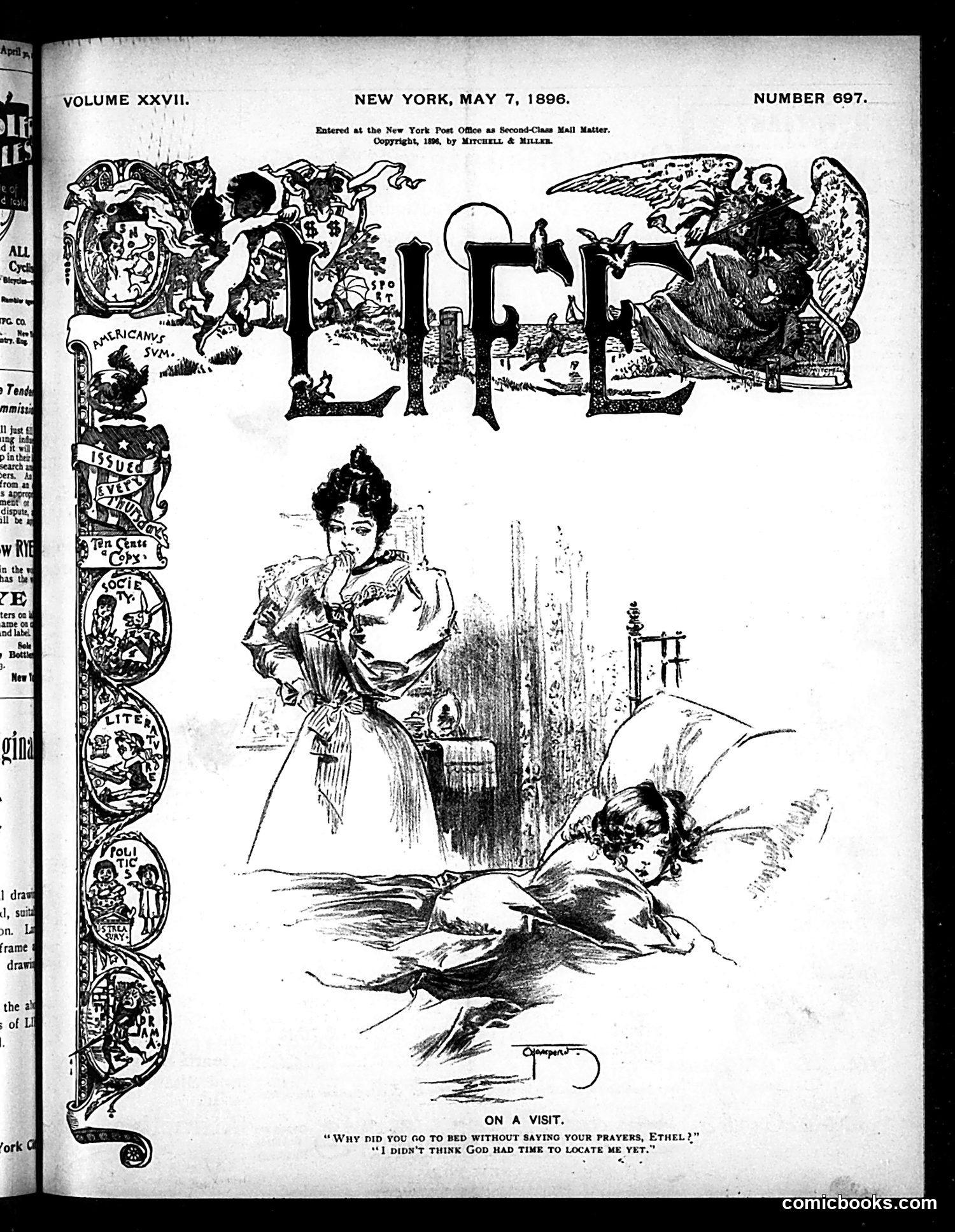
This satirical illustration titled "On a Visit" depicts a woman in late Victorian dress standing over a cherub or cupid figure lying on the ground. The caption reads: "Why did you go to bed without saying your prayers, Ethel?" with the response "I didn't think God had time to locate me yet." The joke appears to target Victorian propriety and religious hypocrisy. The cherub's flippant response satirizes both child behavior and the era's assumptions about divine omniscience—suggesting God might be too busy to monitor someone's whereabouts. The woman's stern, moralistic posture contrasts with the cherub's irreverent answer, mocking the sanctimonious enforcement of religious observance that characterized upper-class Victorian households.
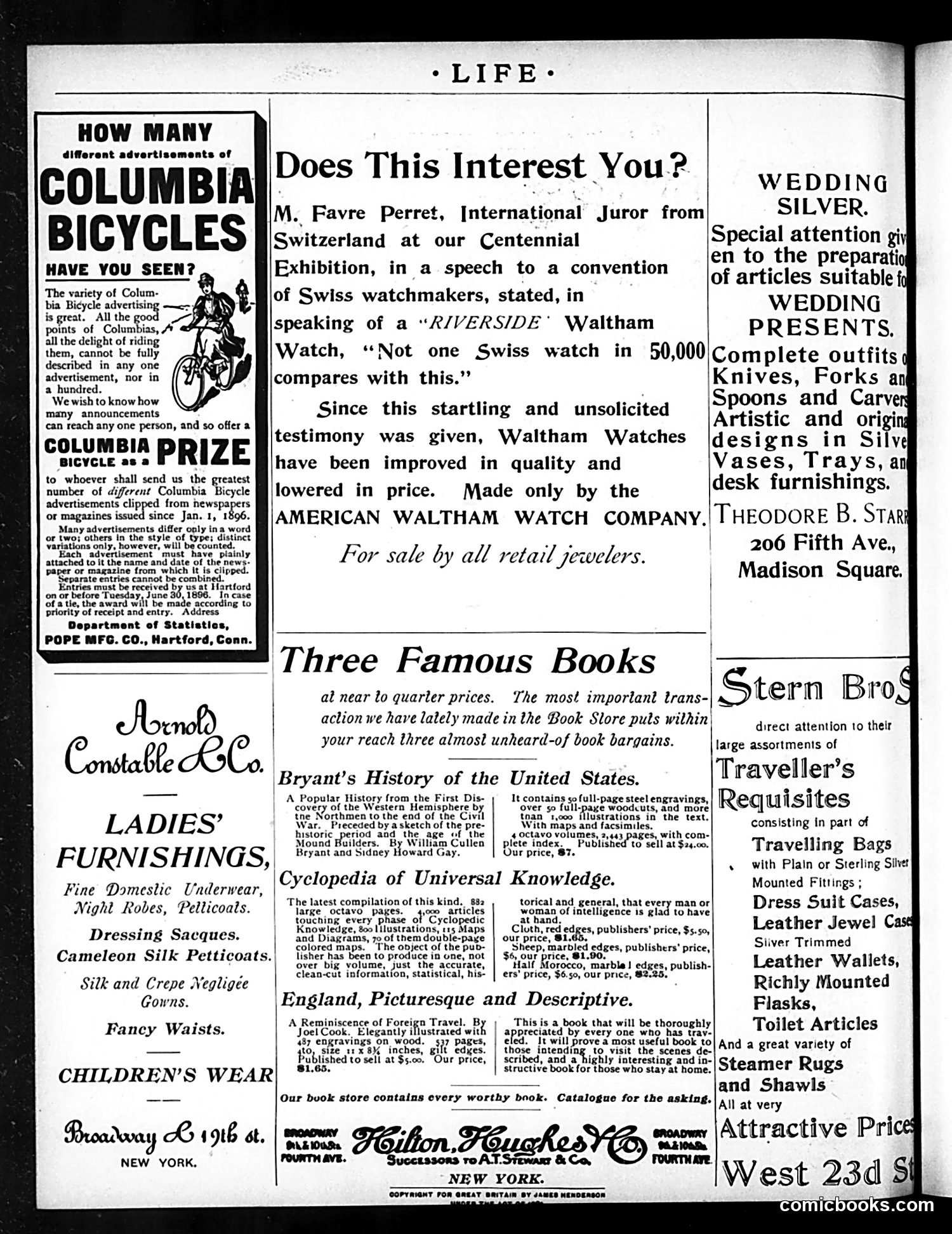
This page is primarily **advertising content** with no political cartoons or satirical material. The advertisements include: - **Columbia Bicycles**: A manufacturer's competition encouraging readers to clip bicycle advertisements and submit them for prizes, with a small illustration of a cyclist. - **Waltham Watches**: Promoting their watches using an endorsement allegedly from a Swiss watchmaker at a Centennial Exhibition, claiming Swiss watches cannot compare. - **Book advertisements**: Promoting three books available at discounted prices through their book store. - **Luxury goods**: Including wedding silver, ladies' furnishings, traveling accessories, and other high-end merchandise. The page reflects early 20th-century consumer culture and advertising strategies, targeting affluent readers of *Life* magazine with premium products and services.
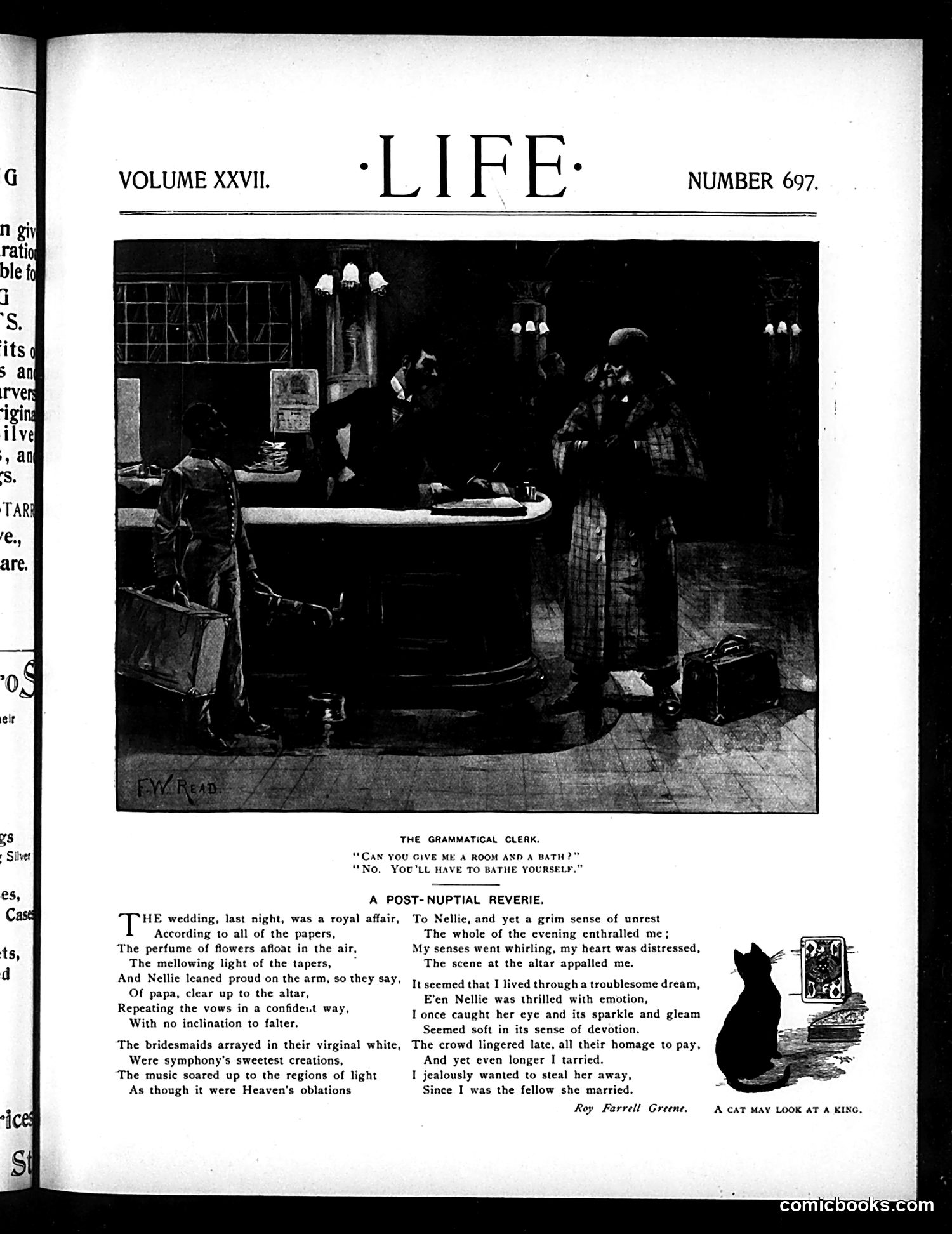
The page contains two distinct pieces: **"The Grammatical Clerk"** (top illustration): A humorous hotel scene where a clerk tells a guest "No. You'll have to bathe yourself" in response to a request for "a room and a bath." The joke plays on the ambiguous phrasing—the guest likely meant a room *with* a bath (bathroom), but the clerk interprets it literally as needing personal bathing assistance, which he refuses. **"A Post-Nuptial Reverie"** (bottom): A poem by Roy Farrell Greene about wedding-night emotional complexity. The speaker describes witnessing his bride's joy while admitting jealous, possessive feelings—a satirical commentary on male insecurity and the tension between romantic idealization and marital reality. The page is primarily literary/humorous commentary rather than political satire.
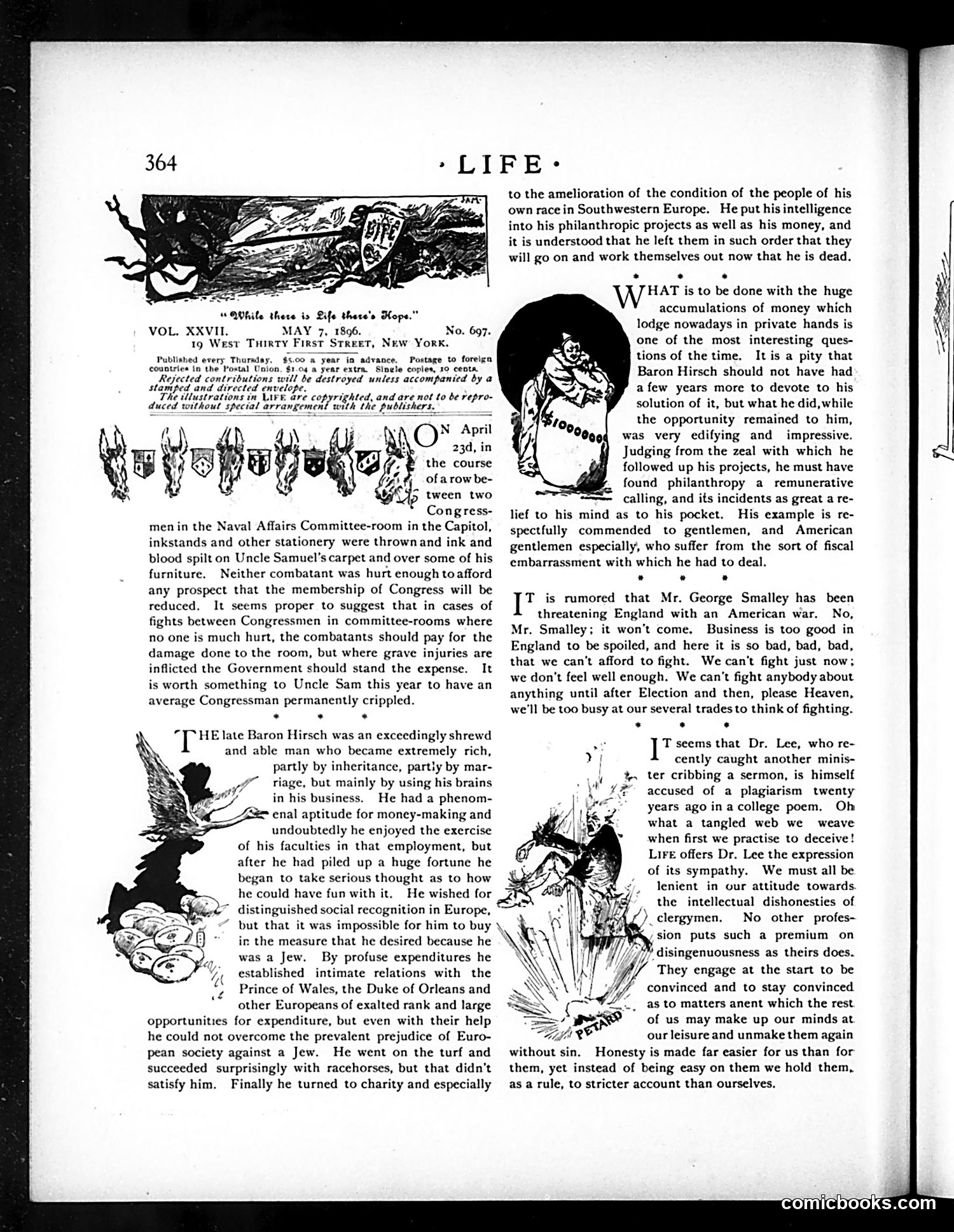
This page contains three distinct satirical sections discussing contemporary figures: **Baron Hirsch**: The text criticizes the deceased Jewish philanthropist's massive wealth accumulation, questioning what should be done with his "huge accumulations of money." While praising his charitable work, the piece reveals period antisemitism through commentary about his Jewish identity and European prejudice. **George Smalley**: A brief satirical item mocking rumors of threats of American war against England, dismissing such conflict as economically unwise given profitable trade relations. **Dr. Lee**: The final section ridicules a clergyman accused of plagiarizing a sermon from a college poem written twenty years prior, using this to launch broader commentary on intellectual dishonesty and the need for stricter moral standards. The illustrations appear to be decorative period engravings accompanying these satirical commentary pieces.
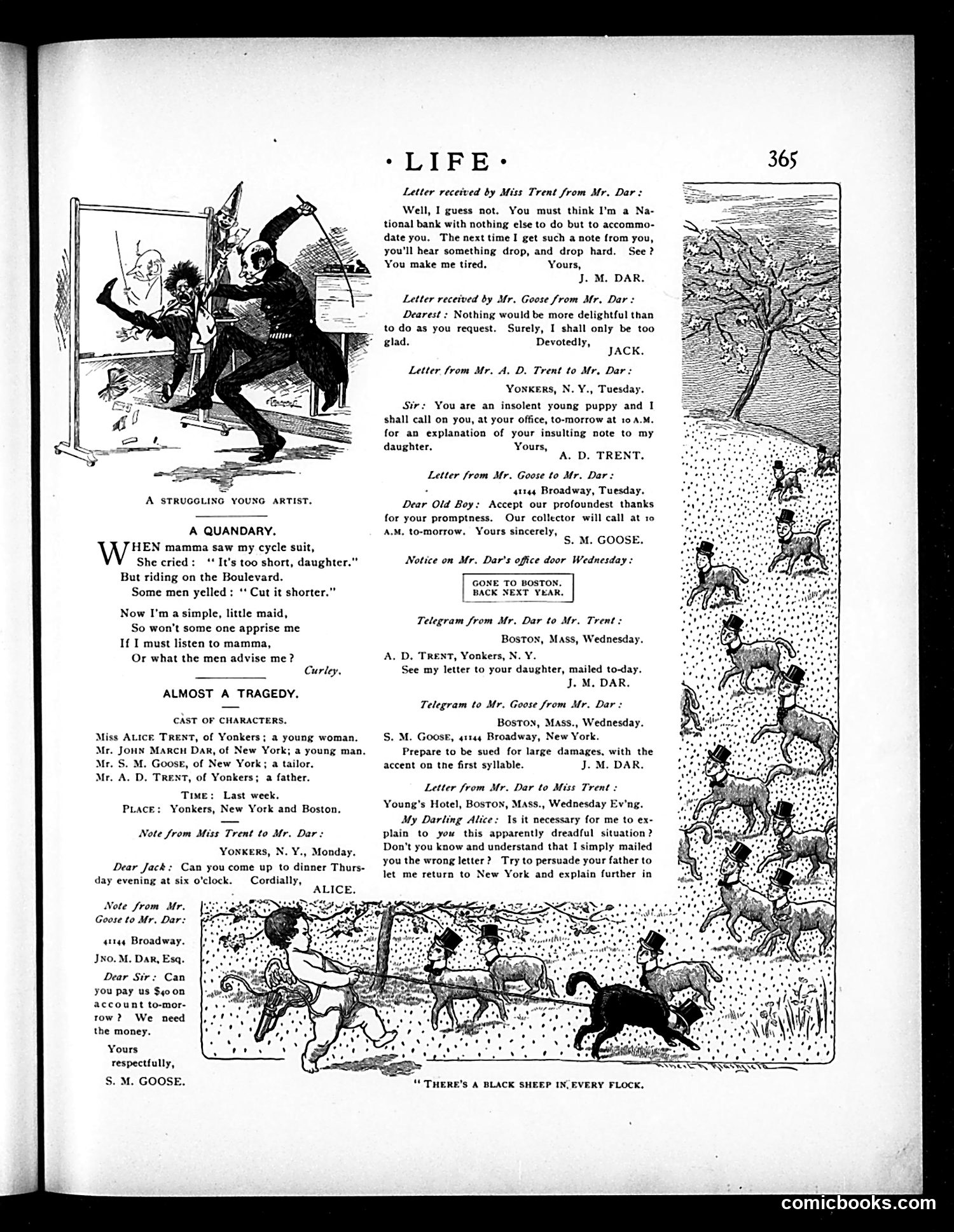
This page contains several satirical pieces about everyday social frustrations rather than political commentary. "A Struggling Young Artist" (top left cartoon) depicts a man being forcibly removed from what appears to be a banker's office, satirizing the difficulty artists face obtaining loans. "A Quandary" is a humorous poem about a maid whose employer demands she shorten her skirt, then criticizes the result—poking fun at contradictory employer demands. "Almost a Tragedy" is a playful dramatic sketch involving characters named Alice Trent, John Dar, and others in Yonkers and Boston, built around mistaken letters and miscommunication causing comedic misunderstandings. The pastoral illustration shows children and sheep in a countryside scene, captioned "There's a black sheep in every flock"—a visual representation of the common proverb about nonconformity in groups. The overall page emphasizes social comedy over political satire.
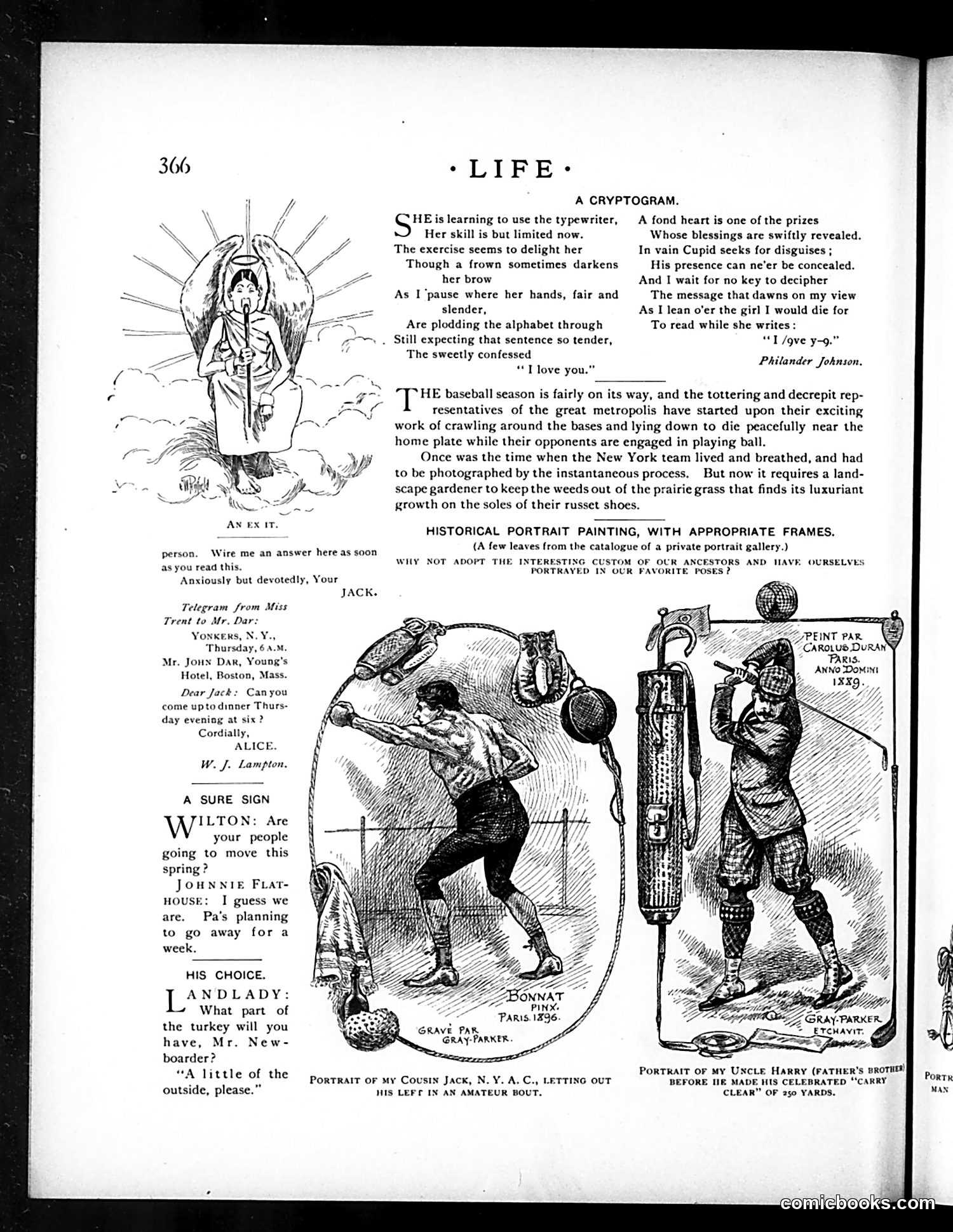
This page contains several unrelated humor pieces typical of Life's format: **"A Cryptogram"** (top): A poem about a woman learning typewriter skills, with romantic undertones—reflecting early 1900s attitudes toward women entering the workforce. **Baseball commentary**: A brief piece mocking the New York baseball team's tendency to lose, suggesting they need a "landscape gardener" to maintain their field rather than skill improvements. **"Historical Portrait Painting"**: A humorous caption suggesting readers commission ancestor portraits in period frames, likely satirizing Victorian nostalgia and portrait gallery customs. **Lower cartoons**: Two framed illustrations labeled as portraits of "Cousin Jack" (an amateur boxer) and "Uncle Harry" (who performed a celebrated "carry clear" of 250 yards), appearing to be humorous family anecdotes rather than political satire. The page primarily contains social humor and light domestic comedy rather than political commentary.
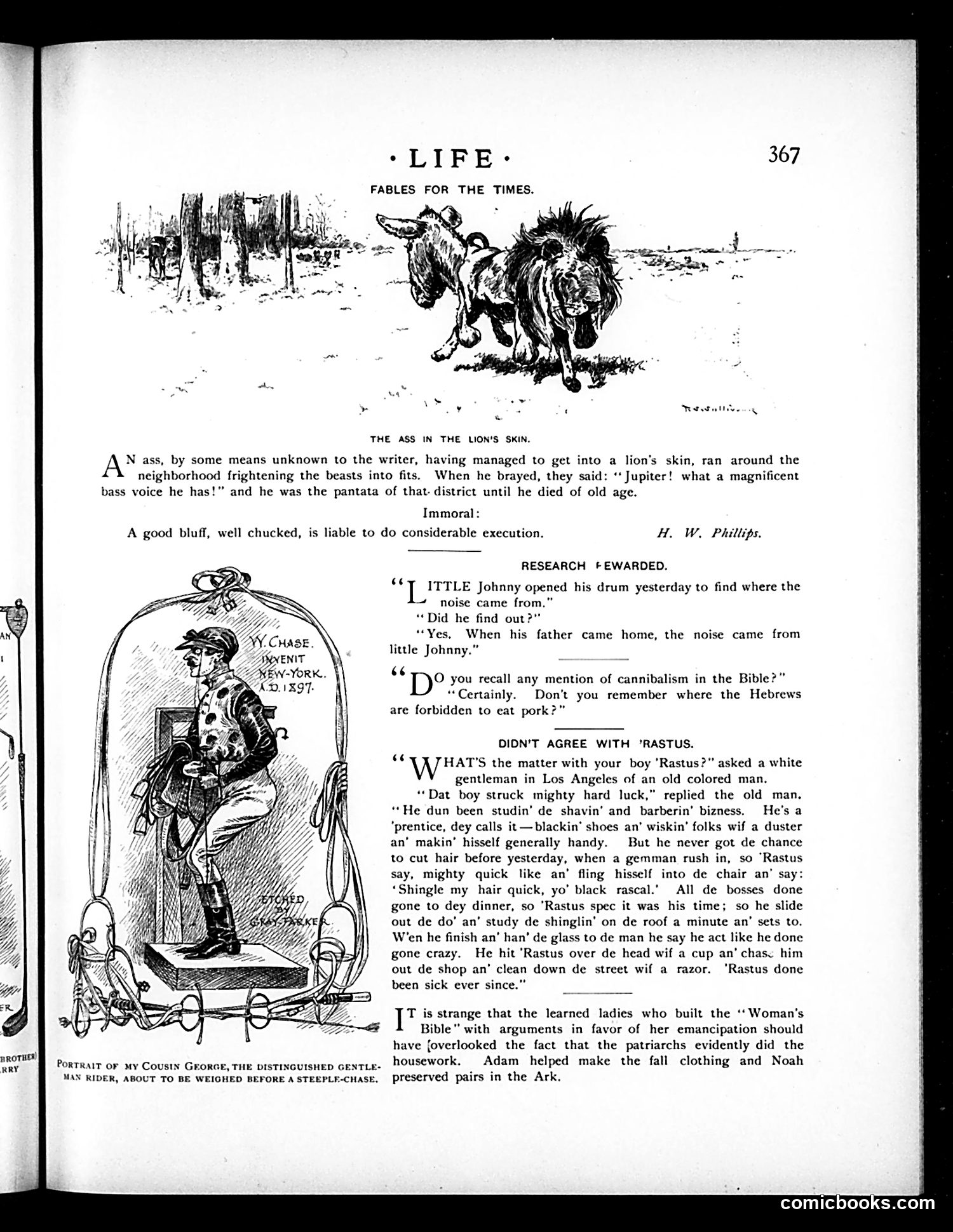
This page contains three satirical pieces: 1. **"The Ass in the Lion's Skin"** — A fable about an ass wearing a lion's skin who frightens beasts until dying of old age. The moral critiques bluffing: "A good bluff, well chucked, is liable to do considerable execution." 2. **"Research Rewarded"** — A brief joke about a child finding noise comes from himself. 3. **"Didn't Agree with 'Rastus'"** — A longer anecdote mocking racial stereotypes, featuring dialect humor about a Black barber named Rastus whose apprentice ("dat boy") supposedly went mad after a German customer's aggressive shaving demands. The page also includes a portrait sketch captioned as "my cousin George" about to be weighed before a steeplechase (horse race). The content reflects early-20th-century American satirical magazine conventions, including ethnic caricature.
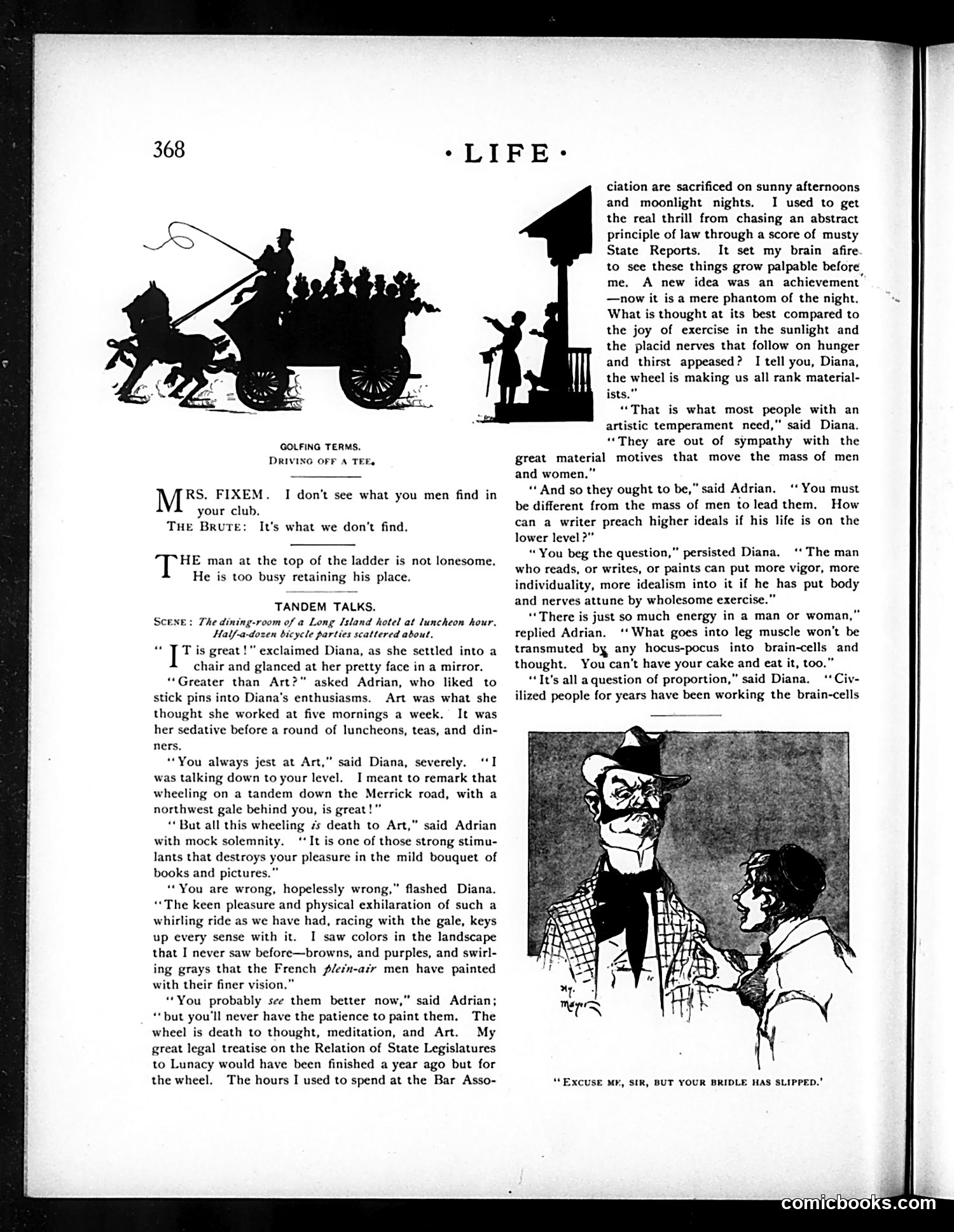
This page contains two satirical exchanges. The top cartoon, titled "Golfing Terms: Driving Off a Tee," shows Mrs. Fixem criticizing men's clubs, with The Brute responding that women simply don't understand them. The lower section, "Tandem Talks," depicts Diana and Adrian debating art and intellectual pursuits. Diana defends cycling and physical activity as stimulating, while Adrian argues that such exertion distracts from intellectual work. The accompanying illustration shows a man (labeled "Mr. Pepper") greeting a woman, with the caption "Excuse me, sir, but your bridle has slipped." The satire targets gender roles and class assumptions of the era: men's exclusive leisure activities versus women's athletic pursuits, and the condescending attitude toward women's intellectual capacity. The bridle caption suggests men view women as animals requiring control.
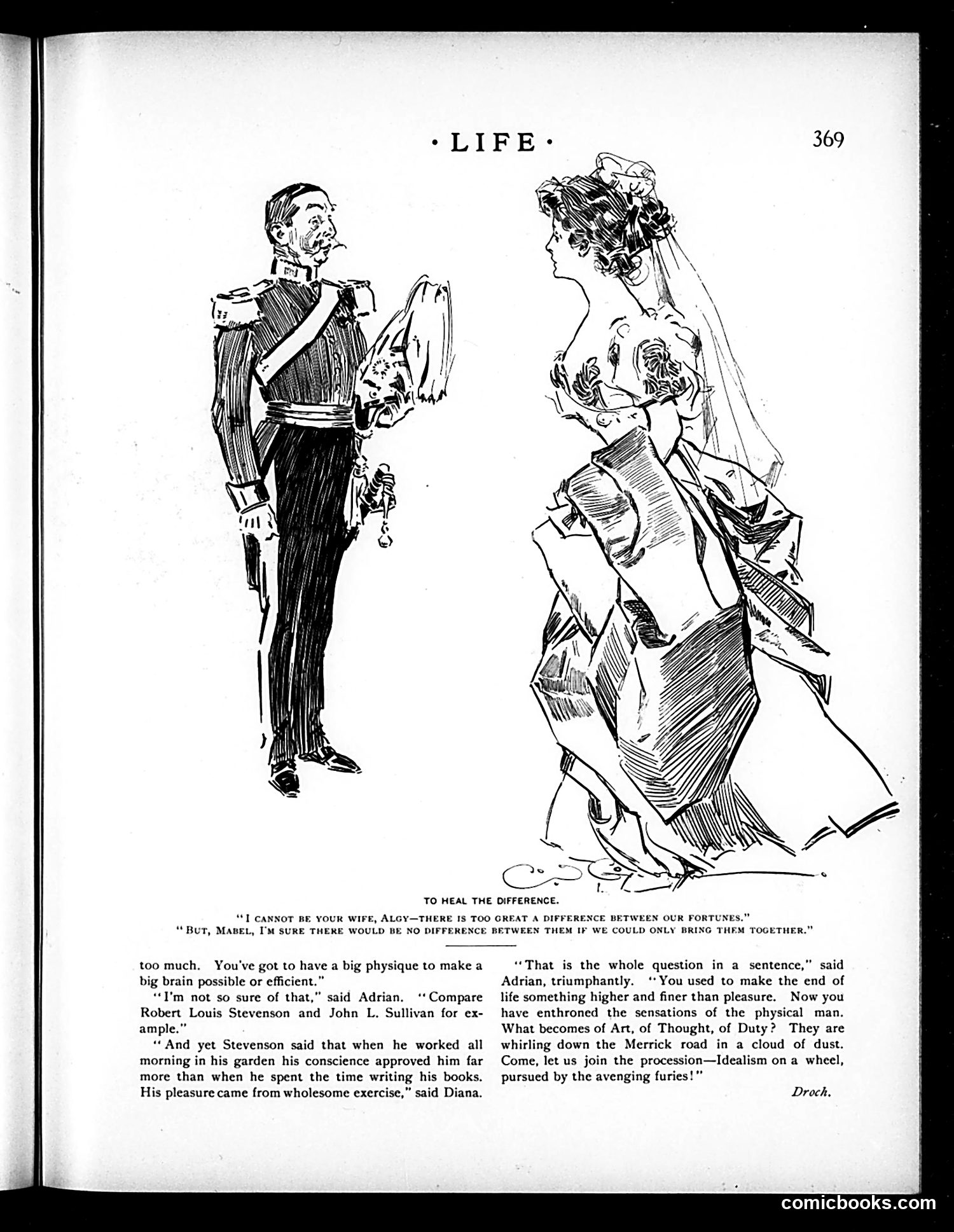
This page depicts a romantic scene between a military officer and an elegant woman in formal dress. The caption reads: "TO HEAL THE DIFFERENCE," with dialogue suggesting class disparity—he claims he cannot marry her due to fortune differences, but she counters that wealth wouldn't matter if they could "bring them together." The satire appears to mock the earnest reconciliation of class divisions through romantic love. The dialogue references Robert Louis Stevenson and John L. Sullivan (a famous boxer), suggesting the cartoon comments on intellectual versus physical pursuits and their social value. The unsigned cartoon (credited to "Droch" at bottom) satirizes early 1900s romantic idealism—the notion that love could transcend economic inequality—by presenting an officer and society woman debating whether money truly matters when passion is involved.
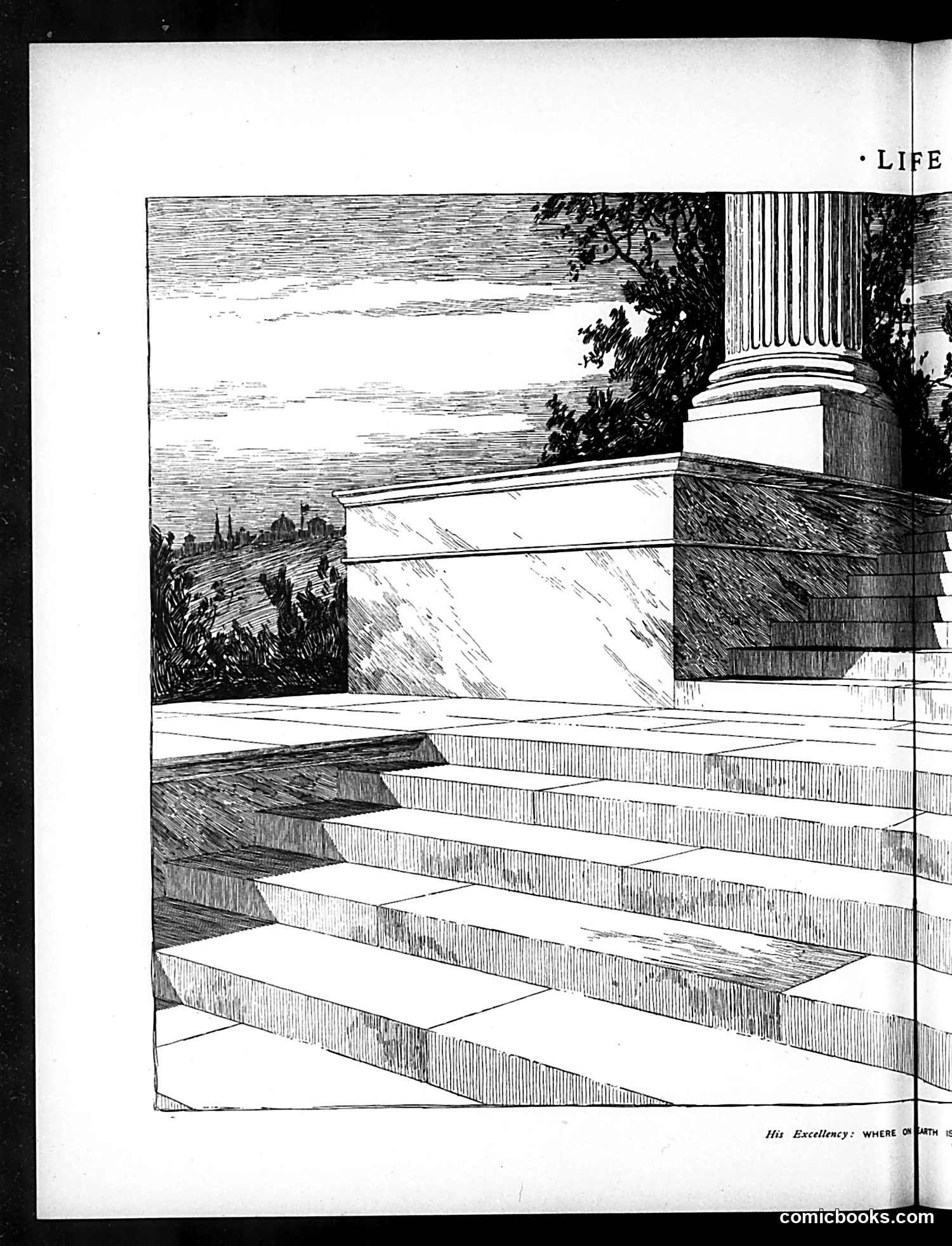
This is an architectural illustration rather than a political cartoon. The image depicts a modernist building with clean lines, broad steps, and a classical column, overlooking a distant cityscape. The style emphasizes geometric forms and contemporary design principles popular in early-to-mid 20th century American architecture. The partial caption at bottom reads "His Excellency: WHERE OR WITH IS..." but the full text is cut off, making the complete meaning unclear. Without the complete caption and publication date, I cannot definitively identify which political figure "His Excellency" references or what specific building this represents. The illustration appears to be satirizing some government building or official residence, but the exact target and intended joke remain uncertain from this page alone.
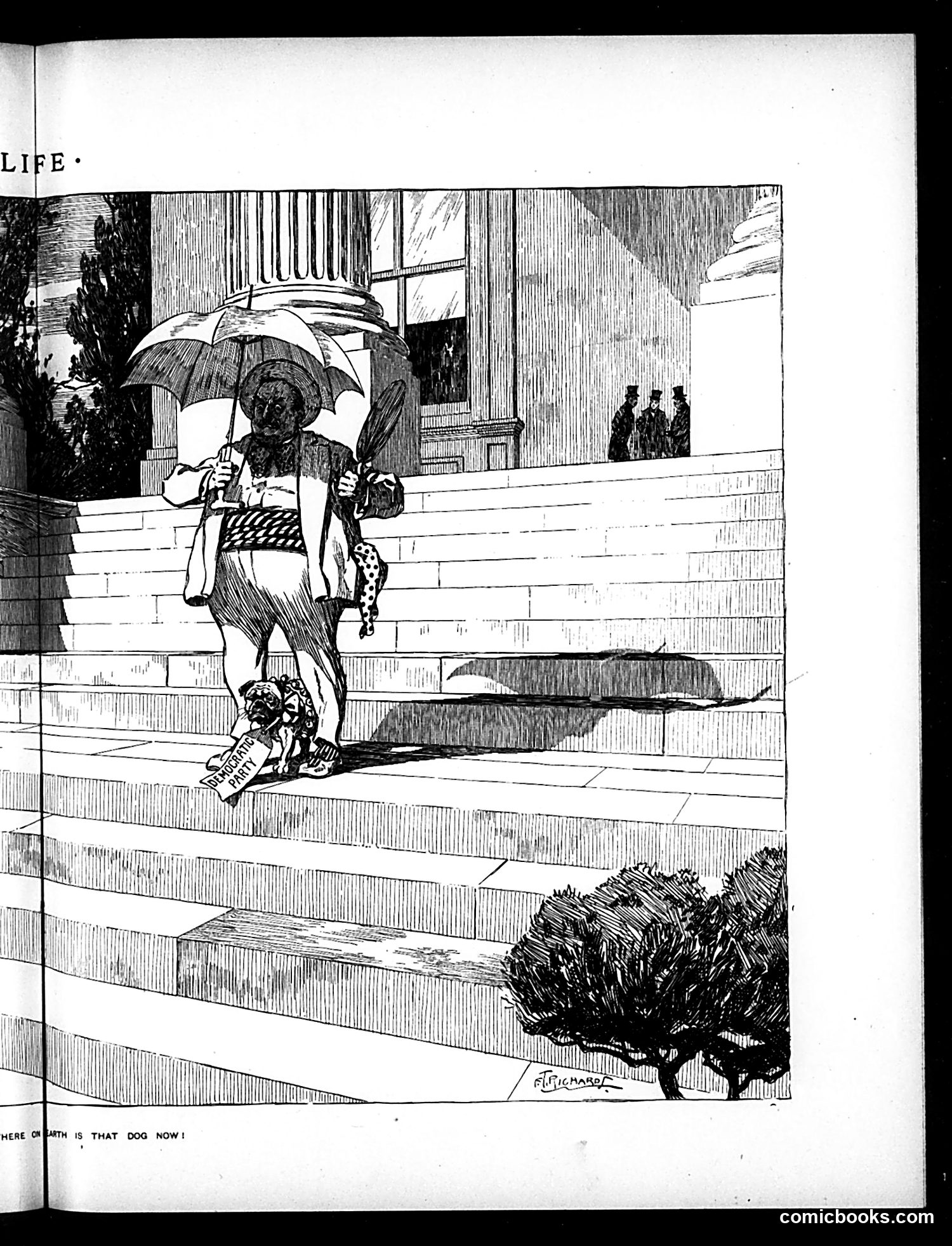
This is a political cartoon from *Life* magazine depicting a figure in what appears to be classical or allegorical dress, holding an umbrella and walking down grand steps. The figure is labeled at the bottom with text reading "HERE ON EARTH IS THAT DOG NOW!" The cartoon appears to be satirizing a political or public figure using the classical "dog days" metaphor—a period of difficulty or disgrace. The grand neoclassical architecture (columns, wide steps) suggests a government building, possibly the Capitol or a courthouse. The umbrella may represent attempts to weather criticism or scandal. Without visible date, artist attribution beyond the signature, or clearer context clues, I cannot definitively identify the specific figure or incident being referenced. The satire seems to involve a prominent person's fall from grace or current predicament.
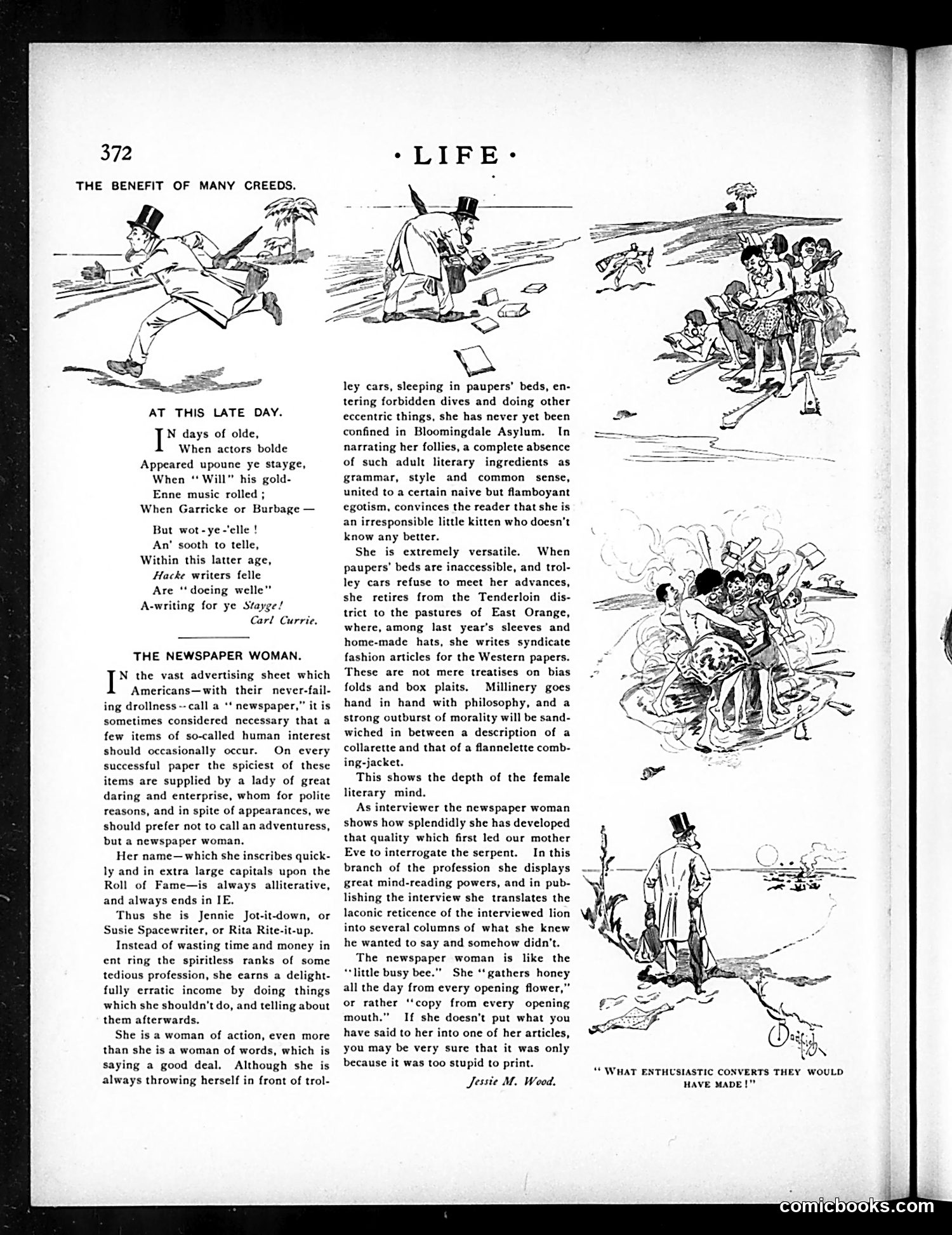
This page contains two satirical essays typical of Life's social commentary: **"At This Late Day"** (left) is a humorous poem by Carl Currie lamenting modern theatrical writers compared to legendary actors and playwrights of earlier eras (Shakespeare, Garrick, Burbage). The joke: contemporary hack writers pale against historical giants, yet they still get produced. **"The Newspaper Woman"** (center/right) by Jessie M. Wood satirizes a specific phenomenon: female journalists who manufacture sensational stories. The piece mocks women reporters with alliterative pseudonyms ending in "-ie" (Jennie Jot-it-down, Susie Spacewriter) who deliberately perform dangerous or scandalous acts—sleeping in poorhouses, entering dives—purely to write about them. Wood's critique: these writers lack basic literary skills (grammar, style) yet succeed through shameless self-promotion and fabricating quotes from interview subjects. The accompanying cartoons humorously depict such stunts and adventures. The satire targets both journalistic sensationalism and female ambition in the profession, reflecting period attitudes about women in journalism.
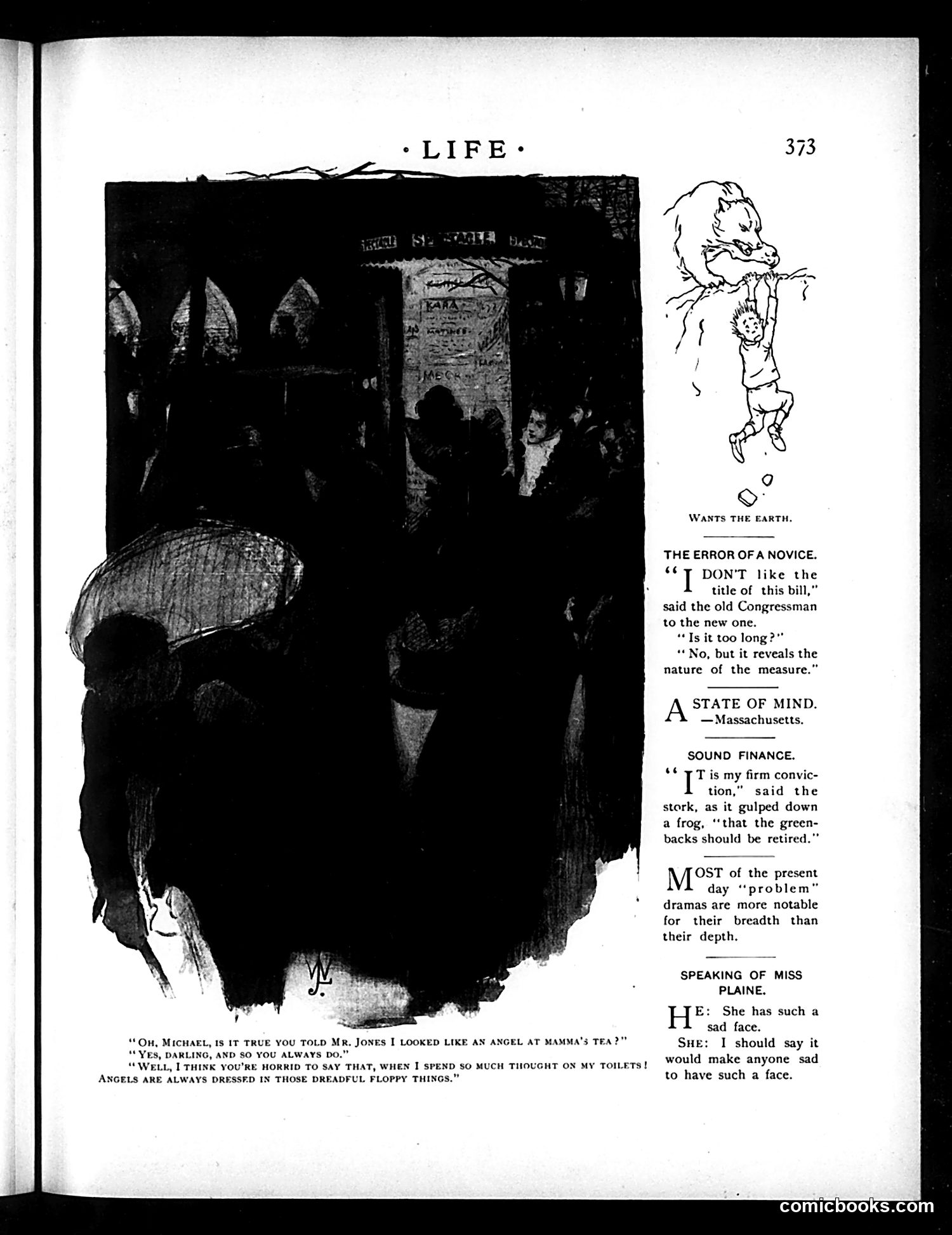
This page contains several short humorous pieces typical of early 20th-century American satire: **Main cartoon** (bottom): A domestic comedy about a woman upset that her boyfriend called her angelic—she's offended because angels wear unflattering, baggy clothing ("floppy things"), implying the compliment accidentally insulted her fashion sense. **"Sound Finance"** joke: A stork swallows a frog while advocating for retiring "greenbacks" (paper currency). This satirizes political figures making economic pronouncements while doing something contradictory—the stork is consuming something living rather than managing money sensibly. **"Error of a Novice"**: An old congressman warns a new one that a bill's title "reveals the nature of the measure"—likely satirizing how bills with vague or misleading titles mask their true legislative intent. **"State of Mind"**: A brief Massachusetts reference, likely political commentary specific to that state's politics. The page exemplifies Life's style: short, punchy social satire aimed at everyday manners, politics, and human nature rather than specific current events.
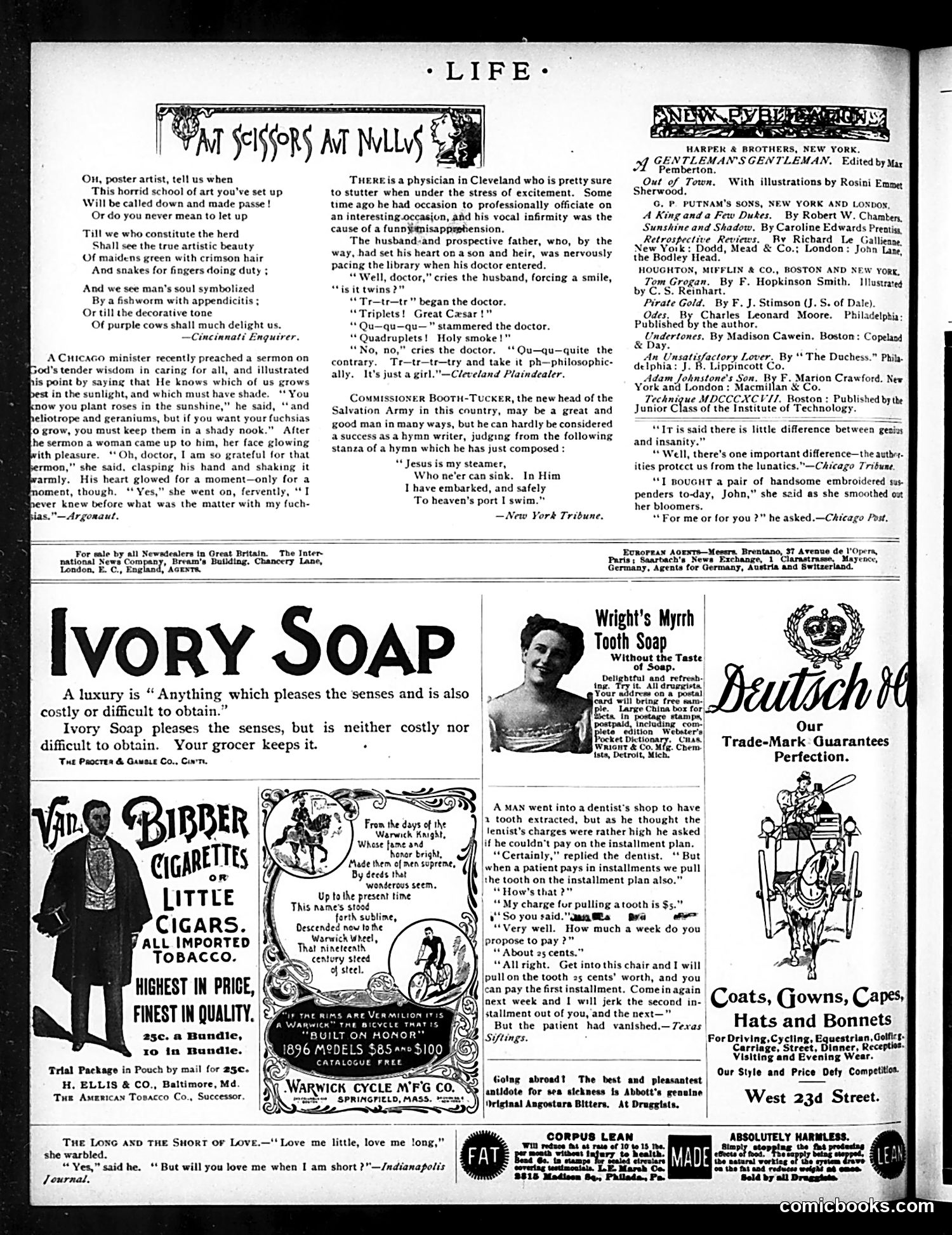
This page consists primarily of **humorous anecdotes and advertisements** rather than political cartoons. ## The Satirical Content: The page opens with a critique of **modern "poster art"** (likely Art Nouveau or similar contemporary movements). The Cincinnati Enquirer mockingly complains about artists depicting "maidens green with crimson hair" and "purple cows"—absurdist imagery that violated realistic aesthetic conventions of the era. Three brief humorous stories follow: - A minister's sermon about God's care is misunderstood by a woman grateful for gardening advice - A stuttering Cleveland physician's stammer causes a father to repeatedly misunderstand the number of children being born - Salvation Army Commissioner Booth-Tucker's hymn using "steamer" (ship) as a metaphor for Jesus ## The Point: These jokes target **pretentious modern art movements**, **miscommunication**, and **awkward religious rhetoric**—reflecting early 20th-century anxieties about changing artistic and social conventions. The remainder consists of book advertisements and product ads (Ivory Soap, cigarettes, etc.).
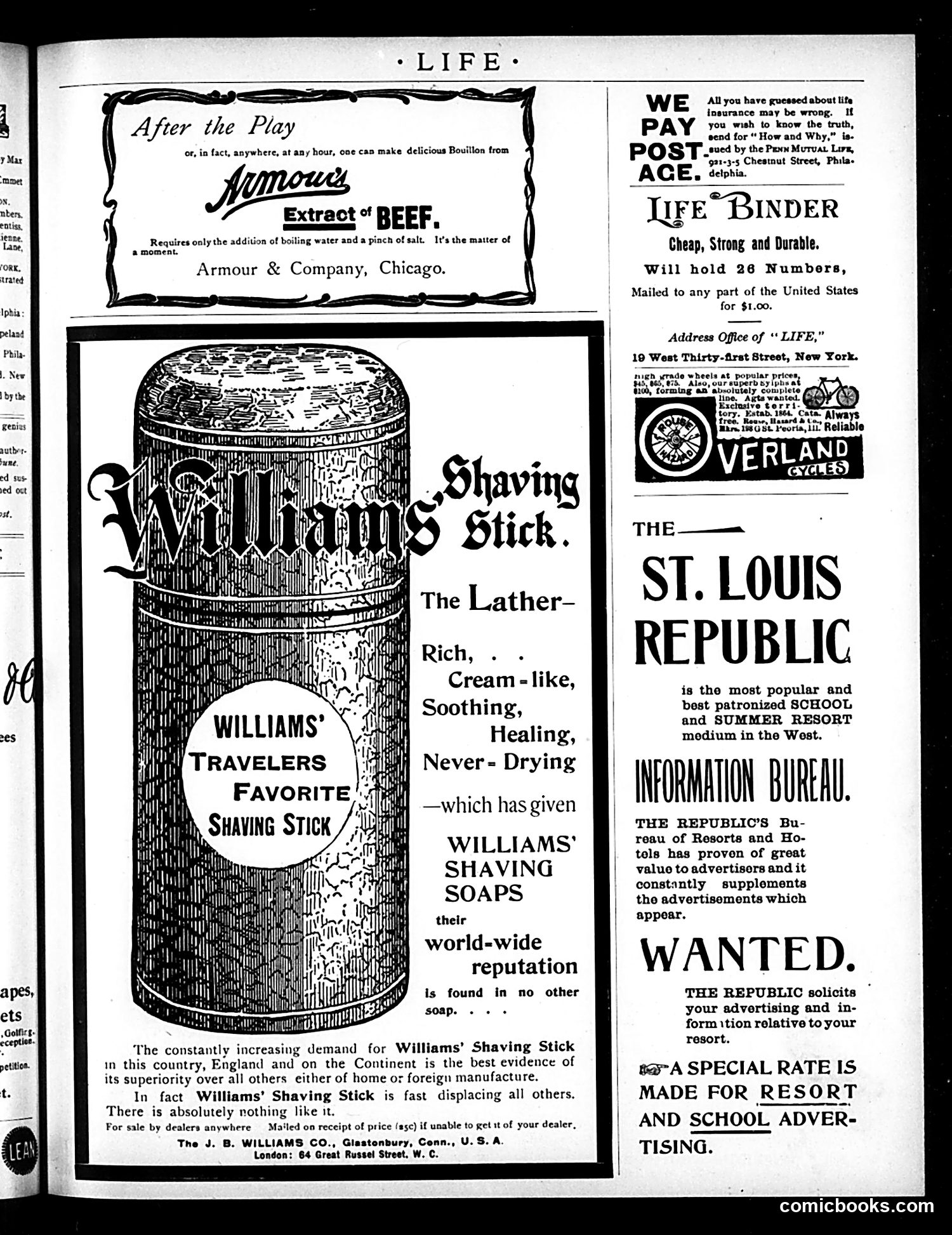
This page is primarily **advertising**, not editorial content or satire. It contains no political cartoons or caricatures requiring historical interpretation. The page features advertisements for consumer products typical of early 20th-century America: - **Armour's Extract of Beef**: Quick bouillon for convenient meals - **Williams' Shaving Stick**: Emphasizes its superior lather and global popularity, positioned as displacing competitors - **Life Binder**: A $1.00 magazine storage product - **Overland Cycles**: Bicycle advertisement - **Life Magazine itself**: Advertising subscriptions and its binder - **St. Louis Republic newspaper**: Promoting its "Information Bureau" for resort and school advertising The tone is straightforward commercial messaging rather than satirical commentary. The "After the Play" header simply suggests these products are convenient for use at any time. No political figures, events, or social satire are present on this page—it's a standard advertising section from an early-1900s magazine.
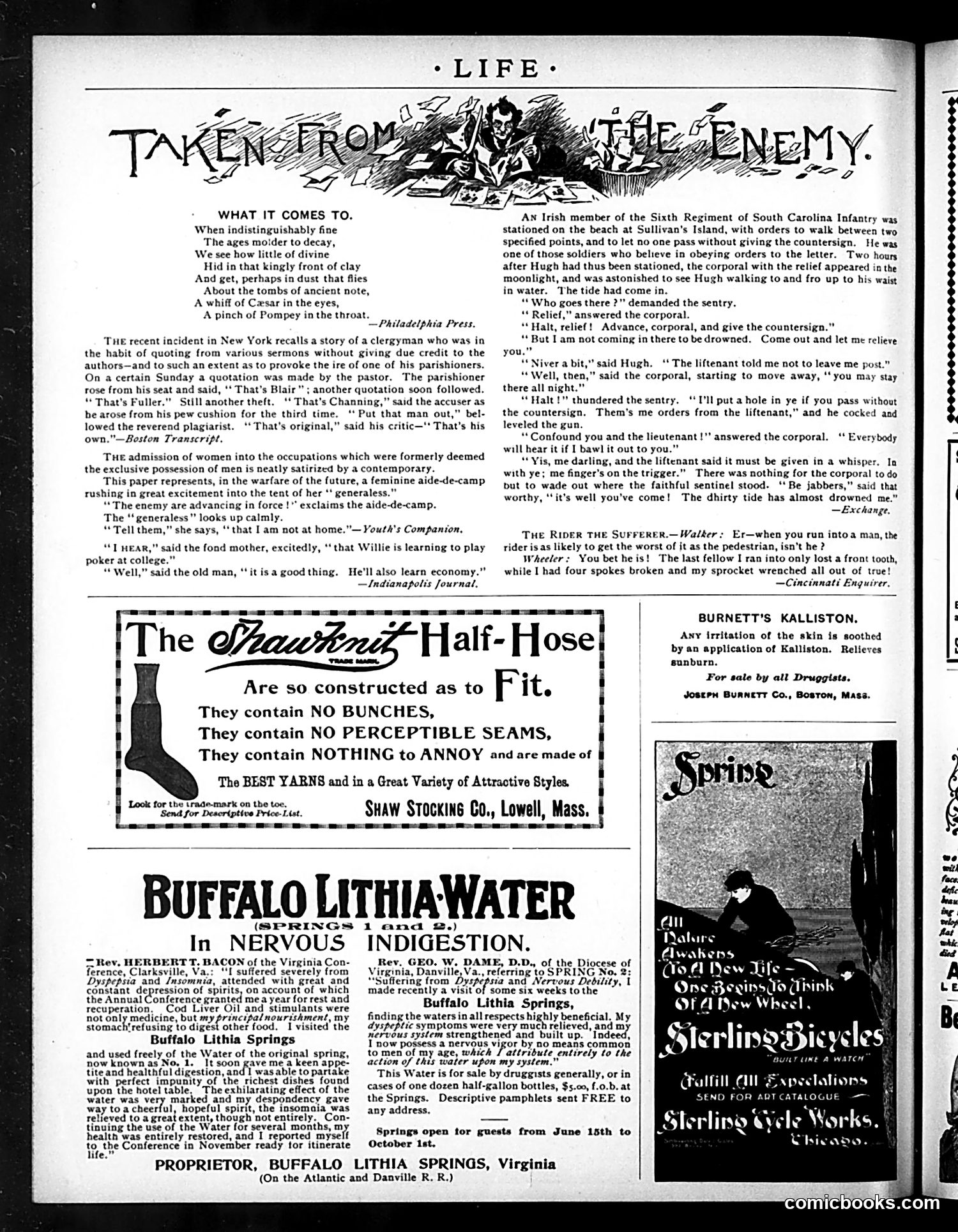
This page contains primarily **humorous anecdotes and satirical commentary** rather than political cartoons. The main pieces include: 1. **The Irish Sentry Story**: A satirical tale about an Irish soldier so literal-minded he refuses to leave his post even as the tide rises—mocking both military rigidity and Irish stereotypes of the era. 2. **The Plagiarist Pastor**: A joke about a clergyman repeatedly stealing sermon quotes without attribution, eventually ordering his critic removed when caught—satire on intellectual dishonesty and hypocrisy in the clergy. 3. **The Woman General**: A brief satire on women entering traditionally male occupations (the military), depicting a female commander responding to enemy attack by claiming she's "not at home"—mocking both women's supposed unsuitability for war and their stereotyped avoidance of confrontation. 4. **The Bicycle Accident**: A joke about relative injury severity between cyclists and pedestrians. The page is primarily **advertising** (Spaulding Hosiery, Buffalo Lithia Water, Sterling Bicycles), with these satirical pieces functioning as filler content typical of Life's format.
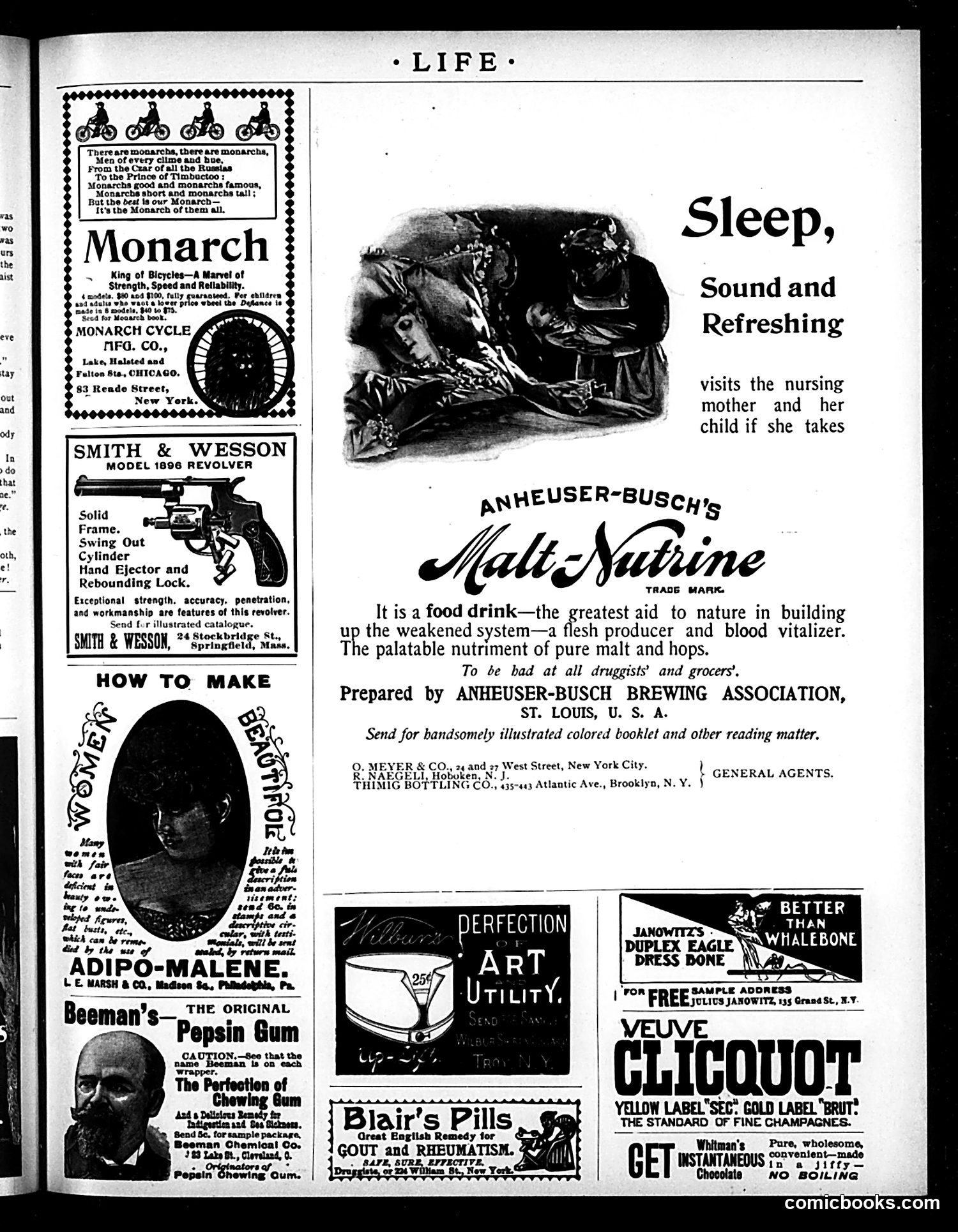
This page is primarily **advertisements**, not editorial content or satire. The main items are patent medicines, firearms, and luxury goods typical of early 20th-century Life magazine advertising. The sole cartoon element is a brief verse at top-left about "Monarch" bicycles, using a joking poetic structure comparing various world rulers ("Czar of all the Russias," "Prince of Timbuctoo") to conclude that their bicycle brand is the "Monarch of them all." This is straightforward product advertising humor with no deeper political satire—just playful wordplay equating the bicycle with supremacy. The page's other content includes ads for Smith & Wesson revolvers, Anheuser-Busch malt beverage (marketed as health drink for nursing mothers), beauty/fashion items, and patent medicines (Adipo-Malene, Beeman's gum, Blair's Pills for gout). These reflect period advertising conventions; the malt beverage claim and medical product promises would be illegal under modern regulations. No political commentary or social satire is evident on this page.
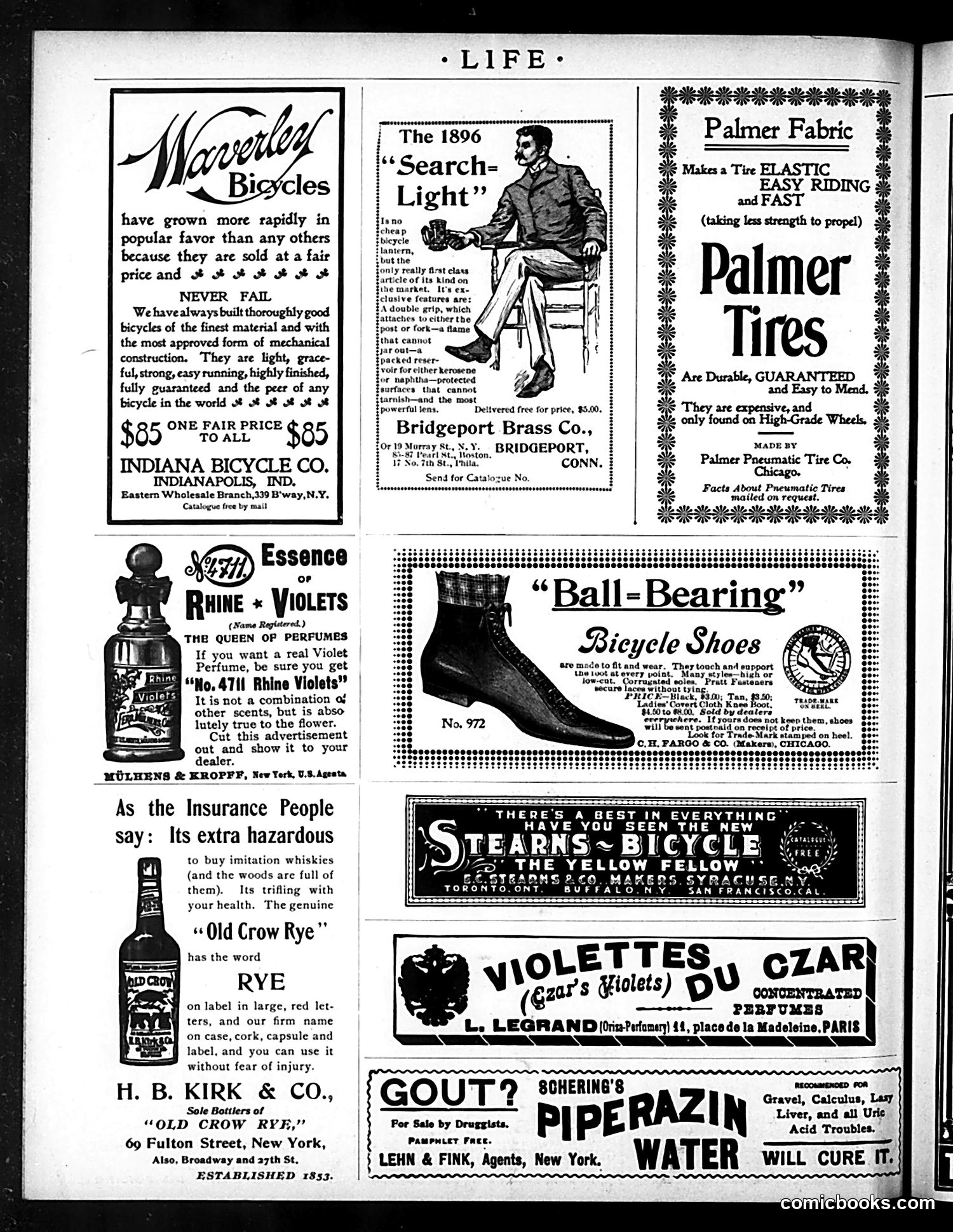
This is primarily an **advertising page** with no political cartoons or satirical content. It showcases turn-of-the-century consumer products marketed to middle-class Americans. The ads reflect late Victorian-era preoccupations: **bicycles** (the new transportation craze), **perfume and cosmetics**, **whiskey** (advertised as medicinal), and **patent medicines**—notably "Piperazin Water" for gout and kidney ailments, typical of an era when dubious elixirs claimed curative powers. The "Search-Light" bicycle ad features a gentleman enjoying leisure, reflecting bicycles' role as symbols of freedom and modernity. The emphasis on "fair price" and durability suggests competition in the emerging bicycle market. The whiskey and patent-medicine ads particularly reveal period attitudes: alcohol and unregulated tonics were marketed as health products. "Old Crow Rye" emphasizes authenticity and safety—concerns suggesting widespread counterfeiting. **Overall significance:** This page documents consumerism, technological optimism, and medicinal practices before FDA regulation and modern advertising standards.
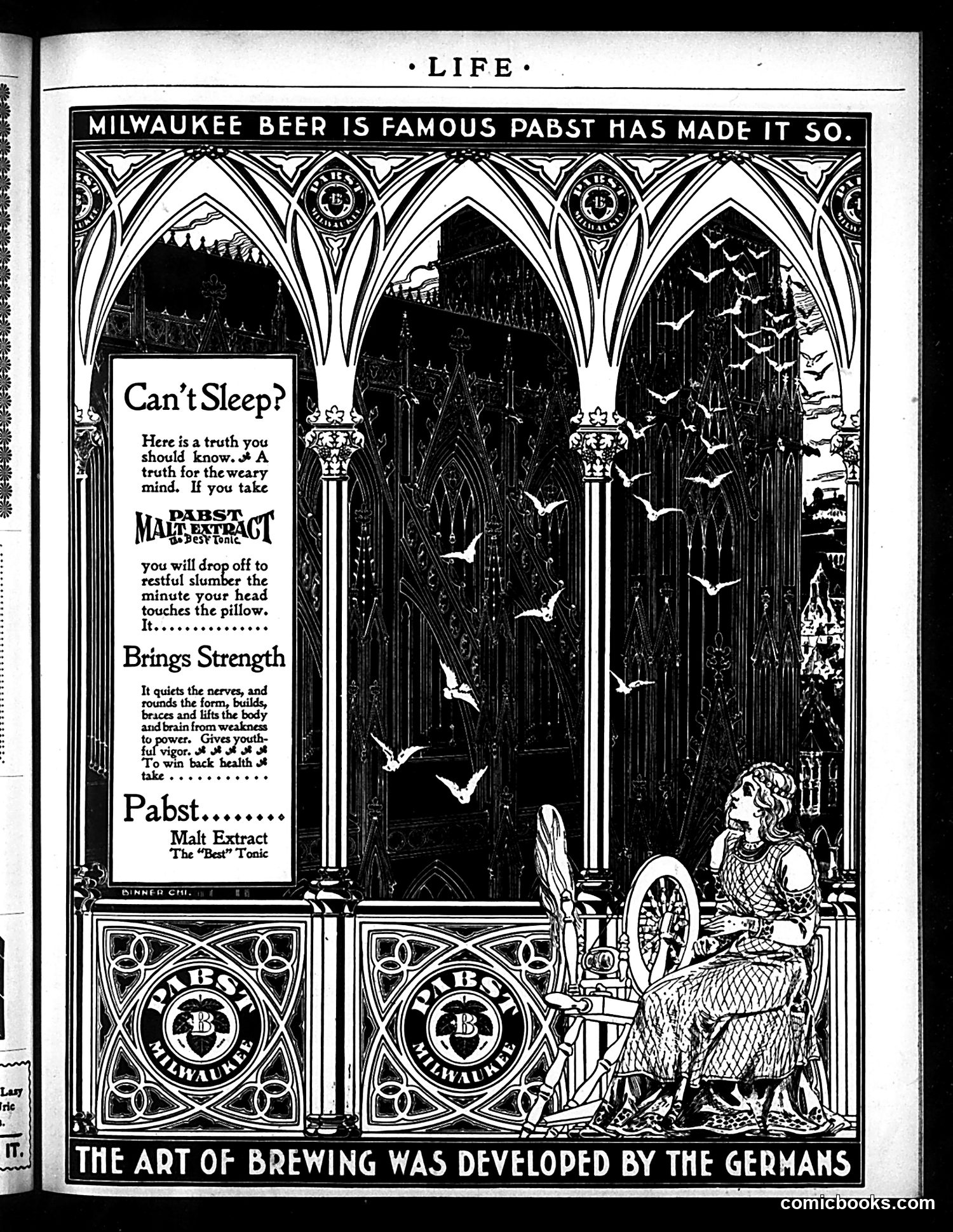
This is a **Pabst Malt Extract advertisement**, not satire. The page promotes Pabst's product as a medicinal tonic for insomnia and general weakness. The medieval cathedral imagery (gothic arches, woman at spinning wheel) creates an Old World/European aesthetic, reinforcing the tagline: "The art of brewing was developed by the Germans." This appeals to German-American consumers and lends historical legitimacy to the product. The "Can't Sleep?" headline addresses a common complaint. The ad claims the malt extract will induce sleep, quiet nerves, build strength, and restore vigor—typical health claims for patent medicines of this era, before FDA regulations. The ornate design and architectural framing suggest quality and tradition. This appears to be early 20th-century advertising, when alcohol-based tonics were marketed as legitimate health remedies despite dubious medical claims.
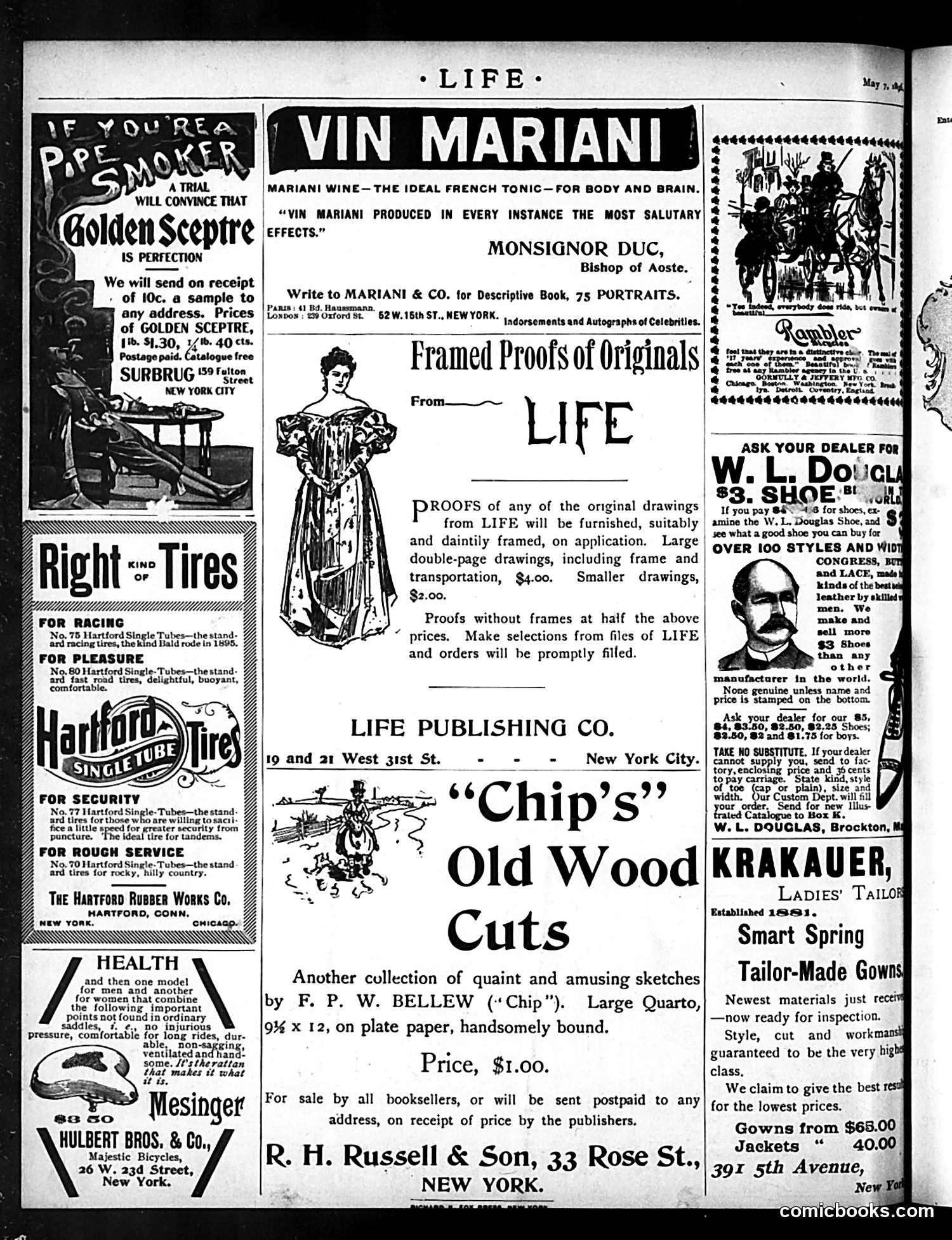
This page is **primarily advertising and commercial content** rather than satirical editorial material. The main items are: **Vin Mariani** (center-top): An advertisement for an Italian wine marketed as a health tonic "for body and brain," claiming endorsements from celebrities and religious authorities. By modern standards, this represents the "patent medicine" era—alcohol-based tonics marketed with exaggerated health claims that would be illegal today. **Side advertisements** include Hartford bicycle tires, Messinger bicycles, W.L. Douglas shoes, and Krakauer ladies' tailoring—typical turn-of-century consumer goods. **"Chip's Old Wood Cuts"** (lower center): An announcement for a book of quaint sketches by F.P.W. Bellew, sold through the LIFE Publishing Company. The page also offers **framed reproductions of original LIFE artwork** for purchase—a marketing extension of the magazine itself. There is no apparent political satire or cartoon humor visible here; this appears to be a standard advertising page from the magazine's back matter.