
Life, 1896-05-07 · page 12 of 20
Life — May 7, 1896 — page 12: what you’re looking at
What you’re looking at
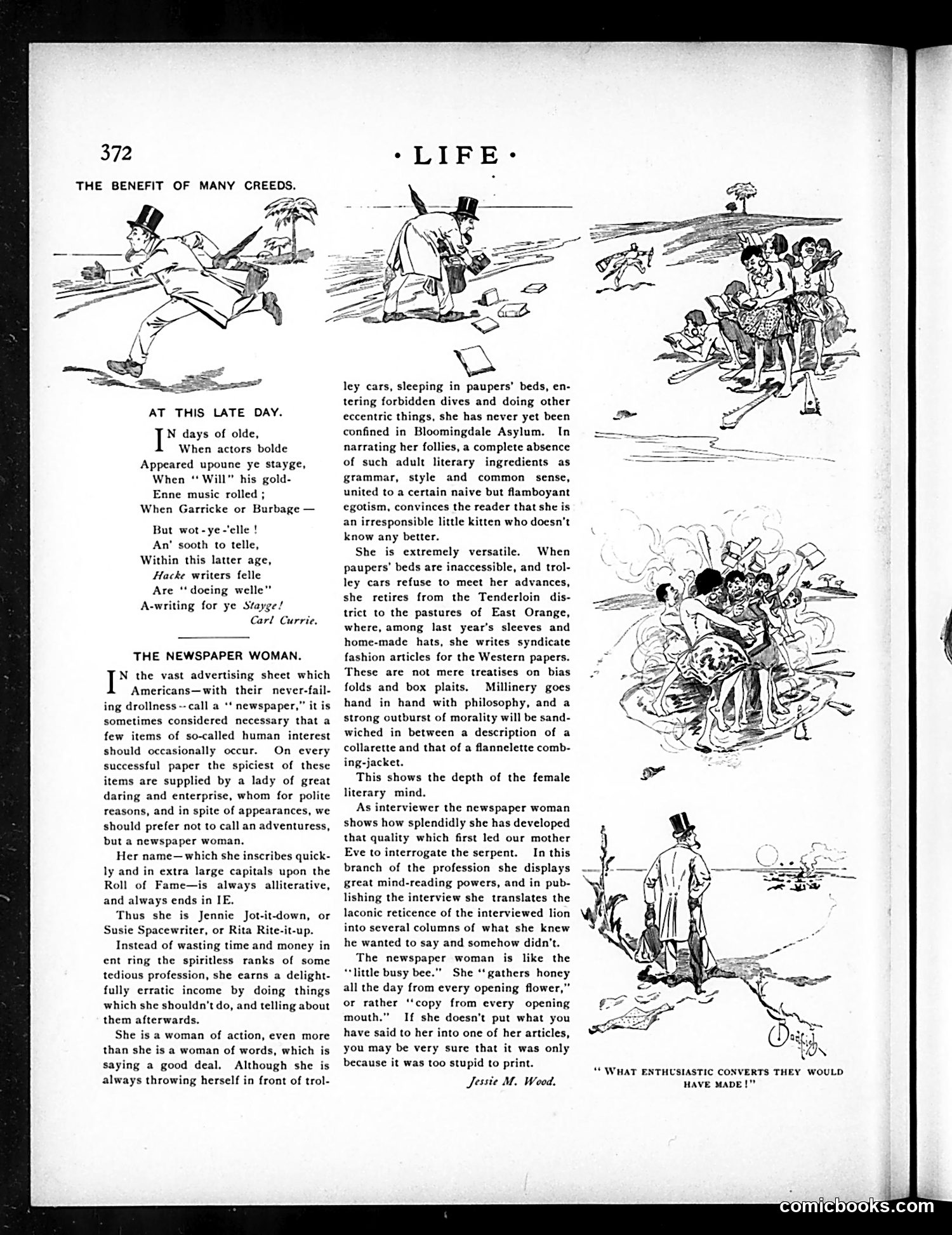
This page contains two satirical essays typical of Life's social commentary: **"At This Late Day"** (left) is a humorous poem by Carl Currie lamenting modern theatrical writers compared to legendary actors and playwrights of earlier eras (Shakespeare, Garrick, Burbage). The joke: contemporary hack writers pale against historical giants, yet they still get produced. **"The Newspaper Woman"** (center/right) by Jessie M. Wood satirizes a specific phenomenon: female journalists who manufacture sensational stories. The piece mocks women reporters with alliterative pseudonyms ending in "-ie" (Jennie Jot-it-down, Susie Spacewriter) who deliberately perform dangerous or scandalous acts—sleeping in poorhouses, entering dives—purely to write about them. Wood's critique: these writers lack basic literary skills (grammar, style) yet succeed through shameless self-promotion and fabricating quotes from interview subjects. The accompanying cartoons humorously depict such stunts and adventures. The satire targets both journalistic sensationalism and female ambition in the profession, reflecting period attitudes about women in journalism.
📄 Transcribed text from this page (OCR, searchable)
Machine-transcribed from the original scan — historical spelling and the odd misread are preserved.
372 THE BENEFIT OF MANY CREEDS. }#?EES AT THIS LATE DAY. N days of olde, When actors bolde Appeared upoune ye stayge, When “Will” his gold- Enne music rolled ; When Garricke or Burbage — But wot-ye-'elle ! An’ sooth to telle, Within this latter age, Hacke writers felle Are ‘doeing welle” Aewriting for ye Stayge! Carl Currie. THE NEWSPAPER WOMAN. N the vast advertising sheet which Americans—with their never-fail- ing drollness --call a ‘* newspaper,” it is sometimes considered necessary that a few items of so-called human interest should occasionally occur. On every successful paper the spiciest of these items are supplied by a lady of great daring and enterprise, whom for polite reasons, and in spite of appearances, we should prefer not to call an adventuress, but a newspaper woman, Her name—which she inscribes quick- ly and in extra large capitals upon the Roll of Fame—is always alliterative, and always ends in IE. Thus she is Jennie Jot-it-down, or Susie Spacewriter, or Rita Rite-it-up. Instead of wasting time and money in ent ring the spiritless ranks of some tedious profession, she earns a delight- fully erratic income by doing things which she shouldn't do, and telling about them afterwards. She is a woman of action, even more than she is a woman of words, which is saying a good deal, Although she is always throwing herself in front of trol- ley cars, sleeping in paupers’ beds, en- tering forbidden dives and doing other eccentric things, she has never yet been confined in Bloomingdale Asylum. In narrating her follies, a complete absence of such adult literary ingredients as grammar, style and common sense, united to a certain naive but flamboyant egotism, convinces the reader that she is an irresponsible little kitten who doesn't know any better. She is extremely versatile. When paupers’ beds are inaccessible, and trol- ley cars refuse to meet her advances, she retires from the Tenderloin dis- trict to the pastures of East Orange, where, among last year’s sleeves and home-made hats, she writes syndicate fashion articles for the Western papers. These are not mere treatises on bias folds and box plaits. Millinery goes hand in hand with philosophy, and a strong outburst of morality will be sand- wiched in between a description of a collarette and that of a flannelette comb- ing-jacket. This shows the depth of the female literary mind. As interviewer the newspaper woman shows how splendidly she has developed that quality which first led our mother Eve to interrogate the serpent. In this branch of the profession she displays great mind-reading powers, and in pub- lishing the interview she translates the laconic reticence of the interviewed lion into several columns of what she knew he wanted to say and somehow didn’t. The newspaper woman is like the “little busy bee." She ‘‘gathers honey all the day from every opening flower,” or rather ‘‘copy from every opening mouth.” If she doesn't put what you have said to her into one of her articles, you may be very sure that it was only because it was too stupid to print. Jessie M. Wood. “* WHAT ENTHUSIASTIC CONVERTS THEY WOULD HAVE MADE !""