
Life, 1896-05-07 · page 4 of 20
Life — May 7, 1896 — page 4: what you’re looking at
What you’re looking at
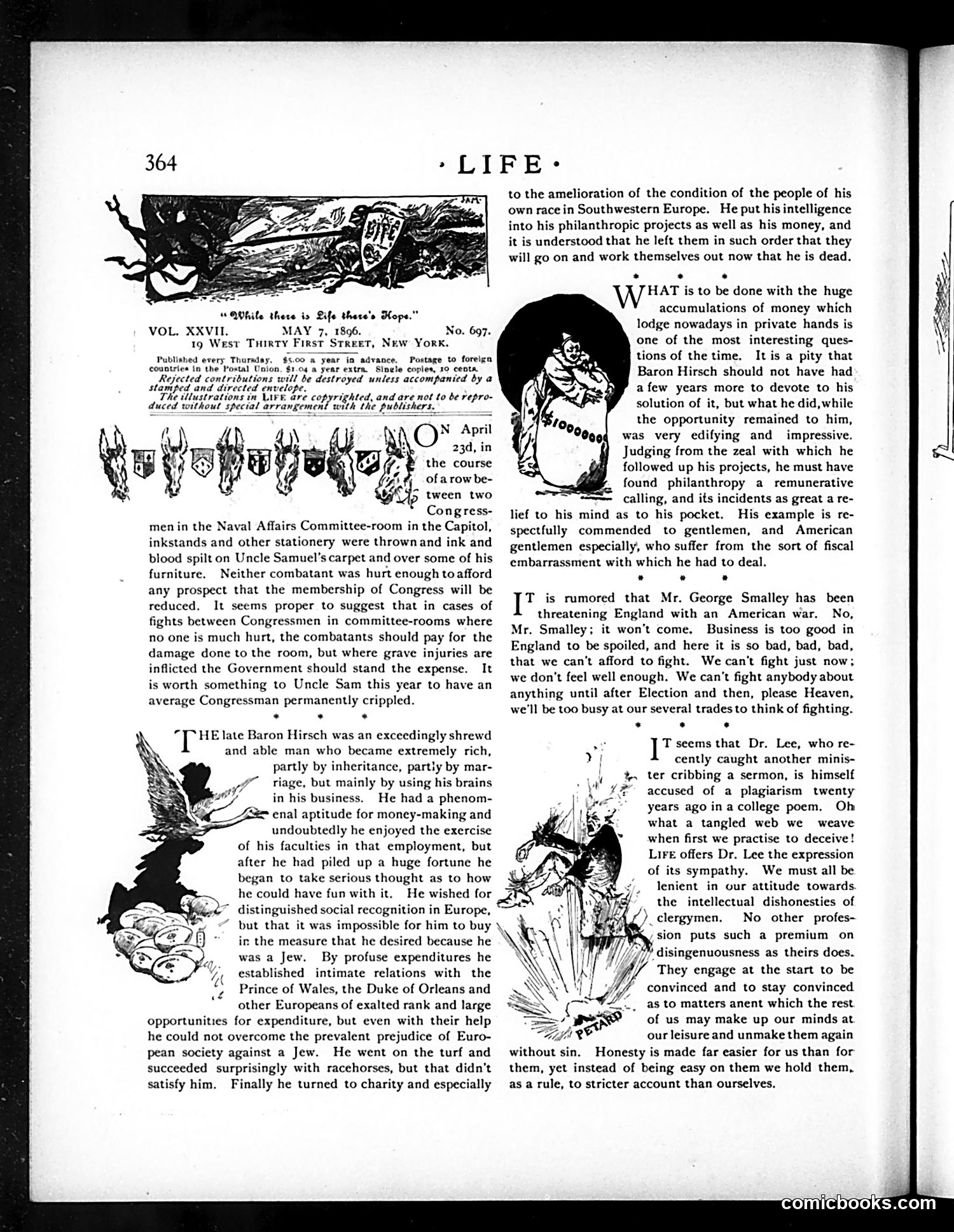
This page contains three distinct satirical sections discussing contemporary figures: **Baron Hirsch**: The text criticizes the deceased Jewish philanthropist's massive wealth accumulation, questioning what should be done with his "huge accumulations of money." While praising his charitable work, the piece reveals period antisemitism through commentary about his Jewish identity and European prejudice. **George Smalley**: A brief satirical item mocking rumors of threats of American war against England, dismissing such conflict as economically unwise given profitable trade relations. **Dr. Lee**: The final section ridicules a clergyman accused of plagiarizing a sermon from a college poem written twenty years prior, using this to launch broader commentary on intellectual dishonesty and the need for stricter moral standards. The illustrations appear to be decorative period engravings accompanying these satirical commentary pieces.
📄 Transcribed text from this page (OCR, searchable)
Machine-transcribed from the original scan — historical spelling and the odd misread are preserved.
»>LIFE: “While there is Life there's Hope.” XXVIL. MAY 7, 1896. 1g West THirty First St Published every Thursday. $5.00 a year in advance. VOL. No. 697. T, New York. Postage to foreign countries in the Postal Union, $1.04 a year extra. Single copies, 10 cents Rejected contributions will be destroyed unless accompanied by a stamped and directed envelope. The itustrations in LPR are copyrighted, and are not to be repro- duced without special arrangemen: with the publishers. 23d, in the course of a row be- KAO “ah ad an. ay menin the Naval Affairs Committee-room in the Capitol, inkstands and other stationery were thrownand ink and blood spilt on Uncle Samuel's carpet and over some of his furniture. Neither combatant was hurt enough toafford any prospect that the membership of Congress will be reduced. It seems proper to suggest that in cases of fights between Congressmen in committee-rooms where no one is much hurt, the combatants should pay for the damage done to the room, but where grave injuries are inflicted the Government should stand the expense. It is worth something to Uncle Sam this year to have an average Congressman permanently crippled. . . . * THE late Baron Hirsch was an exceedingly shrewd and able man who became extremely rich, partly by inheritance, partiy by mar- riage, but mainly by using his brains in his business. He had a phenom- enal aptitude for money-making and undoubtedly he enjoyed the exercise of his faculties in that employment, but after he had piled up a huge fortune he began to take serious thought as to how he could have fun with it. He wished for distinguished social recognition in Europe, but that it was impossible for him to buy \ in the measure that he desired because he was a Jew. By profuse expenditures he established intimate relations with the Prince of Wales, the Duke of Orleans and other Europeans of exalted rank and large opportunities for expenditure, but even with their help he could not overcome the prevalent prejudice of Euro- pean society against a Jew. He went on the turf and succeeded surprisingly with racehorses, but that didn’t satisfy him. Finally he turned to charity and especially to the amelioration of the condition of the people of his own race in Southwestern Europe. He put his intelligence into his philanthropic projects as well as his money, and it is understood that he left them in such order that they will go on and work themselves out now that he is dead. . . . HAT is to be done with the huge accumulations of money which lodge nowadays in private hands is one of the most interesting ques- tions of the time. Itis a pity that Baron Hirsch should not have had afew years more to devote to his solution of it, but what he did,while the opportunity remained to him, was very edifying and impressive. Judging from the zeal with which he followed up his projects, he must have found philanthropy a remunerative “<= calling, and its incidents as great a re- lief to his mind as to his pocket. His example is re- spectfully commended to gentlemen, and American gentlemen especially, who suffer from the sort of fiscal embarrassment with which he had to deal. * * . I’ is rumored that Mr. George Smalley has been threatening England with an American war. No, Mr. Smalley; it won’t come, Business is too good in England to be spoiled, and here it is so bad, bad, bad, that we can’t afford to fight. We can't fight just now; we don’t feel well enough. We can’t fight anybody about anything until after Election and then, please Heaven, we'll be too busy at our several trades to think of fighting. . . . T seems that Dr. Lee, who re- cently caught another minis- %, ter cribbing a sermon, is himself accused of a plagiarism twenty years ago ina college poem. Oh what a tangled web we weave when first we practise to deceive! Lire offers Dr. Lee the expression of its sympathy, We must all be lenient in our attitude towards. the intellectual dishonesties of ) clergymen. No other profes~ ,sion puts such a premium on 77’ Aisingenuousness as theirs does. WY) I They engage at the start to be yy convinced and to stay convinced. £< as to matters anent which the rest of us may make up our minds at our leisure and unmake them again without sin. Honesty is made far easier for us than for them, yet instead of being easy on them we hold them, as a rule, to stricter account than ourselves.