A complete issue · 20 pages · 1896
Life — April 23, 1896
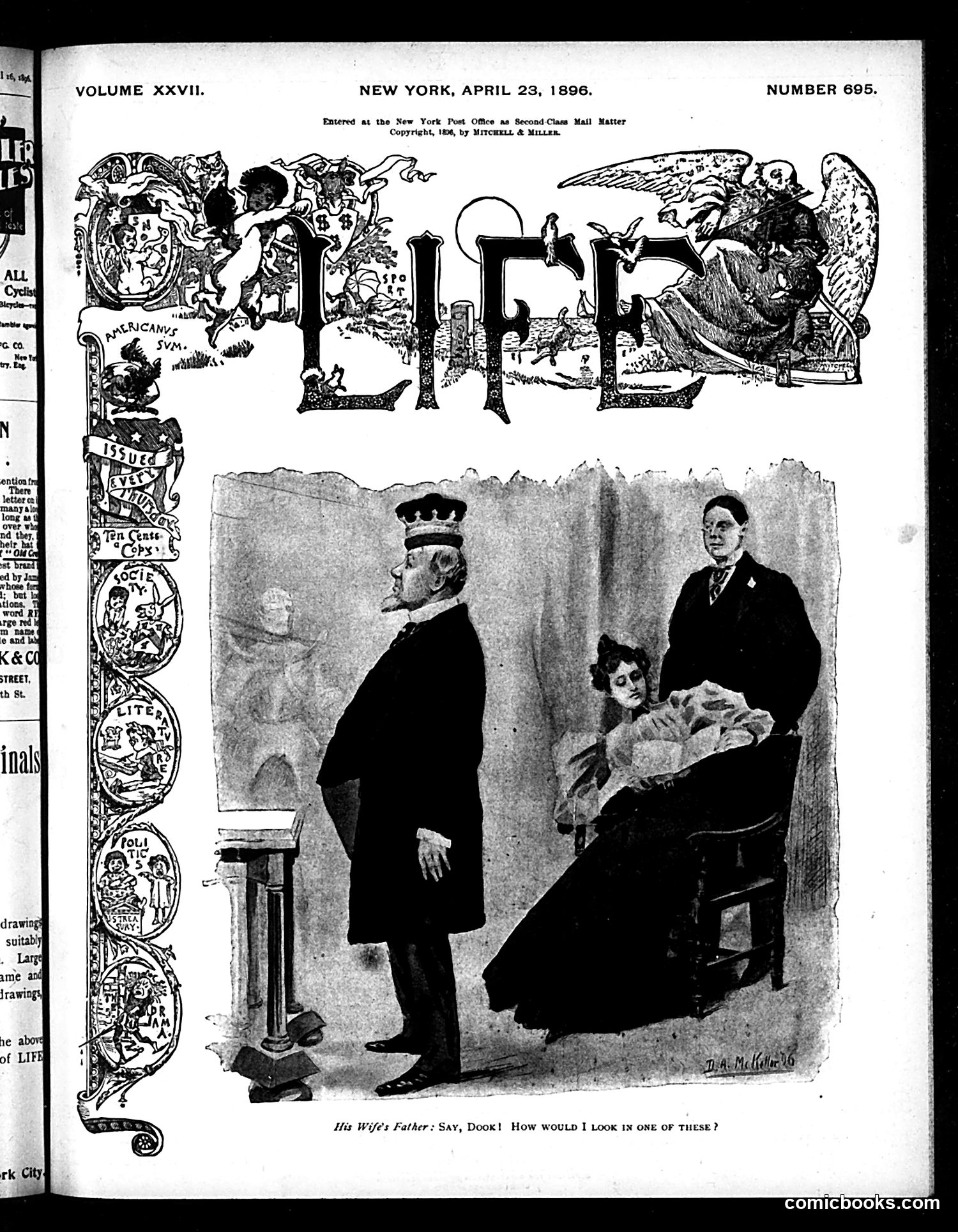
The cartoon depicts a domestic scene where a man in a tall hat (appearing to be of high social status) stands beside a seated woman holding an infant, with a young girl between them. The caption reads: "His Wife's Father: Say, Door! How would I look in one of these?" The joke appears to reference fashion or clothing—likely related to the woman's dress or the baby's garments. The father-in-law is asking how he'd appear in similar attire, presumably something impractical or comically unsuitable for a man of his station. This satirizes either changing fashion trends of the 1890s or mocks the absurdity of men adopting women's or infant clothing styles. The ornate "LIFE" masthead and decorative border are typical of the magazine's design from this era.
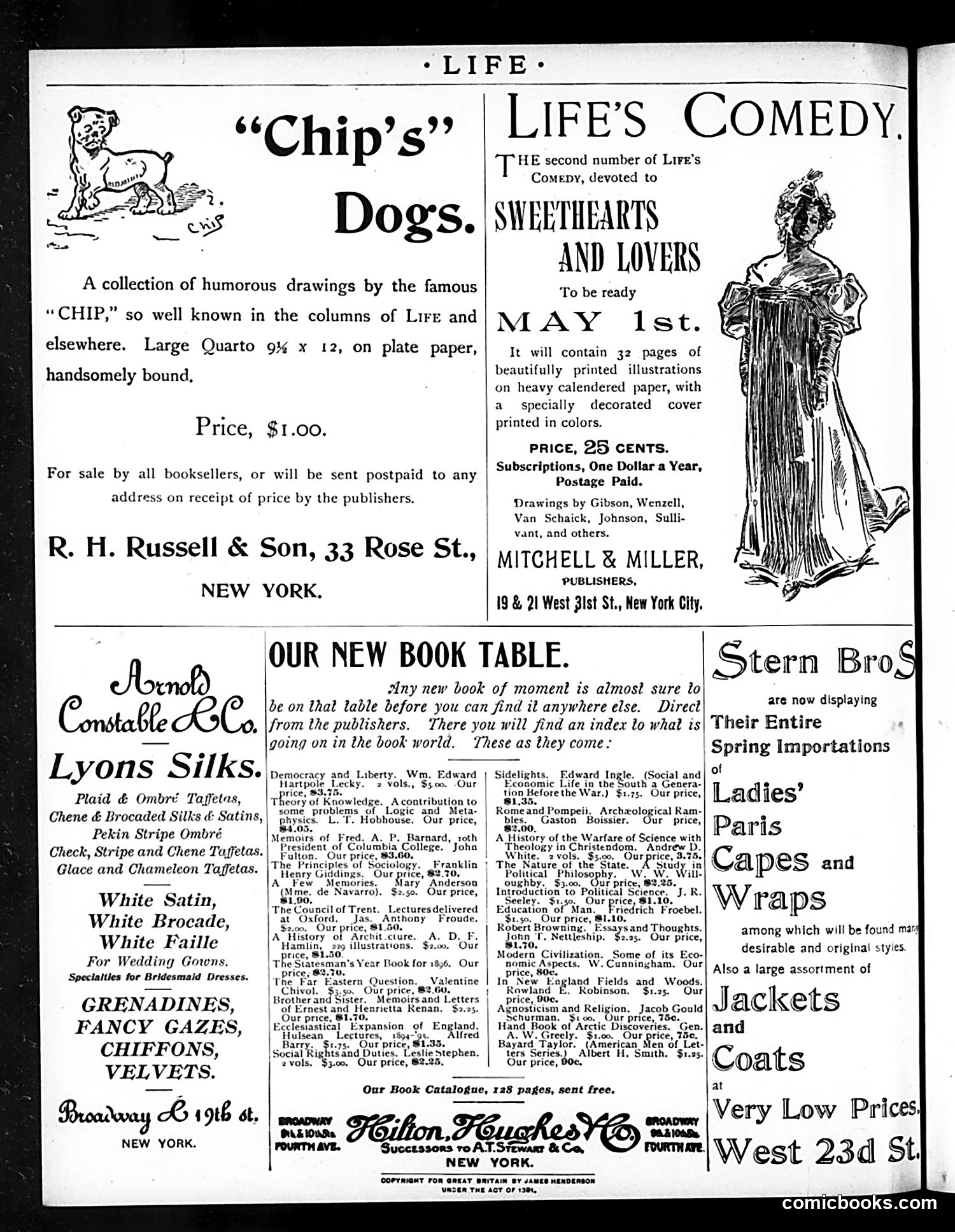
This page is primarily **advertising**, not editorial content or satire. The left side advertises "Chip's Dogs," a collection of humorous dog drawings by an artist known as "Chip" who contributed to Life magazine ($1.00). The right side promotes "Life's Comedy" issue #2 (May 1st), focused on "Sweethearts and Lovers," featuring illustrations by Gibson, Wenzell, and others (25 cents). Below are book advertisements from Arnold Constable & Co. (silks and taffetas for wedding gowns), and Stern Bros. (spring ladies' fashion imports). The bottom features Hamilton Houghton & Co., a publisher. There is **no political cartoon or satire** on this page—it's a commercial product catalog typical of early 20th-century magazine layouts.
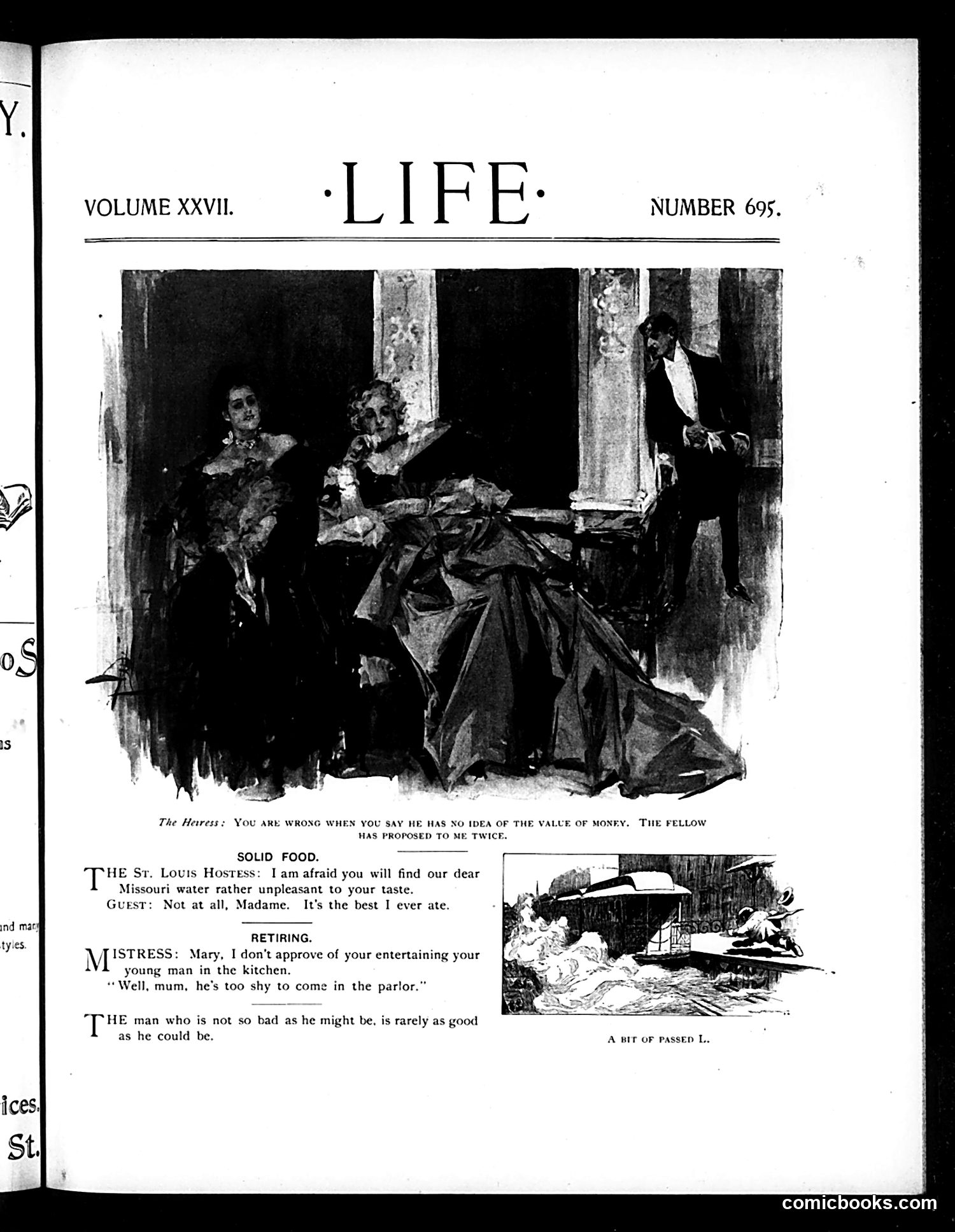
This page from *Life* magazine (Volume XXVII, Number 695) contains humorous domestic sketches rather than political cartoons. **"Solid Food"** depicts a St. Louis hostess apologizing for serving plain water instead of fancier refreshment, while a guest compliments it as "the best I ever ate"—satirizing either the guest's politeness or questionable taste. **"Retiring"** shows a mistress scolding a servant for entertaining a young man in the kitchen, with his bashful reply about propriety—poking fun at rigid Victorian social conventions and class hierarchies. The final aphorism about men being "rarely as good as he could be" offers gentle social commentary. The small illustration labeled "A Bit of Passe[d] Li[fe]" appears decorative. Overall, this page contains lighthearted domestic humor rather than political satire.
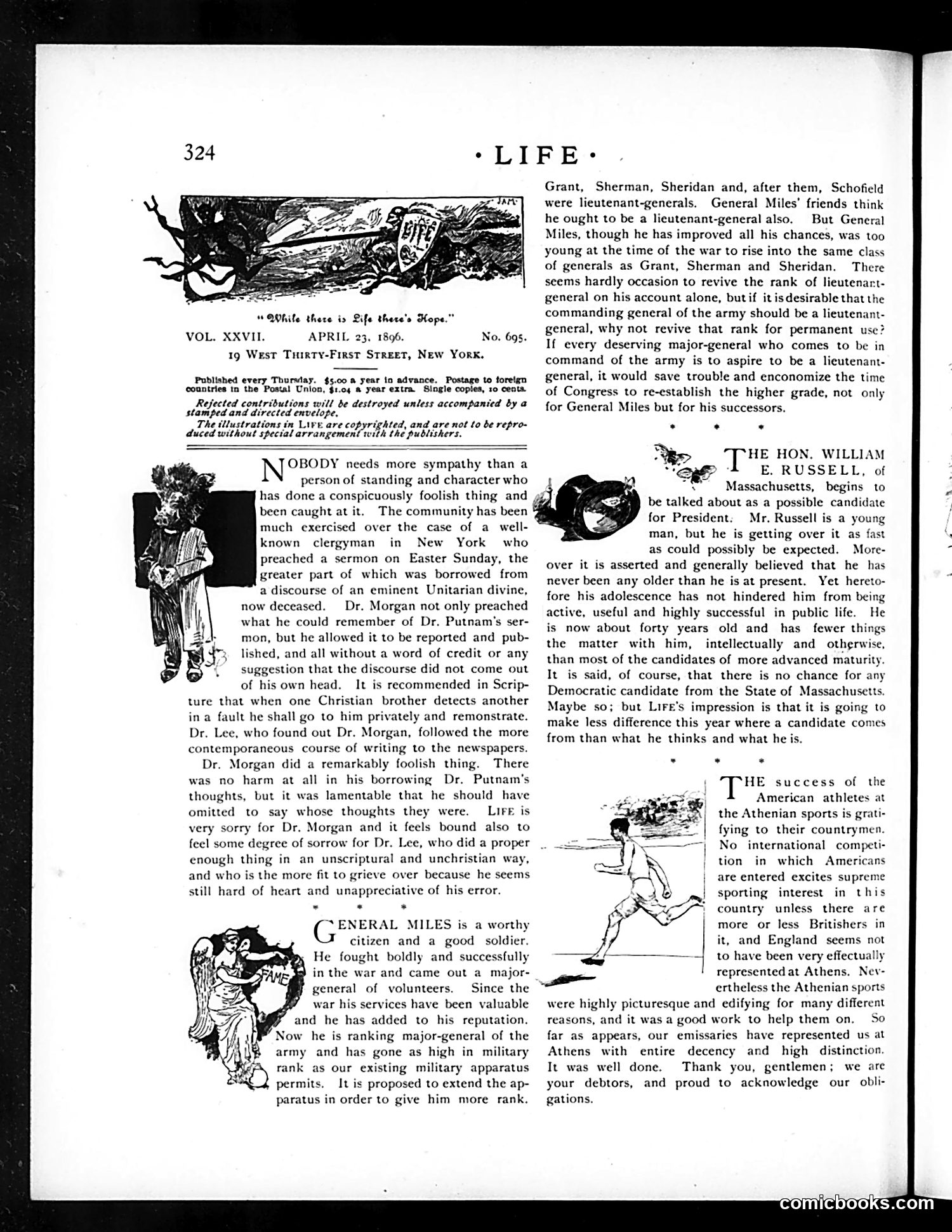
This page contains three separate editorial commentaries with illustrations: 1. **Top section** discusses General Miles and military rank disputes, arguing Miles deserves lieutenant-general status alongside Grant, Sherman, and Sheridan. 2. **Middle section** critiques a clergyman who plagiarized a sermon from Dr. Putnam without attribution, then followed with an original composition. The text sarcastically notes this demonstrates poor judgment and Christian hypocrisy—the clergyman should have credited his source. 3. **Bottom section** praises American athletes' success at the Athenian sports competitions, crediting their representatives for bringing "entire decency and high distinction" to the games while noting British participation was limited. The decorative woodcut illustrations are typical of 1890s Life magazine's satirical style.
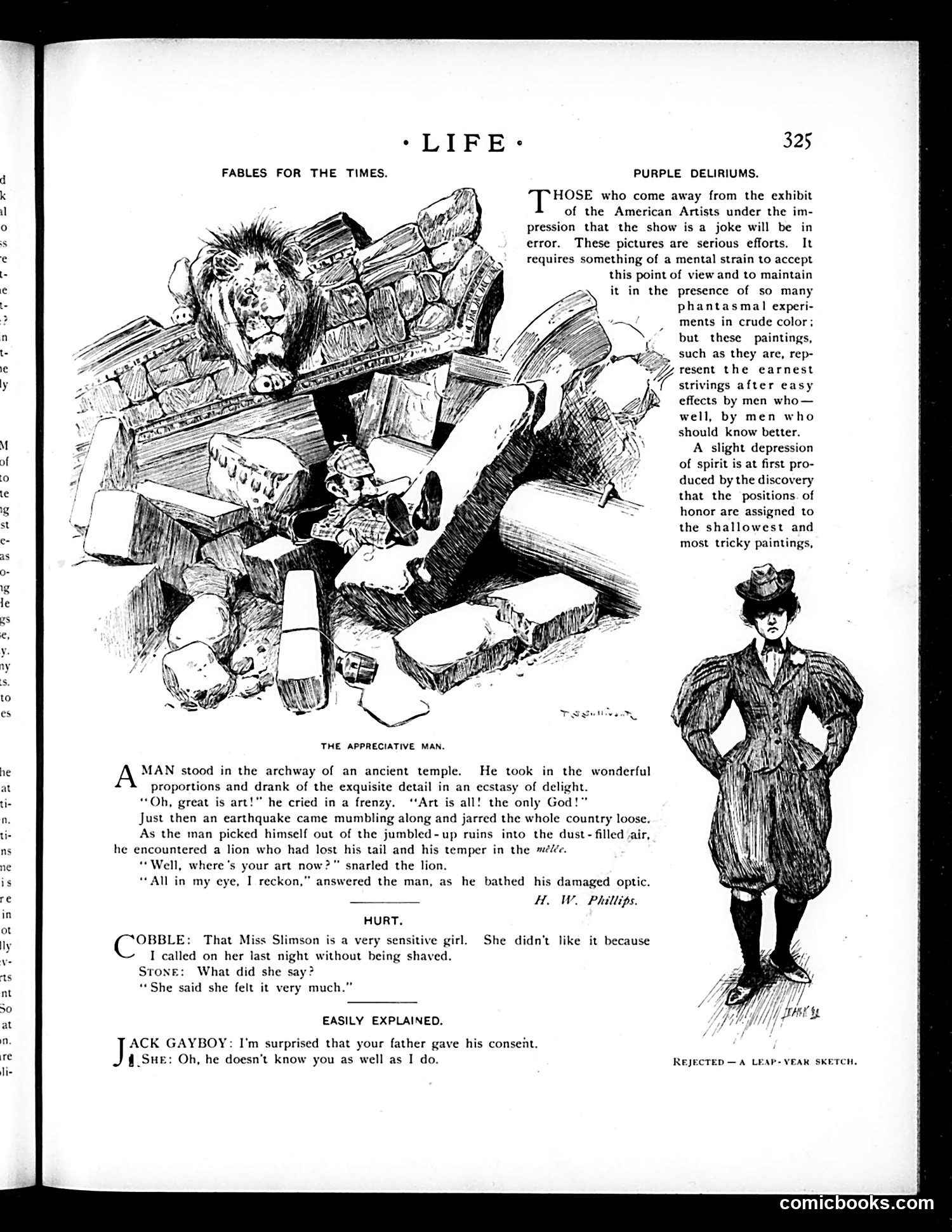
This page contains several satirical pieces typical of early 20th-century American humor magazines. **"Purple Deliriums"** critiques the American Artists exhibit, suggesting modernist/abstract paintings are bewildering and require "mental strain" to appreciate—a common contemporary complaint about avant-garde art. **"The Appreciative Man"** is a fable mocking art snobs. A man admires temple architecture in "ecstasy of delight," praising "Art is all!" An earthquake destroys everything. A injured lion sarcastically asks where his art is now—satirizing impractical aesthetic appreciation divorced from reality. **"Hurt," "Easily Explained,"** and the sketch labeled **"Rejected—A Leap-Year Sketch"** are brief joke segments typical of the magazine's format, though their specific references are unclear without additional context. The page exemplifies Life's role satirizing both pretentious intellectualism and social conventions.
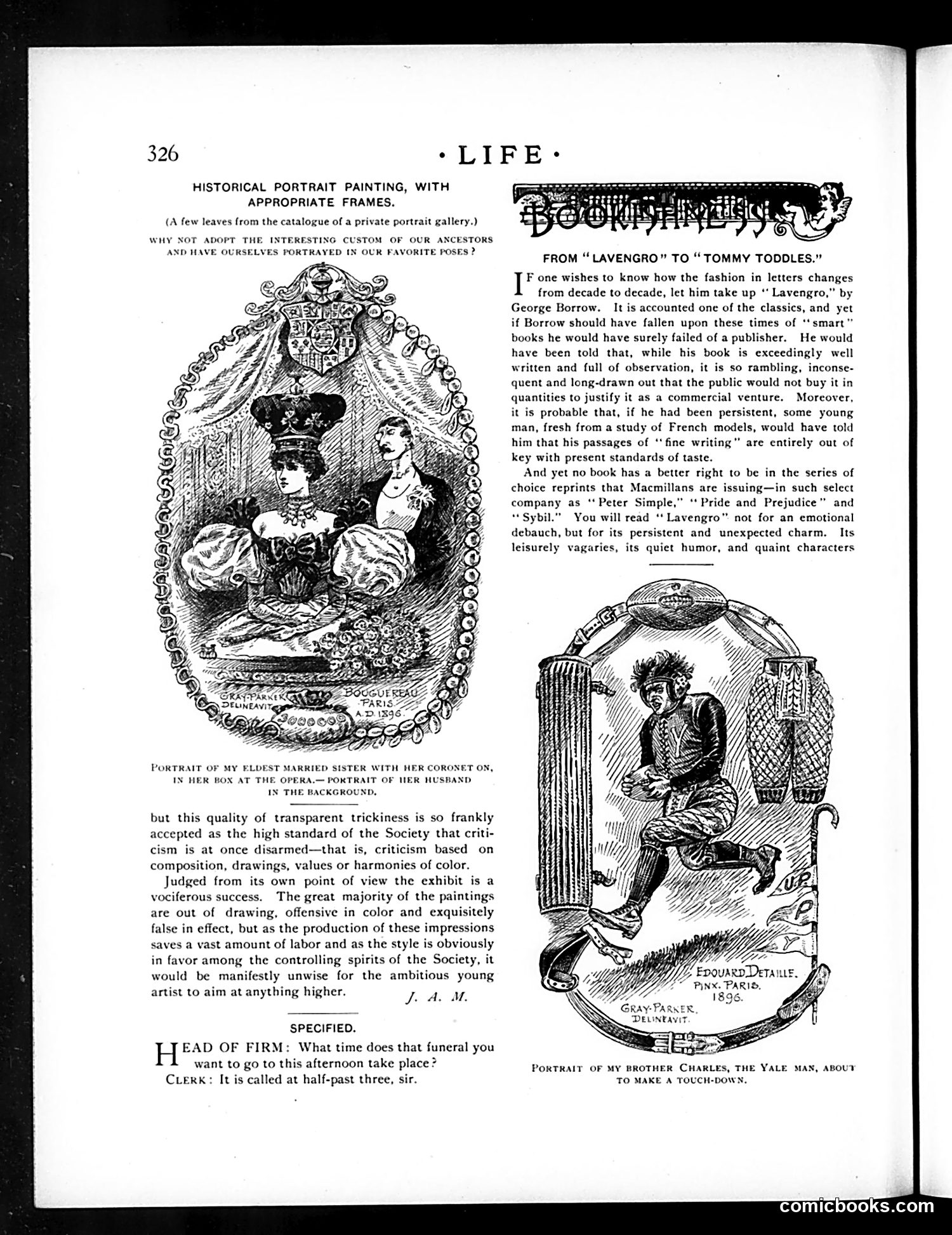
This page contains a literary essay on George Borrow's "Lavengro," praising its "persistent and unexpected charm" despite being rambling and commercially unmarketable. The piece advocates for Macmillan's reprint series that includes classics like "Peter Simple," "Pride and Prejudice," and "Sybil." The two framed illustrations are Victorian-era portrait paintings—not political cartoons. They depict: (1) the author's married sister wearing a coronet at the opera, with her husband in background, and (2) the author's brother Charles, "the Yale man," about to make a touchdown. These appear to be humorous personal anecdotes about family members rather than social satire. The bottom joke about funeral timing is unrelated office humor.
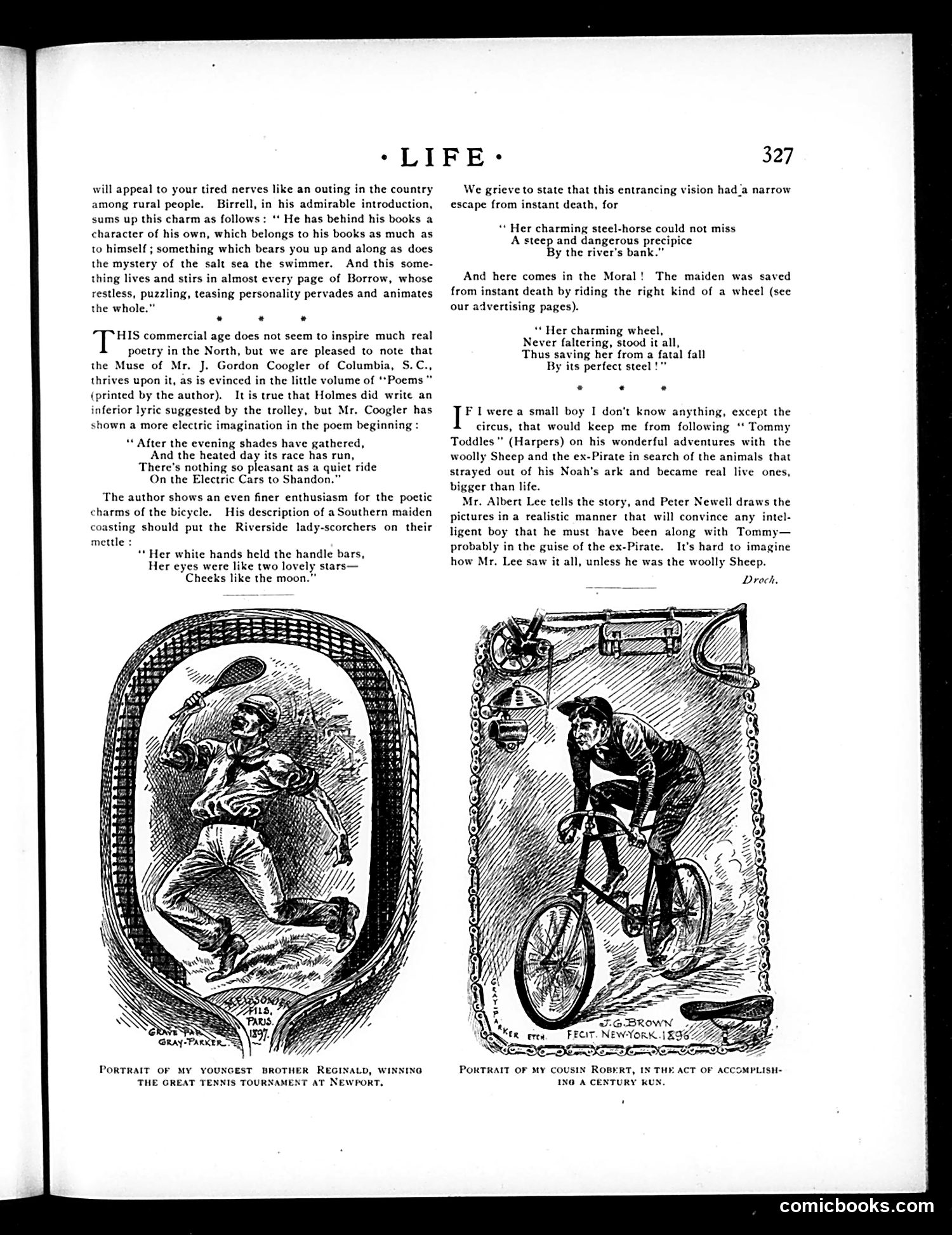
This page from *Life* magazine features two illustrations with captions identifying them as portraits of the author's relatives engaged in athletic pursuits around the turn of the century. The left illustration shows "Portrait of My Youngest Brother Reginald, Winning the Great Tennis Tournament at Newport"—depicting a tennis player in action. The right illustration shows "Portrait of My Cousin Robert, in the Act of Accomplishing a Century Run"—showing a cyclist riding a bicycle. The accompanying text discusses the literary merits of bicycling and cycling in contemporary poetry. Rather than political satire, this appears to be a humorous, autobiographical piece celebrating turn-of-the-century sports culture among the upper classes (Newport being an exclusive resort). The "satire" is gentle—poking fun at the author's own relatives' athletic achievements through mock-formal portraiture.
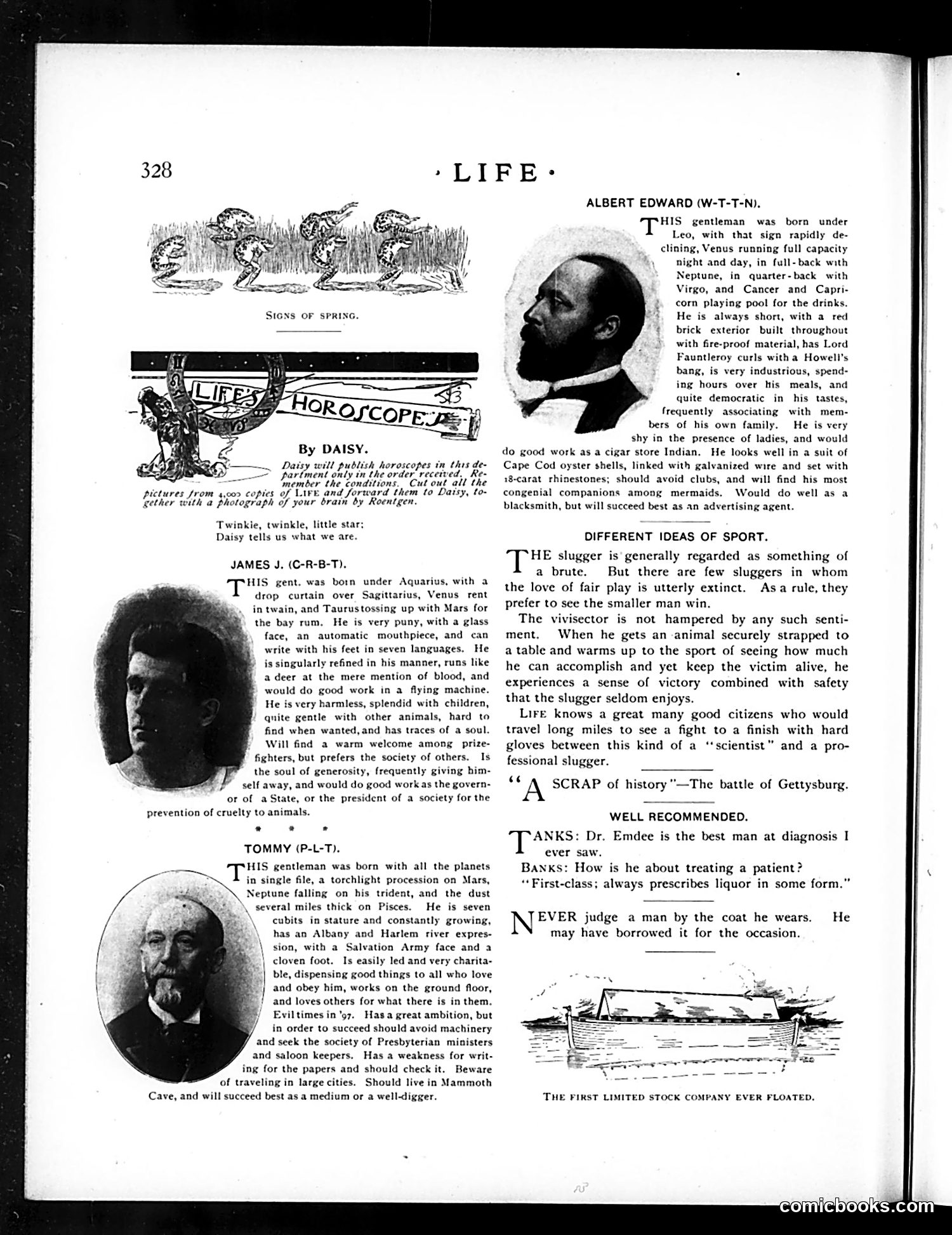
This page features **Life's Horoscope** — satirical astrological character sketches of three men identified by initials: Albert Edward (W-T-T-N), James J. (C-R-B-T), and Tommy (P-L-T). Each receives a humorous personality reading based on their zodiac signs. The sketches mock these individuals through exaggerated traits: one is described as industrious but short-tempered; another as harmless but refined. The horoscope format allows Life to deliver cutting social commentary disguised as amusement. The page also includes editorial content on "Different Ideas of Sport" and brief humorous exchanges between characters named "Banks" and "Emdee," along with the satirical note "Never judge a man by the coat he wears." Without identifying the actual individuals, this format was Life's signature style: using astrology as cover for personal satire.
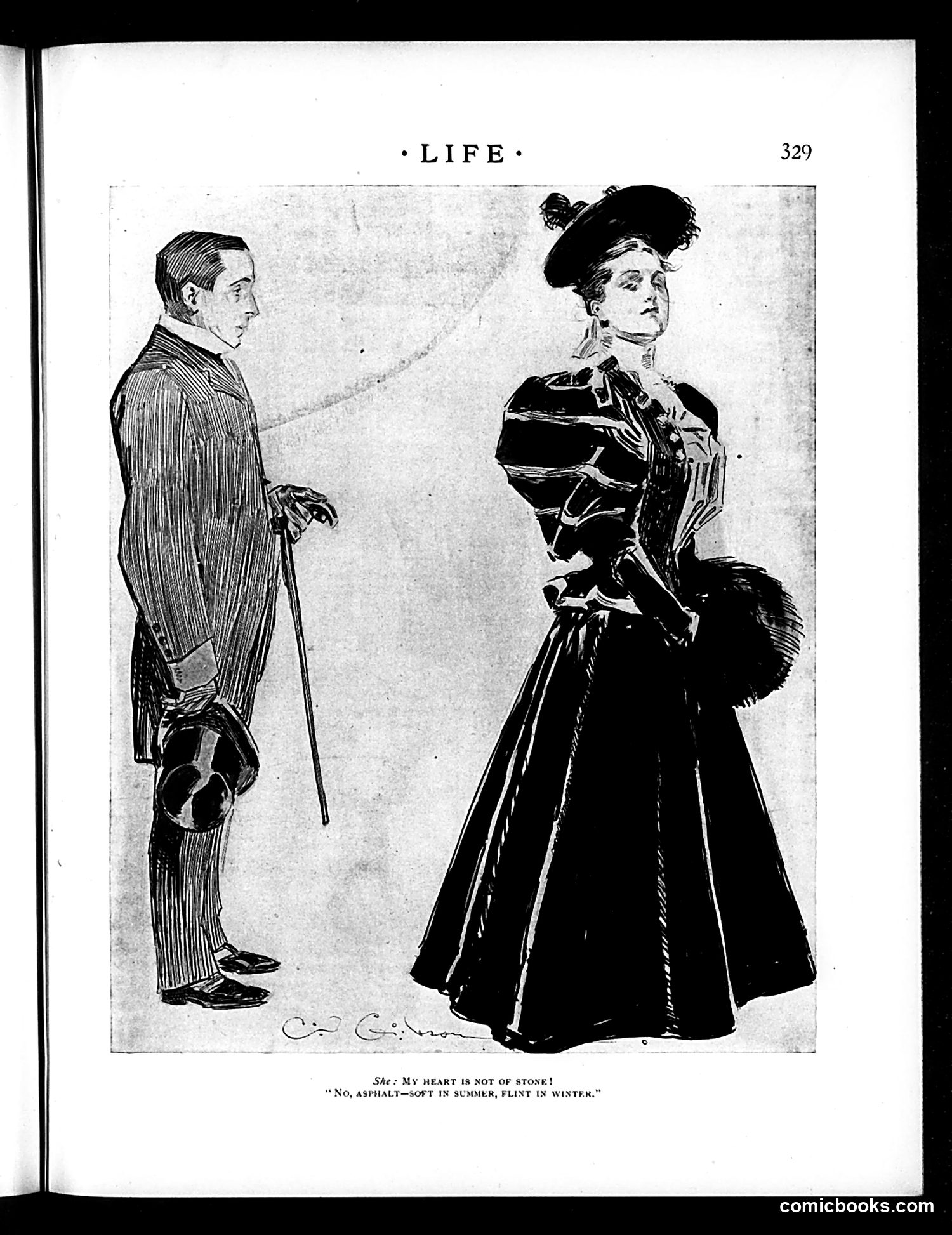
This illustration from *Life* magazine (page 329) presents a social satire about romantic rejection. The caption reads: "She: MY HEART IS NOT OF STONE! 'NO, ASPHALT—SOT IN SUMMER, FLINT IN WINTER.'" The cartoon depicts a well-dressed man with a cane addressing a fashionably-dressed woman who turns away coldly. The joke plays on the woman's claim that her heart isn't stone—the man's retort suggests her heart is actually *asphalt* (soft/yielding in summer heat, hard in winter cold), implying her affections are inconsistent and weather-dependent rather than genuinely cold. This is a typical early-20th-century *Life* magazine quip about female fickleness in romance, using architectural materials as metaphors for emotional unreliability. The sophisticated dress and refined setting suggest upper-class courtship humor.
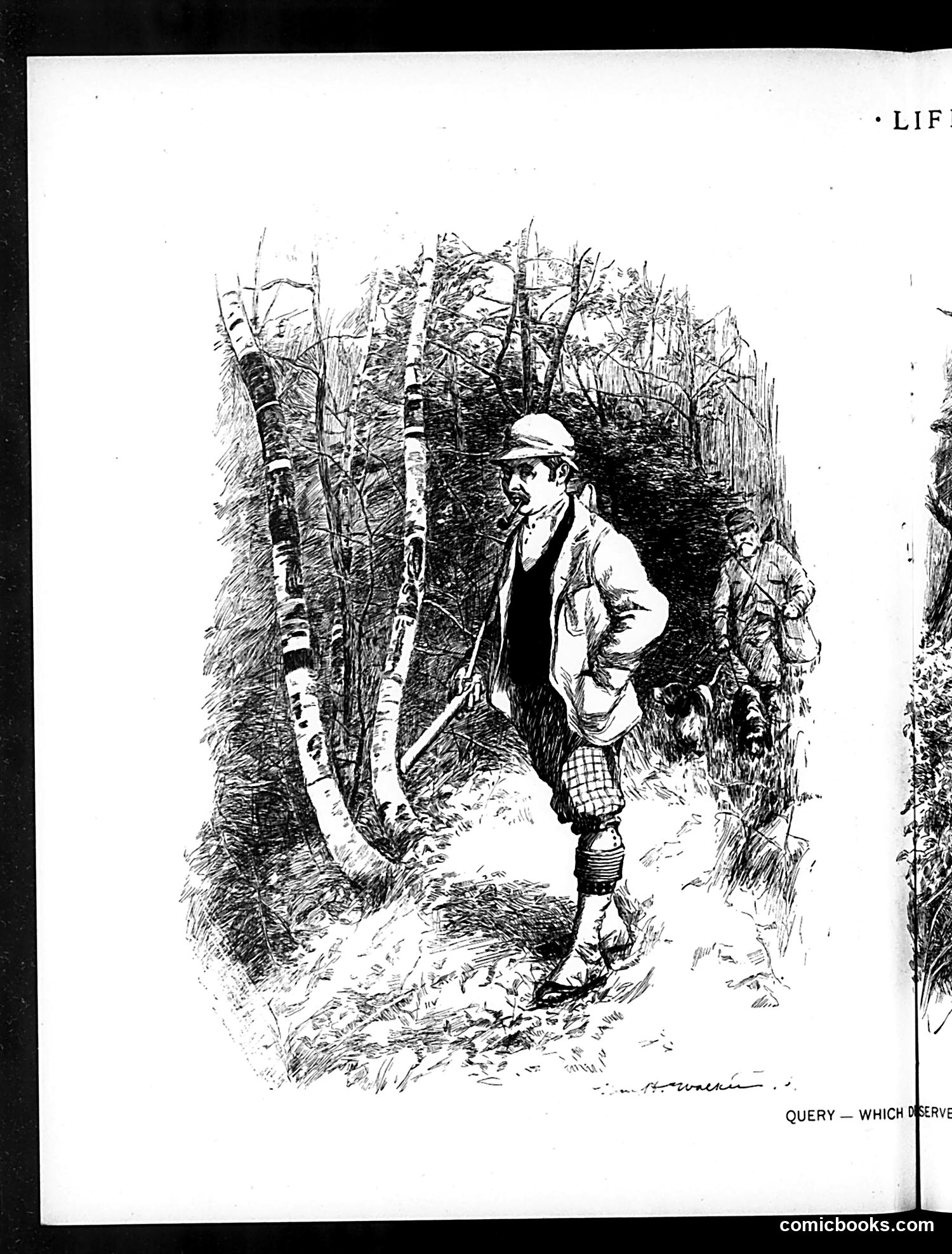
This is a pen-and-ink illustration showing a man in early 20th-century attire (hat, suit, knickerbockers) walking through a birch forest. The caption reads "QUERY — WHICH D[ESERVE]" (text cut off). The illustration appears to be satirical commentary, though the incomplete caption makes the specific target unclear. The figure's somewhat rotund physique and formal dress suggest he may represent a wealthy or privileged person. The forest setting could reference nature, conservation, or rural versus urban themes—common subjects in Life magazine's social satire. Without the complete caption, I cannot definitively identify who is being caricatured or what specific policy, person, or social issue is being mocked. The partial text prevents determining whether this critiques labor practices, environmental policy, class distinctions, or another contemporary concern.
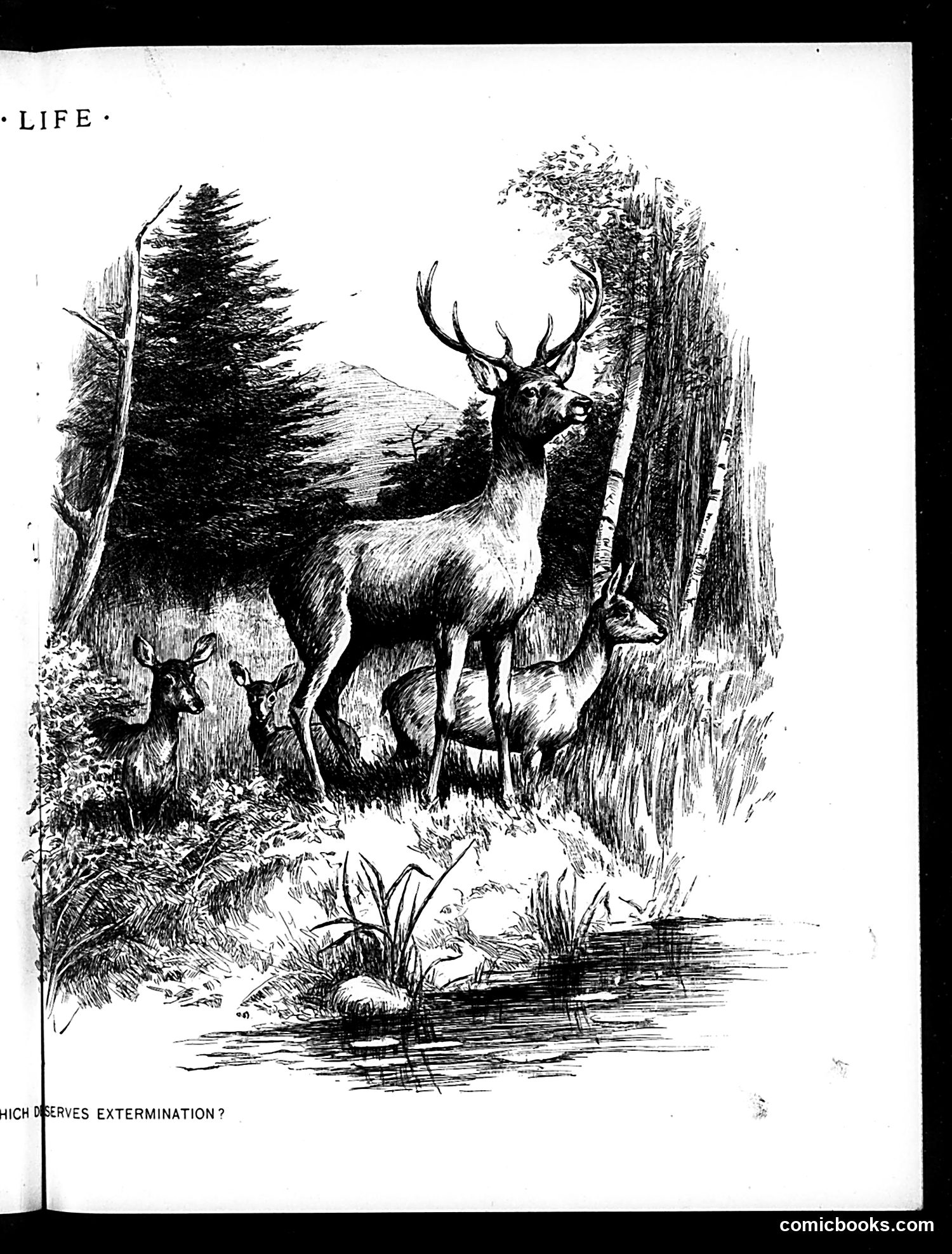
This page features a detailed engraving of a male deer (buck) with impressive antlers standing in a natural setting with birch trees, evergreens, and a stream. The visible text fragment reads "WHICH DESERVES EXTERMINATION?" The cartoon appears to be satirizing wildlife management or conservation debates, likely from the late 19th or early 20th century. The question posed suggests a commentary on whether certain animal species merit preservation or elimination—possibly addressing overhunting, ecological balance, or property damage concerns of the era. Without the full article text, the specific political or social target remains unclear, but the juxtaposition of the majestic animal with the provocative question implies irony: questioning whether something beautiful or valuable "deserves" destruction.
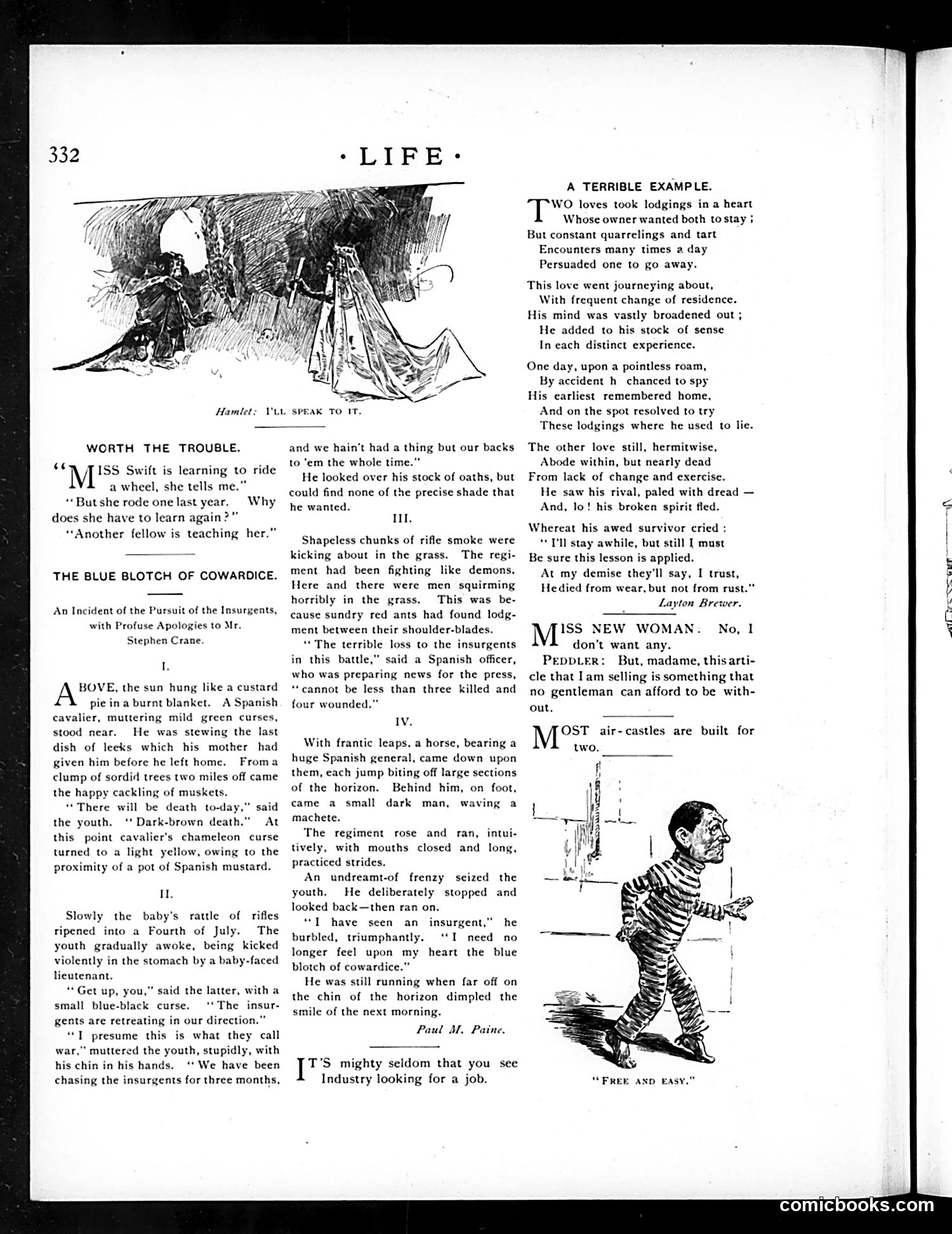
This page contains three distinct satirical pieces: **"The Blue Blotch of Cowardice"** (main story): A parody of Stephen Crane's war fiction style, mocking Spanish military incompetence during the Philippine-American War insurgency. The humor lies in the absurd contrast between the soldier's internal heroic narrative and external reality—he claims to have "seen an insurgent" while actually just running away with everyone else. The "blue blotch of cowardice" is his imagined shame, comically deflated by the ridiculous actual circumstances (ants causing casualties, exaggerated casualty counts for press). **"A Terrible Example"** (poem): A moral fable about romantic relationships, advising that variety/change preserves vitality while stagnation causes decay. **"Free and Easy"** (cartoon): A domestic humor sketch about a woman rejecting a peddler's product with the implication being flirtatious or suggestive (typical period innuendo). The page satirizes both military bungling and uses literary parody as its primary vehicle for political commentary on the ongoing insurgent conflicts.
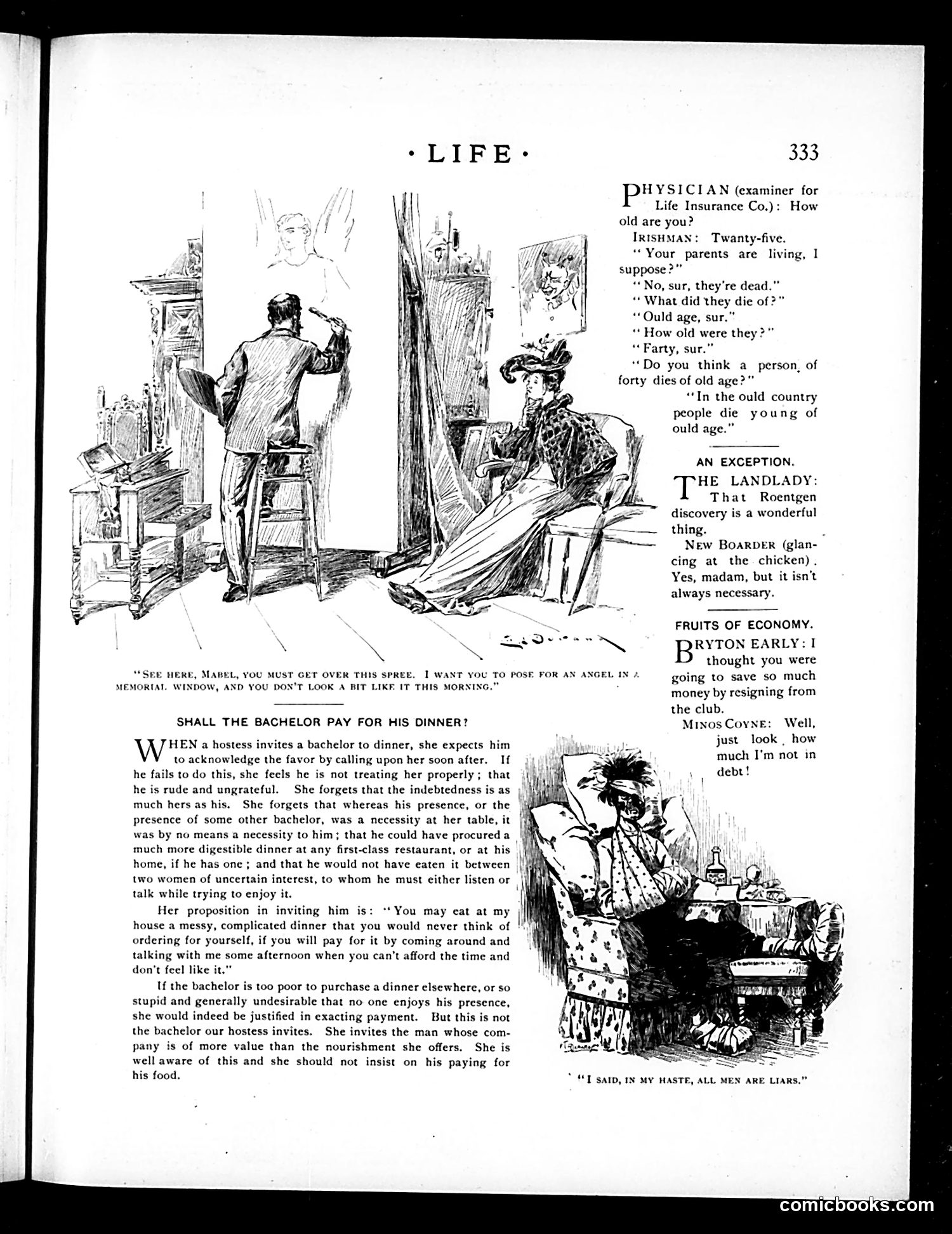
This page contains several satirical jokes reflecting early 20th-century American social attitudes: **Top cartoon**: A physician examining an Irish immigrant for life insurance encounters absurd logic—the man claims his parents died of "old age" at forty, normalizing early death in Ireland. The satire mocks both ethnic stereotypes about Irish immigrants and insurance industry practices. **Middle cartoons**: Two brief jokes—one about a landlord's suspicious new boarder eyeing a scrawny chicken (X-rays making things transparent), another mocking a club member's failed economy plan (still spending despite "savings"). **Main article**: "Shall the Bachelor Pay for His Dinner?" argues bachelors shouldn't reimburse hostesses for dinner invitations. The piece sarcastically notes hostesses invite bachelors for *their* social benefit, not charity—bachelors could dine better elsewhere. The author contends that company valuable enough to invite shouldn't require payment for food. The satire targets Victorian-era social conventions and gender dynamics around dining obligations and courtship rituals.
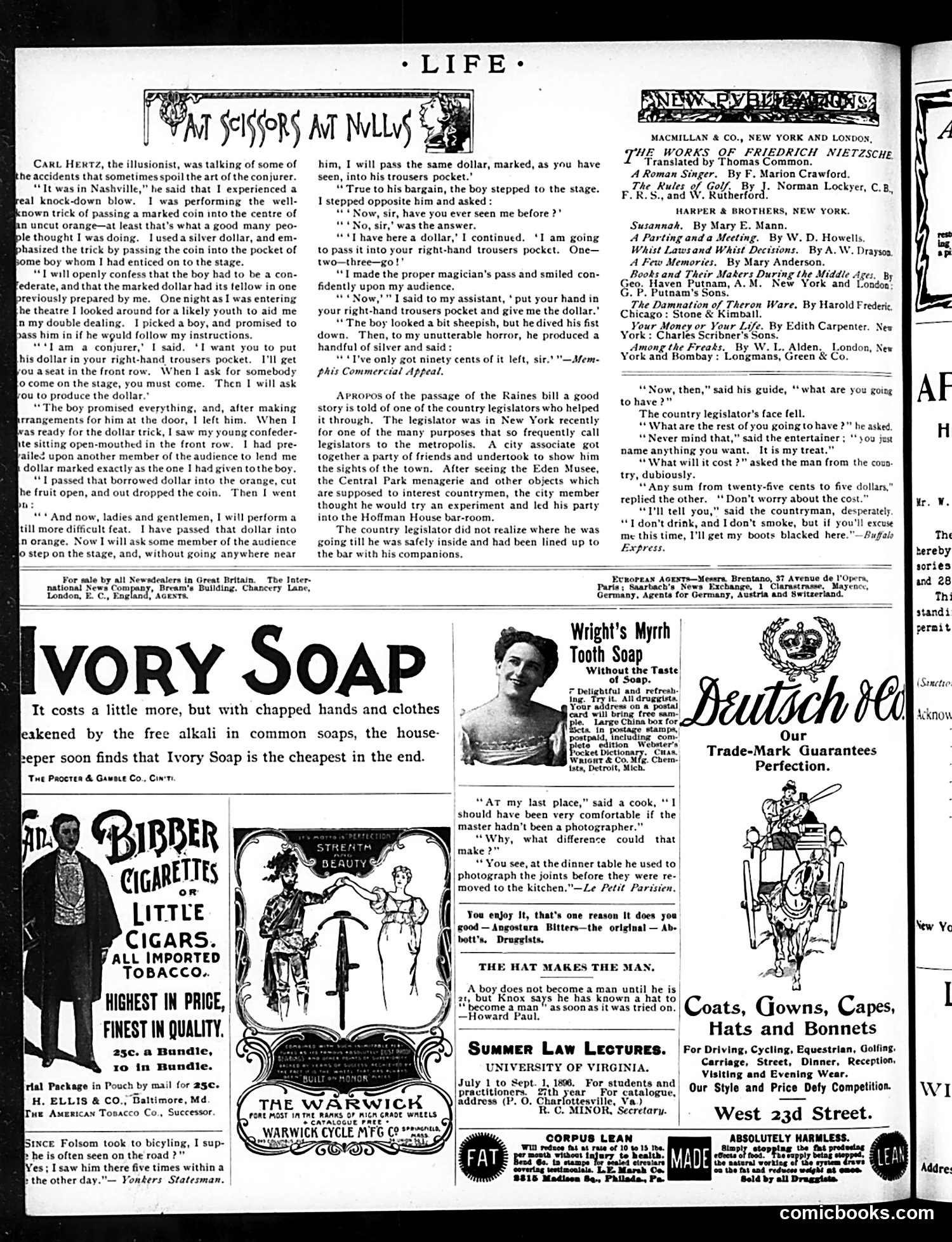
This page contains two humorous anecdotes rather than political cartoons. The main story features Carl Hertz, a real illusionist of the era, recounting a magic trick gone wrong. He attempted to pass a marked silver dollar into a boy's pocket through an orange. However, his planted assistant was replaced by a genuine audience member who actually *had* money in his pocket—ninety cents less than the dollar Hertz had supposedly placed there, revealing the trick's deception to the audience. The secondary anecdote (incomplete on this page) concerns a country legislator visiting New York who doesn't realize his urban companions are taking him into a bar—likely implying naïveté about city sophistication. The page is primarily filled with period advertisements (Ivory Soap, Wright's Myrrh Tooth Soap, Bibber Cigarettes) and book announcements, typical of Life magazine's format at this time.
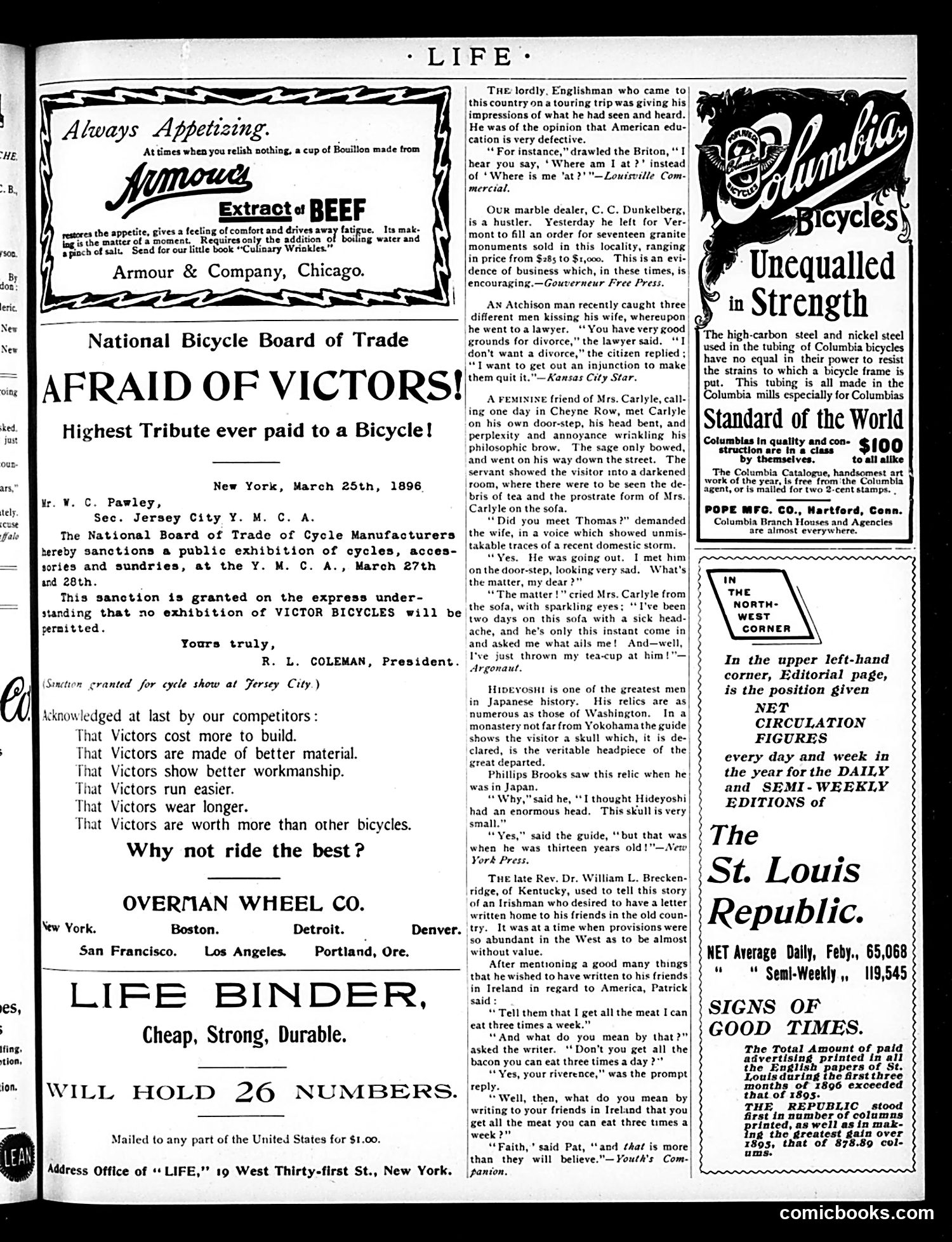
This page is primarily **advertising and business notices** rather than political satire. The main content is a letter from the National Bicycle Board of Trade *banning* Victor bicycles from an upcoming cycle exhibition—presented as mock "evidence" that Victors are superior (the Overman Wheel Co. satirically frames the ban as a "tribute"). This reflects **fierce late-1800s bicycle industry competition**. The page also includes humorous **anecdotes** mocking various social situations: an Englishman criticizing American grammar, an Atchison man seeking an injunction (not divorce) after catching his wife kissing other men, and Thomas Carlyle's wife throwing tea at him during a domestic dispute. These are gentle social humor pieces rather than pointed political cartoons. The remaining space contains product advertisements (Armour's beef extract, Columbia bicycles, Life binder subscriptions) and circulation figures for *The St. Louis Republic*.
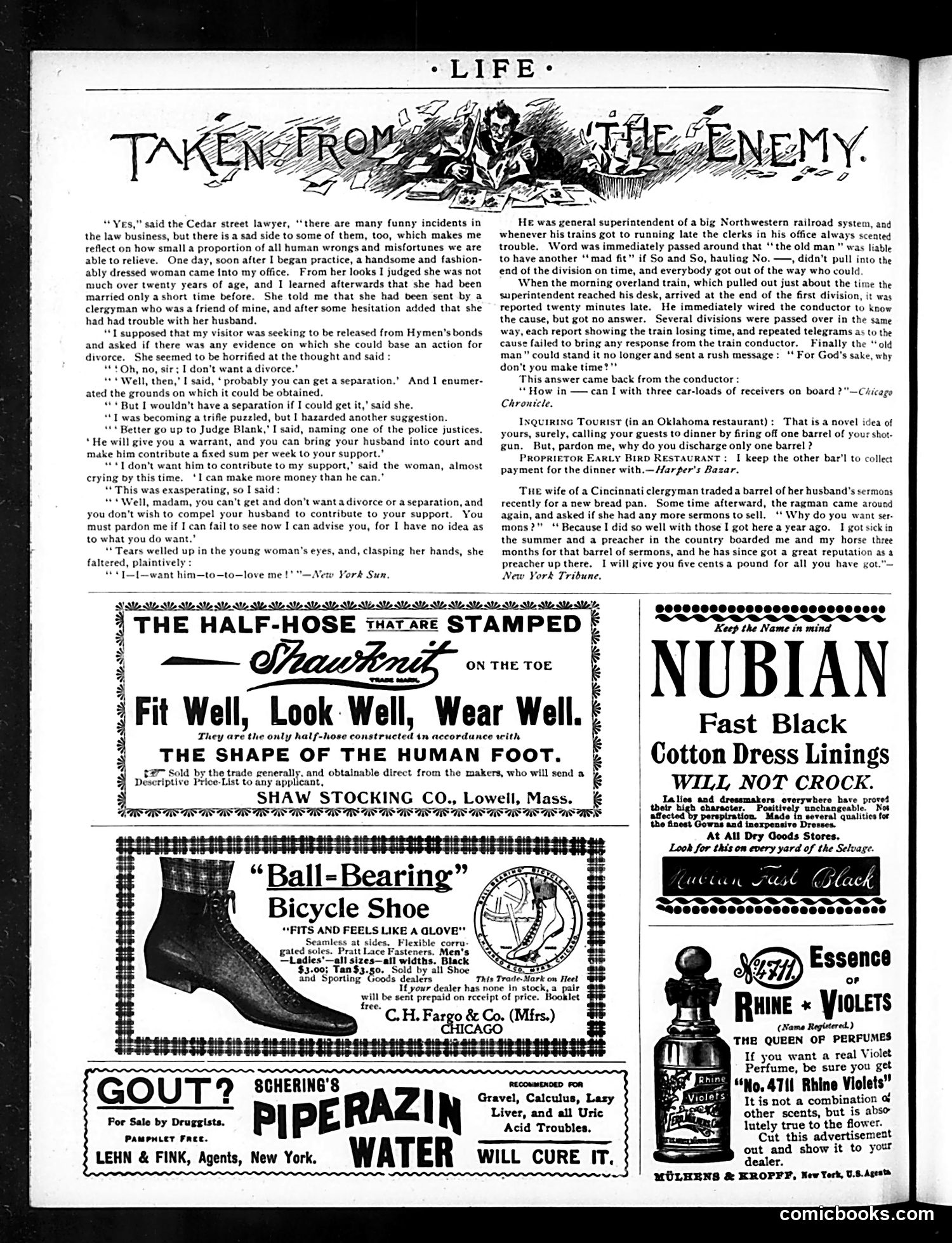
This Life magazine page combines anecdotal humor with period advertisements. The main content presents three brief satirical stories: 1. **The Lawyer's Dilemma**: A young married woman seeks legal help but refuses divorce, separation, or financial support—she simply wants her husband to love her again. The satire mocks the gap between legal remedies and human emotional needs. 2. **The Railroad Superintendent**: A superintendent frantically demands his late train "make time," only to learn the conductor is hauling three car-loads of court-appointed receivers—implying the railroad itself is financially failing. The joke satirizes management's obliviousness to systemic problems. 3. **The Clergyman's Sermons**: A pastor's wife trades his sermon collection to a ragman for a bread pan; when the ragman returns asking for more sermons, she's willing to sell again. This mocks sermon quality as worthless. The advertisements below are period-typical (hosiery, shoes, perfume, patent medicine)—unremarkable to modern readers but standard for early 1900s Life.
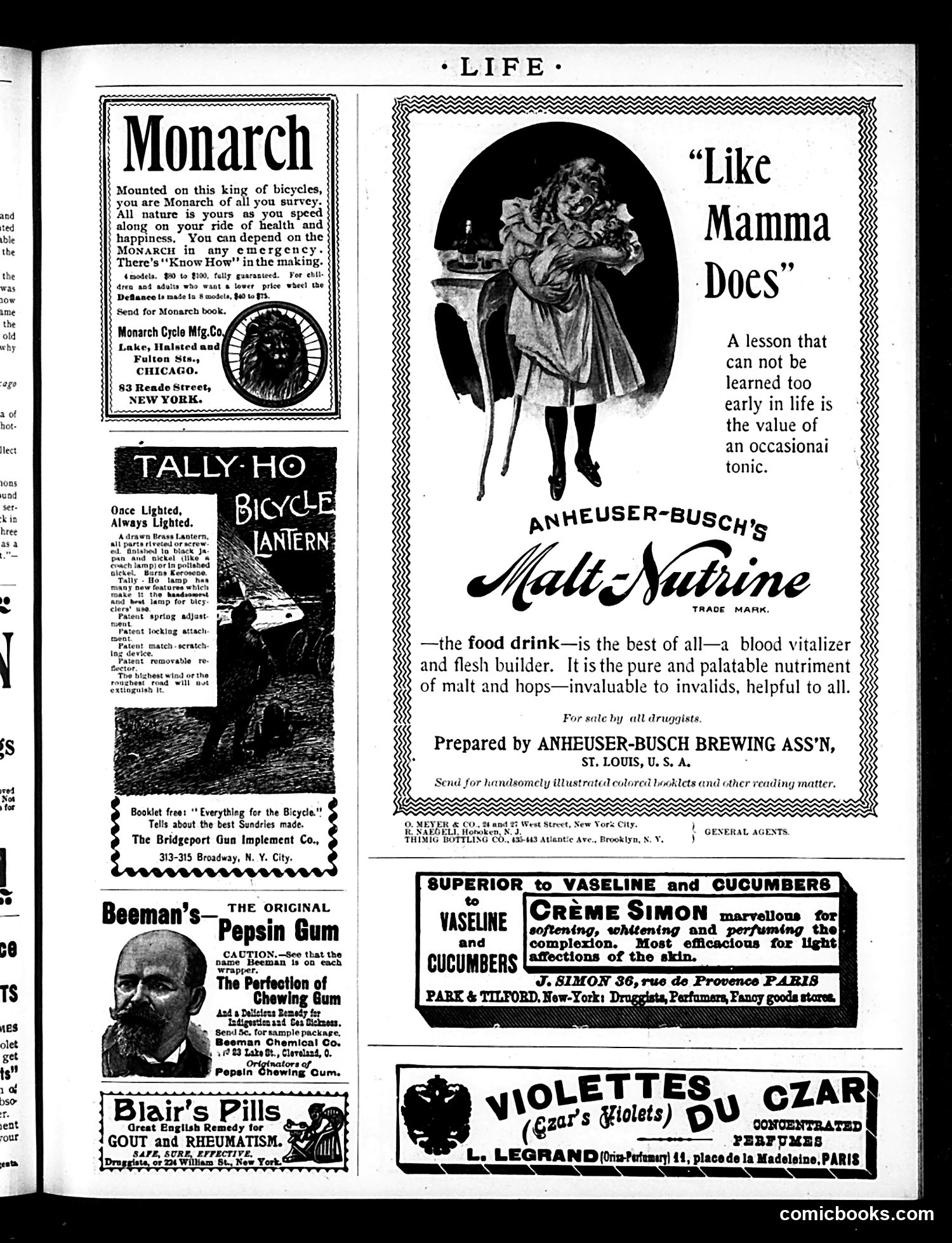
This is primarily an **advertising page**, not a satirical cartoon page. It contains various product advertisements typical of early 20th-century American magazines. The notable ad is **Anheuser-Busch's Malt Nutrine**, which depicts a mother giving her child a drink. The text claims it's "the best of all—a blood vitalizer and flesh builder," marketed as medicinal tonic for "invalids" and children. This reflects the era when alcohol-based tonics were legally sold as health remedies, before Prohibition and modern FDA regulations. The phrase "Like Mamma Does" suggests maternal endorsement of this patent medicine. Other ads promote bicycles (Monarch), bicycle accessories (Tally-Ho lanterns), chewing gum (Beeman's), cosmetics (Crème Simon), and pills for gout/rheumatism (Blair's). **For modern readers:** These ads reveal how unregulated patent medicines and dubious health claims were openly advertised to families, including children, in mainstream publications.
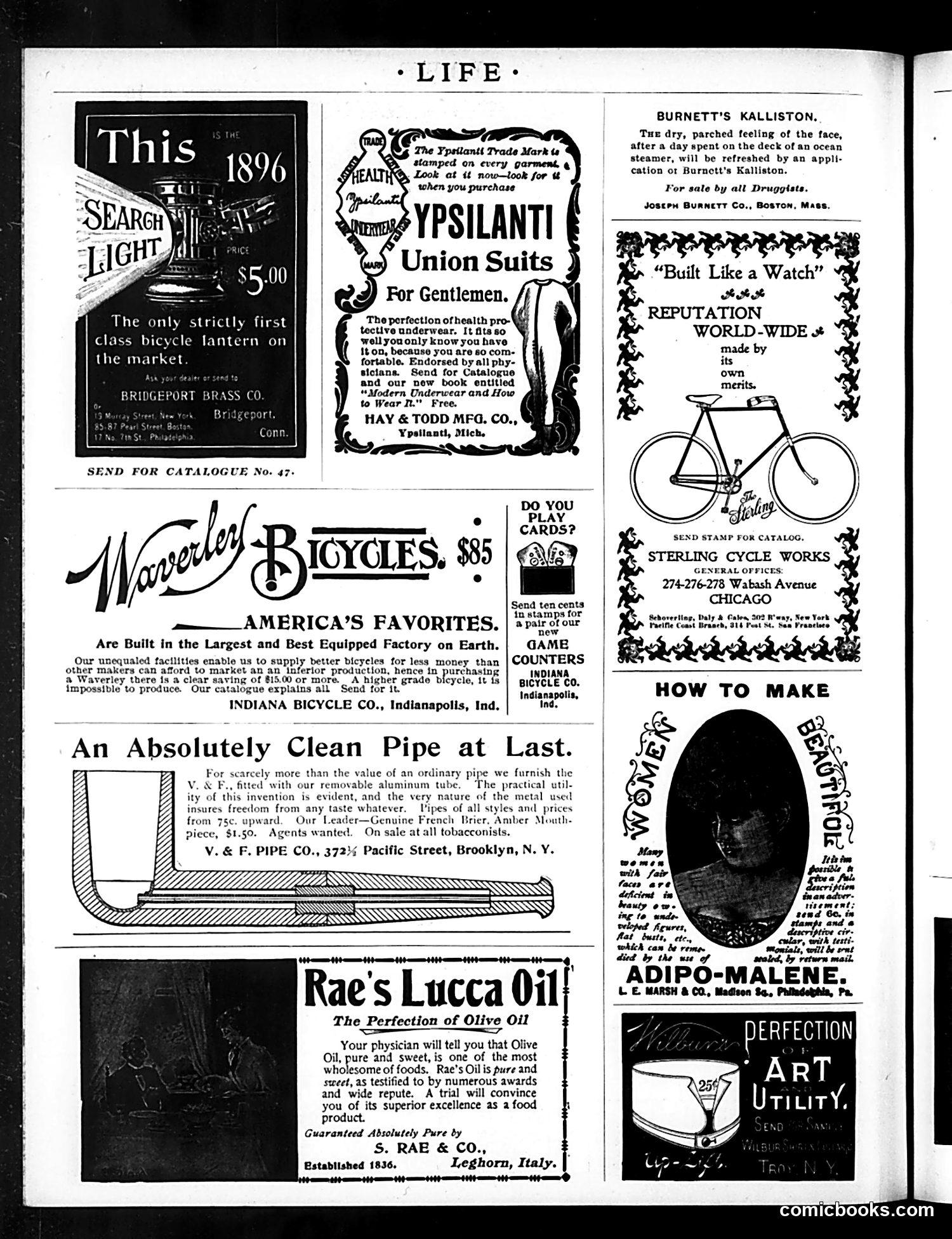
This page is **entirely advertising**—no political cartoons or satirical content. It showcases late-19th-century consumer products through period advertisements. The ads reflect 1890s concerns and innovations: bicycle culture dominates (multiple bicycle manufacturers competing), reflecting the bicycle boom's peak. Products address specific anxieties—the "clean pipe" advertisement emphasizes hygiene fears common to the era; Burnett's Kaliston addresses sun damage for ocean travelers (a leisure-class concern); underwear advertisements reference health concerns about proper support. The ads collectively show an affluent, urban American market buying into new technologies (bicycles, removable-tube pipes) and imported luxury goods (Italian olive oil established 1836; French briars for pipes). Prices like $85 bicycles and $5 lanterns indicate these were expensive luxury items. The page's layout and typography—ornate borders, varied fonts, dense copy—typifies 1890s magazine design when advertising subsidized publication costs.
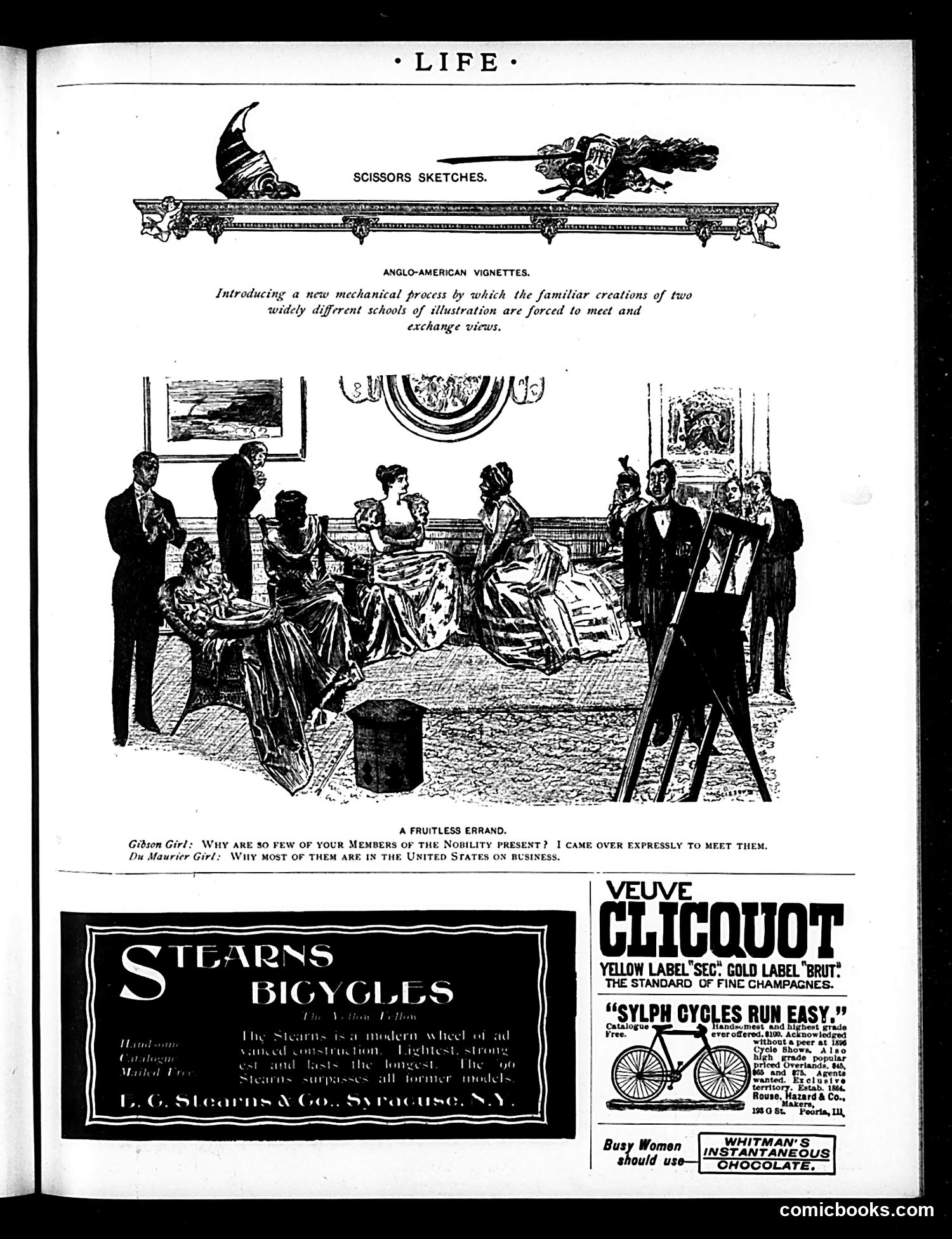
This cartoon contrasts two iconic female illustrations of the era: the American "Gibson Girl" (Charles Dana Gibson's creation) and the British "Du Maurier Girl" (from George du Maurier's work). The joke satirizes transatlantic social dynamics around 1900. The Gibson Girl, representing American wealth and modernity, visits England expecting to meet British nobility. Instead, she's told the aristocrats are absent—they're in America conducting business. The satire cuts both ways: it mocks American nouveau-riche social climbing (the Gibson Girl seeking titled connections) while simultaneously suggesting British nobles are now chasing American money, abandoning their traditional social roles. The "mechanical process" mentioned in the subtitle refers to this being a collaborative illustration combining two distinct artistic styles to make them "exchange views"—literally forcing different cultural perspectives to meet, mirroring the cartoon's theme.