
Life, 1896-04-23 · page 7 of 20
Life — April 23, 1896 — page 7: what you’re looking at
What you’re looking at
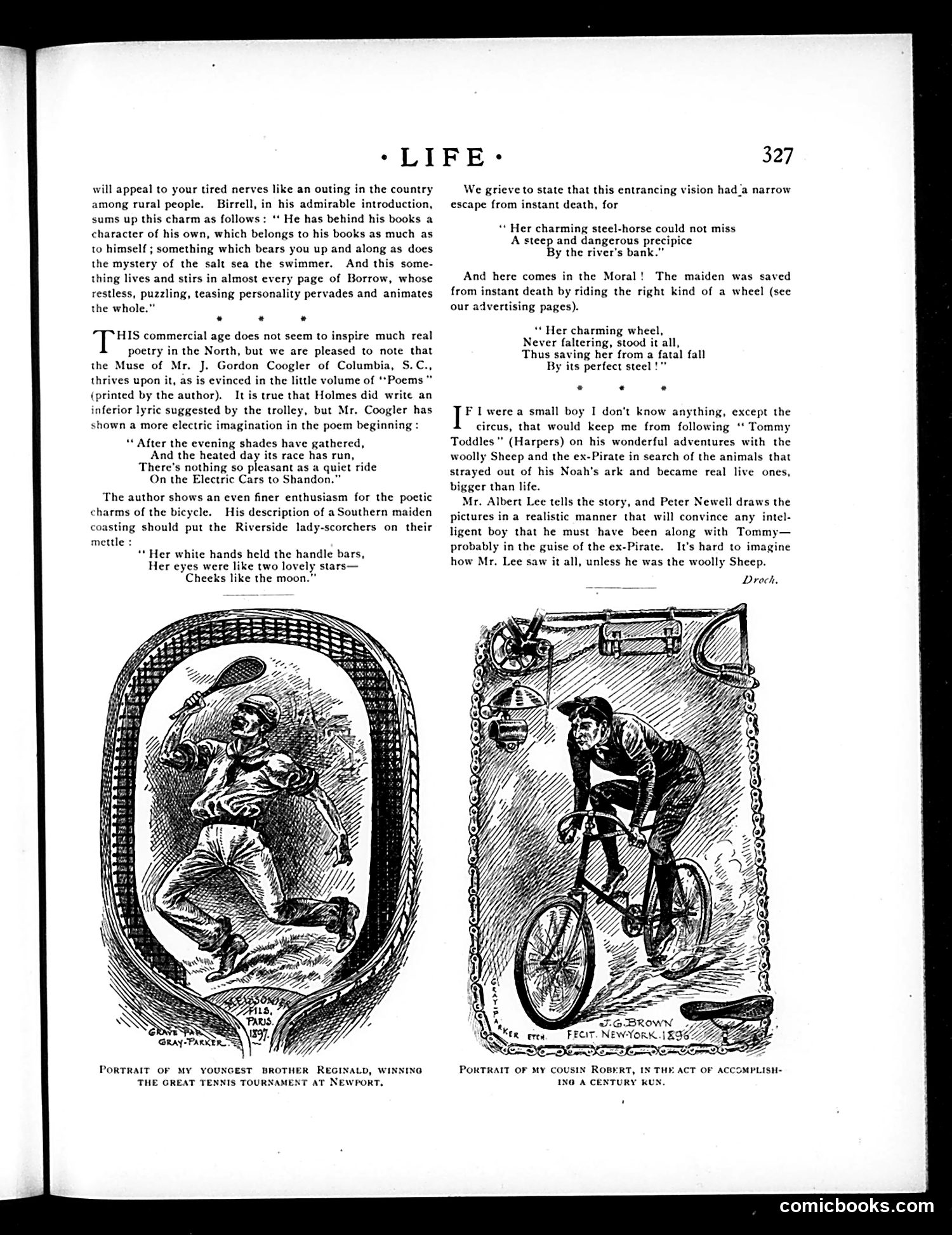
This page from *Life* magazine features two illustrations with captions identifying them as portraits of the author's relatives engaged in athletic pursuits around the turn of the century. The left illustration shows "Portrait of My Youngest Brother Reginald, Winning the Great Tennis Tournament at Newport"—depicting a tennis player in action. The right illustration shows "Portrait of My Cousin Robert, in the Act of Accomplishing a Century Run"—showing a cyclist riding a bicycle. The accompanying text discusses the literary merits of bicycling and cycling in contemporary poetry. Rather than political satire, this appears to be a humorous, autobiographical piece celebrating turn-of-the-century sports culture among the upper classes (Newport being an exclusive resort). The "satire" is gentle—poking fun at the author's own relatives' athletic achievements through mock-formal portraiture.
📄 Transcribed text from this page (OCR, searchable)
Machine-transcribed from the original scan — historical spelling and the odd misread are preserved.
“LIFE: will appeal to your tired nerves like an outing in the country among rural people. Birrell, in his admirable introduction, sums up this charm as follows: ‘* He has behind his books a character of his own, which belongs to his books as much as to himself ; something which bears you up and along as does the mystery of the salt sea the swimmer. And this some- thing lives and stirs in almost every page of Borrow, whose restless, puzzling, teasing personality pervades and animates the whole.” . * * HIS commercial age does not seem to inspire much real poetry in the North, but we are pleased to note that the Muse of Mr. J. Gordon Coogler of Columbia, S.C., thrives upon it, as is evinced in the little volume of ‘*Poems ” (printed by the author). It is true that Holmes did write an inferior lyric suggested by the trolley, but Mr. Coogler has shown a more electric imagination in the poem beginning : “After the evening shades have gathered, And the heated day its race has run, There's nothing so pleasant as a quiet ride On the Electric Cars to Shandon.” The author shows an even finer enthusiasm for the poctic charms of the bicycle. His description of a Southern maiden coasting should put the Riverside lady-scorchers on their mettle : ‘* Her white hands held the handle bars, Her eyes were like two lovely stars— Cheeks like the moon.” a\\ A \\ ) SSS ea a ae SS ~- PORTRAIT OF MY YOUNGEST BROTHER REGINALD, WINNING THE GREAT TENNIS TOURNAMENT AT NEWPORT, 327 We grieve to state that this entrancing vision had_a narrow escape from instant death, for “Her charming steel-horse could not miss A steep and dangerous precipice By the river's bank.” And here comes in the Moral! The maiden was saved from instant death by riding the right kind of a wheel (see our advertising pages). “* Her charming wheel, Never faltering, stood it all, Thus saving her from a fatal fall By its perfect steel!" * * * I’ I were a small boy I don't know anything, except the circus, that would keep me from following ‘‘ Tommy Toddles"" (Harpers) on his wonderful adventures with the woolly Sheep and the ex-Pirate in search of the animals that strayed out of his Noah's ark and became real live ones, bigger than life. Mr. Albert Lee tells the story, and Peter Newell draws the pictures in a realistic manner that will convince any intel- ligent boy that he must have been along with Tommy— probably in the guise of the ex-Pirate. It's hard to imagine how Mr. Lee saw it all, unless he was the woolly Sheep. J-G BROWN WORK. EICZ . ENCER eres PORTRAIT OF MY COUSIN ROBERT, IN THE ACT OF ACCOMPLISH- SIE comicbooks.com