
Life, 1896-04-23 · page 4 of 20
Life — April 23, 1896 — page 4: what you’re looking at
What you’re looking at
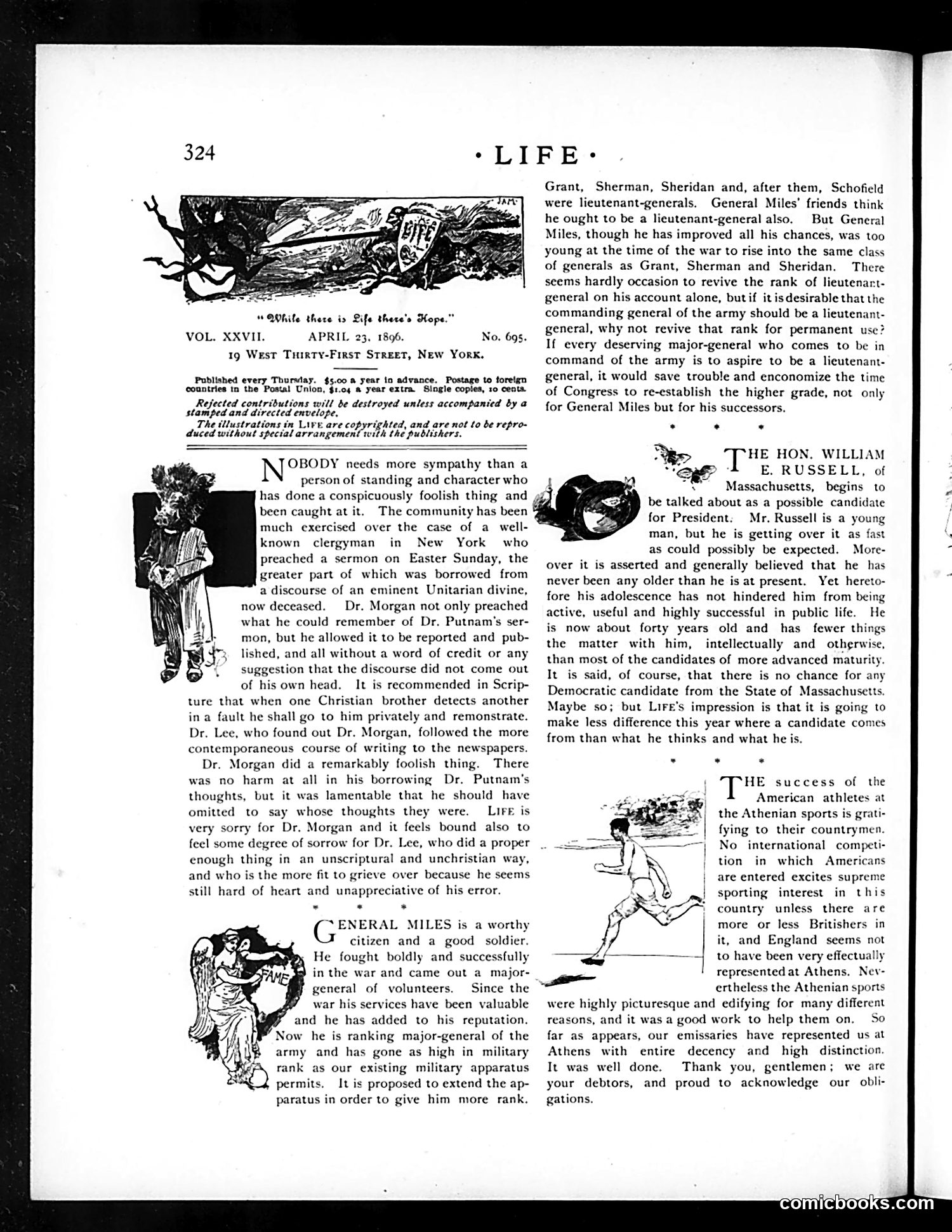
This page contains three separate editorial commentaries with illustrations: 1. **Top section** discusses General Miles and military rank disputes, arguing Miles deserves lieutenant-general status alongside Grant, Sherman, and Sheridan. 2. **Middle section** critiques a clergyman who plagiarized a sermon from Dr. Putnam without attribution, then followed with an original composition. The text sarcastically notes this demonstrates poor judgment and Christian hypocrisy—the clergyman should have credited his source. 3. **Bottom section** praises American athletes' success at the Athenian sports competitions, crediting their representatives for bringing "entire decency and high distinction" to the games while noting British participation was limited. The decorative woodcut illustrations are typical of 1890s Life magazine's satirical style.
📄 Transcribed text from this page (OCR, searchable)
Machine-transcribed from the original scan — historical spelling and the odd misread are preserved.
* LIFE: QWhile there is Life there's Hope.” VOL. XXVII. APRIL 23, 1896. 19 West Tuirty-First STREET, NEW YORK. Published every Thurwliay. $5.00 a year in advance. to foreign countries In the Postal Union, $1.04 @ year extra. Single copies, 10 centa Rejected contributions will be destroyed unless accompanied by a stamped and directed envelope, The illustrations in Live are copyrighted, and are not to be repro- duced without special arrangement with the publishers. OBODY needs more sympathy than a person of standing and character who has done a conspicuously foolish thing and gg been caught at it. The community has been much exercised over the case of a well- known clergyman in New York who preached a sermon on Easter Sunday, the greater part of which was borrowed from a discourse of an eminent Unitarian divine, now deceased. Dr. Morgan not only preached what he could remember of Dr. Putnam's ser- mon, but he allowed it to be reported and pub- lished, and all without a word of credit or any suggestion that the discourse did not come out of his own head. It is recommended in Scrip- ture that when one Christian brother detects another in a fault he shall go to him privately and remonstrate. Dr. Lee, who found out Dr. Morgan, followed the more contemporaneous course of writing to the newspapers. Dr. Morgan did a remarkably foolish thing. There was no harm at all in his borrowing Dr. Putnam's thoughts, but it was lamentable that he should have omitted to say whose thoughts they were. LIFE is very sorry for Dr. Morgan and it feels bound also to feel some degree of sorrow for Dr. Lee, who did a proper enough thing in an unscriptural and unchristian way, and who is the more fit to grieve over because he seems still hard of heart and unappreciative of his error. ENERAL MILES is a worthy citizen and a good soldier. He fought boldly and successfully in the war and came out a major- general of volunteers. Since the A war his services have been valuable and he has added to his reputation. “Now he is ranking major-general of the army and has gone as high in military rank our existing military apparatus permits. It is proposed to extend the ap- paratus in order to give him more rank. Grant, Sherman, Sheridan and, after them, Schofield were lieutenant-generals. General Miles’ friends think he ought to be a lieutenant-general also. But General Miles, though he has improved all his chances, was too young at the time of the war to rise into the same class of generals as Grant, Sherman and Sheridan. There seems hardly occasion to revive the rank of lieutenart- general on his account alone, butif it isdesirable that the commanding general of the army should be a lieutenant- genera], why not revive that rank for permanent usc? If every deserving major-general who comes to be in command of the army is to aspire to be a licutenant- general, it would save trouble and enconomize the time of Congress to re-establish the higher grade, not only for General Miles but for his successors. . HE HON. WILLIAM E. RUSSELL, of Massachusetts, begins to be talked about as a possible candidate for President: Mr. Russell is a young man, but he is getting over it as fast as could possibly be expected. More- over it is asserted and generally believed that he has never been any older than he is at present. Yet hereto- fore his adolescence has not hindered him from being active, useful and highly successful in public life. He is now about forty years old and has fewer things the matter with him, intellectually and otherwise, than most of the candidates of more advanced maturity. It is said, of course, that there is no chance for any Democratic candidate from the State of Massachusetts. Maybe so; but Lire’s impression is that it is going to make less difference this year where a candidate comes from than what he thinks and what he is. HE success of the American athletes at the Athenian sports is grati- fying to their countrymen. No international competi- tion in which Americans are entered excites supreme sporting interest in this country unless there are more or less Britishers in it, and England seems not to have been very effectually represented at Athens. Nev- —— ertheless the Athenian sports were highly picturesque and edifying for many different reasons, and it was a good work to help them on. So far as appears, our emissaries have represented us at Athens with entire decency and high distinction. It was well done. Thank you, gentlemen; we are your debtors, and proud to acknowledge our obli- gations.