
A complete issue · 20 pages · 1896
Life — April 9, 1896
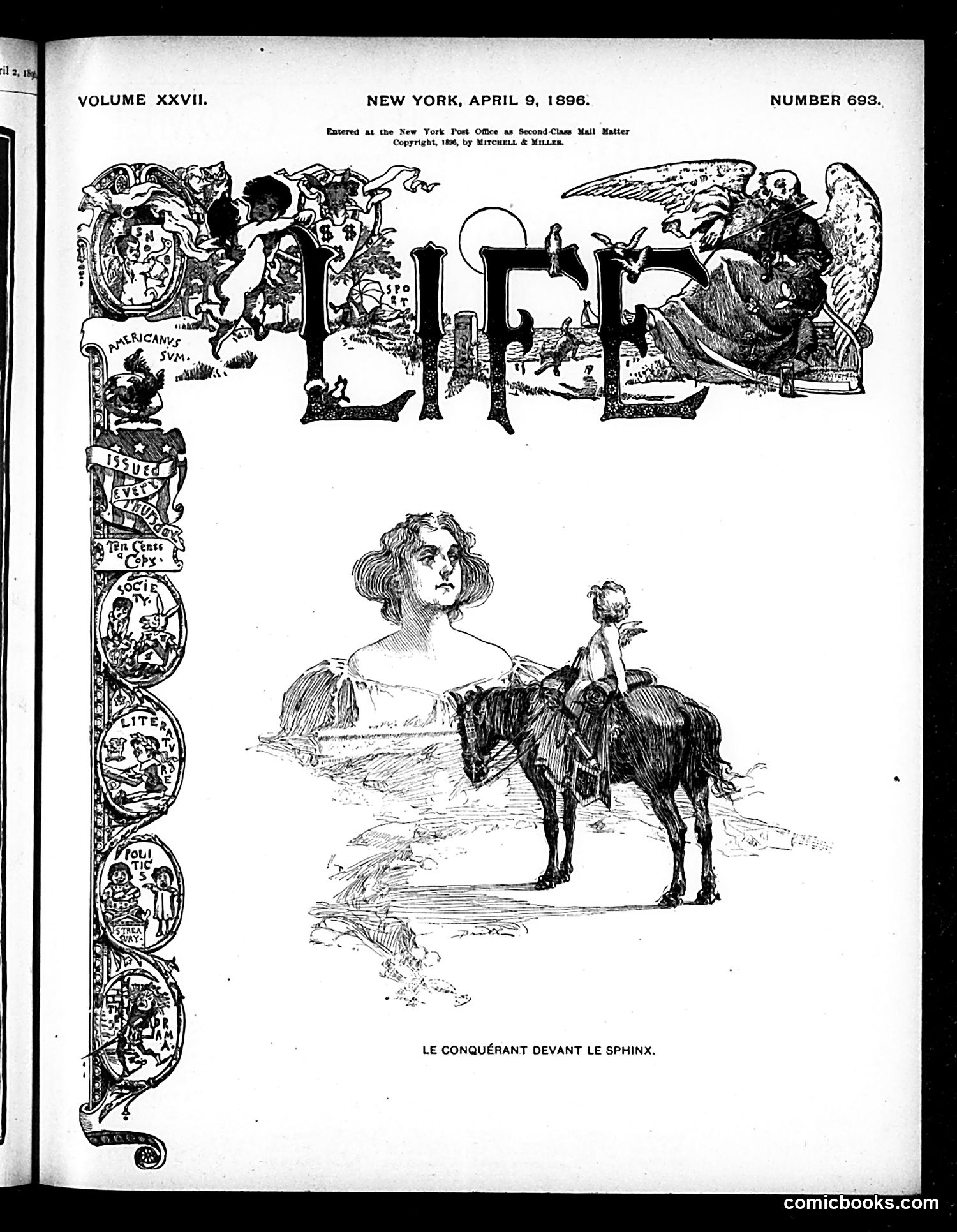
The French caption "LE CONQUÉRANT DEVANT LE SPHINX" (The Conqueror Before the Sphinx) suggests this cartoon references Napoleon Bonaparte and imperial conquest. The illustration shows a woman gazing at a camel carrying what appears to be a cherub or cupid figure, depicted in a classical/romantic style. The ornate left border contains small emblematic vignettes typical of Life's decorative design work. Without clearer context from surrounding articles, the specific satirical point remains uncertain. It likely comments on French imperial ambitions, romantic idealism, or contemporary geopolitical matters of 1896. The sphinx reference invokes Egypt and colonial aspirations. The woman's contemplative pose suggests romantic or philosophical reflection on conquest and power.
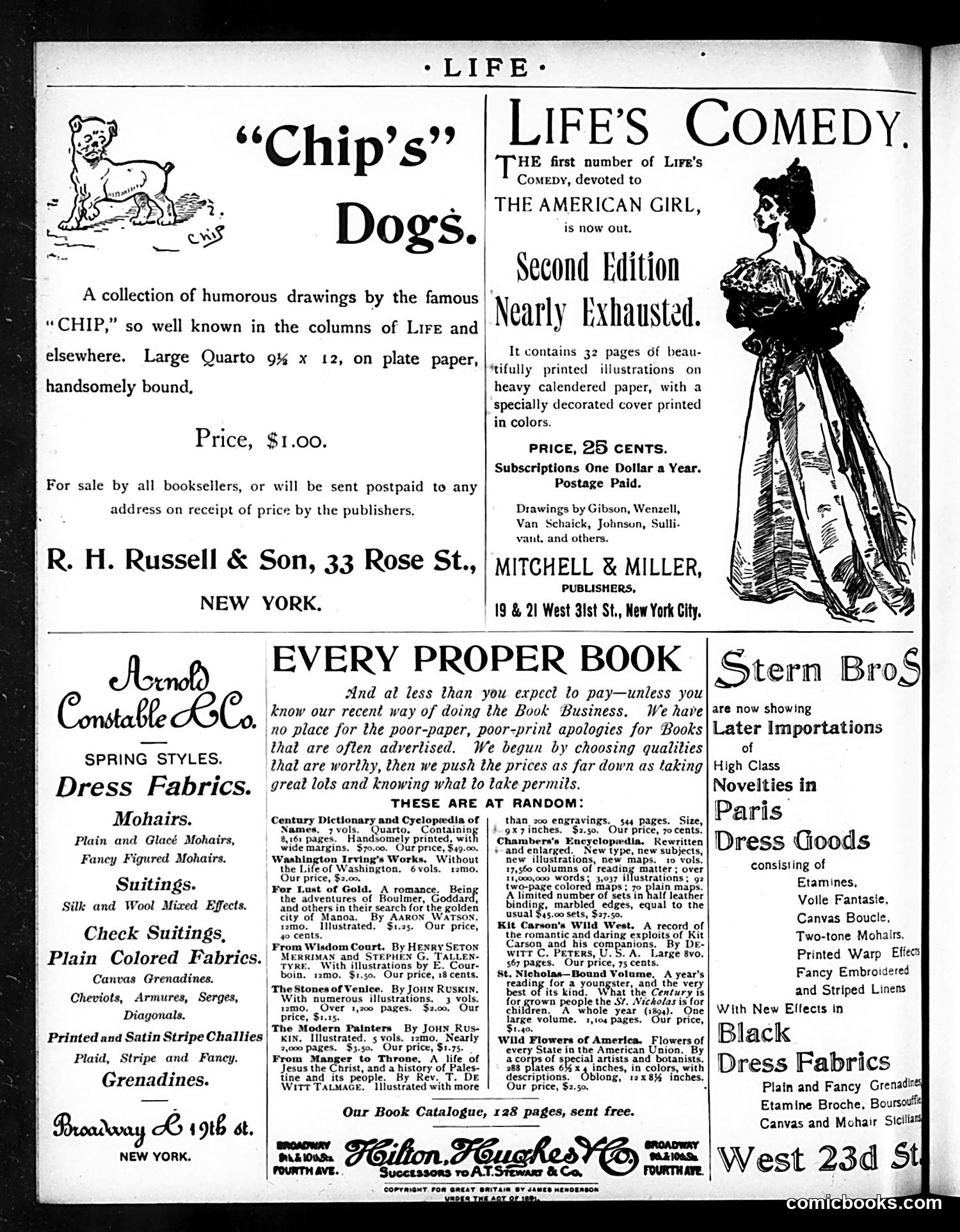
This page is primarily **advertising**, not political commentary. The main content promotes three products: 1. **"Chip's Dogs"** — A humorous cartoon collection book by artist "Chip," priced at $1.00. The small illustration shows a dog, establishing the book's subject matter. 2. **Life's Comedy** — A magazine supplement featuring American girl illustrations, priced at 25 cents. 3. **Other advertisements** for dress fabrics, books, and imported goods from retailers like Arnold Constable & Co. and Stern Bros. There is no apparent political satire on this page. It reflects turn-of-the-century commercial publishing and retail, showcasing how Life magazine supplemented editorial content with advertisements for books, fashion, and merchandise targeting middle-class readers.
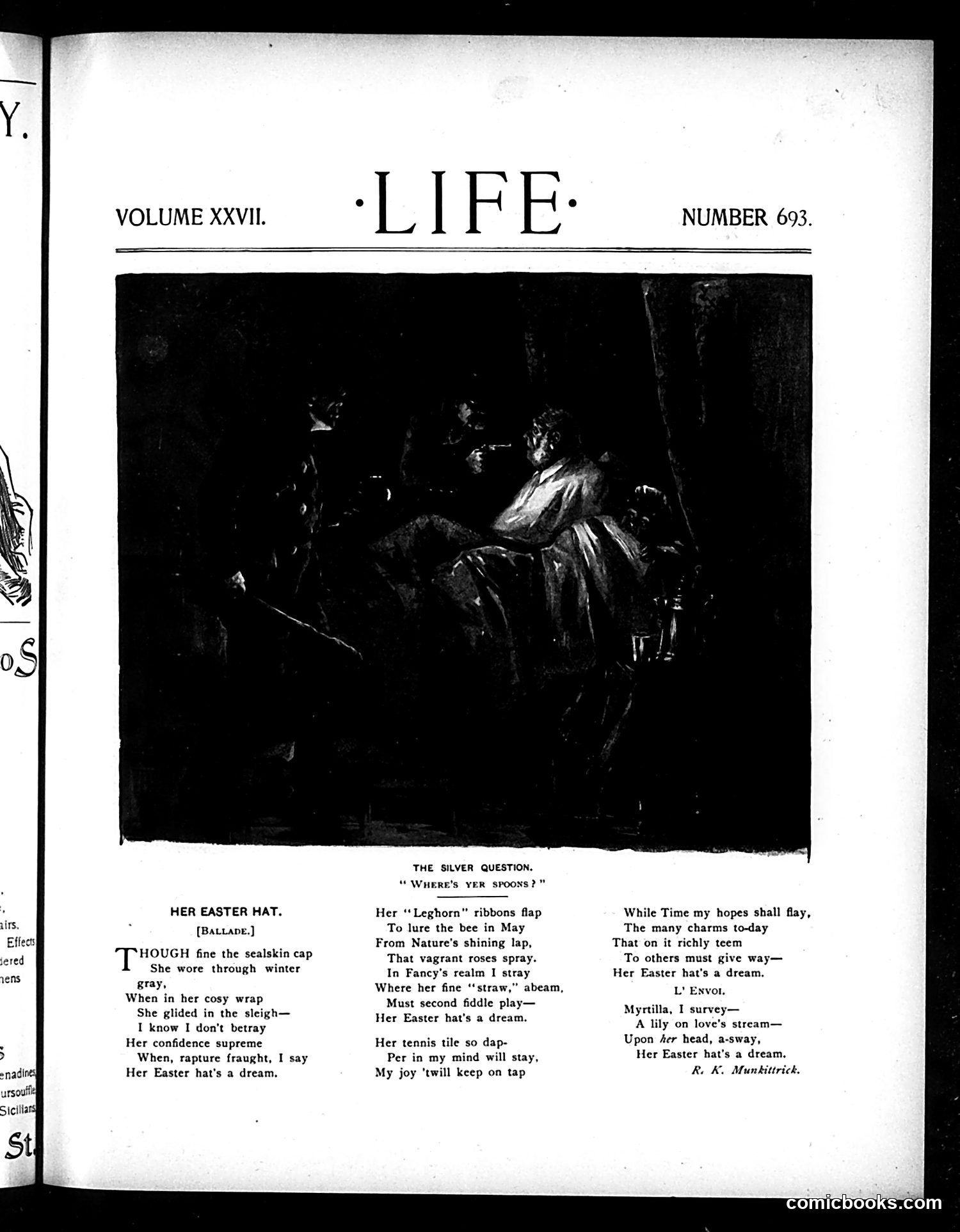
This page contains three poems about Easter bonnets and spring fashion, not political satire. The central image "The Silver Question" depicts what appears to be a theatrical or social scene in a darkened interior, though the specific reference remains unclear from the image quality. The poems—"Her Easter Hat," "The Silver Question," and an untitled piece—are lighthearted verses celebrating women's Easter fashion, particularly elaborate hats. They reference spring imagery (roses, bees, lilies) and romance. The tone is whimsical rather than satirical. Without clearer visibility of the illustration or additional context about "The Silver Question" reference, the specific social commentary intended remains uncertain, though the overall page treats Easter fashion as a subject of romantic, frivolous entertainment typical of early 20th-century Life magazine.
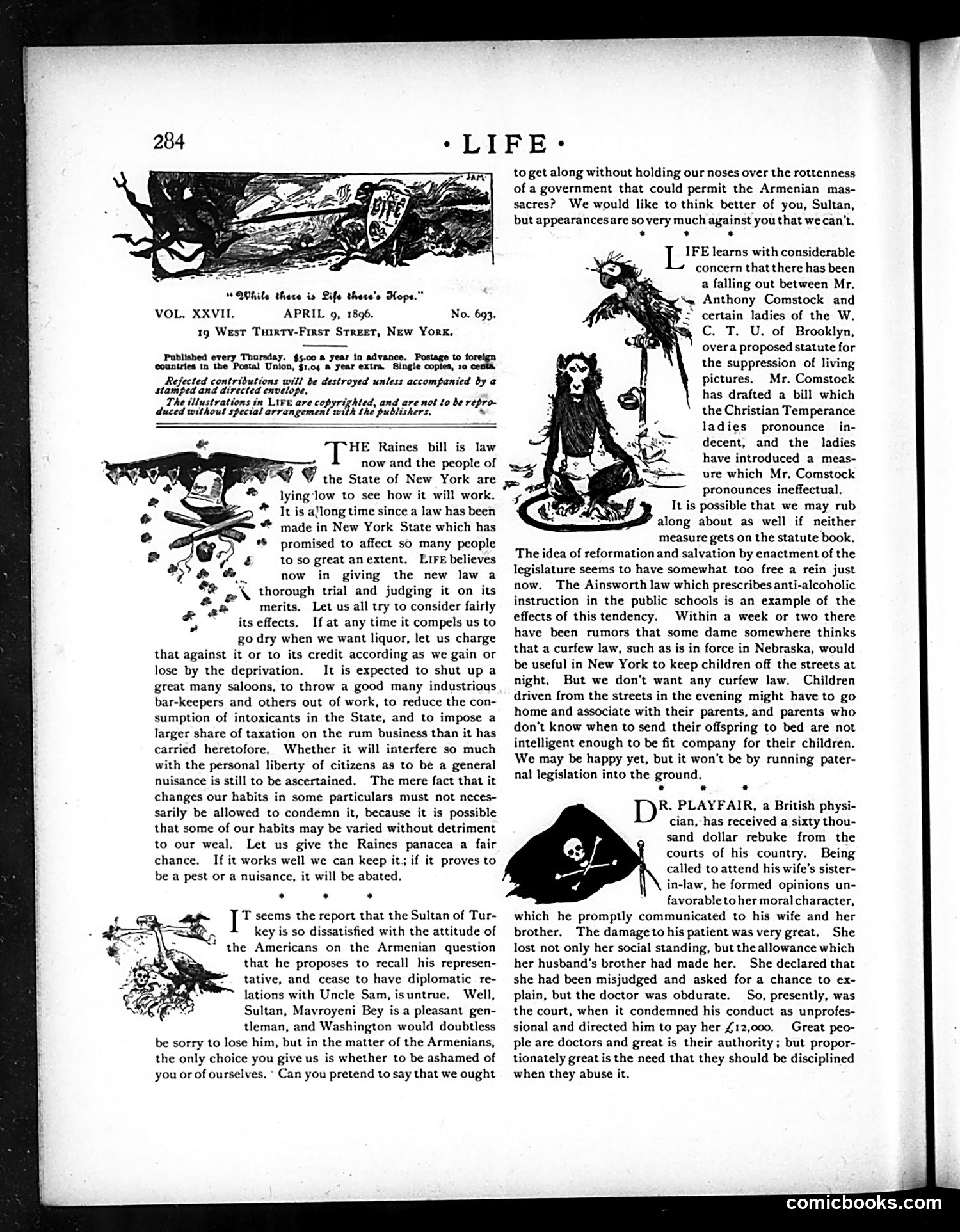
This page contains editorial commentary on several contemporary issues: **The Raines Law**: The text discusses New York's newly enacted liquor regulation, expressing skepticism about its effectiveness. Life questions whether the law will achieve its stated goals of reducing bar-keeper misconduct and taxation issues. **Armenian Question**: The editorial addresses the Sultan of Turkey's dismissal of American diplomatic pressure regarding Armenian treatment. Life criticizes both the Sultan's position and American hypocrisy—arguing the U.S. cannot credibly pressure Turkey while tolerating its own injustices. **Dr. Playfair Case**: A British physician received a £60,000 court judgment after his wife's brother made damaging claims about his character. Life uses this to critique doctors who abuse their professional authority and argues they need institutional discipline. The illustrations are decorative satirical vignettes rather than specific political caricatures.
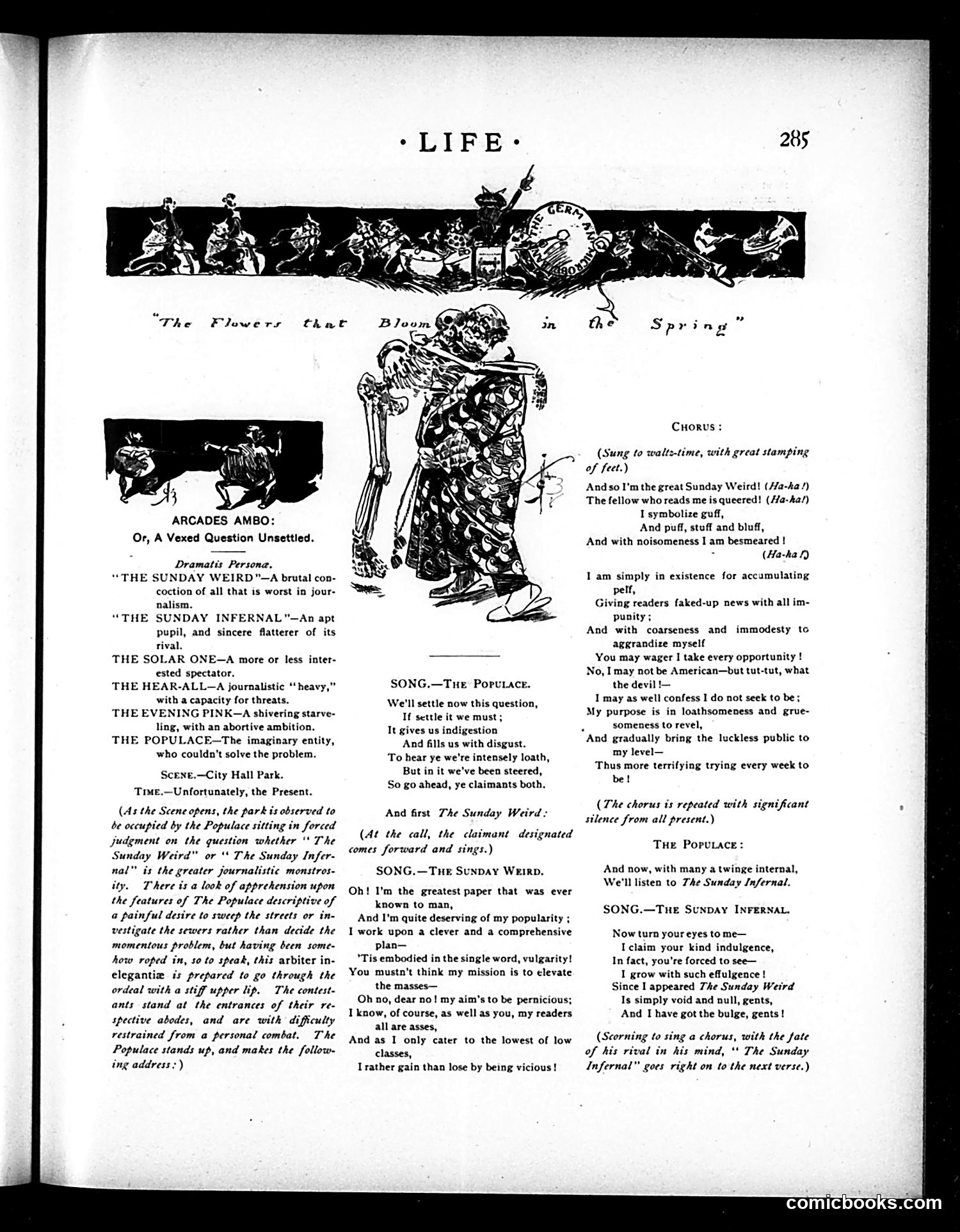
This page satirizes journalism and newspaper ethics through two theatrical pieces. "Arcades Ambo" presents a debate about "The Sunday Weird" — apparently a sensationalist newspaper known for brutal content and false stories. The satire criticizes journalism that: - Publishes fabricated "news" for profit - Caters to low-class readers through sensationalism - Uses dishonesty to accumulate wealth The skeleton figure in the central illustration likely represents Death or decay resulting from such corrupt journalism. The songs mock both "The Sunday Weird" newspaper and "The Populace" (the gullible readership), suggesting mutual culpability—readers demand sensational content while papers exploit that demand. The satire questions whether journalism or its audience bears greater blame for the degradation of public discourse.
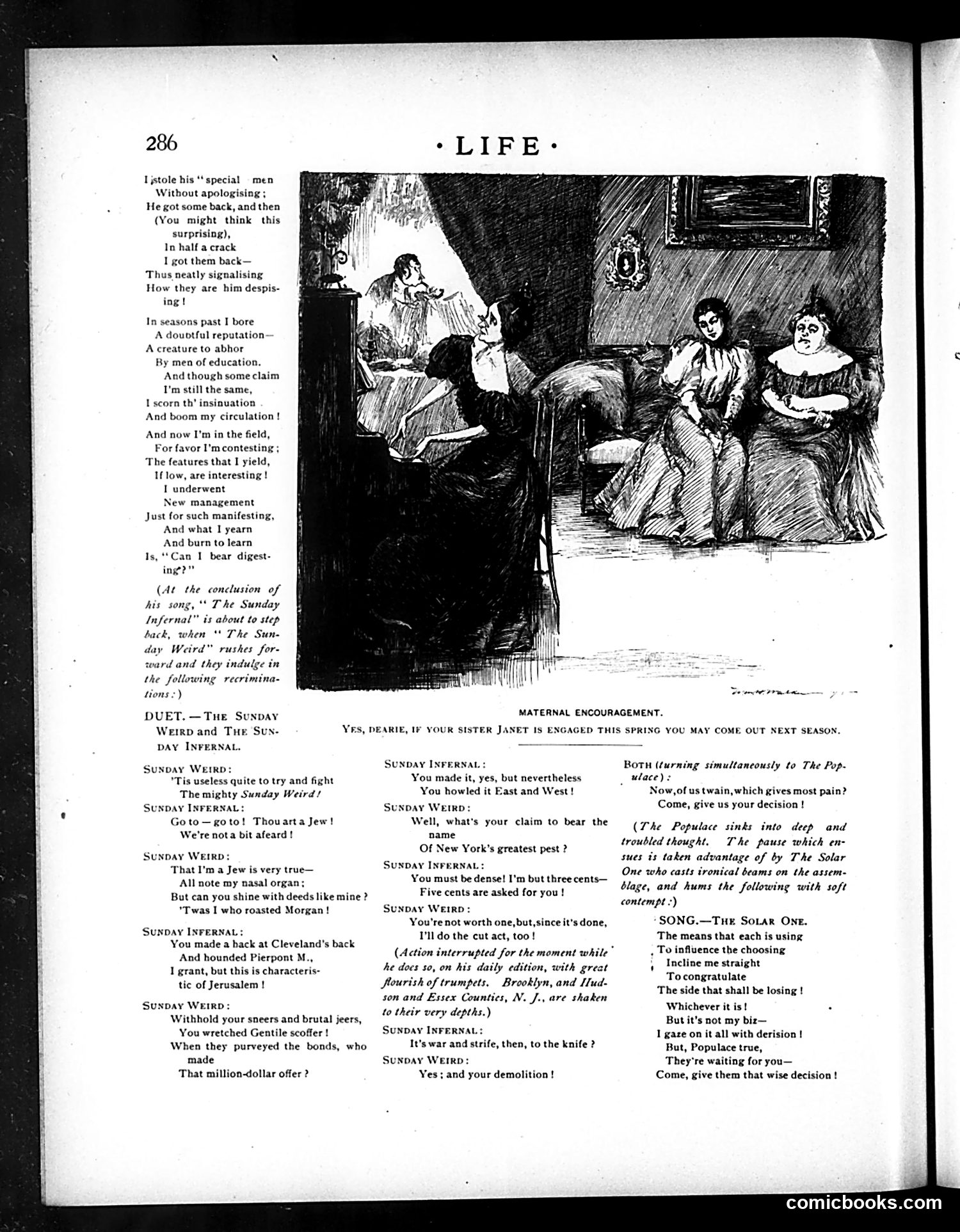
This page features a satirical duet titled "The Sunday Weird and The Sunday Infernal," depicting a dialogue between two competing newspaper sections. The illustration shows figures in an interior setting, likely representing newspaper editors or personified sections of publications. The satire mocks sensationalist Sunday newspaper supplements of the era—particularly their competing claims to expose scandals and attract readers through increasingly lurid content. "The Sunday Weird" and "The Sunday Infernal" represent rival papers engaging in one-upmanship, each boasting of more shocking revelations and scandals they've uncovered. The accompanying text "Maternal Encouragement" appears to satirize how such sensationalism affected families and social reputation. The satire critiques the yellow journalism competition between publications vying for readership through scandal rather than substantive reporting.
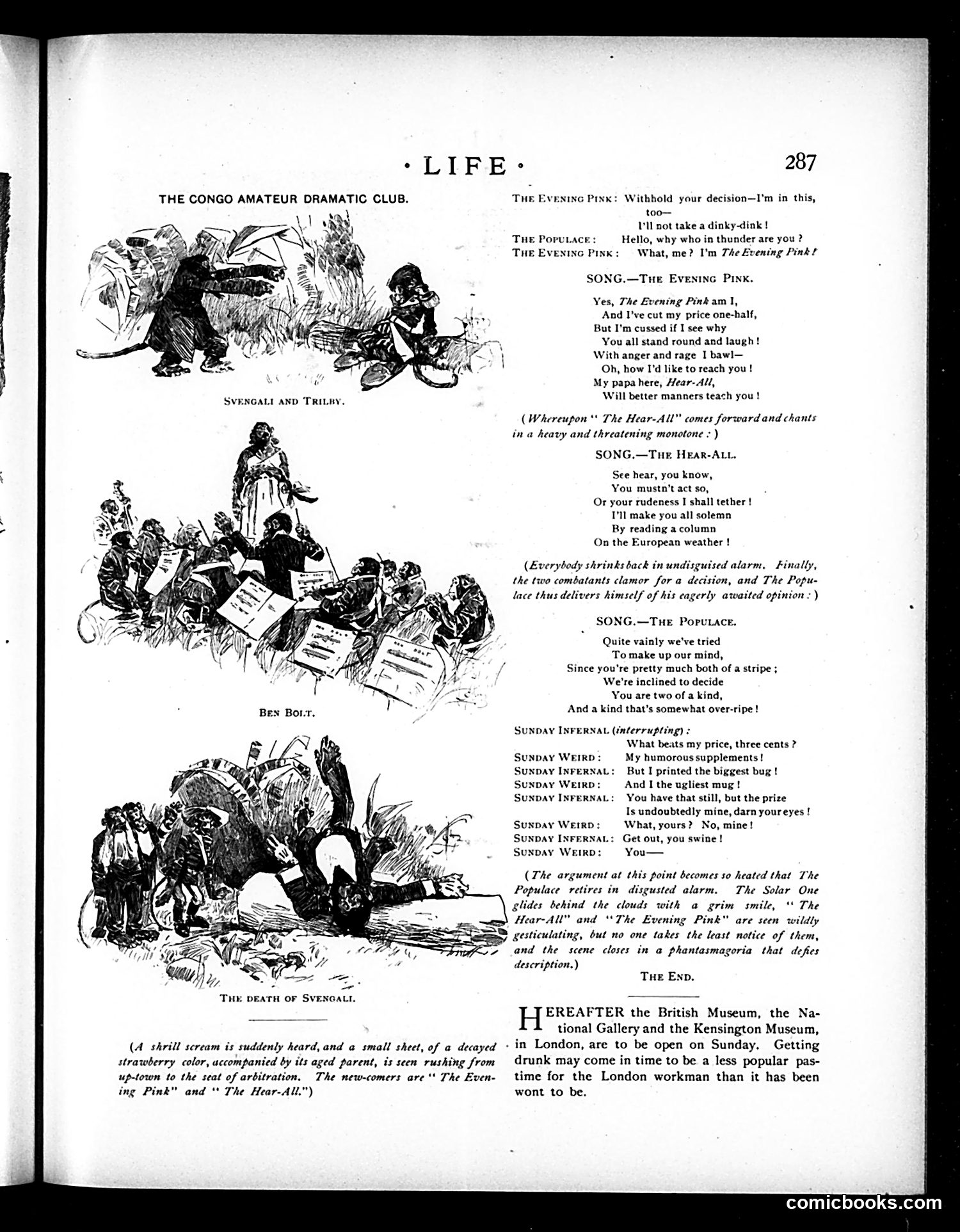
This page satirizes a theatrical production about Congo colonialism. The sketches show various characters performing in what appears to be an amateur dramatic society's play. The dialogue and songs mock both the performers and their subject matter—particularly the condescending, self-righteous attitudes of colonial figures. The jokes target pompous "civilizing mission" rhetoric. Characters like "The Evening Pink" (a newspaper) and "The Populace" exchange absurd dialogue about manners and European superiority. The "Hear-All" character represents paternalistic colonial attitudes. The cartoon ridicules how amateur theatricals trivialize serious colonial issues through melodrama and pretension, suggesting the performers are more concerned with their own importance than genuine understanding of Congo or its people.
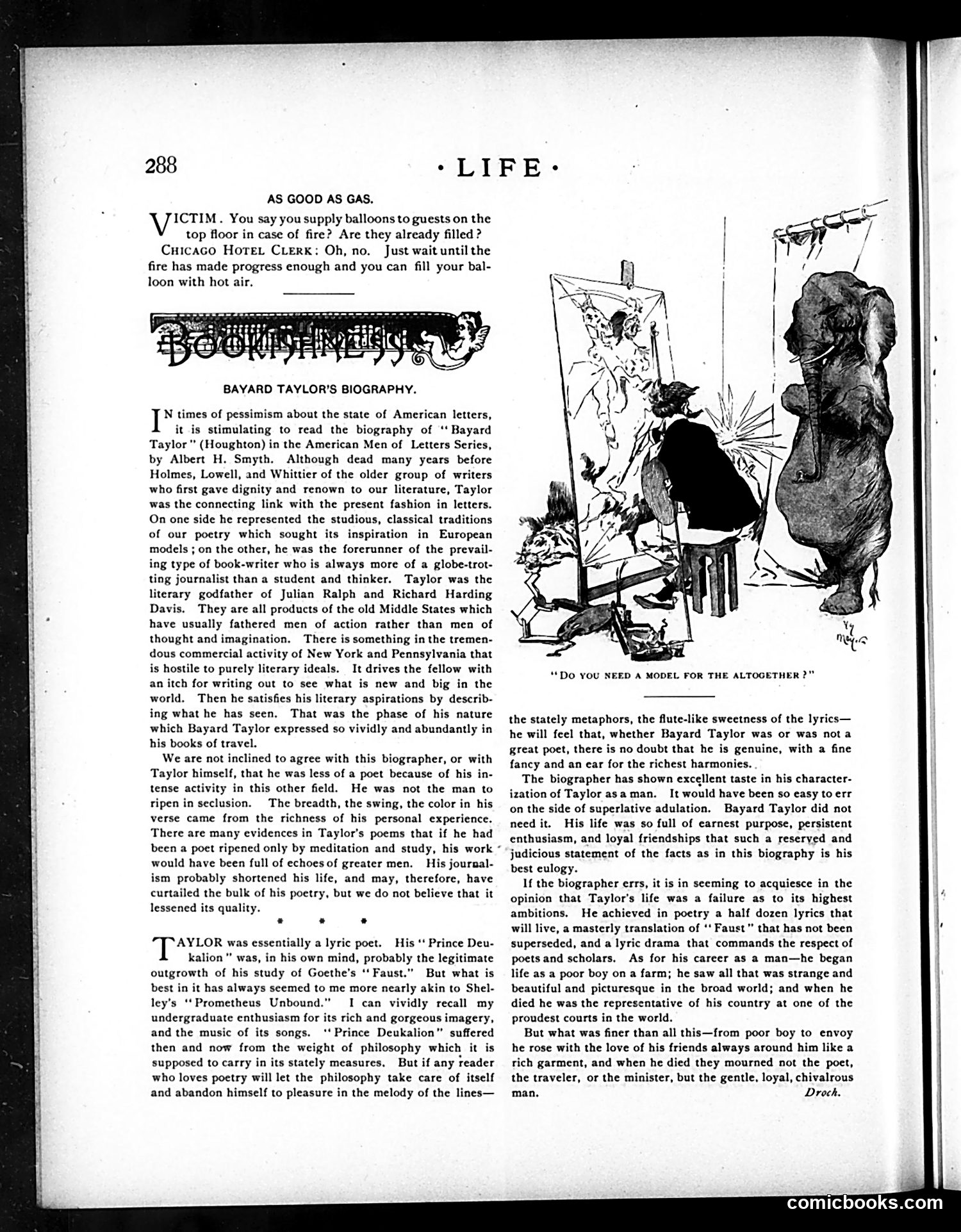
This page contains two distinct items: **Top section ("As Good as Gas"):** A brief comedic exchange between a hotel guest worried about fire safety and a Chicago Hotel clerk who suggests waiting for an actual fire to fill balloons with hot air—a pun on the clerk's own verbose, unhelpful response. **Main content ("Bayard Taylor's Biography"):** A biographical essay about 19th-century American writer Bayard Taylor, illustrated with a drawing titled "Do You Need a Model for the Altogether?" (depicting an artist's studio scene with a model). The essay discusses Taylor's literary significance, his role bridging classical and modern American letters, and his career as poet, traveler, and writer. The illustration appears to be a separate satirical cartoon about artists and models, unrelated to the biographical text above it.
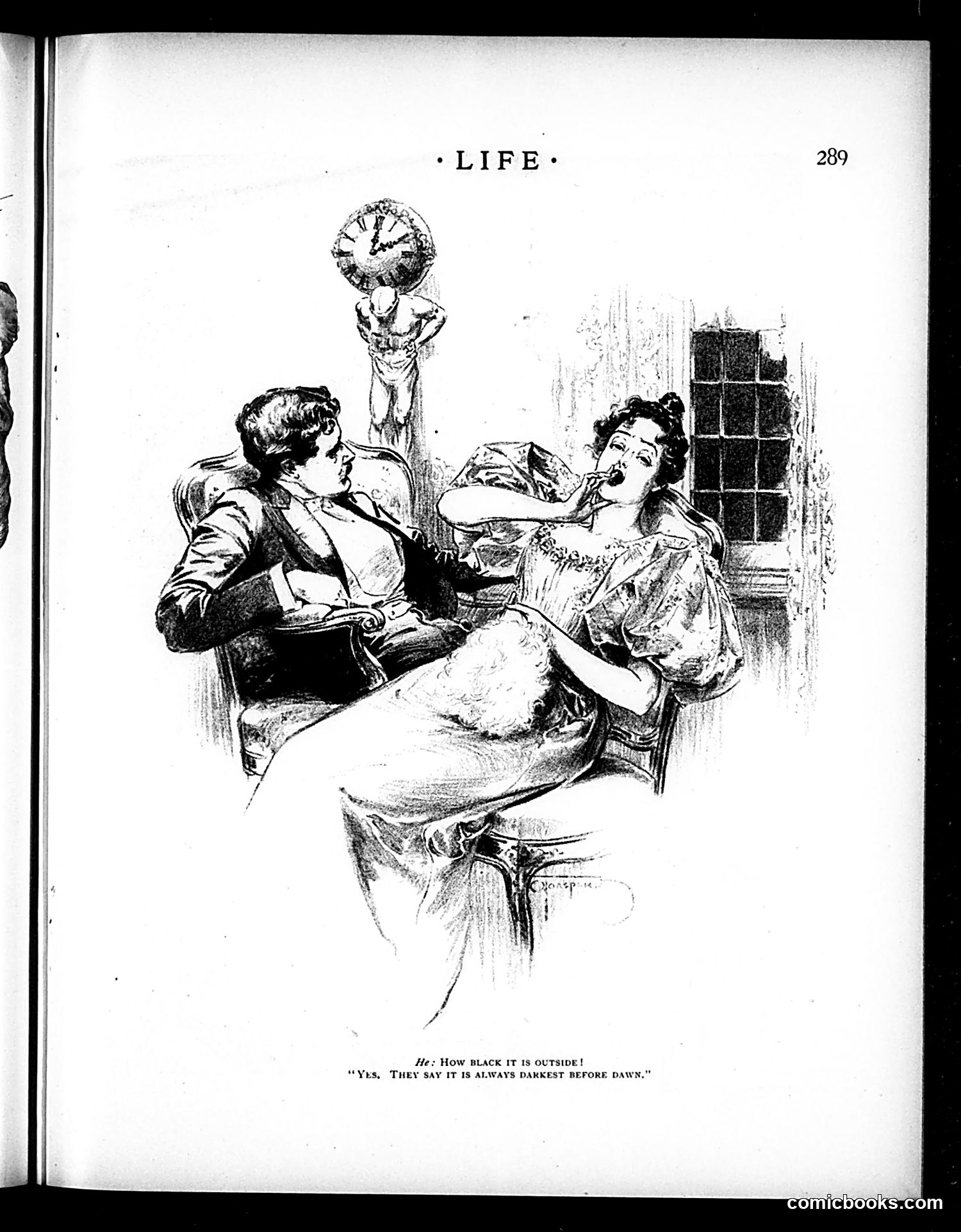
This is a satirical illustration showing a couple in an intimate moment. The man, looking at a clock showing near midnight, remarks "How black it is outside!" The woman responds: "Yes. They say it is always darkest before dawn." The cartoon plays on a double meaning of the common proverb "it's always darkest before dawn." While the man makes literal observations about the nighttime hour, the woman's response suggests optimism about overcoming difficulties—a contrast highlighting either romantic tension, relationship conflict, or perhaps commentary on social/political circumstances requiring perseverance. The clock emphasizes the late hour, adding urgency or intimacy to their exchange. The exact historical context remains unclear without additional publication date information.
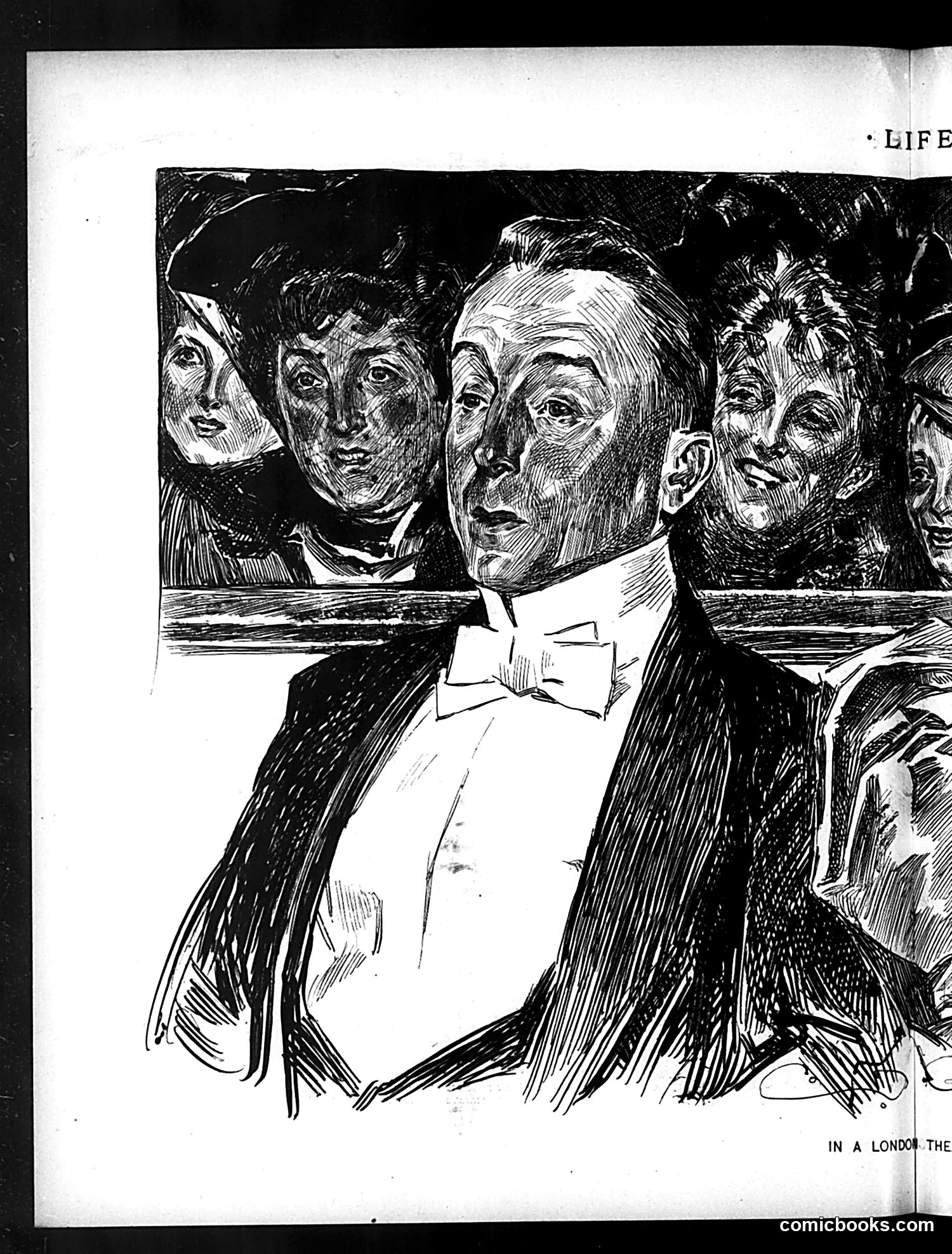
This appears to be a satirical illustration from Life magazine showing a formal social scene. The central figure is a distinguished gentleman in formal evening wear (tuxedo with bow tie), depicted in an expressive line-drawing style characteristic of early-to-mid 20th century satirical art. The caption text reads "IN A LONDON THE..." (incomplete in the visible portion). The surrounding faces in the background suggest this depicts a high-society or theatrical gathering, rendered with exaggerated, theatrical expressions typical of Life's social satire. The style and subject matter suggest commentary on upper-class pretension or social artifice, though without the complete caption text, the specific target of the satire remains unclear. The artist's signature appears in the lower right corner.
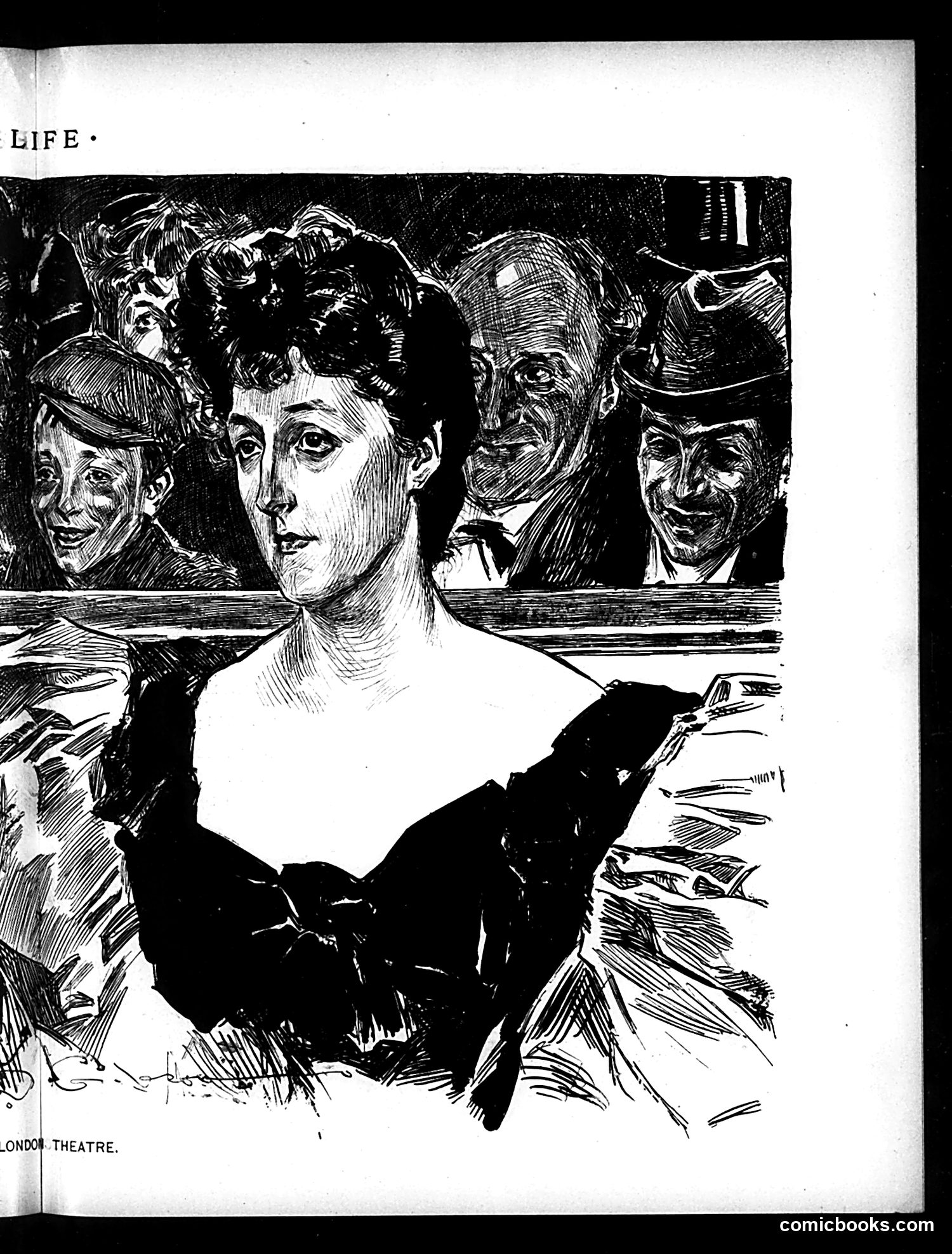
This appears to be a theatrical illustration from *Life* magazine labeled "London Theatre." The image shows a elegantly dressed woman in the foreground wearing a black off-shoulder gown, positioned prominently. Behind her are several male figures in formal attire (top hats, evening wear), rendered with exaggerated, caricatured features typical of satirical art. The composition suggests social commentary on London theater society—likely satirizing the dynamics between a central female figure and the men surrounding her. However, without clear identification of the specific individuals, play, or theatrical event being referenced, the precise target of the satire remains unclear. The style and technique are consistent with early-to-mid 20th century satirical illustration.
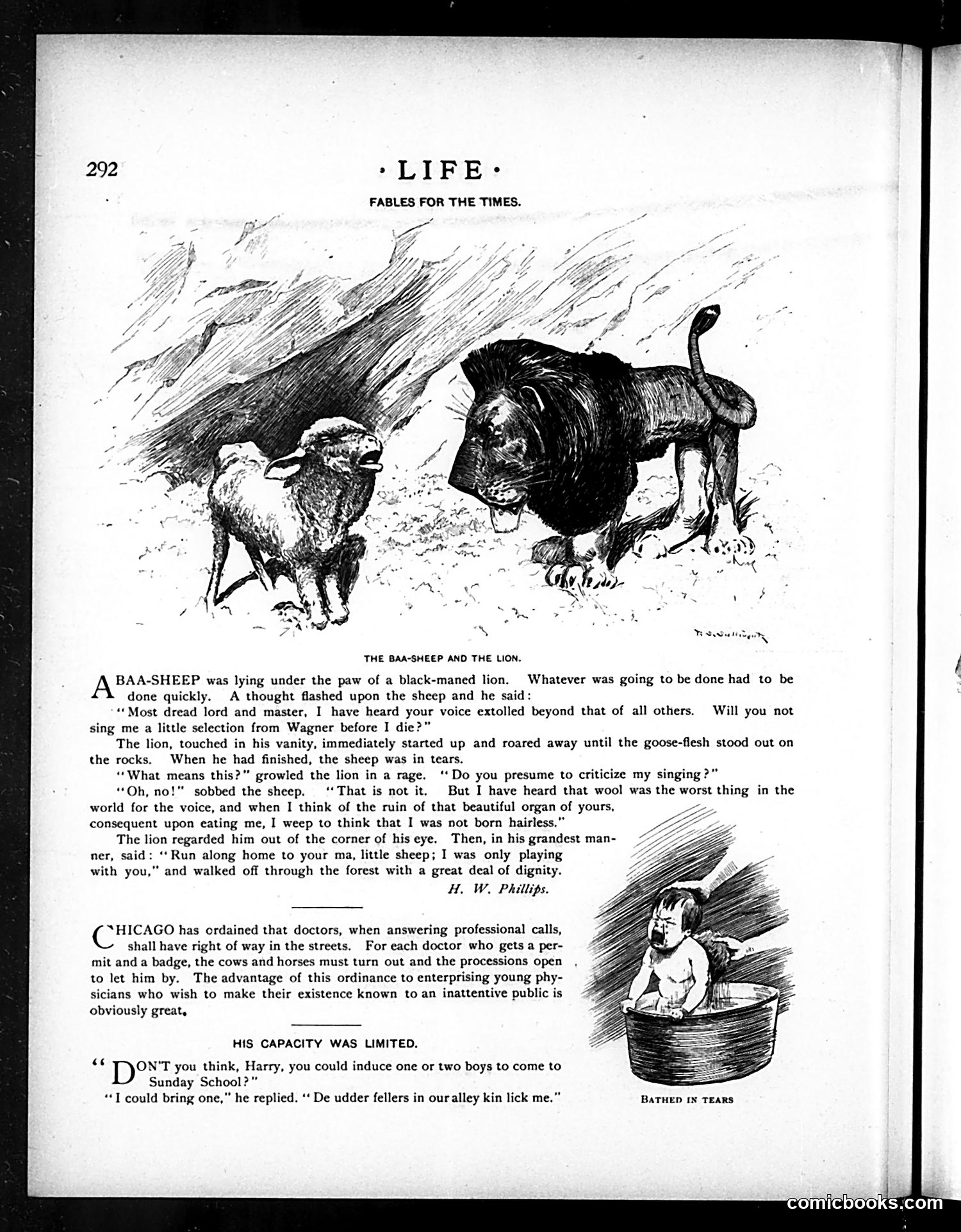
This page contains three satirical pieces from *Life* magazine's "Fables for the Times" section: **"The Baa-Sheep and the Lion"** is a moral fable where a clever sheep, facing death, flatters a lion into singing Wagner opera—then manipulates him by praising his voice while expressing fake concern that eating sheep would damage it. The lion, vain and gullible, lets the sheep go. The satire targets vanity and how flattery can disarm even the powerful. **The Chicago doctors' ordinance** piece mocks a real municipal rule giving physicians right-of-way in streets. The joke: this creates absurdly theatrical processions for "enterprising young physicians" seeking attention—satirizing both self-promotion and municipal overreach. **"His Capacity Was Limited"** is a dialect-humor joke where a boy can only recruit one schoolmate because the other neighborhood boys can physically beat him. The humor relies on period working-class stereotypes about street toughness and violence. The page reflects early 20th-century satirical style mixing fables, local news mockery, and humor that would now be considered socially insensitive.
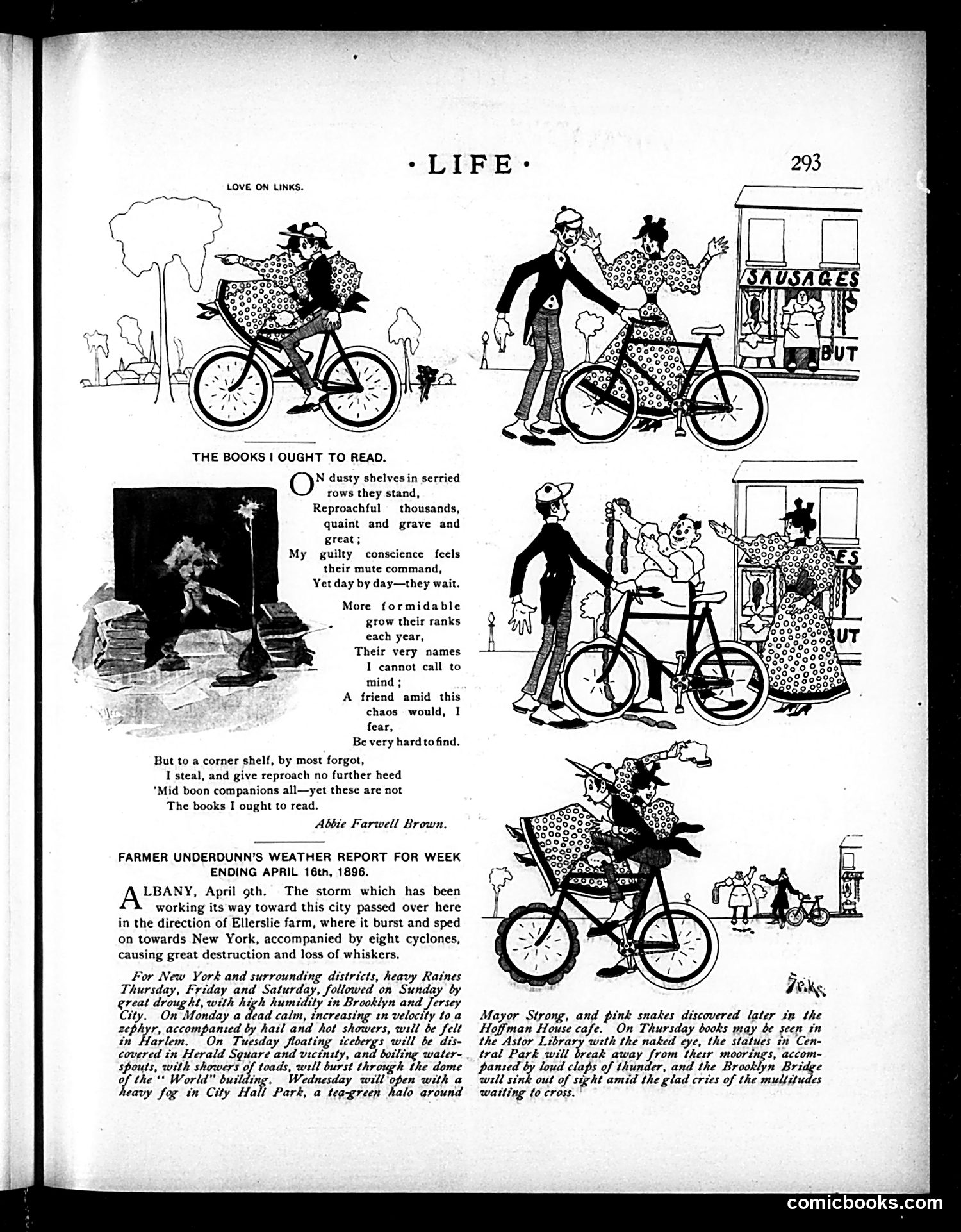
This page contains two satirical pieces mocking contemporary life: **"Love on Links"** (top): Cartoon series showing couples on bicycles near shops. The bicycle craze of the 1890s was transforming courtship and social customs. The humor lies in depicting bicycles as enabling romantic encounters in public spaces—a relatively scandalous development for the era, as it allowed unchaperoned young people mobility and independence. **"The Books I Ought to Read"** (middle): A poem lampooning educated guilt—the common middle-class anxiety of owning "important" unread books on dusty shelves, while actually preferring lighter entertainment. It satirizes pretentious self-improvement culture. **"Farmer Underdunn's Weather Report"** (bottom): Absurdist humor mocking New York City weather forecasts and urban life through impossible predictions (icebergs in Herald Square, toads from the sky). The final crack about the Brooklyn Bridge sinking "amid the glad cries of multitudes" is cynical social commentary on public frustration with the city.
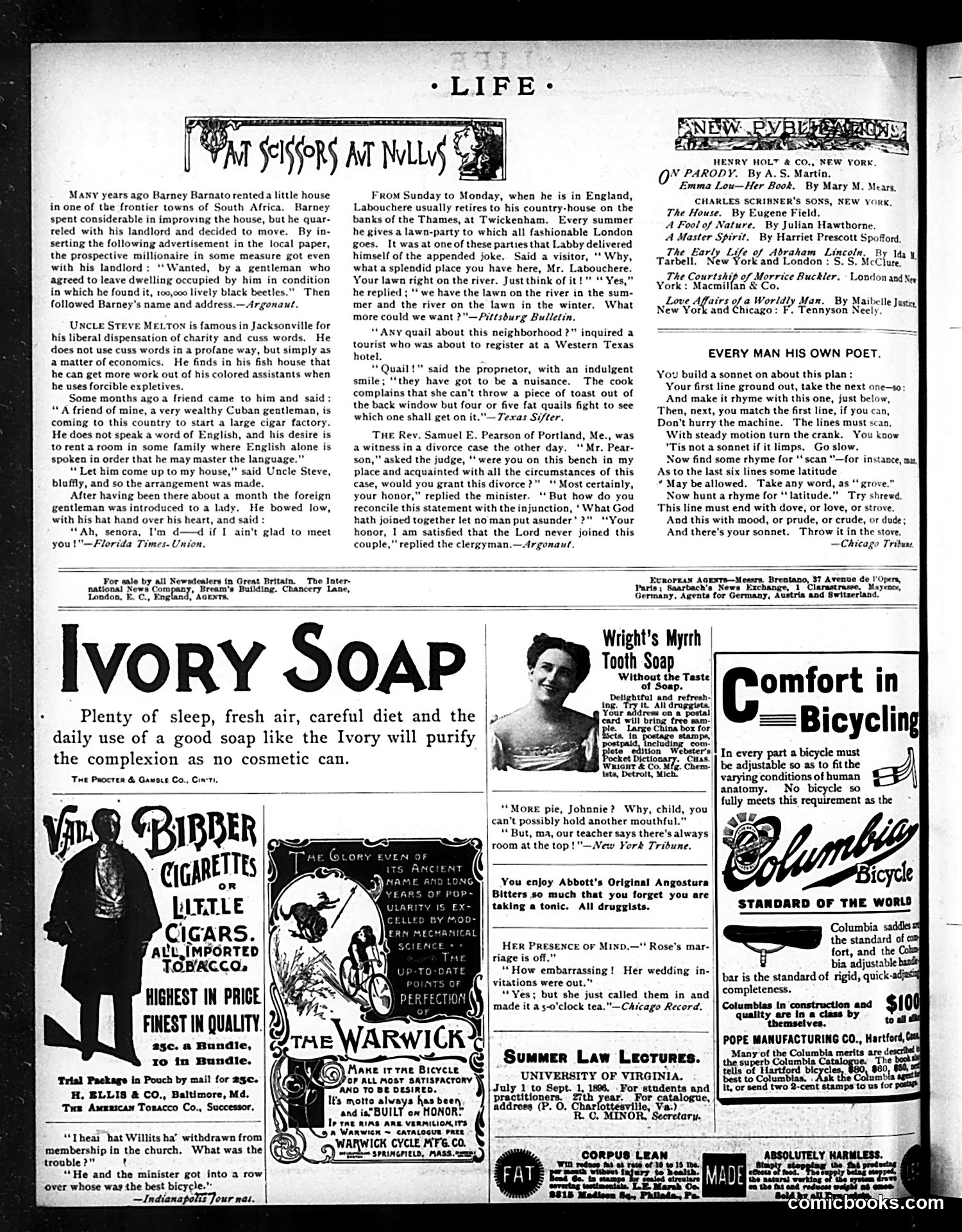
This page from *Life* magazine presents humorous anecdotes alongside period advertisements. The main content consists of brief comedic stories illustrating social situations: **Key Humor Pieces:** - A South African millionaire's revenge on his landlord through an absurd classified ad for "lively black beetles" - A Jacksonville businessman whose colorful language ironically teaches English to a Cuban visitor - A clergyman's candid testimony in a divorce case, suggesting the couple was never truly joined by God These anecdotes mock Victorian social pretenses, linguistic mishaps, and clerical hypocrisy through gentle satire. **Advertisements** dominate the lower half, hawking products typical of the era: Ivory Soap, Van Bibber Cigarettes, The Warwick bicycle, Wright's Myrrh Tooth Soap, and Columbia bicycles. The "Every Man His Own Poet" section offers humorous DIY sonnet-writing instructions, reflecting period literary culture. Overall, this represents *Life's* characteristic blend of social commentary and commercial content aimed at educated, middle-class readers.
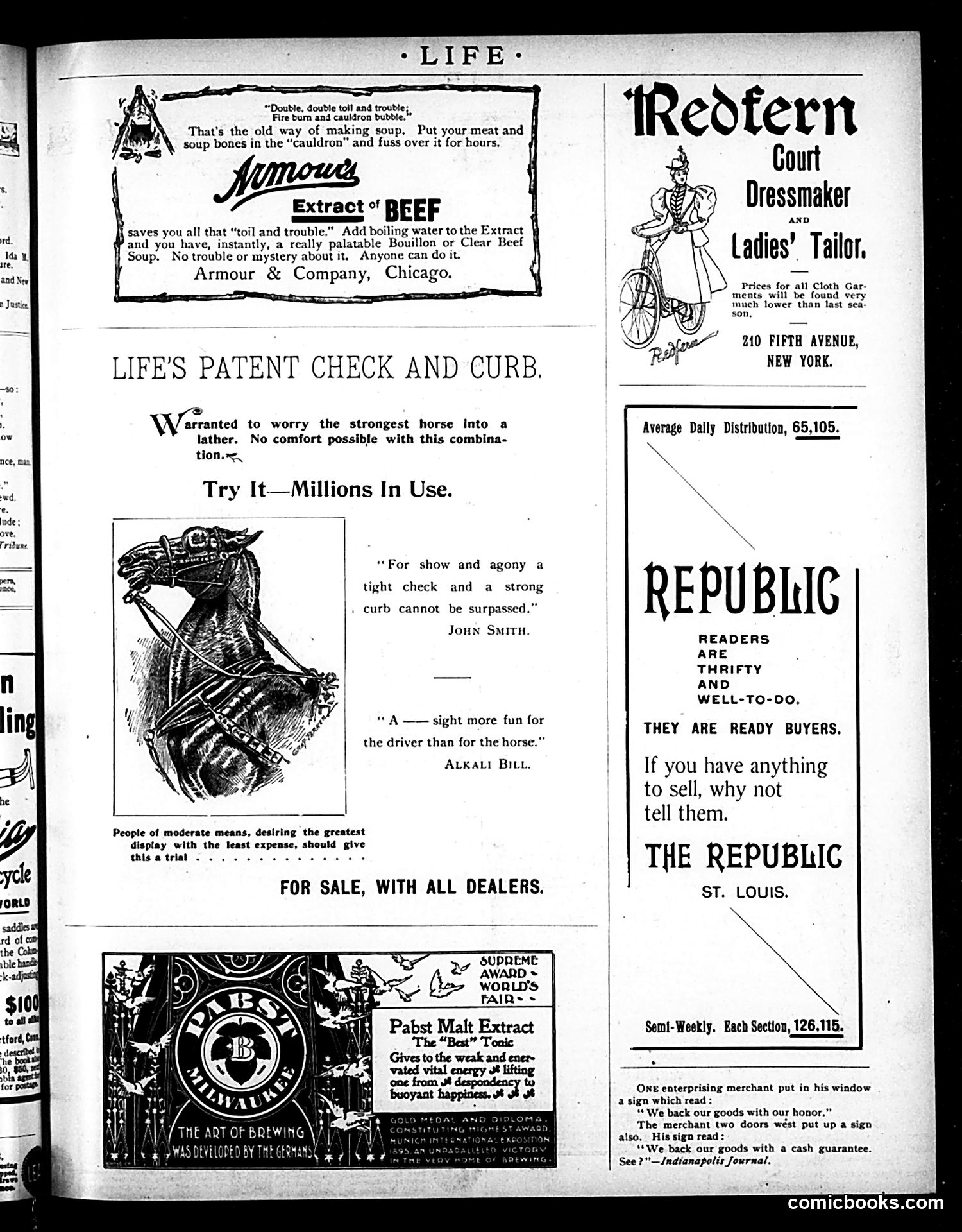
This is primarily an **advertising page** from Life magazine, not a political cartoon. The content consists of period product advertisements and promotional material. The main satirical element appears in "Life's Patent Check and Curb"—a mock advertisement for a horse restraint device. It's presented as if genuinely useful ("Warranted to worry the strongest horse into a lather"), but the quoted testimonials undercut this, with "Alkali Bill" admitting it's "more fun for the driver than for the horse." The satire mocks overly harsh horse equipment and perhaps the dubious marketing claims common in the era. The page also includes a humorous anecdote about two merchants' window signs—one claiming goods backed "with our honor," the other with "cash guarantee." This gentle satire suggests that financial backing is more trustworthy than appeals to honor, reflecting turn-of-the-century attitudes about commerce and credibility. The remaining content—beef extract, dressmaker services, newspaper promotions—represents standard period advertising with no apparent satirical intent.
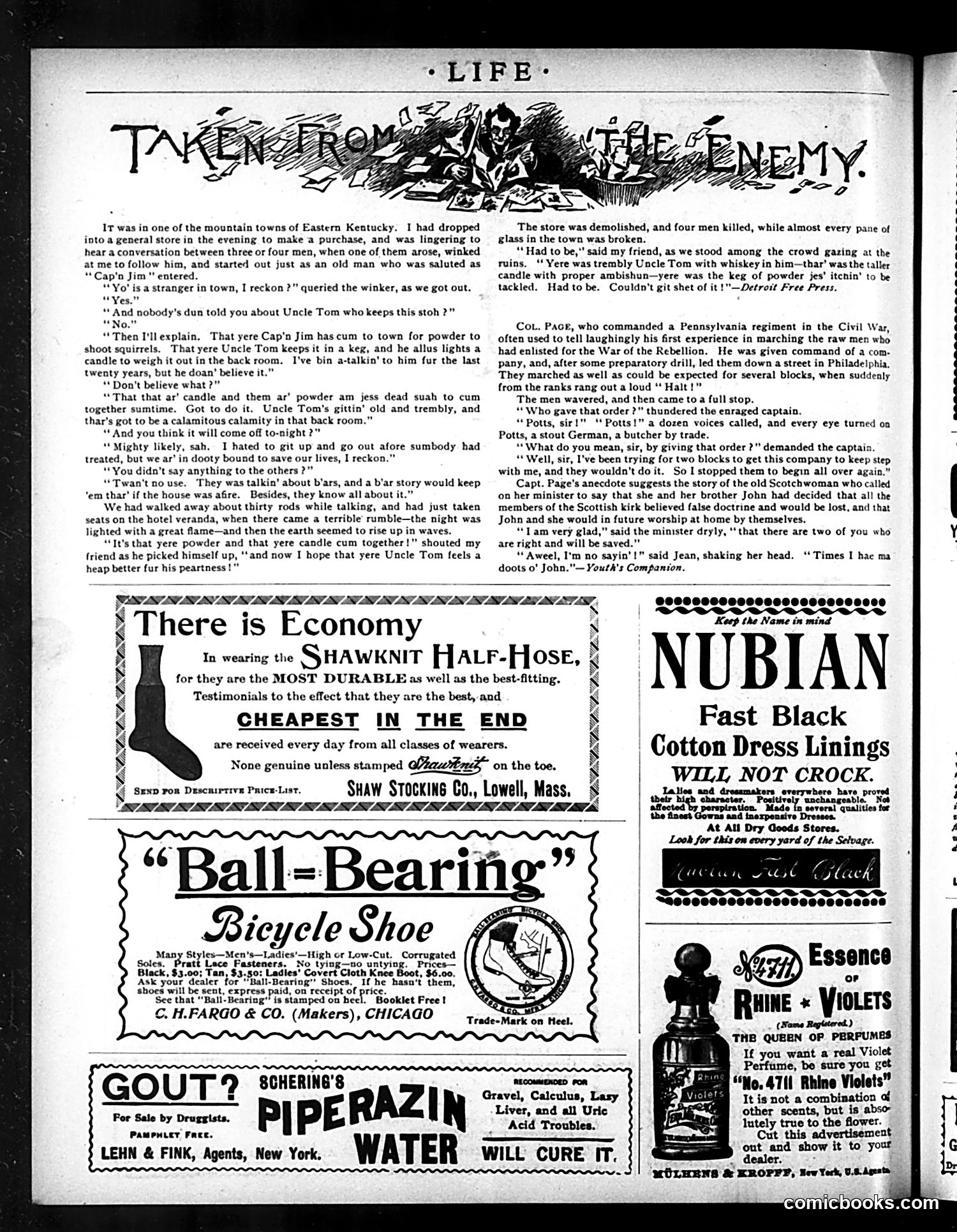
This page contains two humorous anecdotes satirizing human nature and social folly, typical of *Life* magazine's content circa early 1900s. **First story**: A Kentucky mountain man warns a stranger that an absent shopkeeper ("Uncle Tom") will inevitably cause a powder magazine explosion by lighting a candle near gunpowder. The joke satirizes fatalistic folk belief—the man is so convinced of inevitable disaster that he abandons the shop to "save our lives." When the explosion occurs as predicted, he treats it as natural law rather than negligence, saying "Had to be." **Second story**: A Civil War captain learns discipline from his soldier Potts, who halts the marching company on his own authority to restore order. The accompanying Scottish anecdote extends the satire: even the righteous doubt each other's salvation. Both mock human stubbornness, superstition, and the gap between expectation and responsibility. The page also contains period advertisements (Shawknit socks, bicycle shoes, patent medicines), typical of *Life*'s mixed content.
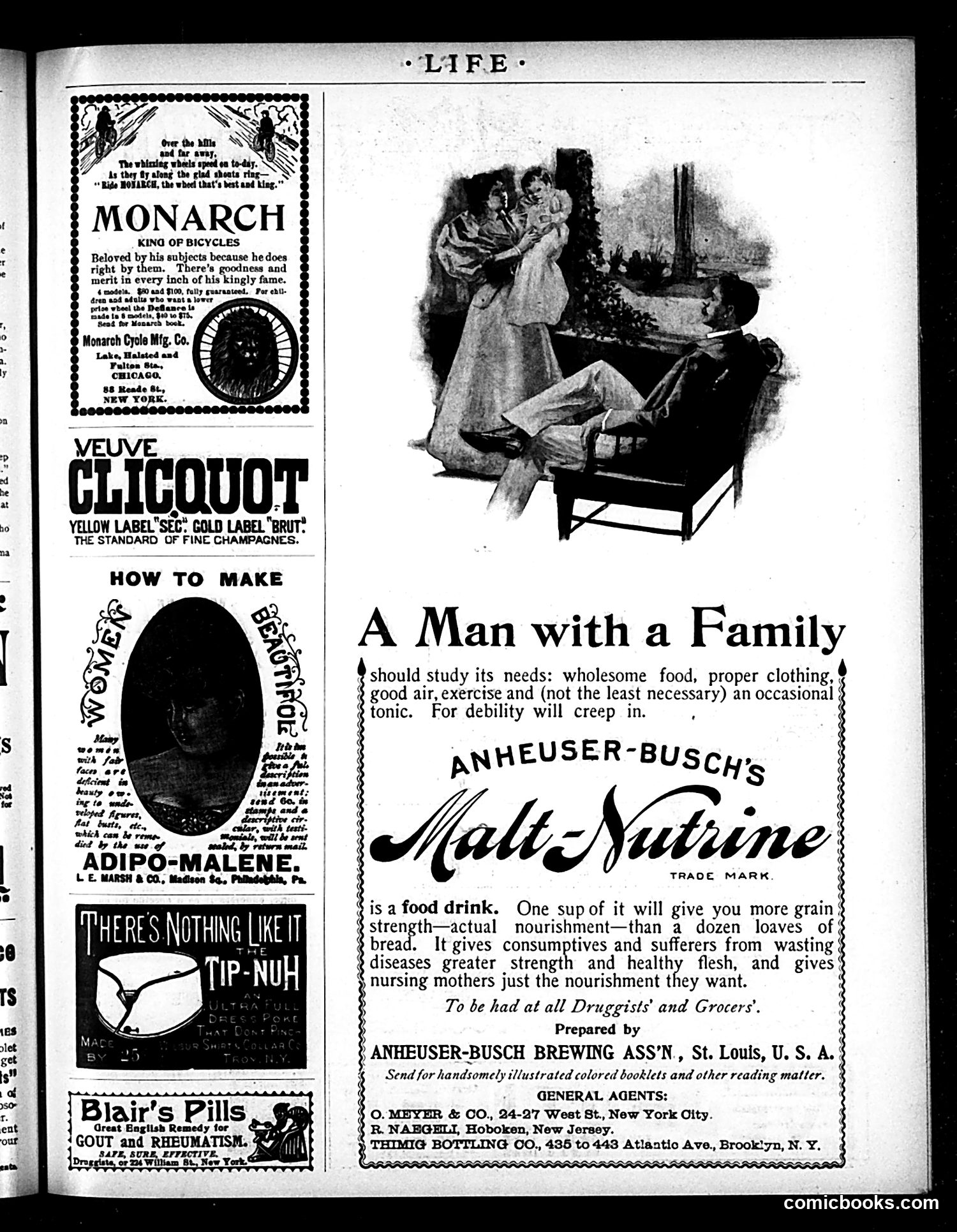
This page is primarily **advertising**, not satire or political commentary. It contains five product advertisements typical of early 1900s American magazines: 1. **Monarch Bicycles** — positioning the bike brand as reliable and worthy of loyalty ("king") 2. **Veuve Clicquot Champagne** — luxury product ad 3. **Acid-Malene** — a beauty/skin treatment product 4. **Tip-Nuh** — appears to be a food or digestive product 5. **Anheuser-Busch Malt Nutrine** — the largest ad, marketing malt beverage as medicinal nutrition for families, pregnant women, and the ill (note the era's looser claims about alcohol's health benefits) 6. **Blair's Pills** — patent medicine for gout and rheumatism The only illustrated content is a romantic domestic scene (man and woman) that accompanies the Malt Nutrine ad, reinforcing the "family health" marketing angle. There is **no political cartoon or satire** on this page—it's a standard commercial magazine page from the patent-medicine era.
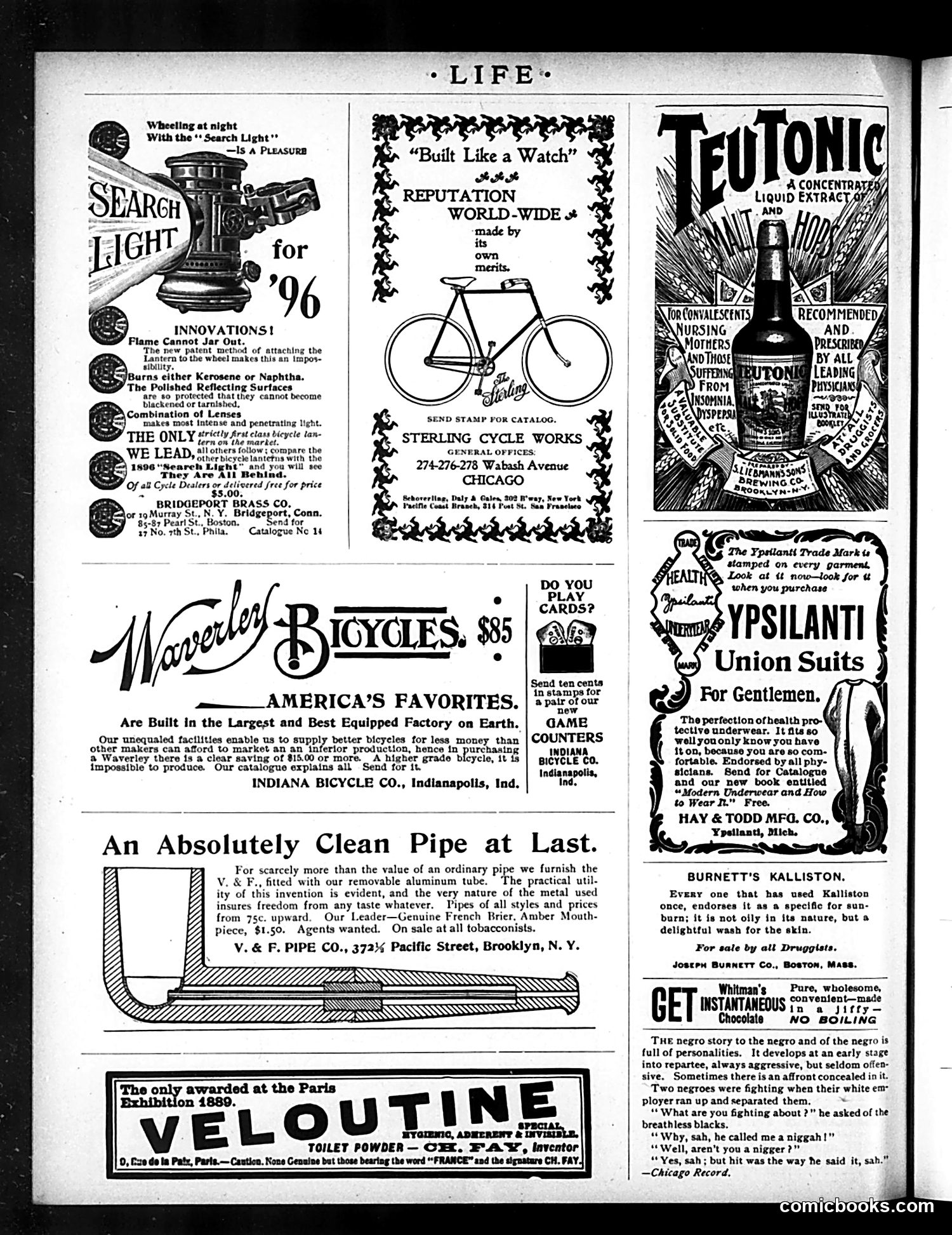
This is primarily an **advertising page** from Life magazine, not a political cartoon. The page contains multiple product advertisements typical of the 1890s (bicycles, underwear, pipes, toiletries). **Notable content:** At the bottom is a **brief anecdotal story** (labeled as from the Chicago Record) depicting two Black men in conflict. The "joke" relies on a racial slur and plays on the idea that offense comes from *tone* rather than the word itself. This reflects the casual racism of the 1890s era—such content was considered acceptable humor in mainstream publications. The remainder of the page advertises consumer goods: bicycles (Waverley, Sterling, Indiana brands), underwear (Ypsilanti Union Suits), smoking pipes, and various toiletries. These ads emphasize innovation and quality as selling points. **Historical context:** This snapshot shows how early Life combined satirical commentary with advertisements, while also revealing the normalized racism of the period—something modern readers would find deeply offensive.
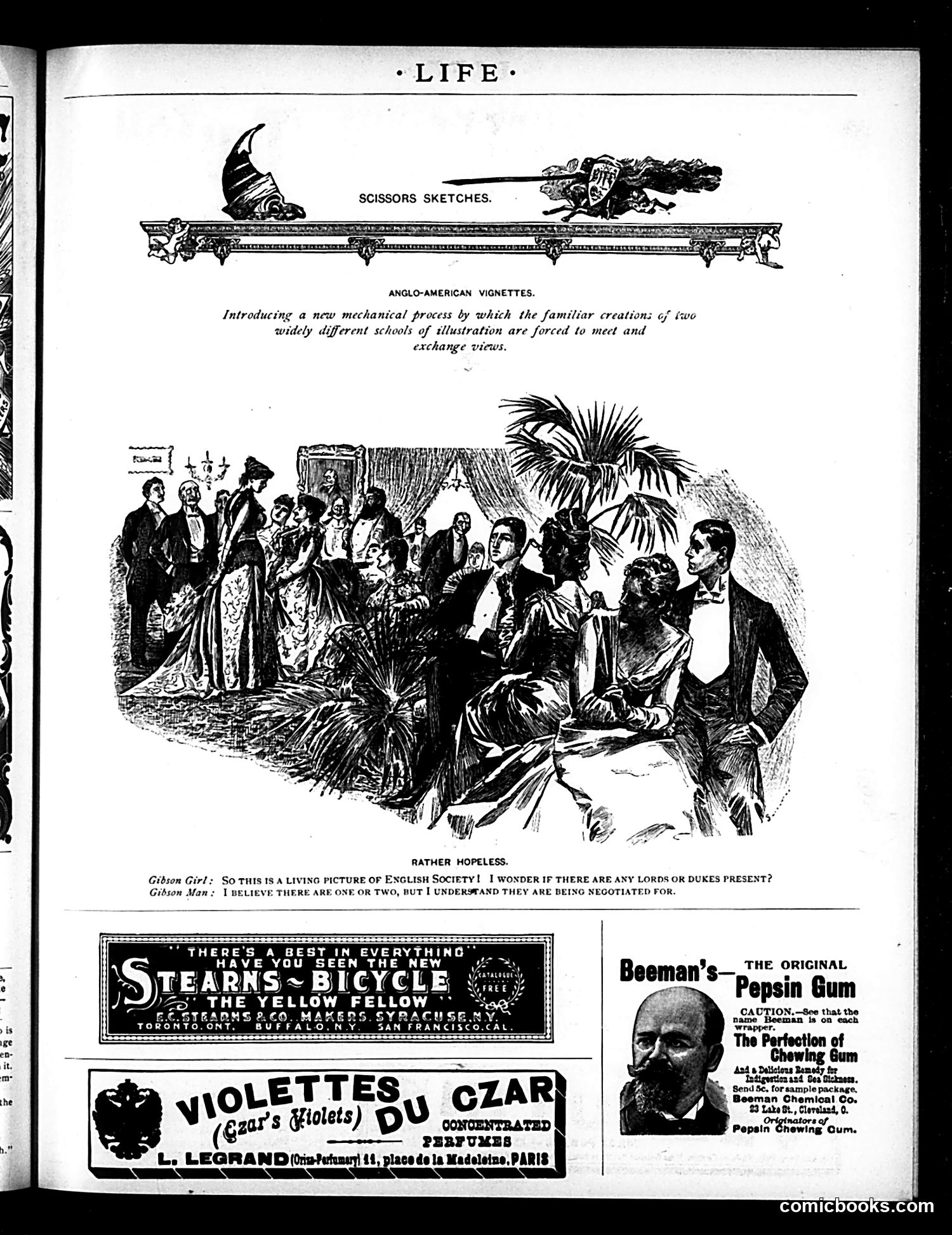
This cartoon satirizes the intersection of American and English high society through two iconic figures: the "Gibson Girl" (representing idealized American femininity and values) and the "Gibson Man" (American masculinity). The joke hinges on class anxiety: the Gibson Girl naively asks whether English lords or dukes are present at this "living picture of English society"—assuming aristocratic titles guarantee social substance. The Gibson Man's reply—that yes, there are one or two, "but I understand they are being negotiated for"—mocks English aristocracy as economically desperate and literally for sale. The satire reflects early 20th-century American attitudes toward old European nobility: that titled families, stripped of real power and money, were increasingly willing to marry wealthy Americans (particularly daughters of industrial magnates) to restore their fortunes. The implication is that English titles are commodities being "negotiated" rather than signs of genuine superiority.
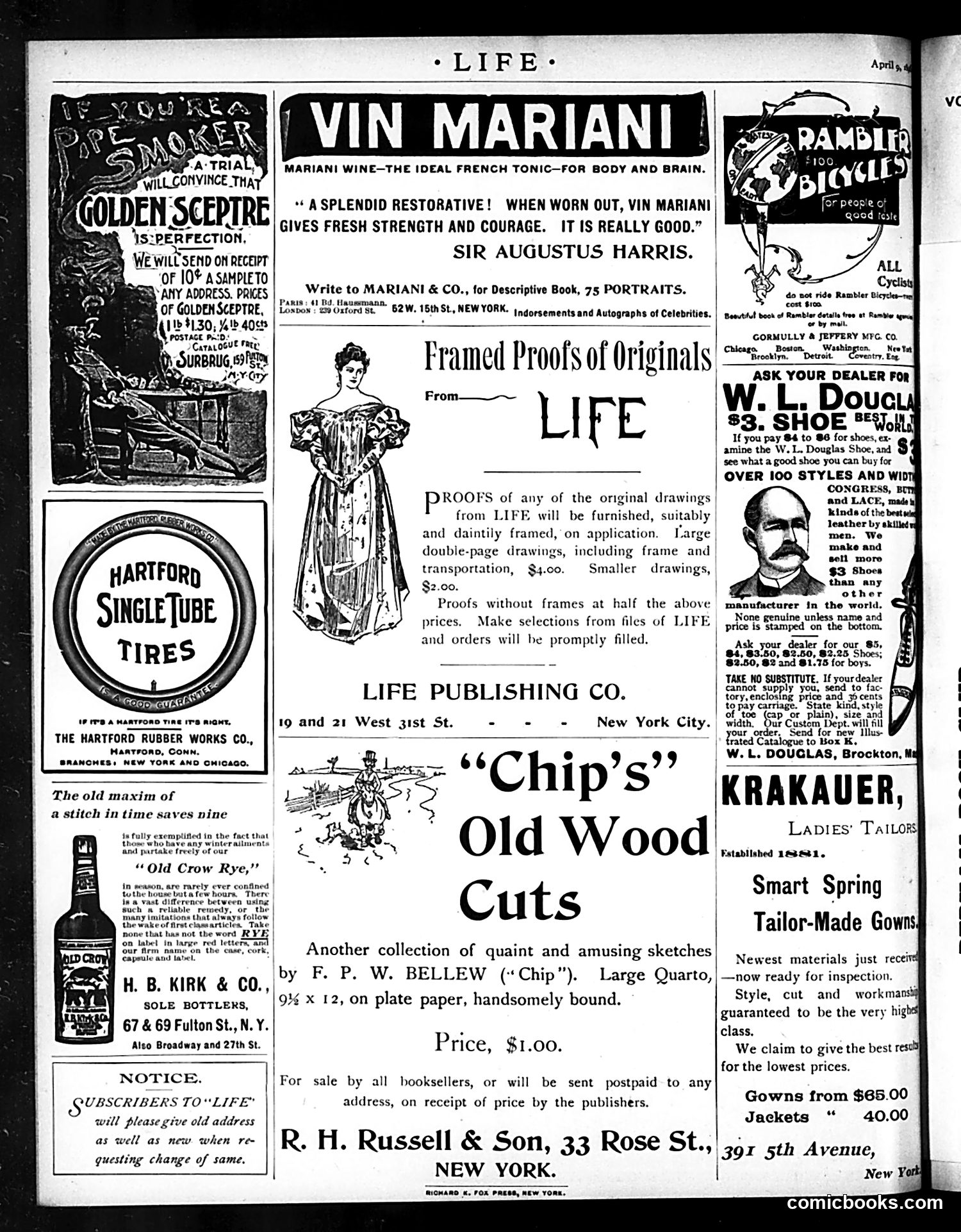
This page is primarily **advertising** from an early 1900s American magazine, with minimal editorial content. The main advertisements include: - **Vin Mariani**: A French wine tonic claiming to restore "strength and courage," endorsed by "Sir Augustus Harris." This product capitalized on widespread patent medicine marketing of the era—often containing alcohol and unregulated ingredients. - **W.L. Douglas Shoes**: Emphasizing American manufacturing and affordability across multiple price points ($1.75–$4). - **Hartford Single Tube Tires** and **Old Crow Rye**: Typical period products marketed for reliability and health benefits. The page also advertises **"Chip's Old Wood Cuts,"** a collection of sketches by F.P.W. Bellew, and offers **framed proofs of original Life drawings** for purchase. The single cartoon visible—untitled—depicts a figure riding a bicycle or similar vehicle in a whimsical sketch style typical of Life's satirical humor, though the specific joke or reference is unclear without additional context.