
Life, 1896-04-09 · page 4 of 20
Life — April 9, 1896 — page 4: what you’re looking at
What you’re looking at
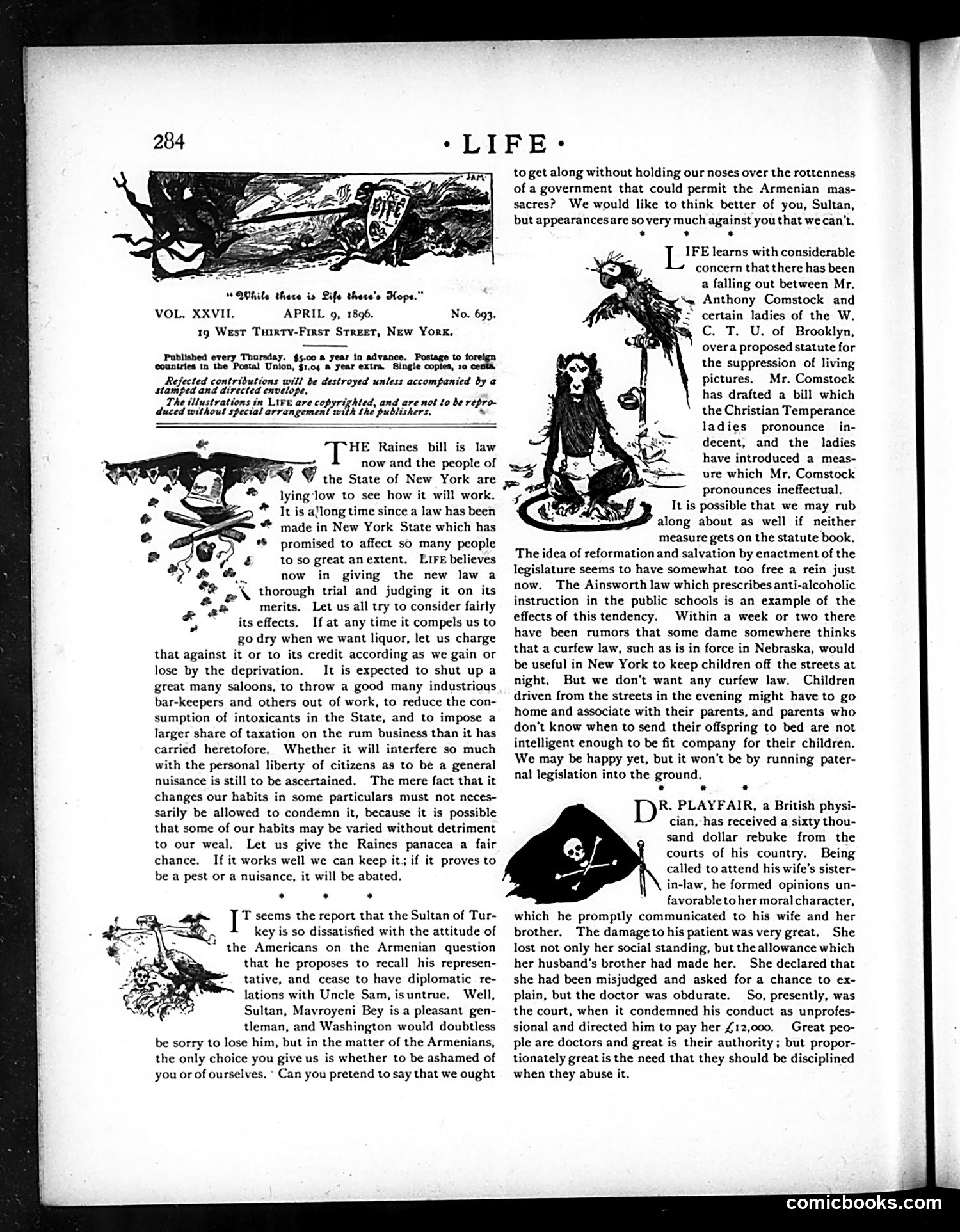
This page contains editorial commentary on several contemporary issues: **The Raines Law**: The text discusses New York's newly enacted liquor regulation, expressing skepticism about its effectiveness. Life questions whether the law will achieve its stated goals of reducing bar-keeper misconduct and taxation issues. **Armenian Question**: The editorial addresses the Sultan of Turkey's dismissal of American diplomatic pressure regarding Armenian treatment. Life criticizes both the Sultan's position and American hypocrisy—arguing the U.S. cannot credibly pressure Turkey while tolerating its own injustices. **Dr. Playfair Case**: A British physician received a £60,000 court judgment after his wife's brother made damaging claims about his character. Life uses this to critique doctors who abuse their professional authority and argues they need institutional discipline. The illustrations are decorative satirical vignettes rather than specific political caricatures.
📄 Transcribed text from this page (OCR, searchable)
Machine-transcribed from the original scan — historical spelling and the odd misread are preserved.
ccs LIFE “While there is Life there's Hope.” VOL. XXVII. APRIL 9, 1896. No. 693. 1g West THIRTY-First STREET, NEw York. Published every Thurstay. $5.00 a year in advance. Postage to countries In the Postal Union, $1.04 @ year extra Single copies, 10 Rejected contributions will be destroyed unless accompanied by a thy ‘and directed envelope. bas Md The illustrations in Live are copyrighted, and are not to be refro- duced without special arrangement with the subiiehers. HE Raines bill is law now and the people of YG the State of New York are lyinglow to see how it will work. It is a!long time since a law has been made in New York State which has promised to affect so many people to so great an extent. Eire believes now in giving the new law a ev thorough trial and judging it on its a merits. Let us all try to consider fairly its effects. If at any time it compels us to go dry when we want liquor, let us charge that against it or to its credit according as we gain or lose by the deprivation. It is expected to shut up a great many saloons, to throw a good many industrious bar-keepers and others out of work, to reduce the con- sumption of intoxicants in the State, and to impose a larger share of taxation on the rum business than it has carried heretofore. Whether it will interfere so much with the personal liberty of citizens as to be a general nuisance is still to be ascertained. The mere fact that it changes our habits in some particulars must not neces- sarily be allowed to condemn it, because it is possible that some of our habits may be varied without detriment to our weal. Let us give the Raines panacea a fair chance, If it works well we can keep it, if it proves to be a pest or a nuisance, it will be abated. & J T seems the report that the Sultan of Tur- =, key is so dissatisfied with the attitude of the Americans on the Armenian question that he proposes to recall his represen- tative, and cease to have diplomatic re- lations with Uncle Sam, isuntrue. Well, Sultan, Mavroyeni Bey is a pleasant gen- tleman, and Washington would doubtless be sorry to lose him, but in the matter of the Armenians, the only choice you give us is whether to be ashamed of you or of ourselves. * Can you pretend to say that we ought to get along without holding our noses over the rottenness of a government that could permit the Armenian mas- sacres? We would like to think better of you, Sultan, but appearancesare so very much against you that wecan't. . . * IFE learns with considerable concern that there has been a falling out between Mr. Anthony Comstock and certain ladies of the W. C. T. U. of Brooklyn, overa proposed statute for the suppression of living pictures. Mr. Comstock has drafted a bill which the Christian Temperance ladies pronounce in- decent, and the ladies have introduced a meas- ure which Mr. Comstock pronounces ineffectual. It is possible that we may rub along about as well if neither measure gets on the statute book. The idea of reformation and salvation by enactment of the legislature seems to have somewhat too free a rein just now. The Ainsworth law which prescribes anti-alcoholic instruction in the public schools is an example of the effects of this tendency. Within a week or two there have been rumors that some dame somewhere thinks that a curfew law, such as is in force in Nebraska, would be useful in New York to keep children off the streets at night. But we don’t want any curfew law. Children driven from the streets in the evening might have to go home and associate with their parents, and parents who don’t know when to send their offspring to bed are not intelligent enough to be fit company for their children. We may be happy yet, but it won't be by running pater- nal legislation into the ground. * ° * R. PLAYFAIR, a British physi- cian, has received a sixty thou- sand dollar rebuke from the courts of his country. Being called to attend his wife's sister- in-law, he formed opinions un- favorable to her moral character, which he promptly communicated to his wife and her brother. The damage to his patient was very great. She lost not only her social standing, but the allowance which her husband's brother had made her. She declared that she had been misjudged and asked for a chance to ex- plain, but the doctor was obdurate. So, presently, was the court, when it condemned his conduct as unprofes- sional and directed him to pay her £12,000. Great peo- ple are doctors and great is their authority; but propor- tionately great is the need that they should be disciplined when they abuse it. comicbooks.com