
Life, 1896-04-09 · page 12 of 20
Life — April 9, 1896 — page 12: what you’re looking at
What you’re looking at
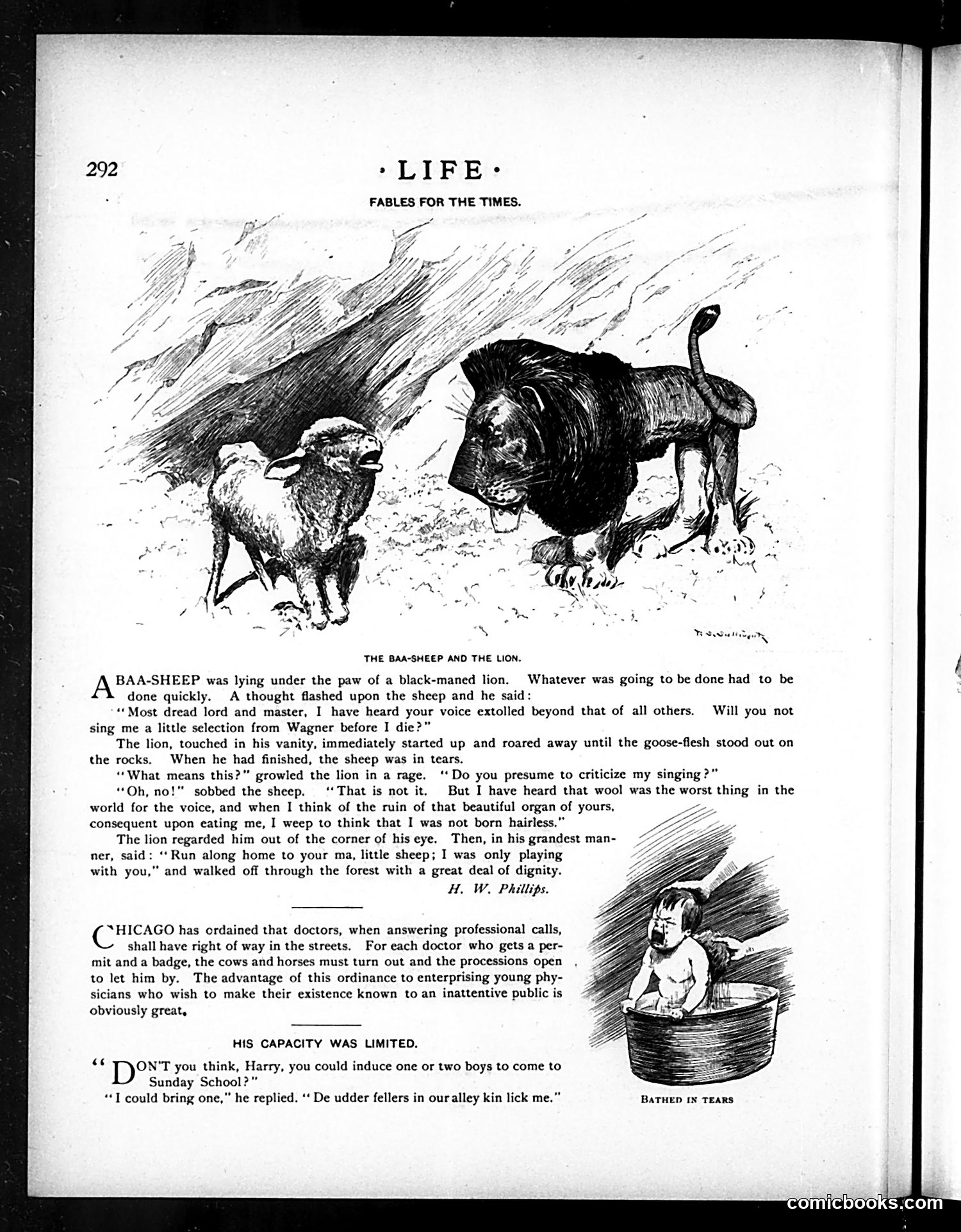
This page contains three satirical pieces from *Life* magazine's "Fables for the Times" section: **"The Baa-Sheep and the Lion"** is a moral fable where a clever sheep, facing death, flatters a lion into singing Wagner opera—then manipulates him by praising his voice while expressing fake concern that eating sheep would damage it. The lion, vain and gullible, lets the sheep go. The satire targets vanity and how flattery can disarm even the powerful. **The Chicago doctors' ordinance** piece mocks a real municipal rule giving physicians right-of-way in streets. The joke: this creates absurdly theatrical processions for "enterprising young physicians" seeking attention—satirizing both self-promotion and municipal overreach. **"His Capacity Was Limited"** is a dialect-humor joke where a boy can only recruit one schoolmate because the other neighborhood boys can physically beat him. The humor relies on period working-class stereotypes about street toughness and violence. The page reflects early 20th-century satirical style mixing fables, local news mockery, and humor that would now be considered socially insensitive.
📄 Transcribed text from this page (OCR, searchable)
Machine-transcribed from the original scan — historical spelling and the odd misread are preserved.
»>LIFE-: FABLES FOR THE TIMES. THE BAA-SHEEP AND THE LION. A BASSHEEL was lying under the paw of a black-maned lion. Whatever was going to be done had to be done quickly. A thought flashed upon the sheep and he said: “Most dread lord and master, I have heard your voice extolled beyond that of all others. Will you not sing me a little selection from Wagner before I die?” The lion, touched in his vanity, immediately started up and roared away until the goose-flesh stood out on the rocks. When he had finished, the sheep was in tears. “What means this?” growled the lion in a rage. ‘‘Do you presume to criticize my singing?” “Oh, no!" sobbed the sheep. ‘‘That is not it. But I have heard that wool was the worst thing in the world for the voice, and when I think of the ruin of that beautiful organ of yours, eo consequent upon eating me, I weep to think that I was not born hairless.” Z The lion regarded him out of the corner of his eye. Then, in his grandest man- ner, said: ‘‘Run along home to your ma, little sheep; I was only playing with you,” and walked off through the forest with a great deal of dignity. H.W. Phillips. *“HICAGO has ordained that doctors, when answering professional calls, shall have right of way in the streets. For each doctor who gets a per- mit and a badge, the cows and horses must turn out and the processions open to let him by. The advantage of this ordinance to enterprising young phy- sicians who wish to make their existence known to an inattentive public is obviously great, HIS CAPACITY WAS LIMITED. <s ON'T you think, Harry, you could induce one or two boys to come to Sunday School?” “I could bring one,” he replied. ‘‘ De udder fellers in our alley kin lick me.” BATHED IN TEARS