
Life, 1896-04-09 · page 8 of 20
Life — April 9, 1896 — page 8: what you’re looking at
What you’re looking at
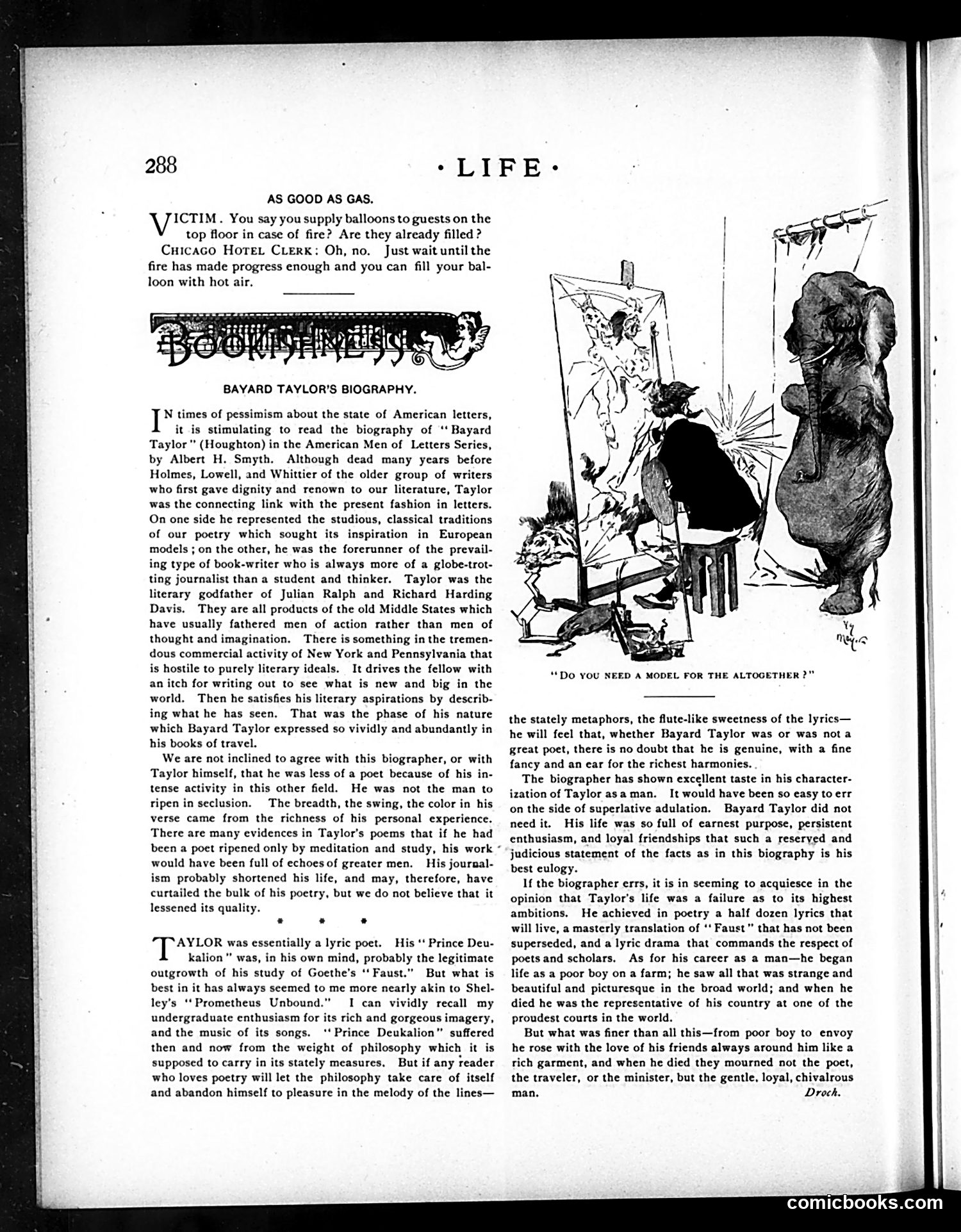
This page contains two distinct items: **Top section ("As Good as Gas"):** A brief comedic exchange between a hotel guest worried about fire safety and a Chicago Hotel clerk who suggests waiting for an actual fire to fill balloons with hot air—a pun on the clerk's own verbose, unhelpful response. **Main content ("Bayard Taylor's Biography"):** A biographical essay about 19th-century American writer Bayard Taylor, illustrated with a drawing titled "Do You Need a Model for the Altogether?" (depicting an artist's studio scene with a model). The essay discusses Taylor's literary significance, his role bridging classical and modern American letters, and his career as poet, traveler, and writer. The illustration appears to be a separate satirical cartoon about artists and models, unrelated to the biographical text above it.
📄 Transcribed text from this page (OCR, searchable)
Machine-transcribed from the original scan — historical spelling and the odd misread are preserved.
288 AS GOOD AS GAS. Vyicum . You say you supply balloons to guests on the top floor in case of fire? Are they already filled ? Cuicaco HoTer CLERK: Oh, no. Just wait until the fire has made progress enough and you can fill your bal- loon with hot air. BAYARD TAYLOR'S BIOGRAPHY. N times of pessimism about the state of American letters, it is stimulating to read the biography of ‘‘ Bayard Taylor” (Houghton) in the American Men of Letters Series, by Albert H. Smyth. Although dead many years before Holmes, Lowell, and Whittier of the older group of writers who first gave dignity and renown to our literature, Taylor was the connecting link with the present fashion in letters. On one side he represented the studious, classical traditions of our poetry which sought its inspiration in European models ; on the other, he was the forerunner of the prevail- ing type of book-writer who is always more of a globe-trot- ting journalist than a student and thinker. Taylor was the literary godfather of Julian Ralph and Richard Harding Davis. They are all products of the old Middle States which have usually fathered men of action rather than men of thought and imagination. There is something in the tremen- dous commercial activity of New York and Pennsylvania that is hostile to purely literary ideals. It drives the fellow with an itch for writing out to see what is new and big in the world. Then he satisfies his literary aspirations by describ- ing what he has seen. That was the phase of his nature which Bayard Taylor expressed so vividly and abundantly in his books of travel. We are not inclined to agree with this biographer, or with Taylor himself, that he was less of a poet because of his tense activity in this other field. He was not the man to ripen in seclusion. The breadth, the swing, the color in his verse came from the richness of his personal experience. There are many evidences in Taylor's poems that if he had been a poet ripened only by meditation and study, his work ° would have been full of echoes of greater men. His journal- ism probably shortened his life, and may, therefore, have curtailed the bulk of his poetry, but we do not believe that it lessened its quality. * * AYLOR was essentially a lyric poet. His ‘‘ Prince Deu- kalion” was, in his own mind, probably the legitimate outgrowth of his study of Goethe's ‘‘ Faust.” But what is best in it has always seemed to me more nearly akin to Shel- ley’s ‘Prometheus Unbound.” I can vividly recall my undergraduate enthusiasm for its rich and gorgeous imagery, and the music of its songs. ‘‘ Prince Deukalion” suffered then and now from the weight of philosophy which it is supposed to carry in its stately measures. But if any reader who loves poetry will let the philosophy take care of itself and abandon himself to pleasure in the melody of the lines— *LIFE-: “*Do YOU NEED A MODEL FOR THE ALTOGETHER ?" the stately metaphors, the flute-like sweetness of the lyrics— he will feel that, whether Bayard Taylor was or was nota great poet, there is no doubt that he is genuine, with a fine fancy and an ear for the richest harmonies. The biographer has shown excellent taste in his character- ization of Taylor asa man. It would have been so easy to err on the side of superlative adulation. Bayard Taylor did not need it. His life was so full of earnest purpose, persistent enthusiasm, and loyal friendships that such a reseryed and judicious statement of the facts as in this biography is his best eulogy. If the biographer errs, it is in seeming to acquiesce in the opinion that Taylor's life was a failure as to its highest ambitions. He achieved in poetry a half dozen lyrics that will live, a masterly translation of ‘‘ Faust” that has not been superseded, and a lyric drama that commands the respect of poets and scholars. As for his career as a man—he began life as a poor boy on a farm; he saw all that was strange and beautiful and picturesque in the broad world; and when he died he was the representative of his country at one of the proudest courts in the world. But what was finer than all this—from poor boy to envoy he rose with the love of his friends always around him like a rich garment, and when he died they mourned not the poet, the traveler, or the minister, but the gentle, loyal, chivalrous man, Droch. comicbooks.com