
A complete issue · 20 pages · 1896
Life — February 20, 1896
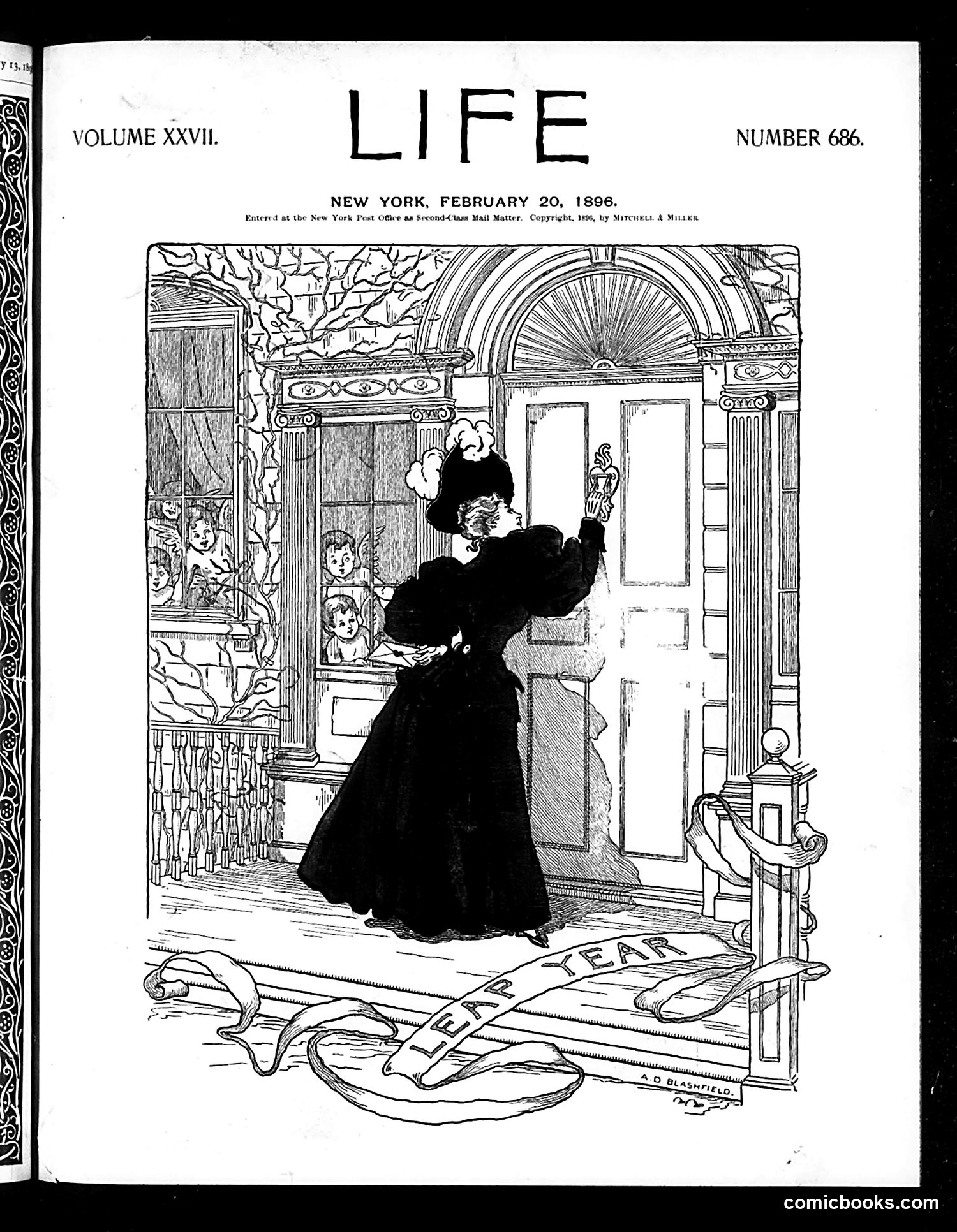
This illustration depicts a well-dressed woman in an elegant interior, gesturing dramatically toward children visible through a window. The ribbon at the bottom reads "NEW FEAR," suggesting contemporary anxiety about something. The cartoon likely satirizes late-Victorian concerns about childcare, education, or domestic life. The woman's theatrical pose and the emphasis on observing children suggests commentary on parenting anxieties or changing social roles. The "new fear" reference indicates this addresses an emerging cultural worry of the 1890s—possibly related to education standards, child labor, or evolving expectations for mothers. Without additional context text, the specific social concern remains unclear, though the image captures period anxieties about childhood and domestic responsibility that preoccupied the era.
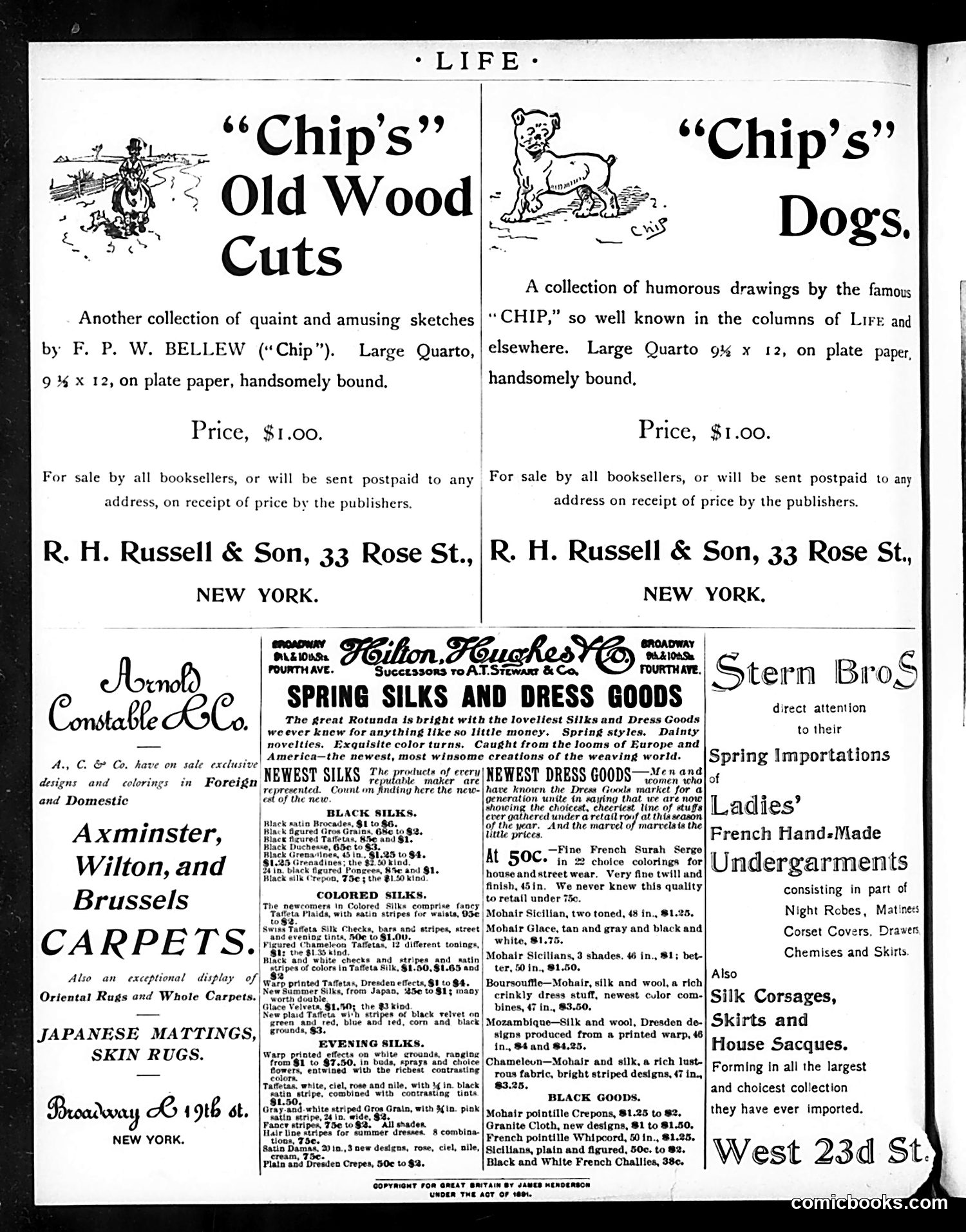
This page is primarily **advertising**, not editorial content or political cartoons. It features two book advertisements for collections by "Chip" (F. P. W. Bellew), a cartoonist known for humorous drawings in *Life* magazine. The books—"Chip's Old Wood Cuts" and "Chip's Dogs"—are priced at $1.00 each and published by R. H. Russell & Son in New York. The remaining advertisements promote various consumer goods: carpets, silks, dress goods, and ladies' undergarments from retailers like Arnold Constable and Stern Bros. The small dog illustration accompanying "Chip's Dogs" is likely a sample of Bellew's cartoon style rather than political commentary. This appears to be from the early 1900s based on typography and product offerings.
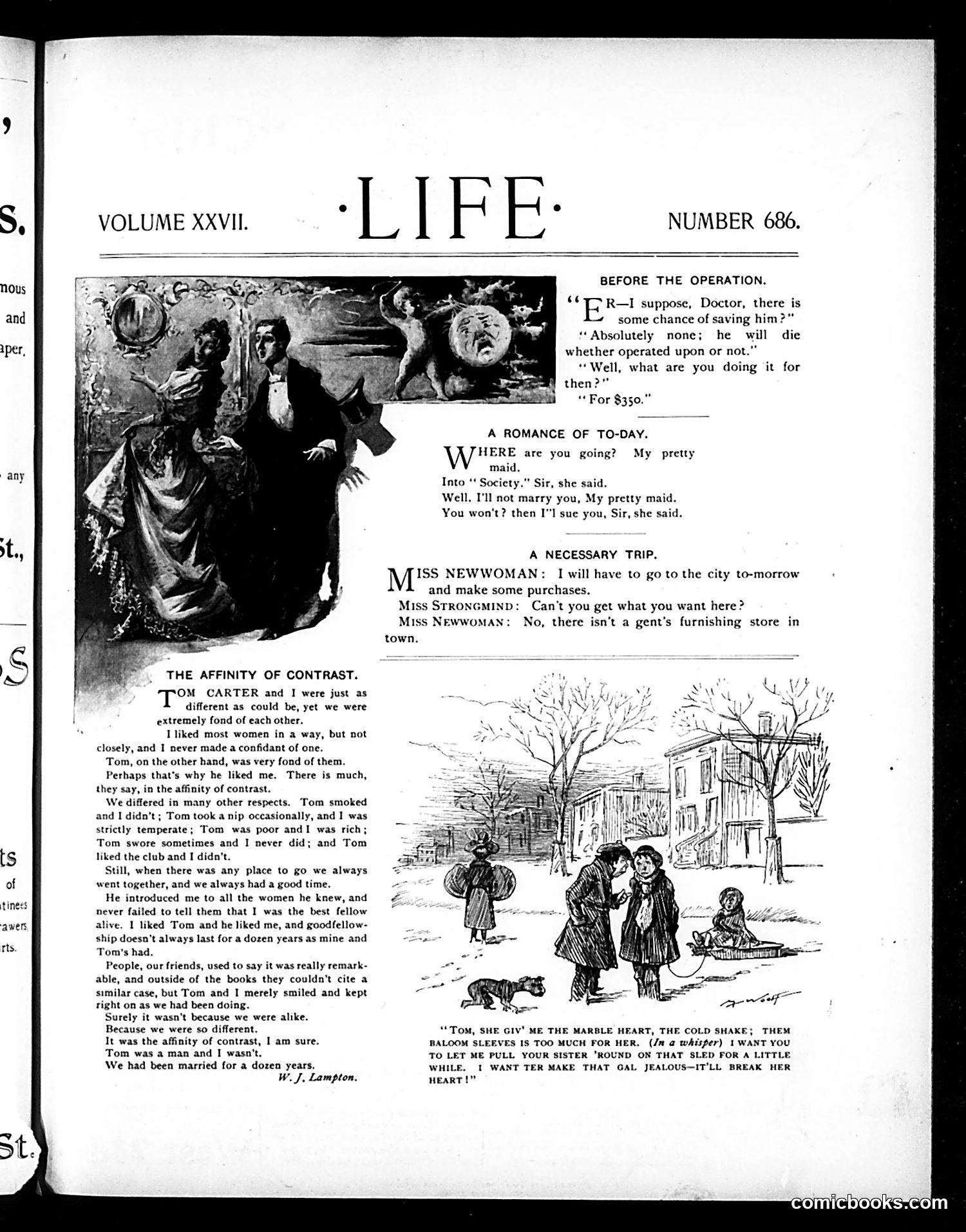
This page from *Life* magazine (Volume XXVII, Number 686) contains several short humorous pieces rather than political cartoons: 1. **"Before the Operation"** - A joke about a doctor charging $350 for a hopeless surgery. 2. **"A Romance of To-Day"** - A brief dialogue about a woman rejecting marriage. 3. **"A Necessary Trip"** - Miss Newwoman needs city shopping; Miss Strongmind notes there's no men's furnishing store in town—likely satirizing early 20th-century women's independence and changing social roles. 4. **"The Affinity of Contrast"** - A longer piece by W.J. Lampton describing how he and his wife Tom differed greatly yet complemented each other—a commentary on marital dynamics. The sketch below illustrates domestic or rural life. The content reflects *Life*'s satirical focus on contemporary social customs and relationships.
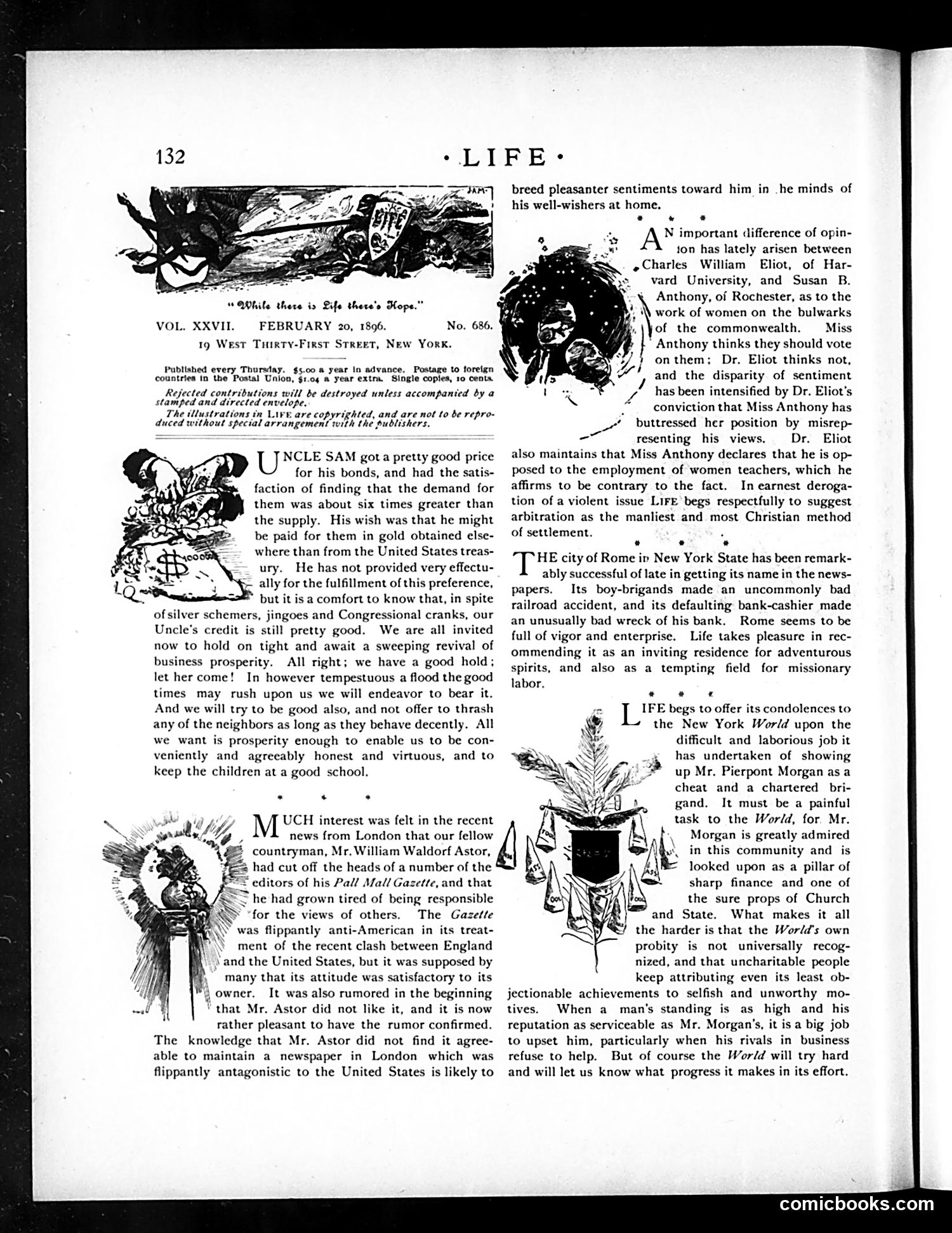
This page contains editorial commentary rather than cartoons. The main content discusses: 1. **Uncle Sam's finances**: A section mocking Uncle Sam for selling bonds at poor prices, criticizing Congressional spending and "jingoes" while hoping for economic revival. 2. **William Waldorf Astor controversy**: The editors note Astor cut off editors of the *Pall Mall Gazette* after they criticized recent England-US tensions. Life finds it ironic Astor maintains an anti-American London newspaper while being American—suggesting disloyalty. 3. **Pierpont Morgan criticism**: Life attacks Morgan's character, noting even his high reputation makes accusations of dishonesty particularly damaging to public trust. The page uses satirical commentary to critique wealthy American figures and financial practices of the 1890s.
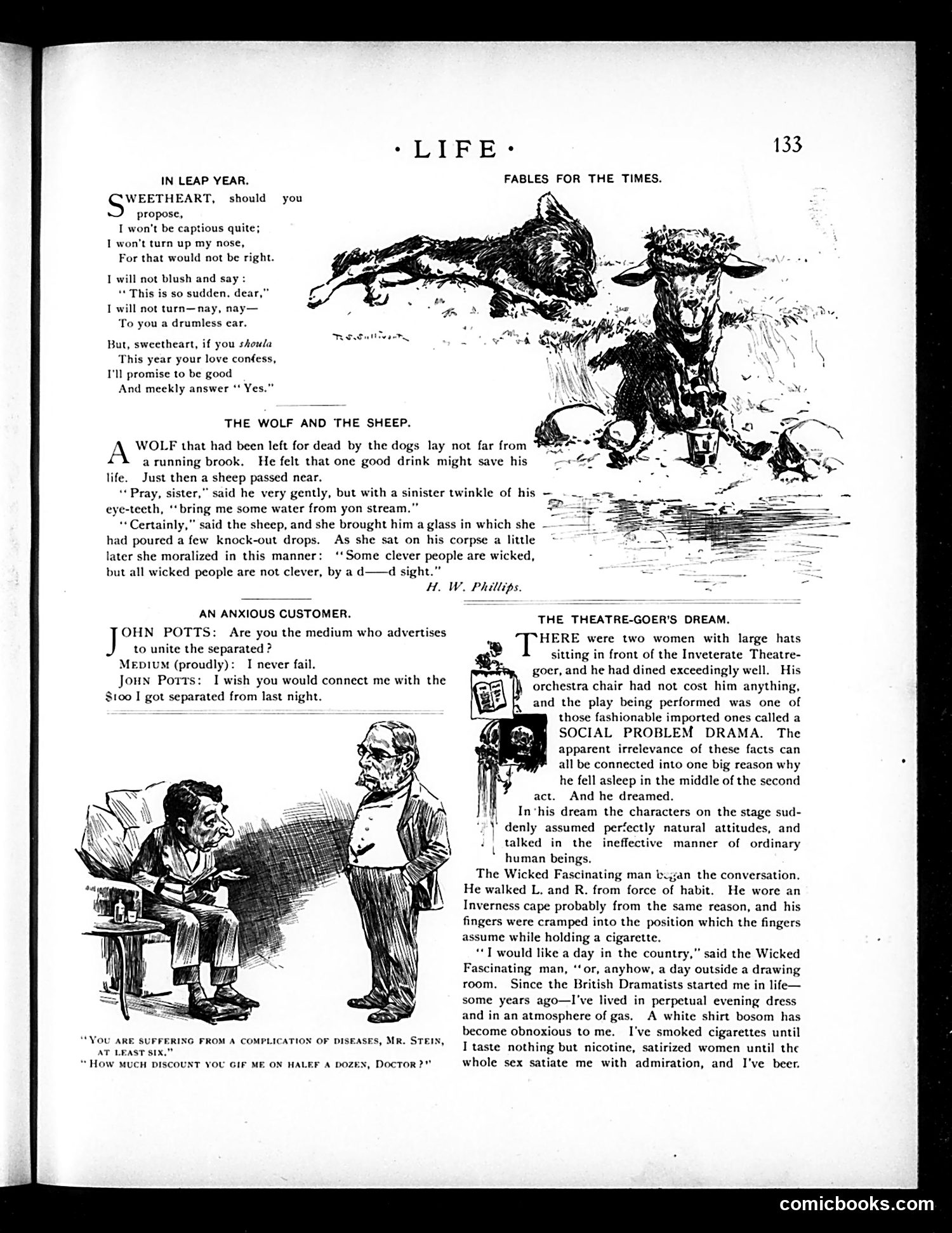
This cartoon satirizes a common social anxiety of the era. John Potts seeks a spiritualist medium to reunite him with his estranged wife, offering $100 as payment. The humor derives from treating marital separation as a supernatural problem requiring professional intervention—suggesting the situation is so hopeless that contacting the dead seems a reasonable solution. The joke reflects contemporary skepticism toward spiritualism, a popular but widely mocked practice. By depicting a desperate man willing to pay substantial money for such a service, the cartoon ridicules both spiritualists as charlatans and clients as gullible. The caption emphasizes Potts's comic desperation about his domestic misfortune.
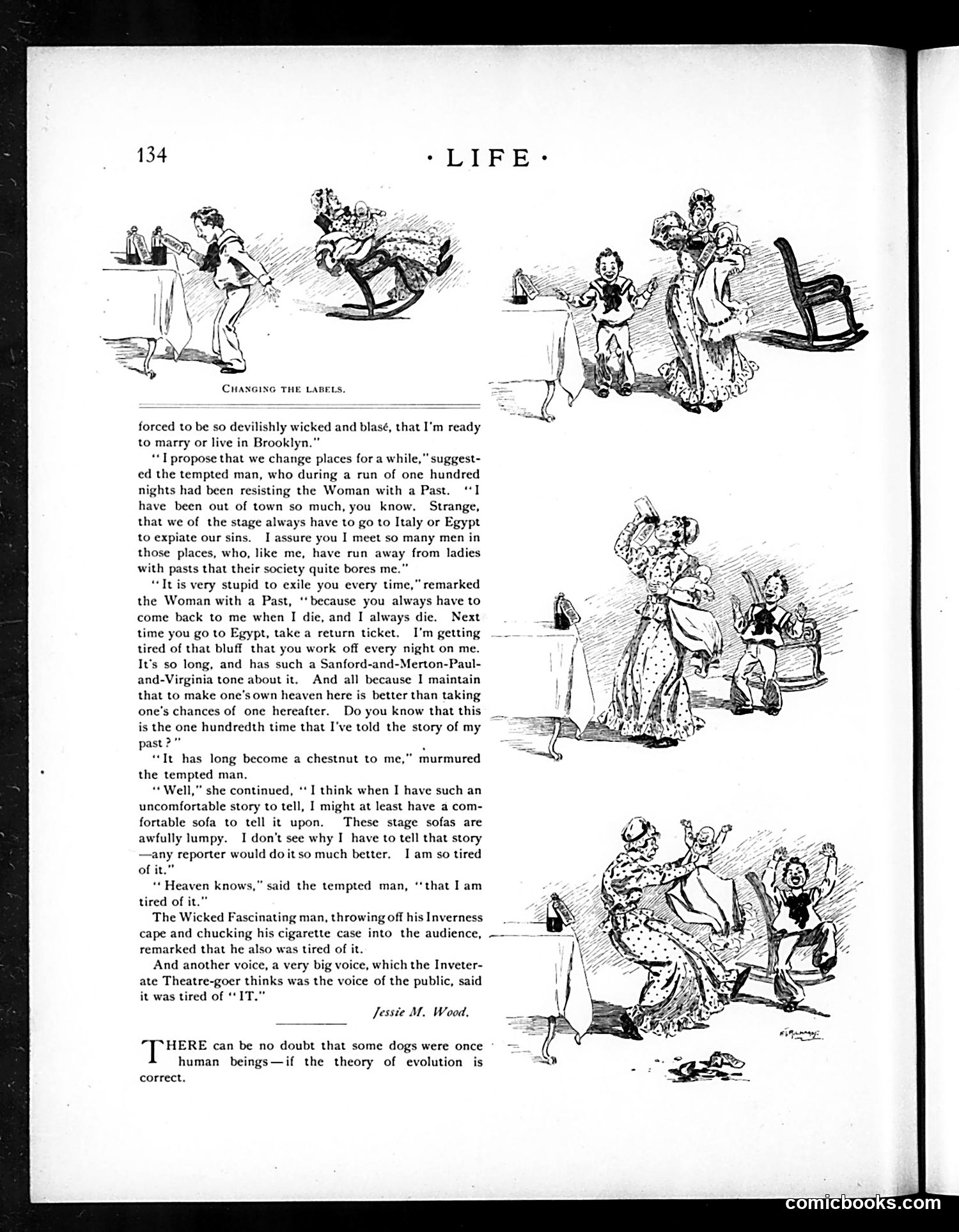
This page satirizes theatrical audiences and performers of the early 20th century. The title "Changing the Labels" suggests repackaging stale material as something new. The dialogue mocks actors who repeatedly tell the same tired stories to audiences, claiming exhaustion with their own narratives. One "tempted man" complains of being forced to exile himself repeatedly to justify his stage presence—a jab at actors recycling worn-out plots and excuses. The illustrations show various theatrical characters in exaggerated poses on sofas and chairs, depicting the "stage sofas" mentioned in the text. The satire targets both performers' lack of originality and audiences' tolerance for repetitive entertainment. The final quip about "some dogs were once human beings" suggests even animals would recognize this recycled material.
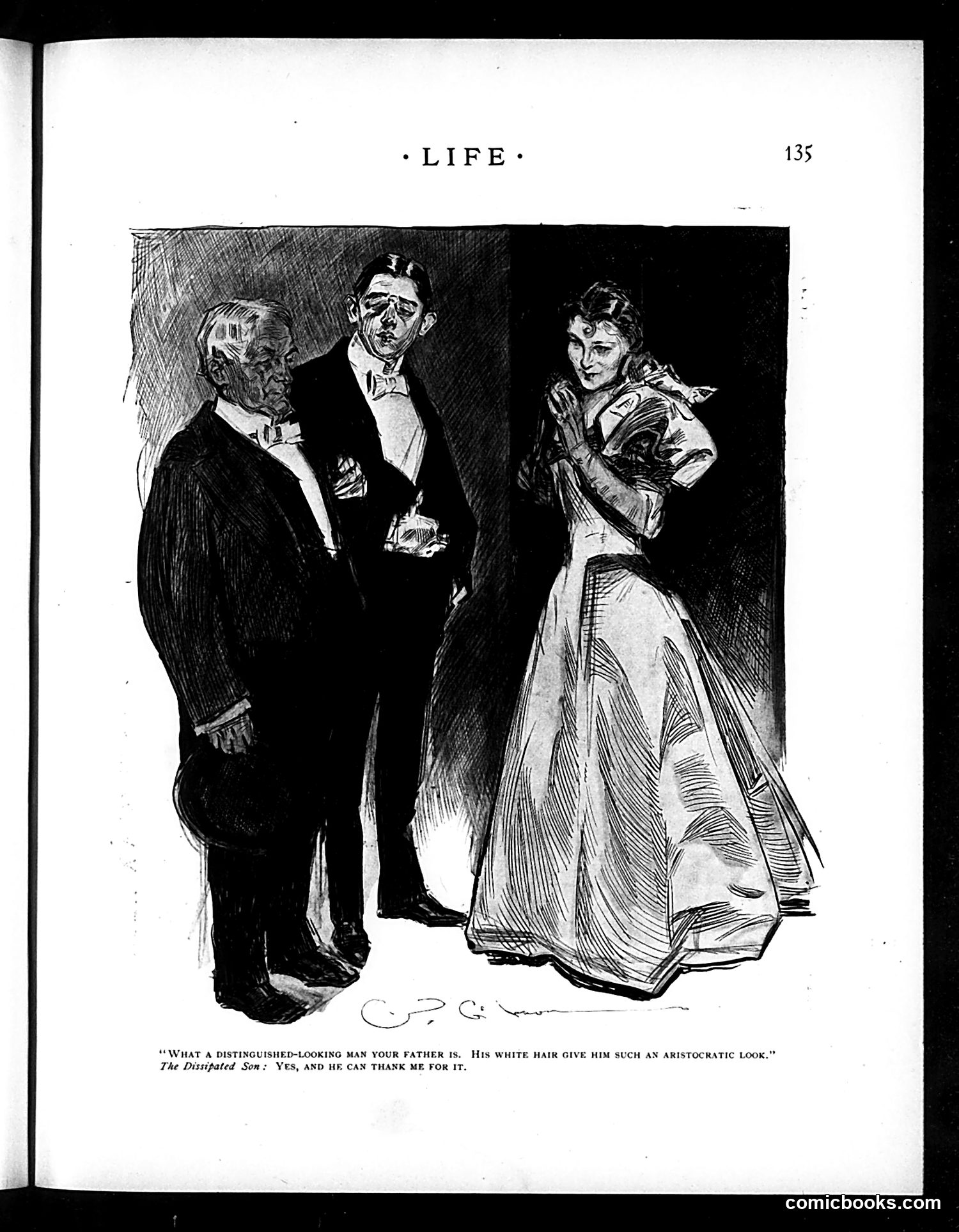
This is a single-panel satirical cartoon from *Life* magazine (page 135). The sketch shows three figures in formal evening dress: two older men in tuxedos conversing with a young woman in an elegant gown. The caption reads: "WHAT A DISTINGUISHED-LOOKING MAN YOUR FATHER IS. HIS WHITE HAIR GIVE HIM SUCH AN ARISTOCRATIC LOOK." The woman's response is: "YES, AND HE CAN THANK ME FOR IT." The joke satirizes social pretension and vanity. The young woman's reply suggests her father's distinguished appearance—his white hair—results from *her* influence or styling rather than natural aging or aristocratic breeding. It mocks both the father's attempt to appear aristocratic and the daughter's narcissism in taking credit for his appearance. The humor targets the superficiality of upper-class social performance.
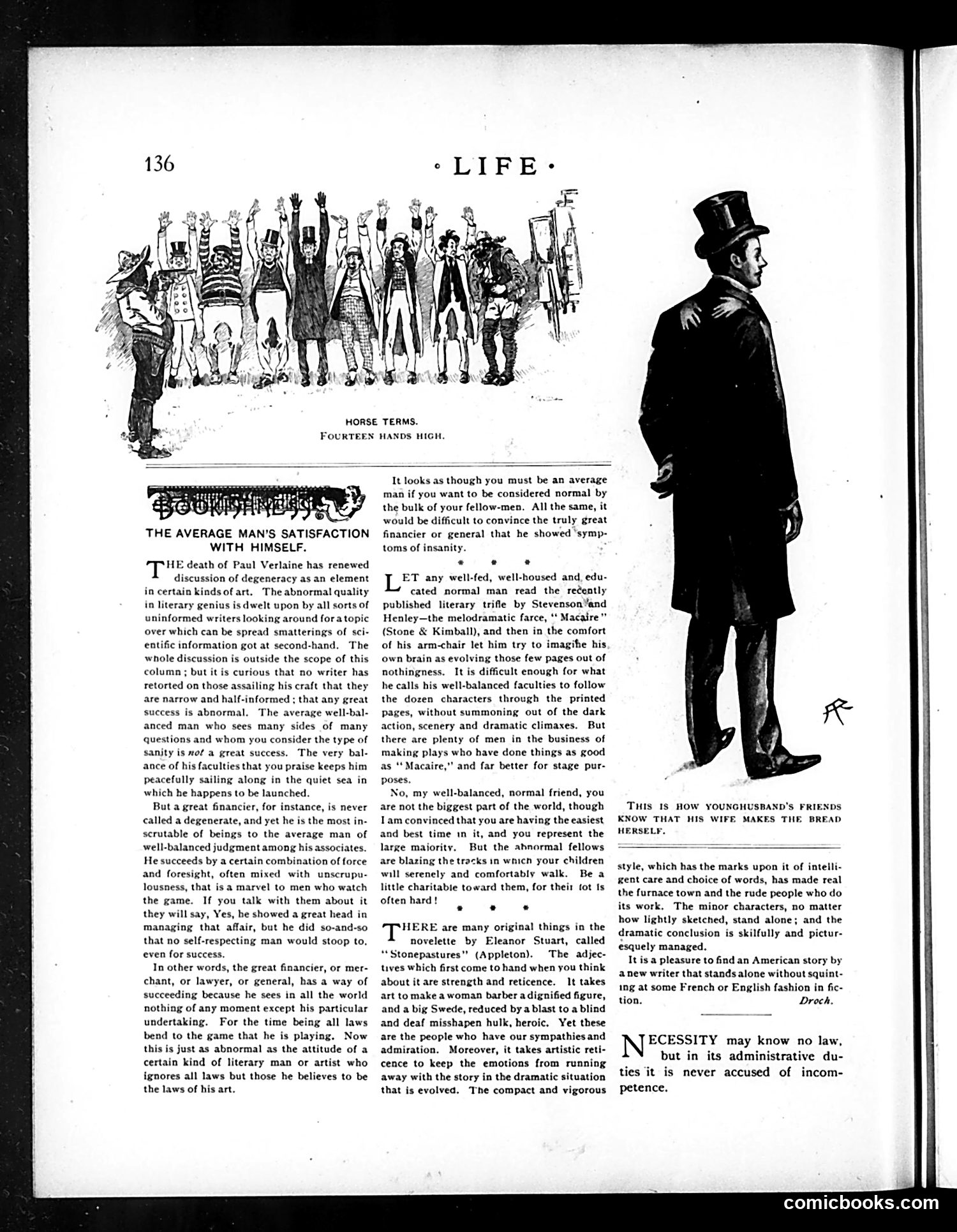
The main cartoon shows a line of people of varying heights labeled "HORSE TERMS: FOURTEEN HANDS HIGH," satirizing the measurement of human worth or status by physical standards. The accompanying article "BOUQUETS: THE AVERAGE MAN'S SATISFACTION WITH HIMSELF" discusses literary mediocrity, referencing Paul Verlaine and criticizing recent works like Stevenson and Henley's "Macaire." The piece argues that average, well-balanced men often lack the abnormal qualities needed for great artistic achievement. On the right is an illustration of a well-dressed gentleman in a top hat with caption "THIS IS HOW YOUNGHUSBAND'S FRIENDS KNOW THAT HIS WIFE MAKES THE BREAD HERSELF," likely a social commentary on domestic economics or class pretension. The satire targets both artistic pretension and middle-class social anxieties about respectability and success.
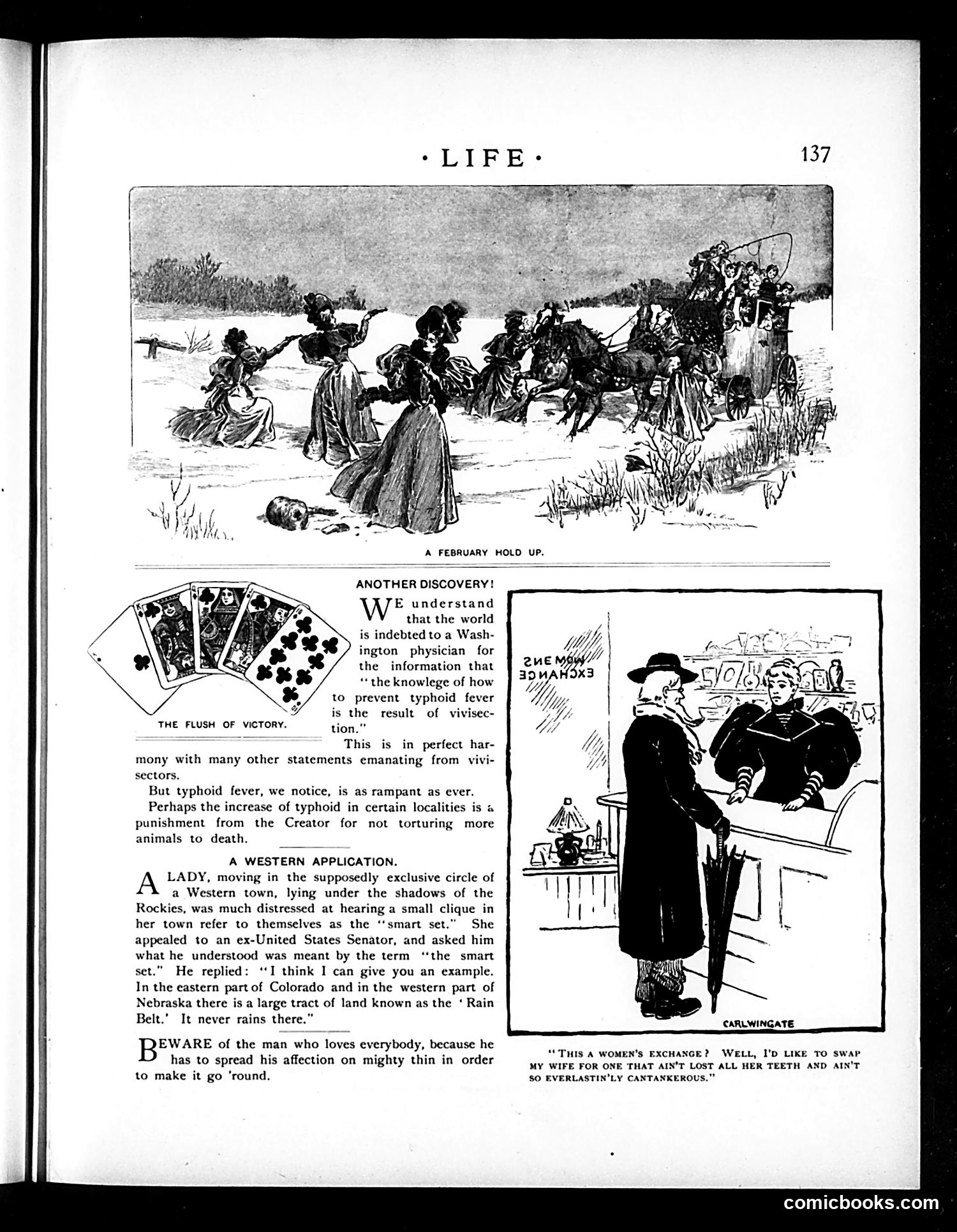
**"A February Hold Up"** (top illustration): A snowy winter scene depicting what appears to be a stagecoach robbery, with armed figures on horseback confronting travelers on a frozen landscape. **"Another Discovery"**: Text discusses typhoid fever prevention, credited to a Washington physician. The playing cards ("The Flush of Victory") and accompanying text suggest irony about medical advances coexisting with persistent disease. **"A Western Application"** (bottom cartoon by Carl Wingate): Shows two men discussing "the smart set" in exclusive Western towns. The humor derives from applying Eastern social pretensions to rough frontier life—one man jokingly proposes wife-swapping, mocking the artificiality of claiming sophistication in an unsophisticated setting. The page mixes serious public health commentary with satirical cartoons about American social hierarchies.
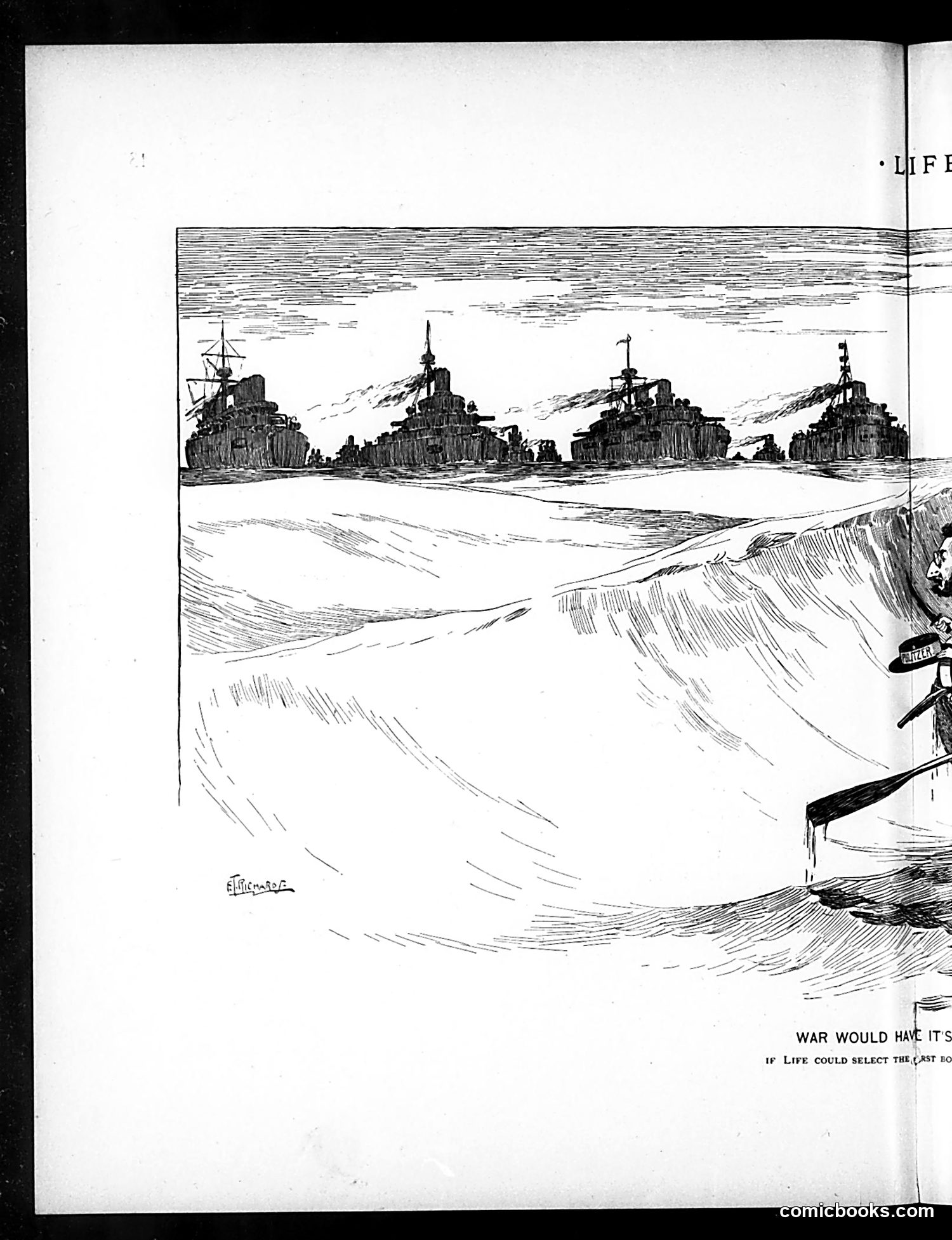
This is a pen-and-ink illustration showing four heavily fortified, castle-like structures on an icy or snowy landscape, viewed from a distance. Each fortress has medieval-style towers with flags. The partial caption visible reads "WAR WOULD HAVE IT'S" and "IF LIFE COULD SELECT THE LAST FO[...]" (text is cut off). The cartoon appears to be satirizing militarism and fortification, likely from the early 20th century based on the style. The artist's signature reads "Ehrenfried." The four identical fortress structures likely represent competing military powers or nations preparing for conflict. The caption suggests a commentary on what *Life* magazine would choose if given the option regarding warfare's future—seemingly critiquing the inevitability or acceptance of military buildup among world powers.
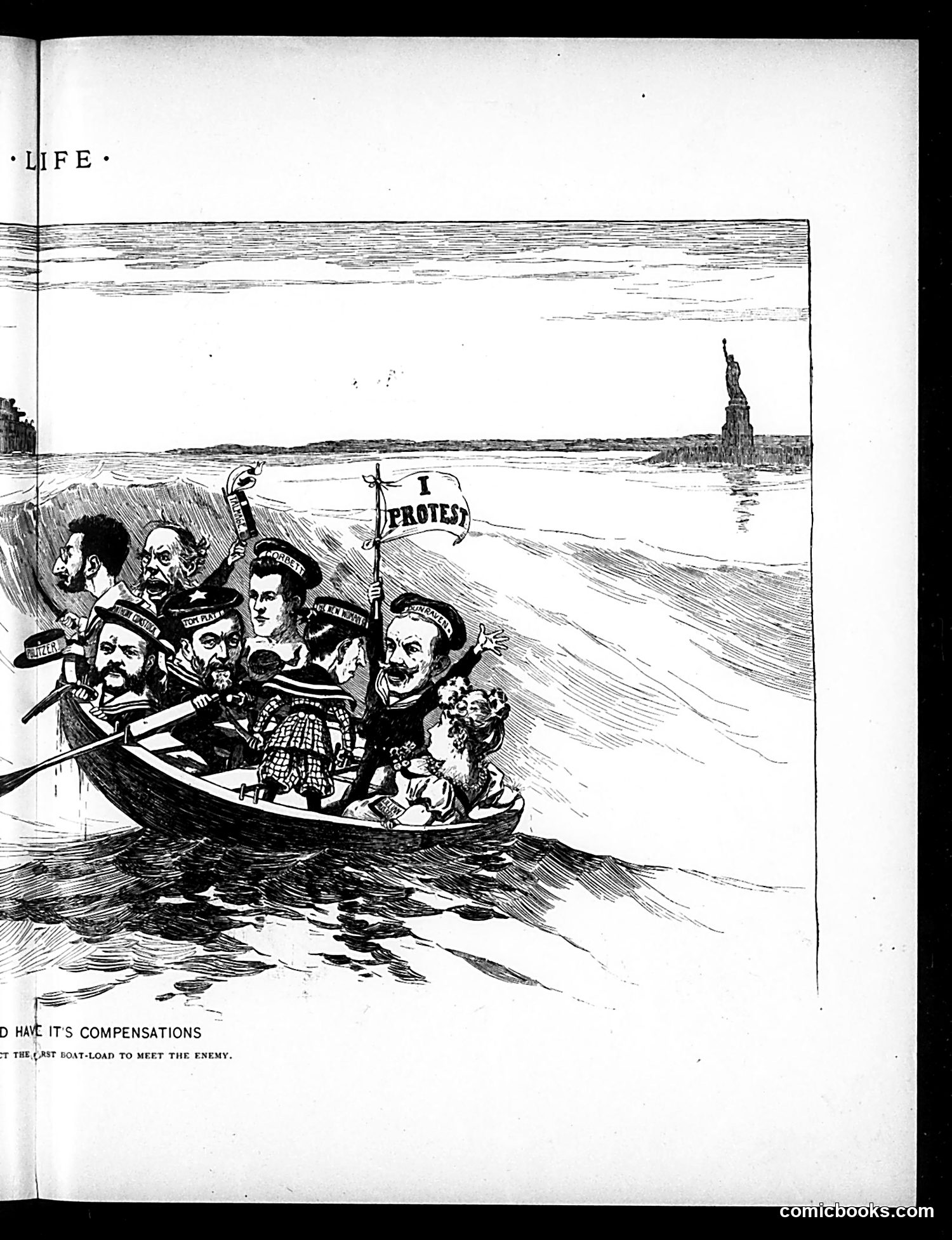
This is a satirical cartoon from *Life* magazine depicting military or political leaders in a small boat displaying a "PROTEST" flag, approaching the Statue of Liberty. The figures wear military uniforms with visible insignia and appear to be caricatured with exaggerated features typical of early 20th-century political cartooning. The caption reads: "AND HAVE IT'S COMPENSATIONS" and "...THE LAST BOAT-LOAD TO MEET THE ENEMY." The satire appears to mock a group of foreign military leaders or dignitaries arriving in America, likely during or after a conflict. The "protest" flag and ironic caption suggest criticism of their motives or the reception they're receiving. However, without the publication date or additional context, the specific historical event and identities of the figures remain unclear.
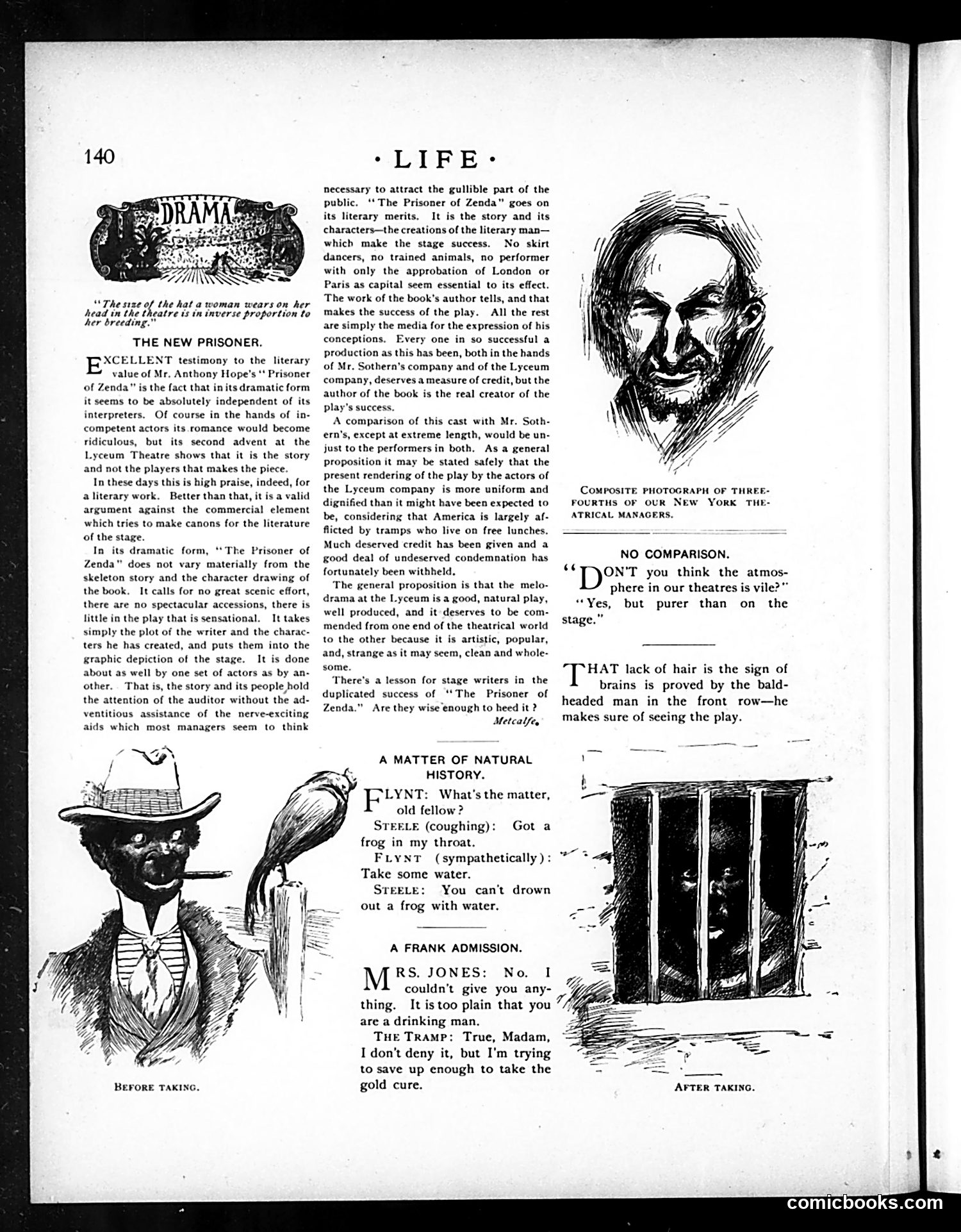
This page from *Life* magazine contains several elements: **Main Article**: A favorable review of the stage adaptation of Anthony Hope's *"The Prisoner of Zenda,"* praising it as a literary work that succeeds through story and character rather than spectacle. The critic argues this demonstrates theater's superiority when focused on artistic merit over commercial gimmicks—implicitly criticizing American theatrical managers who rely on "skirt dancers" and "trained animals." **Opening Epigram**: A snobbish jab at women's theater etiquette, claiming large hats indicate poor breeding. **Comic Vignettes**: Three brief jokes satirizing human nature: 1. A dialogue about a "frog in the throat" (wordplay) 2. A tramp admitting his drinking problem while claiming he's saving for the "gold cure" (alcoholism treatment)—dark humor about poverty and addiction **Caricature**: A sketch labeled "Before Taking" showing a well-dressed man with a parrot, likely satirizing theatrical pretension. The overall tone mocks both theatrical excess and social pretension while praising substantive art.
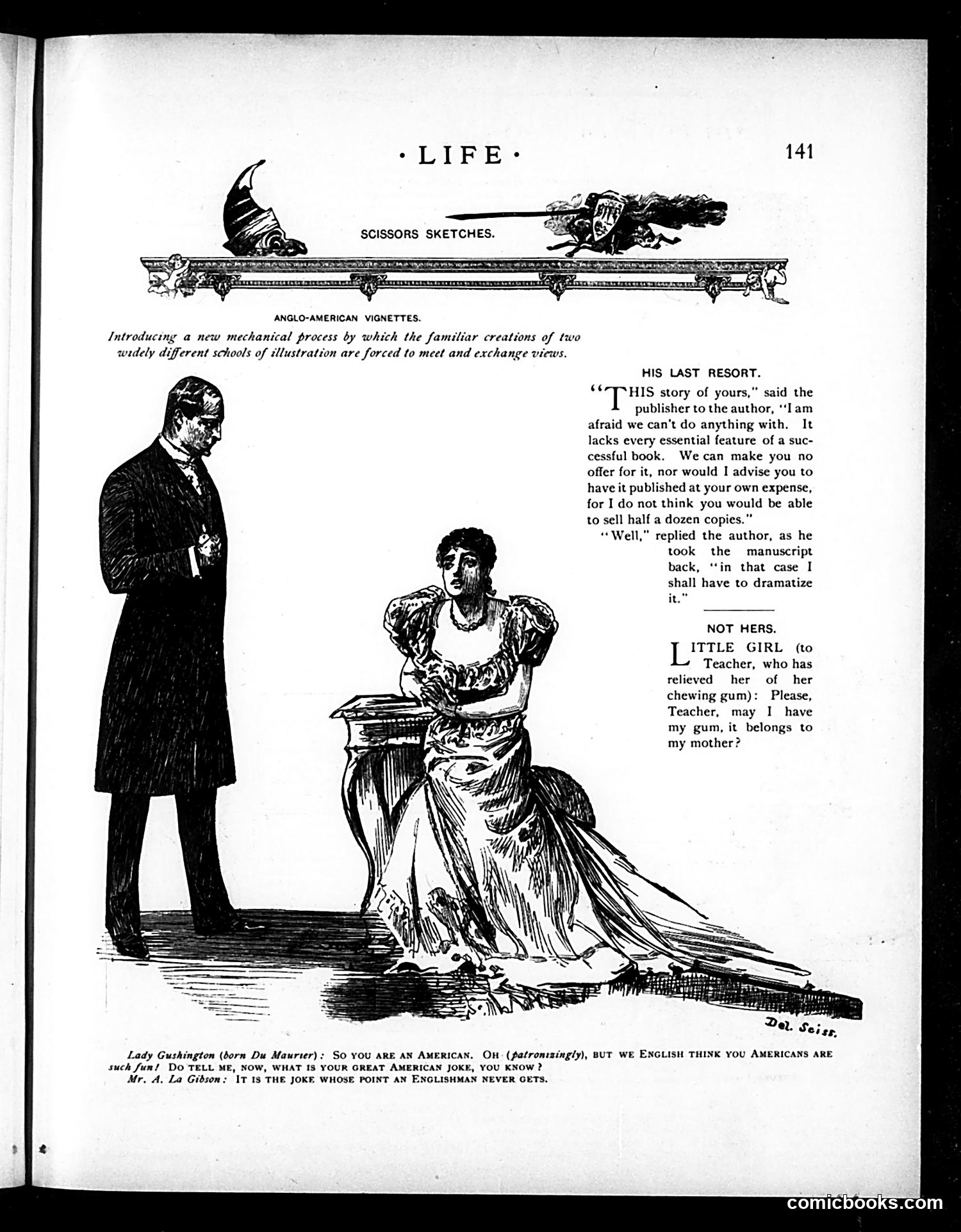
This page presents three satirical vignettes labeled "Anglo-American Vignettes," comparing American and English humor and attitudes. The top cartoon shows a publisher rejecting an author's manuscript as unpublishable, to which the author replies he'll "dramatize it"—satirizing how failed literature gets recycled into theater. The middle item mocks American children, depicting a girl claiming her chewing gum belongs to her mother—poking fun at American parenting and consumerism. The bottom cartoon features "Lady Gushington (born Du Maurier)"—likely referencing English illustrator George Du Maurier—patronizingly asking an American (identified as "A. La Gibson," referencing illustrator Charles Dana Gibson) to explain "the great American joke." Gibson's punchline: "It is the joke whose point an Englishman never gets"—a jab at English superiority and their alleged inability to understand American humor. The page's conceit is comparing English and American illustration styles and sensibilities, with the satire targeting both national stereotypes.
This page contains several brief humorous anecdotes typical of Life's satirical humor. The main cartoon titled "Kissers at Nullus" presents four short jokes: 1. **The Coal Bin Story**: A man's awkward attempt at humor about wife-beating backfires when listeners suspect he's describing his own experience. 2. **Samuel Galloway**: A famous Ohio politician's homely appearance inspires a child's innocent but cutting remark—that his mother "must have loved children" to raise him despite his ugly face. 3. **The Noisy Visitor**: A British diplomat (Labouchere) deflates an aggressive American by coolly informing him the minister won't return for six weeks. 4. **City vs. Country Girl**: A country visitor rejects urban attractions (theaters, shops, society), claiming cities lack "the best thing"—presumably romantic opportunity or wholesome courtship customs. The humor relies on period assumptions about gender relations, social hierarchies, and urban-rural cultural differences.
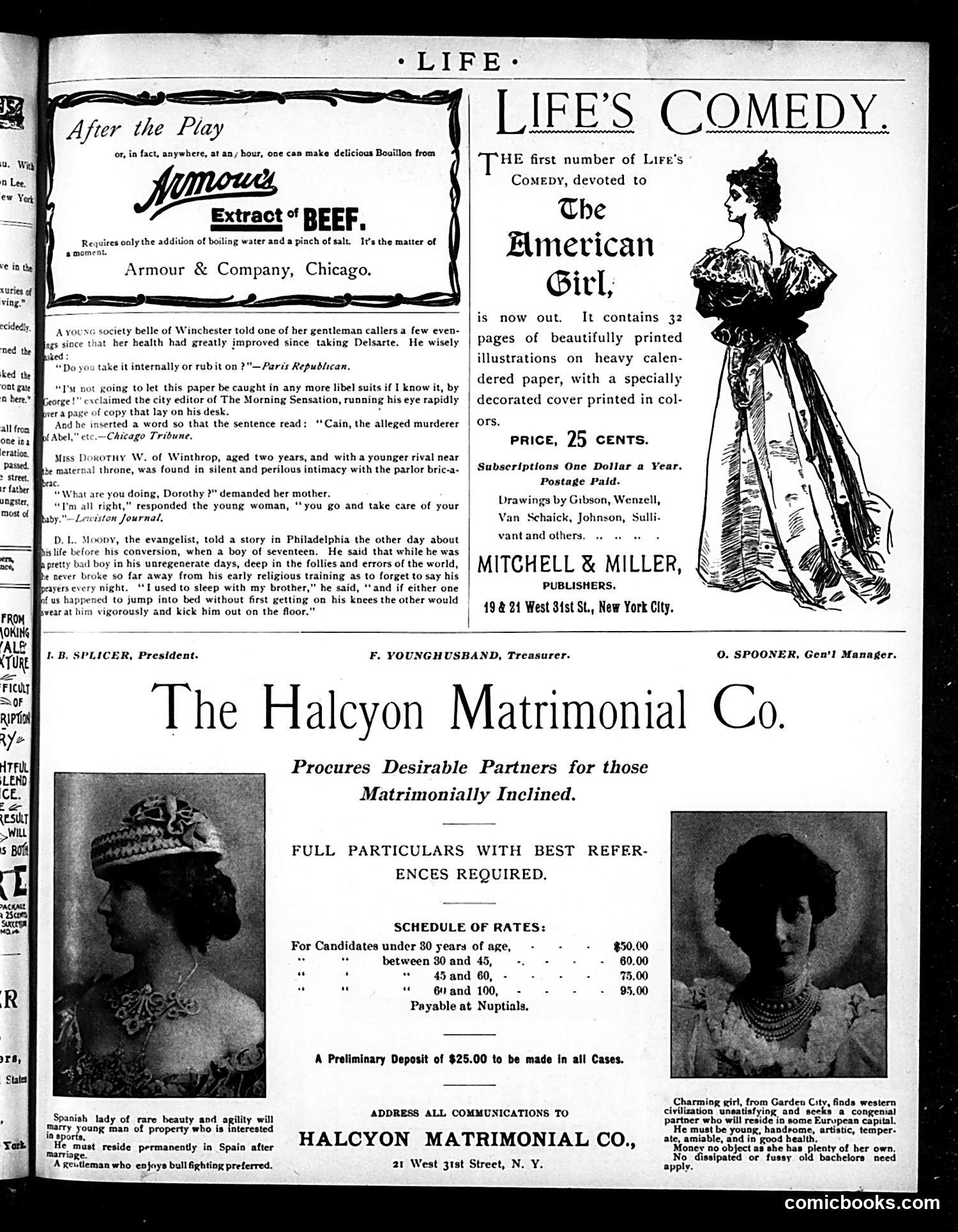
This page combines satirical humor with period advertising. The left side contains three brief comedic anecdotes mocking contemporary figures and situations: 1. **The newspaper editor** censoring a libel suit—satire on journalism's legal vulnerabilities 2. **A two-year-old girl** in "silent intimacy" with a rival—likely mocking society gossip columns and domestic drama 3. **D.L. Moody, the evangelist**—ridiculing religious hypocrisy, suggesting forced piety (kicking brothers out of bed for skipping prayers) The right side advertises *Life's Comedy: The American Girl* (a publication), priced at 25 cents. **Below** sits the real satire: **The Halcyon Matrimonial Co.**, a fake matchmaking service with price tiers ($50-$95) based on age and a $25 deposit. The accompanying text mocks wealthy, desperate women seeking European husbands. This lampoons both the marriage market and nouveau riche American women seeking foreign prestige—a common satirical target of the era. The Armour beef extract ad is unrelated commercial content.
This page contains three humorous anecdotes satirizing social pretension and gender dynamics of the era: 1. **"A Long Life"**: A witty exchange between two female writers (Mrs. Craigie and an unnamed American novelist) mocking romantic idealization. When told a woman decided to "be kissed to death," Craigie's response—"she evidently intends to be immortal"—deflates sentimental notions of romantic death. 2. **The Cross-eyed Man anecdote**: A Boston woman cleverly embarrasses a boastful, sexist man by innocently questioning which eye he's using to watch her—mocking his pretentious authority and casual condescension. 3. **The Elevator Story**: Rural/working-class woman overcomes fear of new technology (elevators) to compete with her husband's boasting. The satire targets masculine showiness and one-upmanship, celebrating her practical courage. **Overall theme**: The page celebrates sharp-witted women deflating pompous men through clever retorts, reflecting turn-of-century feminist humor challenging male social dominance. The surrounding advertisements are unrelated.
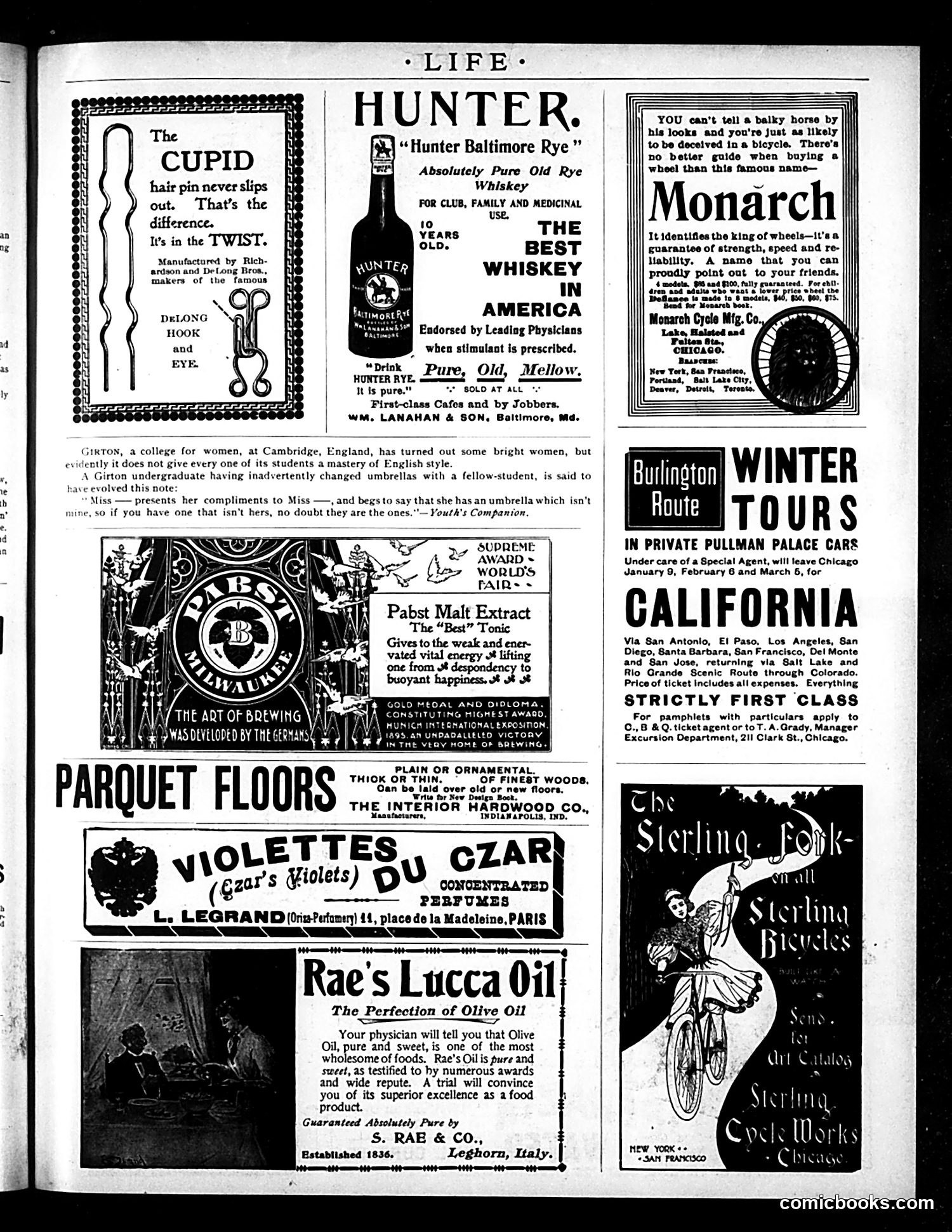
This is primarily an **advertising page** with a brief humorous anecdote. The main content consists of commercial advertisements for various products: Hunter Baltimore Rye whiskey, Cupid hairpins, Monarch bicycles, Burlington Route tours, parquet flooring, Violettes du Czar perfume, and Rae's Lucca Oil. The only editorial content is a short satirical **note from a Girton College student** (Cambridge, England). The joke mocks awkward, pretentious academic writing: a young woman tries to politely explain she accidentally swapped umbrellas with a classmate, but her convoluted phrasing makes it nearly incomprehensible. The satire suggests that even well-educated women from prestigious institutions can write poorly when attempting formal courtesy—a gentle jab at both affected speech and women's education pretensions of the era. The page reflects early 1900s consumer culture and gender attitudes.
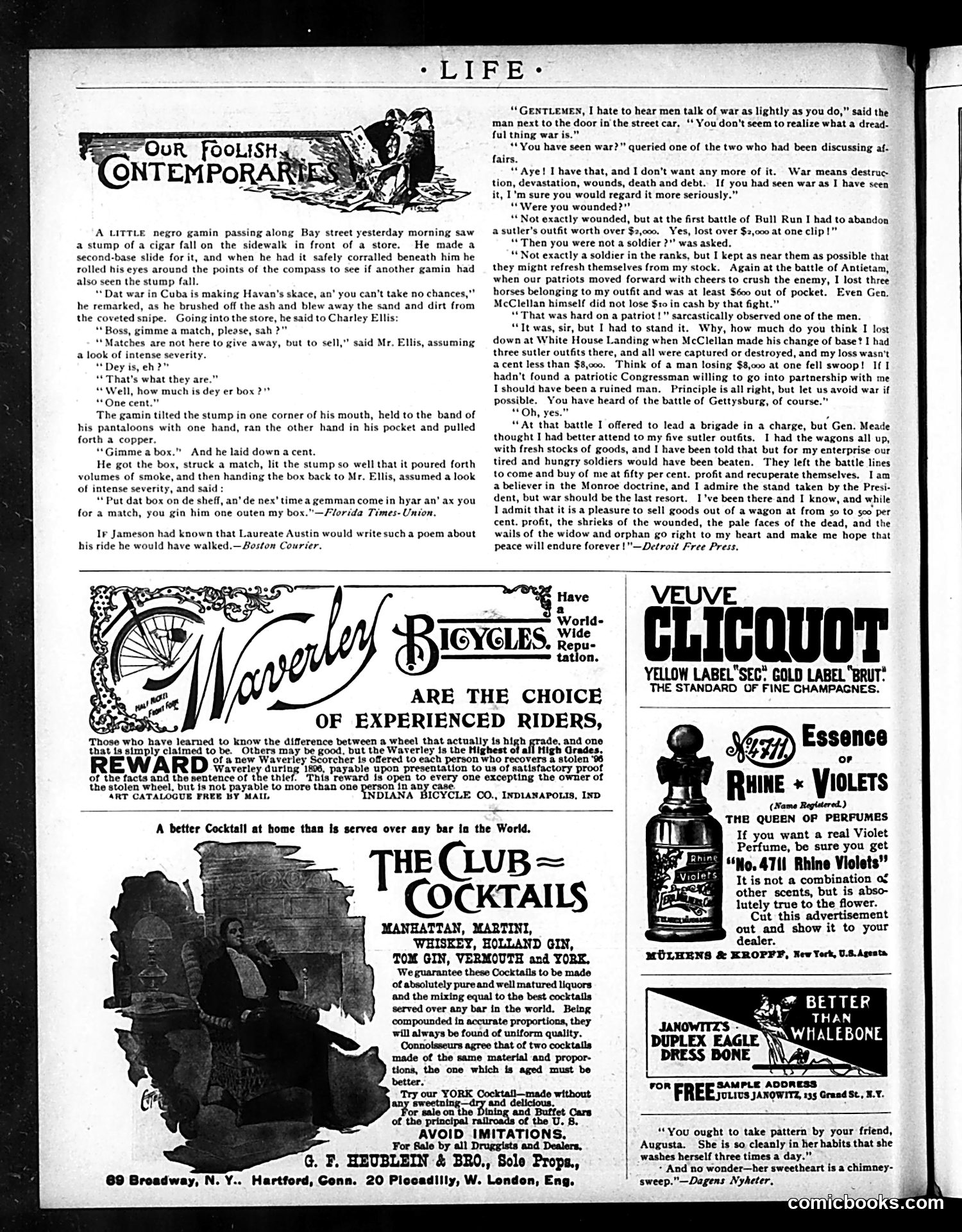
This page satirizes a common type of American: the war profiteer who claims patriotism while enriching himself. The unnamed speaker in the main cartoon boasts of his "sacrifices" during the Civil War—but reveals he was a **sutler** (a merchant who sold goods to soldiers), not a soldier. His "losses" ($2,000, $600, $8,000) came from abandoned merchandise, not combat wounds. He frames commercial setbacks as patriotic suffering, even claiming to have "offered to lead a brigade" while actually protecting his five supply wagons. The joke: he's lectured others about war's horrors while profiting from soldiers' desperation—selling goods at "fifty per cent. profit" to hungry troops. His self-serving revisionism presents business transactions as heroic sacrifice, exemplifying the hypocritical patriot who enriched himself during national tragedy. The opening "little negro gamin" anecdote appears unrelated—a brief humorous vignette about a child's resourcefulness.
This page from *Life* magazine shows a black and white illustration titled "The Swimming Lesson" (text appears rotated/reversed in the OCR). The image depicts what appears to be a swimming or water scene with multiple figures, though the high contrast and image quality make specific details difficult to discern with certainty. Without being able to read accompanying article text clearly or identify specific figures with confidence, I cannot definitively explain the political or social satire intended. The composition suggests it may be depicting a humorous or critical moment related to swimming instruction or water-based activity, but asserting specific meanings or identifying particular individuals would require clearer image resolution or additional context.
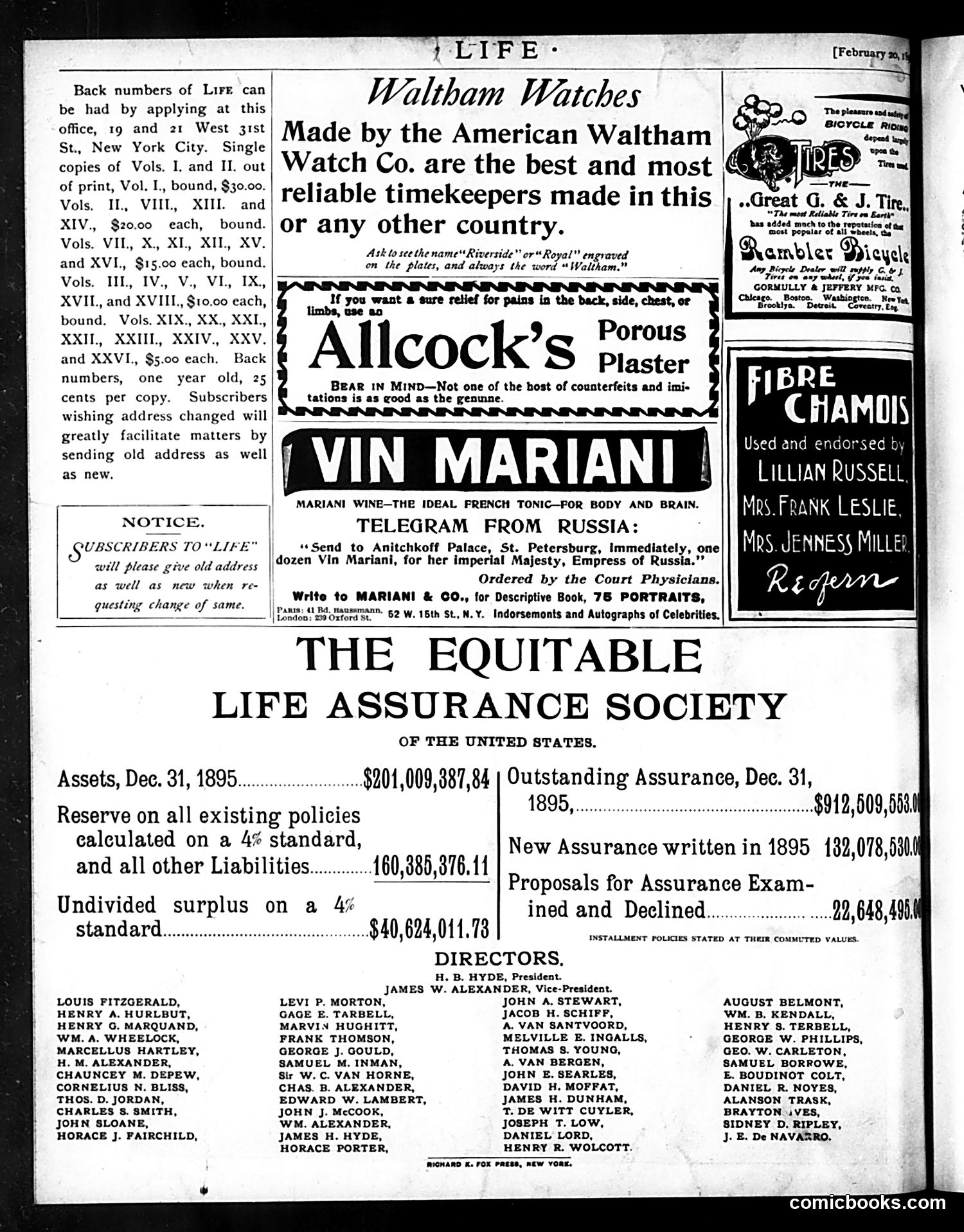
This is primarily a **advertisements and business notices page** from Life magazine (February 20, 1895), not a satirical cartoon page. **Key Content:** The page features standard classified advertising and company announcements typical of late 19th-century magazines: - **Waltham Watches** ad emphasizing American manufacturing quality - **Allcock's Porous Plaster** (pain relief product) warning against counterfeits - **Vin Mariani** wine tonic—notably includes a (likely fabricated) "telegram from Russia" claiming the Empress ordered it, a common advertising tactic exploiting celebrity/royal endorsements - **Fibre Chamois** product endorsed by theatrical stars (Lillian Russell, Mrs. Frank Leslie, Mrs. Jenness Miller) - **The Equitable Life Assurance Society** detailed financial statement and board of directors **For Modern Readers:** This reflects how 19th-century magazines monetized through aggressive advertising, including dubious celebrity endorsements and claims that would face modern regulatory scrutiny. The fake Russian telegram exemplifies period advertising's casual relationship with truth.