
Life, 1896-02-20 · page 4 of 20
Life — February 20, 1896 — page 4: what you’re looking at
What you’re looking at
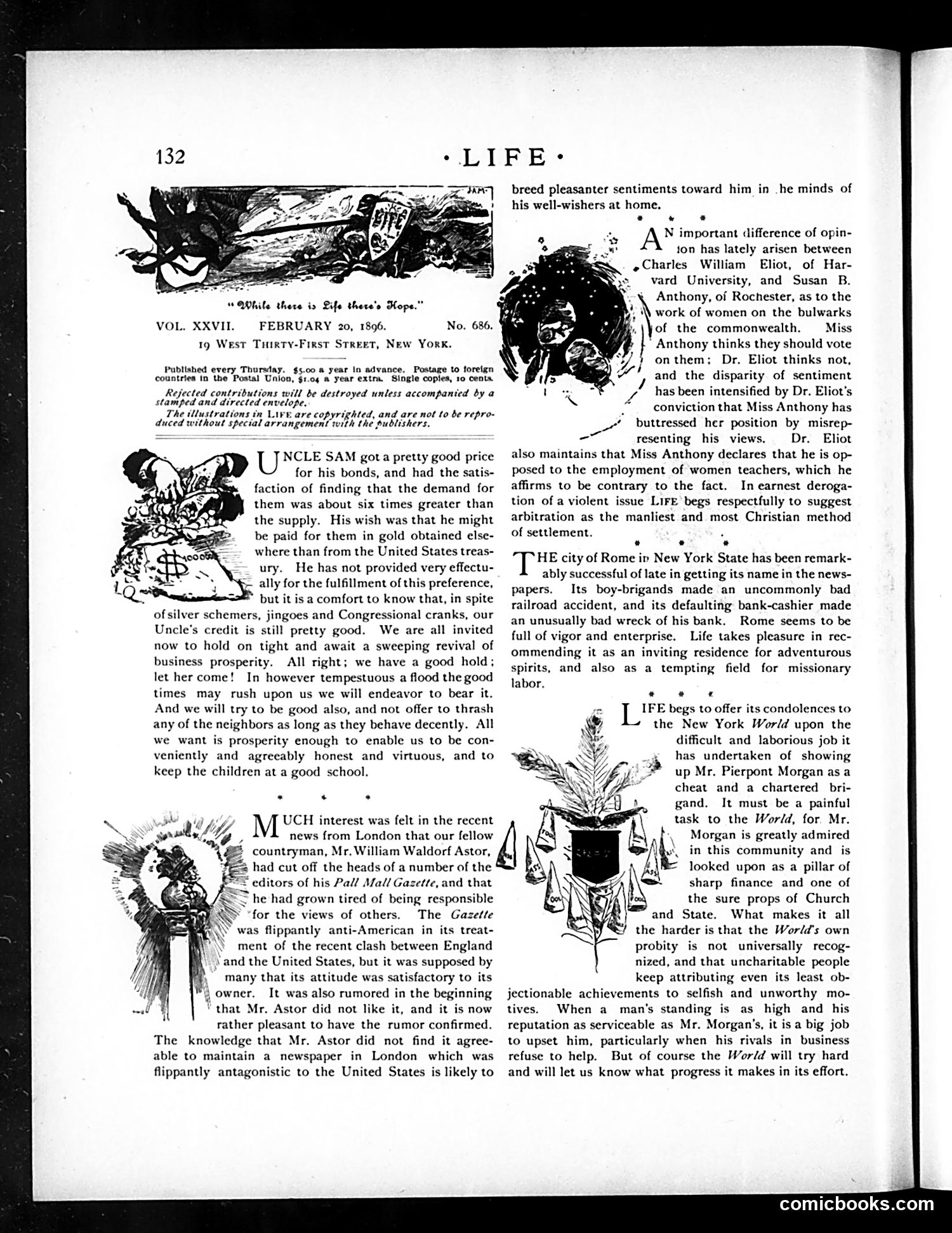
This page contains editorial commentary rather than cartoons. The main content discusses: 1. **Uncle Sam's finances**: A section mocking Uncle Sam for selling bonds at poor prices, criticizing Congressional spending and "jingoes" while hoping for economic revival. 2. **William Waldorf Astor controversy**: The editors note Astor cut off editors of the *Pall Mall Gazette* after they criticized recent England-US tensions. Life finds it ironic Astor maintains an anti-American London newspaper while being American—suggesting disloyalty. 3. **Pierpont Morgan criticism**: Life attacks Morgan's character, noting even his high reputation makes accusations of dishonesty particularly damaging to public trust. The page uses satirical commentary to critique wealthy American figures and financial practices of the 1890s.
📄 Transcribed text from this page (OCR, searchable)
Machine-transcribed from the original scan — historical spelling and the odd misread are preserved.
*LIFE- “While there is Life there's Hope.” VOL. XXVIL. FEBRUARY 20, 1896. No. 686, 19 West Tuirty-First Street, New York. Published every Thursday. $5.00 a year In advance. Postage to foreign countries in the Postal Union, $1.04 @ year extra. Single copies, 10 cents, Rejected contributions will be destroyed unless accompanied by a stamped and directed envelope. The illustrations in Live are copyrighted, and are not to be repro- duced without special arrangement with the publishers. NCLE SAM gota pretty good price for his bonds, and had the satis- faction of finding that the demand for them was about six times greater than the supply. His wish was that he might be paid for them in gold obtained else- where than from the United States treas- ury. He has not provided very effectu- p— ally for the fulfillment of this preference, ~ > but it is a comfort to know that, in spite ofsilver schemers, jingoes and Congressional cranks, our Uncle's credit is still pretty good. We are all invited now to hold on tight and await a sweeping revival of business prosperity. All right; we have a good hold; let her come! In however tempestuous a flood the good times may rush upon us we will endeavor to bear it. And we will try to be good also, and not offer to thrash any of the neighbors as long as they behave decently. All we want is prosperity enough to enable us to be con- veniently and agreeably honest and virtuous, and to keep the children at a good school. . ‘ . UCH interest was felt in the recent , news from London that our fellow "a countryman, Mr. William Waldorf Astor, “fe= had cut off the heads of a number of the ditors of his Pad/ Mal/ Gazette, and that > he had grown tired of being responsible for the views of others. The Gazette was flippantly anti-American in its treat- ment of the recent clash between England ‘and the United States, but it was supposed by ‘ many that its attitude was satisfactory to its 4 owner. It was also rumored in the beginning “that Mr. Astor did not like it, and it is now rather pleasant to have the rumor confirmed. The knowledge that Mr. Astor did not find it agree- able to maintain a newspaper in London which was flippantly antagonistic to the United States is likely to breed pleasanter sentiments toward him in .he minds of his well-wishers at home, . © N important difference of opin- ton has lately arisen between Charles William Eliot, of Har- vard University, and Susan B. ¥ Anthony, of Rochester, as to the ¥ \ work of women on the bulwarks of the commonwealth. Miss ' Anthony thinks they should vote y onthem; Dr. Eliot thinks not, Y! and the disparity of sentiment ns has been intensified by Dr. Eliot's conviction that Miss Anthony has buttressed her position by misrep- resenting his views. Dr. Eliot ins that Miss Anthony declares that he is op- posed to the employment of women teachers, which he affirms to be contrary to the fact. In earnest deroga- tion of a violent issue LIFE begs respectfully to suggest arbitration as the manliest and most Christian method of settlement. . . * * HE city of Rome in New York State has been remark- ably successful of late in getting its name in the news- papers. Its boy-brigands made an uncommonly bad railroad accident, and its defaulting bank-cashier made an unusually bad wreck of his bank, Rome seems to be full of vigor and enterprise. Life takes pleasure in rec- ommending it as an inviting residence for adventurous spirits, and also as a tempting field for missionary * 8 « IFE begs to offer its condolences to the New York World upon the difficult and laborious job it has undertaken of showing up Mr. Pierpont Morgan as a cheat and a chartered bri- gand, It must be a painful task to the World, for Mr. Morgan is greatly admired in this community and is looked upon as a pillar of P/\\ GS sharp finance and one of iN the sure props of Church | and State. What makes it all ? the harder is that the World's own probity is not universally recog- nized, and that uncharitable people keep attributing even its least ob- jectionable achievements to selfish and unworthy mo- tives. When a man’s standing is as high and his reputation as serviceable as Mr. Morgan’s, it is a big job to upset him, particularly when his rivals in business refuse to help. But of course the Wor/d will try hard and will let us know what progress it makes in its effort. Si comicbooks.com