
Life, 1896-02-20 · page 12 of 20
Life — February 20, 1896 — page 12: what you’re looking at
What you’re looking at
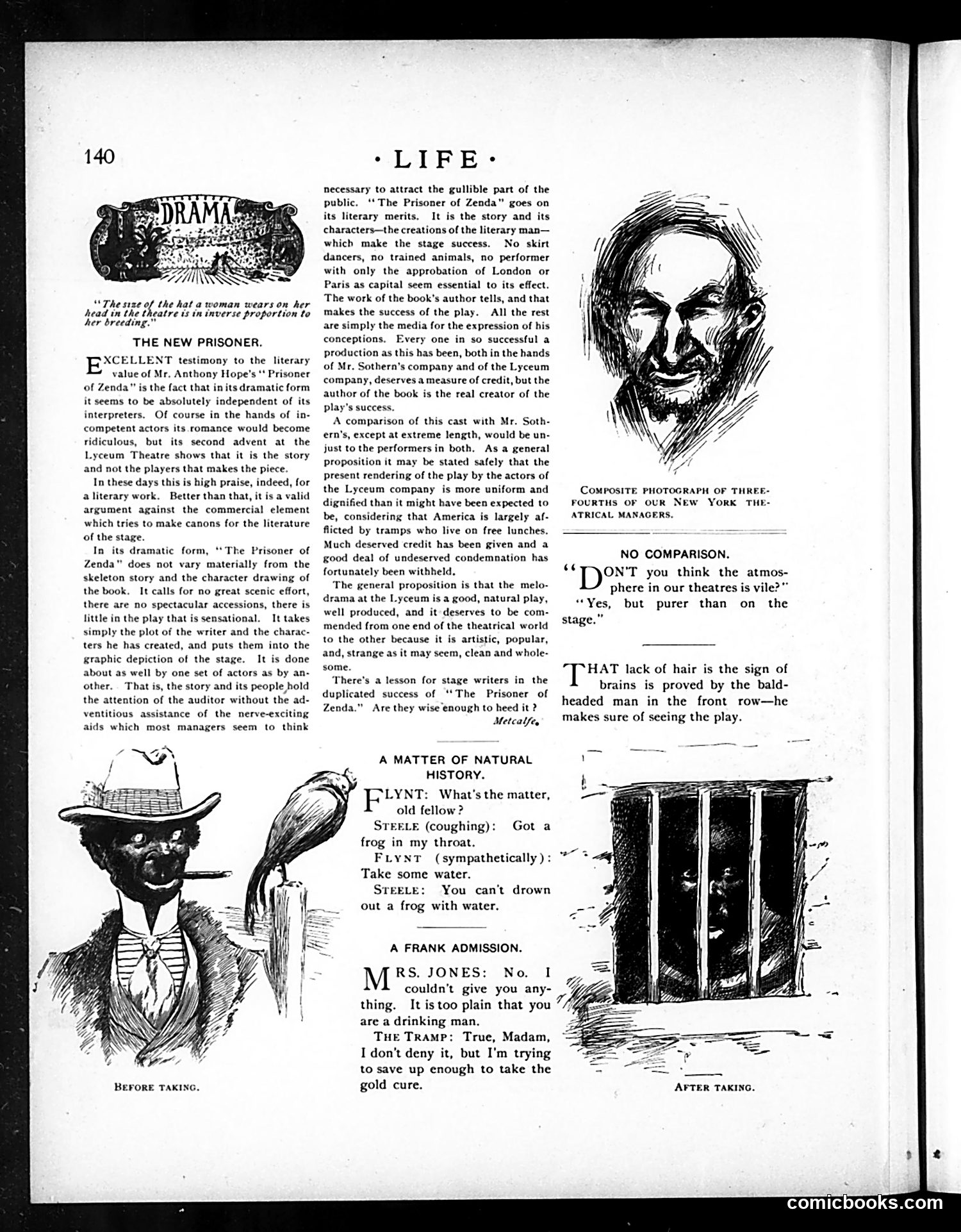
This page from *Life* magazine contains several elements: **Main Article**: A favorable review of the stage adaptation of Anthony Hope's *"The Prisoner of Zenda,"* praising it as a literary work that succeeds through story and character rather than spectacle. The critic argues this demonstrates theater's superiority when focused on artistic merit over commercial gimmicks—implicitly criticizing American theatrical managers who rely on "skirt dancers" and "trained animals." **Opening Epigram**: A snobbish jab at women's theater etiquette, claiming large hats indicate poor breeding. **Comic Vignettes**: Three brief jokes satirizing human nature: 1. A dialogue about a "frog in the throat" (wordplay) 2. A tramp admitting his drinking problem while claiming he's saving for the "gold cure" (alcoholism treatment)—dark humor about poverty and addiction **Caricature**: A sketch labeled "Before Taking" showing a well-dressed man with a parrot, likely satirizing theatrical pretension. The overall tone mocks both theatrical excess and social pretension while praising substantive art.
📄 Transcribed text from this page (OCR, searchable)
Machine-transcribed from the original scan — historical spelling and the odd misread are preserved.
“The size of the hat a woman wears on her head in the theatre is in inverse proportion to her breeding.” THE NEW PRISONER. <CELLENT testimony to the literary value of Mr, Anthony Hope's" Prisoner of Zenda" is the fact that in its dramatic form it seems to be absolutely independent of its interpreters. Of course in the hands of in- competent actors its romance would become ridiculous, but its second advent at the Lyceum Theatre shows that it is the story and not the players that makes the piece. In these days this is high praise, indeed, for aliterary work. Better than that, it is a valid argument against the commercial element which tries to make canons for the literature of the stage. In its dramatic form, The Prisoner of Zenda" does not vary materially from the skeleton story and the character drawing of the book. It calls for no great scenic effort, there are no spectacular accessions, there is little in the play that is sensational. It takes simply the plot of the writer and the charac- ters he has created, and puts them into the graphic depiction of the stage. It is done about as well by one set of actors as by an- other. That is, the story and its people hold the attention of the auditor without the ad- ventitious assistance of the nerve-exciting aids which most managers seem to think BEFORE TAKING. > LIFE: necessary to attract the gullible part of the public. ‘' The Prisoner of Zenda" goes on its literary merits, It is the story and its characters—the creations of the literary man— which make the stage success. No skirt dancers, no trained animals, no performer with only the approbation of London or Paris as capital seem essential to its effect. The work of the book's author tells, and that makes the success of the play. All the rest are simply the media for the expression of his conceptions. Every one in so successful a production as this has been, both in the hands of Mr, Sothern’s company and of the Lyceum company, deserves a measure of credit, but the author of the book is the real creator of the play's success. A comparison of this cast with Mr. Soth- ern’s, except at extreme length, would be un- just to the performers in both. As a general Proposition it may be stated safely that the present rendering of the play by the actors of the Lyceum company is more uniform and dignified than it might have been expected to be, considering that America is largely af- flicted by tramps who live on free lunches. Much deserved credit has been given and a good deal of undeserved condemnation has fortunately been withheld, The general proposition is that the melo- drama at the Lyceum is a good, natural play, well produced, and it deserves to be com- mended from one end of the theatrical world to the other because it is artistic, popular, and, strange as it may seem, clean and whole- some. ‘There's a lesson for stage writers in the duplicated success of ‘The Prisoner of Zenda.” Are they wise enough to heed it ? Metcalfe, A MATTER OF NATURAL HISTORY. LYNT: What's the matter, old fellow ? STEELE (coughing): frog in my throat. FLYNT (sympathetically): Take some water. STEELE: You can't drown out a frog with water. Got a A FRANK ADMISSION. RS. JONES: No. I couldn't give you any- thing. It istoo plain that you are a drinking man. Tue TRAMP: True, Madam, I don’t deny it, but I'm trying to save up enough to take the gold cure. COMPOSITE PHOTOGRAPH OF THREE- FOURTHS OF OUR NEW YorRK TH! ATRICAL MANAGERS, NO COMPARISON. *€TON'T you think the atmos- phere in our theatres is vile?” but purer than on the HAT lack of hair is the sign of brains is proved by the bald- headed man in the front row—he makes sure of seeing the play. AFTER TAKING. comicbooks.com