
A complete issue · 20 pages · 1896
Life — January 23, 1896
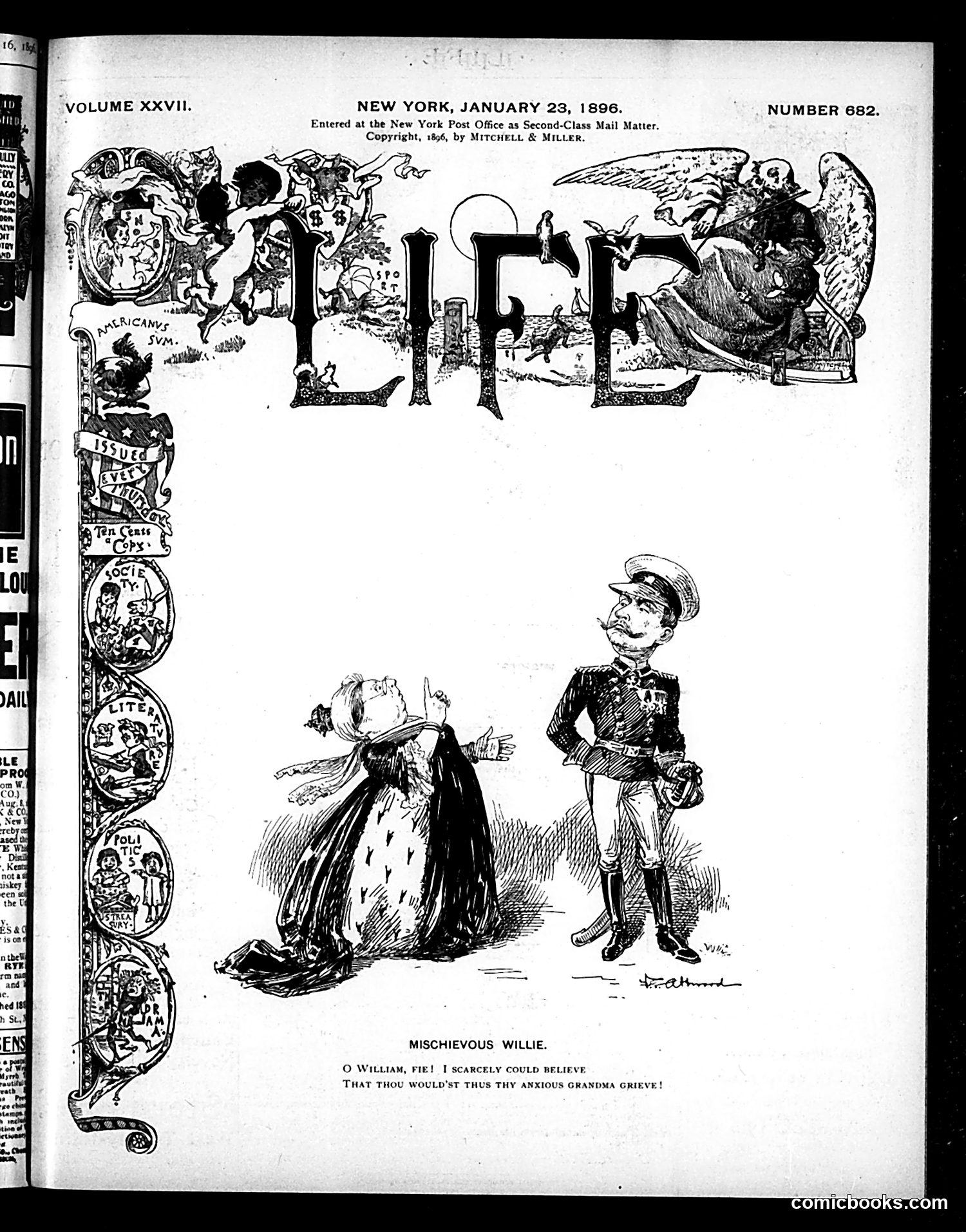
This political cartoon depicts a confrontation between two figures: an elderly woman (representing Britain or Britannia, based on her regal bearing and crown) and a young military officer in formal uniform (likely representing Germany's Kaiser Wilhelm II). The caption reads: "O William, fie! I scarcely could believe / That thou would'st thus thy anxious grandma grieve!" The satire addresses Wilhelm's aggressive foreign policy during the 1890s. As Queen Victoria's grandson, Wilhelm was literally and figuratively disappointing his grandmother—the cartoon sardonically presents his imperial ambitions as family misbehavior. The "anxious grandma" complaint reflects Britain's anxiety over German naval expansion and colonial ambitions that were escalating tensions between the European powers in this pre-World War I period.
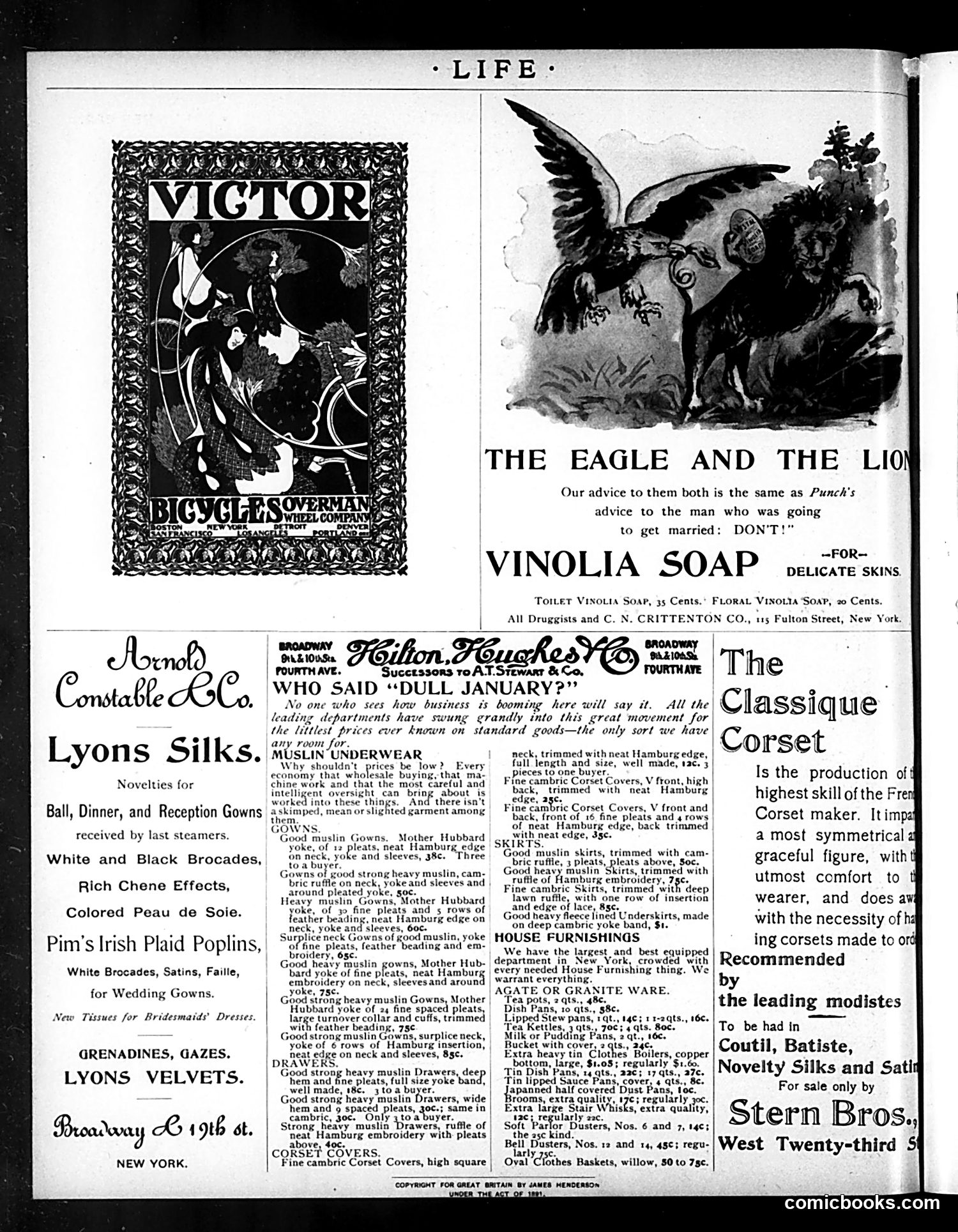
This page is **primarily advertising** with one small satirical cartoon. The main cartoon, titled "The Eagle and the Lion," depicts an eagle and lion in conversation. The accompanying text references *Punch* magazine's famous advice: "DON'T!" — suggesting the two animals (likely representing nations, possibly America and Britain) should avoid marriage or close union. The joke appears to play on international relations through animal symbolism, though without additional historical context, the specific political moment referenced is unclear. It's likely commentary on Anglo-American diplomatic relations of that era. The rest of the page consists entirely of period advertisements for silk goods, corsets, household furnishings, and toiletries—typical *Life* magazine commercial content from this period.
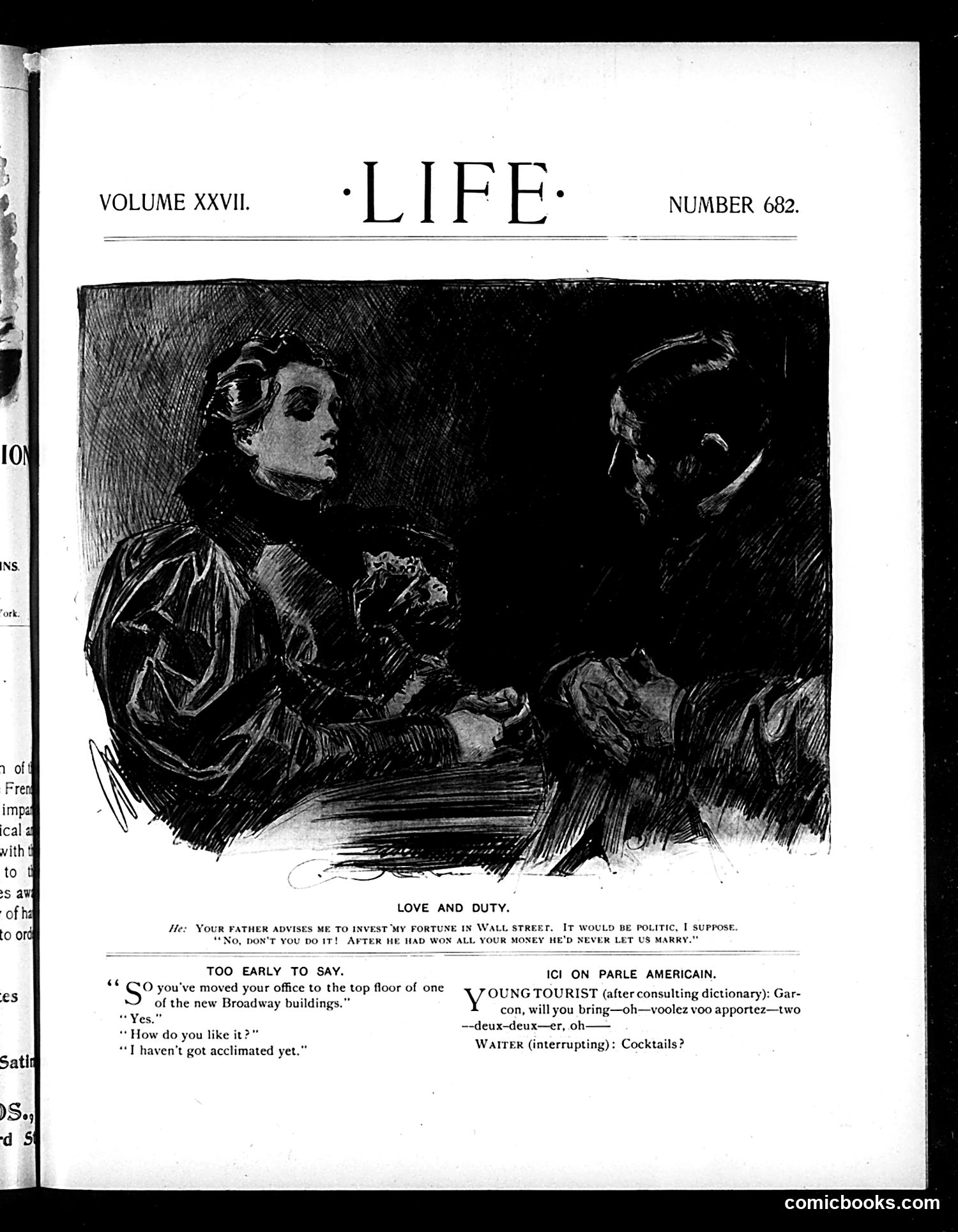
The main cartoon titled "Love and Duty" depicts a conversation between two figures—likely a woman and a man—about financial investment. The dialogue suggests a father advising his daughter to invest her fortune in Wall Street, promising wealth but warning she'd "never let us starve." This satirizes the tension between filial duty and personal financial security during the era of American industrial capitalism. Below are two brief humorous sketches: "Too Early to Say" mocks someone's adjustment to a new office location, while "Ici On Parle Américain" jokes about language barriers and American tourist behavior abroad, with a waiter misunderstanding a tourist's French attempts to order drinks. These pieces reflect early 20th-century American social anxieties about finance, mobility, and cultural identity.
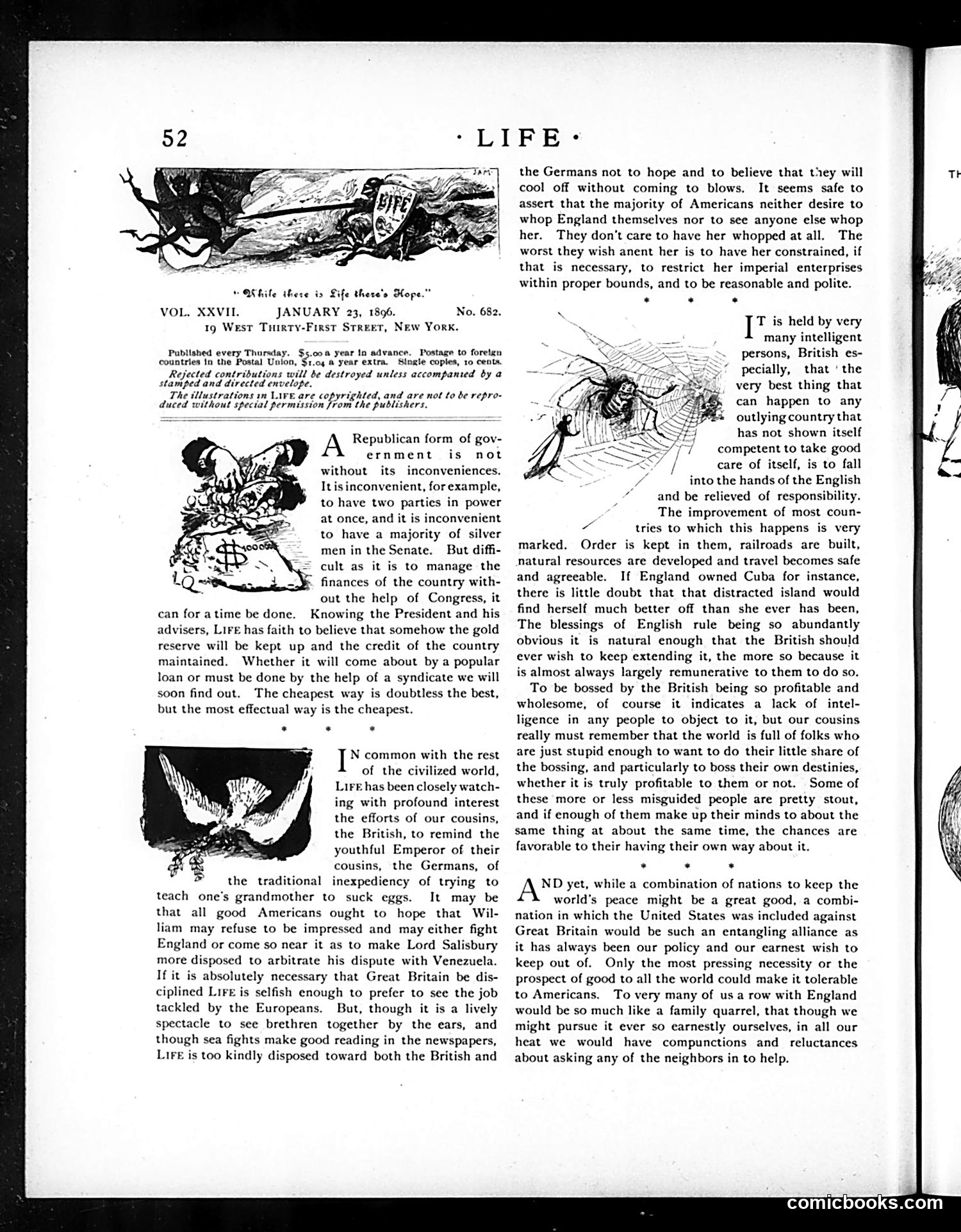
**Main Cartoon (top left):** Shows a figure labeled "BITE" - likely representing aggressive foreign policy or imperialism - attacking or menacing another figure. The caption "While there is Life there's Hope" suggests ironic commentary on American optimism despite international tensions. **Central Editorial Cartoon:** Depicts what appears to be a political figure (possibly President Cleveland or an advisor) juggling or managing financial matters, symbolized by coins and a money bag. This relates to the text's discussion of managing national finances and the gold reserve without Congressional help. **Context:** The page discusses Republican vs. Democratic governance, British influence, Venezuelan disputes, and American financial stability during the economically turbulent 1890s. The satire critiques American political divisions and international entanglements.
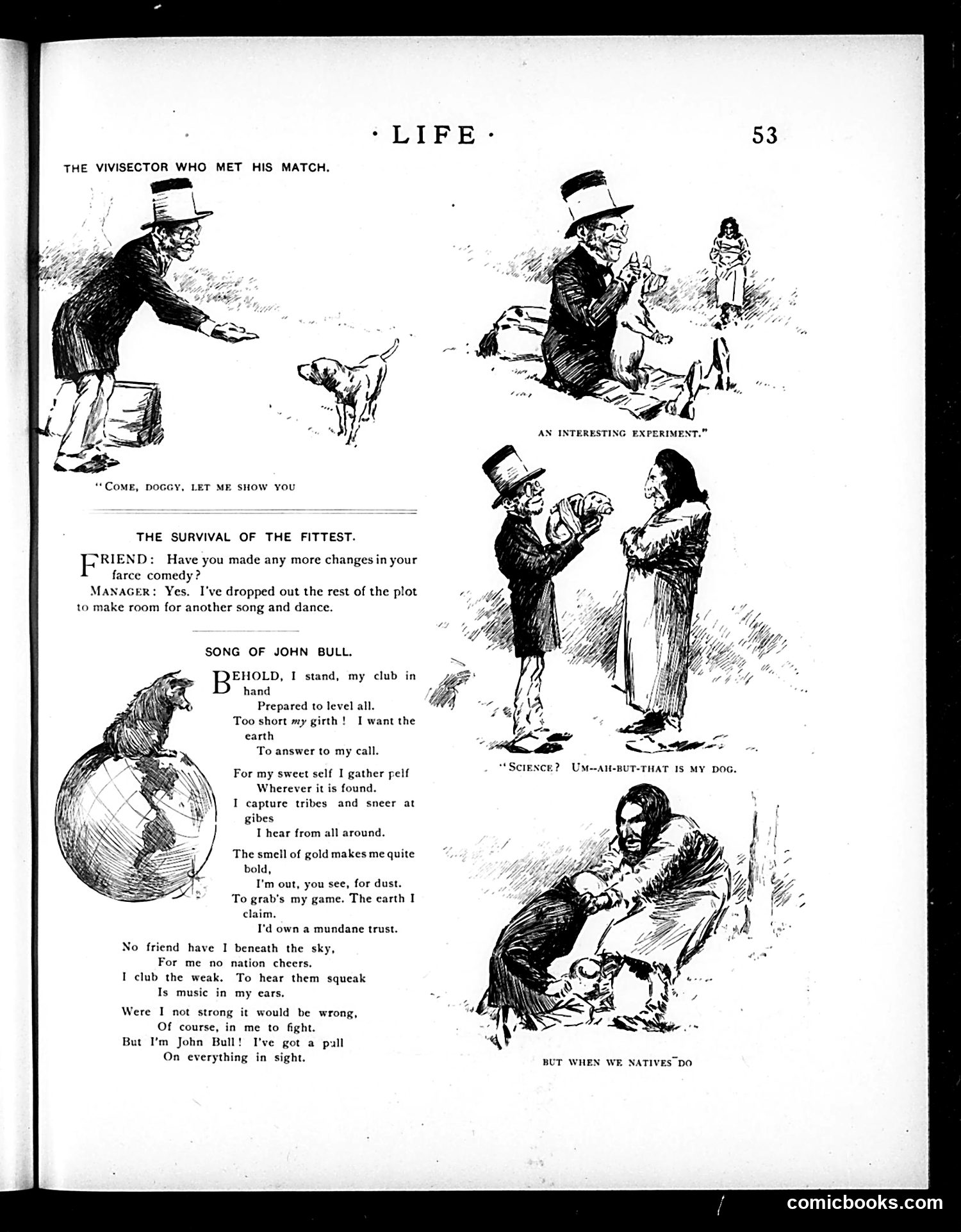
This page contains three satirical pieces: 1. **"The Vivvisector Who Met His Match"** shows a man attempting to train a small dog, with a woman observing—the joke being the reversal of who controls whom, mocking anti-vivisection sentiment popular in early 20th-century America. 2. **"The Survival of the Fittest"** is a brief dialogue mocking theater managers who sacrifice plot coherence for musical numbers and dance sequences. 3. **"Song of John Bull"** features a bull standing on Earth, with accompanying verse celebrating British imperial dominance and resource acquisition. The poem's boastful tone satirizes British jingoism and colonial attitudes of the era. The cartoons target animal welfare activism, commercial entertainment priorities, and British imperialism—all contemporary social concerns.
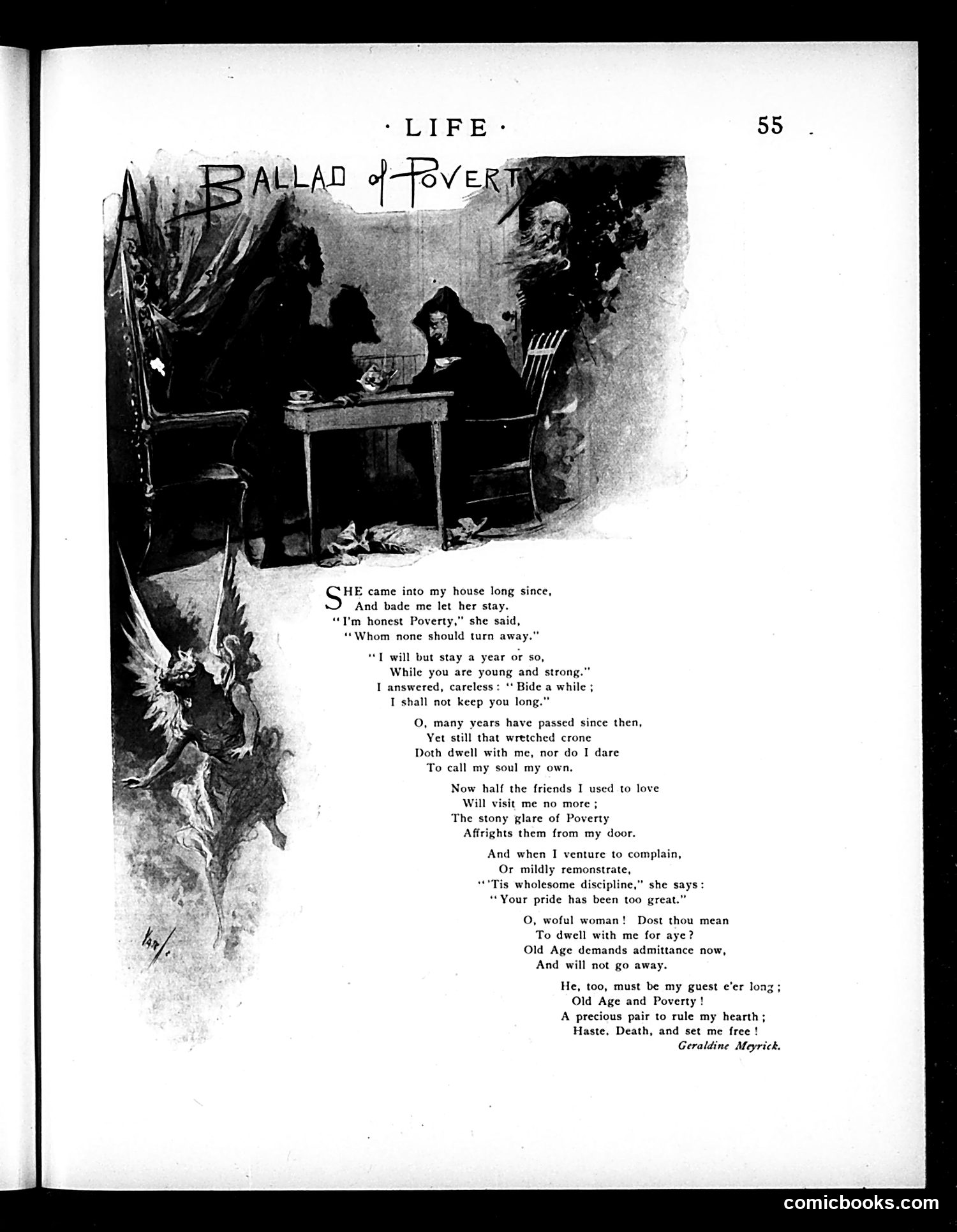
This page from *Life* magazine presents a poem by Geraldine Meyrick titled "A Ballad of Poverty." The accompanying illustration shows a sparse interior where poverty personified as a woman has taken up residence in someone's home. The poem's narrative describes Poverty as an unwelcome guest who arrived "long since" and overstayed indefinitely, despite promising to leave within a year. The speaker laments how this condition has isolated them—old friends now avoid visiting due to the "stony glare of Poverty" at the door, and acquaintances blame the speaker's "pride" for their misfortune. The work uses allegorical language to explore 19th-century attitudes toward poverty: as both a personal failing and a social stigma that causes shame and estrangement from community.
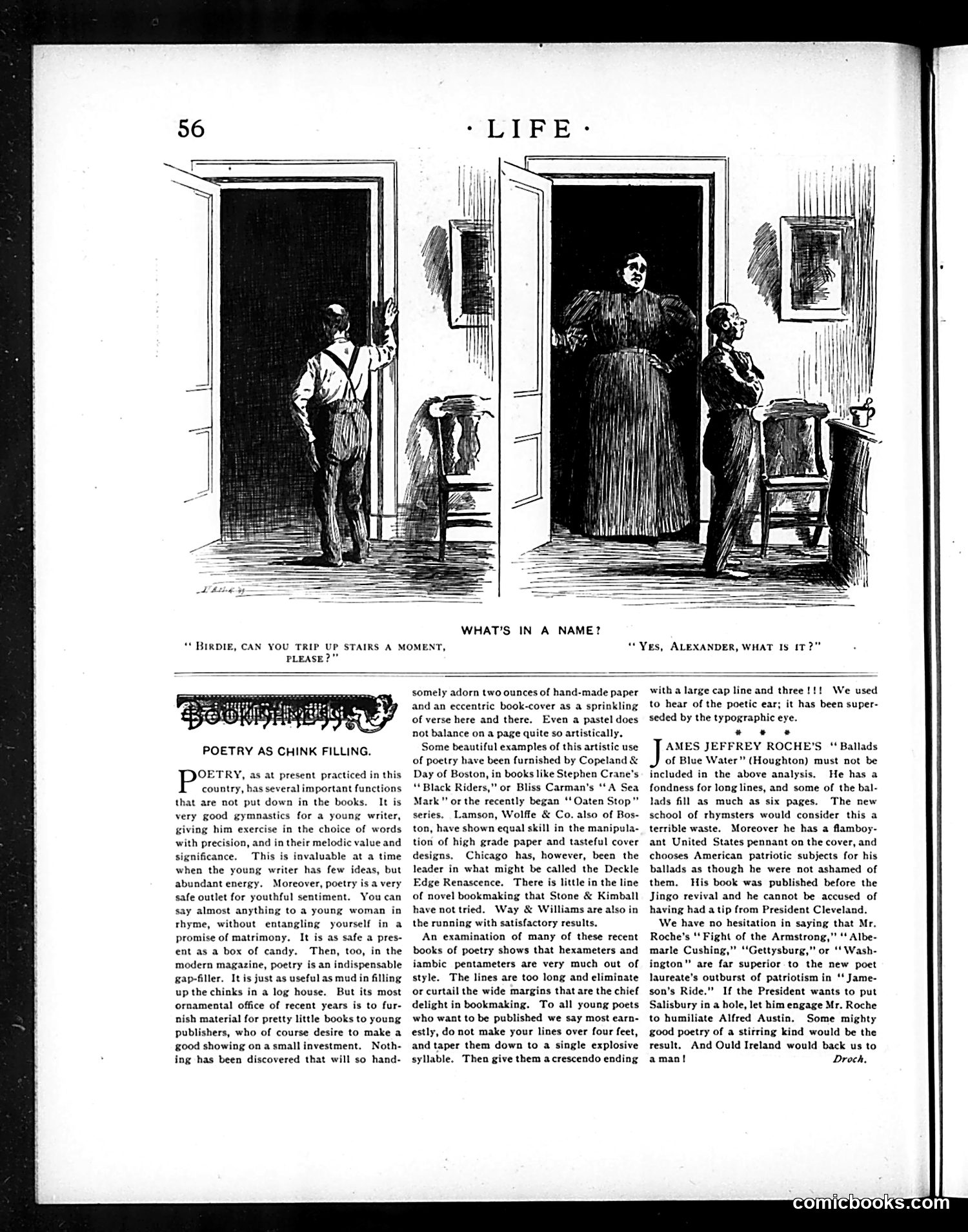
This two-panel cartoon depicts a domestic scene contrasting class positions. In the left panel, a maid addresses her employer: "Birdie, can you trip up stairs a moment, please?" In the right panel, the employer responds: "Yes, Alexander, what is it?" The satire plays on the formality of addressing servants by their first names casually, while servants must address employers with titles and formal surnames. The humor derives from the reversal: the maid calls the employer by an informal pet name ("Birdie"), while the employer calls the maid by a masculine name ("Alexander") — a mocking formality that ironically strips away dignity rather than conferring it. The cartoon satirizes the arbitrary social conventions governing class-based address and respect in the period.
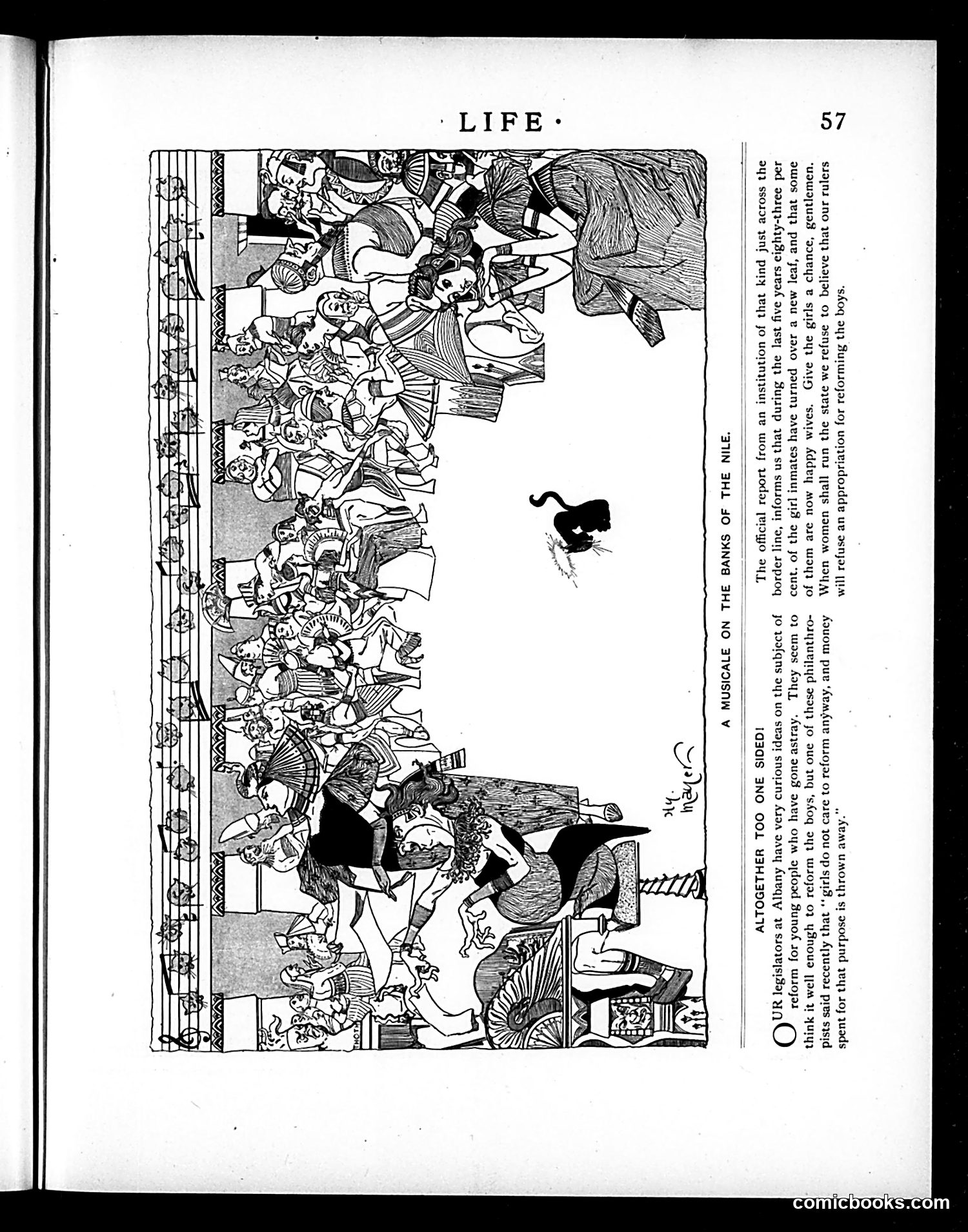
This is a satirical cartoon depicting what appears to be a chaotic scene along the Nile River. The image shows numerous figures in apparent disorder or conflict, with the caption suggesting a "miscue" (mistake or blunder) involving official or diplomatic matters in Egypt. The accompanying text discusses how "The official support from an instruction that had just across the border inform[s] during the last five years" and references "Young people who have turned over a new leaf and that matter. Given the dates and reference to Egypt, this likely satirizes recent colonial or imperial complications in Egypt, though the specific historical context and identities of key figures remain unclear from this page alone.
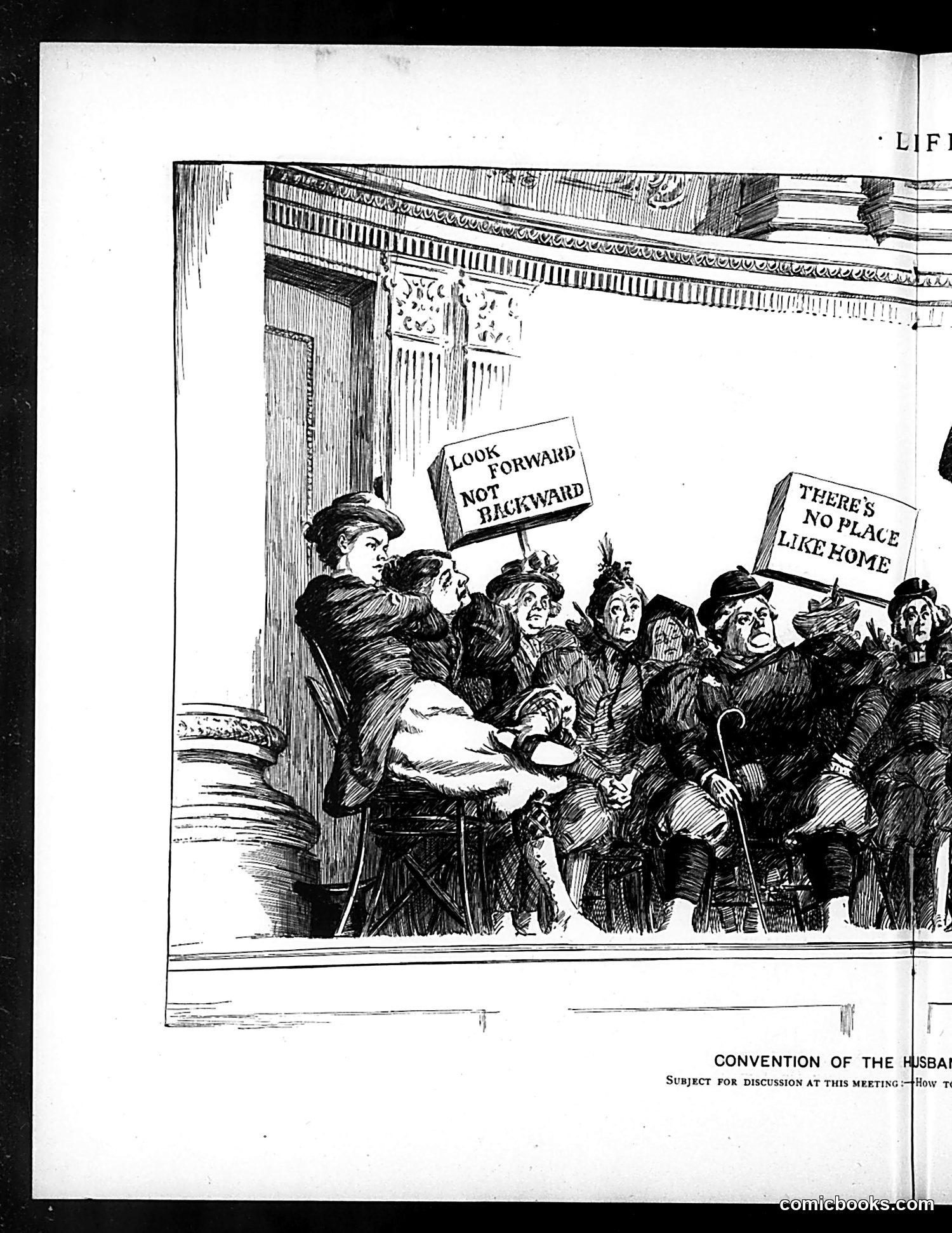
This satirical cartoon depicts a gathering of husbands holding protest signs. One sign reads "LOOK FORWARD NOT BACKWARD" while another states "THERE'S NO PLACE LIKE HOME." A speaker (left) addresses the assembled group from what appears to be a formal building interior. The satire appears to criticize husbands' resistance to social progress, particularly regarding women's roles. The conflicting messages—urging forward-thinking while simultaneously invoking domestic tradition—suggest hypocrisy in male opposition to women's advancement. The "convention" format mocks organized resistance to social change. The cartoon likely addresses early 20th-century debates over women's rights, suffrage, or labor participation, presenting husbands' arguments against such progress as contradictory and worthy of ridicule.
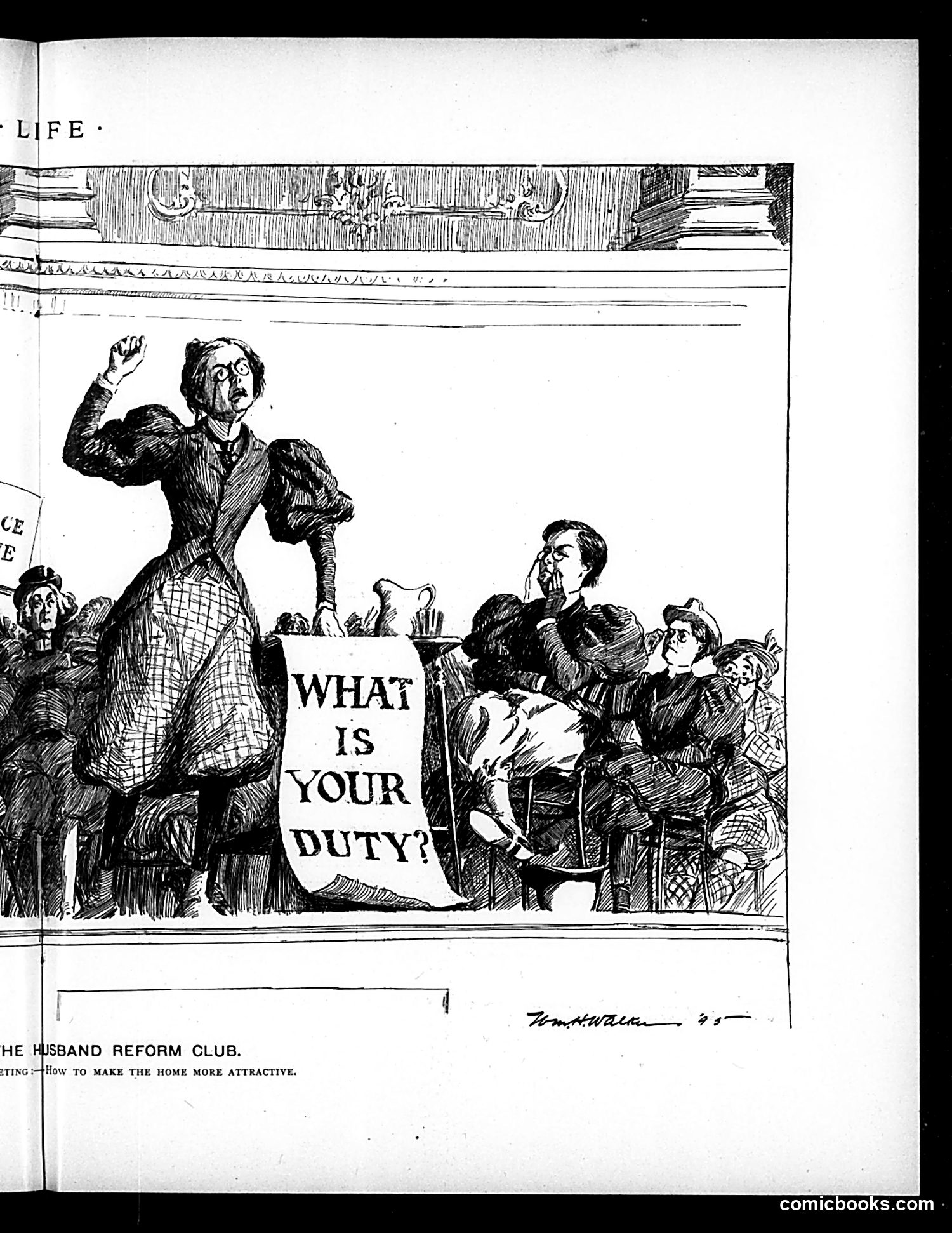
This satirical cartoon depicts a woman standing on a podium addressing a meeting, with the caption "WHAT IS YOUR DUTY?" The visible text references "THE HUSBAND REFORM CLUB" and "HOW TO MAKE THE HOME MORE ATTRACTIVE." The cartoon mocks early 20th-century women's reform movements and domestic advice culture. It satirizes women's clubs that advocated improving domestic life, suggesting they functioned as forums to lecture men about their household responsibilities and behavior. The woman's commanding pose and the audience's apparent discomfort lampoon the era's gender dynamics—specifically, the notion of wives organizing to "reform" their husbands' conduct. The satire targets both women's organizing efforts and the domestic reform rhetoric of the period, presenting it as somewhat comedic overreach.
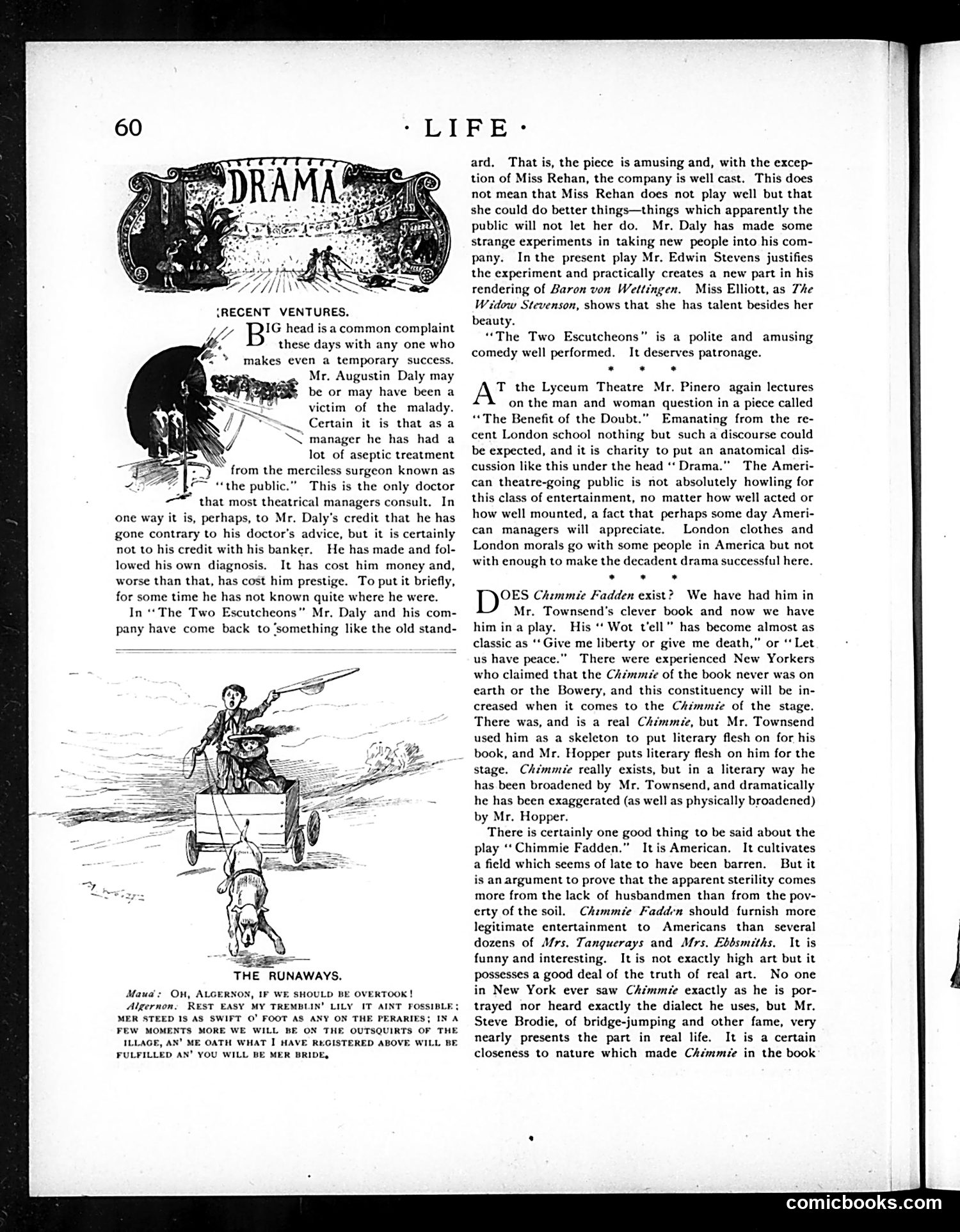
This page reviews recent theatrical productions. The main cartoon, "The Runaways," depicts a melodramatic scene of eloping lovers in a horse-drawn cart, with exaggerated dialogue ("If we should be overtook!"). It's a satirical visual commentary on the sorts of overwrought theatrical plots being staged. The text discusses theater manager Augustin Daly's recent play "The Two Escutcheons," suggesting he's lost creative direction and public favor—comparing public opinion to a "merciless surgeon." It also reviews "The Benefit of the Doubt" at the Lyceum Theatre, dismissing London-influenced "decadent drama" as unsuited to American audiences. Most notably, the page praises "Chimmie Fadden," a stage adaptation of a popular book character. The critic argues this American play proves the theater can succeed by cultivating "American" subject matter rather than imported British morality plays—suggesting a contemporary cultural debate about American versus European theatrical legitimacy.
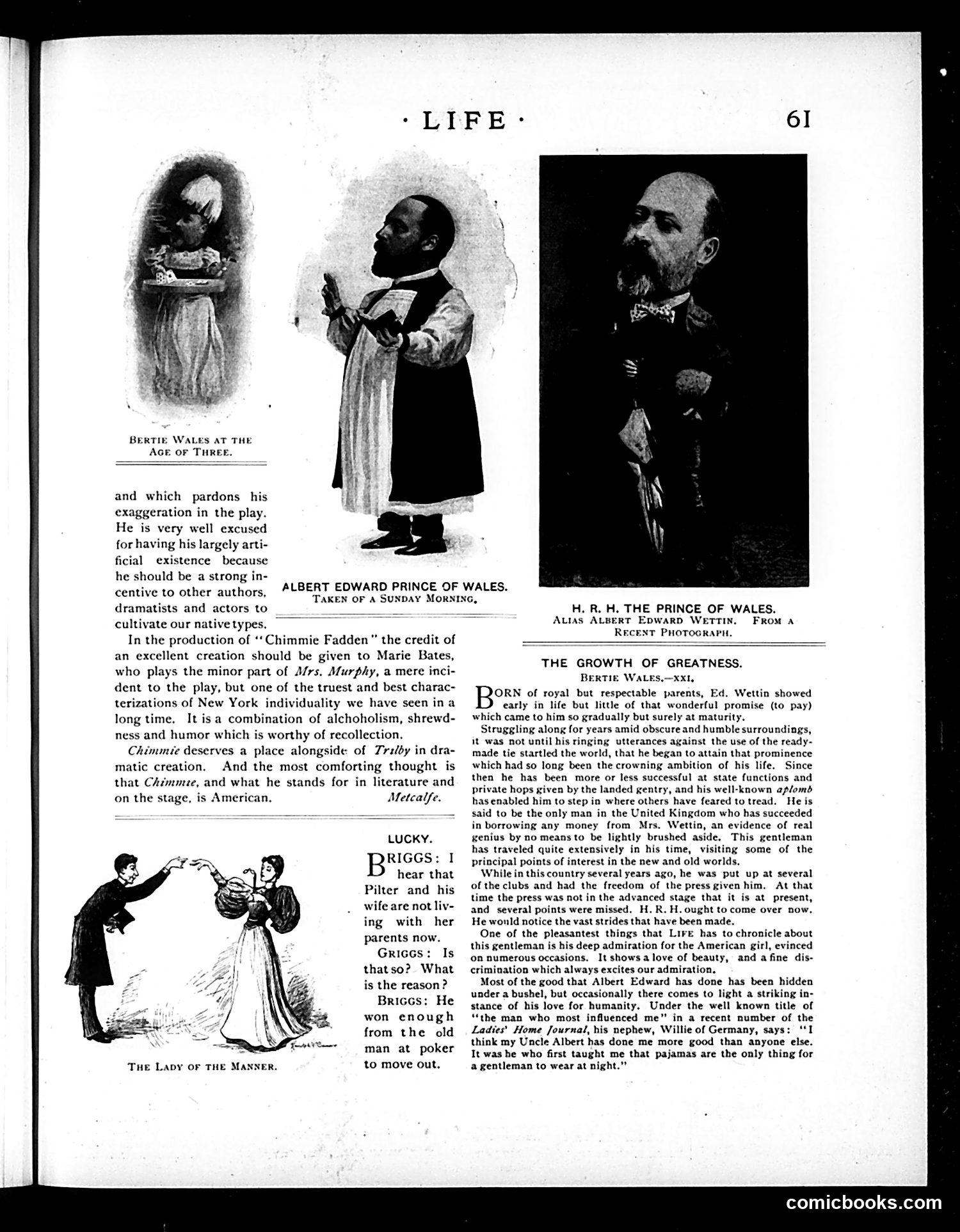
This page satirizes **Albert Edward, Prince of Wales** (later King Edward VII), the heir to the British throne. The three photographs show him at different ages, labeled mockingly as "Bertie Wales." The main text, "The Growth of Greatness," is heavy satire. It claims he was born of "royal but respectable parents" and achieved prominence primarily by opposing "ready-made ties"—a trivial accomplishment inflated as major. The piece notes his talent for borrowing money and his well-known *aplomb* (composure), and praises his "deep admiration for the American girl." The closing anecdote—where his nephew Kaiser Wilhelm credits him with teaching that "pajamas are the only thing for a gentleman to wear at night"—is the satirical punchline: the Prince's sole meaningful contribution to civilization is fashion advice about sleepwear. The sidebar cartoon "Lucky" jokes about a man winning poker money from his father-in-law, allowing escape from in-laws—lighthearted domestic humor unrelated to the main content.
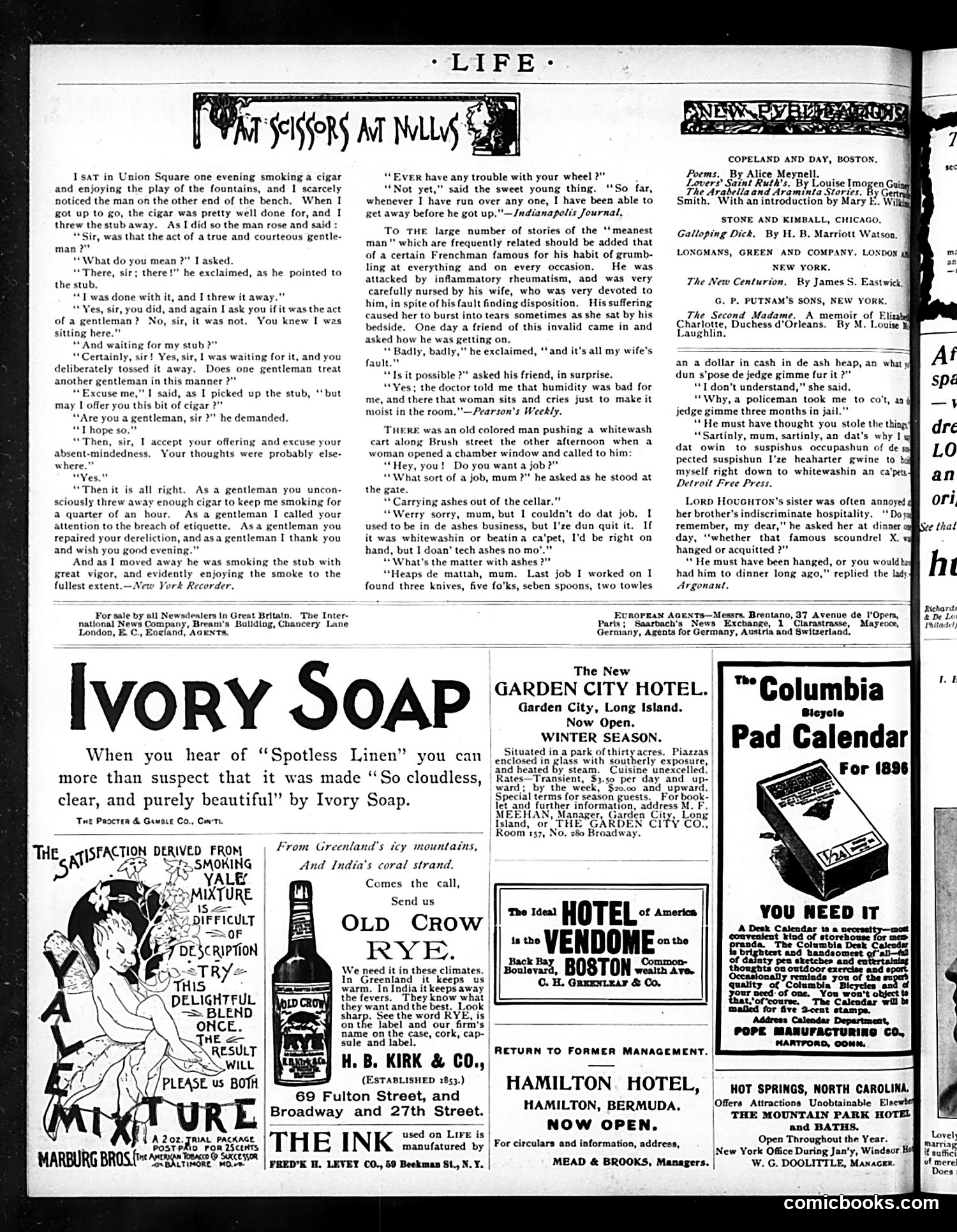
This page features three humorous anecdotes typical of *Life* magazine's satirical humor, presented without political content. **The Main Story** ("Scissors at Nully's"): A gentleman in Union Square discards a cigar stub. Another man—apparently poor or homeless—objects, claiming the smoker has violated gentlemanly etiquette by wasting tobacco he could have shared. The "twist" is that this shabby man lectures the well-dressed gentleman on proper conduct, ultimately shaming him into retrieving and offering the stub. The satire mocks both excessive pride in poor circumstances and the hypocrisy of "gentlemanly" behavior. **The three shorter anecdotes** satirize: 1. A woman cyclist's cavalier attitude toward hitting pedestrians 2. A hypochondriac Frenchman blaming his wife's emotional tears for worsening his humidity-sensitive condition 3. A Black laborer refusing ash-hauling work because his previous job in "ashes" yielded too many lost valuables The humor relies on period-specific class anxieties, gender stereotypes, and racial caricature typical of 1890s American magazine humor.
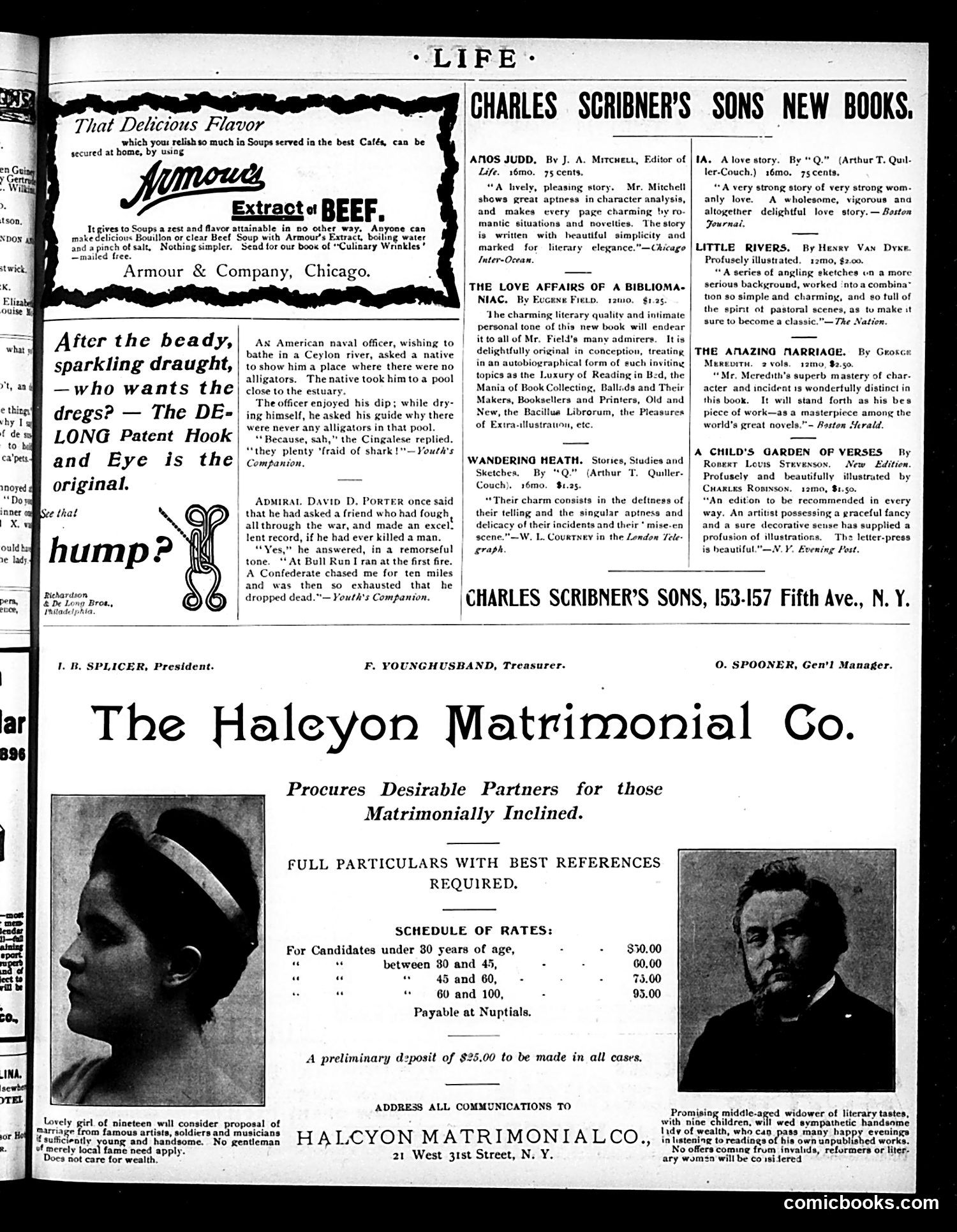
This page is primarily **advertisements and book reviews**, not political satire or editorial cartooning. The content includes: **Book advertisements** from Charles Scribner's Sons promoting literary works (novels and poetry collections) **Product advertisements** for Armour's Beef Extract (a soup flavoring) and DeLong Patent Hook and Eye (fasteners) **The Haleycon Matrimonial Co.** — a matchmaking service advertising "desirable partners for those matrimonially inclined," with pricing tiers ($30-$93) based on age and a required $25 deposit **Two brief humorous anecdotes** from *Youth's Companion* magazine about a Ceylon river (alligators) and Admiral David D. Porter (Civil War story) The page reflects late 19th/early 20th-century commercial culture: consumer products, literary publishing, and notably, a formalized matchmaking business treating marriage as a transactional service with published rates. There is no political commentary or caricature.
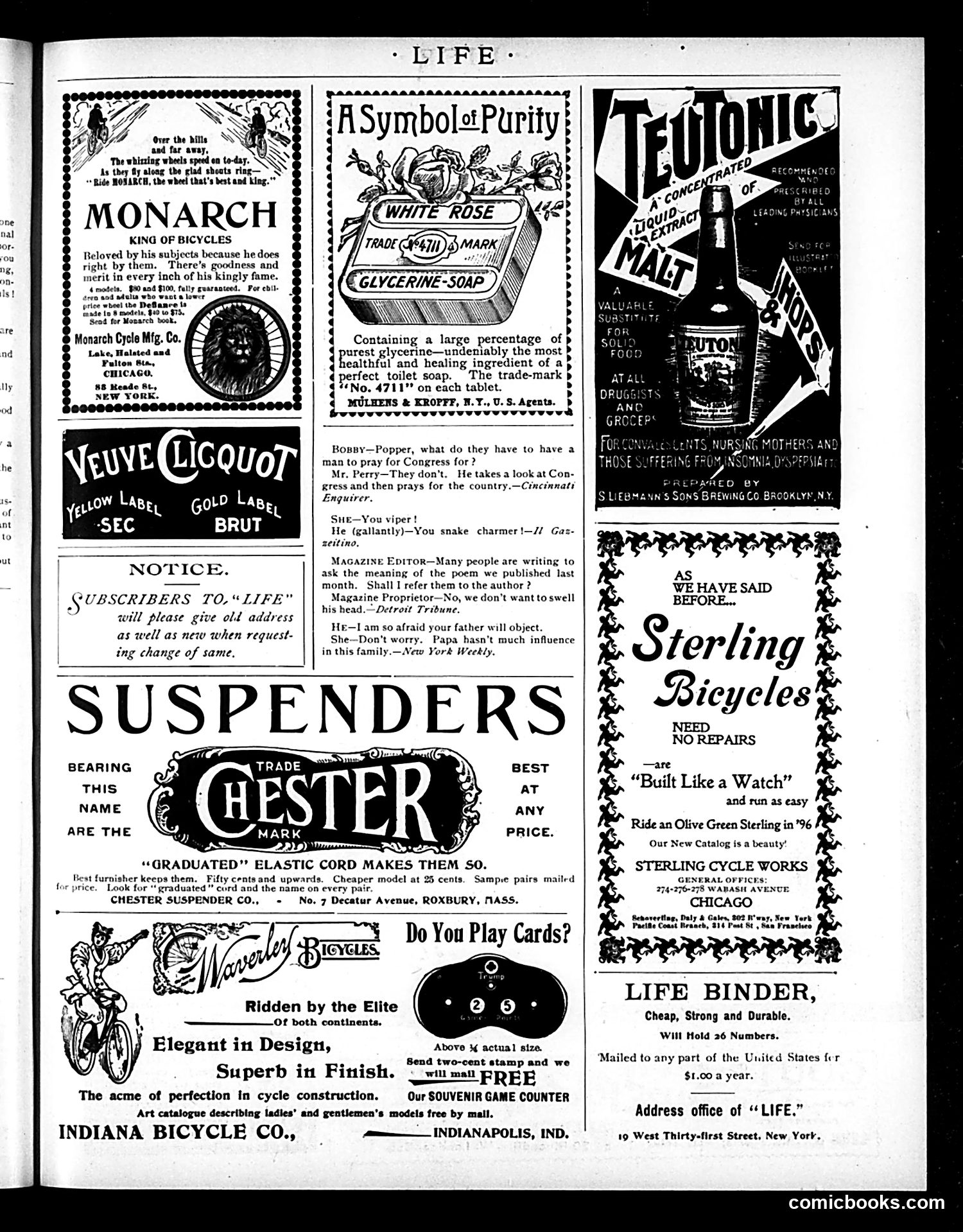
This is primarily an **advertising page** from Life magazine, circa 1890s, featuring period product endorsements with minimal satirical content. The page includes several humorous short jokes typical of the era: - A Congress joke mocking politicians' need for prayer - A flirtation joke playing on "viper/snake charmer" wordplay - Editorial humor about a confusing poem and a wife's independence from her father The bulk of the page consists of bicycle and consumer product advertisements—Monarch bicycles, Chester suspenders, Indiana and Sterling bicycles, along with soap, liquor, and malt extract products. These reflect the 1890s bicycle craze. The only identifiable cultural reference is the **Congress joke**, a mild jab at legislative incompetence. Otherwise, the page showcases late-Victorian consumer culture and genteel humor typical of Life's target middle-class audience rather than pointed political satire.
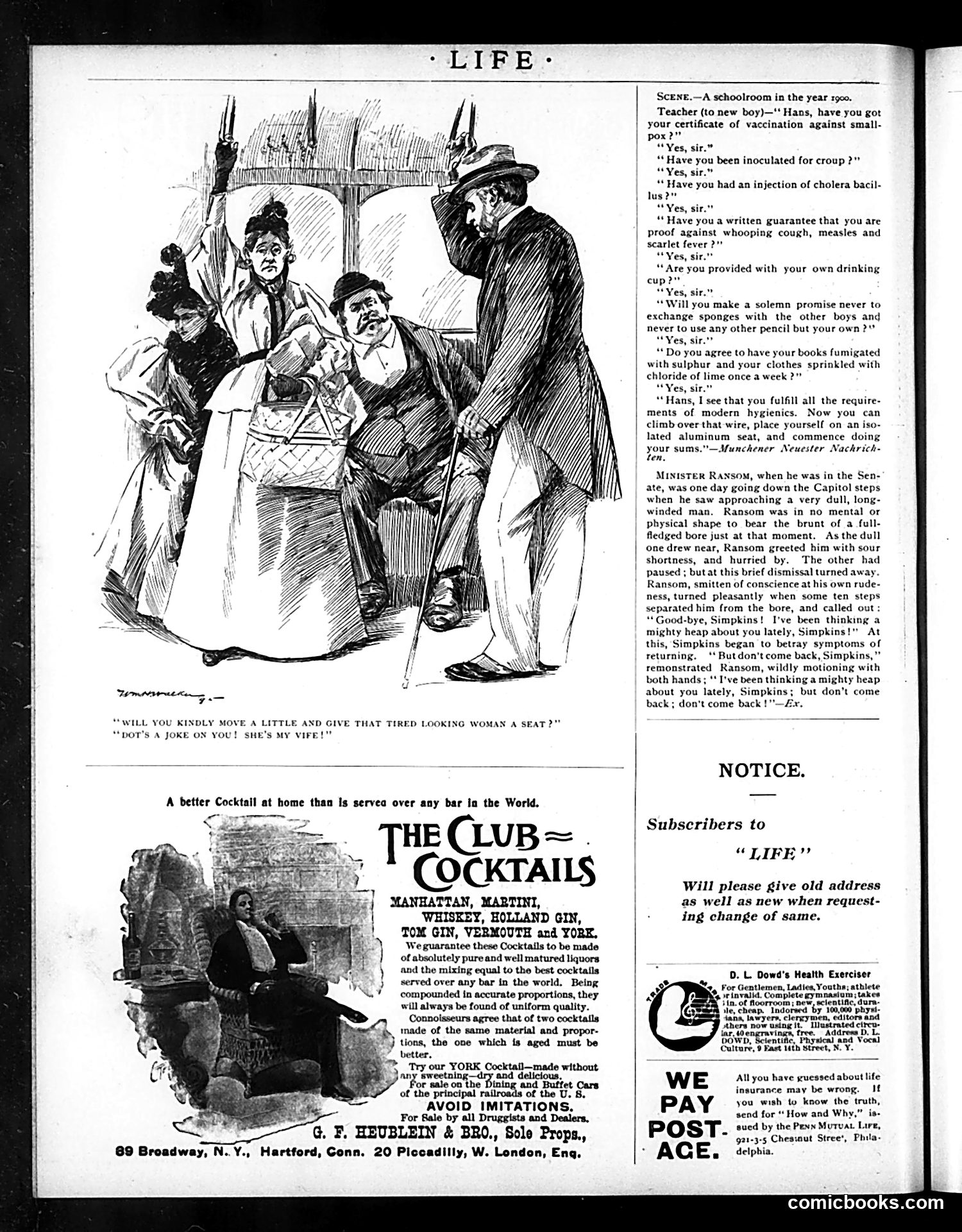
**Main Cartoon ("Will You Kindly Move..."):** A man refuses to give his seat to a tired-looking woman on public transportation, claiming "it's a joke on you! She's my wife!" The satire mocks male rudeness and lack of chivalry—particularly the pretense that mistreating one's own wife is humorous rather than shameful. It critiques both the man's behavior and the social acceptance of such conduct. **School Hygiene Cartoon (text):** This satirizes obsessive early-1900s hygiene practices in schools. A teacher interrogates a new student about vaccinations, inoculations, drinking cups, and sanitized materials—then ironically seats him on an "isolated aluminum seat" to do arithmetic. The joke: despite all these modern precautions, the actual learning environment remains absurd and impractical. **Historical Context:** Both pieces reflect turn-of-the-century anxieties about disease prevention and evolving social expectations, while mocking overcorrection and hypocrisy. **Page also contains:** Cocktail advertising (Heublein & Bros.), subscription notices, and health product ads typical of the era.
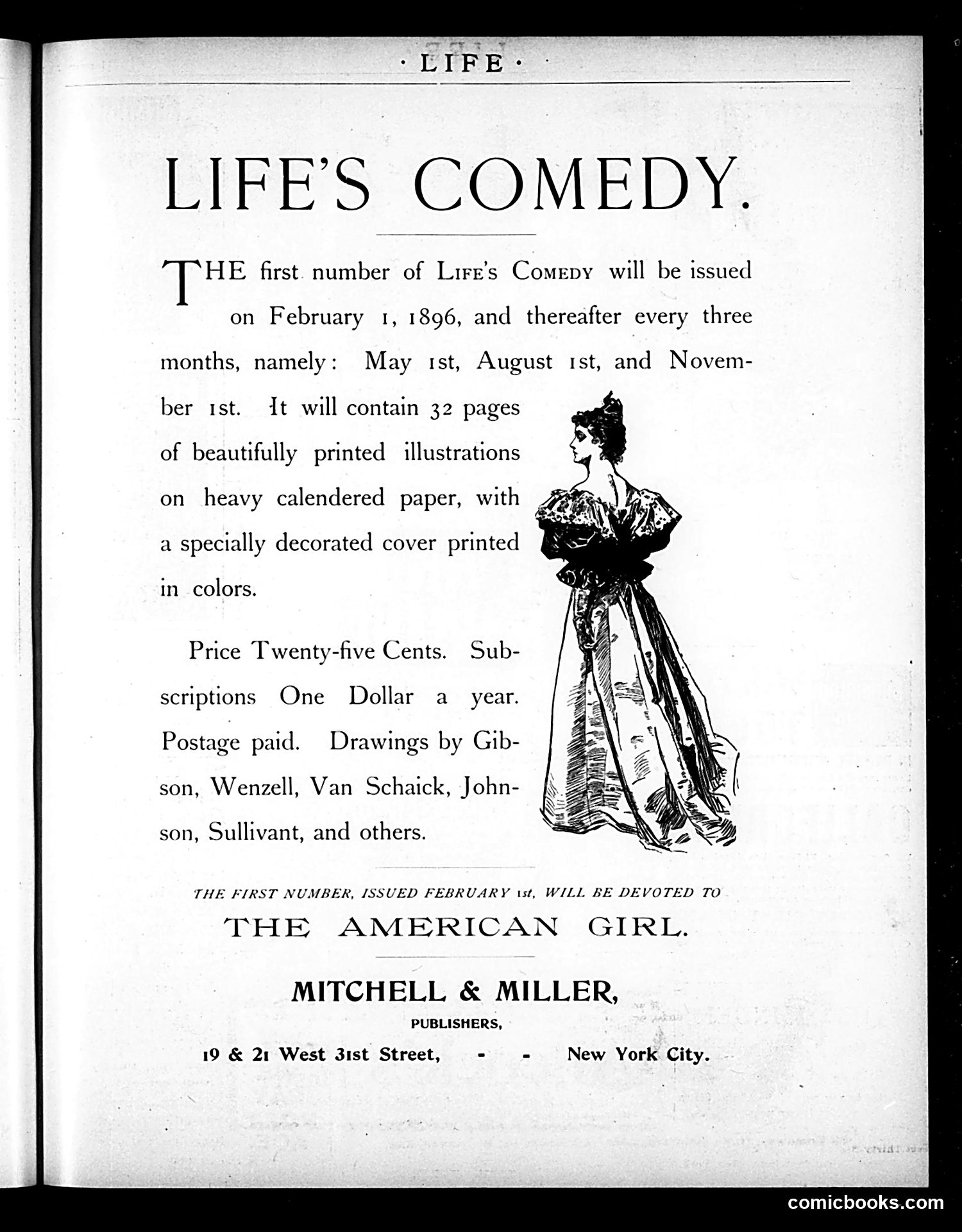
This is primarily an **advertisement for a new publication series**, not political satire. "Life's Comedy" was a quarterly illustrated magazine launching February 1, 1896, published by Mitchell & Miller in New York. The page announces: - **Format**: 32 pages of illustrations on quality paper, colored cover - **Price**: 25 cents per issue; $1/year subscription - **Artists**: Notable illustrators Gibson, Wenzell, Van Schaick, Johnson, and Sullivant—prestigious names in late-19th-century American cartooning - **First issue theme**: "The American Girl" The elegant pen-and-ink illustration of a fashionable woman in 1890s dress exemplifies the publication's focus on contemporary society and female subjects. This reflects the period's growing market for illustrated magazines aimed at middle-class readers, particularly appealing to women interested in fashion, social commentary, and humor.
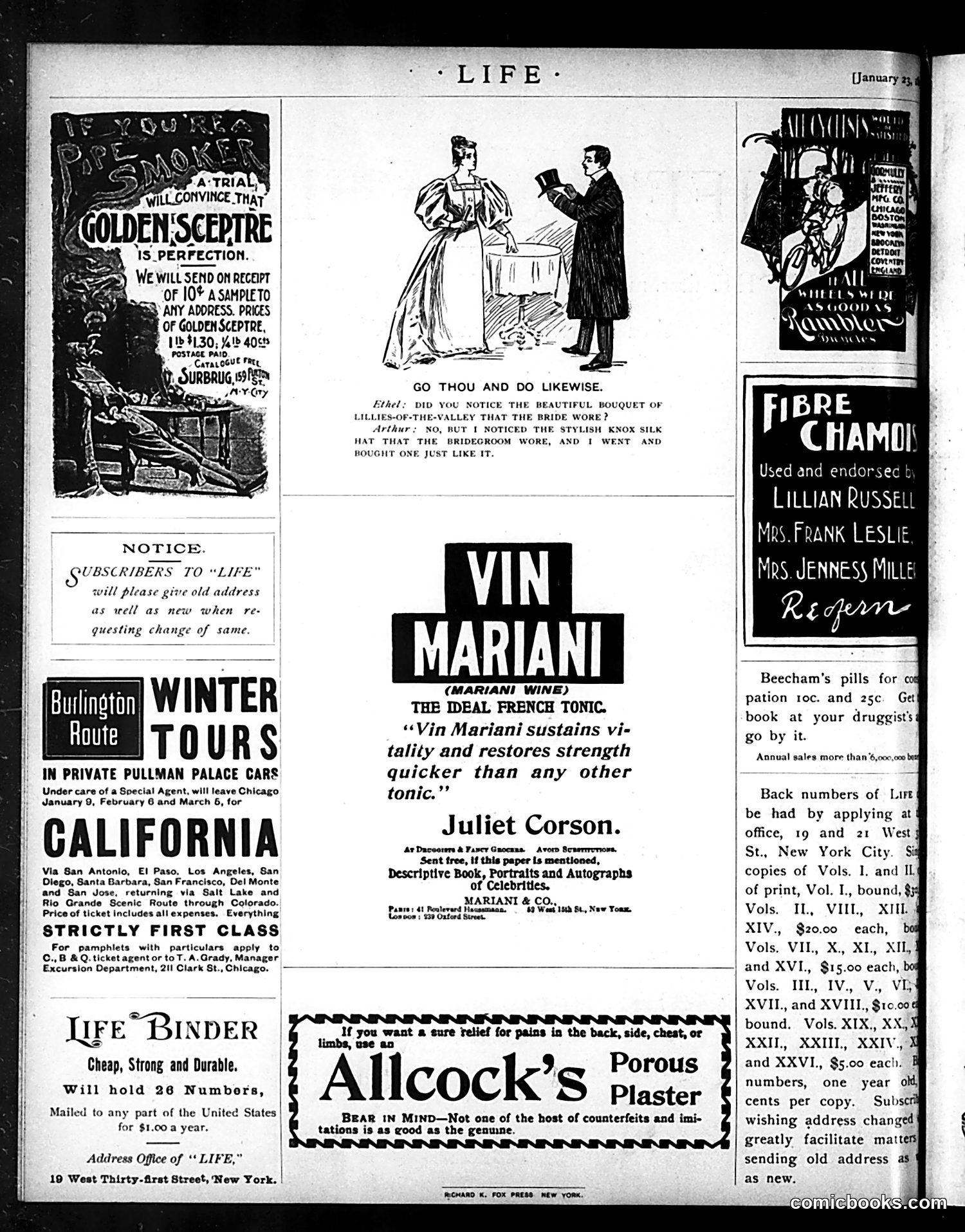
This page is primarily **advertisements and notices** rather than political satire. The main cartoon shows a dialogue between "Ethel" and "Arthur" about a wedding: Ethel asks if Arthur noticed the bride's beautiful bouquet of lilies-of-the-valley, but Arthur reveals he was actually paying attention to the **bridegroom's stylish Knox silk hat**—and promptly bought one identical to it. **The joke** satirizes male materialism and shallow consumerism: rather than appreciating romantic or aesthetic details (the bridal flowers), the male character focuses on acquiring fashionable accessories for himself. This reflects early 20th-century social commentary about masculine vanity. The page also features vintage advertisements for Vin Mariani (a wine tonic endorsed by actress Lillian Russell), Beecham's pills, Burlington Route California tours, and other period products—typical of Life magazine's revenue model.