
Life, 1896-01-23 · page 8 of 20
Life — January 23, 1896 — page 8: what you’re looking at
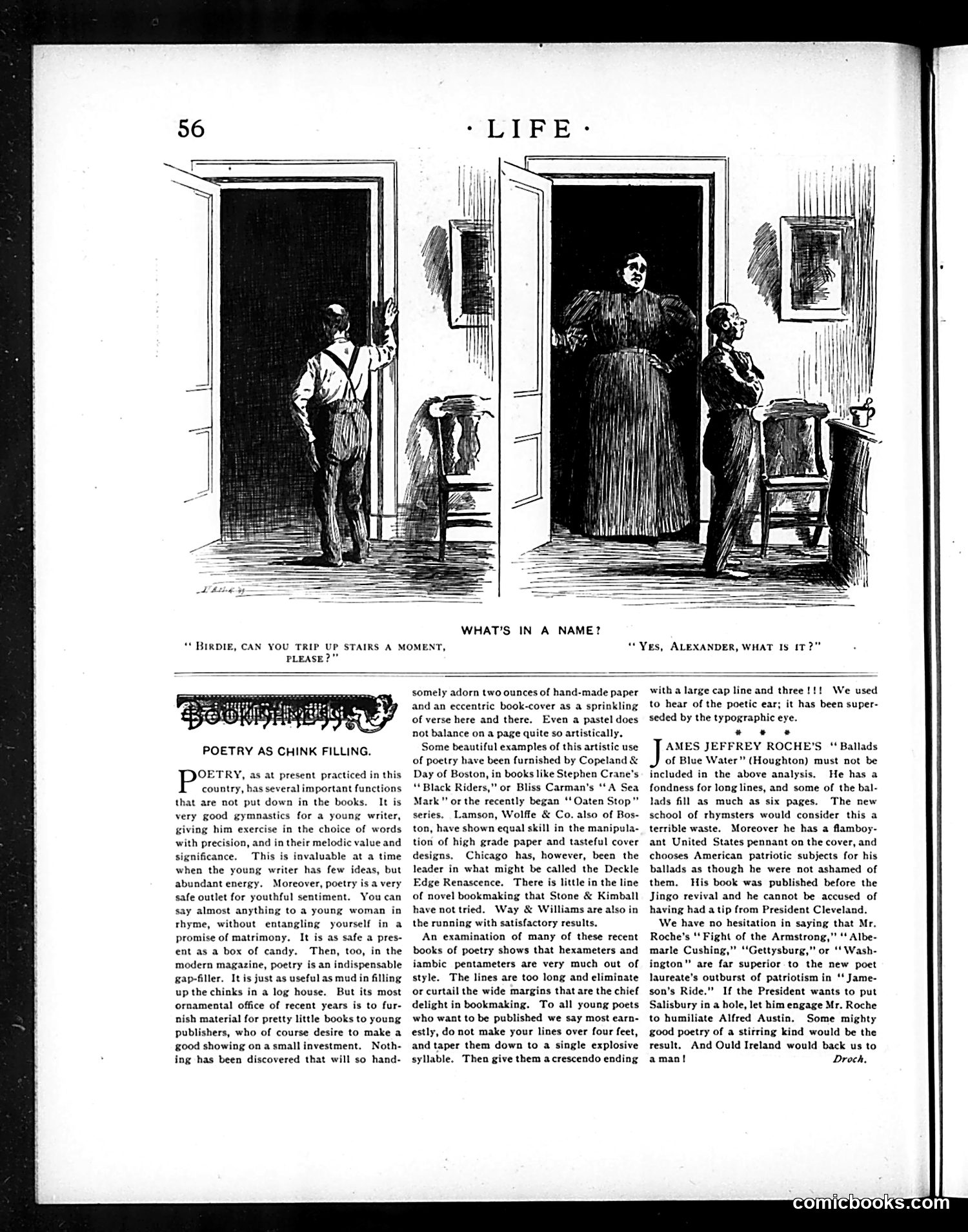
What you’re looking at
This two-panel cartoon depicts a domestic scene contrasting class positions. In the left panel, a maid addresses her employer: "Birdie, can you trip up stairs a moment, please?" In the right panel, the employer responds: "Yes, Alexander, what is it?" The satire plays on the formality of addressing servants by their first names casually, while servants must address employers with titles and formal surnames. The humor derives from the reversal: the maid calls the employer by an informal pet name ("Birdie"), while the employer calls the maid by a masculine name ("Alexander") — a mocking formality that ironically strips away dignity rather than conferring it. The cartoon satirizes the arbitrary social conventions governing class-based address and respect in the period.
📄 Transcribed text from this page (OCR, searchable)
Machine-transcribed from the original scan — historical spelling and the odd misread are preserved.
‘‘ BIRDIE, CAN YOU TRIP be STAIRS A MOMENT, POETRY AS CHINK FILLING. OETRY, as at present practiced in this country, has several important functions that are not put down in the books. It is very good gymnastics for a young writer, ing him exercise in the choice of words with precision, and in their melodic value and significance. This is invaluable at a time when the young writer has few ideas, but abundant energy. Moreover, poetry isa very safe outlet for youthful sentiment. Youcan say almost anything to a young woman in thyme, without entangling yourself in a promise of matrimony. It is as safe a pres- ent as a box of candy, Then, too, in the modern magazine, poetry is an indispensable gap-filler, It is just as useful as mud in filling up the chinks in a log house. But its most ornamental office of recent years is to fur- nish material for pretty little books to young publishers, who of course desire to make a good showing on a small investment. Noth- ing has been discovered that will so hand- WHAT’S IN A NAME? “Yes, ALEXANDER, WHAT IS IT?” somely adorn two ounces of hand-made paper and an eccentric book-cover as a sprinkling of verse here and there. Even a pastel does not balance on a page quite so artistically. Some beautiful examples of this artistic use of poetry have been furnished by Copeland & Day of Boston, in books like Stephen Crane's “Black Riders,” or Bliss Carman’s ‘A Sea Mark" or the recently began ‘‘Oaten Stop” series. Lamson, Wolffe & Co. also of Bos- ton, have shown equal skill in the manipula- tion of high grade paper and tasteful cover designs. Chicago has, however, been the leader in what might be called the Deckle Edge Renascence. There is little in the line of novel bookmaking that Stone & Kimball have not tried. Way & Williams are also in the running with satisfactory results, An examination of many of these recent books of poetry shows that hexameters and iambic pentameters are very much out of style. The lines are too long and eliminate or curtail the wide margins that are the chief delight in bookmaking. To all young poets who want to be published we say most earn- estly, do not make your lines over four feet, and taper them down to a single explosive syllable. Then give them acrescendo ending with a large cap line and three!!! We used to hear of the poetic ear; it has been super- seded by the typographic eye. * # 6 AMES JEFFREY ROCHE'S ‘Ballads of Blue Water” (Houghton) must not be included in the above analysis. He has a fondness for long lines, and some of the bal- lads fill as much as six pages. The new school of rhymsters would consider this a terrible waste. Moreover he has a flamboy- ant United States pennant on the cover, and chooses American patriotic subjects for his ballads as though he were not ashamed of them. His book was published before the Jingo revival and he cannot be accused of having had a tip from President Cleveland. We have no hesitation in saying that Mr. Roche's "Fight of the Armstrong,” " Albe- marle Cushing,” ‘‘Gettysburg,” or ‘* Wash- ington" are far superior to the new poet laureate’s outburst of patriotism in ‘t Jame- son's Ride.” If the President wants to put Salisbury in a hole, let him engage Mr. Roche to humiliate Alfred Austin. Some mighty good poetry of a stifring kind would be the result, And Ould Ireland would back us to aman! Droch,