
Life, 1896-01-23 · page 12 of 20
Life — January 23, 1896 — page 12: what you’re looking at
What you’re looking at
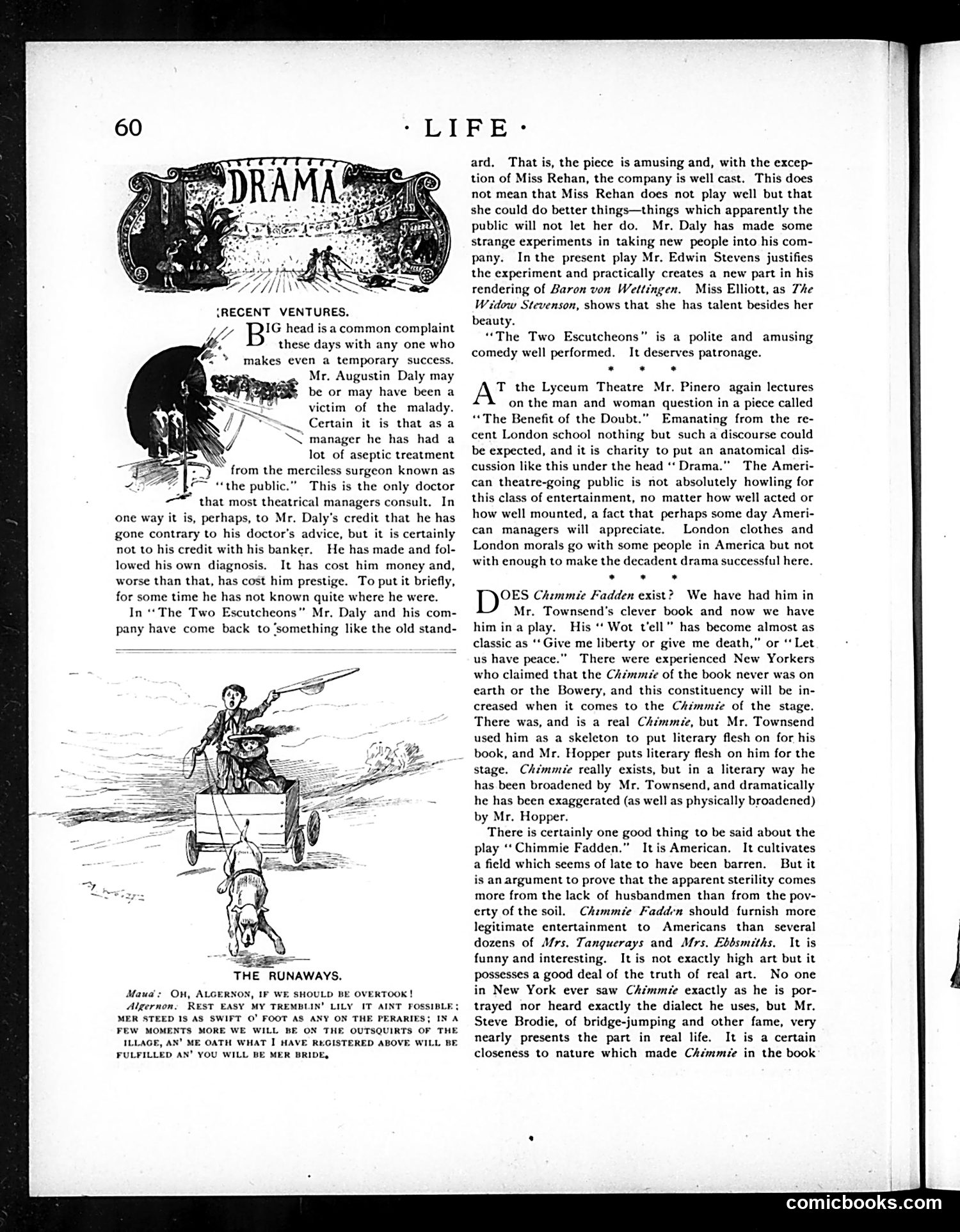
This page reviews recent theatrical productions. The main cartoon, "The Runaways," depicts a melodramatic scene of eloping lovers in a horse-drawn cart, with exaggerated dialogue ("If we should be overtook!"). It's a satirical visual commentary on the sorts of overwrought theatrical plots being staged. The text discusses theater manager Augustin Daly's recent play "The Two Escutcheons," suggesting he's lost creative direction and public favor—comparing public opinion to a "merciless surgeon." It also reviews "The Benefit of the Doubt" at the Lyceum Theatre, dismissing London-influenced "decadent drama" as unsuited to American audiences. Most notably, the page praises "Chimmie Fadden," a stage adaptation of a popular book character. The critic argues this American play proves the theater can succeed by cultivating "American" subject matter rather than imported British morality plays—suggesting a contemporary cultural debate about American versus European theatrical legitimacy.
📄 Transcribed text from this page (OCR, searchable)
Machine-transcribed from the original scan — historical spelling and the odd misread are preserved.
> LIFE: G head is acommon complaint these days with any one who makes even a temporary success. Mr. Augustin Daly may be or may have been a victim of the malady. ~ Certain it is that asa ‘NV manager he has had a q lot of aseptic treatment Es) “ from the merciless surgeon known as & “the public.” This is the only doctor —* that most theatrical managers consult. In one way it is, perhaps, to Mr. Daly's credit that he has gone contrary to his doctor's advice, but it is certainly not to his credit with his banker. He has made and fol- lowed his own diagnosis. It has cost him money and, worse than that, has cost him prestige. To put it briefly, for some time he has not known quite where he were. In ‘The Two Escutcheons” Mr. Daly and his com- pany have come back to ‘something like the old stand- THE RUNAWAYS. Maud; OW, ALGERNON, IF WE SHOULD BE OVERTOOK ! Algernon, REST EASY MY TREMBLIN’ LILY IT AINT F MER STEED 1S AS SWIFT ©’ FOOT AS ANY ON THE PERARI FEW MOMENTS MORE WE WILL BE ON THE OUTSQUIRTS OF THE ILLAGE, AN’ ME OATH WHAT I HAVE REGISTERED ABOVE WILL BE FULFILLED AN’ YOU WILL BE MER BRIDE, ard. That is, the piece is amusing and, with the excep- tion of Miss Rehan, the company is well cast. This does not mean that Miss Rehan does not play well but that she could do better things—things which apparently the public will not let her do. Mr. Daly has made some strange experiments in taking new people into his com- pany. Inthe present play Mr. Edwin Stevens justifies the experiment and practically creates a new part in his rendering of Baron von Wettingen. Miss Elliott, as The Widow Stevenson, shows that she has talent besides her beauty. “The Two Escutcheons” a polite and amusing comedy well performed. It deserves patronage. “ 8 6 A’ the Lyceum Theatre Mr. Pinero again lectures on the man and woman question in a piece called “The Benefit of the Doubt.” Emanating from the re- cent London school nothing but such a discourse could be expected, and it is charity to put an anatomical dis- cussion like this under the head ‘‘ Drama." The Ameri- can theatre-going public is not absolutely howling for this class of entertainment, no matter how well acted or how well mounted, a fact that perhaps some day Ameri- can managers will appreciate. London clothes and London morals go with some people in America but not with enough to make the decadent drama successful here. * 8 6 OES Chimmie Fadden exist? We have had him in Mr. Townsend's clever book and now we have him ina play. His ‘* Wot t’ell” has become almost as classic as ‘* Give me liberty or give me death,” or ‘Let us have peace." There were experienced New Yorkers who claimed that the Chzmmie of the book never was on earth or the Bowery, and this constituency will be in- creased when it comes to the Chimmie of the stage. There was, and is a real Chimmée, but Mr. Townsend used him as a skeleton to put literary flesh on for his book, and Mr. Hopper puts literary flesh on him for the stage. Chimmie really exists, but in a literary way he has been broadened by Mr. Townsend, and dramatically he has been exaggerated (as well as physically broadened) by Mr. Hopper. There is certainly one good thing to be said about the play ‘‘ Chimmie Fadden.” Itis American. It cultivates a field which seems of late to have been barren. But it is an argument to prove that the apparent sterility comes more from the lack of husbandmen than from the pov- erty of the soil. Chzmmie Fadden should furnish more legitimate entertainment to Americans than several dozens of Mrs. Tanguerays and Mrs. Ebbsmiths. It is funny and interesting. It is not exactly high art but it possesses a good deal of the truth of real art. No one in New York ever saw Chimmie exactly as he is por- trayed nor heard exactly the dialect he uses, but Mr. Steve Brodie, of bridge-jumping and other fame, very nearly presents the part in real life. It is a certain closeness to nature which made Chemmyze in the book | comicbooks.com