
A complete issue · 20 pages · 1896
Life — January 2, 1896
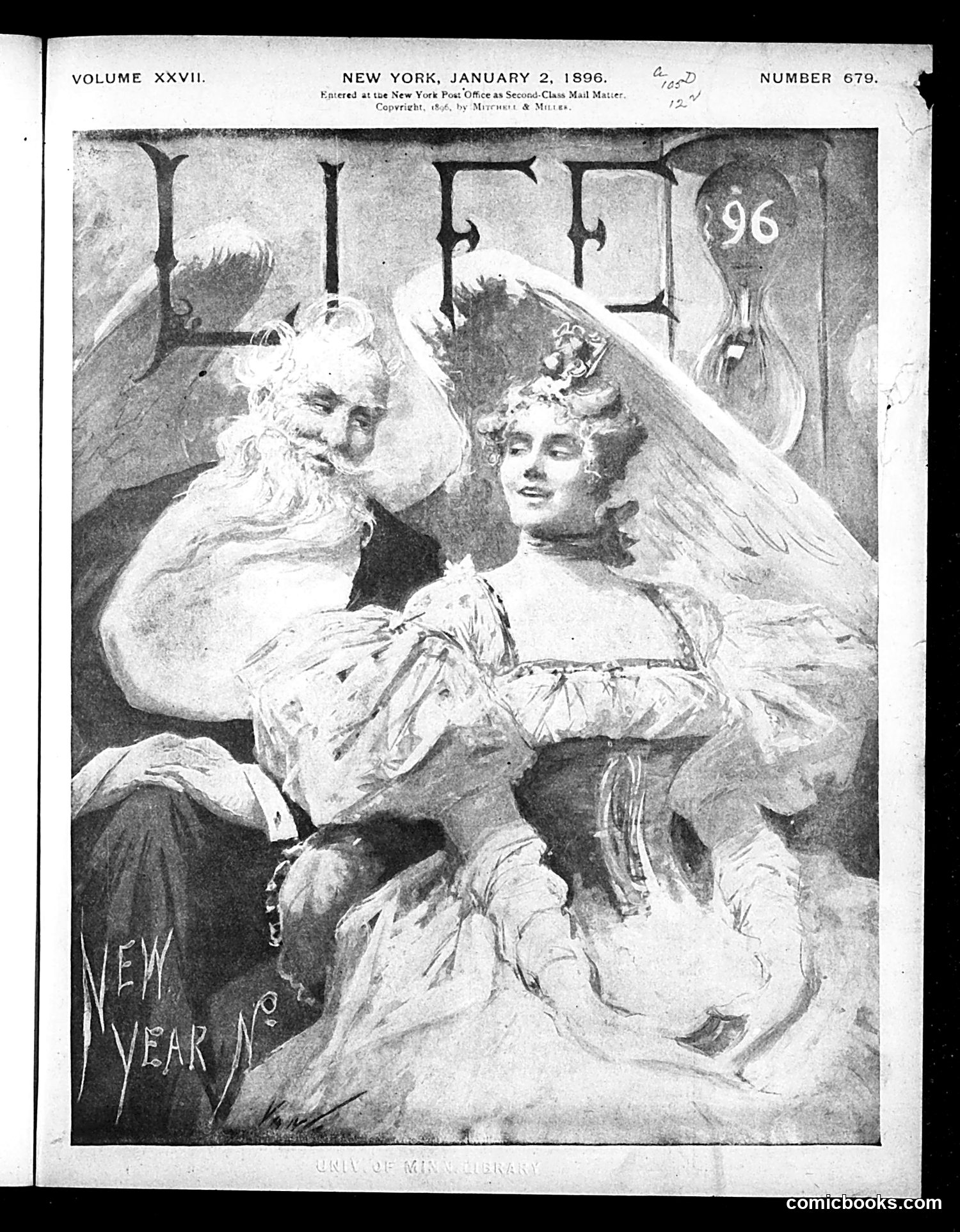
This is a New Year's themed cover illustration featuring an elderly bearded man (likely Father Time or Old Man 1895) bidding farewell to a young winged woman representing 1896. The artistic style is allegorical rather than political satire. The composition shows the outgoing year symbolically handing off to the incoming year—a common journalistic convention for New Year's issues. The woman's angelic wings and youthful appearance contrast with the aged, weary figure of the departing year, suggesting optimism and renewal associated with the new calendar year. The "NEW YEAR No." notation and decorative lettering confirm this is celebratory rather than satirical in intent, serving primarily as festive holiday cover art for Life's January 2 issue.
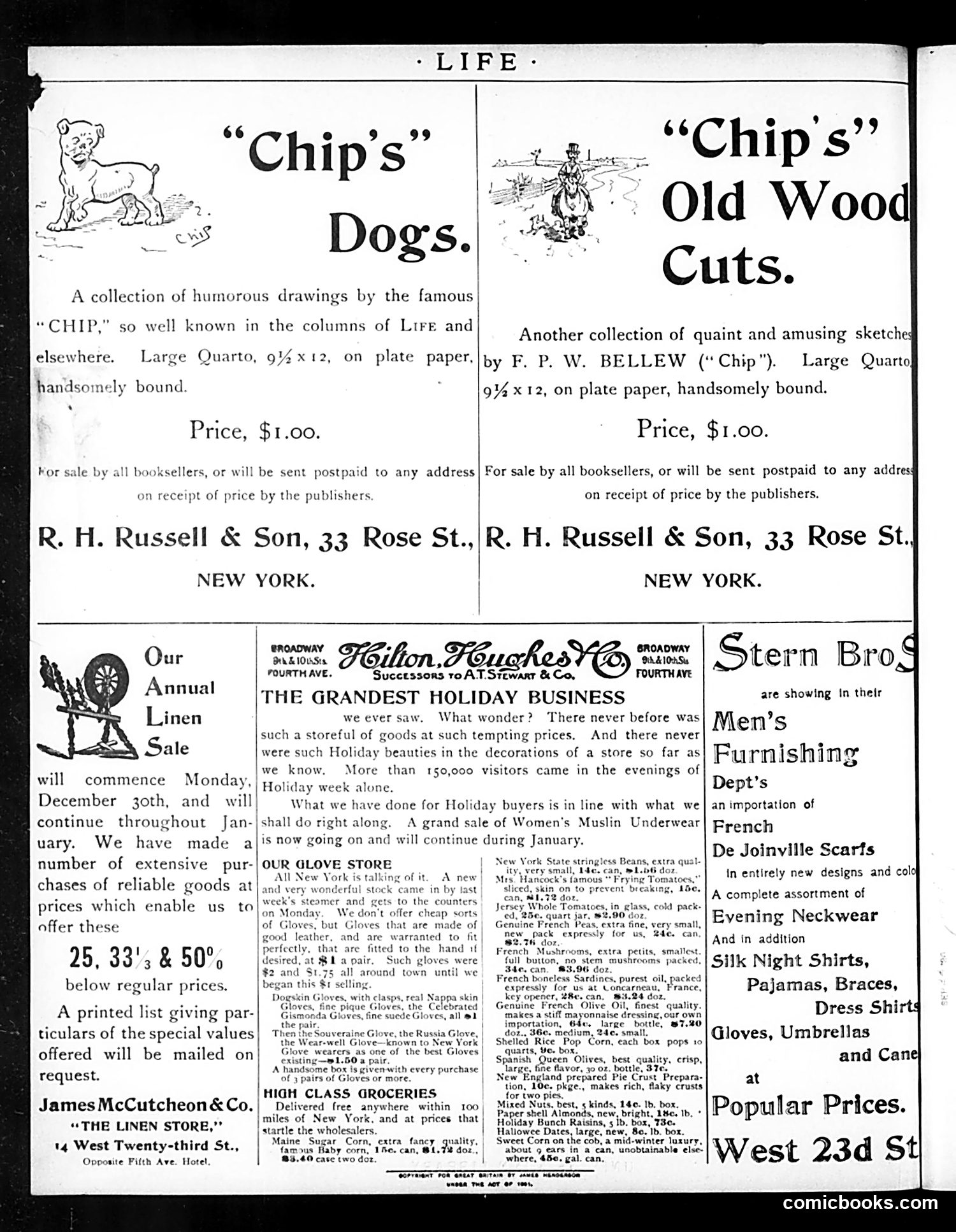
This page is primarily **advertising**, not political satire. The top half features two book advertisements for collections of humorous drawings by "Chip" (F.P.W. Bellew), a cartoonist known for work in Life magazine. Both books—"Chip's Dogs" and "Chip's Old Wood Cuts"—cost $1.00 and were published by R.H. Russell & Son in New York. The lower half contains department-store and specialty-shop advertisements: James McCutcheon & Co.'s linen sale, Hilton, Houchés & Co.'s holiday goods, and Stern Bros.' men's furnishings. These ads announce seasonal sales, new inventory, and pricing. There is **no political cartoon or satire** visible on this page. It represents typical early-20th-century magazine advertising mixed with book promotion.
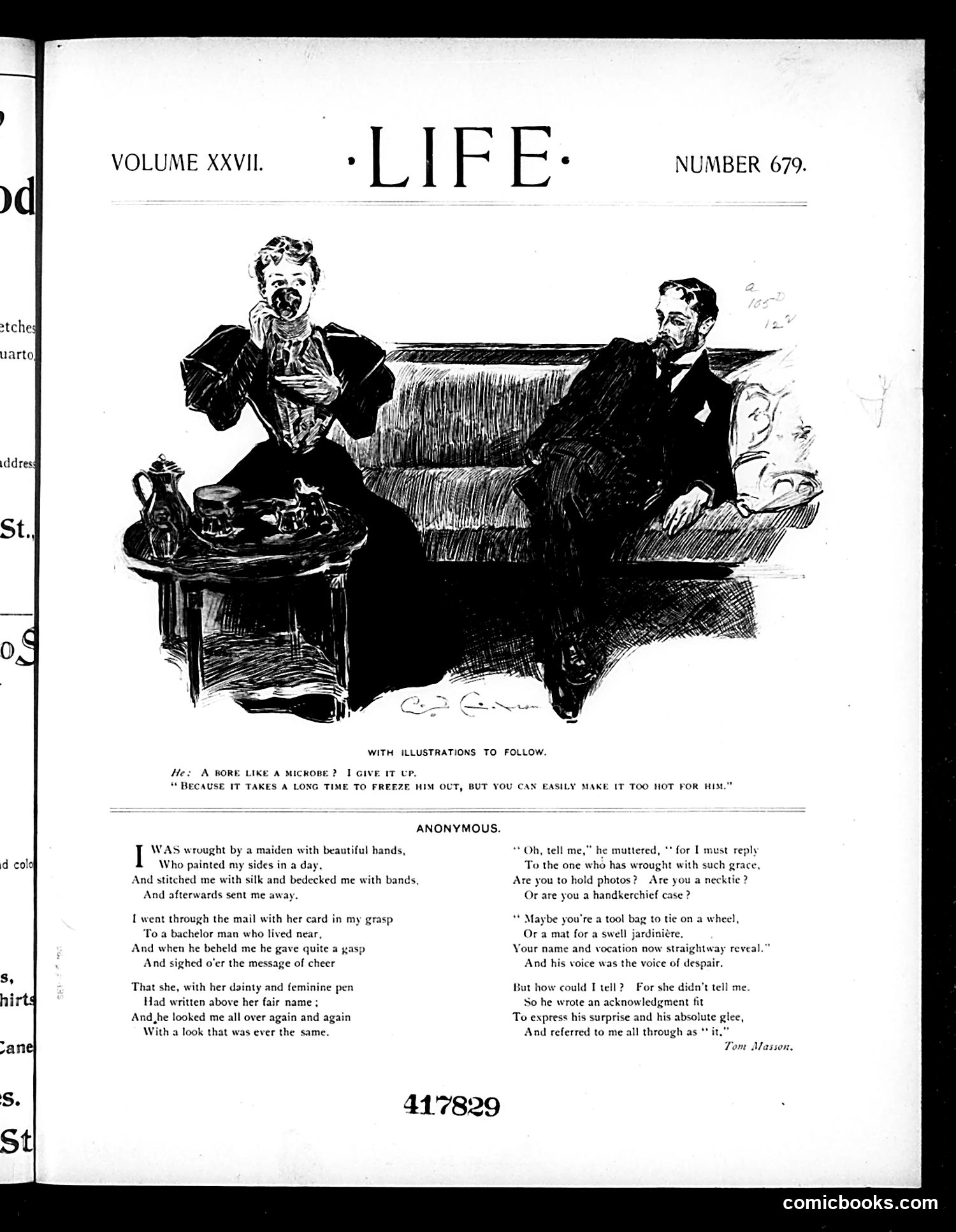
This page from *Life* magazine (Volume XXVII, Number 679) contains a satirical cartoon and accompanying poem about romantic correspondence. **The Cartoon:** Shows a woman gesturing dramatically while a man sits on a sofa looking uncomfortable or dismissive. The caption references a debate about "a bore like a microbe"—suggesting the woman is tediously persistent. **The Poem (Anonymous):** Describes a woman who sends a love letter to a bachelor via a maid. The man reads it repeatedly but seems conflicted, eventually responding coldly. The poem's conclusion, attributed to "Tom Masson," suggests the woman cannot understand his lack of reciprocation—the humor lies in her obliviousness to his disinterest. **The Satire:** This mocks romantic persistence and miscommunication between genders, particularly women's supposed inability to recognize when their affections are unwanted—a common theme in early 20th-century satirical publications.
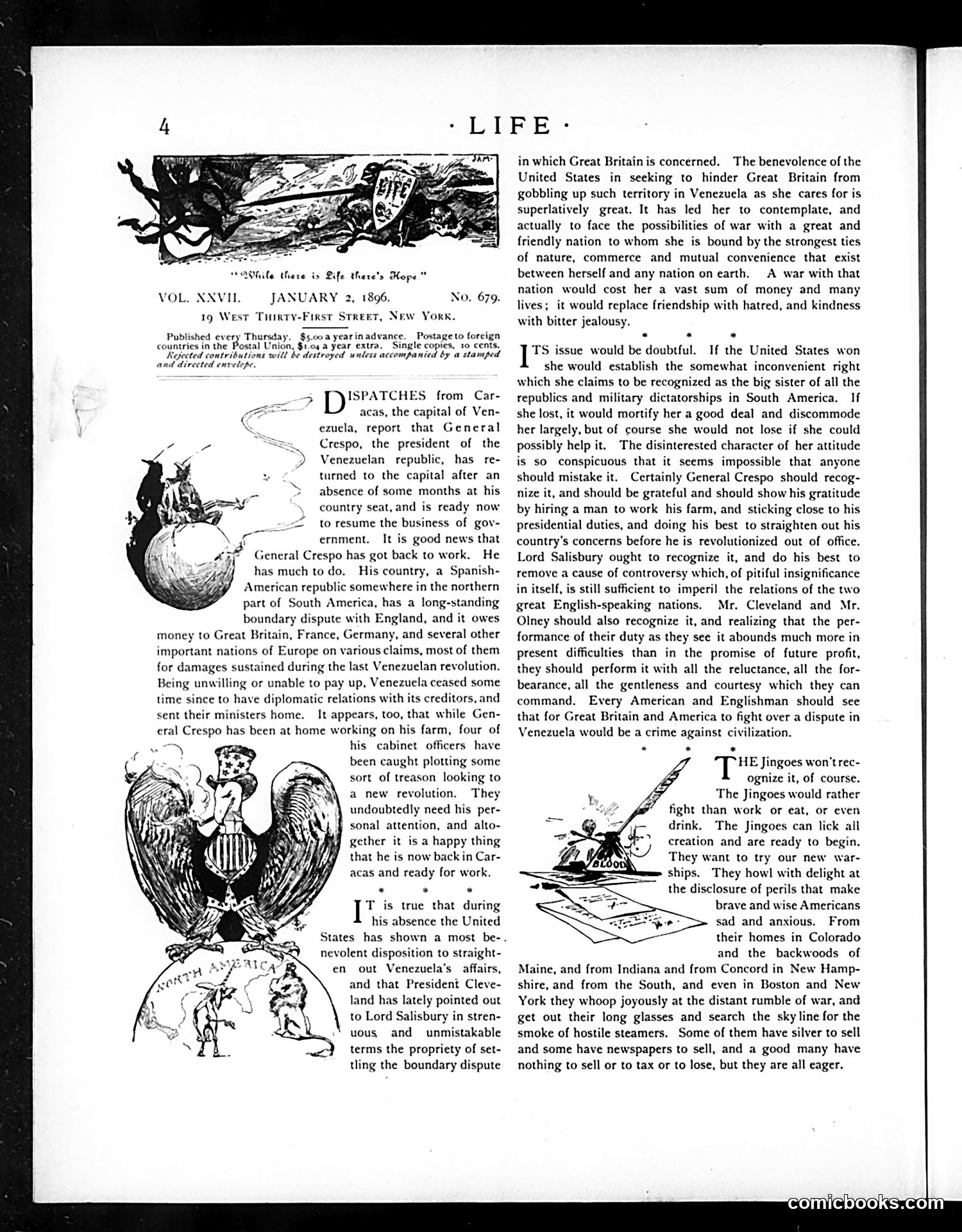
This page satirizes the **Venezuela boundary dispute** between Great Britain and Venezuela over territory in South America. The text argues the United States should not intervene militarily, despite American sympathy for Venezuela. The cartoons mock the **Jingoes** (American imperialists eager for war). One illustration shows them as eager, bellicose figures ready to attack British ships. The satire criticizes their enthusiasm—they're willing to fight despite having little to lose personally, unlike soldiers who'd actually die. The political point: while Britain's territorial claim may be unjust, American military intervention would damage Anglo-American relations and replace "friendship with hatred." The author urges restraint and diplomacy rather than jingoistic warmongering.
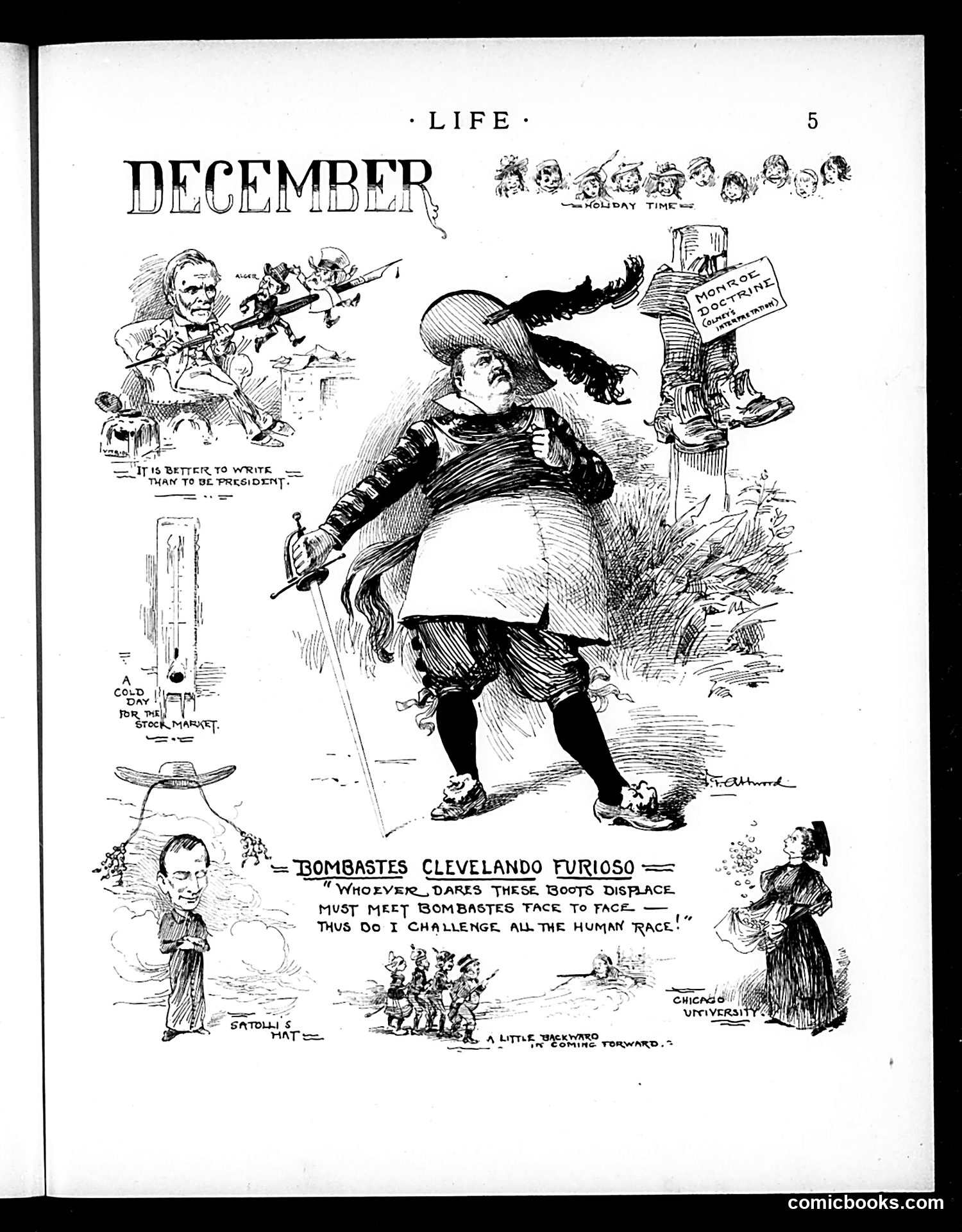
This page presents December-themed political satire. The central figure "Bombastes Clevelandio Furioso" appears to reference President Grover Cleveland, depicted in exaggerated martial pose with sword drawn, challenging "all the human race" to combat. Surrounding smaller cartoons mock various December topics: one references writing being preferable to the presidency; another shows "Cold Day for the Mugwump" (likely criticizing political fence-sitters); others touch on holiday themes and Chicago University. The satire seems aimed at Cleveland's combative political style or controversial policies. The "Bombastes" reference—evoking bombastic, theatrical aggression—suggests the cartoonist viewed Cleveland as overly aggressive or melodramatic in his governance. The overall tone is mocking, using exaggeration and caricature typical of 1880s-90s political commentary.
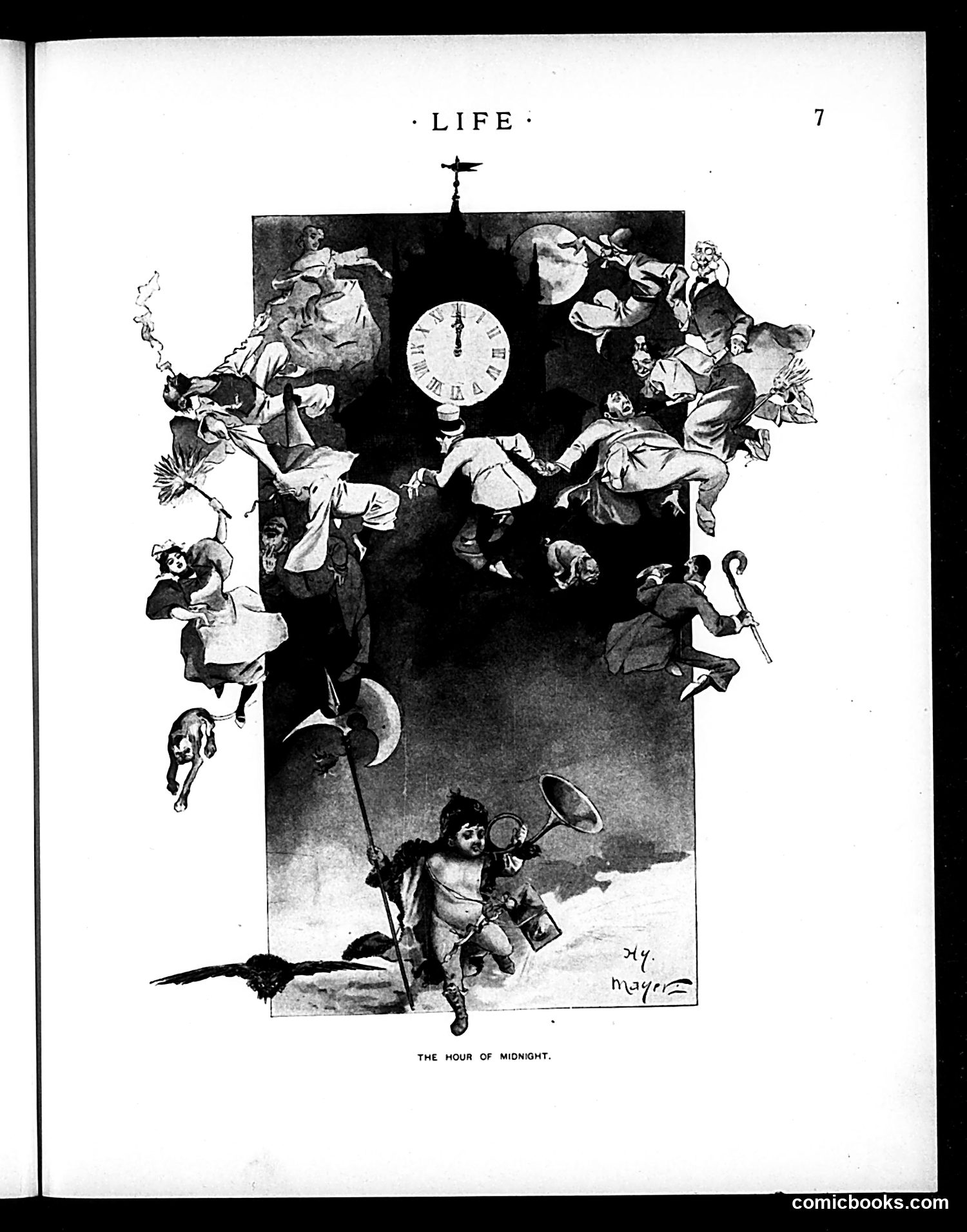
This is a satirical illustration by the artist Magri depicting various figures engaged in mischievous or chaotic activities surrounding a clock showing midnight. The composition appears allegorical, with cherubs and anthropomorphic characters (including what looks like a monkey or imp) engaged in different pursuits—some playing instruments, others holding weapons or tools, and figures in various states of disarray. The title "The Hour of Midnight" suggests commentary on nocturnal mischief or disorder. Without additional context about the specific publication date, it's unclear whether this references a particular political event, social concern about nightlife, or more general satirical commentary on chaos and revelry. The style is typical of early-to-mid 20th century satirical cartooning.
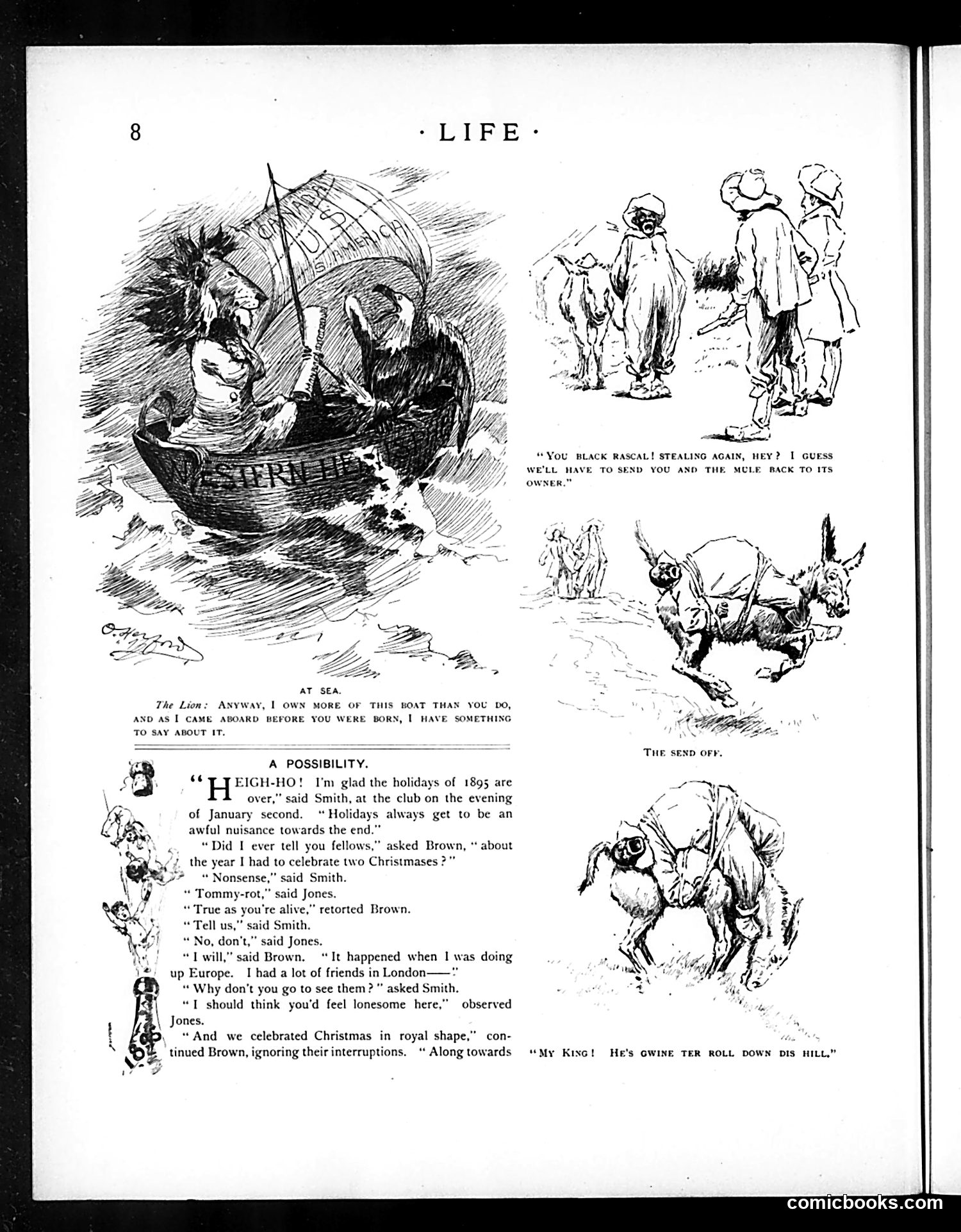
This page contains two separate satirical pieces: **"At Sea"** (left): A caricatured lion, apparently representing Britain, complains about owing more of a boat than the viewer and having prior claim to it. This likely references colonial or imperial disputes over maritime territory or vessels. **"A Possibility"** (center/bottom): A conversation between characters named Smith, Brown, and Jones about celebrating Christmas in London. The satire appears to target the mundane complaints of wealthy club members during holiday season—lamenting loneliness while describing elaborate celebrations. It's gentle social satire mocking upper-class ennui. **Right side**: Illustrations labeled "The seed off" and "My King! He's gwine ter roll down dis hill" depict animals (possibly goats or similar creatures), though their satirical purpose is unclear without additional context.
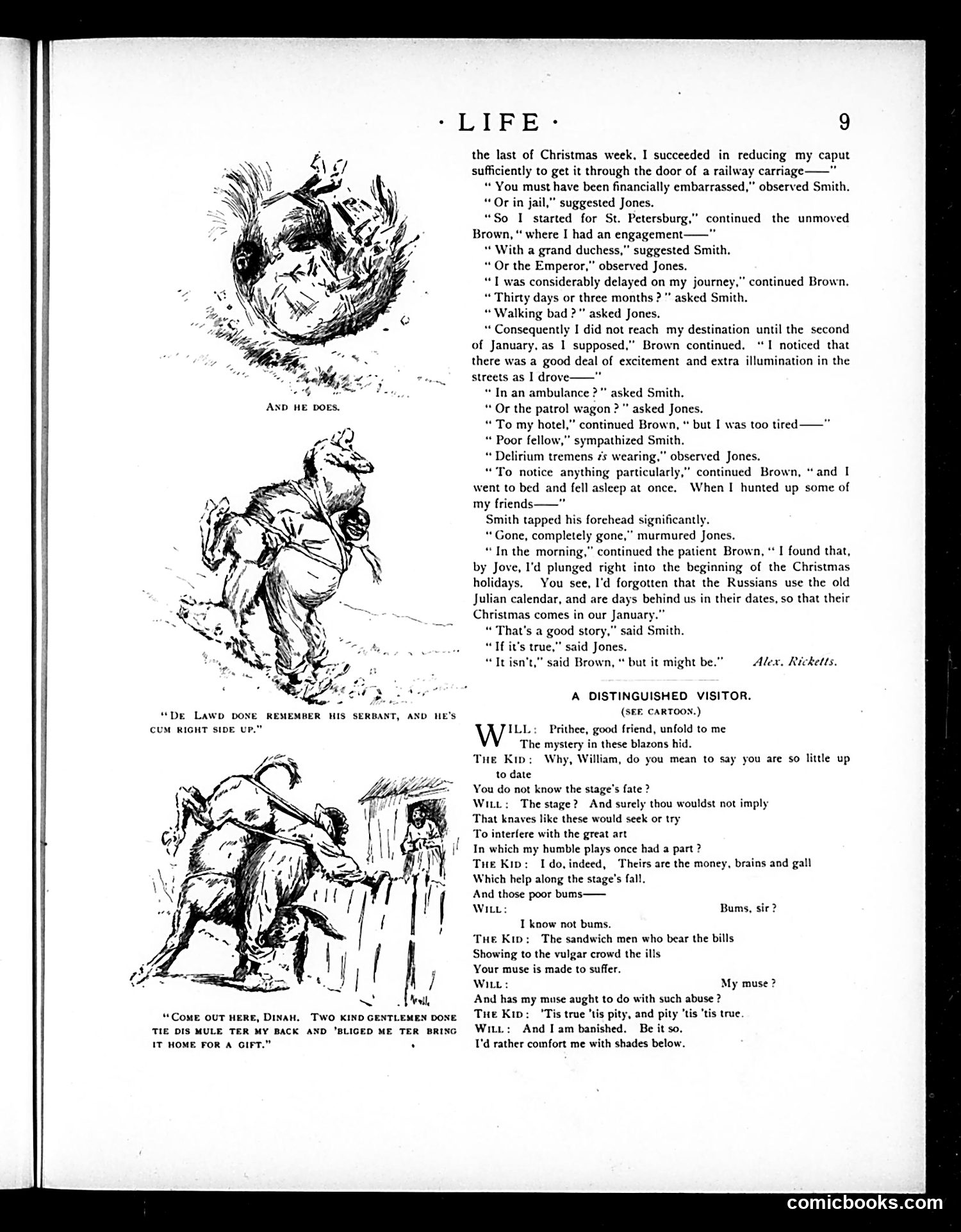
This page contains a narrative anecdote illustrated with three ink sketches, plus a separate dramatic scene (titled "A Distinguished Visitor"). **The main story** (by Alex. Ricketts) depicts a man's misadventure reducing his oversize hat to fit through a railway carriage door during Christmas week. The joke involves his delayed journey to St. Petersburg and confusion about Russian calendar dates—the Russians used the Julian calendar, placing their Christmas in January, not December. When he meets friends, they're "completely gone" (celebrating), creating the satirical point about cultural/calendar differences. **The dramatic scene** appears to be a theatrical dialogue between "Will" and "The Kid," discussing stage performance and artistic merit versus commercial concerns—likely satirizing debates about theater quality versus popular appeal. The cartoons emphasize physical comedy and social embarrassment, typical of Life's early satirical approach.
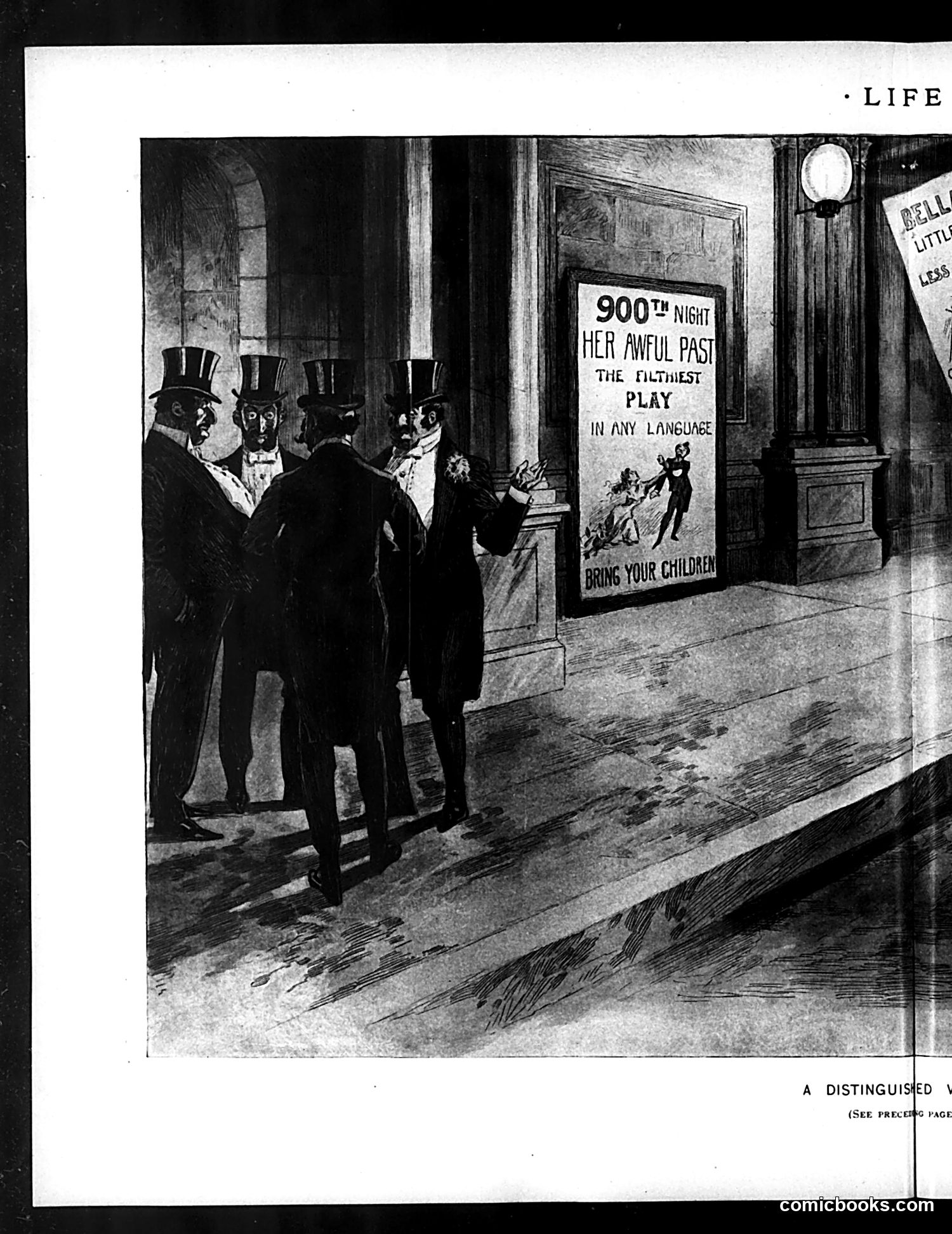
This appears to be a satirical cartoon from *Life* magazine critiquing theatrical advertising and social standards. The image shows well-dressed men in top hats examining a theater poster for "900th Night" - described as "Her Awful Past," claimed to be "the filthiest play in any language" with a caption urging "Bring Your Children." The satire targets the hypocrisy of early 20th-century entertainment marketing: theaters promoted scandalous, sexually suggestive plays as family entertainment while simultaneously appealing to adult audiences seeking salacious content. The gentlemen's formal attire contrasts with the crude promotional tactics, mocking both the industry's shameless advertising and society's willingness to patronize such shows regardless of their actual content or suitability.
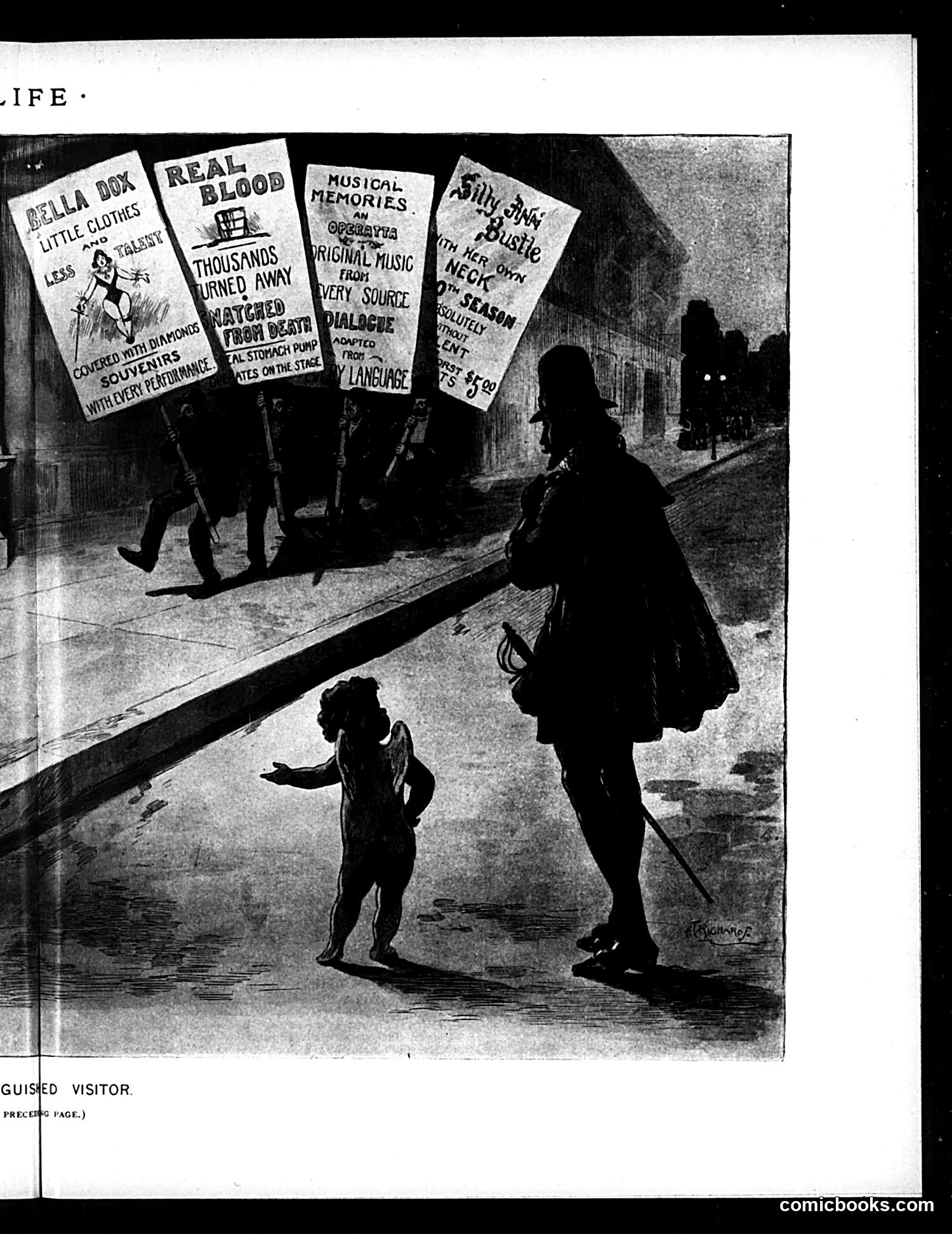
This cartoon satirizes early 20th-century theater marketing. A small child encounters a tall figure in dark clothing and cape outside a theater displaying five promotional posters. The posters advertise melodramatic productions: "Cella Box in Little Clothes," "Real Blood," "Musical Memories," "Army Song," and "Bustic" — each promising sensational content like "thousands turned away," "watched from best seats," and "original music." The joke depicts the disparity between theatrical advertising's exaggerated promises and reality. The child appears startled or confused by the imposing figure, suggesting the gap between what theaters advertise (grand spectacles attracting massive crowds) and the actual modest experience. The "guised visitor" likely refers to theater promotion itself as a deceptive costume concealing ordinary entertainment.
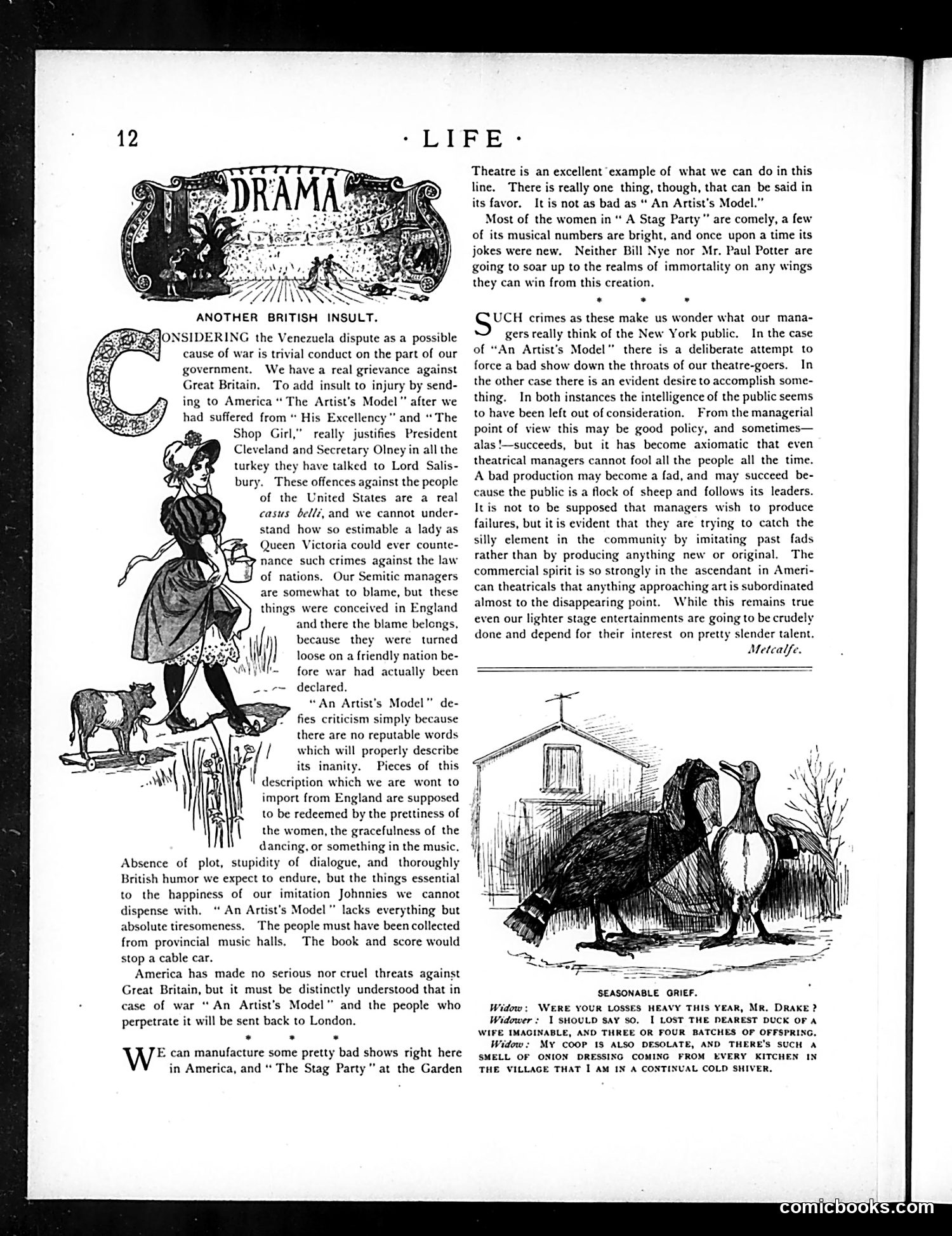
This page satirizes British theatrical imports to America, particularly the play "An Artist's Model." The author uses hyperbolic indignation to mock both the imported show's quality and American theater managers' desperation to profit from it. **The Setup:** The piece references the Venezuela Dispute (a real 1895 U.S.-Britain diplomatic crisis) to absurdly elevate theatrical complaints to matters of national insult—claiming bad British plays constitute justification for war alongside actual political grievances. **The Joke:** The satire ridicules American theater managers ("Semitic managers") for importing tired, plotless British entertainments featuring pretty women and outdated jokes, then presenting them as superior to homegrown productions. The author contrasts this with "The Stag Party," a local flop that's still "not as bad" as the British import. **The Point:** American theater has become commercialized and artistically bankrupt. Rather than creating original work, managers cynically recycle proven formulas and import foreign content, treating audiences as sheep who'll passively follow trends. The cartoon (right) appears unrelated—showing rural winter hardship.
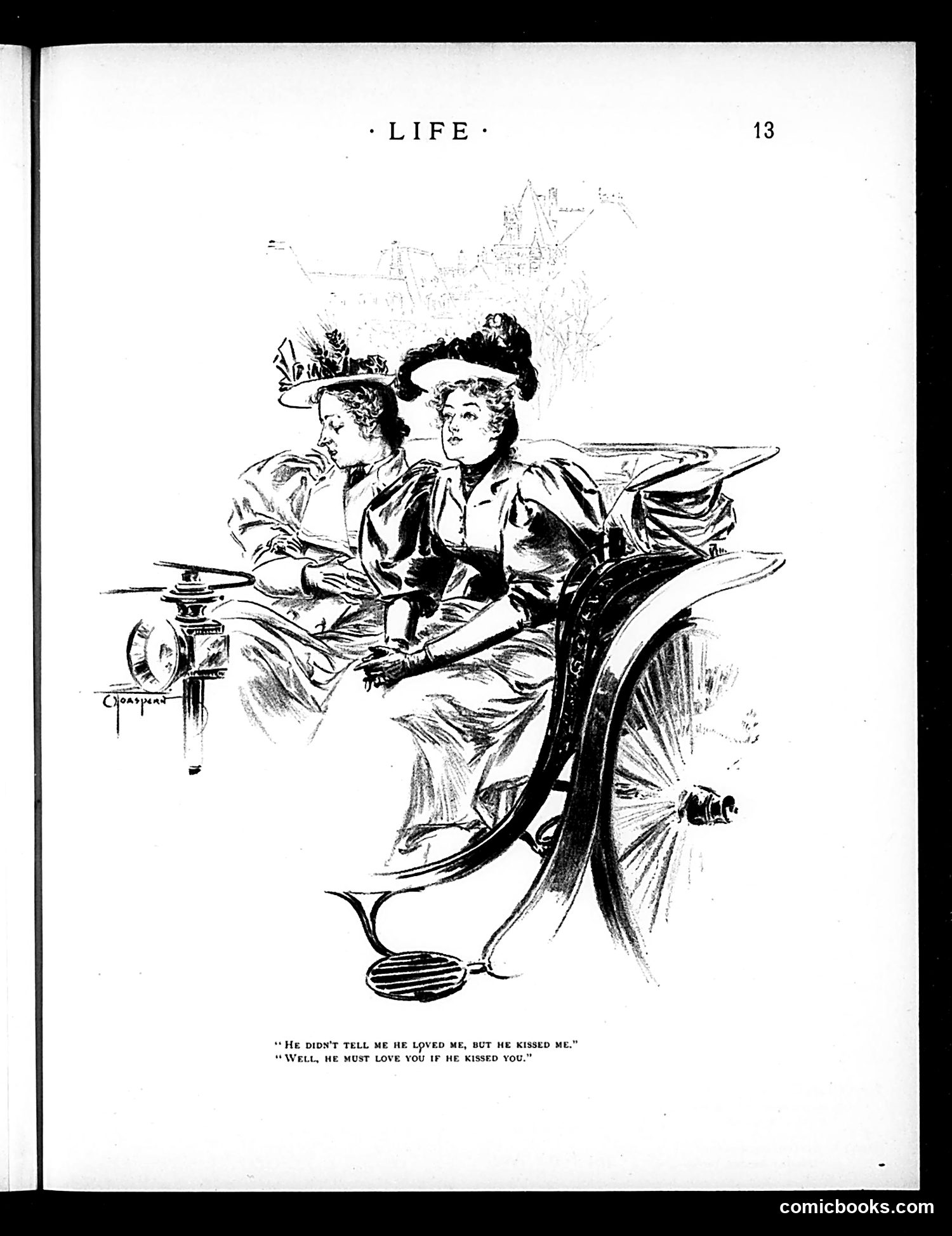
This is a flirtatious cartoon from Life magazine depicting two fashionably dressed women in what appears to be an early automobile or motorcar. The illustration, signed by the artist, shows them in an intimate conversation about romantic matters. The humor relies on a dated social convention: the suggestion that a kiss is a reliable indicator of love—a romantic sentiment presented here with gentle mockery. The women's elaborate hats, flowing garments, and the presence of the automobile suggest this dates to the early 1900s, when motorcar rides were novel, somewhat daring social activities, often associated with courtship and romance. The cartoon satirizes feminine logic and romantic idealism of that era, playing on the notion that physical affection necessarily signifies deeper emotional commitment—a premise the dialogue presents as obvious common sense to the characters, if not to the reader.
This page contains three humorous anecdotes satirizing human folly and social pretension: 1. **"Moses in the Bulrushes"**: A countryman asks an artist who painted a biblical scene to paint his dead father. When the artist protests he has no reference materials, the countryman illogically argues the artist painted Moses without a photograph, so the father should be easier—since he's "been dead nearly so long." The satire mocks rustic logic and ignorance. 2. **"Young George Washington"**: A teacher compares underperforming student John unfavorably to young Washington, claiming Washington surveyed estates at sixteen. John's response—that Washington was merely a surveyor then but became President later—cleverly deflates the teacher's presumption, satirizing adults who use misleading comparisons to shame children. 3. **The Courier's Blunder**: A British traveler's servant, unable to pronounce his employer's name from his luggage, registers him as "Monsieur Warrantedsolidleather"—copying text from the portmanteau itself. This mocks servile obsequiousness and incompetent attempts at respectability. All three target human absurdity through comic misunderstandings.
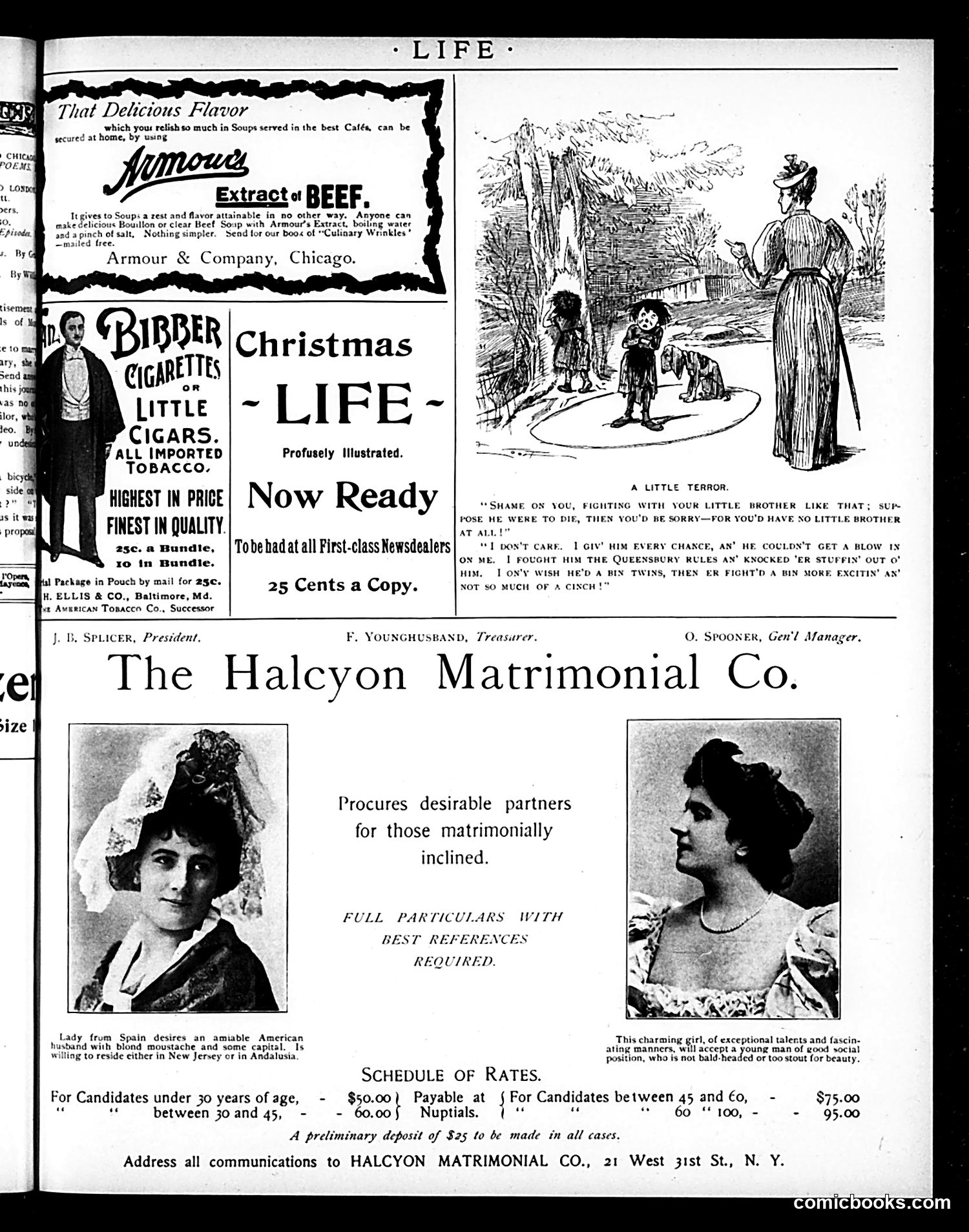
**The Cartoon ("A Little Terror"):** This depicts a domestic scene where an older woman scolds two children caught fighting. The dialogue reveals bitter sibling rivalry—the children boast they've fought using "Queensbury Rules" (formal boxing regulations) and express regret they aren't twins so they could fight more. The satire mocks both the children's aggressive competitiveness and the absurdity of applying gentlemanly boxing etiquette to childish squabbles. It's darkly humorous commentary on how Victorian-era children internalized adult competitive values. **The Matrimonial Advertisement:** Below, "The Halcyon Matrimonial Co." offers a matchmaking service with tiered pricing ($50-$95 depending on age). The accompanying photographs show eligible candidates with frank, comedic descriptions—a Spanish woman seeking a wealthy American husband willing to live abroad; a charming young woman rejecting bald or overweight suitors. This satirizes the transactional nature of matrimony and the superficial criteria of spousal selection among the period's marriage-minded classes.
This page from *Life* magazine contains two brief humorous anecdotes followed by period advertisements. **The Main Stories:** The first tale mocks amateur "deduction" — a man named Horntackle attempts to impress a stranger by mimicking Sherlock Holmes's deductive methods, correctly identifying he carries a tea kettle and inferring the owner is absent-minded and married. The joke: despite being right, Horntackle is so insufferably pompous that the man punches him and leaves the kettle behind — proving Horntackle's deductions correct in the worst possible way. The second anecdote satirizes a former Confederate soldier's revisionist interpretation of the Civil War, claiming the South "only got the better of us" and used this to justify ongoing pension claims — poking fun at post-war Southern grievances and questionable pension arguments. **The Advertisements:** The remainder is vintage product advertising (Shawknit hosiery, Waverly bicycles, Teuton malt extract, Rhine Violets perfume, Veloute powder), typical of the era. The humor is gentle, domestic, and contemporary to early 1900s America.
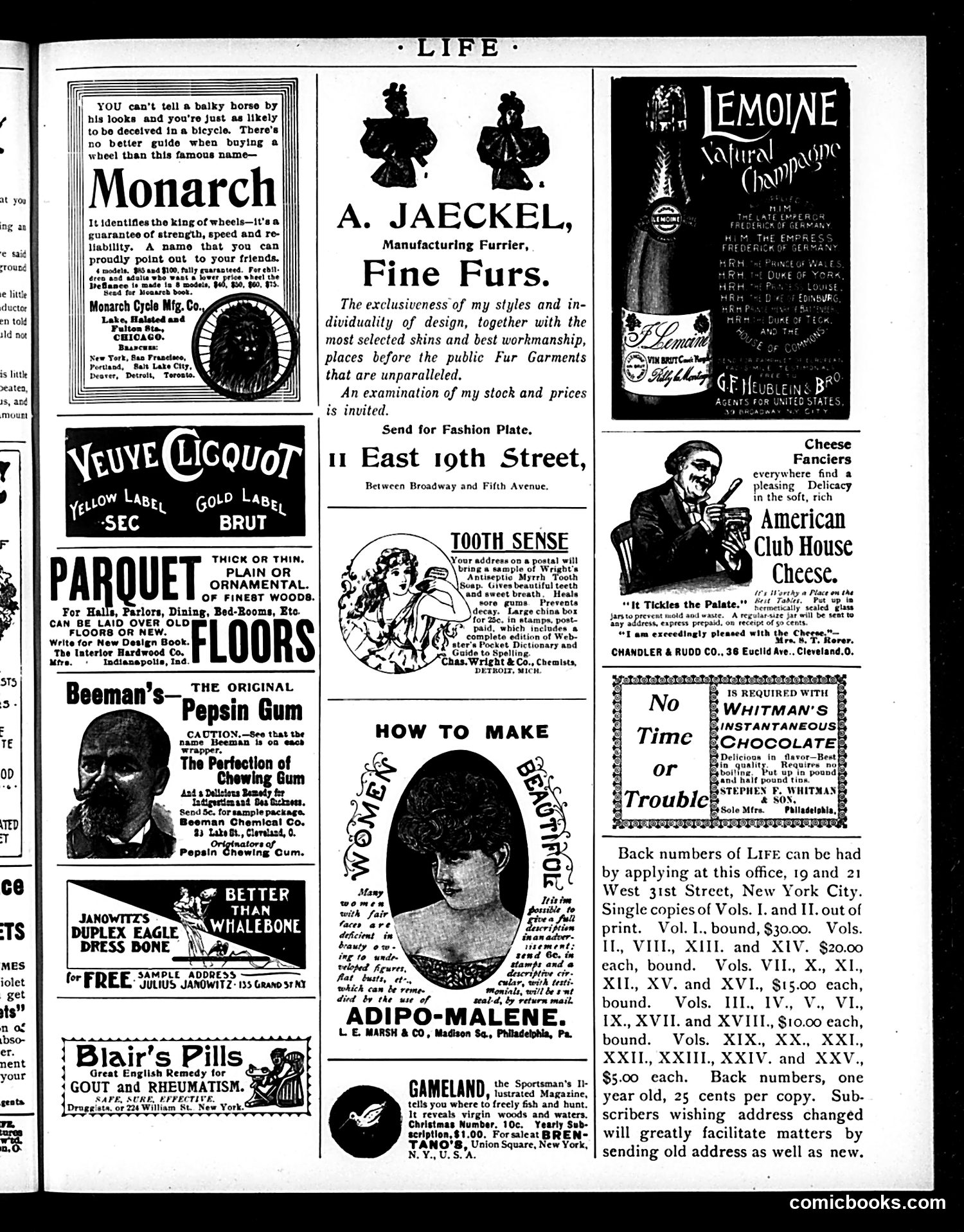
This is a Life magazine page from the early 1900s consisting almost entirely of commercial advertisements with no satirical cartoons or political content visible. The ads promote period products: bicycles (Monarch), champagne (Lemoine), furs (Jaeckel), cheese, chewing gum (Beeman's), parquet flooring, patent medicines (Blair's Pills for gout), tooth products, and a weight-reduction cream (Adipo-Malene). One small illustrated element appears in the "Tooth Sense" ad—a woman's face promoting dental hygiene products—but this is product marketing, not satire. The page also includes publisher information about obtaining back issues of Life magazine. There are no political cartoons, no identifiable caricatured figures of public persons, and no apparent satirical commentary on this page.
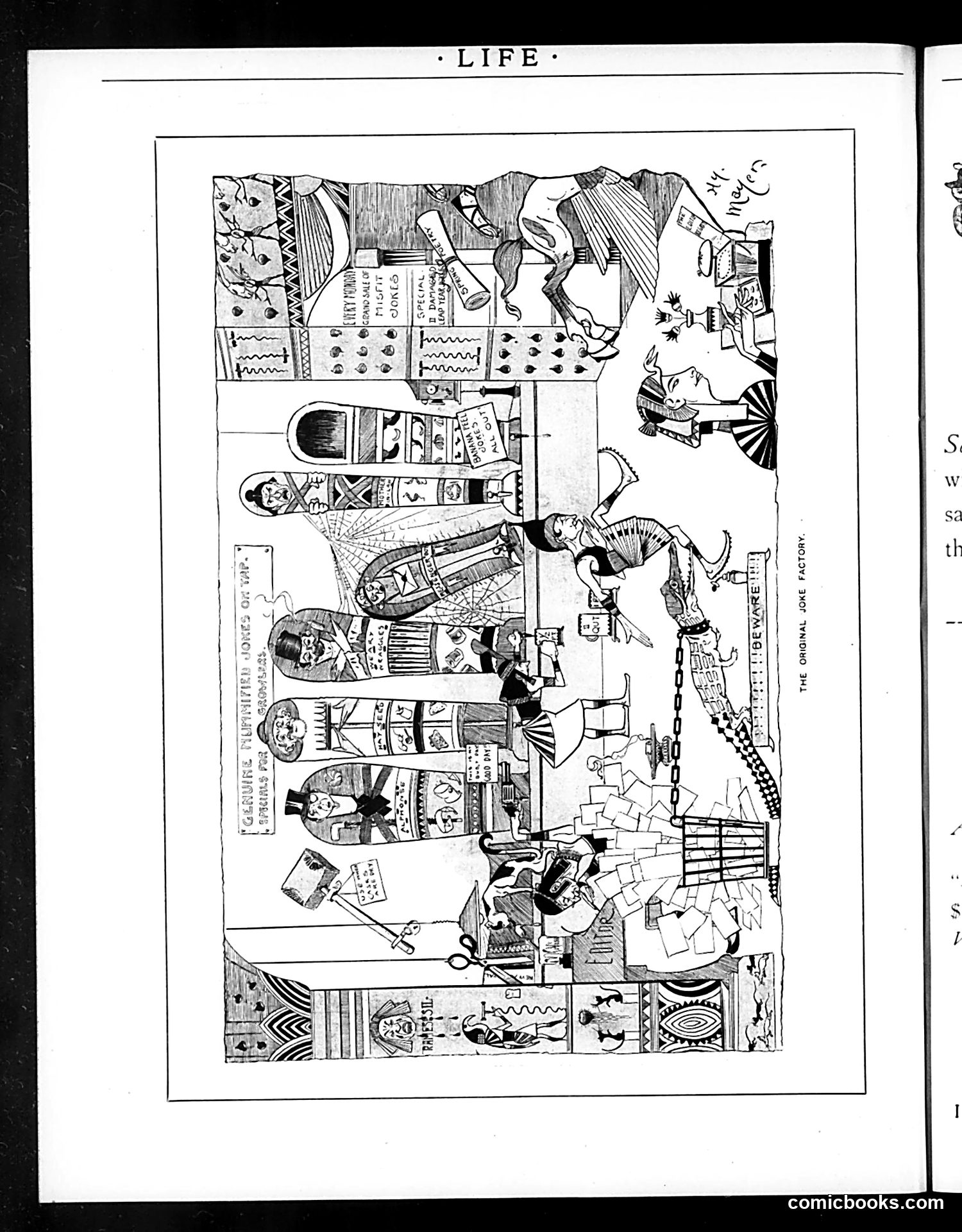
This appears to be a single-panel satirical cartoon showing what looks like a domestic or social scene viewed from above (rotated 90 degrees). The illustration depicts multiple figures in an interior setting with various furnishings, decorative elements, and patterned walls. However, the OCR text provided only contains "comicbooks.com" and no actual article text or caption describing the cartoon's subject, figures, or satirical message. Without the original caption or accompanying text, I cannot reliably identify the specific political or social references, the individuals depicted, or the intended satire. To properly explain this cartoon's meaning to a modern reader would require the missing caption and contextual text that would typically accompany such illustrations in Life magazine.
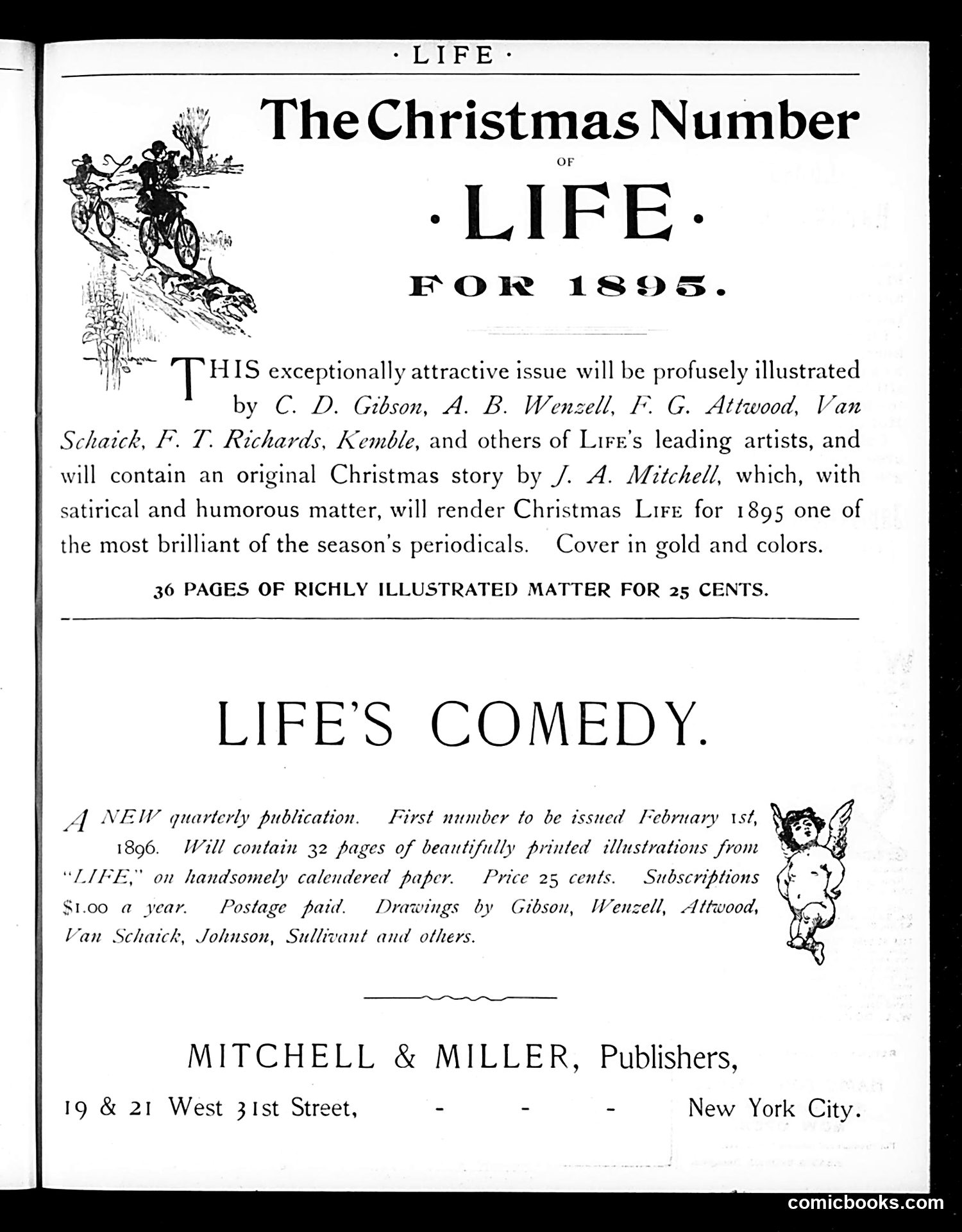
This is primarily a **title page and advertisement** rather than a cartoon with political satire. It announces *Life* magazine's Christmas 1895 issue and a new spinoff publication called *Life's Comedy*. The page promotes the Christmas Number as a premium product featuring prominent illustrators of the era (C.D. Gibson, A.B. Wenzell, and others) and an original Christmas story by J.A. Mitchell, priced at 25 cents for 36 pages. A separate quarterly publication, *Life's Comedy*, is announced for February 1896, featuring reprinted illustrations from *Life*. The small decorative illustrations—a cherub figure and a vintage sleigh scene—are festive ornaments typical of holiday publishing, not satirical commentary. The content is essentially marketing material showcasing *Life's* artistic talent and commercial offerings during the 1890s publishing boom.
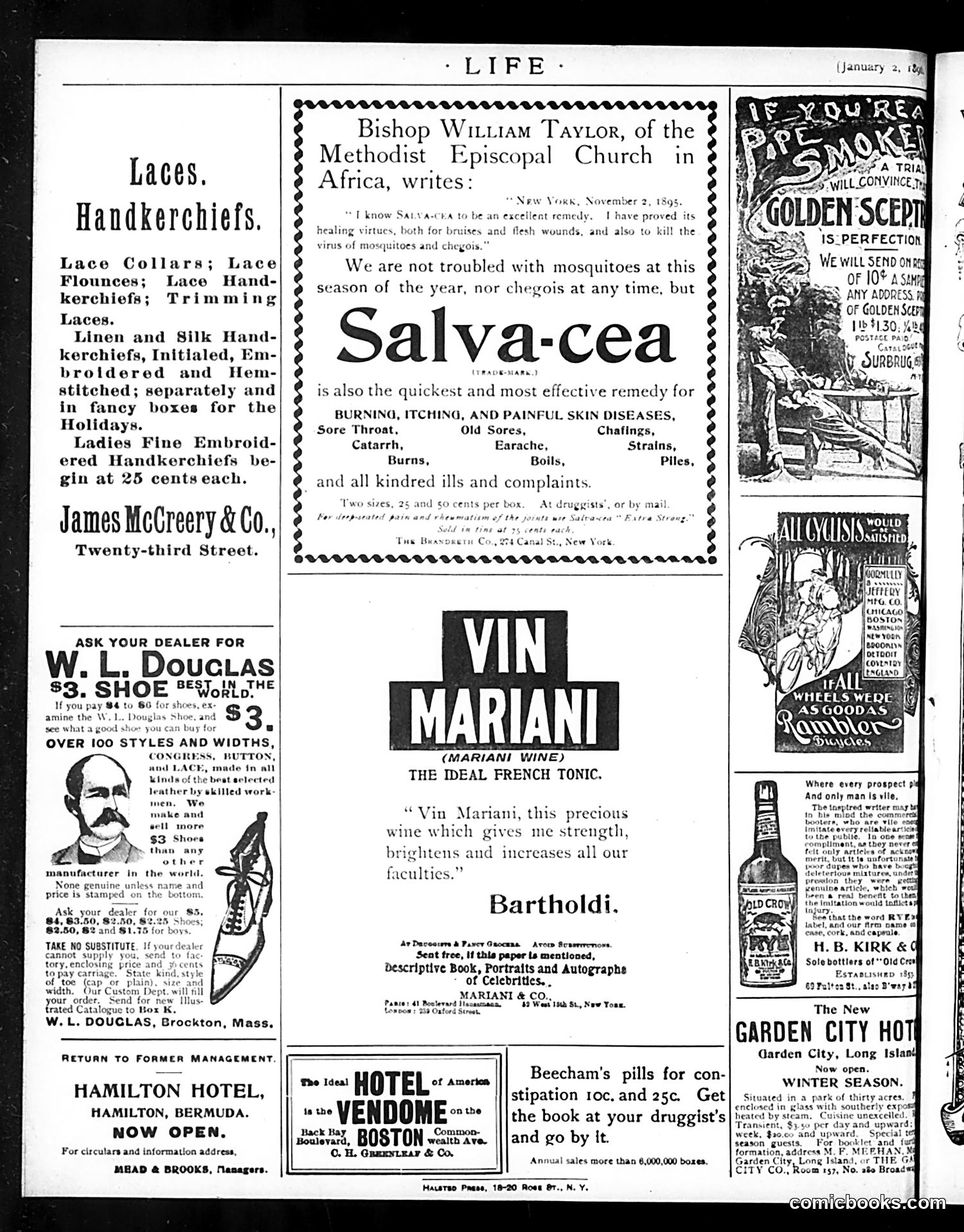
This page is primarily **advertising**, with no political cartoons. The dominant feature is a testimonial advertisement for **Salva-cea**, a patent medicine. Bishop William Taylor of the Methodist Episcopal Church in Africa endorses it as a cure-all for wounds, mosquito-borne illness, and various skin conditions—a typical late-19th-century snake-oil pitch using religious authority to build credibility. The page includes ads for other period products: W.L. Douglas shoes, Vin Mariani wine (marketed as a "French tonic" for strength and mental faculties), Beecham's pills for constipation, and hotels. The Bartholdi reference appears to be another product endorsement. **For modern readers**: These ads illustrate how unregulated patent medicines dominated American magazines, using celebrity/authority testimonials and vague health claims—practices now illegal. The casual invocation of tropical diseases and the assumption that readers would accept such dubious cures reveals attitudes toward medicine and advertising standards radically different from today.