
Life, 1896-01-02 · page 4 of 20
Life — January 2, 1896 — page 4: what you’re looking at
What you’re looking at
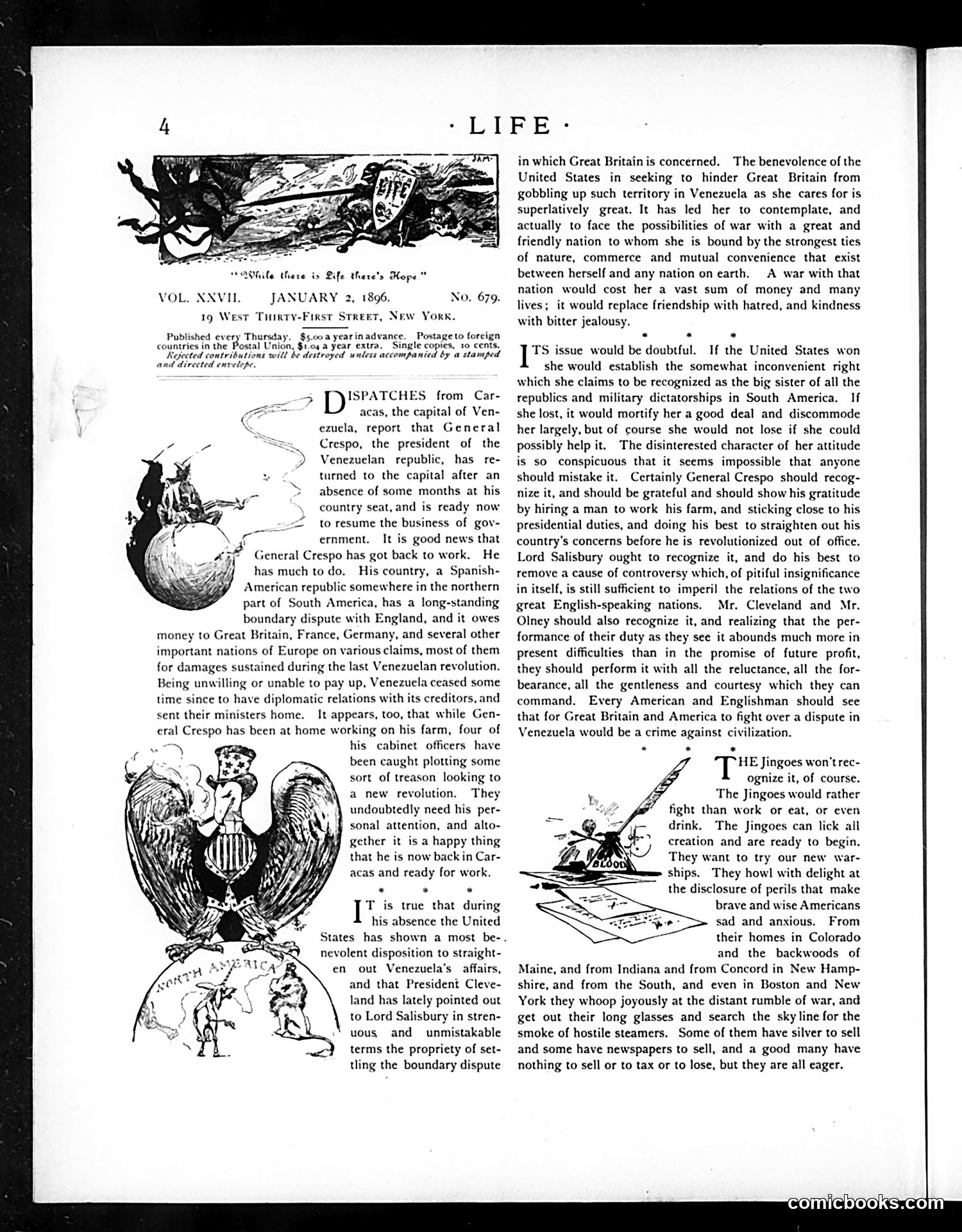
This page satirizes the **Venezuela boundary dispute** between Great Britain and Venezuela over territory in South America. The text argues the United States should not intervene militarily, despite American sympathy for Venezuela. The cartoons mock the **Jingoes** (American imperialists eager for war). One illustration shows them as eager, bellicose figures ready to attack British ships. The satire criticizes their enthusiasm—they're willing to fight despite having little to lose personally, unlike soldiers who'd actually die. The political point: while Britain's territorial claim may be unjust, American military intervention would damage Anglo-American relations and replace "friendship with hatred." The author urges restraint and diplomacy rather than jingoistic warmongering.
📄 Transcribed text from this page (OCR, searchable)
Machine-transcribed from the original scan — historical spelling and the odd misread are preserved.
While there is Life there's Hope” VOL, XXVII. JANUARY 2, 1896, 19 West Tuirty-First Street, > No. 679. EW York. Published every Thursday. $5.00a yearinadvance. Postage to foreign countries in the Bostal Union, $1oya year extra, Single copies, 10 cents, Rejected contributions will be destroyed untess accompanied by a stamped and directed envelope, ISPATCHES from Car- acas, the capital of Ven- ezuela, report that General Crespo, the president of the Venezuelan republic, has re- turned to the capital after an absence of some months at his country seat, and is ready now to resume the business of gov- ernment. It is good news that General Crespo has got back to work. He has much to do, His country, a Spanish- American republic somewhere in the northern part of South America, has a long-standing boundary dispute with England, and it owes money to Great Britain, France, Germany, and several other important nations of Europe on various claims, most of them for damages sustained during the last Venezuelan revolution. Being unwilling or unable to pay up, Venezuela ceased some time since to have diplomatic relations with its creditors, and sent their ministers home. It appears, too, that while Gen- eral Crespo has been at home working on his farm, four of his cabinet officers have been caught plotting some sort of treason looking to a new revolution. They undoubtedly need his per- sonal attention, and alto- gether it is a happy thing that he is now back in Car- acas and ready for work, . . . T is true that during his absence the United States has shown a most be-. nevolent disposition to straight- en out Venezuela's affairs, and that President Cleve- land has lately pointed out to Lord Salisbury in stren- uous and unmistakable terms the propriety of set- tling the boundary dispute in which Great Britain is concerned. The benevolence of the United States in seeking to hinder Great Britain from gobbling up such territory in Venezuela as she cares for is superlatively great. It has led her to contemplate, and actually to face the possibilities of war with a great and friendly nation to whom she is bound by the strongest ties of nature, commerce and mutual convenience that exist between herself and any nation on earth. A war with that nation would cost her a vast sum of money and many lives; it would replace friendship with hatred, and kindness with bitter jealousy. . . . TS issue would be doubtful. If the United States won she would establish the somewhat inconvenient right which she claims to be recognized as the big sister of all the repul and military dictatorships in South America. If she lost, it would mortify her a good deal and discommode her largely, but of course she would not lose if she could possibly help it. The disinterested character of her attitude is so conspicuous that it seems impossible that anyone should mistake it. Certainly General Crespo should recog- nize it, and should be grateful and should show his gratitude by hiring a man to work his farm, and sticking close to his presidential duties, and doing his best to straighten out his country’s concerns before he is revolutionized out of office. Lord Salisbury ought to recognize it, and do his best to remove a cause of controversy which, of pitiful insignificance in itself, is still sufficient to imperil the relations of the two great English-speaking nations. Mr. Cleveland and Mr. Olney should also recognize it, and realizing that the per- formance of their duty as they see it abounds much more in present difficulties than in the promise of future profit, they should perform it with all the reluctance, all the for- bearance, all the gentleness and courtesy which they can command. Every American and Englishman should see that for Great Britain and America to fight over a dispute in Venezuela would be a crime against civilization. . HE Jingoes won't rec- ognize it, of course. The Jingoes would rather fight than work or eat, or even drink, The Jingoes can lick all creation and are ready to begin. They want to try our new war- ships. They howl with delight at the disclosure of perils that make brave and wise Americans sad and anxious. From their homes in Colorado and the backwoods of Maine, and from Indiana and from Concord in New Hamp- shire, and from the South, and even in Boston and New York they whoop joyously at the distant rumble of war, and get out their long glasses and search the sky line for the smoke of hostile steamers. Some of them have silver to sell and some have newspapers to sell, and a good many have nothing to sell or to tax or to lose, but they are all eager.