
Life, 1896-01-02 · page 12 of 20
Life — January 2, 1896 — page 12: what you’re looking at
What you’re looking at
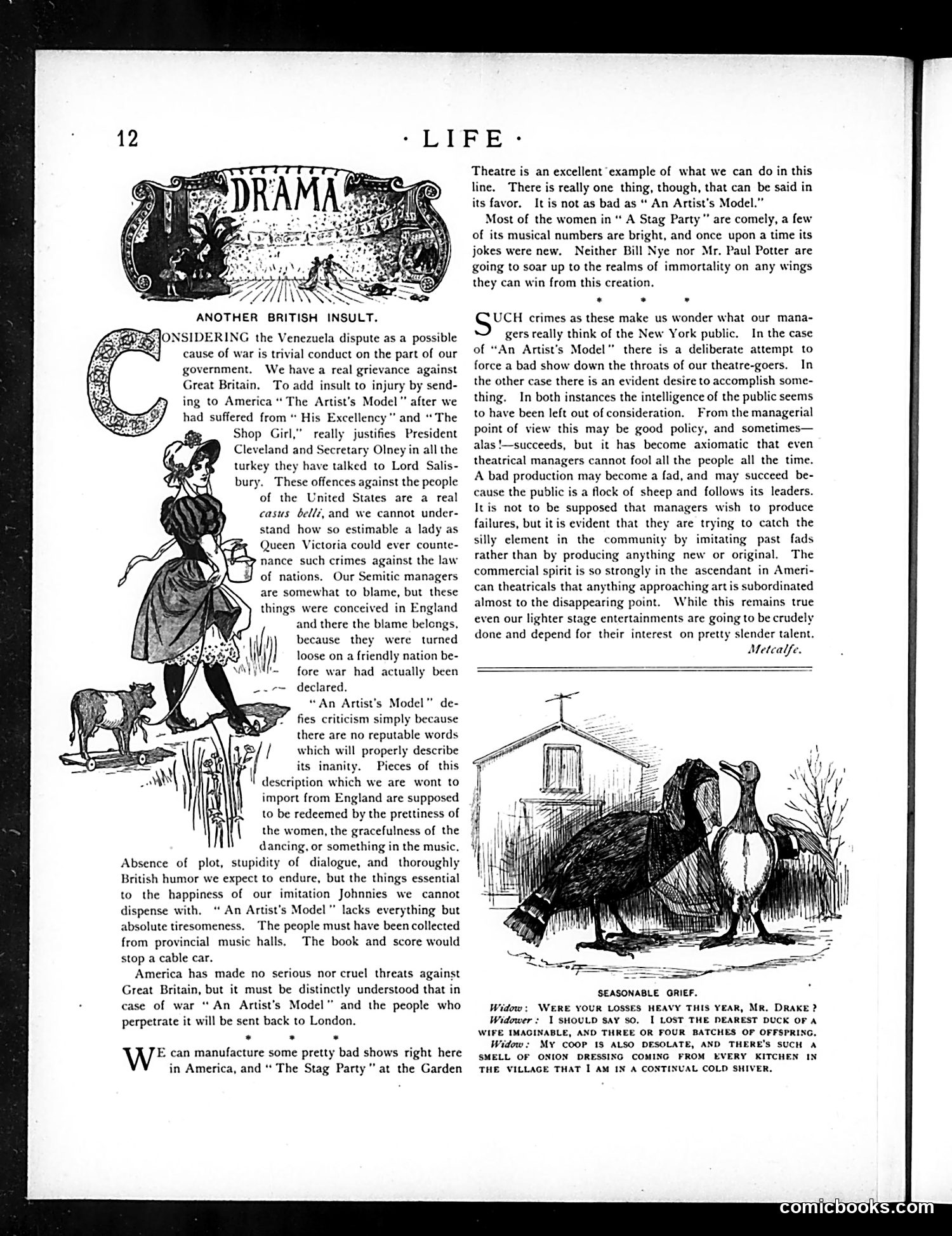
This page satirizes British theatrical imports to America, particularly the play "An Artist's Model." The author uses hyperbolic indignation to mock both the imported show's quality and American theater managers' desperation to profit from it. **The Setup:** The piece references the Venezuela Dispute (a real 1895 U.S.-Britain diplomatic crisis) to absurdly elevate theatrical complaints to matters of national insult—claiming bad British plays constitute justification for war alongside actual political grievances. **The Joke:** The satire ridicules American theater managers ("Semitic managers") for importing tired, plotless British entertainments featuring pretty women and outdated jokes, then presenting them as superior to homegrown productions. The author contrasts this with "The Stag Party," a local flop that's still "not as bad" as the British import. **The Point:** American theater has become commercialized and artistically bankrupt. Rather than creating original work, managers cynically recycle proven formulas and import foreign content, treating audiences as sheep who'll passively follow trends. The cartoon (right) appears unrelated—showing rural winter hardship.
📄 Transcribed text from this page (OCR, searchable)
Machine-transcribed from the original scan — historical spelling and the odd misread are preserved.
- LIFE - ANOTHER BRITISH INSULT. IONSIDERING the Venezuela dispute as a possible cause of war is trivial conduct on the part of our government. We havea real grievance against Great Britain. To add insult to injury by send- ing to America‘ The Artist's Model” after we had suffered from * His Excellency" and “The Shop Girl,” really justifies President Cleveland and Secretary Olney in all the turkey they have talked to Lord Salis- bury. These offences against the people of the United States are a real casus belli, and we cannot under- stand how so estimable a lady as Queen Victoria could ever counte- nance such crimes against the law of nations. Our Semitic managers are somewhat to blame, but these things were conceived in England and there the blame belongs, because they were turned loose on a friendly nation be- fore war had actually been declared. “An Artist's Model” de- fies criticism simply because there are no reputable words which will properly describe | its inanity. Pieces of this description which we are wont to import from England are supposed to be redeemed by the prettiness of the women, the gracefulness of the dancing, or something in the music. Absence of plot, stupidity of dialogue, and thoroughly British humor we expect to endure, but the things essential to the happiness of our imitation Johnnies we cannot dispense with. ‘ An Artist's Model” lacks everything but absolute tiresomeness. The people must have been collected from provincial music halls, The book and score would stop a cable car. America has made no serious nor cruel threats against Great Britain, but it must be distinctly understood that in case of war “An Artist's Model” and the people who perpetrate it will be sent back to London. . . . W can manufacture some pretty bad shows right here in America, and * The Stag Party" at the Garden Theatre is an excellent example of what we can do in this line. There is really one thing, though, that can be said in its favor. It is not as bad as “ An Artist's Model.” Most of the women in “ A Stag Party" are comely, a few of its musical numbers are bright, and once upon a time its jokes were new. Neither Bill Nye nor Mr. Paul Potter are going to soar up to the realms of immortality on any wings they can win from this creation. . . . UCH crimes as these make us wonder what our mana- gers really think of the New York public. In the case of “An Artist's Model” there is a deliberate attempt to force a bad show down the throats of our theatre-goers. In the other case there is an evident desire to accomplish some- thing. In both instances the intelligence of the public seems to have been left out of consideration. From the managerial point of view this may be good policy, and sometimes— alas !—succeeds, but it has become axiomatic that even theatrical managers cannot fool all the people all the time. A bad production may become a fad, and may succeed be- cause the public is a flock of sheep and follows its leaders. It is not to be supposed that managers wish to produce failures, but itis evident that they are trying to catch the silly element in the community by imitating past fads rather than by producing anything new or original, The commercial spirit is so strongly in the ascendant in Ameri- can theatricals that anything approaching art is subordinated almost to the disappearing point. While this remains true even our lighter stage entertainments are going to be crudely done and depend for their interest on pretty slender talent. Metcalfe. SEASONABLE GRIEF. Widow: WERE YOUR LOSSES HEAVY THIS YEAR, MR. DRAKE ? Widower: 1 SHOULD Say SO, I LOST THE DEAREST DUCK OF A WIFE IMAGINABLE, AND THREE OR FOUR BATCHES OF OFFSPRING. Widow: MY COOP 1S ALSO DESOLATE, AND THERE'S SUCH A SMELL OF ONION DRESSING COMING FROM EVERY KITCHEN IN THE VILLAGE THAT I AM IN A CONTINUAL COLD SHIVER,