
A complete issue · 18 pages · 1895
Life — December 19, 1895
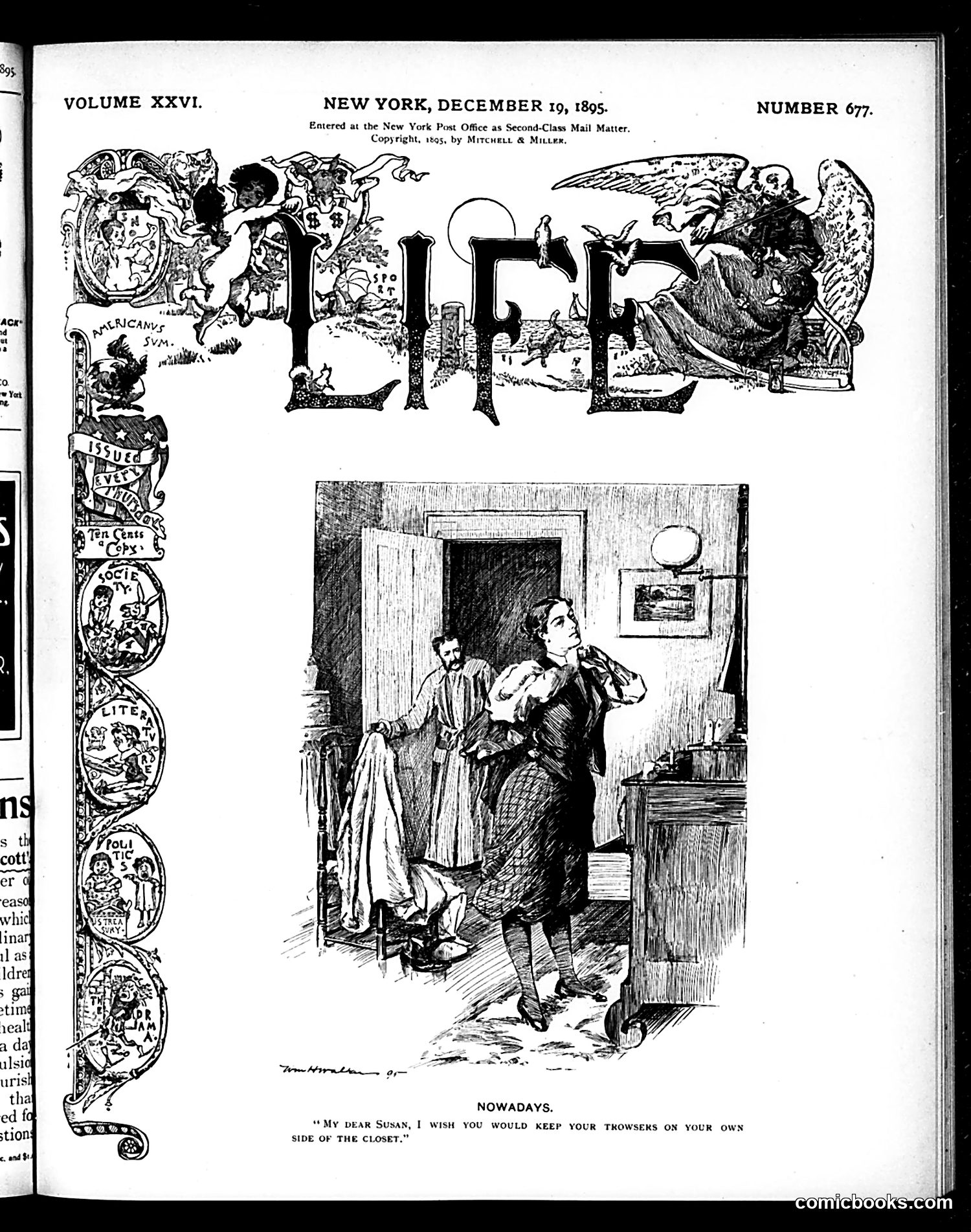
This page features a single cartoon titled "Nowadays" depicting a domestic scene. A man stands in a doorway confronting a woman, saying: "My dear Susan, I wish you would keep your trousers on your own side of the closet." The satire comments on late-Victorian gender relations and changing women's roles. The joke relies on the shocking implication that women are now wearing trousers—a radical departure from Victorian dress norms requiring women's skirts. By having the man complain about shared closet space as an equal problem, the cartoon mocks both the novelty of women adopting masculine clothing and anxieties about blurred gender boundaries. The humor targets progressive changes in women's dress and independence during the 1890s "New Woman" era.
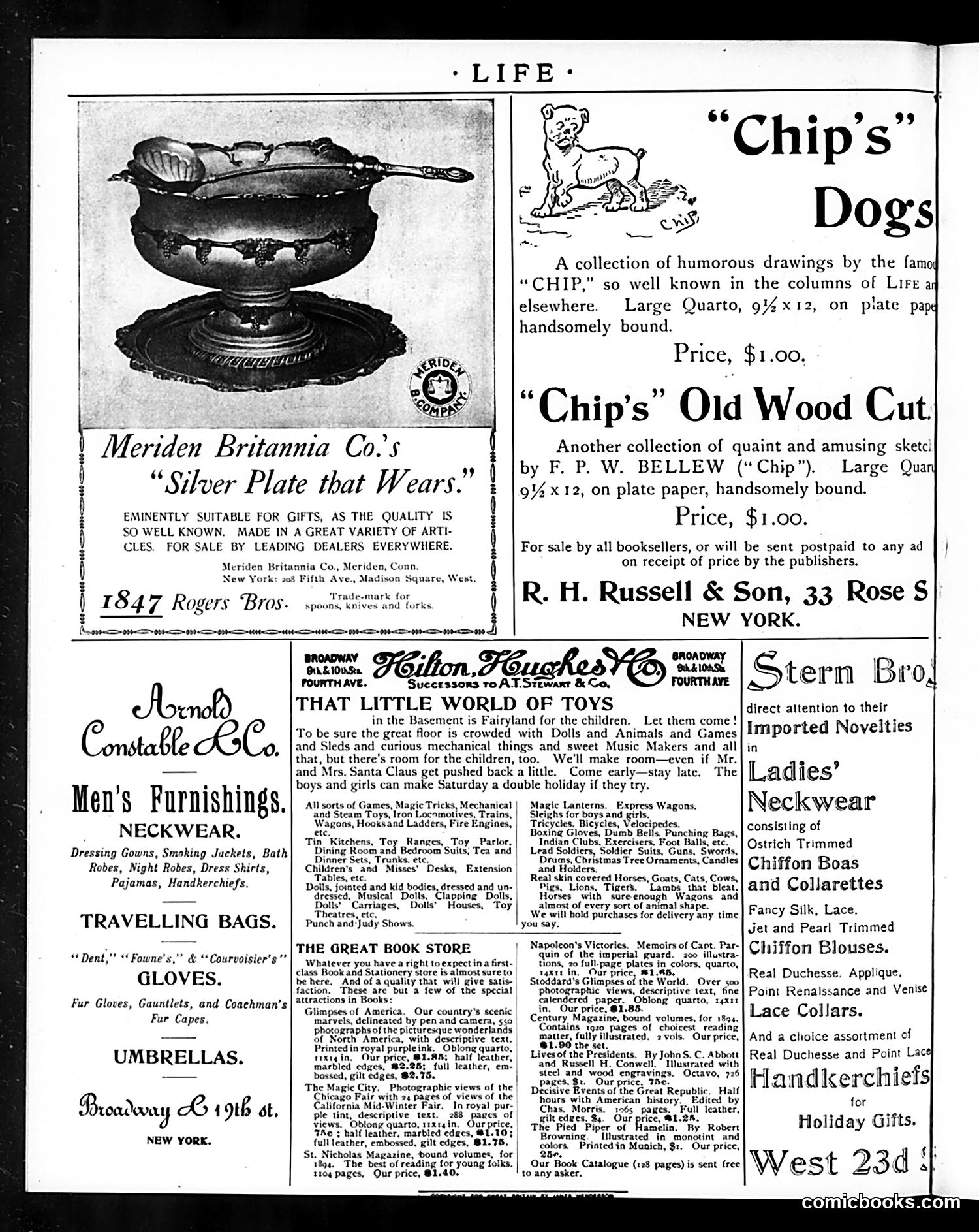
This page is **primarily advertising** with no political cartoons or satirical content visible. The main image shows a decorative silver bowl/tureen by Meriden Britannia Co., marketed as "Silver Plate that Wears"—a product advertisement targeting gift-buyers. The right side advertises "Chip's" Dogs and Old Wood Cuts—collections of humorous drawings by an artist known as "CHIP" who contributed to Life magazine. These are being sold as bound books for $1.00 each. Below are various advertisements for men's furnishings (Arnold Constable & Co.), toys (Halton Houckes & Co.), and women's accessories (Stern Bros.). The page represents typical early-20th-century Life magazine layout: editorial/satirical content mixed with commercial advertisements. No satirical point is evident here—it's a commercial page rather than editorial content.
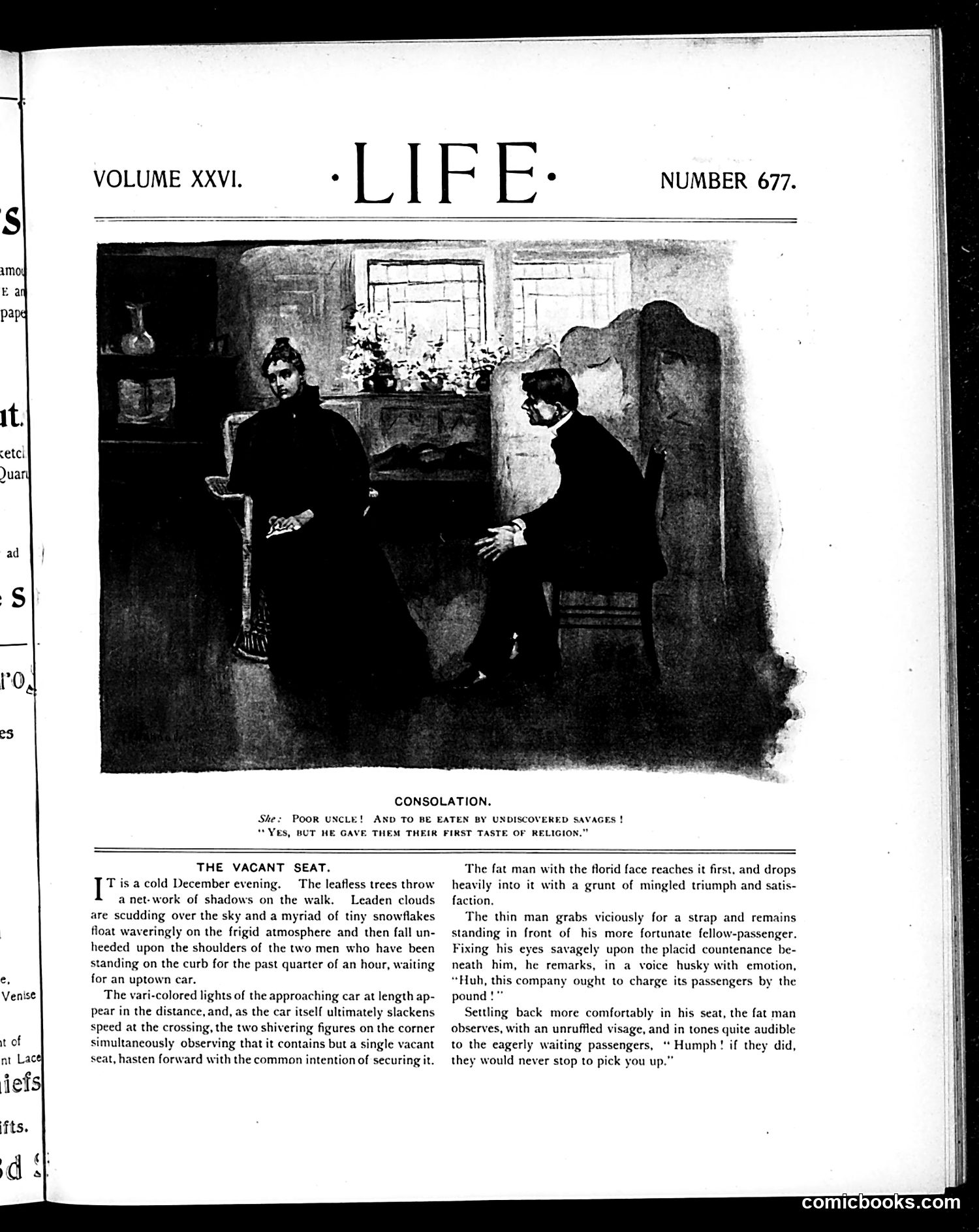
This cartoon satirizes overcrowded public transportation, likely from the early 20th century. Two working-class men on a street corner spot an approaching streetcar with a rare empty seat—a precious commodity on crowded urban transit. They rush forward "with the common intention of securing it," but the fat man reaches it first and claims the seat. The accompanying dialogue mocks both the desperation for seating and class tensions: the thin man complains about passenger overcharging ("by the pound"), while the successful fat man smugly remarks that the company "ought to charge its passengers by the pound." The satire targets transit companies' greed and the indignity of crowded commuting conditions affecting ordinary workers.
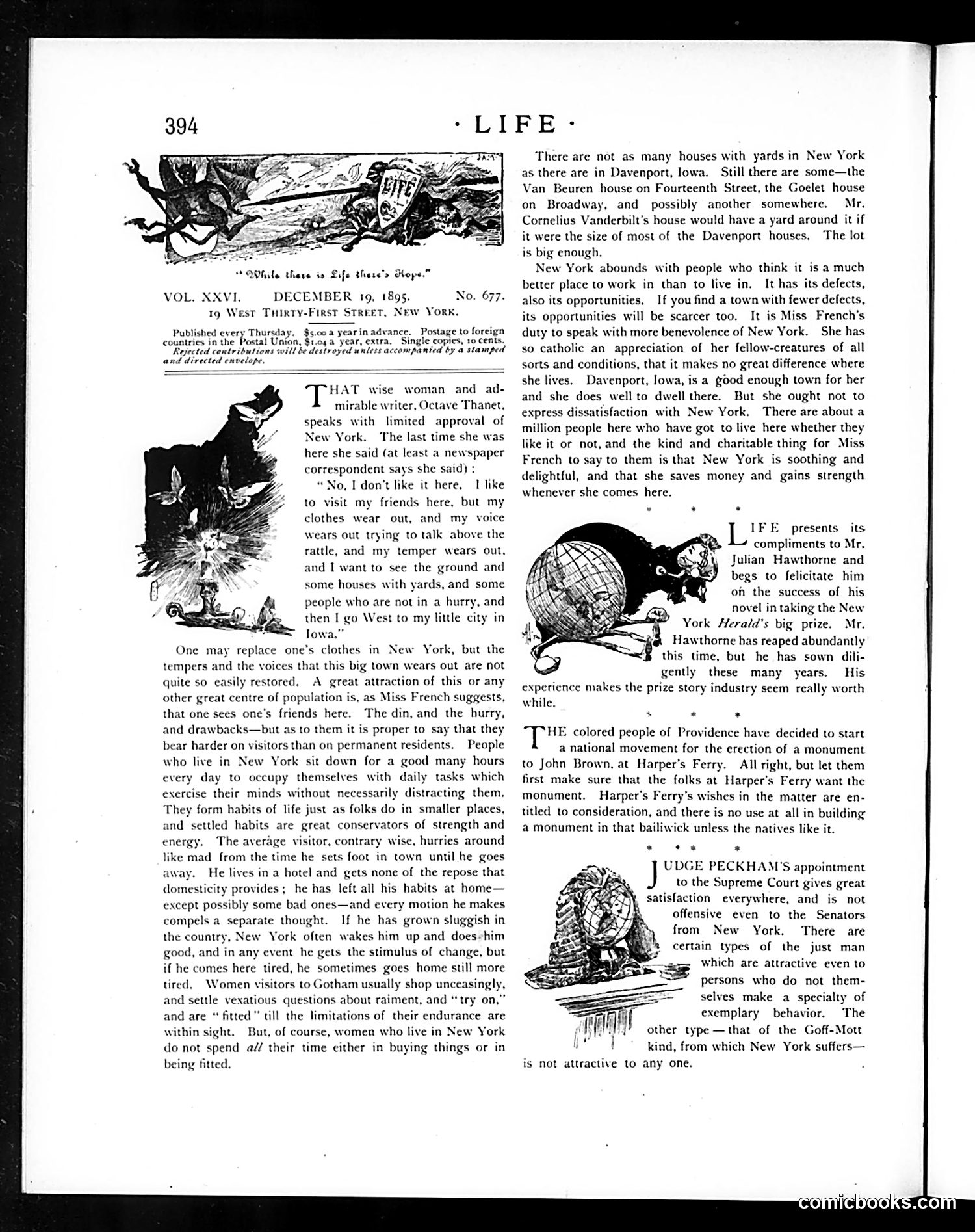
This page contains editorial commentary rather than political cartoons. The main illustrations are decorative vignettes accompanying text about New York City life. The article discusses **Octave Thanet** (a pen name of French writer Alice French), who expresses qualified approval of New York while preferring smaller towns like Davenport, Iowa. The satire critiques how New Yorkers rush constantly, wear out clothes quickly, and miss leisure—contrasting urban stress with small-town peace. Other brief items praise **Julian Hawthorne's** Herald prize-winning novel and comment on Judge Peckham's Supreme Court appointment. A final note mocks the "Goff-Mott kind" of New Yorker—apparently a recognizable social type associated with unattractive behavior. The overall message: urbane mockery of New York's frantic pace versus provincial tranquility.
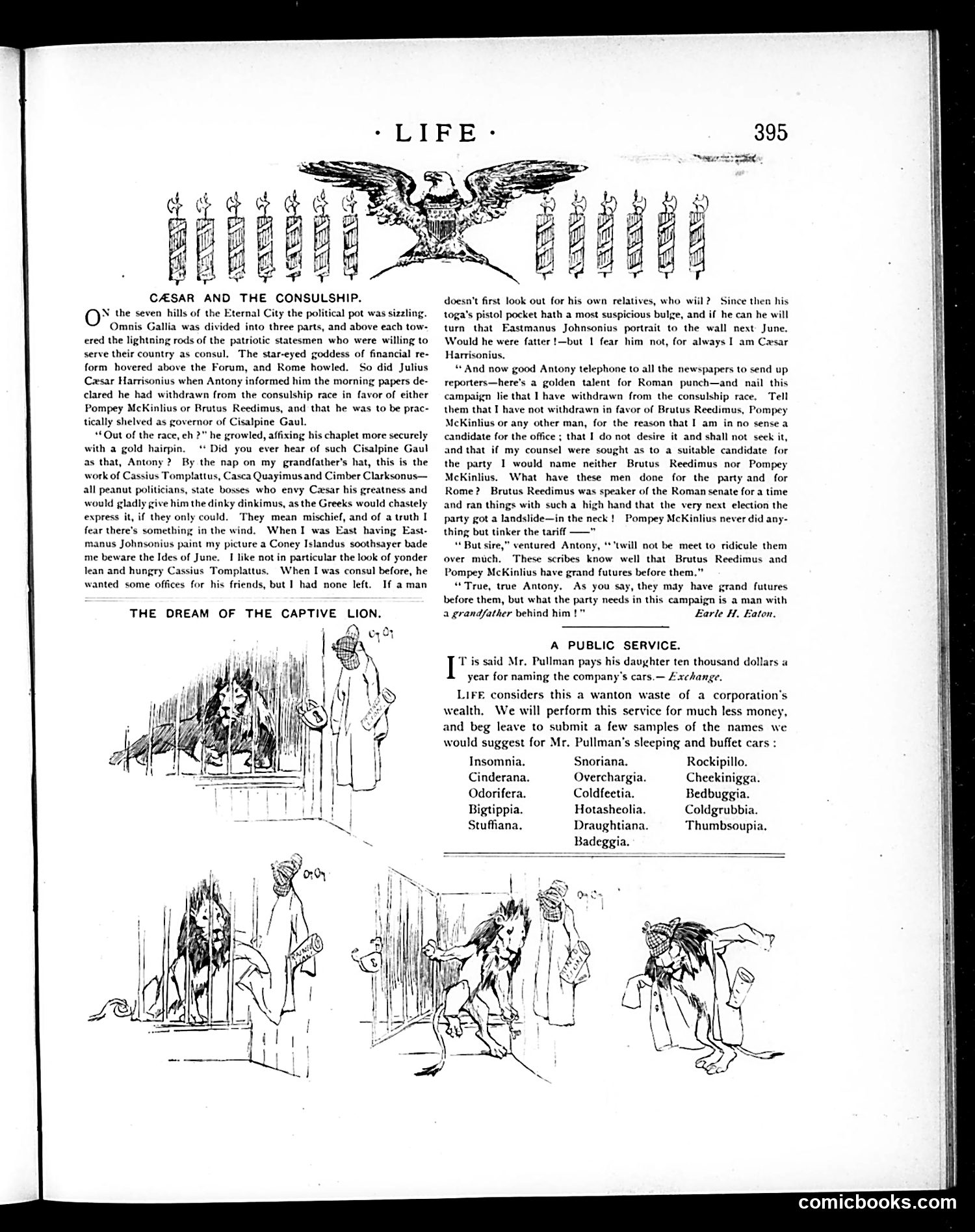
This page contains a three-panel satirical cartoon depicting a lion imprisoned in a cage, dreaming of freedom and revenge against those who confined it. The lion imagines itself as a powerful, menacing figure terrorizing its captors. The cartoon appears to be political allegory, likely representing a powerful political figure (the "lion") constrained by circumstances or opponents, fantasizing about retribution. The cartoonist uses the lion's captivity as metaphor for political restraint or powerlessness. Without additional context about the magazine's date and contemporary politics, the specific figure and situation cannot be identified with certainty. However, the satirical tone mocks either the captive's grandiose revenge fantasies or his actual powerlessness—typical of Life magazine's political commentary.
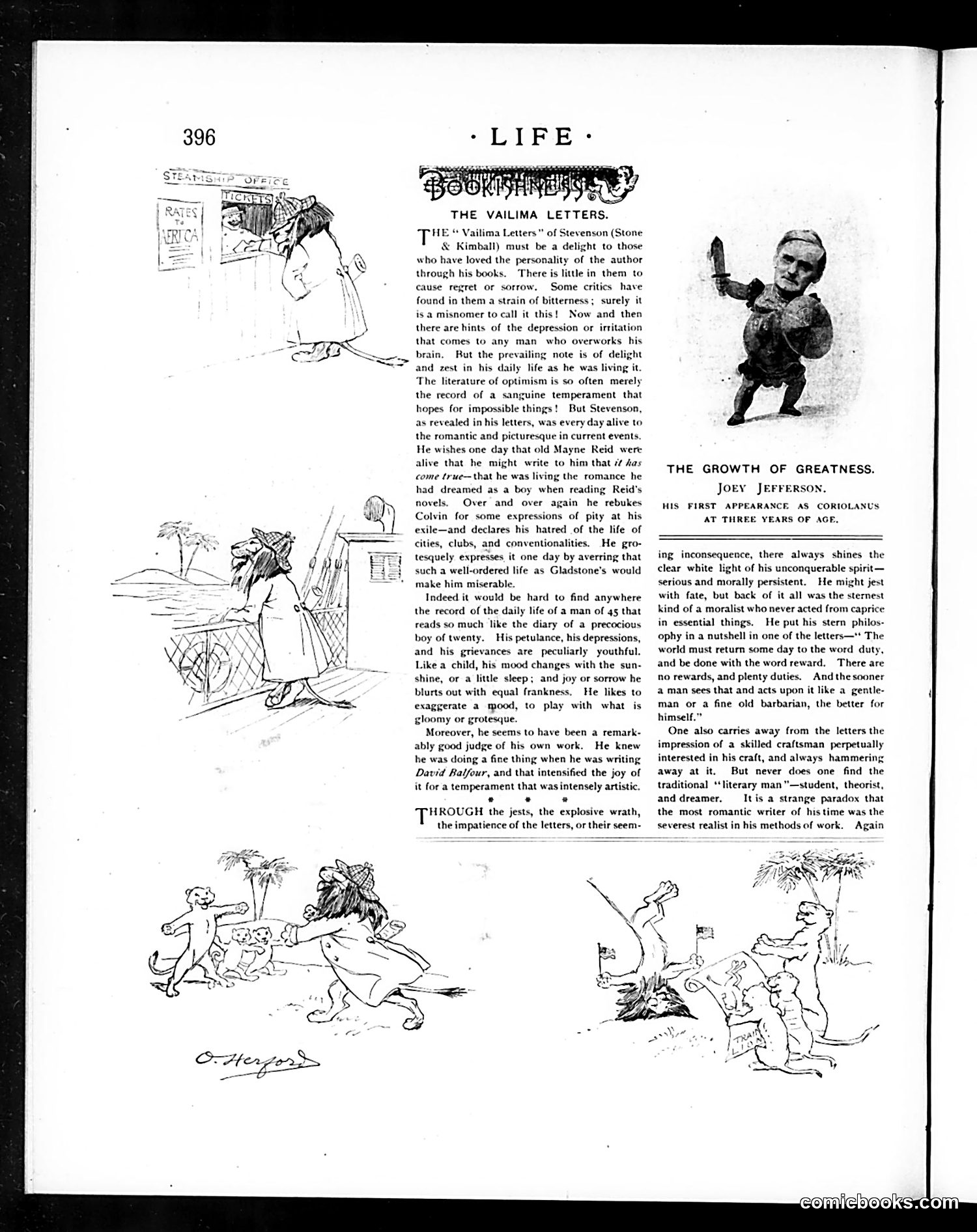
This page discusses Robert Louis Stevenson's "Vailima Letters," praising the author's optimistic temperament and romantic spirit. The right column features "The Growth of Greatness: Joey Jefferson," describing his first appearance as a coriolanus at three years old. The illustrations are decorative sketches (signed "O. Herford") depicting children in various playful scenarios—no specific political satire is evident. These appear to be generic humorous vignettes accompanying the literary discussion. The page is primarily **editorial content about literature**, not political commentary. The "Joey Jefferson" section remains unclear without additional context about who this child performer was, though the reference to playing "Coriolanus" (Shakespeare's Roman general) suggests a theatrical child prodigy of the era.
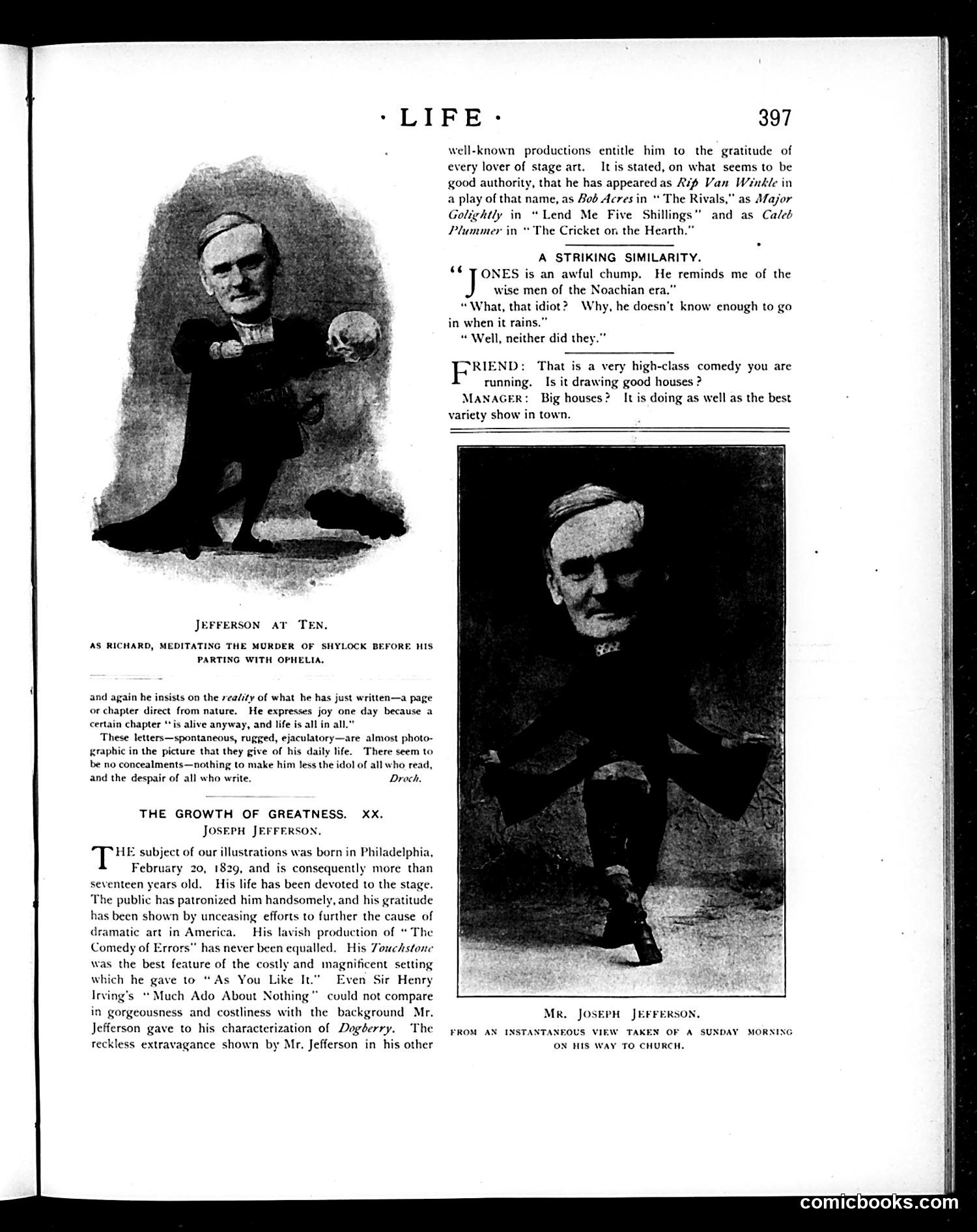
This page celebrates **Joseph Jefferson**, a famous 19th-century American actor (born Philadelphia, February 20, 1829). The left illustration shows Jefferson as **Richard III** in Shakespeare's play, depicted meditating on murder before abandoning Ophelia—referencing his celebrated theatrical roles. The right photograph captures Jefferson in everyday dress heading to church, labeled as "an instantaneous view taken of a sunday morning." The satire lies in the contrast: the page juxtaposes Jefferson's theatrical persona—capable of portraying dark, morally complex characters—against his mundane, respectable real life. This highlights the common Victorian fascination with actors' dual natures: the dramatic intensity they displayed onstage versus their ordinary, pious private conduct. The piece celebrates Jefferson's contributions to American theater and public admiration.
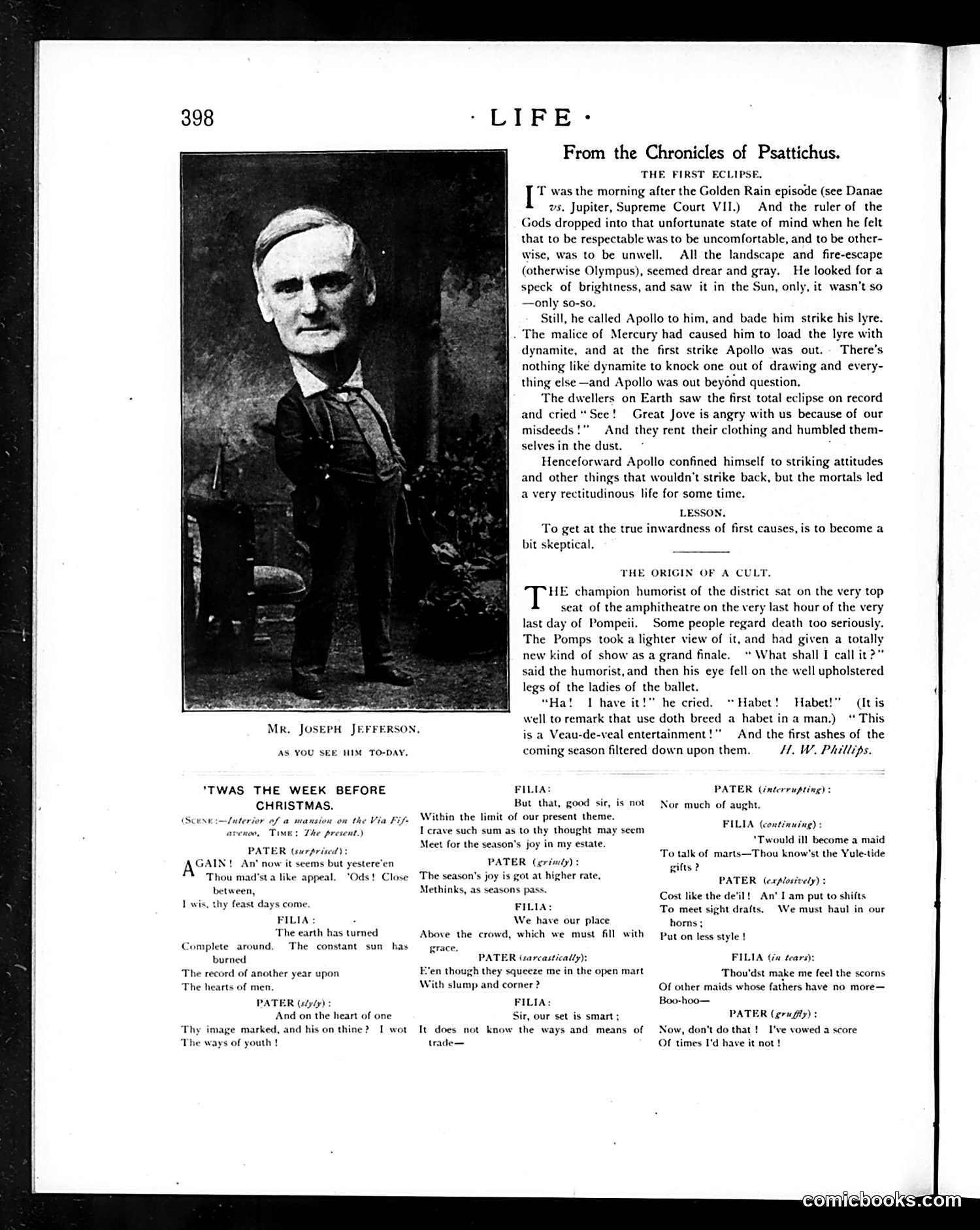
This page features **Mr. Joseph Jefferson**, a prominent 19th-century actor, pictured in period costume. The main text is a humorous mythological piece titled "From the Chronicles of Psattichus," which parodies classical literature by describing Apollo's destruction via dynamite after the "Golden Rain episode." Below is a theatrical dialogue scene titled "'TWAS THE WEEK BEFORE CHRISTMAS," featuring characters named Pater and Filia discussing seasonal preparations and social obligations. The satire appears to mock both pretentious classical allusions (through the absurd Apollo story) and upper-class domestic life (through the domestic conversation about Christmas preparations and social expectations). The humor relies on incongruity—mixing high mythology with modern concerns and casual domestic banter—typical of Life's satirical approach to American society.
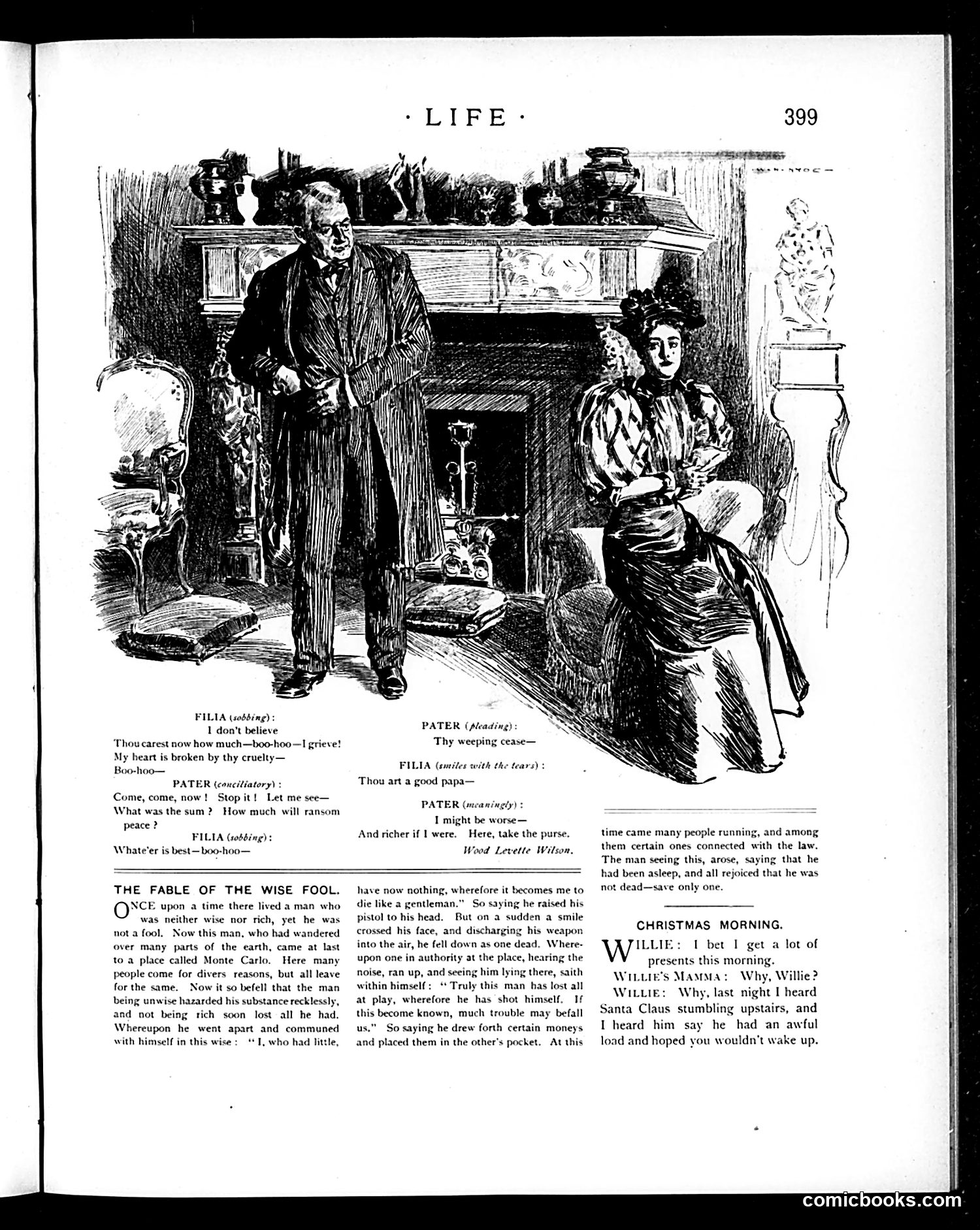
This page contains two distinct pieces: **Upper illustration**: A dramatic domestic scene showing a man and woman in what appears to be a confrontation near a fireplace. The dialogue indicates a melodramatic quarrel about infidelity and betrayal—the man accuses the woman of cruelty, while she questions his fidelity. The theatrical staging and overwrought emotions parody Victorian-era domestic drama. **Lower section**: "The Fable of the Wise Fool" tells of a poor man who, after becoming rich, shoots himself rather than endure the change in social status—a sardonic commentary on wealth's corrupting influence and social pretension. **Bottom right**: "Christmas Morning" features a brief humorous exchange between characters named Willie and his mother, likely a joke about childhood Christmas expectations versus reality. The page exemplifies *Life* magazine's satirical approach to social manners, domestic relations, and human folly.
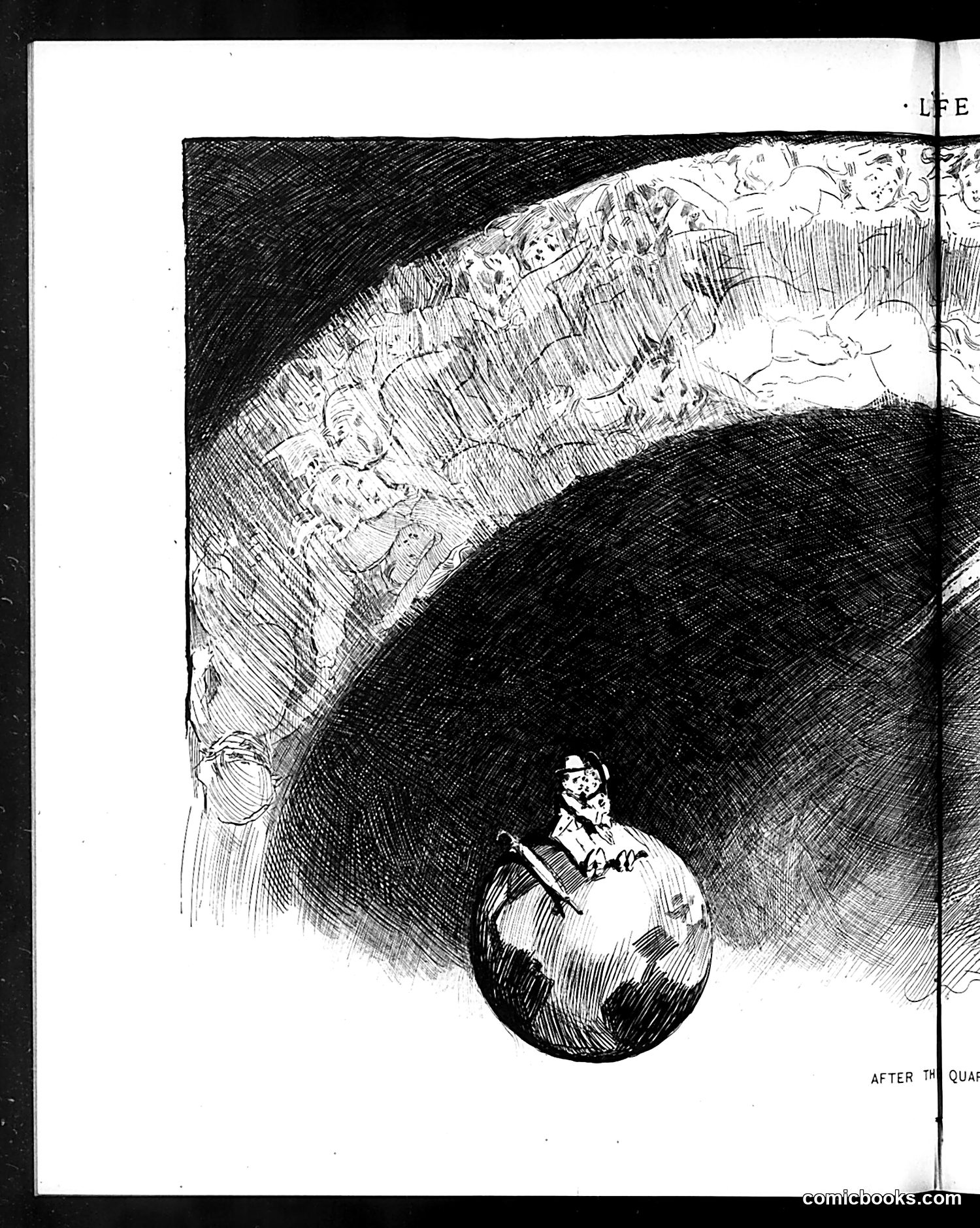
This political cartoon depicts a figure in military uniform standing atop a spherical bomb or globe, wielding what appears to be a pickaxe or mining tool. The figure wears a hat and cross-belts typical of early 20th-century military dress. The heavy cross-hatching creates a dark, ominous atmosphere—suggesting danger or catastrophe. The sphere likely represents the world or a destructive weapon. The militaristic figure actively "mining" or "breaking" it suggests warmongering or the destructive power of military action. The partial caption reads "AFTER TH[E] QUAR[REL]" (likely "quarrel"), implying this shows consequences of conflict. Without the full caption or publication date, the specific historical reference remains unclear, though the style suggests early-to-mid 20th century satirical commentary on militarism and global destruction.
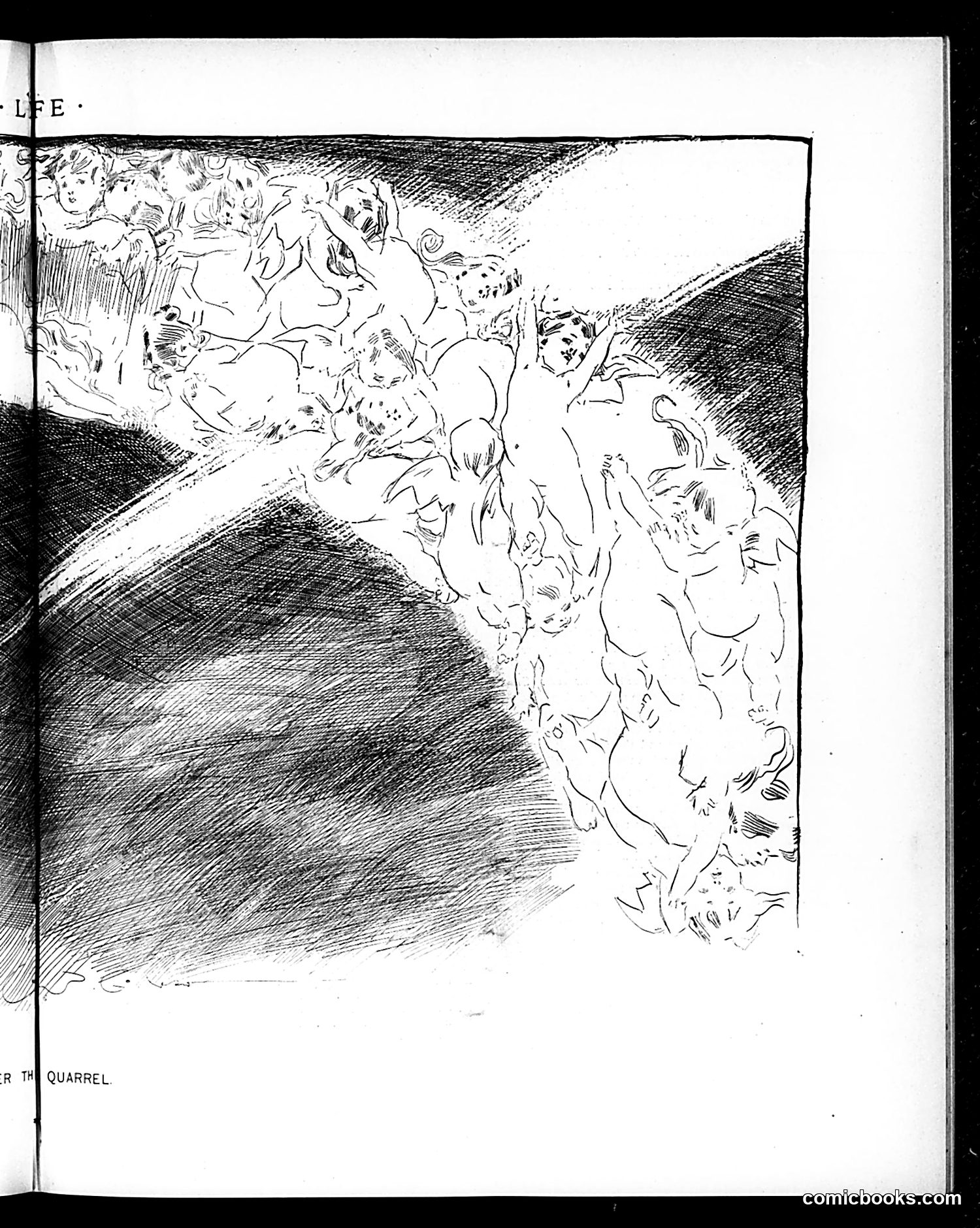
This page contains an illustration labeled "R TH QUARREL" (possibly "THE QUARREL," with the beginning cut off). The sketch shows multiple nude or semi-nude figures in what appears to be a chaotic, crowded scene with dramatic line work and cross-hatching creating shadows and movement. Without clearer text or caption identifying the specific figures or political/social reference, I cannot definitively explain the cartoon's meaning. The artistic style—loose pen-and-ink drawing with energetic linework—is consistent with early 20th-century satirical illustration. The crowded composition and dramatic shading suggest conflict or turmoil, but the specific historical or political reference remains unclear from this image alone. A caption or fuller context would be needed to identify the figures and explain the satire.
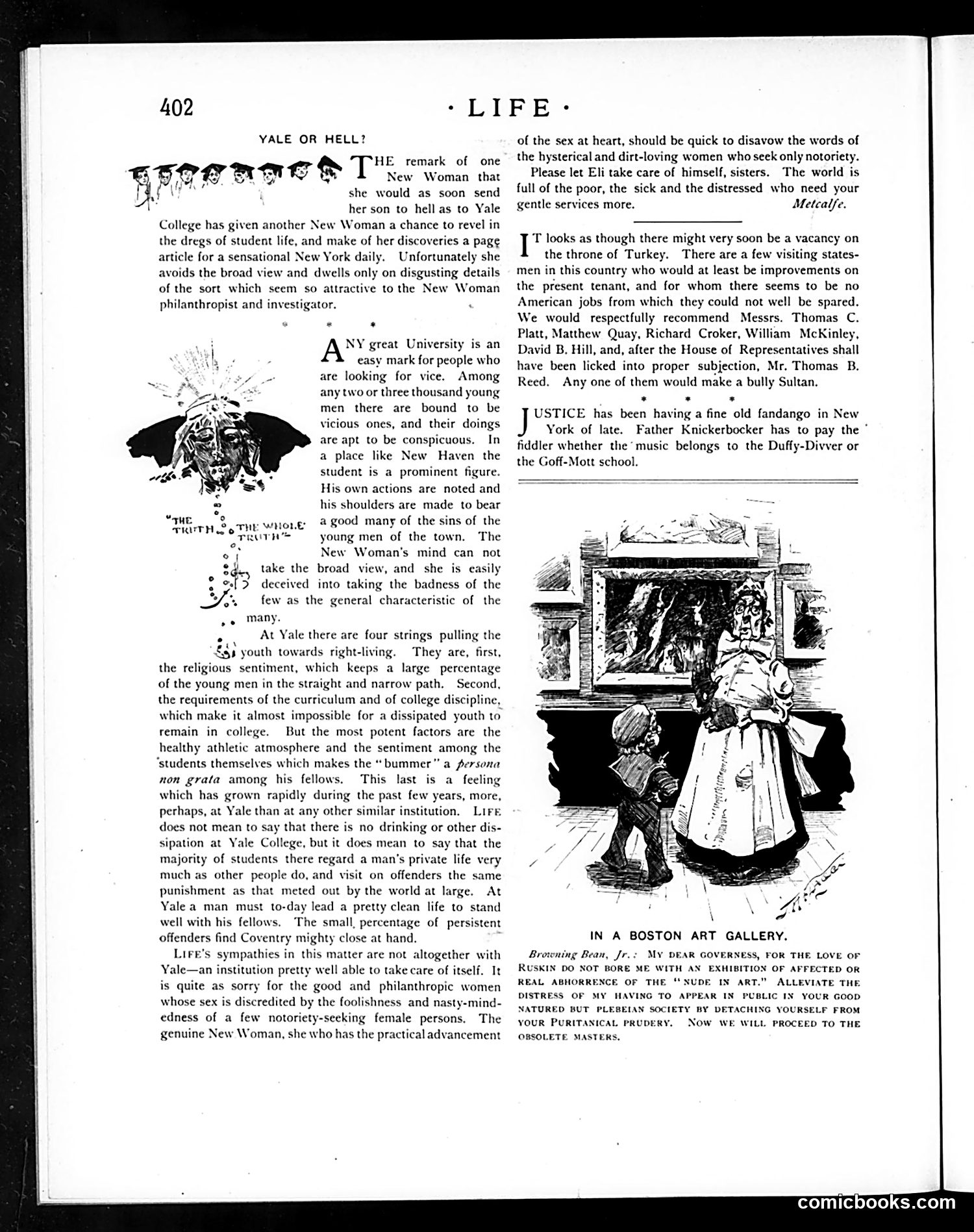
This page satirizes self-righteousness and hypocrisy. The main article attacks certain "New Woman" activists and journalists who sensationalize Yale students' moral failings. The author (Metcalfe) criticizes women reformers for dwelling on sordid details and painting a distorted picture of student vice, while ignoring the university's positive moral influences—religion, discipline, and peer pressure against degeneracy. The satire targets the reformers themselves as "notoriety-seeking female persons" who discredit the legitimate women's suffrage movement. The author defends Yale's character while dismissing these critics as unserious attention-seekers, suggesting women should redirect their reformist energy toward genuine social needs (poor, sick, distressed) rather than university scandal-mongering.
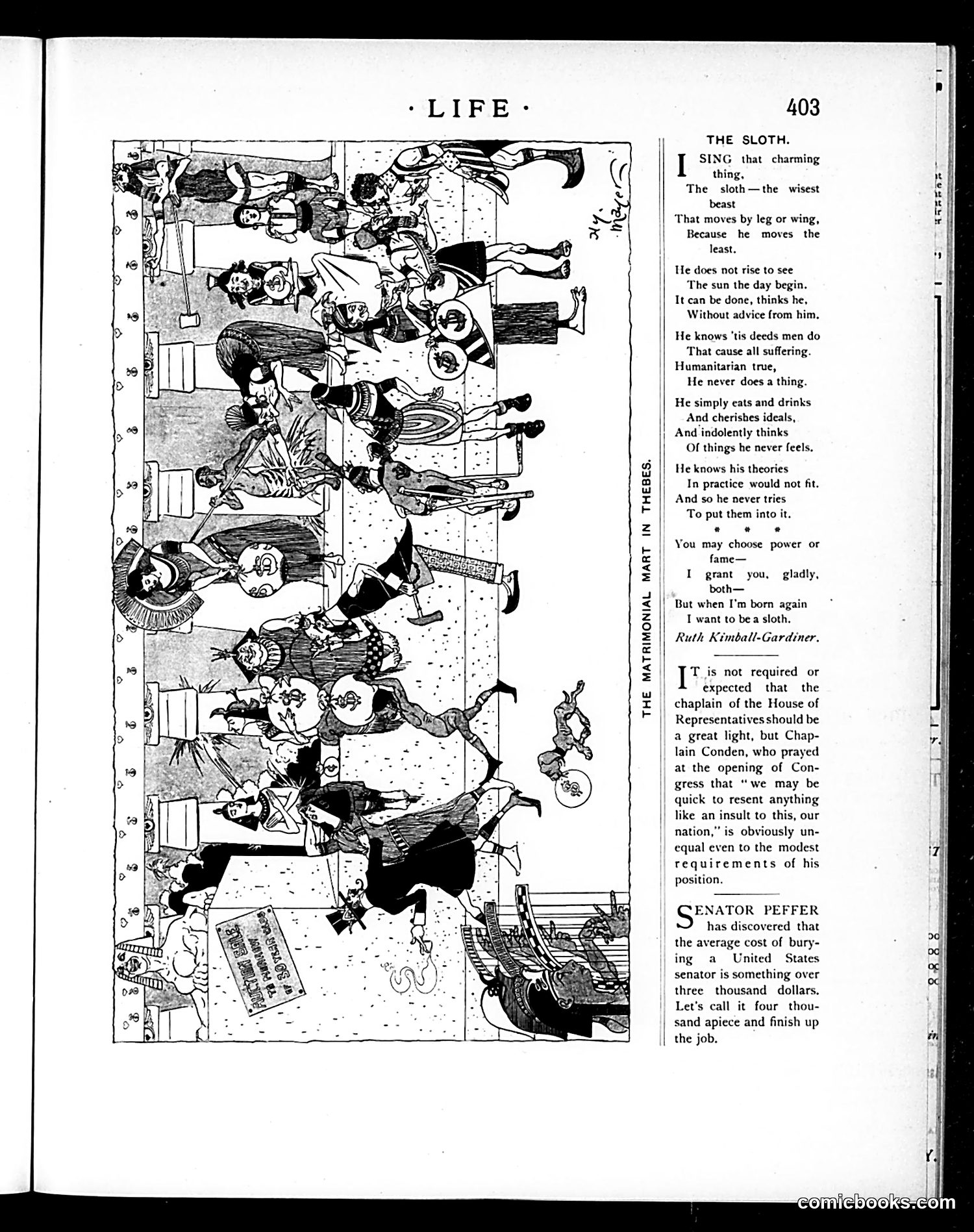
This page contains three distinct pieces of satire: **"The Sloth"** (poem by Ruth Kimball-Gardiner): A humorous critique of political inaction and detachment. The sloth represents politicians or public figures who avoid taking action, justify inaction through elaborate philosophies ("theories"), and prioritize comfort over responsibility. The satire mocks those who espouse ideals they never act upon—a common critique of passive governance. **Chaplain Conden paragraph**: Criticism of the House Chaplain for his inflammatory prayer requesting Congress be "quick to resent" insults to the nation. The writer sarcastically notes that Conden is "obviously unequal" even to his modest job requirements—implying his inflammatory rhetoric is inappropriate for a religious official. **Senator Peffer paragraph**: Sharp satire suggesting the cost of burying senators ($3,000+) is excessive, with a darkly humorous suggestion to "finish up the job"—meaning pay senators to retire/die. This likely reflects frustration with aging or ineffective senators. The left illustration (rotated) appears to show a crowded social scene titled "The Matrimonial Mart in Thebes."
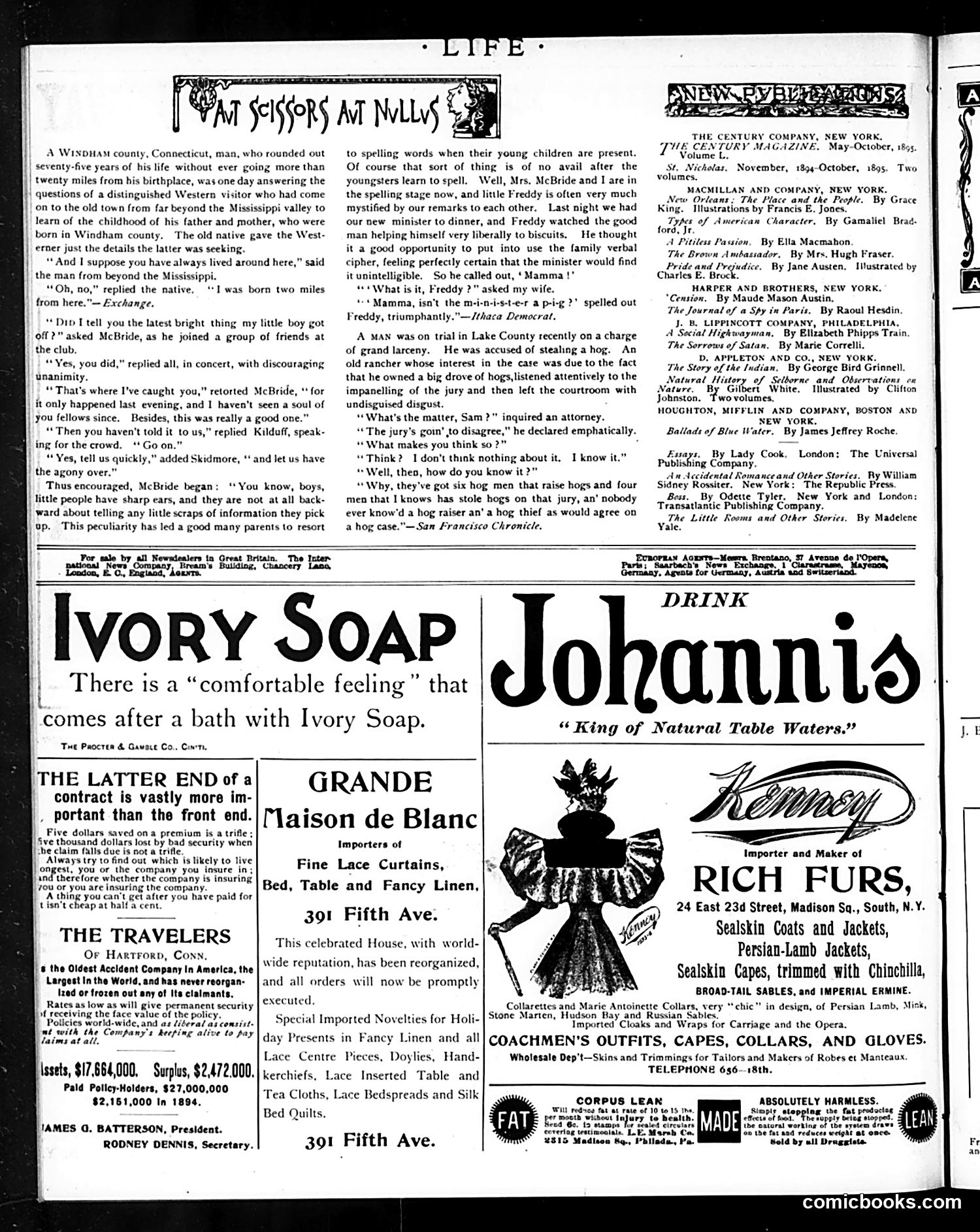
This page contains three humorous anecdotes rather than political cartoons. The pieces satirize rural American attitudes and social behavior: 1. **"Pat Sensors at Nullys"**: Mocks a Connecticut native's extreme localism—he's lived 75 years without traveling 20 miles from home, yet claims he wasn't born locally (two miles away). The joke ridicules provincial insularity. 2. **The McBride anecdote**: Satirizes middle-class parents who spell out words (like "p-i-g") to discuss unsuitable topics around children. The humor comes from the child's innocent but devastating observation that the minister eats like a pig—exposing the parents' failed strategy. 3. **The Lake County trial story**: Mocks jury selection bias. The rancher observes the jury includes both hog thieves and hog raisers, predicting disagreement since neither group would convict fairly. It satirizes the absurdity of jury composition in frontier communities. The page primarily features period advertisements (Ivory Soap, Johannis mineral water, furs).
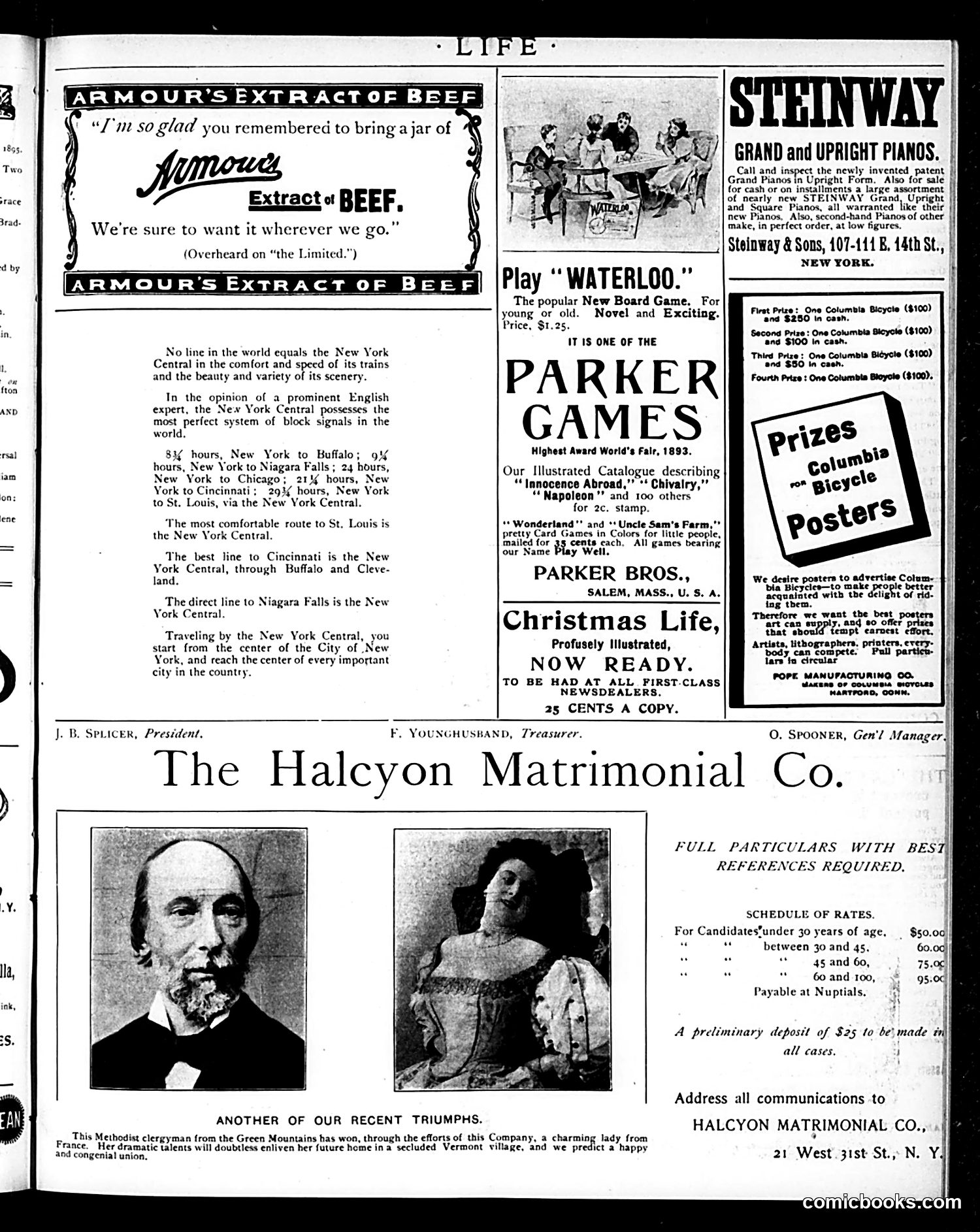
This page is primarily **advertising**, not political satire. It contains: 1. **Product ads**: Armour's Extract of Beef, Steinway pianos, Parker board games, and Columbia bicycles 2. **Service ads**: The New York Central Railroad (emphasizing speed and comfort to various cities) and a "Matrimonial" matchmaking service The only quasi-humorous content is: - A brief Armour's ad joke (overheard conversation about wanting beef extract while traveling) - A "triumph" caption for the Halcyon Matrimonial Co., presenting a matched couple (Methodist clergyman and actress) with tongue-in-cheek optimism about their "happy conjugal union" There is **no political cartoon** on this page. The matchmaking service ad is mildly satirical about romance and class (pairing a rural clergyman with an actress), but it's marketing satire, not social commentary. This reflects turn-of-the-century attitudes toward matrimonial agencies as legitimate businesses.
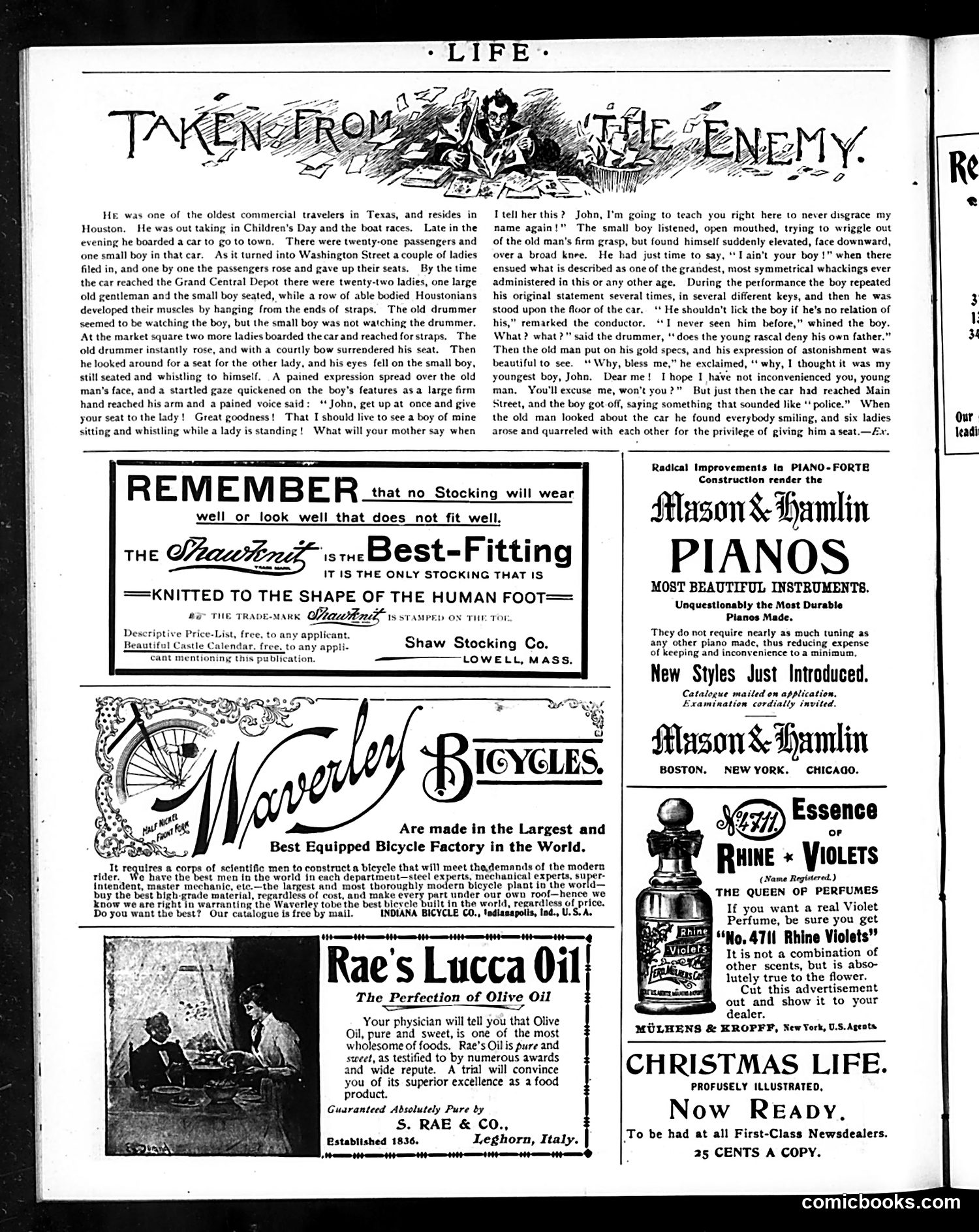
This page features a humorous moral tale about a traveling salesman who mistakes a stranger's boy for his own son on a crowded streetcar. The story satirizes **Victorian gentlemen's codes of conduct** regarding chivalry toward ladies. The setup: A respectable "old drummer" (traveling salesman) has been giving up his seat to women all evening. When he spots a boy refusing to yield his seat to a lady, he's appalled at such ungentlemanly behavior and administers a public spanking—only to discover the child is a complete stranger. **The satire's point**: The story mocks the performative nature of upper-class propriety. The old man's outrage at the boy's rudeness, while entirely reasonable by Victorian standards, becomes absurd when applied to someone else's child. The irony intensifies when, after his embarrassed apology, the other passengers reward him with their seats anyway—validating his social status despite his blunder. The humor relies on audience recognition that such strict codes of masculine honor and female deference were culturally paramount in the era.
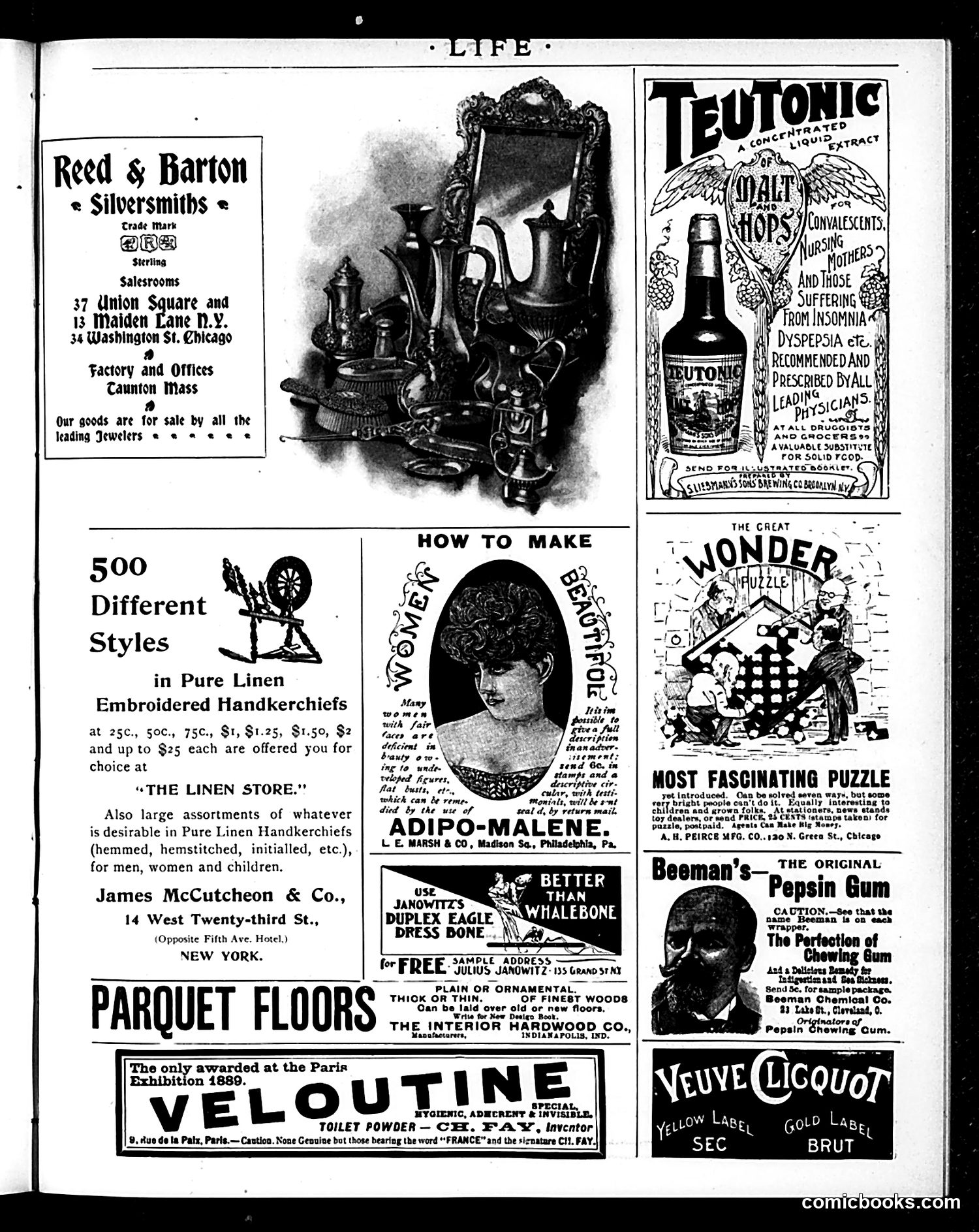
This page consists almost entirely of **advertisements** rather than editorial cartoons or satirical content. The notable ads include: - **Reed & Barton Silversmiths**: Promoting sterling silverware through jewelry stores - **Teutonic liqueur extract**: A medicinal tonic marketed to treat insomnia, dyspepsia, and other ailments—typical of the patent medicine era - **Embroidered handkerchiefs**: Various linen goods sold through specialty retailers - **Adipo-Malene**: A weight-reduction product (the central image shows a woman's face) - **Beeman's Pepsin Gum**: Marketed as an digestive aid - **Veloute toilet powder**: A French cosmetic product - Various other products (puzzle, dress bone, parquet floors) The only potentially satirical element is the puzzle advertisement, though it's presented straightforwardly. The page reflects early 20th-century consumer culture, emphasizing patent medicines and beauty products as solutions to modern ailments—a recurring target of satire in *Life* magazine generally, though not evident here.
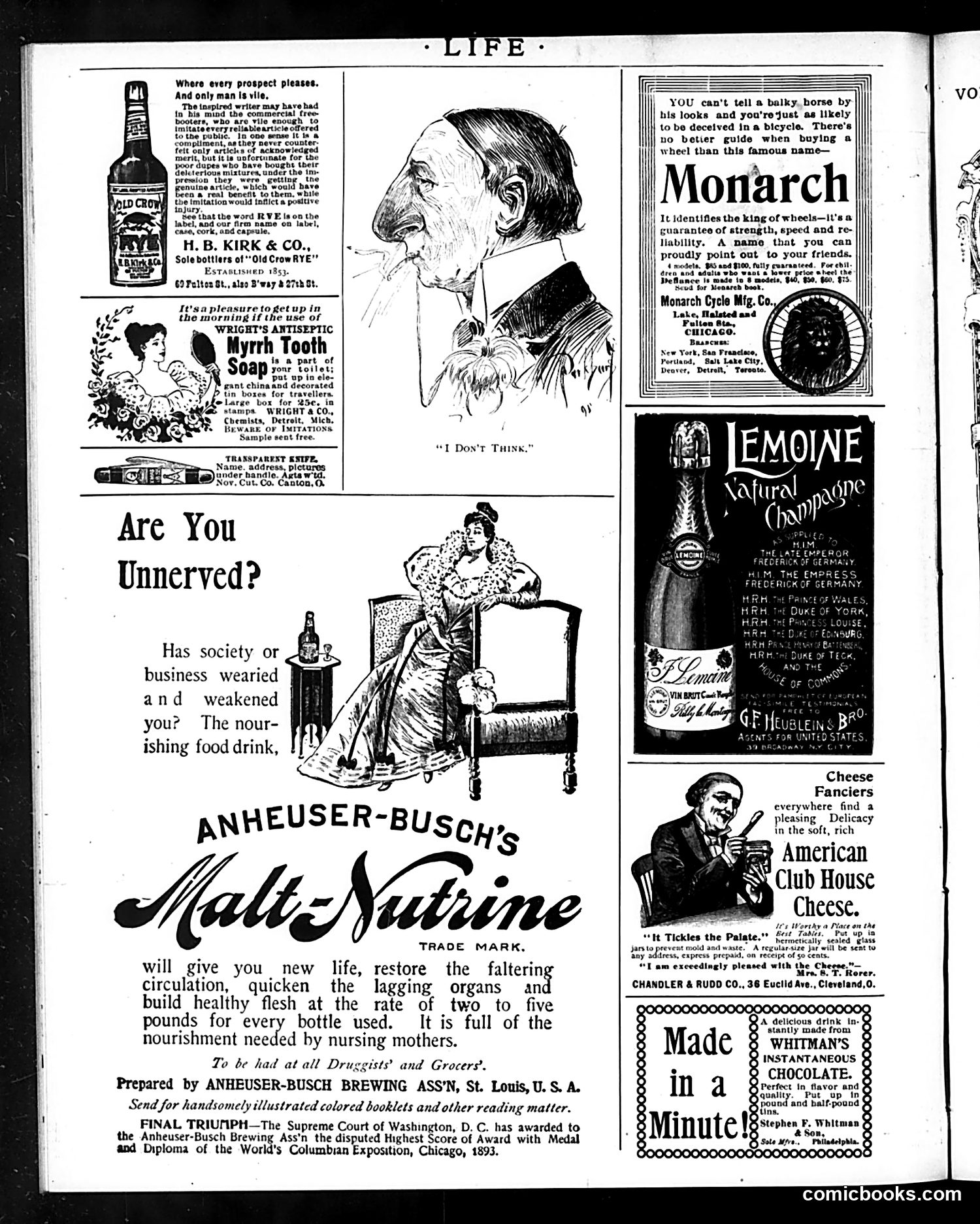
This page is primarily **advertising**, not editorial satire. The central cartoon—a profile sketch labeled "I Don't Think"—appears to be a generic illustration accompanying the advertisements rather than political commentary. The ads reflect **turn-of-the-century patent medicine culture**: Anheuser-Busch's "Malt-Nutrine" claims to restore health and build flesh; Wright's Antiseptic Myrrh Tooth Soap promises wellness. These were typical era claims, often exaggerated. The Monarch bicycle ad uses competitive marketing language ("king of wheels"), while food products like American Club House Cheese and Whitman's Chocolate emphasize quality and endorsements. The "Final Triumph" note about Anheuser-Busch's 1893 World's Columbian Exposition award was a genuine marketing achievement—major breweries competed fiercely for such recognition. **The satire, if any, is implicit**: Life magazine's inclusion of these dubious health claims itself may constitute gentle mockery of contemporary advertising excess, though the page reads primarily as straightforward commercial content typical of the era.