
Life, 1895-12-19 · page 6 of 18
Life — December 19, 1895 — page 6: what you’re looking at
What you’re looking at
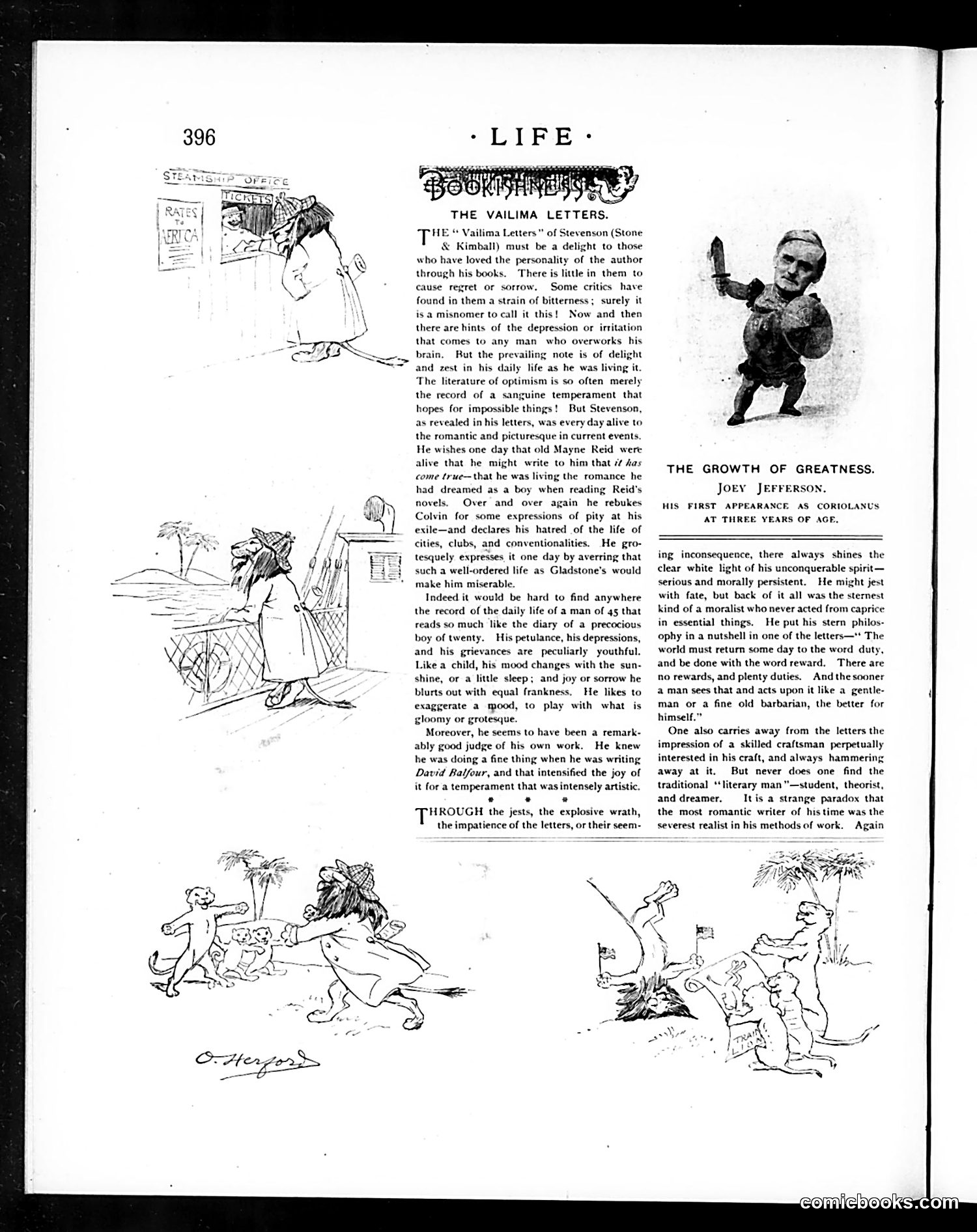
This page discusses Robert Louis Stevenson's "Vailima Letters," praising the author's optimistic temperament and romantic spirit. The right column features "The Growth of Greatness: Joey Jefferson," describing his first appearance as a coriolanus at three years old. The illustrations are decorative sketches (signed "O. Herford") depicting children in various playful scenarios—no specific political satire is evident. These appear to be generic humorous vignettes accompanying the literary discussion. The page is primarily **editorial content about literature**, not political commentary. The "Joey Jefferson" section remains unclear without additional context about who this child performer was, though the reference to playing "Coriolanus" (Shakespeare's Roman general) suggests a theatrical child prodigy of the era.
📄 Transcribed text from this page (OCR, searchable)
Machine-transcribed from the original scan — historical spelling and the odd misread are preserved.
& Kimball) must be a delight to those who have loved the personality of the author through his books. There is little in them to cause regret or sorrow, Some critics have found in them a strain of bitterness ; surely it isa misnomer to call it this! Now and then there are hints of the depression or irritation that comes to any man who overworks his brain, But the prevailing note is of del and zest in his daily life as he was living it. ‘The literature of optimism is so often merely the record of a sanguine temperament that hopes for impossible things! But Stevenson, as revealed in his letters, was every day alive to the romantic and picturesque in current events. He wishes one day that old Mayne Reid were alive that he might write to him that 77 das come true—that he was living the romance he had dreamed as a boy when reading Reid’s novels. Over and over again he rebukes Colvin for some expressions of pity at his exile—and declares his hatred of the life of cities, clubs, and conventionalities. He gro- tesquely expresses, it one day by averring that such a well-ordered life as Gladstone’s would make him miserable. Indeed it would be hard to find anywhere the record of the daily life of a man of 45 that reads so much like the diary of a precocious boy of twenty. His petulance, his depressions, and his grievances are peculiarly youthful. Like a child, his mood changes with the sun- shine, or a little sleep; and joy or sorrow he blurts out with equal frankness. He likes to exaggerate a mood, to play with what is gloomy or grotesque. Moreover, he seems to have been a remark- ably good judge of his own work. He knew he was doing a fine thing when he was writing David Balfour, and that intensified the joy of it for a temperament that wasintensely artistic. * * * THROUGH the jests, the explosive wrath, the impatience of the letters, or their seem- THE GROWTH OF GREATNESS. Jory JEFFERSON. HIS FIRST APPEARANCE AS CORIOLANUS. AT THREE YEARS OF AGE. ing inconsequence, there always shines the clear white light of his unconquerable spirit— serious and morally persistent. He might jest with fate, but back of it all was the sternest kind of a moralist who never acted from caprice in essential things. He put his stern philos- ophy in a nutshell in one of the letters—"* The world must return some day to the word duty, and be done with the word reward. There are no rewards, and plenty duties. And the sooner a man sees that and acts upon it like a gentle- man or a fine old barbarian, the better for himself.” One also carries away from the letters the impression of a skilled craftsman perpetually interested in his craft, and always hammering away at it. But never does one find the traditional “literary man"—student, theorist, and dreamer. It is a strange paradox that the most romantic writer of his time was the severest realist in his methods of work. Again