
Life, 1895-12-19 · page 4 of 18
Life — December 19, 1895 — page 4: what you’re looking at
What you’re looking at
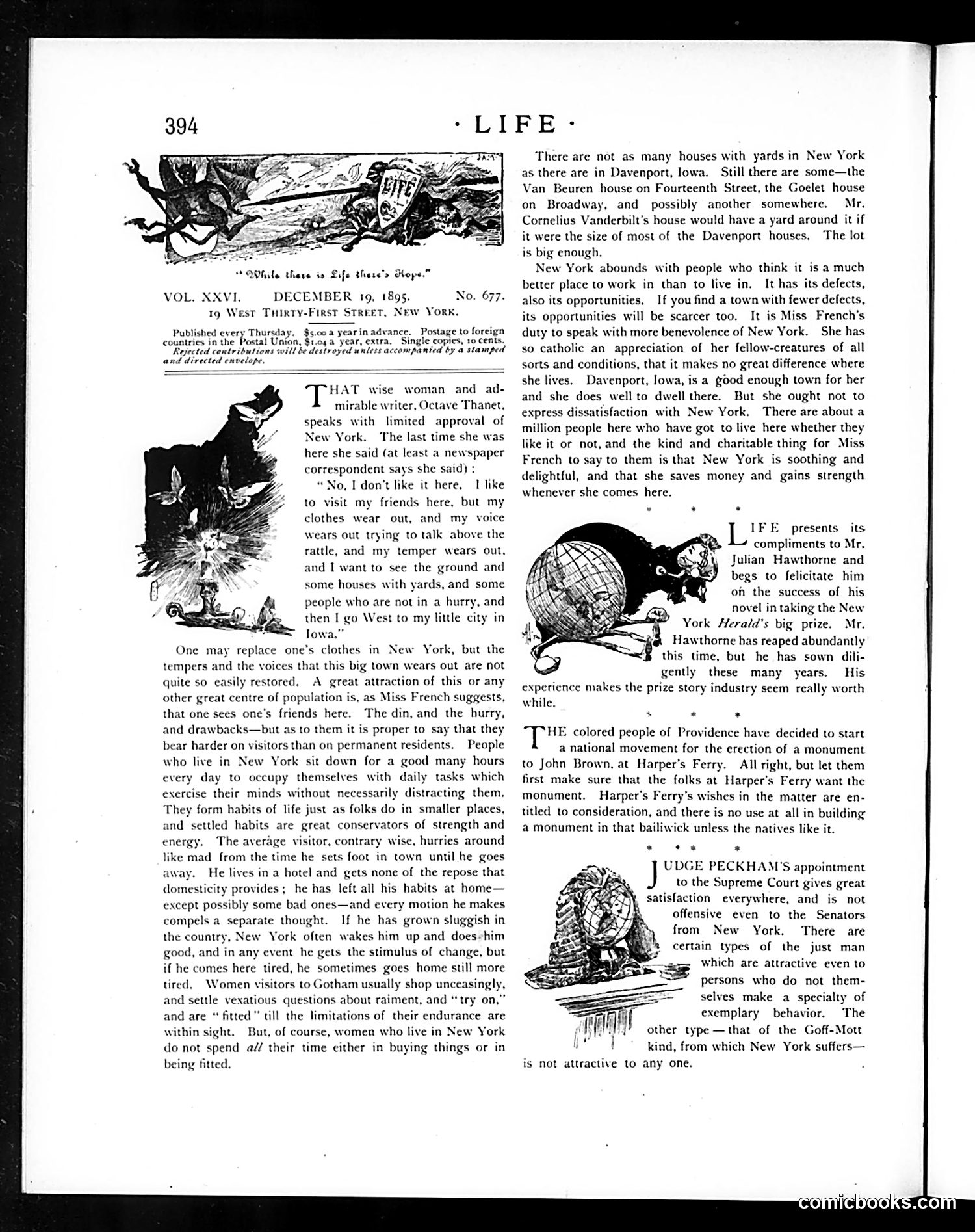
This page contains editorial commentary rather than political cartoons. The main illustrations are decorative vignettes accompanying text about New York City life. The article discusses **Octave Thanet** (a pen name of French writer Alice French), who expresses qualified approval of New York while preferring smaller towns like Davenport, Iowa. The satire critiques how New Yorkers rush constantly, wear out clothes quickly, and miss leisure—contrasting urban stress with small-town peace. Other brief items praise **Julian Hawthorne's** Herald prize-winning novel and comment on Judge Peckham's Supreme Court appointment. A final note mocks the "Goff-Mott kind" of New Yorker—apparently a recognizable social type associated with unattractive behavior. The overall message: urbane mockery of New York's frantic pace versus provincial tranquility.
📄 Transcribed text from this page (OCR, searchable)
Machine-transcribed from the original scan — historical spelling and the odd misread are preserved.
> LIFE: While there is Life there's Hope.” VOL. XXVI. DECEMBER 19, 1895. No. 677. 1g West Tuirty-First Street, New York. Published every Thursday, $s.co.a year in advance. Postage to foreign countries in the Postal Union, $1.04 a year, extra, Single copies, 10 cents. Rejected contributions will be destroyed untess accompanied by a stamped and directed envelope, HAT wise woman and ad- mirable writer, Octave Thanet, speaks with limited approval of New York. The last time she was here she said (at least a newspaper correspondent says she said) : “No, I don't like it here. 1 like to visit my friends here, but my clothes wear out, and my voi wears out trying to talk above the rattle, and my temper wears out, and I want to see the ground and some houses with yards, and some people who are not in a hurry, and then I go West to my little city in Towa.” he One may replace one’s clothes in New York, but the this big town wears out are not A great attraction of this or any other great centre of population is, as Miss French suggests, tempers and the voices that quite so easily restored. that one sees one’s friends here. The din, and the hurry, and drawbacks—but as to them it is proper to say that they bear harder on visitors than on permanent residents. People who live in New York sit down for a good many hours every day to occupy themselves with daily tasks which exercise their minds without necessarily distracting them, They form habits of life just as folks do in smaller places, and settled habits are great conservators of strength and energy. The average visitor, contrary wise, hurries around like mad from the time he sets foot in town until he goes away. He lives ina hotel and gets none of the repose that domesticity provides ; he has left all his habits at home— except possibly some bad ones—and every motion he makes compels a separate thought. If he has grown sluggish in the country, New York often wakes him up and doesehim good, and in any event he gets the stimulus of change, but if he comes here tired, he sometimes goes home still more tired. Women visitors to Gotham usually shop unceasingly and settle vexatious questions about raiment, and “try ot and are “fitted” till the limitations of their endurance are within sight. But, of course, women who live in New York do not spend a// their time either in buying things or in being fitted. ‘There are not as many houses with yards in New York as there are in Davenport, Iowa. Still there are some—the Van Beuren house on Fourteenth Street, the Goelet house on Broadway, and possibly another somewhere. Mr. Cornelius Vanderbilt's house would have a yard around it if it were the size of most of the Davenport houses. The lot is big enough. New York abounds with people who think it is a much better place to work in than to live in. It has its defects, also its opportunities. If you find a town with fewer defect its opportunities will be scarcer too. It is Miss French's duty to speak with more benevolence of New York. She has so catholic an appreciation of her fellow-creatures of all sorts and conditions, that it makes no great difference where she lives. Davenport, Iowa, is a good enough town for her and she does well to dwell there. But she ought not to express dissatisfaction with New York. There are about a million people here who have got to live here whether they like it or not, and the kind and charitable thing for Miss French to say to them is that New York is soothing and delightful, and that she saves money and gains strength whenever she comes here. IFE presents its compliments to Mr. Julian Hawthorne and begs to felicitate him on the success of his novel in taking the New York Herald's big prize. Mr. Hawthorne has reaped abundantly this time, but he has sown dil gently these many years. His experience makes the prize story industry seem really worth while. FS . * T* colored people of Providence have decided to start a national movement for the erection of a monument to John Brown, at Harper's Ferry. All right, but let them first make sure that the folks at Harper's Ferry want the monument. Harper's Ferry’s wishes in the matter are en- titled to consideration, and there is no use at all in building a monument in that bailiwick unless the natives like it. o« * ° UDGE PECKHAMSS appointment J to the Supreme Court gives great satisfaction everywhere, and is not offensive even to the Senators from New York. There are certain types of the just man segs Which are attractive even to SS persons who do not them- selves make a specialty of = i] if exemplary behavior. The Ae Mi? other type —that of the Goff-Mott weed kind, from which New York suffers— is not attractive to any one. ——