
A complete issue · 18 pages · 1895
Life — December 12, 1895
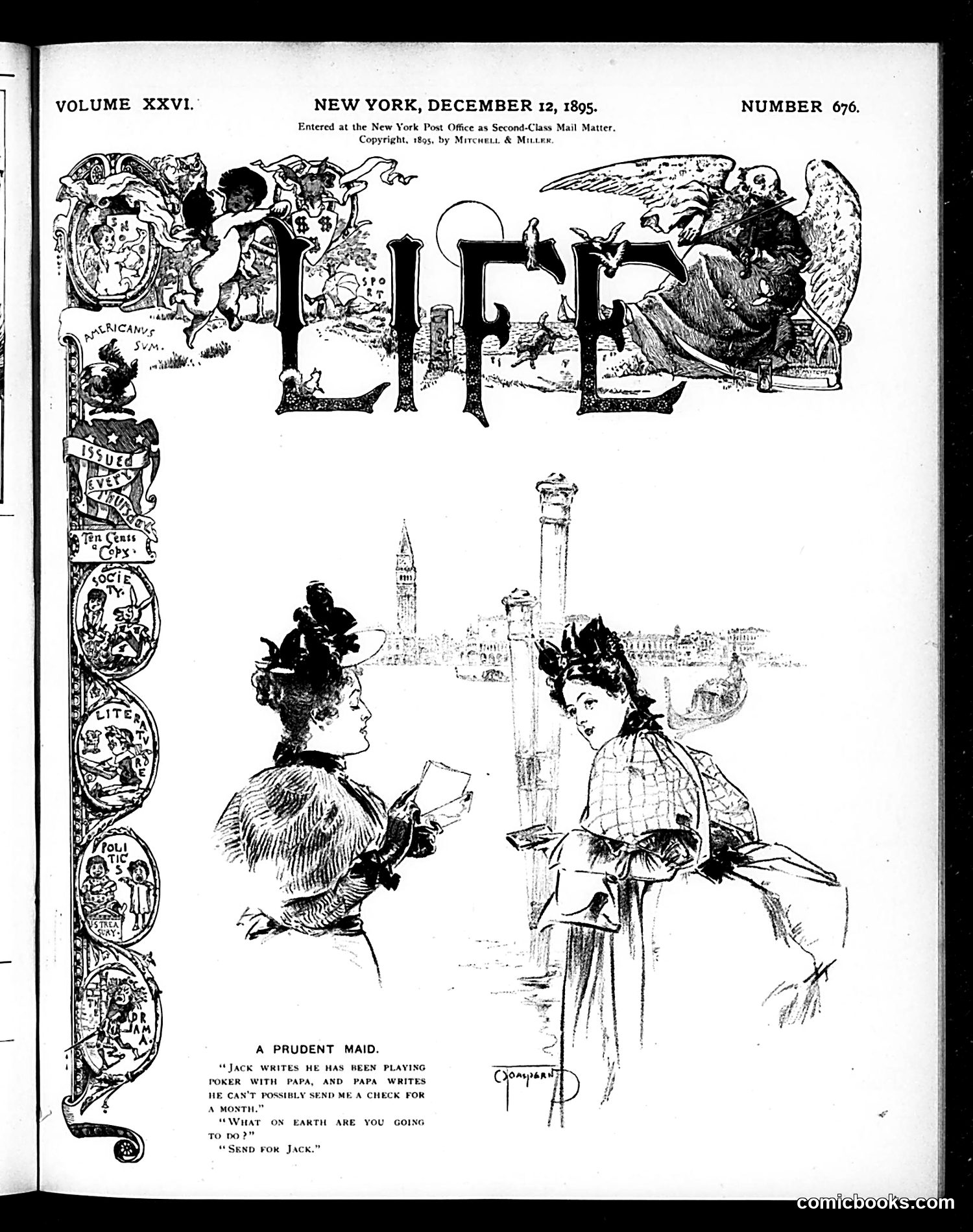
This cartoon satirizes financial dependence in marriage. Two women in Edwardian dress discuss a domestic situation: one's husband Jack has been gambling with his father and can't send money for a month. Rather than panic, the "prudent maid" advises simply: "Send for Jack"—meaning the wife should summon her husband home immediately rather than accept his excuses. The joke targets both masculine irresponsibility (gambling, broken financial promises) and celebrates female assertiveness in marriage. It reflects early 1900s anxieties about male leisure activities and gambling's threat to household finances, while positioning the sensible woman as the solution to her husband's weakness.
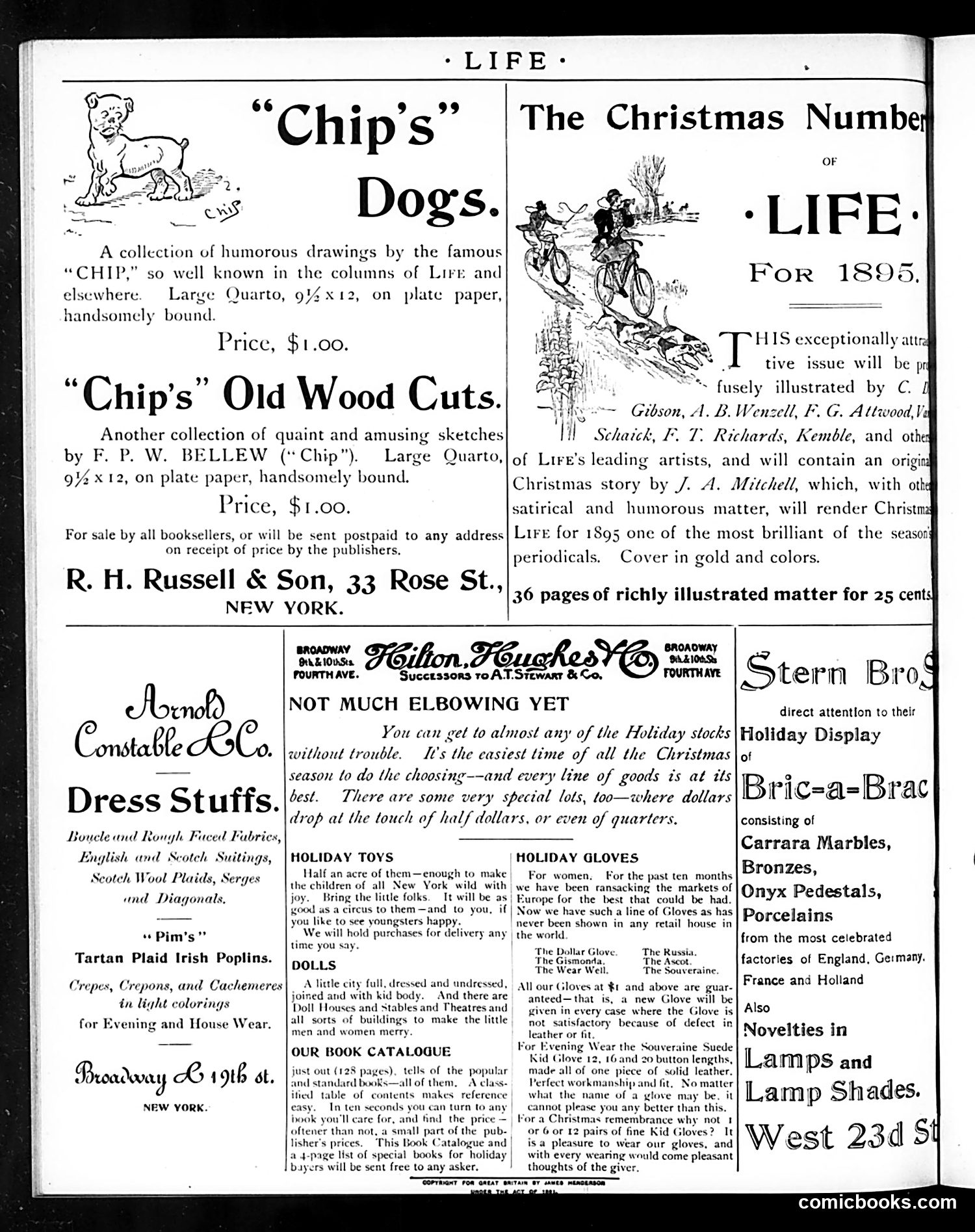
This page is primarily **advertising and promotional content** rather than political satire or editorial cartoons. The left side advertises "Chip's Dogs" and "Chip's Old Wood Cuts"—humorous drawing collections by artist F.P.W. Bellew ("Chip"), priced at $1.00 each. The small illustration shows a simple dog sketch typical of this style. The right side promotes **Life magazine's 1895 Christmas issue**, featuring illustrations by notable artists and a Christmas story by J.A. Mitchell, priced at 25 cents. The remainder consists of retail advertisements for holiday goods: dress fabrics, toys, dolls, gloves, and decorative items from businesses like Arnold Constable & Co. and Stern Bros. **No political or social satire is evident**—this is a standard late-19th-century magazine page mixing editorial promotion with commercial advertising.
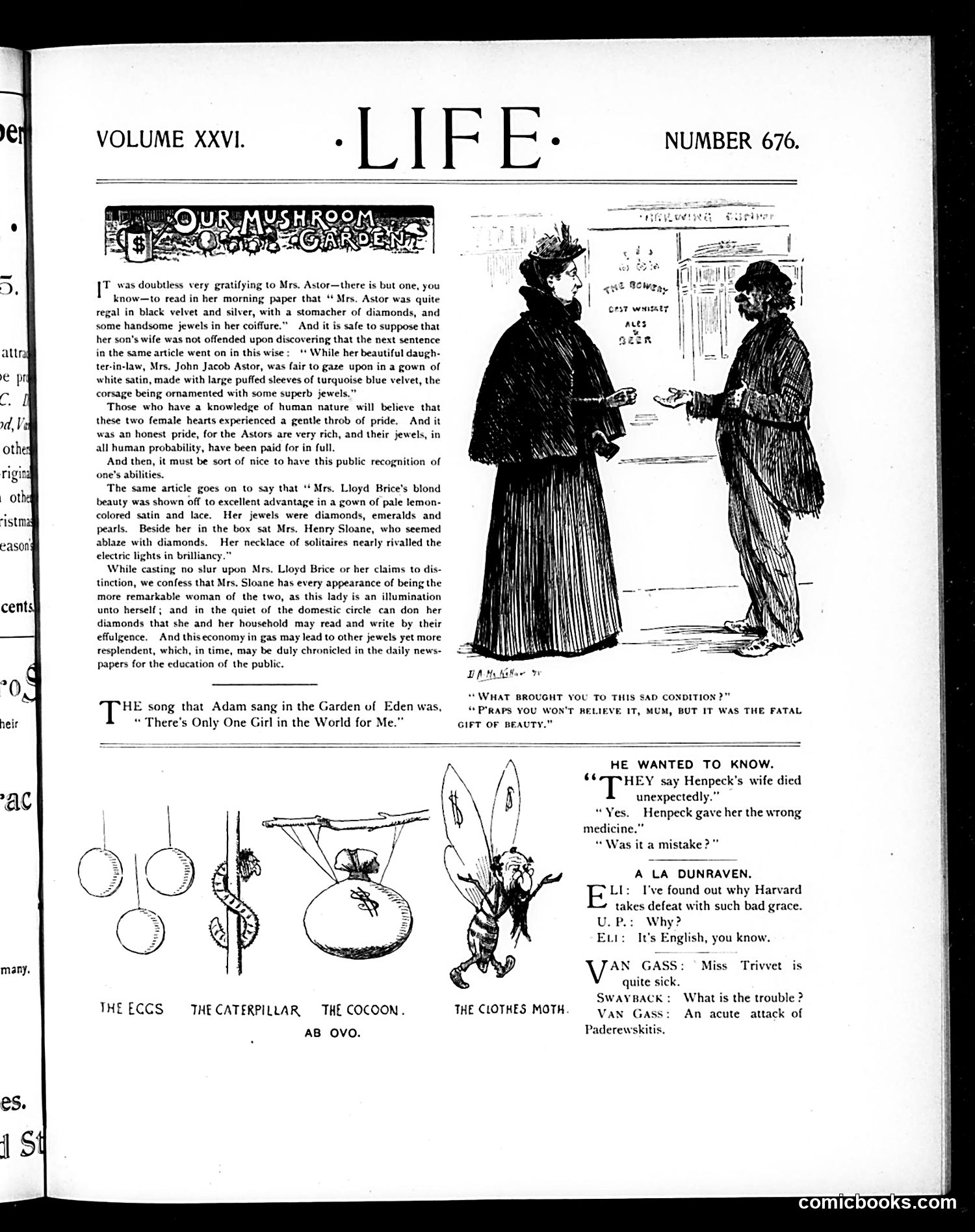
This page contains two main sections: **Top illustration**: A domestic scene showing a woman confronting a man about his infidelity. The caption reads: "What brought you to this sad condition?" / "Perhaps you won't believe it, mum, but it was the fatal gift of beauty." The accompanying text discusses wealthy society women (Mrs. Astor, Mrs. Lloyd Brice) and their jewelry collections, establishing a satirical commentary on how beauty and material wealth corrupt morality. **Bottom section**: Brief humorous dialogues mocking academic pretension ("A La Dunraven") and medical terminology. The final joke uses "Paderewskitis" (referencing pianist Paderewski) as a fabricated disease name. The page satirizes both aristocratic vanity and pseudo-intellectual pomposity typical of Edwardian-era Life magazine humor.
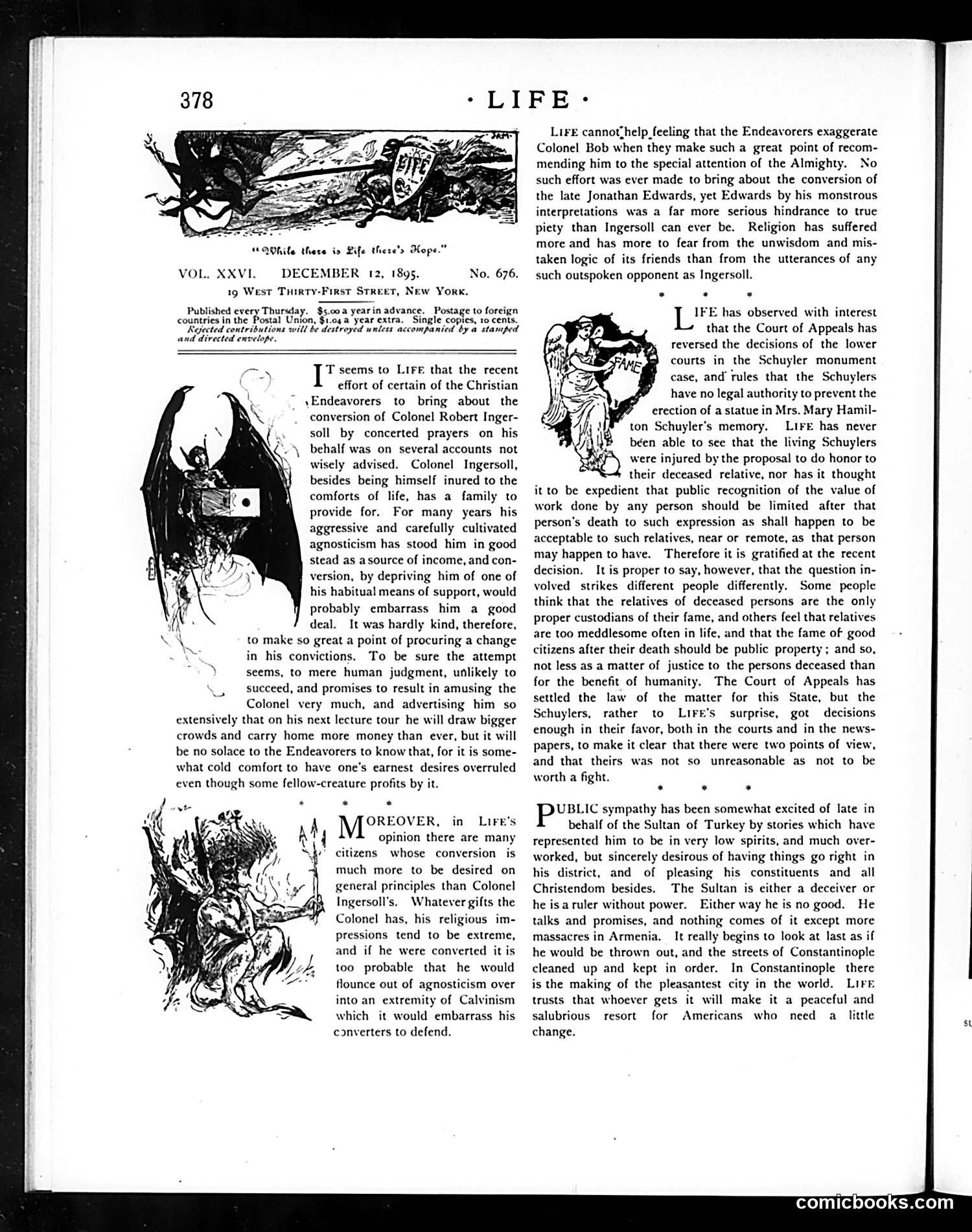
This page critiques Christian efforts to convert Colonel Robert Ingersoll, a famous 19th-century agnostic and public speaker. The text sarcastically defends Ingersoll against overzealous religious advocates, arguing his "monstrous interpretations" of faith were less damaging than forced conversion attempts. The accompanying illustrations appear to be generic allegorical or satirical drawings rather than specific political caricatures. The content also discusses a Court of Appeals decision regarding the Schuyler family and a memorial statue, and comments on Turkey's Sultan and Constantinople's conditions. The satire targets religious zealotry and what Life viewed as inappropriate efforts to change people's fundamental beliefs through aggressive proselytizing.
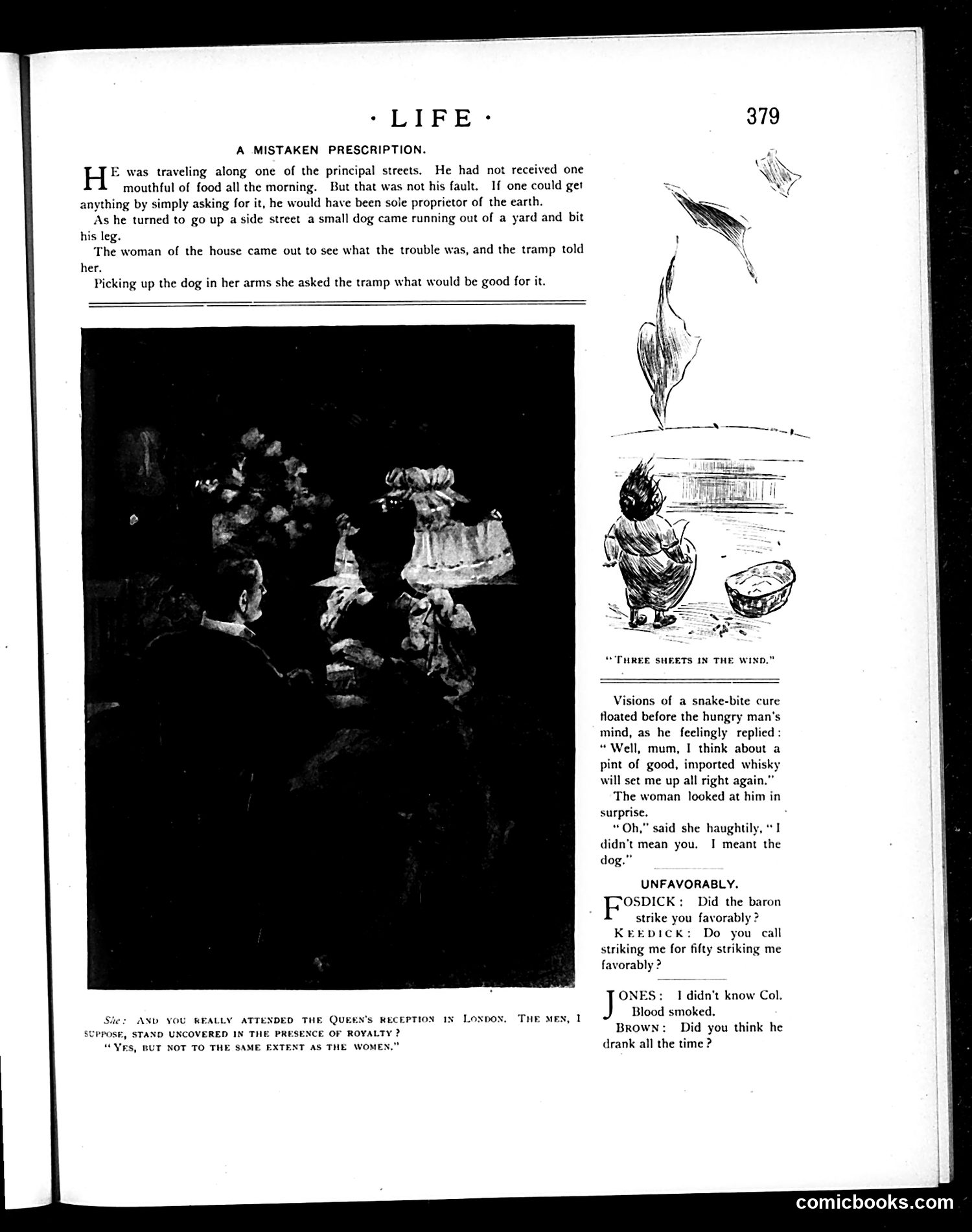
This page contains three distinct humorous pieces: **"A Mistaken Prescription"** (top): A tramp, starving and malnourished, encounters a woman whose dog he's injured. When she asks what would help the dog, he hopefully suggests whiskey—expecting medicinal alcohol for himself. She clarifies she meant the *dog*, not him. The satire mocks both his desperation and the era's faith in whiskey as a universal cure. **"Three Sheets in the Wind"** (right): An illustration of a figure losing laundry in wind, with the title referencing the nautical phrase meaning "drunk." The visual pun plays on this colloquial expression. **"Unfavorably"** (bottom): A dialogue between military figures (Fosdick, Keedick, Jones, and Brown) discussing combat violence and drinking habits—likely satirizing soldiers' brutality and alcoholism during wartime.
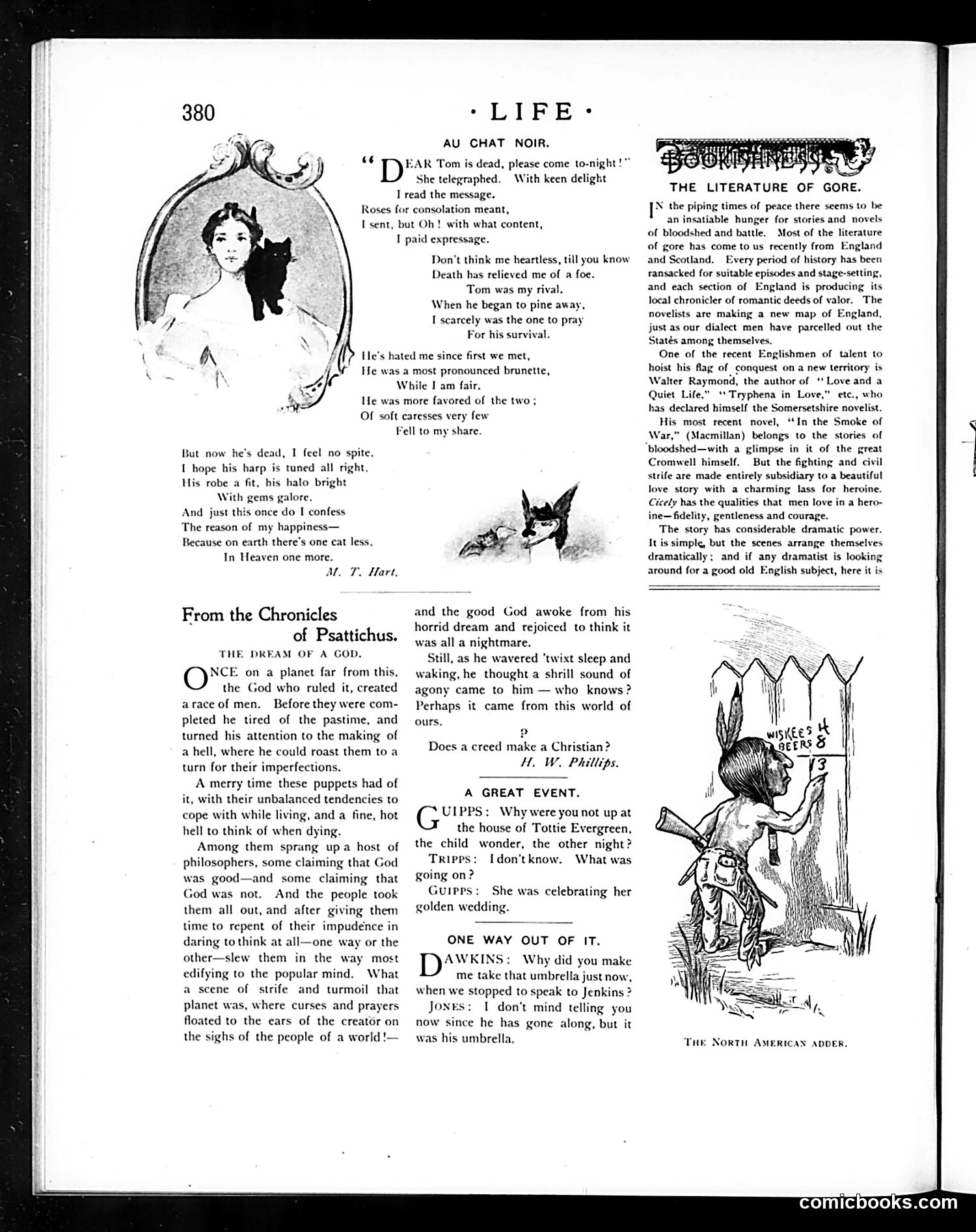
This page contains literary content rather than political cartoons. The main pieces include: **"Au Chat Noir"** - A sentimental poem by M. V. Hart about a deceased rival, expressing forgiveness now that he's dead. The accompanying illustration shows a woman with a black cat. **"From the Chronicles of Patitichus"** - A philosophical story about a god creating a hell-like planet to test imperfect beings, questioning whether suffering produces morality. It concludes with a brief theological question. **Short humorous exchanges** like "A Great Event" and "One Way Out of It" - light social comedy involving characters discussing a golden wedding and a missing umbrella. The page represents Life's mixed editorial approach: combining verse, short fiction, and humor rather than satirical political cartooning.
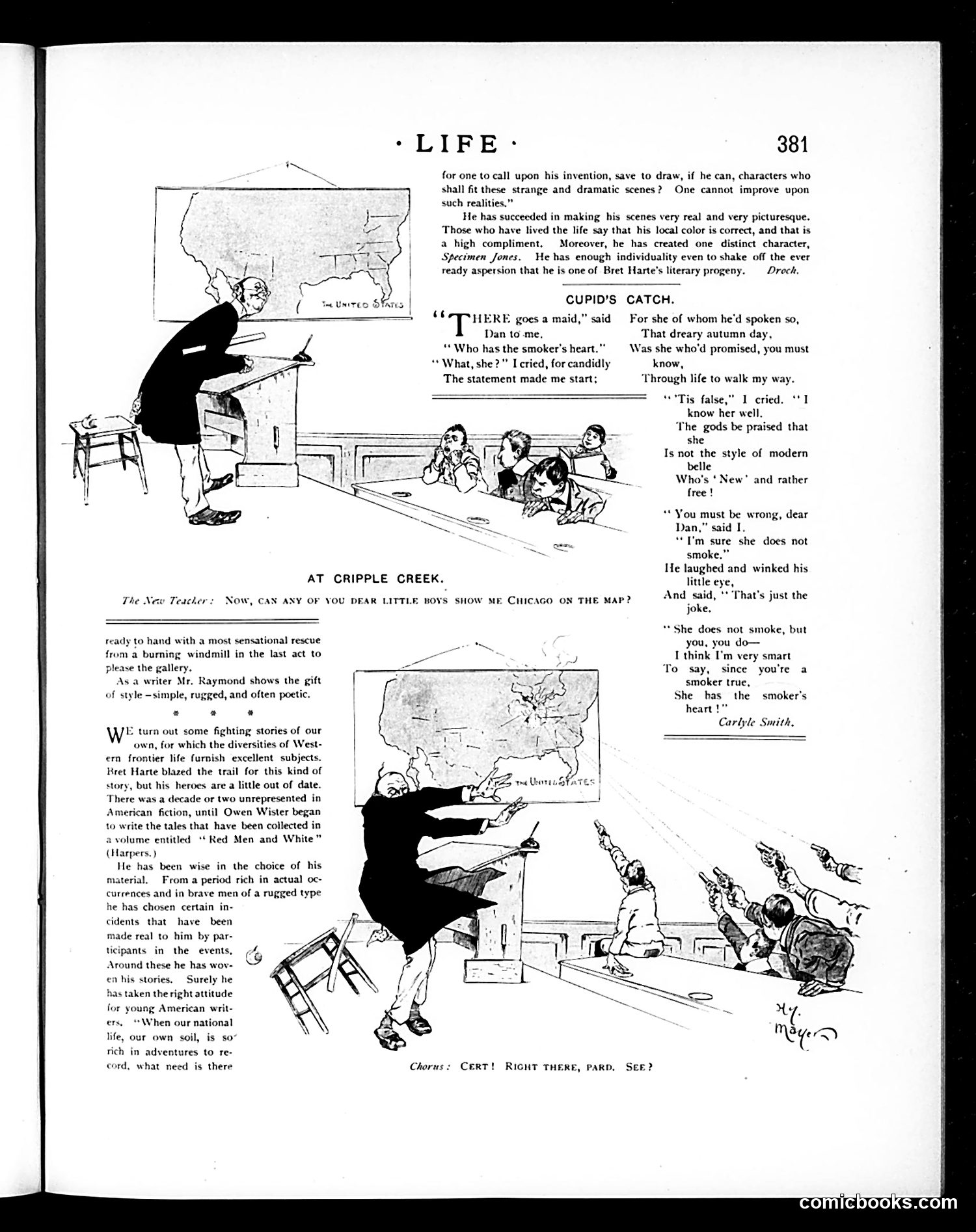
This page contains two cartoon illustrations with accompanying text discussing Western frontier fiction and teaching methods. The **top cartoon** ("Cupid's Catch") depicts a schoolteacher pointing at a U.S. map while children sit on the floor. The dialogue reveals a domestic comedy: a man jokes that a woman who "smokes" has had her heart stolen, but he's using "smoker" as slang—she doesn't literally smoke cigarettes. The humor plays on the double meaning and the narrator's relief that the woman is respectable by modern standards. The **bottom cartoon** ("At Cripple Creek") shows a teacher asking students to locate Chicago on a map, with what appears to be mining or frontier activity illustrated. The page discusses Owen Wister's Western fiction and praises American frontier stories as suitable material for writers seeking authentic Americana.
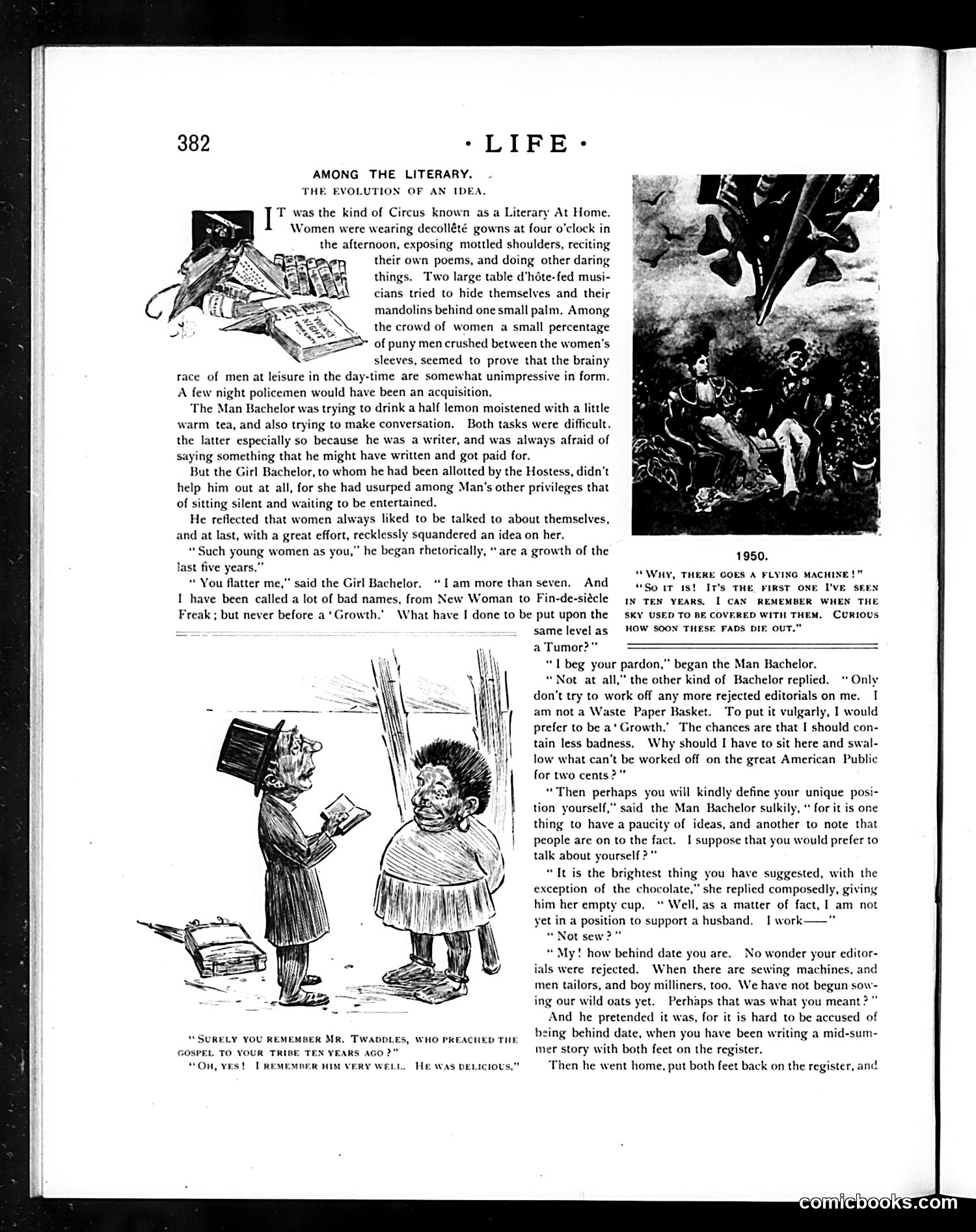
This page satirizes early 20th-century women's literary and intellectual pretensions. The article "Among the Literary: The Evolution of an Idea" describes a social gathering where women in fashionable dress recite poetry while musicians hide behind furniture—mocking the performative nature of amateur literary circles. The accompanying cartoons ridicule women attempting serious intellectual work. One depicts a woman struggling with excessive papers, suggesting women are overwhelmed or unsuited for serious writing. The dialogue mocks a "Girl Bachelor" who claims to be a "Growth" rather than accepting traditional roles, which the Man Bachelor dismisses as pretentious. The satire targets women's claims to literary and professional ambition as laughable affectation—a common theme in early Life magazine's conservative humor about changing women's roles.
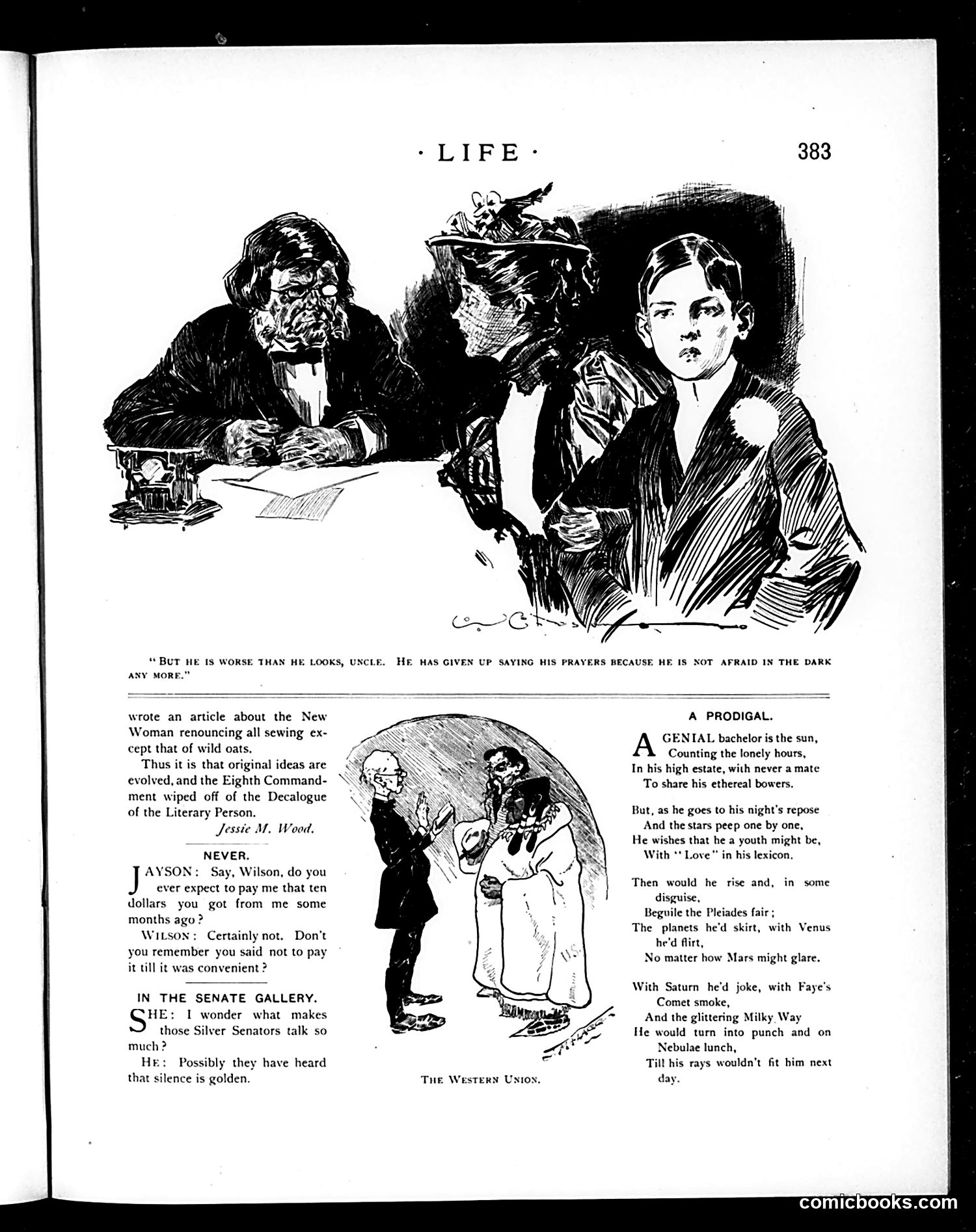
The top cartoon depicts an interrogation scene where a young boy is being questioned by two stern male figures (likely teachers or authority figures), with the caption indicating the boy has stopped saying prayers because he's "not afraid in the dark any more." The middle illustration labeled "The Western Union" shows a man at what appears to be a telegraph office speaking with a woman. The page includes three literary sections: a discussion of "The New Woman" and sewing, a dialogue between "Jayson" and "Wilson" about money owed, and another titled "In the Senate Gallery" with witty commentary about silence being golden. The poem "A Prodigal" appears on the right side, satirizing the lifestyle of a wealthy bachelor. Overall, the page combines social satire about modern manners, gender roles, and contemporary life with humorous poetry.
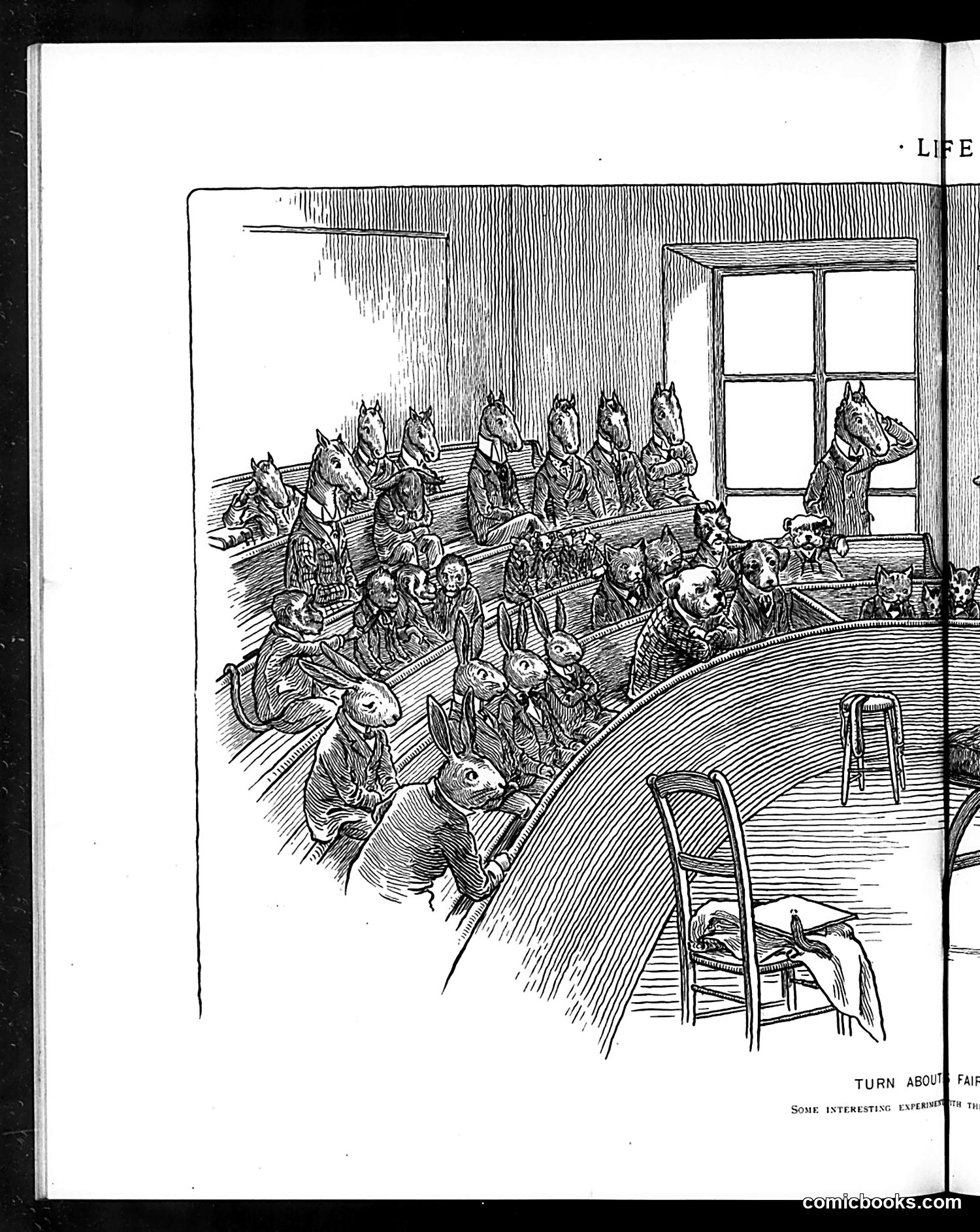
This engraving depicts anthropomorphic animals (primarily cats and dogs with human characteristics) seated in what appears to be a formal meeting or assembly room with windows and wooden flooring. The figures are dressed in human clothing and arranged in rows, suggesting a legislative body, court, or official gathering. The satire likely mocks human institutions—possibly government, law, or society—by replacing humans with animals. This was a common technique in 19th-century satirical magazines to critique political figures or bureaucratic absurdity. The formal, serious poses of the animal-people contrast humorously with their animal nature, highlighting the perceived foolishness of the institution being satirized. The caption references "experiments," though full context is unclear from the visible text. Without additional context or clearer identification of specific figures, the precise political target remains uncertain.
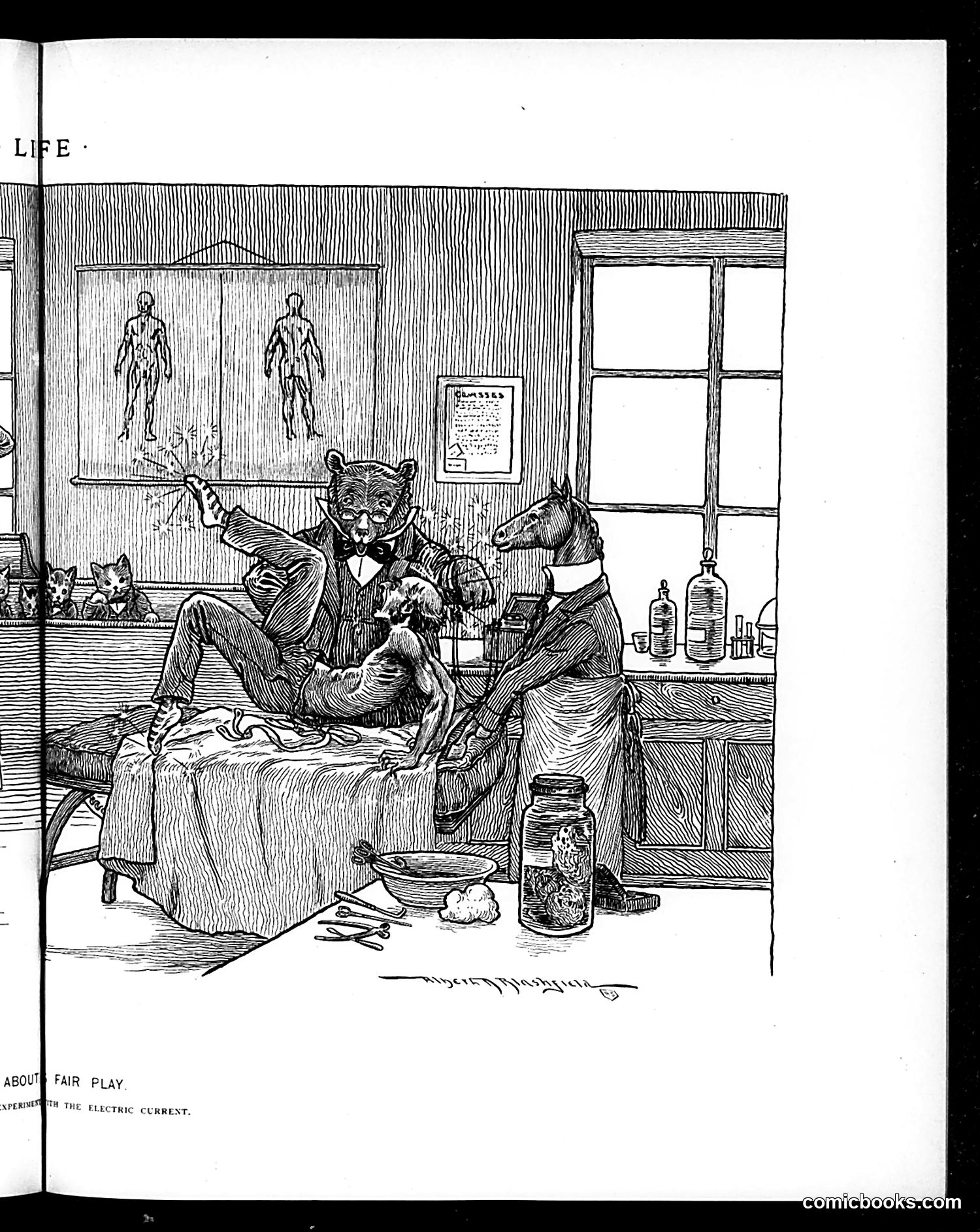
This satirical illustration depicts a medical or scientific examination scene. A figure with a cat's head (wearing formal attire) appears to conduct some kind of procedure or experiment on a small dog, while a horse-headed figure observes from the right. Medical bottles and instruments are visible on the windowsill. The caption "About Fair Play" combined with the animal-headed humans suggests social satire about conducting experiments "fairly" or ethically. The text fragment references "the electric current," indicating this likely comments on early electrical experiments, possibly vivisection or animal testing practices of the era. The anthropomorphic animal heads may represent different social classes or positions of power, satirizing how "fair play" was applied differently depending on one's position in society. The precise political targets remain unclear without additional context.
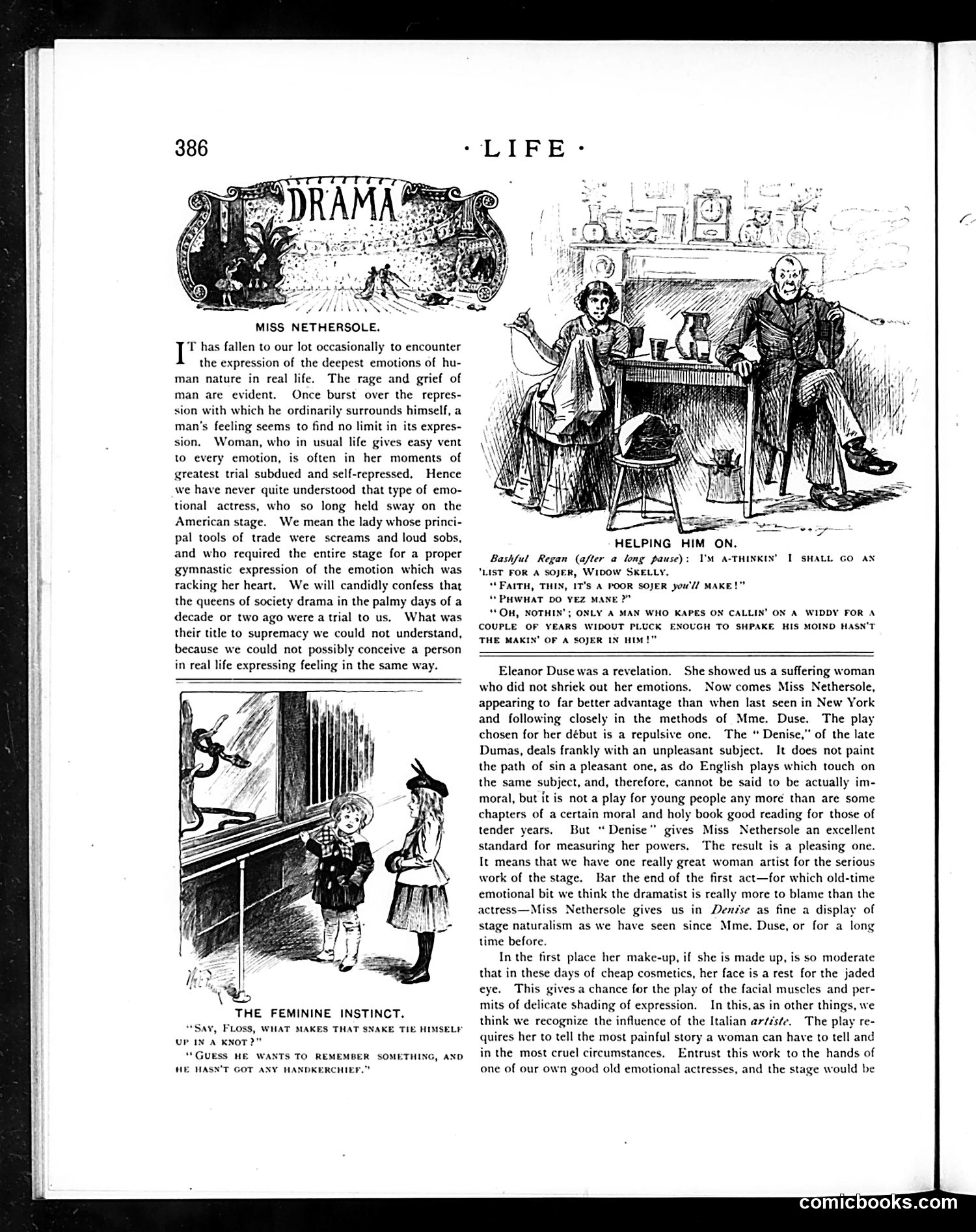
This page critiques actress Miss Nethersole's theatrical performance, comparing her to the renowned Italian actress Eleanor Duse. The article praises Nethersole for adopting realistic, restrained emotional acting rather than the exaggerated screaming and sobbing that characterized earlier American stage actresses. The cartoons below illustrate contrasting approaches to emotional expression. "The Feminine Instinct" shows a woman cleverly using a snake's behavior to suggest a man's forgetfulness—subtle and clever. "Helping Him On" depicts an Irish widow nudging an indecisive suitor toward commitment through witty dialogue rather than histrionics. The author argues that Nethersole's subdued performance in "Denise" (a morally serious play about sin) demonstrates superior artistry compared to melodramatic actresses. Her understated makeup and facial expressions allow genuine emotional nuance—influenced by European theatrical standards—rather than relying on loud displays of feeling.
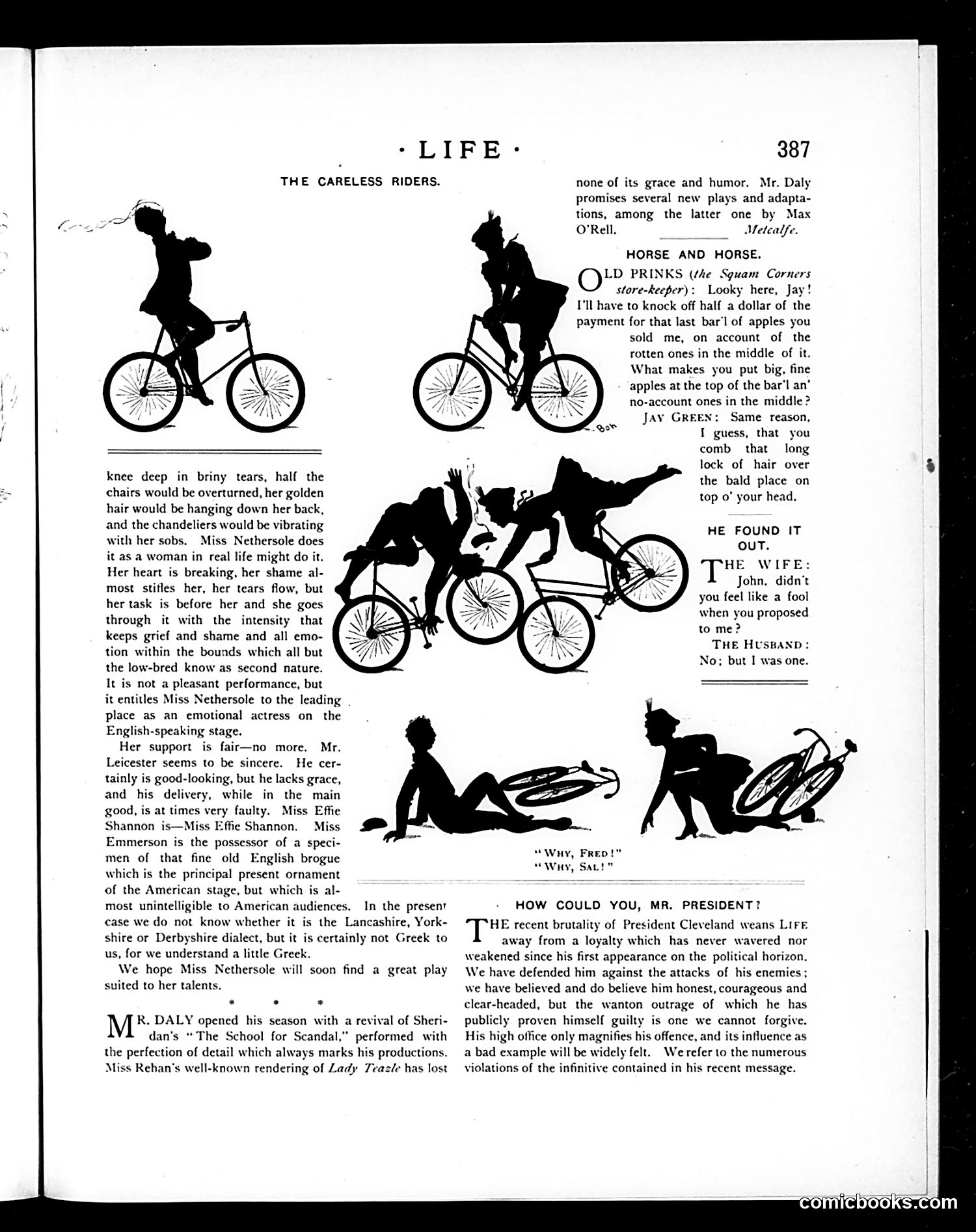
This page contains theatrical reviews and several humorous cartoons satirizing American life around the Cleveland presidency era. **"The Careless Riders"** depicts bicyclists performing acrobatic stunts—a visual joke about reckless behavior, likely reflecting anxieties about the new bicycle craze's dangers. **"Horse and Horse"** is a dialogue cartoon where a store-keeper accuses farmer Jay Green of placing rotten apples in barrel centers while concealing them with fine ones at top. Jay replies by noting the store-keeper similarly combs hair over his bald spot—mutual hypocrisy exposed. **"He Found It Out"** shows a husband admitting he *was* a fool for proposing, revealing his wife's suspicions correct. **"How Could You, Mr. President?"** satirizes President Cleveland by mock-seriously condemning his "recent brutality"—but the offense is grammatical: violating the infinitive in his recent message, not political wrongdoing. This is satire through misdirection.
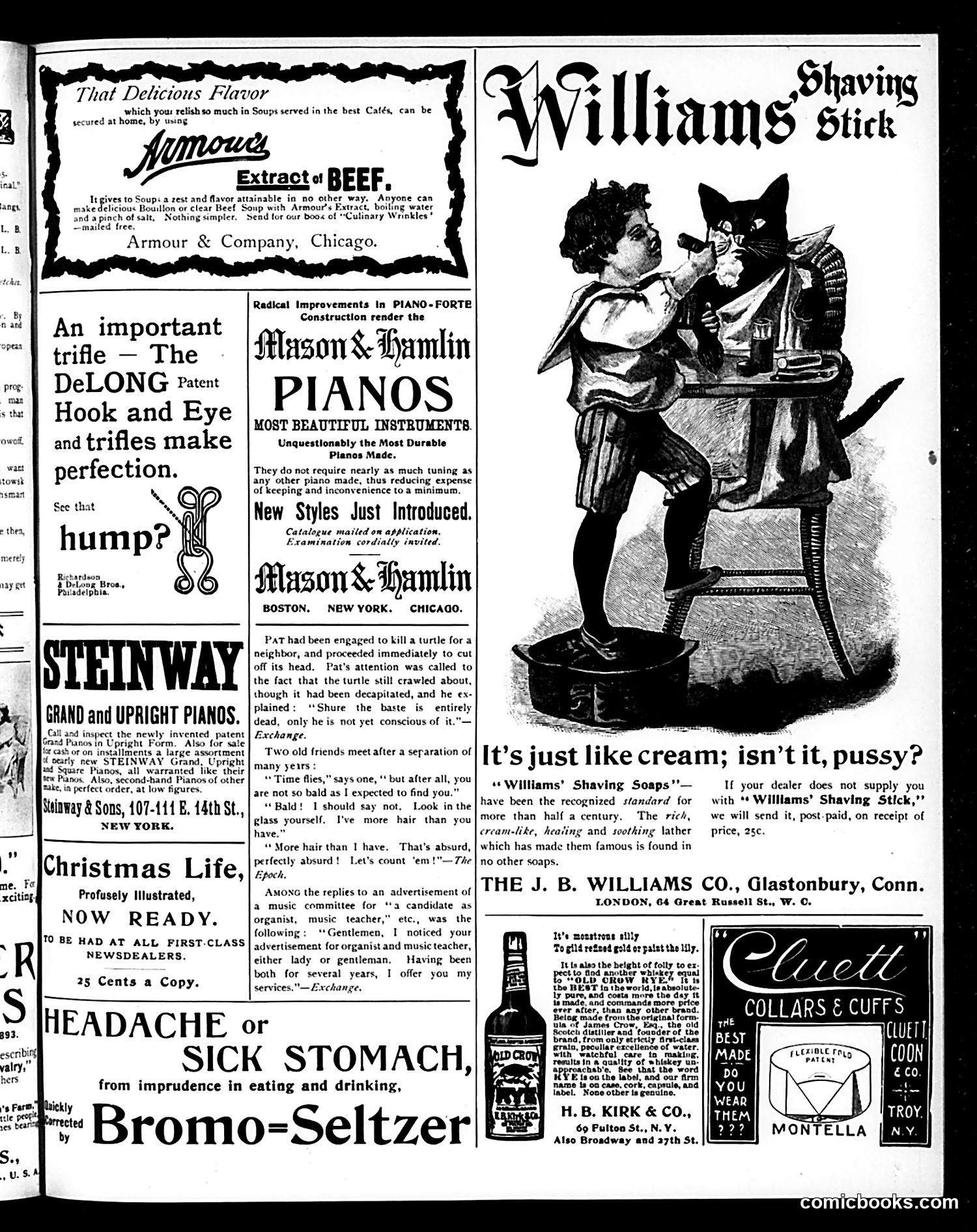
This page is primarily **advertisements** rather than political cartoons. The main illustrated content is the **Williams' Shaving Stick advertisement** (right side), featuring a caricatured couple—a woman and man in period dress. The caption "It's just like cream; isn't it, pussy?" is a playful double entendre, using "pussy" as a pet name while emphasizing the product's creamy lather quality. This reflects early 20th-century advertising's comfort with language that would later become considered inappropriate. The page also contains several brief **humorous anecdotes** (including an Irish stereotype about "Pat" and a decapitated turtle), which were typical filler content in *Life* magazine during this era. The remaining space is occupied by straightforward product advertisements: beef extract, piano manufacturers (Steinway, Mason & Hamlin), DeLong hooks-and-eyes, and remedies like Bromo-Seltzer. These ads represent the commercial revenue model supporting the magazine. No significant political satire or social commentary is evident on this particular page.
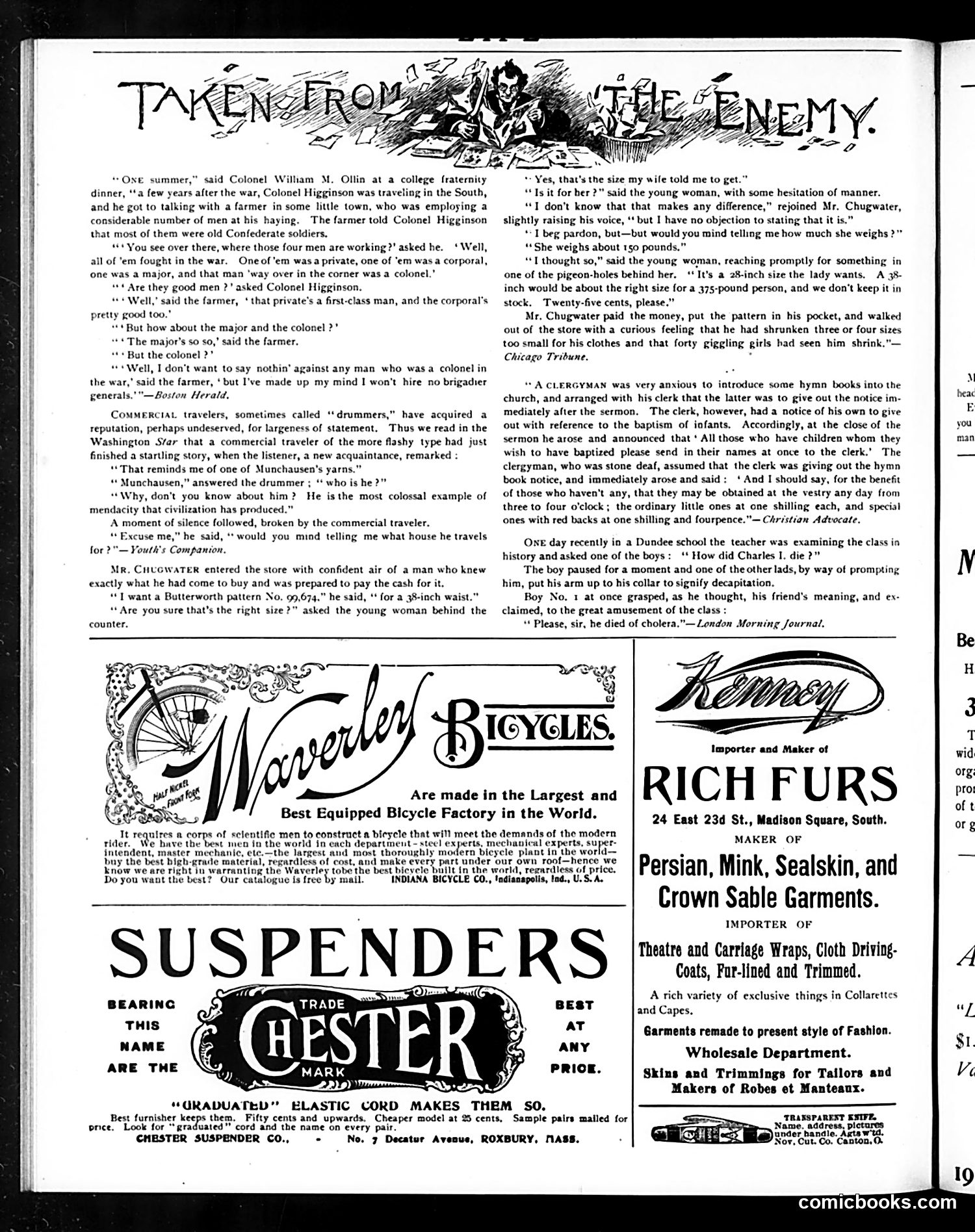
This page contains three humorous anecdotes satirizing male pride and pomposity: 1. **"Taken from the Enemy"**: A post-Civil War joke mocking former Confederate officers. A farmer employs ex-soldiers of various ranks but refuses to hire "brigadier generals"—suggesting officers were useless or troublesome compared to enlisted men. The satire critiques the perceived incompetence of military leadership. 2. **The Drummer's Tale**: A commercial traveler (traveling salesman/"drummer") claims ignorance of Baron Munchausen, the legendary liar, then ironically asks what company he works for—implying the salesman himself is a notorious fabricator. 3. **Mr. Chugwater's Humiliation**: A man confidently orders a women's sewing pattern in a tiny size his wife supposedly wears. The saleswoman politely reveals his wife actually weighs 150 pounds (requiring a much larger size), publicly embarrassing him. The joke ridicules male assumptions about women's bodies and his mortification before "forty giggling girls." All three mock male ego deflation through understated humor typical of *Life* magazine's satirical voice.
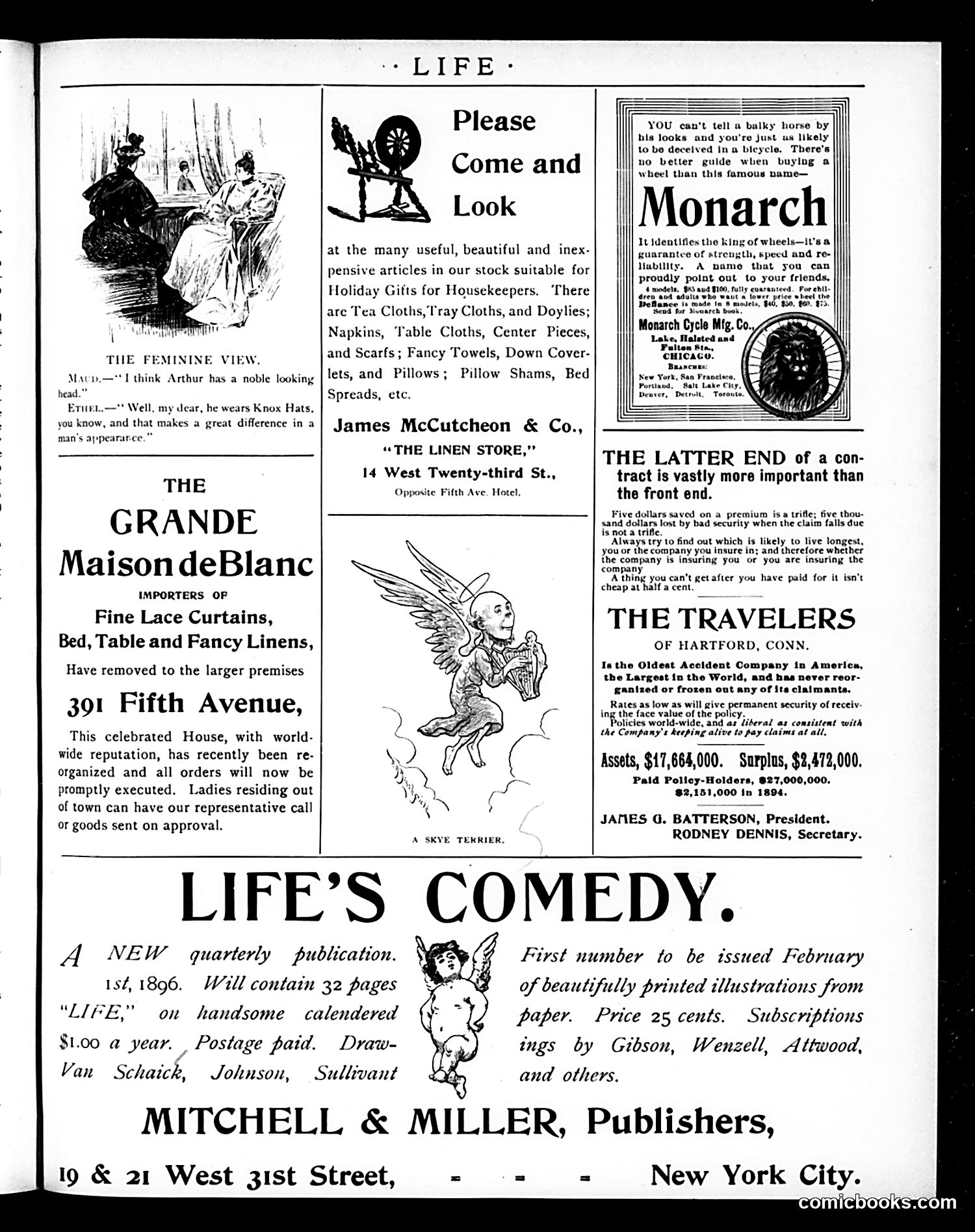
**The Main Cartoon ("The Feminine View"):** A brief satirical dialogue between two women, Maud and Ethel, discussing a man named Arthur. The joke mocks feminine superficiality: Ethel attributes Arthur's "noble looking" appearance entirely to his Knox Hat brand, suggesting that women judge men based on fashionable accessories rather than character. This reflects 1890s satirical attitudes toward consumer culture and gender stereotypes. **The Skye Terrier Illustration:** Appears to be a decorative sketch accompanying a James McCutcheon & Co. linen advertisement—likely unrelated to satire, serving primarily as page ornament. **Context:** This is mostly a commercial advertising page for luxury goods (linens, bicycles, insurance) interspersed with light social satire. The magazine's humor targets consumer pretension and gender roles typical of Gilded Age America. Knox Hats were an actual brand, making the reference concrete.
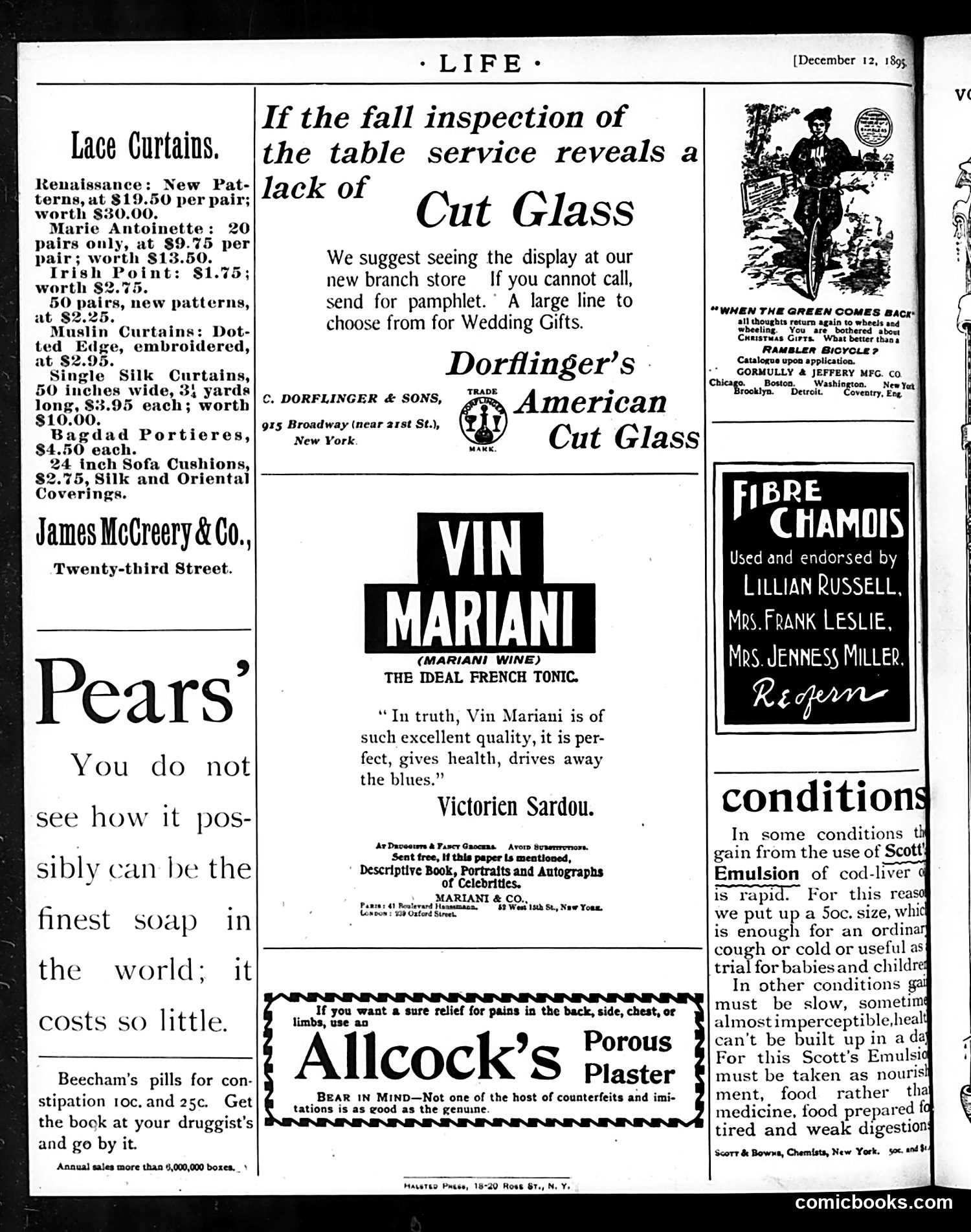
This is primarily an **advertising page** with no political cartoons or satirical content to analyze. The page contains commercial advertisements for late-Victorian consumer goods: lace curtains, fine soaps (Pears'), patent medicines (Beecham's pills, Vin Mariani wine tonic, Allcock's porous plasters), cut glass, and Scott's Emulsion cod-liver oil. The small illustration in the upper right—captioned "When the Green Comes Back"—appears to be a product advertisement for Chandler bicycles, showing a cyclist, likely aimed at holiday gift-buyers. The testimonial crediting "Victorien Sardou" (a famous French playwright) endorsing Vin Mariani reflects the era's common practice of using celebrity testimonials in advertising, often of questionable authenticity. This represents typical Life magazine advertising revenue rather than satirical editorial content.