
Life, 1895-12-12 · page 12 of 18
Life — December 12, 1895 — page 12: what you’re looking at
What you’re looking at
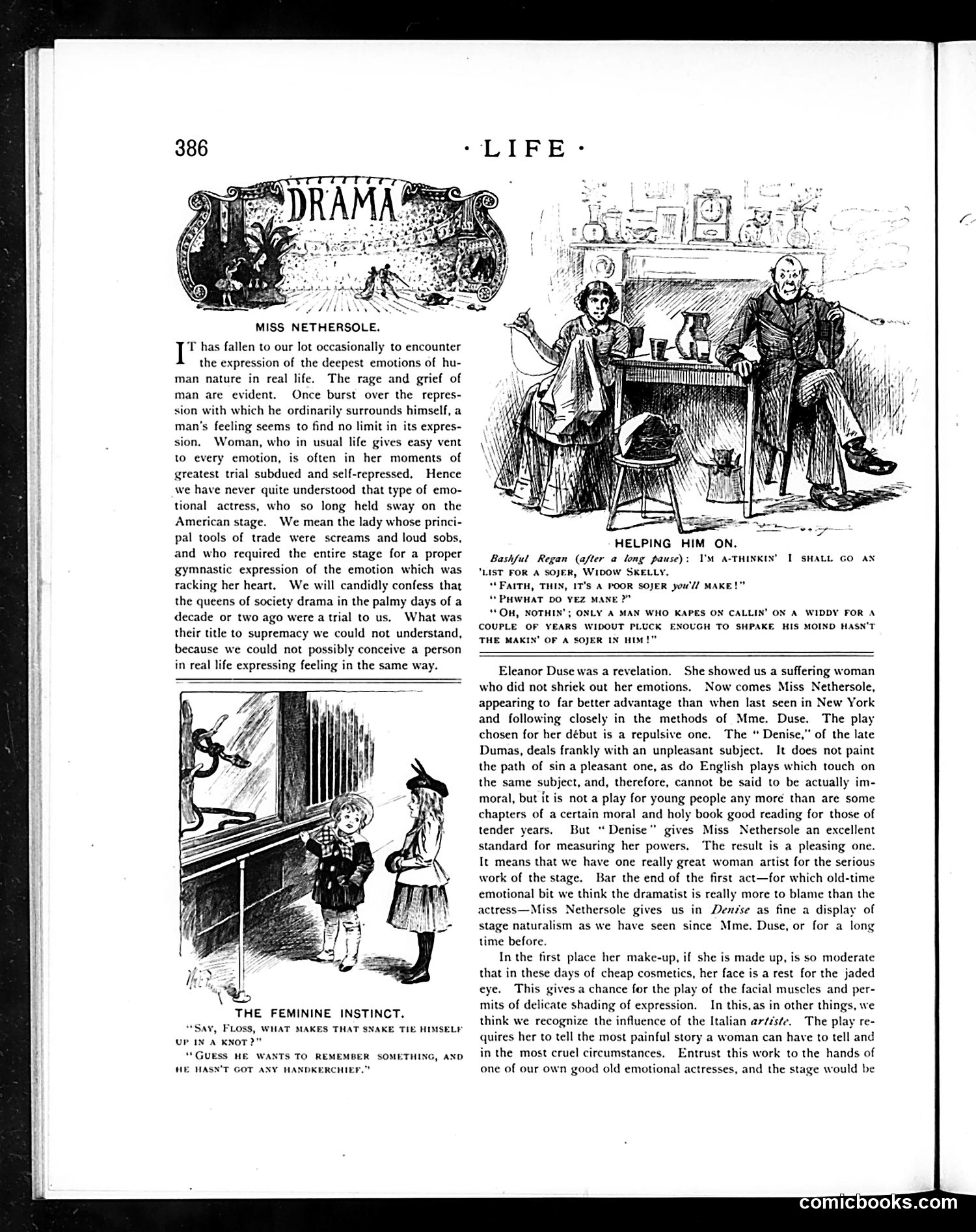
This page critiques actress Miss Nethersole's theatrical performance, comparing her to the renowned Italian actress Eleanor Duse. The article praises Nethersole for adopting realistic, restrained emotional acting rather than the exaggerated screaming and sobbing that characterized earlier American stage actresses. The cartoons below illustrate contrasting approaches to emotional expression. "The Feminine Instinct" shows a woman cleverly using a snake's behavior to suggest a man's forgetfulness—subtle and clever. "Helping Him On" depicts an Irish widow nudging an indecisive suitor toward commitment through witty dialogue rather than histrionics. The author argues that Nethersole's subdued performance in "Denise" (a morally serious play about sin) demonstrates superior artistry compared to melodramatic actresses. Her understated makeup and facial expressions allow genuine emotional nuance—influenced by European theatrical standards—rather than relying on loud displays of feeling.
📄 Transcribed text from this page (OCR, searchable)
Machine-transcribed from the original scan — historical spelling and the odd misread are preserved.
WN MISS NETHERSOLE. T has fallen to our lot occasionally to encounter the expression of the deepest emotions of hu- man nature in real life. The rage and grief of man are evident. Once burst over the repres- sion with which he ordinarily surrounds himself, a man’s feeling seems to find no limit in its expres- sion. Woman, who in usual life gives easy vent to every emotion, is often in her moments of greatest trial subdued and self-repressed. Hence we have never quite understood that type of emo- tional actress, who so long held sway on the American stage. We mean the lady whose princi- pal tools of trade were screams and loud sobs, and who required the en stage for a proper gymnastic expression of the emotion which was racking her heart. We will candidly confess that the queens of society drama in the palmy days of a decade or two ago were a trial to us. What was their title to supremacy we could not understand, because we could not possibly conceive a person in real life expressing feeling in the same way. THE FEMININE INSTINCT. “SAY, FLOSS, WHAT MAKES THAT SNAKE TIE HIMSELF UP IN A KNOT?” “GUESS HE WANTS TO REMEMBER SOMETHIN HE HASN'T GOT ANY HANDKERCHIEF,” _ HELPING HIM ON. Bashful Regan (after a long pause): VM A-THINKIN’ ‘LIST FOR A SOJER, Widow SKELLY. “FAITH, THIN, IT'S A POOR SOJER you'll MAKE!" “*PHWHAT DO YEZ MANE ?” “OH, NOTHIN’; ONLY A MAN WHO KAPES ON CALLIN’ ON A WIDDY FOR A COUPLE OF YEARS WIDOUT PLUCK ENOUGH TO SHPAKE HIS MOIND HASN'T THE MAKIN’ OF A SOJER IN HIM!” 1 SHALL GO AN Eleanor Duse was a revelation. She showed us a suffering woman who did not shriek out her emotions. Now comes Miss Nethersole, appearing to far better advantage than when last seen in New York and following closely in the methods of Mme. Duse. The play chosen for her début is a repulsive one. The “ Denise,” of the late Dumas, deals frankly with an unpleasant subject. It does not paint the path of sin a pleasant one, as do English plays which touch on the same subject, and, therefore, cannot be said to be actually im- moral, but it is not a play for young people any more than are some chapters of a certain moral and holy book good reading for those of tender years. But “Denise” gives Miss Nethersole an excellent standard for measuring her powers. The result is a pleasing one. It means that we have one really great woman artist for the serious work of the stage. Bar the end of the first act—for which old-time emotional bit we think the dramatist is really more to blame than the actress—Miss Nethersole gives us in Denise as fine a display of stage naturalism as we have seen since Mme. Duse, or for a long time before. In the first place her make-up, if she is made up, is so moderate that in these days of cheap cosmetics, her face is a rest for the jaded eye. This gives a chance for the play of the facial muscles and per- mits of delicate shading of expression. In this,as in other things, we think we recognize the influence of the Italian av/sste. The play re- quires her to tell the most painful story a woman can have to tell and in the most cruel circumstances. Entrust this work to the hands of one of our own good old emotional actresses, and the stage would be comicbooks.com