
Life, 1895-12-12 · page 6 of 18
Life — December 12, 1895 — page 6: what you’re looking at
What you’re looking at
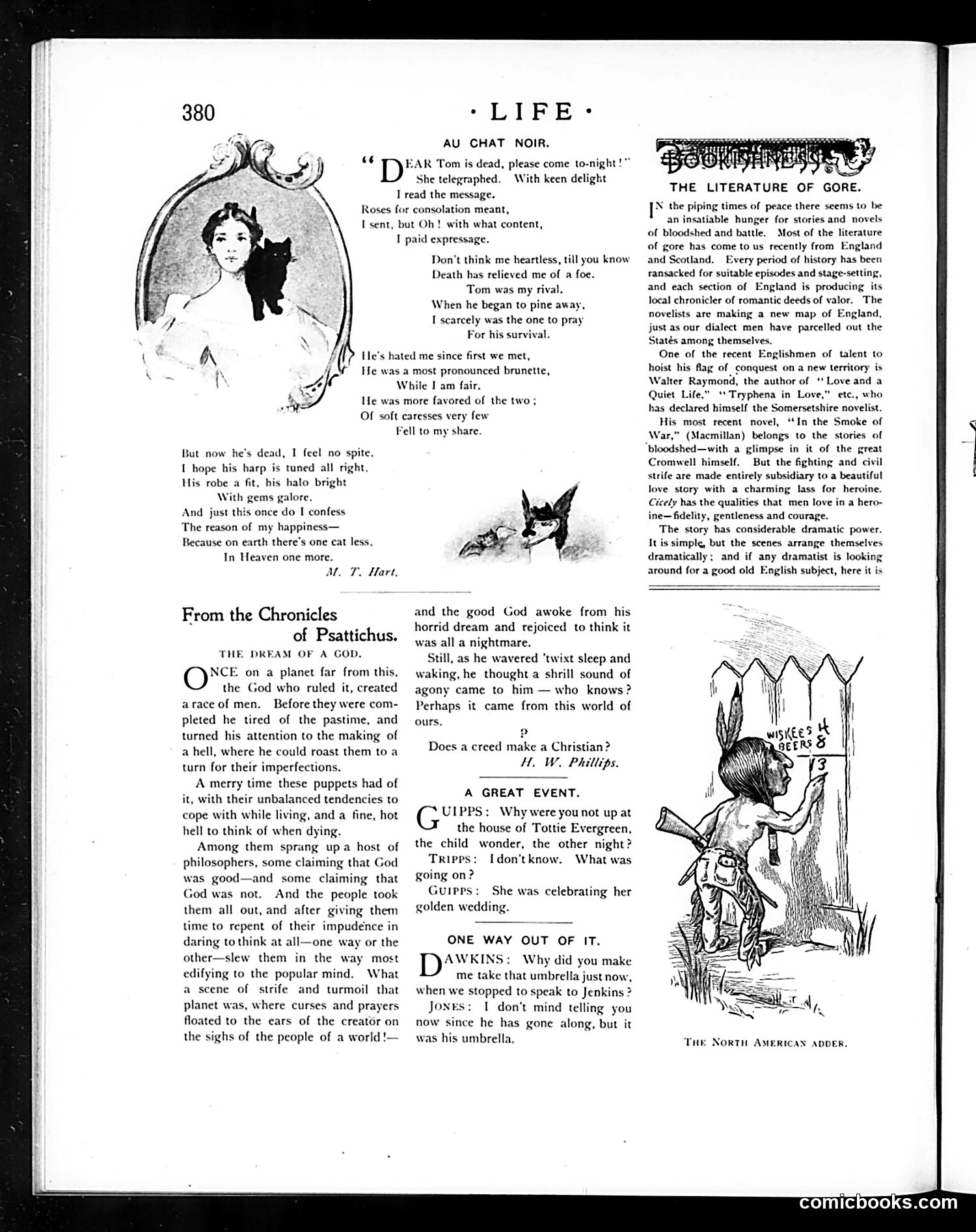
This page contains literary content rather than political cartoons. The main pieces include: **"Au Chat Noir"** - A sentimental poem by M. V. Hart about a deceased rival, expressing forgiveness now that he's dead. The accompanying illustration shows a woman with a black cat. **"From the Chronicles of Patitichus"** - A philosophical story about a god creating a hell-like planet to test imperfect beings, questioning whether suffering produces morality. It concludes with a brief theological question. **Short humorous exchanges** like "A Great Event" and "One Way Out of It" - light social comedy involving characters discussing a golden wedding and a missing umbrella. The page represents Life's mixed editorial approach: combining verse, short fiction, and humor rather than satirical political cartooning.
📄 Transcribed text from this page (OCR, searchable)
Machine-transcribed from the original scan — historical spelling and the odd misread are preserved.
“D I read the message. * LIFE: AU CHAT NOIR. R Tom is dead, please come to-night!" She telegraphed. With keen delight Roses for consolation meant, I sent, but O1 I paid expressage. ! with what content, Don’t think me heartless, till you know Death has relieved me of a foe. Tom was my rival. When he began to pine away, I scarcely was the one to pray For his surviv He's hated me since first we met, He was a most pronounced brunette, While I am fair. Ife was more favored of the two ; Of soft caresses very few Fell to my share. But now he’s dead, I feel no spite. I hope his harp is tuned all right, His robe a fit, his halo bright With gems galore. And just this once do I confess The reason of my happiness— Because on earth there's one cat less, In Heaven one more. AL. 7. Hart, From the Chronicles of Psattichus. THE DREAM OF A GOD. O*S = on a planet far from this, the God who ruled it, created araceof men. Before they were com- pleted he tired of the pastime, and turned his attention to the making of a hell, where he could roast them to a turn for their imperfections, A merry time these puppets had of it, with their unbalanced tendencies to cope with while living, and a fine, hot hell to think of when dying. Among them sprang up a host of philosophers, some claiming that God was good—and some claiming that God was not. And the people took them all out, and after giving them time to repent of their impudence in daring to think at all—one way or the other—slew them in the way most edifying to the popular mind. What a scene of strife and turmoil that planet was, where curses and prayers floated to the ears of the creator on the sighs of the people of a world!— and the good God awoke from his horrid dream and rejoiced to think it was all a nightmare. Still, as he wavered ‘twixt sleep and waking, he thought a shrill sound of agony came to him — who knows ? Perhaps it came from this world of ours. p Does a creed make a Christian? H.W. Phillips. A GREAT EVENT. G" PPS: Why were you not up at the house of Tottie Evergreen, the child wonder, the other night? Tripps: Idon'tknow. What was going on? Gutpps: She was celebrating her golden wedding. ONE WAY OUT OF IT. Daves: Why did you make me take that umbrella just now, when we stopped to speak to Jenkins? Jones: I don’t mind telling you now since he has gone along, but it was his umbrella, THE LITERATURE OF GORE. [® te piping times of peace there seems to be an insatiable hunger for stories and novels of bloodshed and battle. Most of the literature of gore has come to us recently from England and Scotland. Every period of history has been ransacked for suitable episodes and stage-setting, and each section of England is producing its local chronicler of romantic deeds of valor. The novelists are making a new map of England, just as our dialect men have parcelled out the Statés among themselves. One of the recent Englishmen of talent to hoist his flag of conquest on a new territory is Walter Raymond, the author of ‘Love and a Quiet Life,” ‘*Tryphena in Love,” etc., who has declared himself the Somersetshire novelist. His most recent novel, “In the Smoke of War,” (Macmillan) belongs to the stories of “bloodshed—with a glimpse in it of the great Cromwell himself, But the fighting and civil strife are made entirely subsidiary to a beautiful love story with a charming lass for heroine. Cicely has the qualities that men love in a hero- ine—fidelity, gentleness and courage. The story has considerable dramatic power. It is simple, but the scenes arrange themselves dramatically; and if any dramatist is looking around for a good old English subject, here it is THE NORTH AMERICAN ADDER. comicbooks.com