
Life, 1895-12-12 · page 4 of 18
Life — December 12, 1895 — page 4: what you’re looking at
What you’re looking at
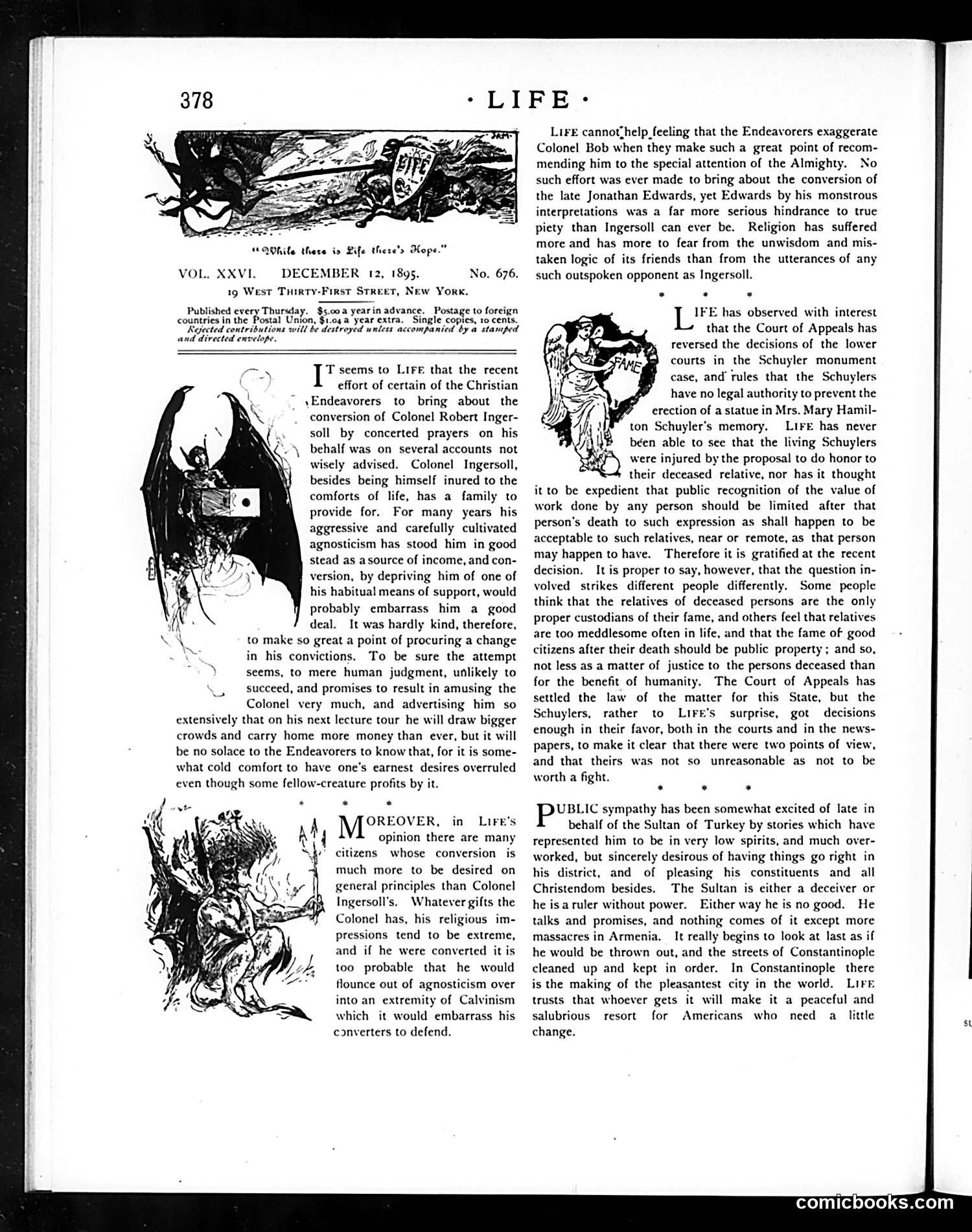
This page critiques Christian efforts to convert Colonel Robert Ingersoll, a famous 19th-century agnostic and public speaker. The text sarcastically defends Ingersoll against overzealous religious advocates, arguing his "monstrous interpretations" of faith were less damaging than forced conversion attempts. The accompanying illustrations appear to be generic allegorical or satirical drawings rather than specific political caricatures. The content also discusses a Court of Appeals decision regarding the Schuyler family and a memorial statue, and comments on Turkey's Sultan and Constantinople's conditions. The satire targets religious zealotry and what Life viewed as inappropriate efforts to change people's fundamental beliefs through aggressive proselytizing.
📄 Transcribed text from this page (OCR, searchable)
Machine-transcribed from the original scan — historical spelling and the odd misread are preserved.
- LIFE: “QNile there is Life there's Hope.” VOL. XXVI. DECEMBER 12, 1895. No. 676. 19 West Tiirty-First Street, New York. Published every Thursday. $s.00a yearin advance. Postage to foreign countries in the Postal Union, $1.04 a year extra. Single copies, 10 cents. Rejected contributions will be destroyed unless accompanied by a stamped and directed envelope. T seems to LIFE that the recent effort of certain of the Christian :Endeavorers to bring about the conversion of Colonel Robert Inger- soll by concerted prayers on his behalf was on several accounts not wisely advised. Colonel Ingersoll, besides being himself inured to the comforts of life, has a family to provide for. For many years his aggressive and carefully cultivated agnosticism has stood him in good stead as asource of income, and con- version, by depriving him of one of his habitual means of support, would probably embarrass him a good deal. It was hardly kind, therefore, to make so great a point of procuring a change in his convictions. To be sure the attempt seems, to mere human judgment, unlikely to succeed, and promises to result in amusing the Colonel very much, and advertising him so extensively that on his next lecture tour he will draw bigger crowds and carry home more money than ever, but it will be no solace to the Endeavorers to know that, for it is some- what cold comfort to have one’s earnest desires overruled even though some fellow-creature profits by it. VER, in Lire’s opinion there are many citizens whose conversion is much more to be desired on general principles than Colonel Ingersoll's. Whatever gifts the Colonel has, his religious im- pressions tend to be extreme, and if he were converted it is too probable that he would flounce out of agnosticism over into an extremity of Calvinism which it would embarrass his converters to defend. Lire cannot<help feeling that the Endeavorers exaggerate Colonel Bob when they make such a great point of recom- mending him to the special attention of the Almighty. No such effort was ever made to bring about the conversion of the late Jonathan Edwards, yet Edwards by his monstrous interpretations was a far more serious hindrance to true piety than Ingersoll can ever be. Religion has suffered more and has more to fear from the unwisdom and mis- taken logic of its friends than from the utterances of any such outspoken opponent as Ingersoll. * . . IFE has observed with interest that the Court of Appeals has reversed the decisions of the lower courts in the Schuyler monument case, and’ rules that the Schuylers have no legal authority to prevent the 7 erection of a statue in Mrs. Mary Hamil- ton Schuyler’s memory. LIFE has never been able to see that the living Schuylers were injured by the proposal to do honor to their deceased relative, nor has it thought it to be expedient that public recognition of the value of work done by any person should be limited after that person's death to such expression as shall happen to be acceptable to such relatives, near or remote, as that person may happen to have. Therefore it is gratified at the recent decision. It is proper to say, however, that the question in- volved strikes different people differently. Some people think that the relatives of deceased persons are the only proper custodians of their fame, and others feel that relatives are too meddlesome often in life, and that the fame of good citizens after their death should be public property ; and so, not less as a matter of justice to the persons deceased than for the benefit of humanity. The Court of Appeals has settled the law of the matter for this State, but the Schuylers, rather to LIFE’s surprise, got decisions enough in their favor, both in the courts and in the news- papers, to make it clear that there were two points of view, and that theirs was not so unreasonable as not to be worth a fight. . . purrs sympathy has been somewhat excited of late in behalf of the Sultan of Turkey by stories which have represented him to be in very low spirits, and much over- worked, but sincerely desirous of having things go right in his district, and of pleasing his constituents and all Christendom besides. The Sultan is either a deceiver or he isaruler without power. Either way he is no good. He talks and promises, and nothing comes of it except more massacres in Armenia. It really begins to look at last as if he would be thrown out, and the streets of Constantinople cleaned up and kept in order. In Constantinople there is the making of the pleasantest city in the world. LIFE trusts that whoever gets it will make it a peaceful and salubrious resort for Americans who need a_ little change. comicbooks.com