
A complete issue · 18 pages · 1895
Life — November 21, 1895
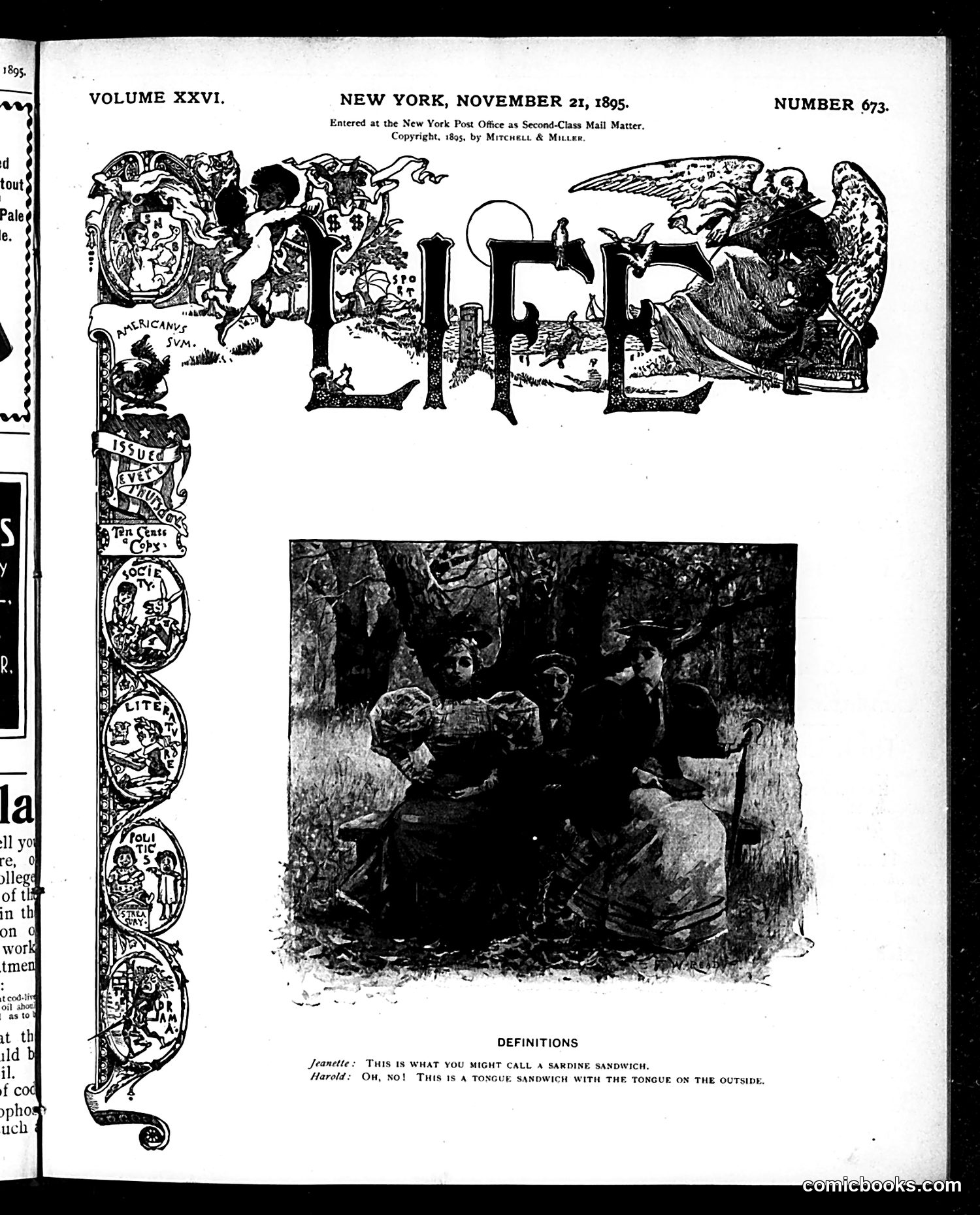
This page features a humorous "Definitions" section with a photograph showing several men in what appears to be an outdoor camping or picnic scene. The joke plays on the term "sardine sandwich" versus "tongue sandwich." Jeanette observes that what's pictured could be called a sardine sandwich—referring to how tightly packed the men are. Harold corrects her, noting it's actually a "tongue sandwich with the tongue on the outside," likely a crude Victorian-era joke about the men's close physical proximity and positioning. The ornate decorative border on the left side is typical of Life's aesthetic design. Without additional context about the specific individuals pictured, their exact identities remain unclear, but the humor relies on visual wordplay about confined spaces and physical arrangement.
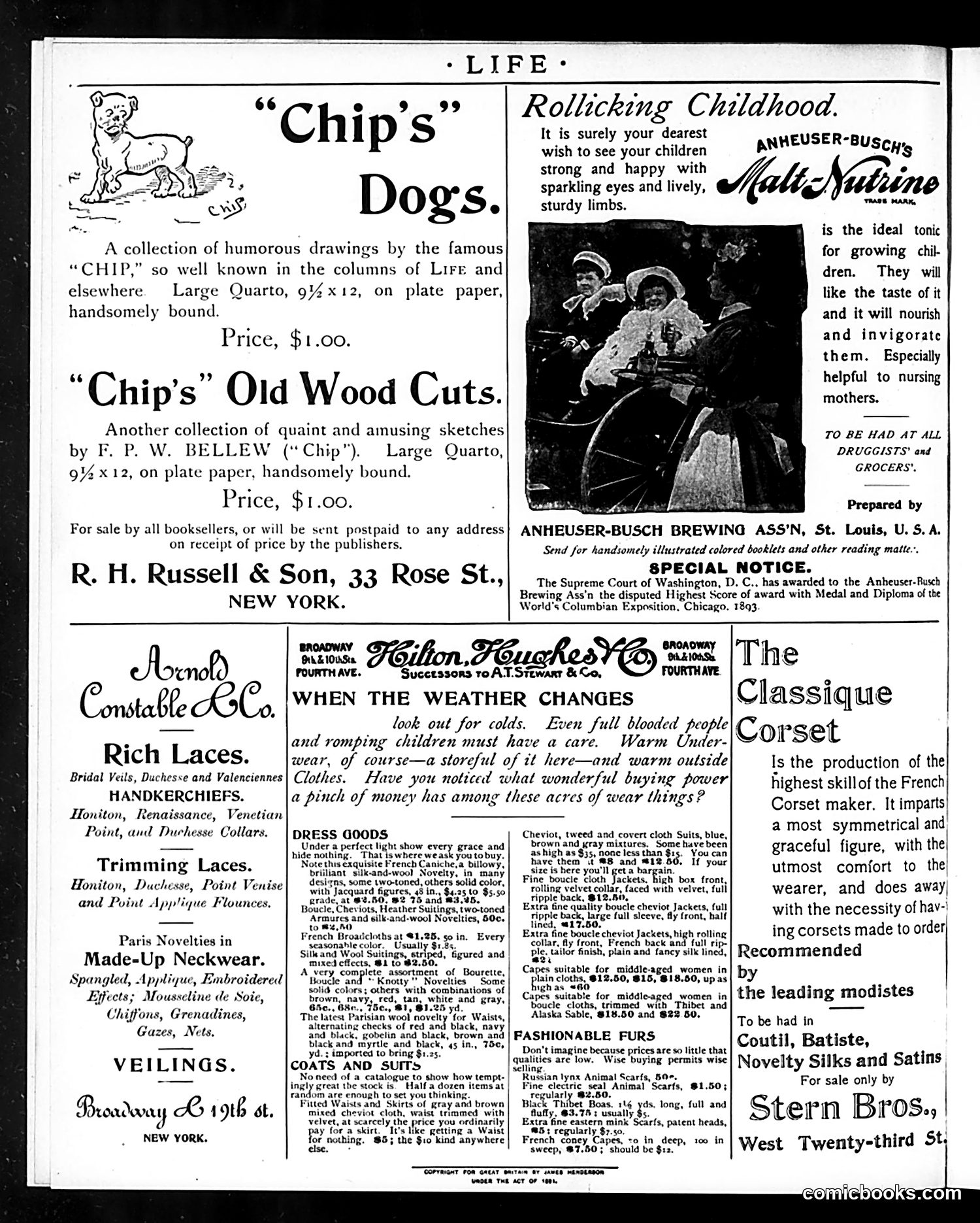
This is primarily an **advertising page** from Life magazine rather than a satirical cartoon page. The main content features: 1. **"Chip's" Dogs** - A book advertisement for humorous dog drawings by the famous "CHIP" cartoonist, known for Life magazine columns. Two volumes are advertised at $1.00 each. 2. **Supporting advertisements** for various products: Arnold Constable laces and neckwear, Anheuser-Busch's Malt-Nutrine tonic (marketed for children's health), The Classique Corset, and Stern Bros. clothing. The dog illustration is charming but decorative rather than satirical. The page reflects early 1900s consumer culture, with advertisements positioning products as solutions for family health and fashion concerns.
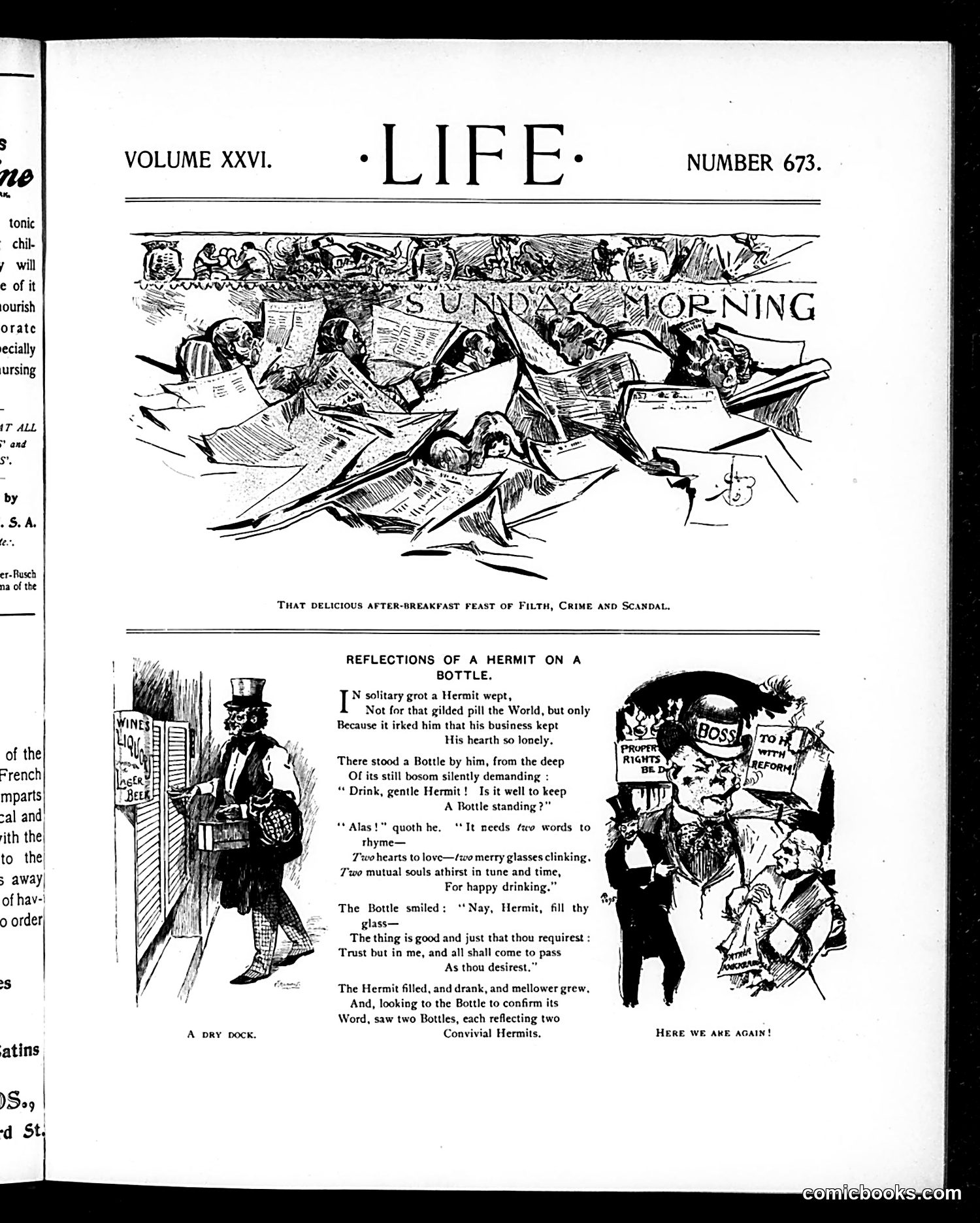
The top cartoon satirizes sensational journalism. "That Delicious After-Breakfast Feast of Filth, Crime and Scandal" depicts figures gorging on newspapers—visual criticism of how media outlets and readers consume lurid news stories. Below, "Reflections of a Hermit on a Bottle" is a whimsical poem about solitary drinking. The illustrations show a solitary figure at a "dry dock" and another labeled figure surrounded by demands ("BOSS," "REFORM," "RIGHTS"). The right cartoon, "Here We Are Again!" appears political but the specific references are unclear from the image alone. The densely-labeled figure seems weighted down by competing demands or controversies. Overall, this page mixes media criticism with social commentary on personal pressure and excess.
This page contains literary criticism rather than political cartoons. The decorative illustrations are generic Victorian ornaments, not specific caricatures. The text discusses Chicago's literary reputation and Eugene Field's death. It defends Chicago's cultural credibility against eastern bias, arguing that writers like Field prove the city capable of producing quality literature despite its industrial reputation. A secondary note addresses a controversy over Dickens's "Cricket on the Hearth," with the critic defending the story's merit against dismissive recent criticism. The final paragraph mentions unconfirmed rumors about Alfred Austin potentially becoming poet laureate of England, suggesting the appointment would test public opinion of his work. The satire here is gentle—mocking eastern literary snobbery and baseless gossip—rather than sharp political commentary.
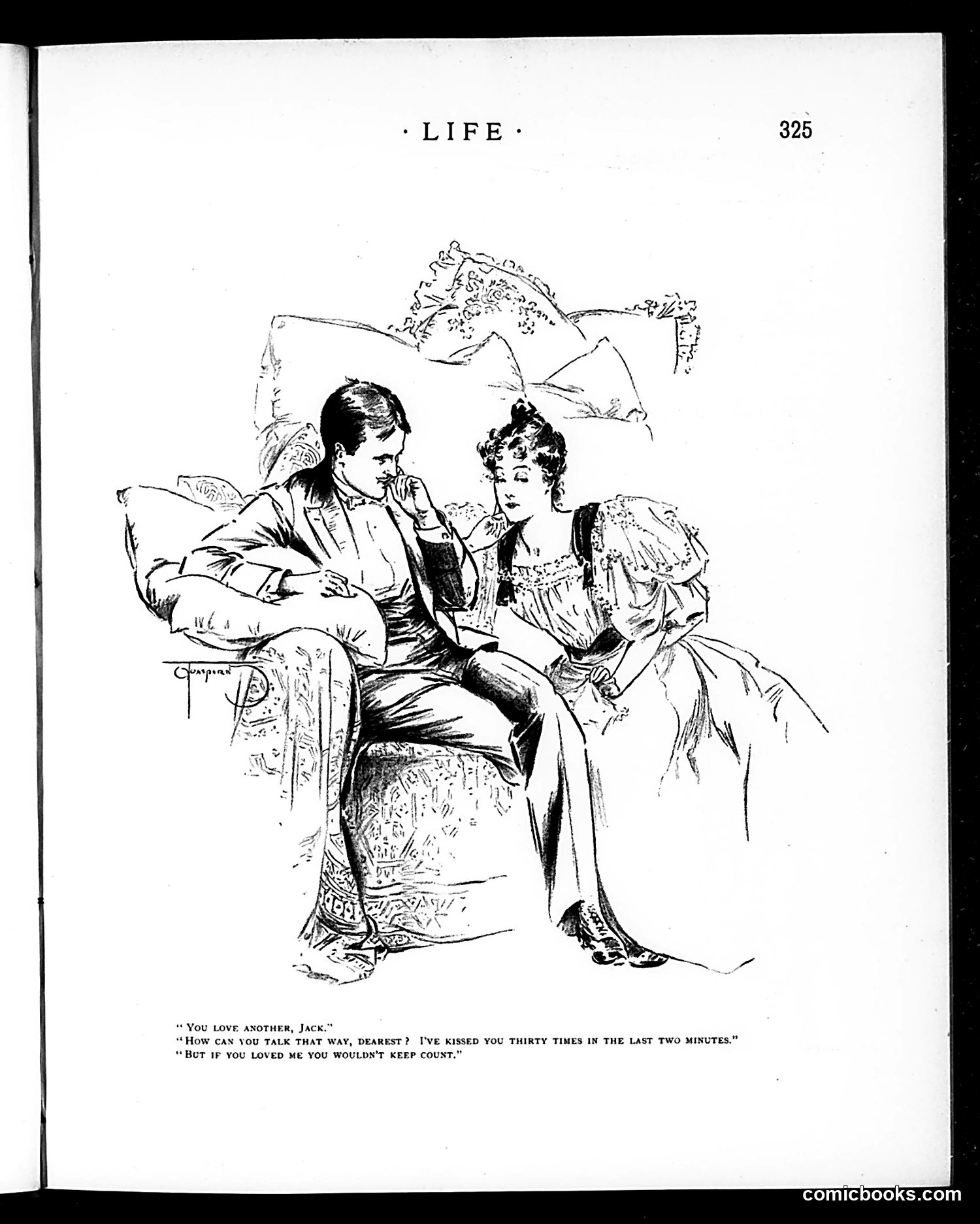
This is a romantic illustration from Life magazine (page 325), depicting a flirtatious scene between a man named Jack and two women in what appears to be late Victorian or Edwardian-era clothing, based on the puffy sleeves and elaborate fabrics. The humor is a straightforward romantic/domestic comedy: Jack is accused of loving "another" woman, and he defensively claims he's kissed his companion thirty times in two minutes. The woman responds with a playful ultimatum—if he truly loved her, he wouldn't keep count. It's lighthearted social satire about courtship customs and romantic behavior of the era, poking fun at male excuses and the performative nature of romantic attention. No specific political figures or events are referenced; this is general humor about gender relations and dating conventions.
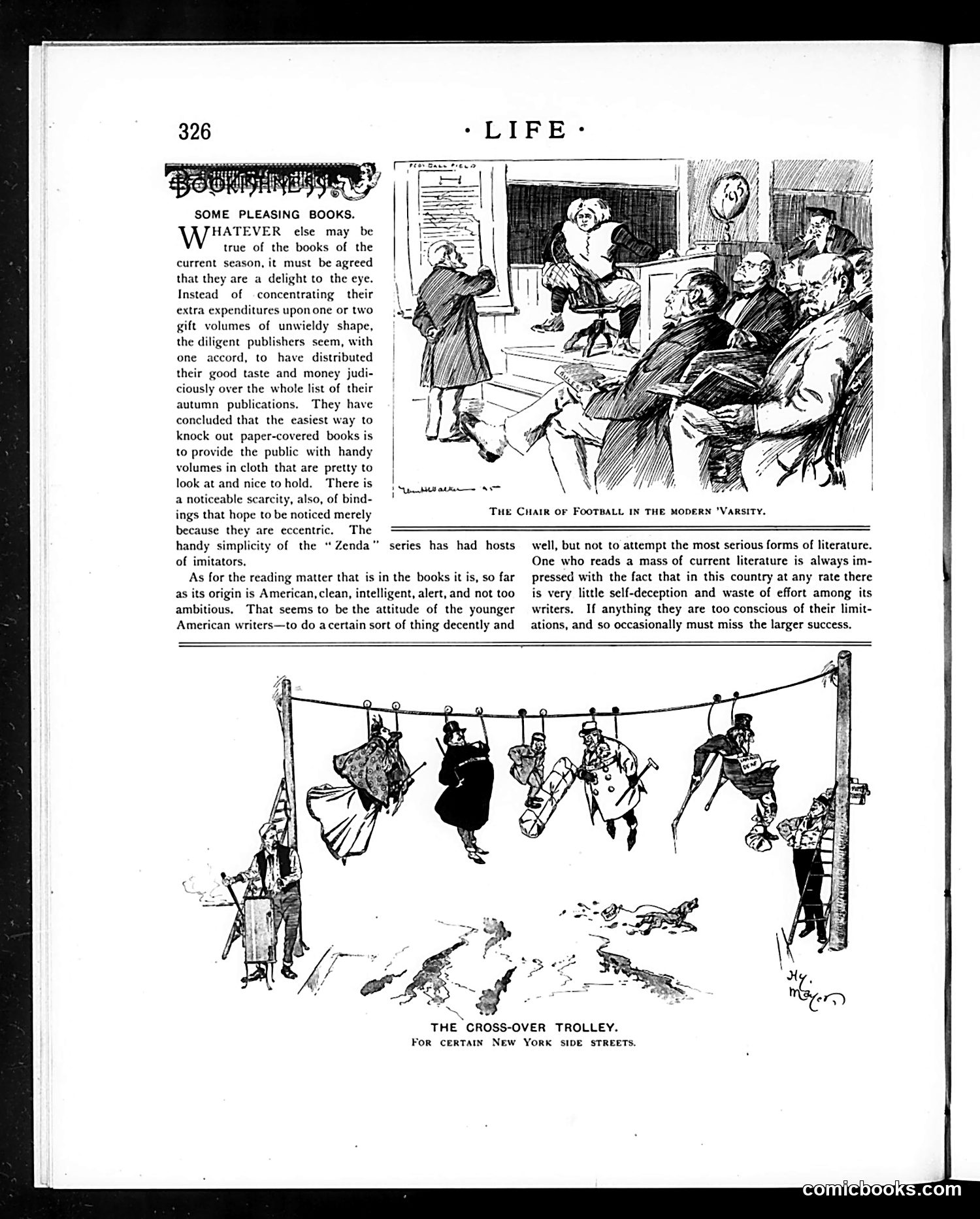
**Top Cartoon: "The Chair of Football in the Modern Varsity"** This depicts a university classroom where a professor lectures to seated students about football. The satire mocks the apparent elevation of football to academic importance in American universities—treating it as worthy of formal instruction and scholarly debate rather than merely athletics. The joke critiques how American universities prioritize football culture. **Bottom Cartoon: "The Cross-Over Trolley for Certain New York Side Streets"** This absurdist sketch shows people suspended on a clothesline-like apparatus strung between buildings, labeled a "trolley." It satirizes crowded New York street transportation problems by proposing a ridiculous solution—literally stringing people overhead to avoid street congestion. The humor mocks both urban overcrowding and impractical proposed fixes.
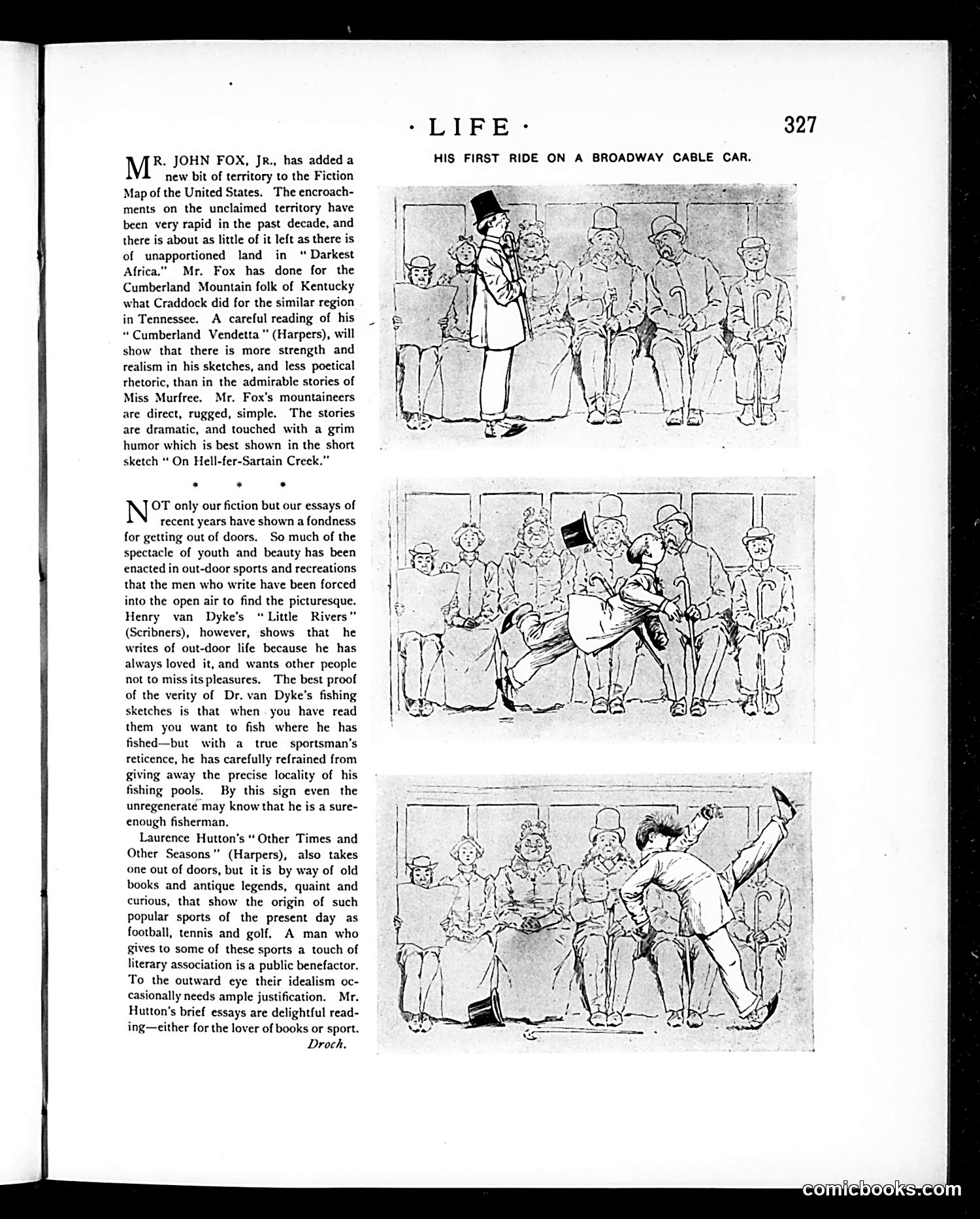
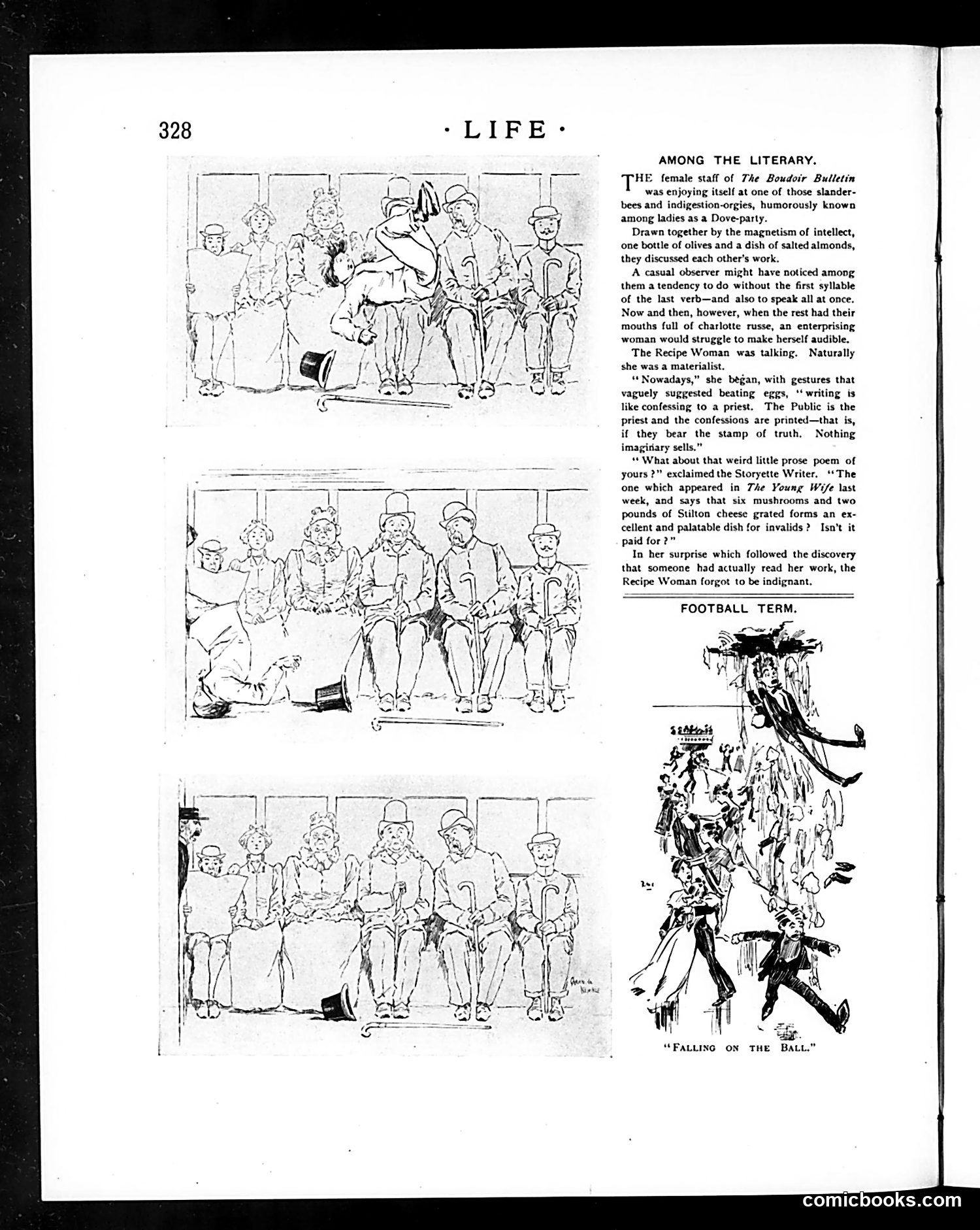
This page contains three cartoon panels depicting a man's inaugural experience on a Broadway cable car (a common urban transit method of the era). The sequential humor shows his increasing alarm and loss of composure as the car moves: **Panel 1:** A well-dressed gentleman in a top hat boards calmly with other passengers. **Panel 2:** He appears increasingly unsteady as the car operates. **Panel 3:** He's visibly panicked, losing his hat and dignity entirely. The joke satirizes the novelty and jarring experience of cable car technology for newcomers—a common subject of humor as these vehicles were still relatively new urban infrastructure. The gentleman's descent from composed respectability to undignified chaos provides the comedic arc.
This page satirizes the female editorial staff of *The Boudoir Bulletin* magazine. The three sequential cartoons show the same group of women in increasingly chaotic states during what appears to be an editorial meeting. The text mocks their tendency to speak without completing sentences ("do without the first syllable of the last verb") and describes one as "The Recipe Woman"—a materialist who compares writing to "confessing to a priest" and reduces literary value to practical measures like "pounds of Sutton cheese grated." The satire targets early 20th-century women journalists and magazine editors, suggesting they were intellectually pretentious yet commercially-minded, prone to incomplete thoughts, and prone to indignation when their work was actually read. The humor relies on period misogyny about women's intellectual capacity and workplace competence.
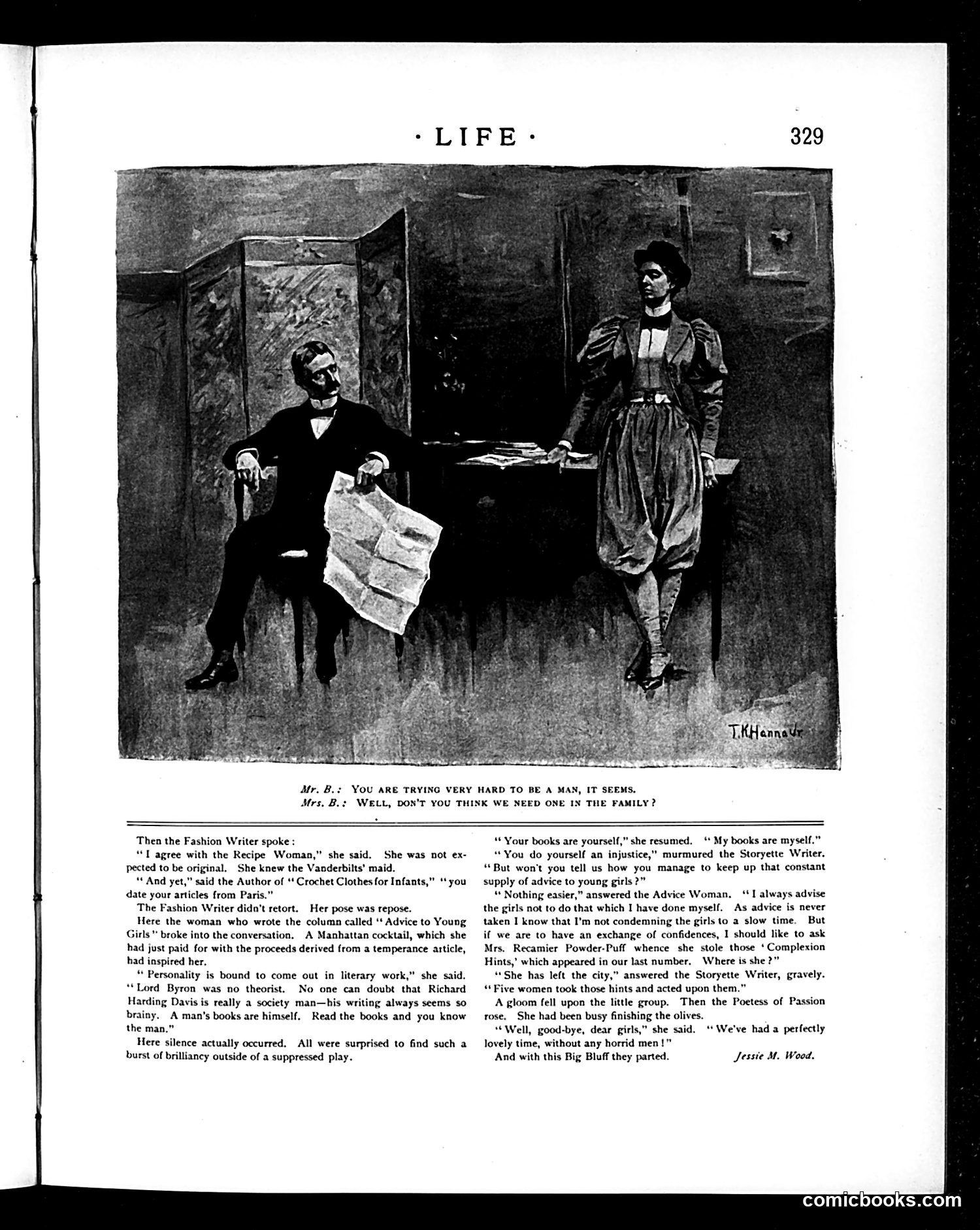
This page features a satirical illustration and accompanying dialogue about gender roles and literary ambition in the early 20th century. The cartoon depicts a man reading a newspaper while a woman stands nearby. The caption records their exchange: the man asks if the woman is "trying very hard to be a man," and she responds by questioning whether they need "one in the family." The subsequent text discusses a "Fashion Writer" who challenges gender conventions by pursuing authorship and literary success. References to Byron, Hazlitt, and other male literary figures underscore the satire: women's intellectual and professional aspirations are being mocked as unfeminine imitation of men. The piece appears to satirize early feminist or suffragist ambitions, treating women's desire for professional independence and intellectual recognition as amusing or unseemly—a common conservative social critique of the period.
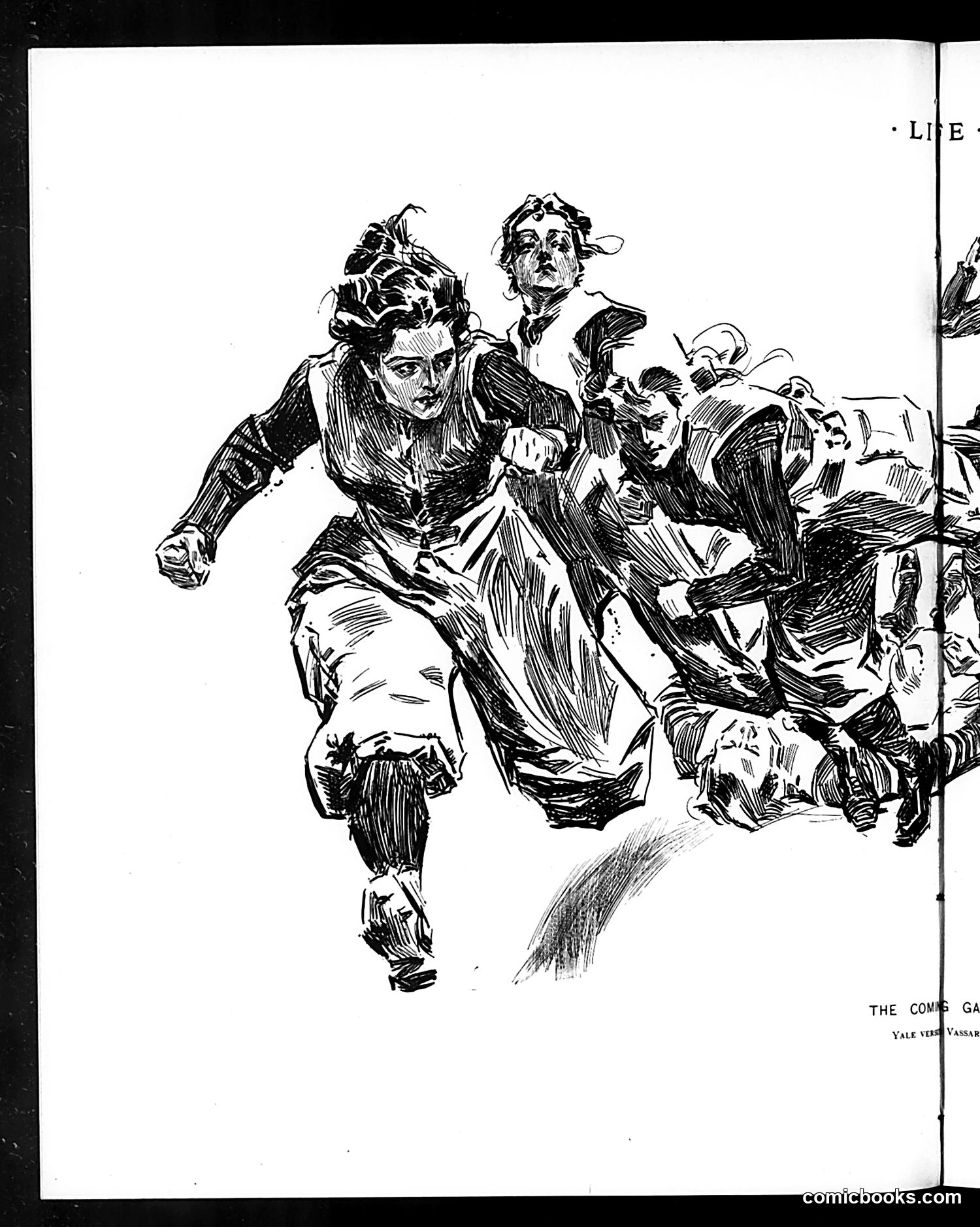
This ink illustration appears to show a dramatic scene of physical conflict or struggle. A woman in the center lunges forward with apparent aggression, while men around her react with alarm—one man behind her appears shocked, and others seem to be restraining or responding to the action. The partial caption visible at bottom reads "THE COM..." with references to "YALE" and "VASSAR," suggesting this relates to a story involving those universities. Without the complete caption and full context from the magazine issue, I cannot definitively identify the specific political or social satire intended. The scene could reference a campus incident, a social conflict of that era, or a theatrical/literary reference. The style and subject matter suggest early-to-mid 20th century American social commentary, but the precise meaning requires the complete article text.
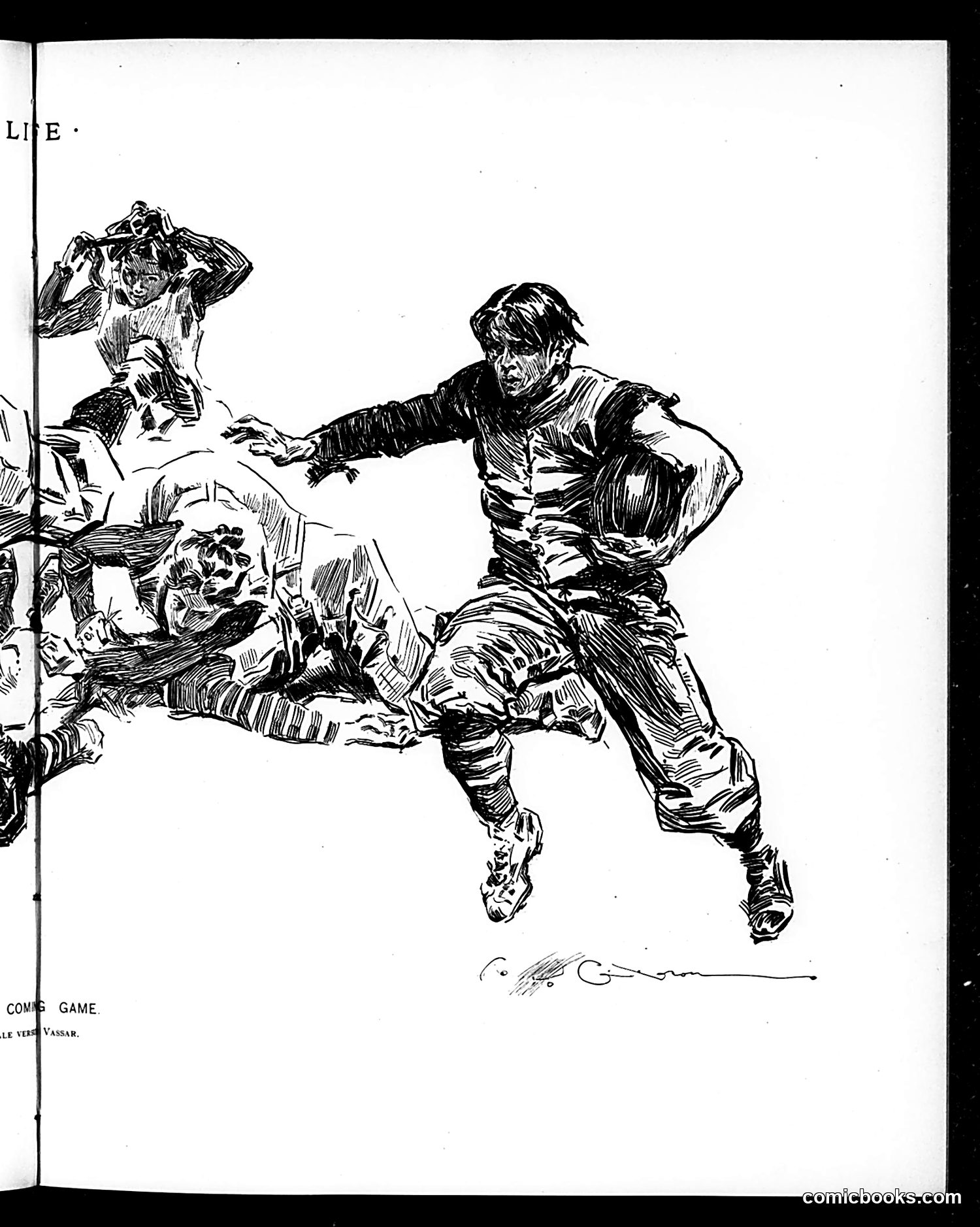
This appears to be a satirical illustration titled "Comic Game" from *Life* magazine, depicting a physical altercation between two figures. The dynamic composition shows one man in striped clothing throwing a punch or aggressive gesture toward another man in similar attire who is falling or being pushed backward. The style and rendering suggest this comments on political or social conflict, likely representing rival politicians or ideological opponents engaged in literal combat. The "comic game" title implies mockery of their conflict as entertainment or absurdity. However, without visible dates, clearer identifying features, or additional text beyond the OCR fragments, I cannot definitively identify the specific figures or the exact historical event being satirized. The illustration's aggressive energy clearly critiques some form of public conflict.
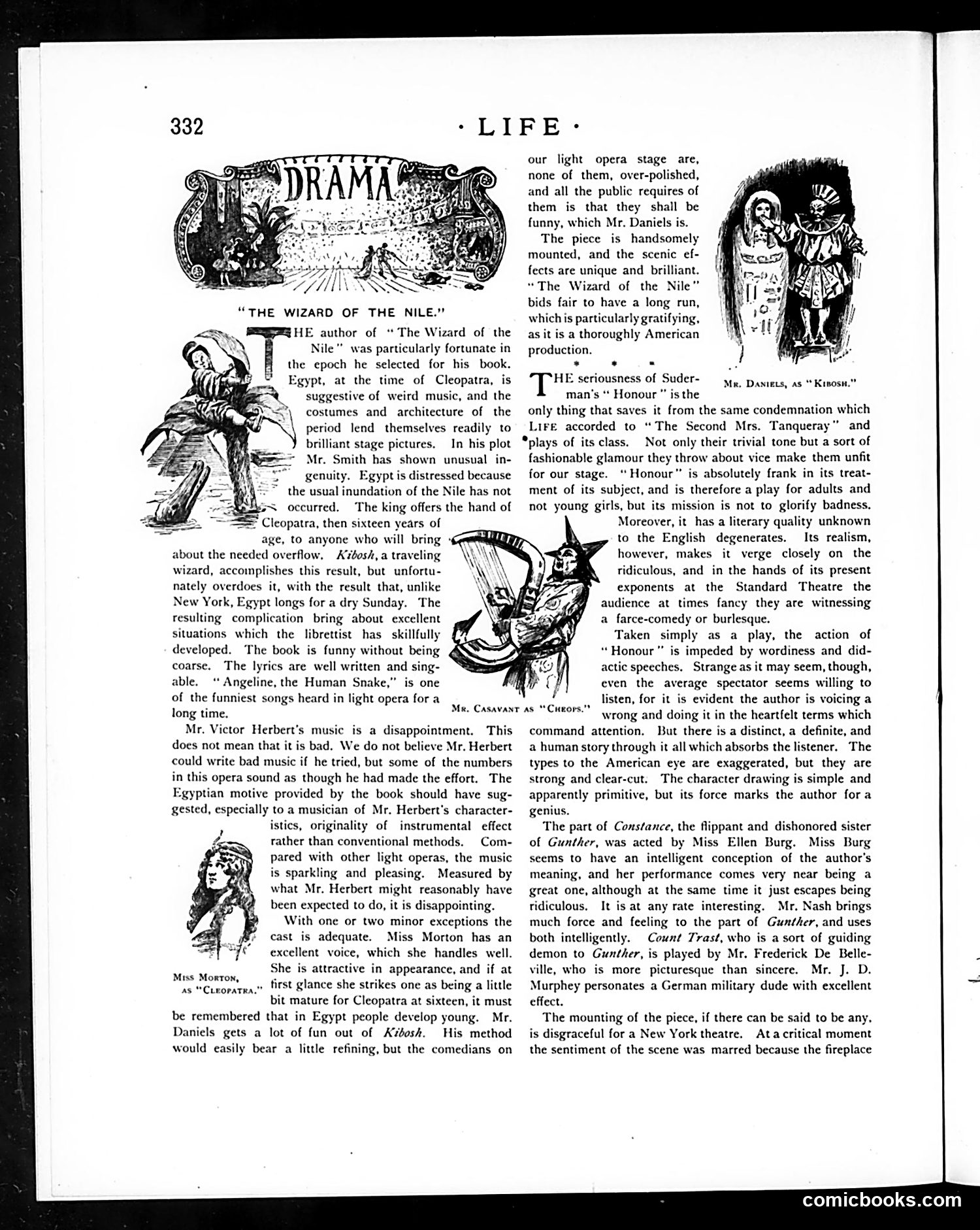
This page reviews two theatrical productions. The main focus is **"The Wizard of the Nile,"** a light opera by Mr. Smith with music by Victor Herbert. The plot—set in ancient Egypt—involves a wizard who must cause the Nile to flood to win Cleopatra's hand. The review praises the book's humor and clever plotting, and commends the performances by Miss Morton (as Cleopatra) and Mr. Daniels (as the wizard Avbosh), though it criticizes Herbert's music as disappointingly conventional. The illustrations show cast members in Egyptian costume. The secondary section reviews Suderman's play **"Honour,"** comparing it unfavorably to trivial plays like "The Second Mrs. Tanqueray," arguing that while "Honour" treats serious moral subjects, its wordiness and didactic speeches impede the action. The overall tone is that of a sophisticated theater critic evaluating production quality, spectacle, and artistic merit for an educated readership interested in contemporary stage entertainment.
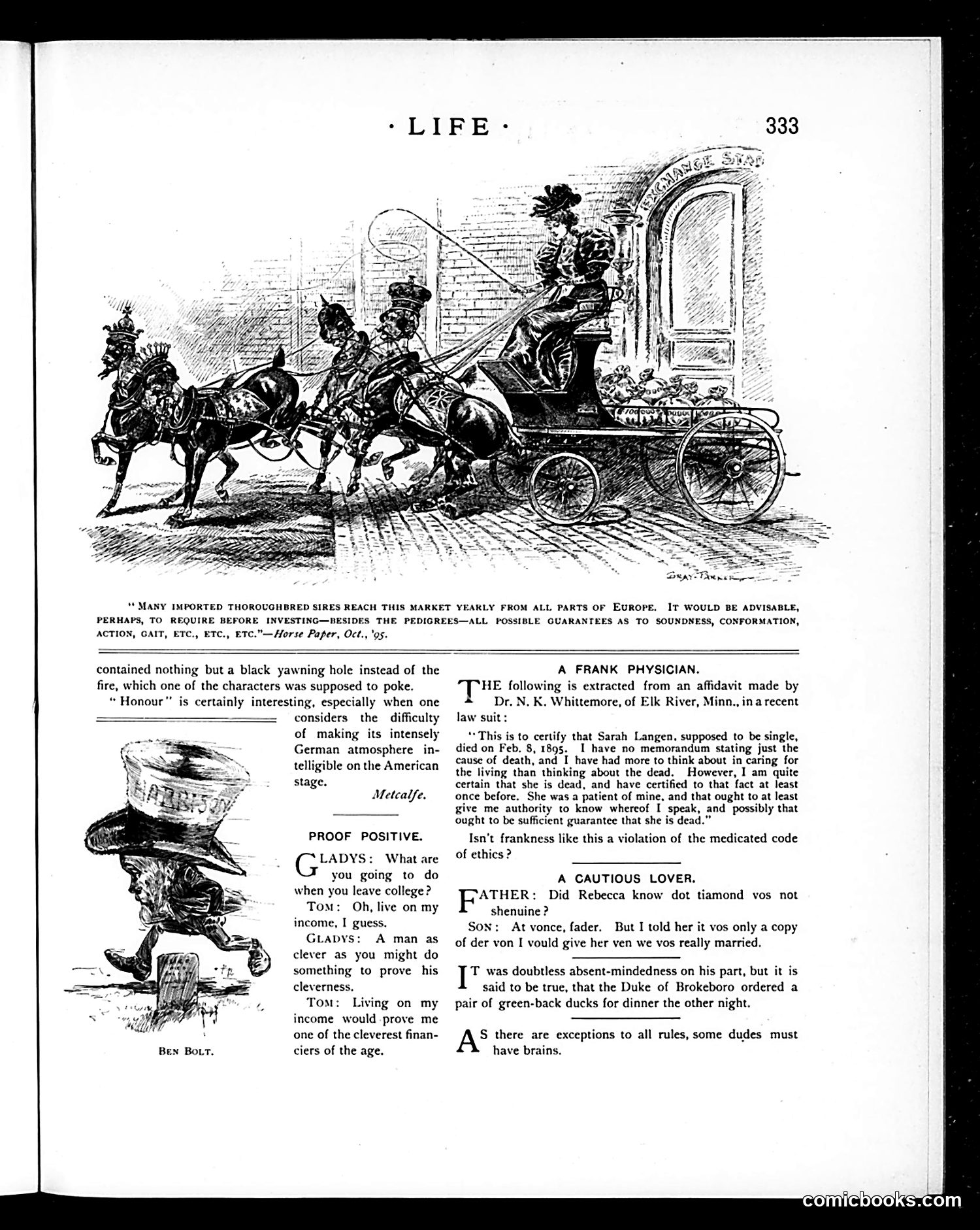
This page contains several unrelated satirical pieces typical of 1890s humor: **Top illustration**: A carriage scene mocking wealthy European horse imports, referencing an October 1895 Horse Paper article. The satire suggests buyers should verify imported thoroughbred sires are legitimate, not just accept pedigrees—implying fraud in the horse trade. **"Proof Positive"**: A college graduate jokes he'll prove his cleverness by living idly on inherited income rather than working—satirizing wealthy young men's laziness and financial incompetence. **"A Frank Physician"**: Dr. Whittemore's affidavit hilariously admits he certified a death without knowing the cause and barely remembers the patient, mocking medical negligence and unethical documentation. **"A Cautious Lover"**: A son admits giving his fiancée a fake diamond, planning to provide a real one only after marriage—satirizing deceptive courtship practices among the affluent. **Bottom quip**: Jokes that even "dudes" (wealthy idlers) occasionally display intelligence, like the Duke of Brokeboro ordering "green-back ducks" (possibly a pun on currency/actual ducks).
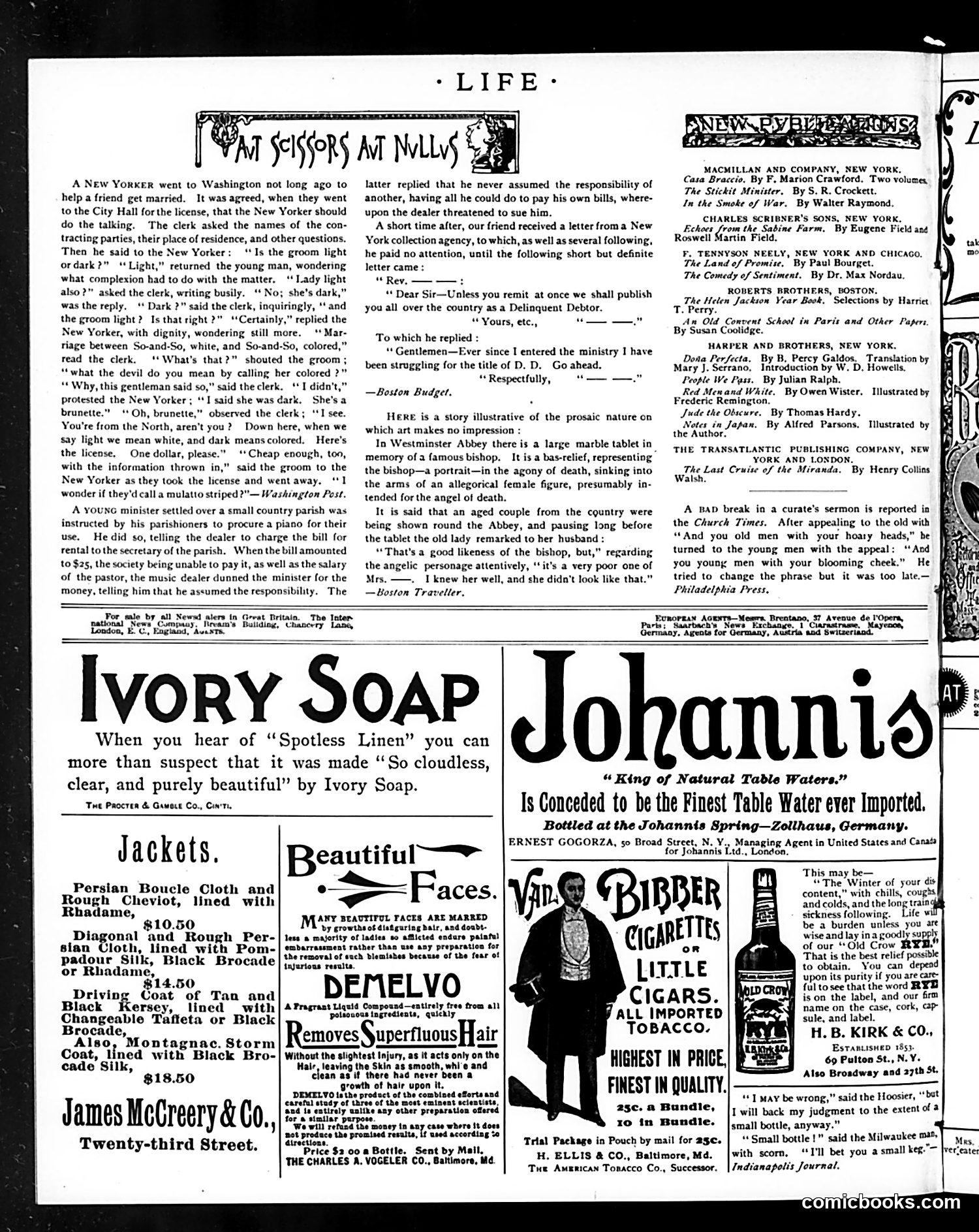
This page is primarily **advertising and literary notices** rather than political satire. The main content consists of three humorous anecdotes: 1. **"Scissors at Willis"** (top): A joke about racial terminology in Washington, D.C. A New Yorker uses "dark" to describe a bride's complexion; the clerk interprets this as "colored," revealing how the South's rigid racial categories differ from Northern euphemisms. The humor comes from the Northern visitor's culture shock at the explicit racial classification system. 2. **The Piano Bill**: A minister refuses to pay a piano rental, claiming he has no responsibility for others' debts. A collection agency threatens to publish him as a "Delinquent Debtor," to which he cleverly responds by requesting they publish away—since "D.D." means Doctor of Divinity, a ministerial credential. 3. **Westminster Abbey Monument**: An elderly country woman views a bishop's death monument but criticizes the allegorical "angel" figure, claiming it's an unflattering portrait of a woman she knew. The page is primarily **commercial**—dominated by product advertisements for Ivory Soap, clothing, and other goods.
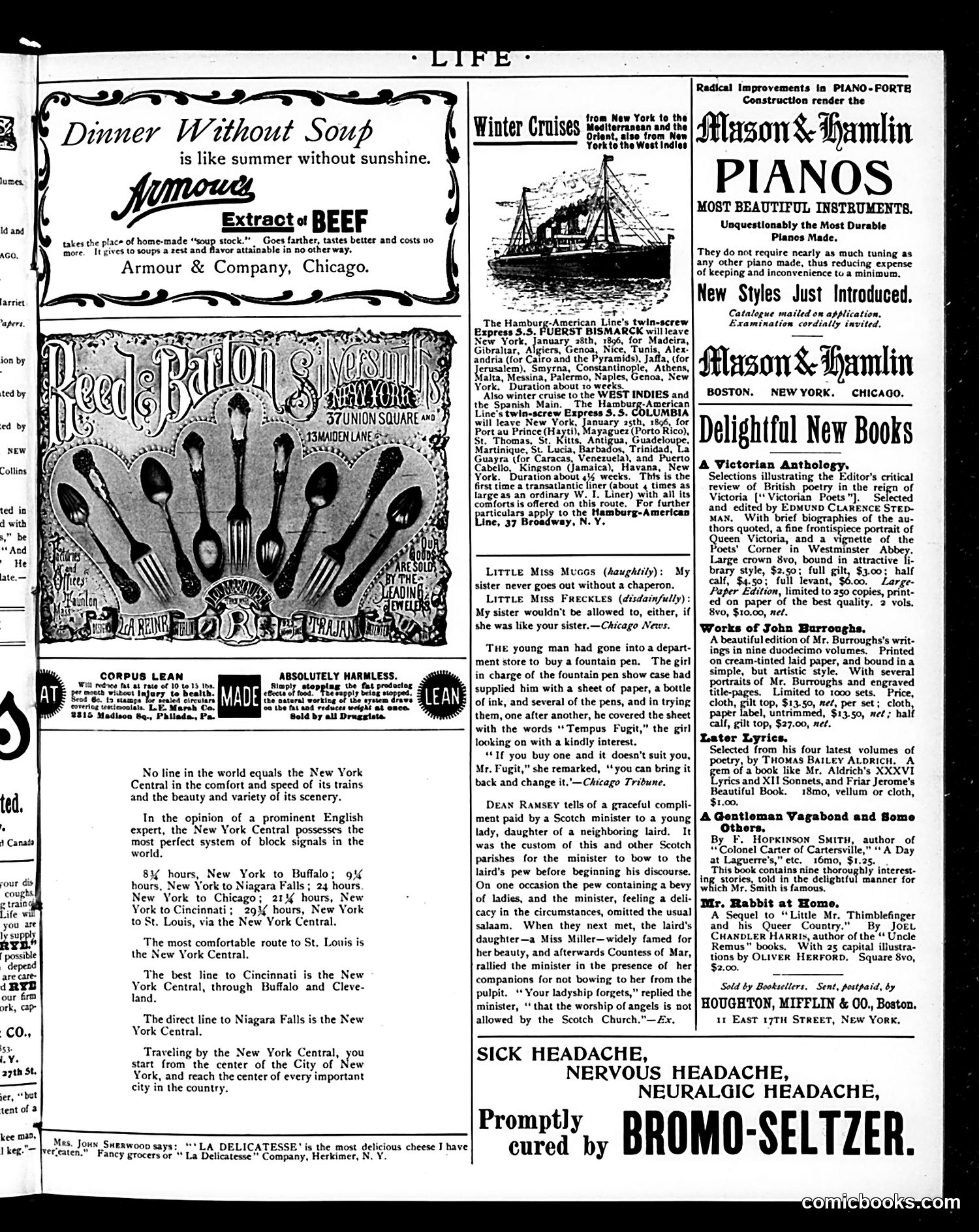
This page is primarily **advertising and light humor**, not political satire. The main elements are: **Central Cartoon ("Reed & Barton Spoons")**: An ornate illustration showcasing decorative spoons arranged in a hand pattern, advertising Reed & Barton flatware from Union Square, New York. This is straightforward product advertising with no satirical content. **Advertisements dominate**: Armour beef extract, Mason & Hamlin pianos, New York Central Railway, cruise lines, and books occupy most space. **Humor pieces** are brief anecdotes: - Two girls exchange barbs about needing chaperones (social commentary on propriety) - A man repeatedly writes "Tempus Fugit" testing fountain pens; salesgirl jokes he can exchange it if unsatisfied - A Scottish minister compliments a beautiful woman by bowing to her pew **No political figures or references** are visible. The page reflects early 1900s consumer culture and genteel social conventions rather than political satire. This appears to be a typical Life magazine page mixing advertisements with light, domestic humor.
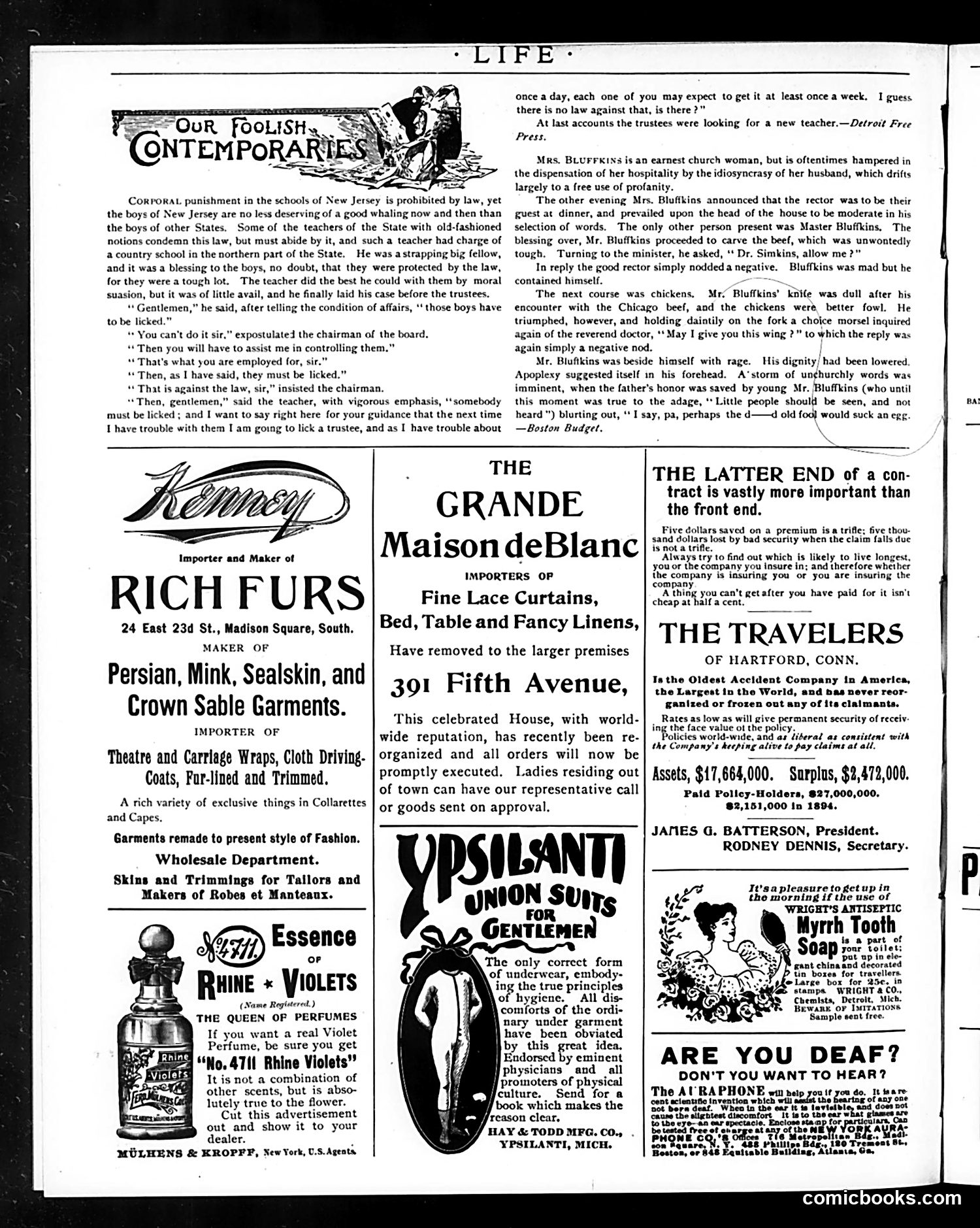
This page presents two humorous stories mocking social hypocrisy and absurd situations: **First story**: A New Jersey teacher, frustrated by laws prohibiting corporal punishment, tells school trustees he'll beat *them* instead if they won't let him discipline unruly students. The joke targets the legal restriction's impracticality and the teacher's exasperation. **Second story**: Mr. Bluffkins, a profane man, tries restraining his language when the rector visits for dinner. When carving tough meat, he repeatedly offers the minister food, barely containing his frustration. The humor lies in his barely-suppressed profanity and the rector's diplomatic silence—satirizing how people perform respectability for clergy despite their true nature. Both stories mock the gap between social propriety and human nature, featuring authority figures (teachers, husbands) whose actual behavior contradicts their public presentation. The satire is gentle, domestic, and relies on situational comedy rather than political commentary.
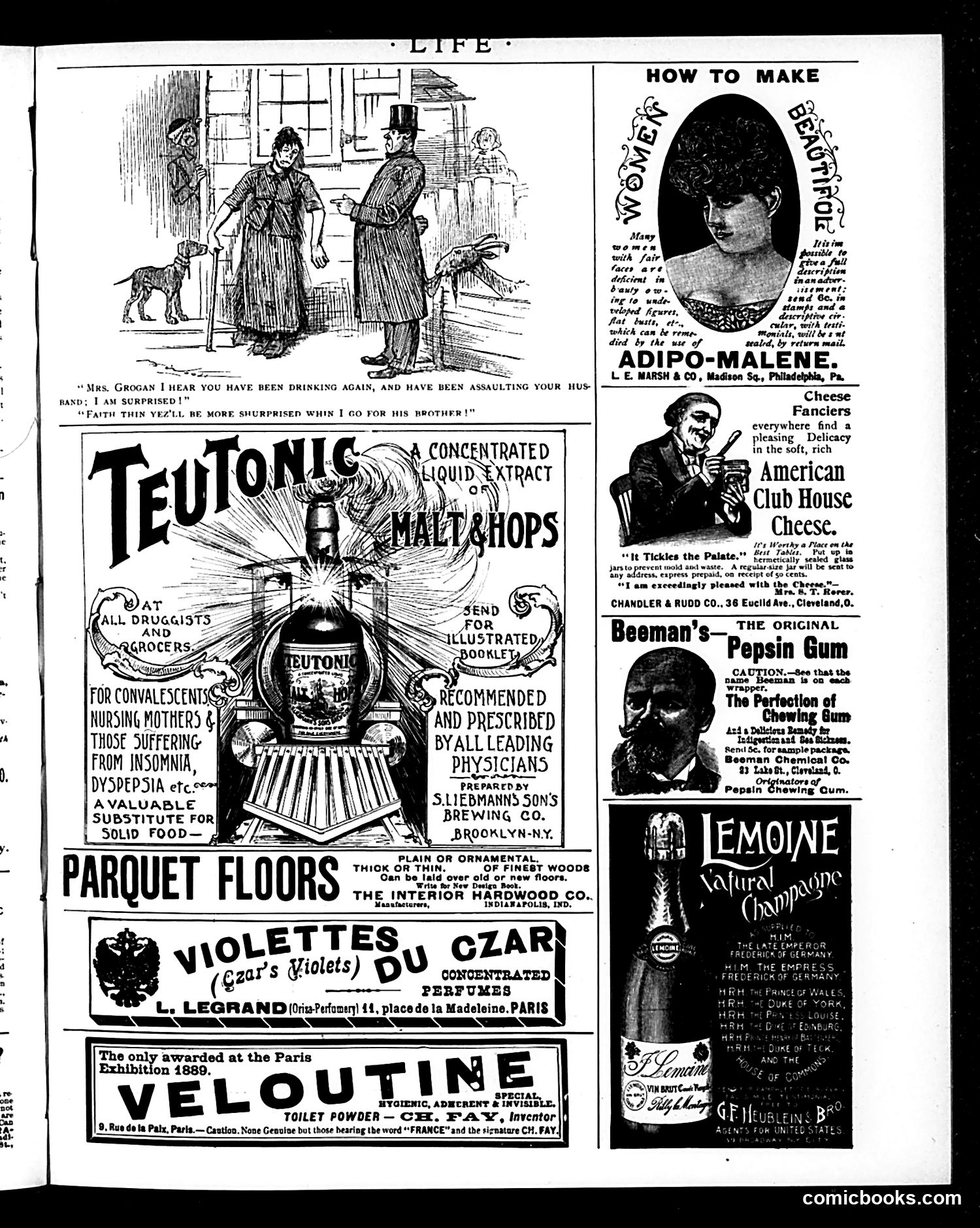
This page combines a satirical cartoon with period advertisements. **The Cartoon:** The main comic depicts an Irish immigrant woman (identifiable by dialect spelling: "Farrit," "Shurprised") speaking to another woman, Mrs. Grogan. The woman admits to drinking and assaulting her husband, then threatens to "go for his brother" next. The satire mocks Irish stereotypes prevalent in late 19th-century America—portraying Irish immigrants as alcoholic, violent, and prone to domestic abuse. This reflects common anti-Irish prejudice of the era, presenting such behavior as characteristic of the group rather than individual failing. **The Advertisements:** The surrounding ads (Teutonic malt extract, parquet floors, perfumes, toilet powder, and various patent medicines) are typical period marketing, showing what contemporary consumers purchased. This page exemplifies how mainstream American humor magazines like *Life* reinforced ethnic stereotypes through caricature and dialect humor.
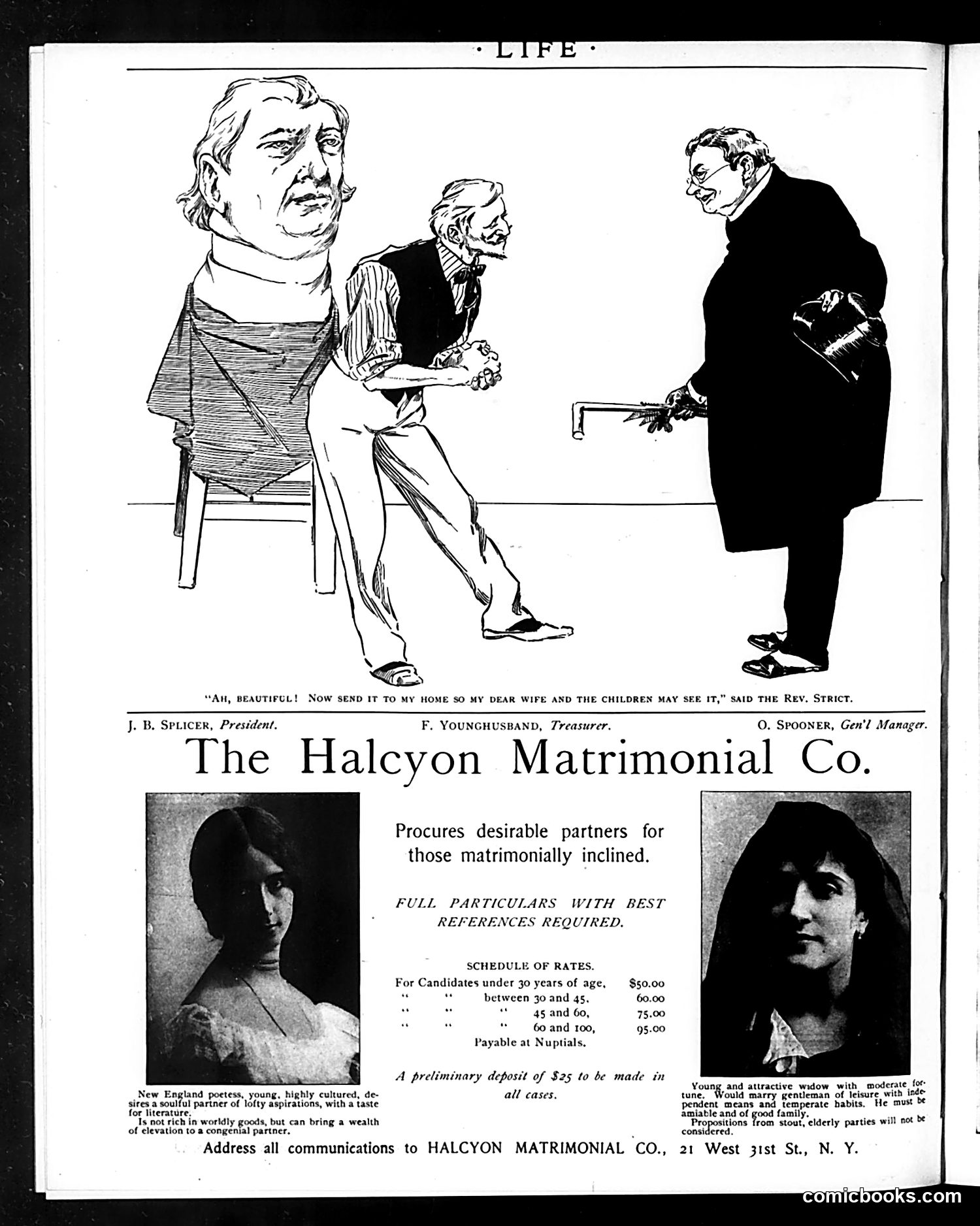
This page satirizes **marriage-broker services** that operated as commercial matchmaking businesses. The cartoon mocks a clergyman (Rev. Strict) admiring a portrait—presumably of a woman available through the service—with the ironic caption about sending it home to his wife and children, exposing the hypocrisy of a supposedly moral figure engaging in what was considered unseemly commercialization of marriage. The "company" listing three officers (Splicer, Younghusband, Spooner) uses punning names typical of Life's humor. The accompanying advertisement parodies such services' actual practices: charging fees based on age, requiring references, and displaying women's photographs with descriptions emphasizing their financial or social worth. The satire targets the reduction of matrimony to a commercial transaction and the era's class-conscious, transactional approach to marriage—particularly the objectification of women and the cynical marriage market among the wealthy and ambitious.