
Life, 1895-11-21 · page 4 of 18
Life — November 21, 1895 — page 4: what you’re looking at
What you’re looking at
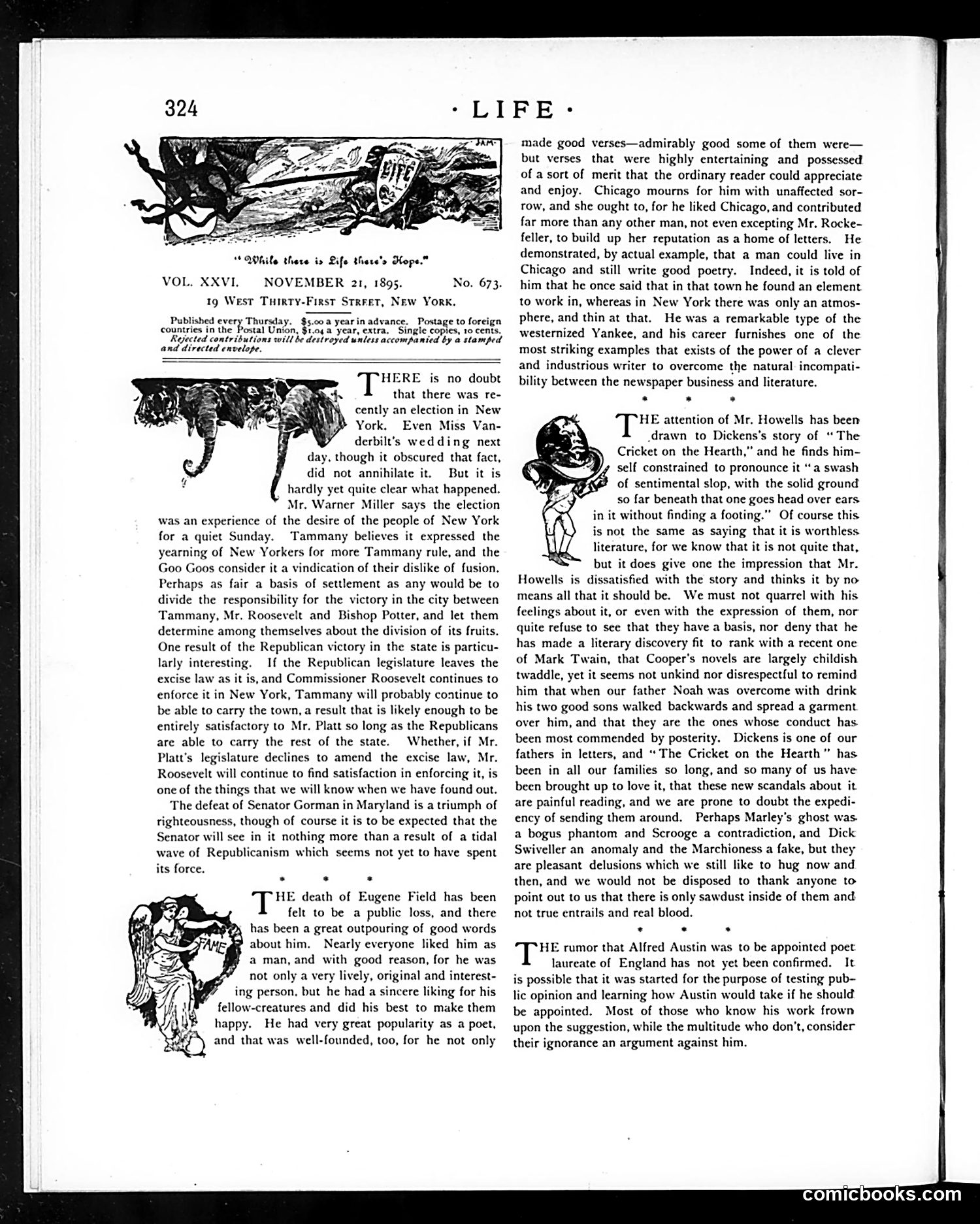
This page contains literary criticism rather than political cartoons. The decorative illustrations are generic Victorian ornaments, not specific caricatures. The text discusses Chicago's literary reputation and Eugene Field's death. It defends Chicago's cultural credibility against eastern bias, arguing that writers like Field prove the city capable of producing quality literature despite its industrial reputation. A secondary note addresses a controversy over Dickens's "Cricket on the Hearth," with the critic defending the story's merit against dismissive recent criticism. The final paragraph mentions unconfirmed rumors about Alfred Austin potentially becoming poet laureate of England, suggesting the appointment would test public opinion of his work. The satire here is gentle—mocking eastern literary snobbery and baseless gossip—rather than sharp political commentary.
📄 Transcribed text from this page (OCR, searchable)
Machine-transcribed from the original scan — historical spelling and the odd misread are preserved.
> LIFE: there is Life there's Hope.” VOL, XXVI. NOVEMBER 21, 1895. 1g West Tuirty-First StRrET, New York. No. 673. Published every Thursday. $5.00 a year in advance. Postage to foreign countries in the Postal Union, $1.04 year, extra. Single copies, 10 cents, Rejected contributions will be destroyed unless accompanied by a stamped and directed envelope. HERE is no doubt that there was re- cently an election in New York, Even Miss Van- derbilt’s wedding next day, though it obscured that fact, did not annihilate it, But it is | hardly yet quite clear what happened. Mr. Warner Miller says the election was an experience of the desire of the people of New York for a quiet Sunday. Tammany believes it expressed the yearning of New Yorkers for more Tammany rule, and the Goo Goos consider it a vindication of their dislike of fusion. Perhaps as fair a basis of settlement as any would be to divide the responsibility for the victory in the city between Tammany, Mr. Roosevelt and Bishop Potter, and let them determine among themselves about the division of its fruits. One result of the Republican victory in the state is particu- larly interesting. If the Republican legislature leaves the excise law as it is, and Commissioner Roosevelt continues to enforce it in New York, Tammany will probably continue to be able to carry the town, a result that is likely enough to be entirely satisfactory to Mr. Platt so long as the Republicans are able to carry the rest of the state. Whether, if Mr. Platt’s legislature declines to amend the excise law, Mr. Roosevelt will continue to find satisfaction in enforcing it, is one of the things that we will know when we have found out. The defeat of Senator Gorman in Maryland is a triumph of righteousness, though of course it is to be expected that the Senator will see in it nothing more than a result of a tidal wave of Republicanism which seems not yet to have spent its force. Sy . . . HE death of Eugene Field has been felt to be a public loss, and there Zs has been a great outpouring of good words fe about him. Nearly everyone liked him as a man, and with good reason, for he was not only a very lively, original and interest- ing person, but he had a sincere liking for his fellow-creatures and did his best to make them happy. He had very great popularity as a poet, and that was well-founded, too, for he not only made good verses—admirably good some of them were— but verses that were highly entertaining and possessed of a sort of merit that the ordinary reader could appreciate and enjoy. Chicago mourns for him with unaffected sor- row, and she ought to, for he liked Chicago, and contributed far more than any other man, not even excepting Mr. Rocke- feller, to build up her reputation as a home of letters. He demonstrated, by actual example, that a man could live in Chicago and still write good poetry. Indeed, it is told of him that he once said that in that town he found an element to work in, whereas in New York there was only an atmos- phere, and thin at that. He was a remarkable type of the westernized Yankee, and his career furnishes one of the most striking examples that exists of the power of a clever and industrious writer to overcome the natural incompati- bility between the newspaper business and literature. . * . HE attention of Mr. Howells has been .drawn to Dickens's story of “ The Cricket on the Hearth,” and he finds him- self constrained to pronounce it “a swash of sentimental slop, with the solid ground so far beneath that one goes head over cars in it without finding a footing.” Of course this is not the same as saying that it is worthless literature, for we know that it is not quite that, but it does give one the impression that Mr. Howells is dissatisfied with the story and thinks it by no means all that it should be. We must not quarrel with his feelings about it, or even with the expression of them, nor quite refuse to see that they have a basis, nor deny that he has made a literary discovery fit to rank with a recent one of Mark Twain, that Cooper's novels are largely childish twaddle, yet it seems not unkind nor disrespectful to remind him that when our father Noah was overcome with drink his two good sons walked backwards and spread a garment over him, and that they are the ones whose conduct has been most commended by posterity. Dickens is one of our fathers in letters, and “The Cricket on the Hearth” has been in all our families so long, and so many of us have been brought up to love it, that these new scandals about it are painful reading, and we are prone to doubt the expedi- ency of sending them around. Perhaps Marley's ghost was. a bogus phantom and Scrooge a contradiction, and Dick Swiveller an anomaly and the Marchioness a fake, but they are pleasant delusions which we still like to hug now and then, and we would not be disposed to thank anyone to point out to us that there is only sawdust inside of them and not true entrails and real blood. . . . HE rumor that Alfred Austin was to be appointed poet laureate of England has not yet been confirmed. It is possible that it was started for the purpose of testing pub- lic opinion and learning how Austin would take if he should be appointed. Most of those who know his work frown upon the suggestion, while the multitude who don’t, consider their ignorance an argument against him. comicbooks.com