
Life, 1895-11-21 · page 7 of 18
Life — November 21, 1895 — page 7: what you’re looking at
What you’re looking at
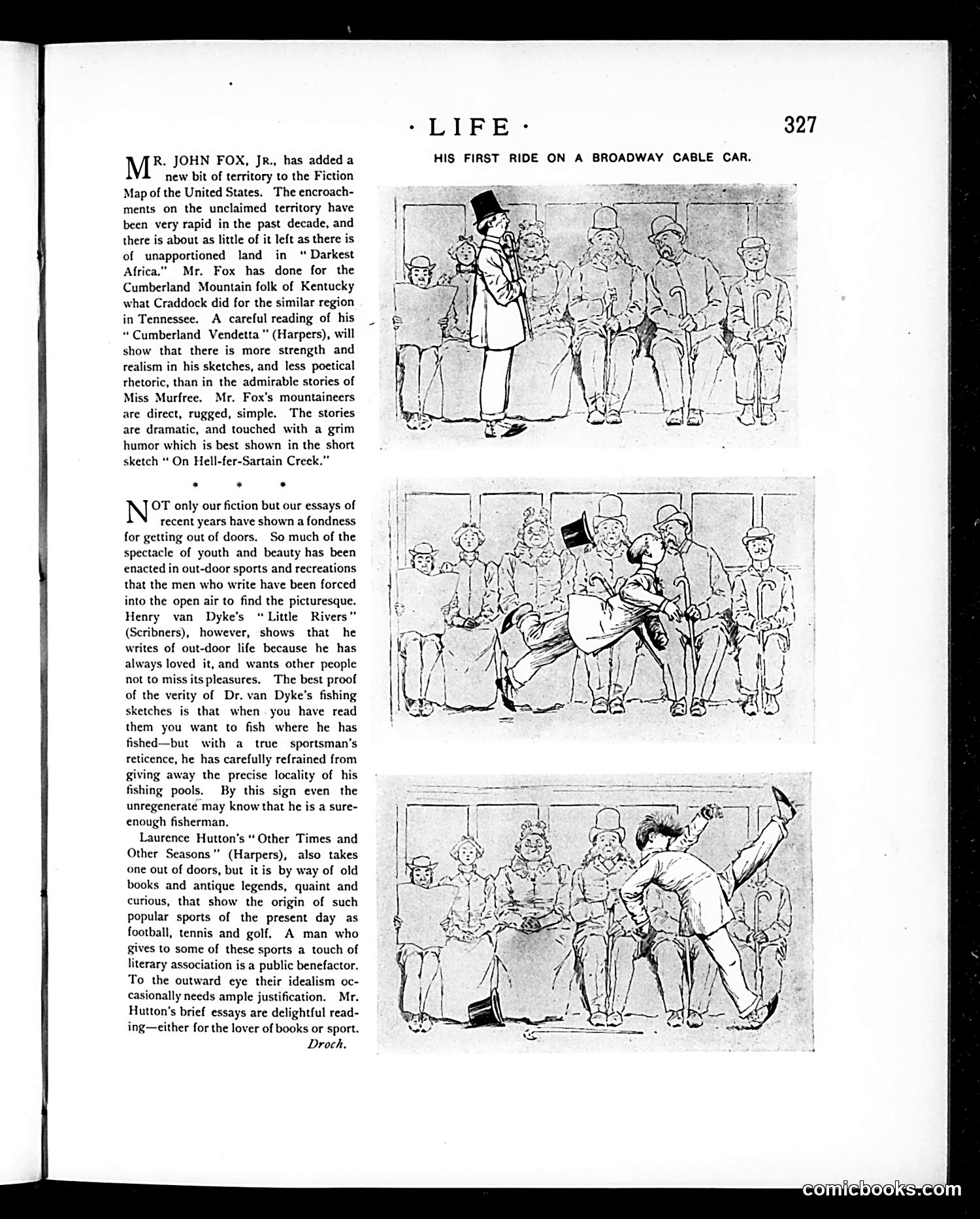
This page contains three cartoon panels depicting a man's inaugural experience on a Broadway cable car (a common urban transit method of the era). The sequential humor shows his increasing alarm and loss of composure as the car moves: **Panel 1:** A well-dressed gentleman in a top hat boards calmly with other passengers. **Panel 2:** He appears increasingly unsteady as the car operates. **Panel 3:** He's visibly panicked, losing his hat and dignity entirely. The joke satirizes the novelty and jarring experience of cable car technology for newcomers—a common subject of humor as these vehicles were still relatively new urban infrastructure. The gentleman's descent from composed respectability to undignified chaos provides the comedic arc.
📄 Transcribed text from this page (OCR, searchable)
Machine-transcribed from the original scan — historical spelling and the odd misread are preserved.
M*. JOHN FOX, Jr., has added a new bit of territory to the Fiction Map of the United States. The encroach- ments on the unclaimed territory have been very rapid in the past decade, and there is about as little of it left as there is of unapportioned land in “ Darkest Africa.” Mr. Fox has done for the Cumberland Mountain folk of Kentucky what Craddock did for the similar region in Tennessee. A careful reading of his “Cumberland Vendetta" (Harpers), will show that there is more strength and realism in his sketches, and less poetical thetoric, than in the admirable stories of Miss Murfree. Mr. Fox’s mountaineers are direct, rugged, simple. The stories are dramatic, and touched with a grim humor which is best shown in the short sketch “ On Hell-fer-Sartain Creek.” . * . N OT only our fiction but our essays of recent years have shown a fondness for getting out of doors. So much of the spectacle of youth and beauty has been enacted in out-door sports and recreations that the men who write have been forced into the open air to find the picturesque. Henry van Dyke's “Little Rivers” (Scribners), however, shows that he writes of out-door life because he has always loved it, and wants other people not to miss its pleasures. The best proof of the verity of Dr. van Dyke's fishing sketches is that when you have read them you want to fish where he has fished—but with a true sportsman's reticence, he has carefully refrained from giving away the precise locality of his fishing pools. By this sign even the unregenerate may know that he is a sure- enough fisherman, Laurence Hutton’s “ Other Times and Other Seasons" (Harpers), also takes one out of doors, but itis by way of old books and antique legends, quaint and curious, that show the origin of such Popular sports of the present day as football, tennis and golf. A man who gives to some of these sports a touch of literary association is a public benefactor. To the outward eye their idealism oc- casionally needs ample justification. Mr. Hutton’s brief essays are delightful read- ing—either for the lover of books or sport. Droch. *LIFE- HIS FIRST RIDE ON A BROADWAY CABLE CAR.