
Life, 1895-11-21 · page 12 of 18
Life — November 21, 1895 — page 12: what you’re looking at
What you’re looking at
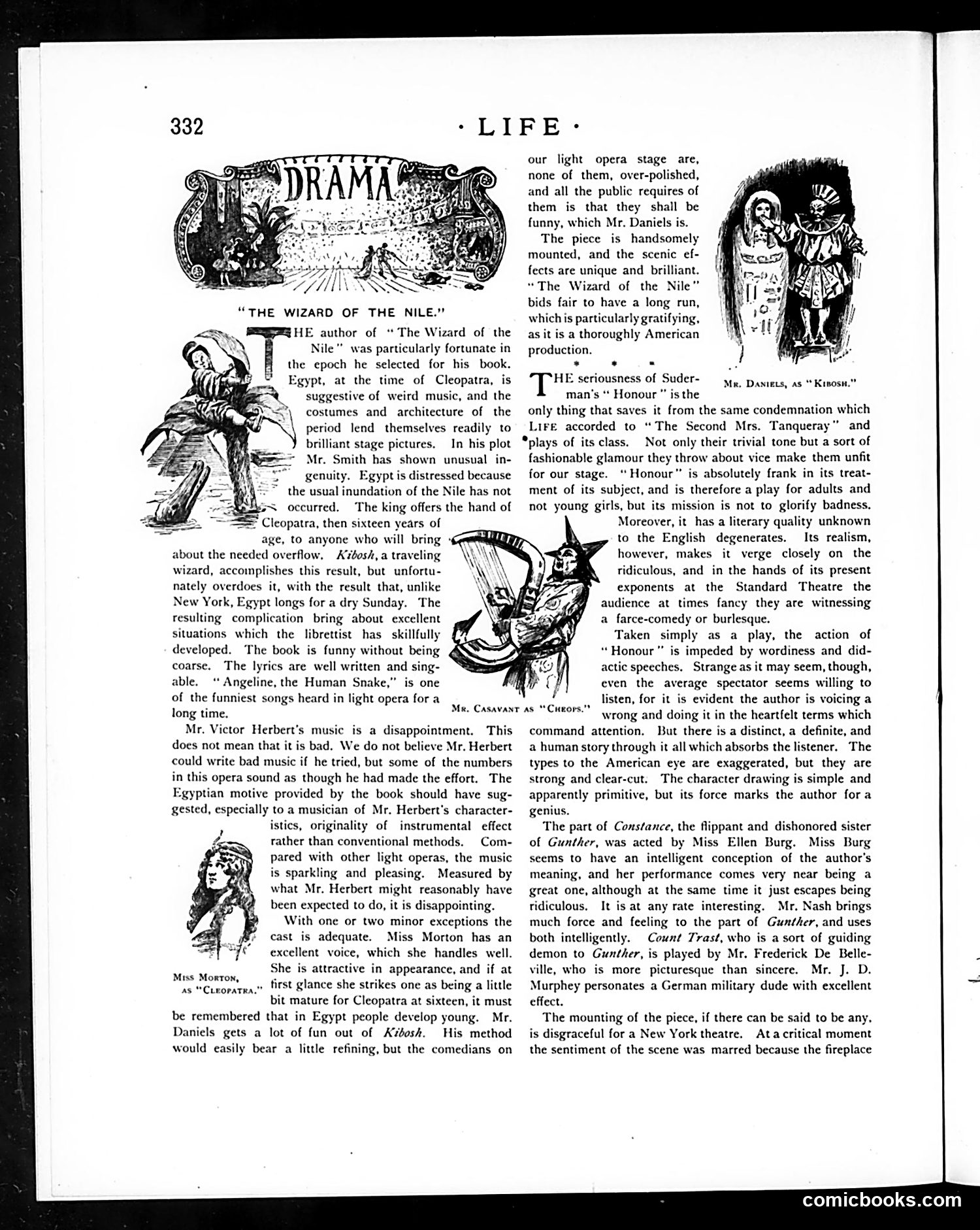
This page reviews two theatrical productions. The main focus is **"The Wizard of the Nile,"** a light opera by Mr. Smith with music by Victor Herbert. The plot—set in ancient Egypt—involves a wizard who must cause the Nile to flood to win Cleopatra's hand. The review praises the book's humor and clever plotting, and commends the performances by Miss Morton (as Cleopatra) and Mr. Daniels (as the wizard Avbosh), though it criticizes Herbert's music as disappointingly conventional. The illustrations show cast members in Egyptian costume. The secondary section reviews Suderman's play **"Honour,"** comparing it unfavorably to trivial plays like "The Second Mrs. Tanqueray," arguing that while "Honour" treats serious moral subjects, its wordiness and didactic speeches impede the action. The overall tone is that of a sophisticated theater critic evaluating production quality, spectacle, and artistic merit for an educated readership interested in contemporary stage entertainment.
📄 Transcribed text from this page (OCR, searchable)
Machine-transcribed from the original scan — historical spelling and the odd misread are preserved.
- LIFE: “THE WIZARD OF THE NILE.” HE author of “ The Wizard of the Nile" was particularly fortunate in the epoch he selected for his book. Egypt, at the time of Cleopatra, is suggestive of weird music, and the costumes and architecture of the period lend themselves readily to brilliant stage pictures. In his plot Mr. Smith has shown unusual in- genuity. Egypt is distressed because the usual inundation of the Nile has not SS occurred. The king offers the hand of ‘leopatra, then sixteen years of age, to anyone who will bring + about the needed overflow, Avbosh, a traveling wizard, accomplishes this result, but unfortu- nately overdoes it, with the result that, unlike New York, Egypt longs for a dry Sunday. The resulting complication bring about excellent situations which the librettist has skillfully developed. The book is funny without being coarse. The lyrics are well written and sing- able.“ Angeline, the Human Snake,” is one of the funniest songs heard in light opera for a long time. Mr. Victor Herbert's music is a disappointment. This does not mean that it is bad. We do not believe Mr. Herbert could write bad music if he tried, but some of the numbers in this opera sound as though he had made the effort. The Egyptian motive provided by the book should have sug- gested, especially to a musician of Mr. Herbert's character- istics, originality of instrumental effect rather than conventional methods. Com- pared with other light operas, the music is sparkling and pleasing. Measured by what Mr. Herbert might reasonably have been expected to do, it is disappointing. With one or two minor exceptions the cast is adequate. Miss Morton has an excellent voice, which she handles well. She is attractive in appearance, and if at first glance she strikes one as being a little bit mature for Cleopatra at sixteen, it must be remembered that in Egypt people develop young. Mr. Daniels gets a lot of fun out of Avbosh. His method would easily bear a little refining, but the comedians on Miss Mortox, as “CLEOPATRA.” Ma. Casavant as Cittors.’* our light opera stage are, none of them, over-polished, and all the public requires of them is that they shall be funny, which Mr. Daniels is. The piece is handsomely mounted, and the scenic ef- fects are unique and brilliant. “The Wizard of the Nile” bids fair to have a long run, which is particularly gratifying, as it is a thoroughly American production. . . . HE seriousness of Suder- man’s * Honour ” isthe only thing that saves it from the same condemnation which Lire accorded to “The Second Mrs. Tanqueray” and “plays of its class. Not only their trivial tone but a sort of fashionable glamour they throw about vice make them unfit for our stage. ‘ Honour" is absolutely frank in its treat- ment of its subject, and is therefore a play for adults and not young girls, but its mission is not to glorify badness. Moreover, it has a literary quality unknown to the English degenerates. Its realism, however, makes it verge closely on the ridiculous, and in the hands of its present exponents at the Standard Theatre the audience at times fancy they are witnessing a farce-comedy or burlesque. Taken simply as a play, the action of “Honour” is impeded by wordiness and did- actic speeches. Strange as it may seem, though, even the average spectator seems willing to listen, for it is evident the author is voicing a wrong and doing it in the heartfelt terms which command attention, But there is a distinct, a definite, and a human story through it all which absorbs the listener. The types to the American eye are exaggerated, but they are strong and clear-cut. The character drawing is simple and apparently primitive, but its force marks the author fora genius. The part of Constance, the flippant and dishonored sister of Gunther, was acted by Miss Ellen Burg. Miss Burg seems to have an intelligent conception of the author's meaning, and her performance comes very near being a great one, although at the same time it just escapes being ridiculous. It is at any rate interesting. Mr. Nash brings much force and feeling to the part of Gunther, and uses both intelligently. Count Trast, who is a sort of guiding demon to Gunther, is played by Mr. Frederick De Belle- ville, who is more picturesque than sincere. Mr. J. D. Murphey personates a German military dude with excellent effect. The mounting of the piece, if there can be said to be any, is disgraceful for a New York theatre. Atacritical moment the sentiment of the scene was marred because the fireplace Mr. Dasiets, as “ Kinosi.” comicbooks.com