
A complete issue · 18 pages · 1895
Life — November 7, 1895
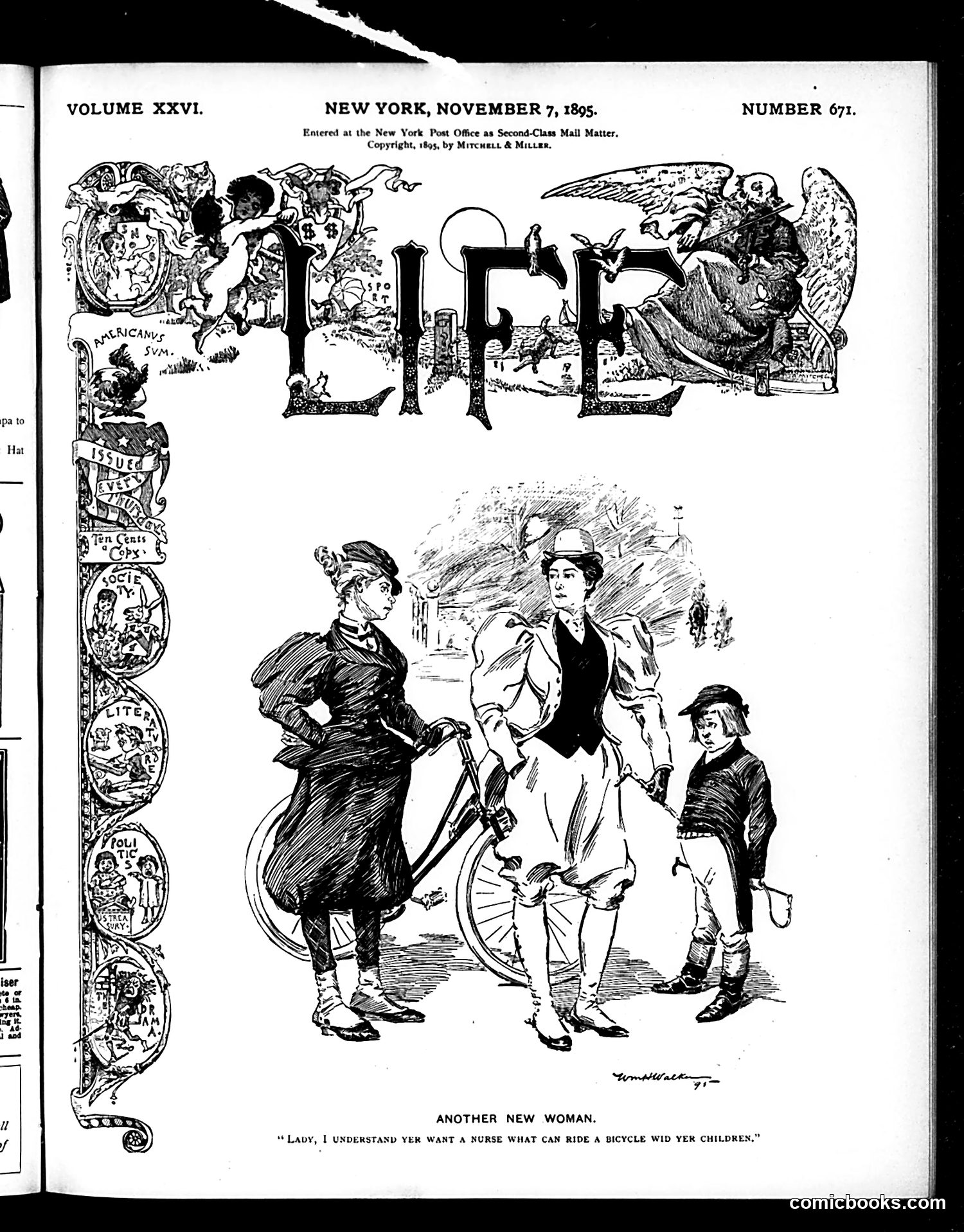
This page satirizes the emerging "New Woman" of the 1890s—a social figure who challenged traditional gender roles by pursuing education, employment, and activities like bicycling. The cartoon's caption, "Lady, I understand yer want a nurse what can ride a bicycle wid yer children," appears to mock both the New Woman's independence and the practical absurdity of hiring servants with unconventional skills. The figures on bicycles—depicted in the era's "rational dress" (shortened skirts)—represent women adopting previously masculine activities. The satire targets anxieties about changing women's roles: the New Woman was simultaneously celebrated for progress and ridiculed as unfeminine or impractical. Bicycling was genuinely controversial, as it required less restrictive clothing and represented female autonomy and mobility that made traditionalists uncomfortable.
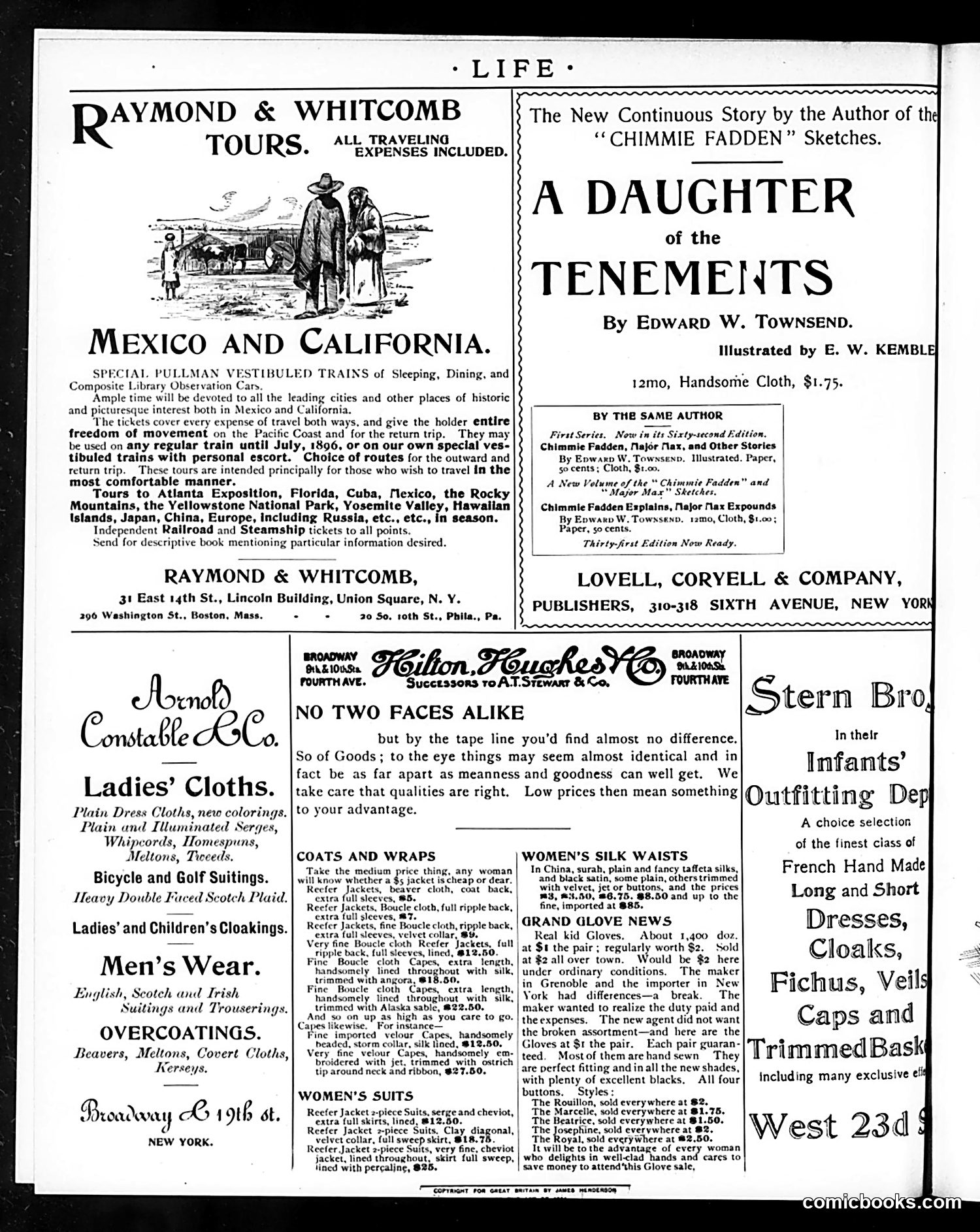
This page is **primarily advertising** rather than editorial satire. It contains notices for: - Raymond & Whitcomb Tours (Mexico and California travel packages) - Arnold Constable & Co. (ladies' clothing, menswear, cloaks) - Holton Hawke & Co. (goods retailer) - Stern Bros. (infants' clothing and accessories) The only editorial content is a brief piece titled "NO TWO FACES ALIKE," which appears to be a humorous commentary on retail merchandise quality—suggesting that while goods may look nearly identical, careful examination reveals differences, and low prices indicate compromised quality. This is gentle consumer advice rather than political satire. The page reflects early 20th-century magazine conventions, mixing advertisements with light lifestyle commentary.
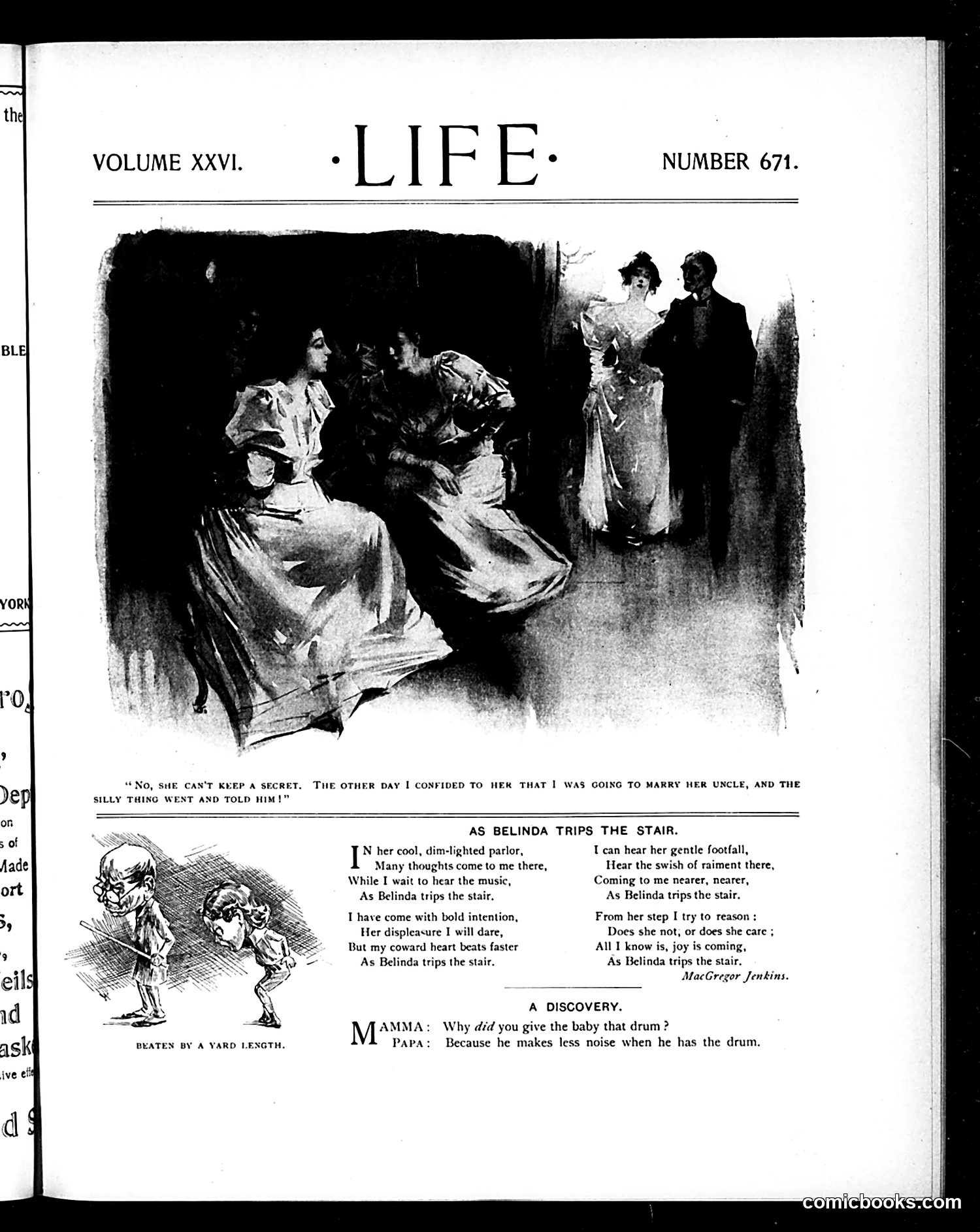
**Top Illustration:** A domestic scene showing women in Edwardian-era dress. The caption quotes gossip about a woman confessing she's marrying her uncle, with the punchline "the silly thing went and told him!"—satirizing how secrets spread despite intentions to keep them private. **Middle Section - "As Belinda Trips the Stair":** A romantic poem by MacGregor Jenkins about a man watching a woman ascend stairs, expressing his conflicted emotions and hesitation. **Bottom Cartoon - "Beaten by a Yard Length":** Two comic figures in a slapstick scene. **"A Discovery" Joke:** A simple parent-child exchange where papa gives baby a drum to reduce noise—absurd logic presented as humorous parenting advice. The page exemplifies early 20th-century Life magazine's blend of sentimental verse, domestic humor, and gentle satire.
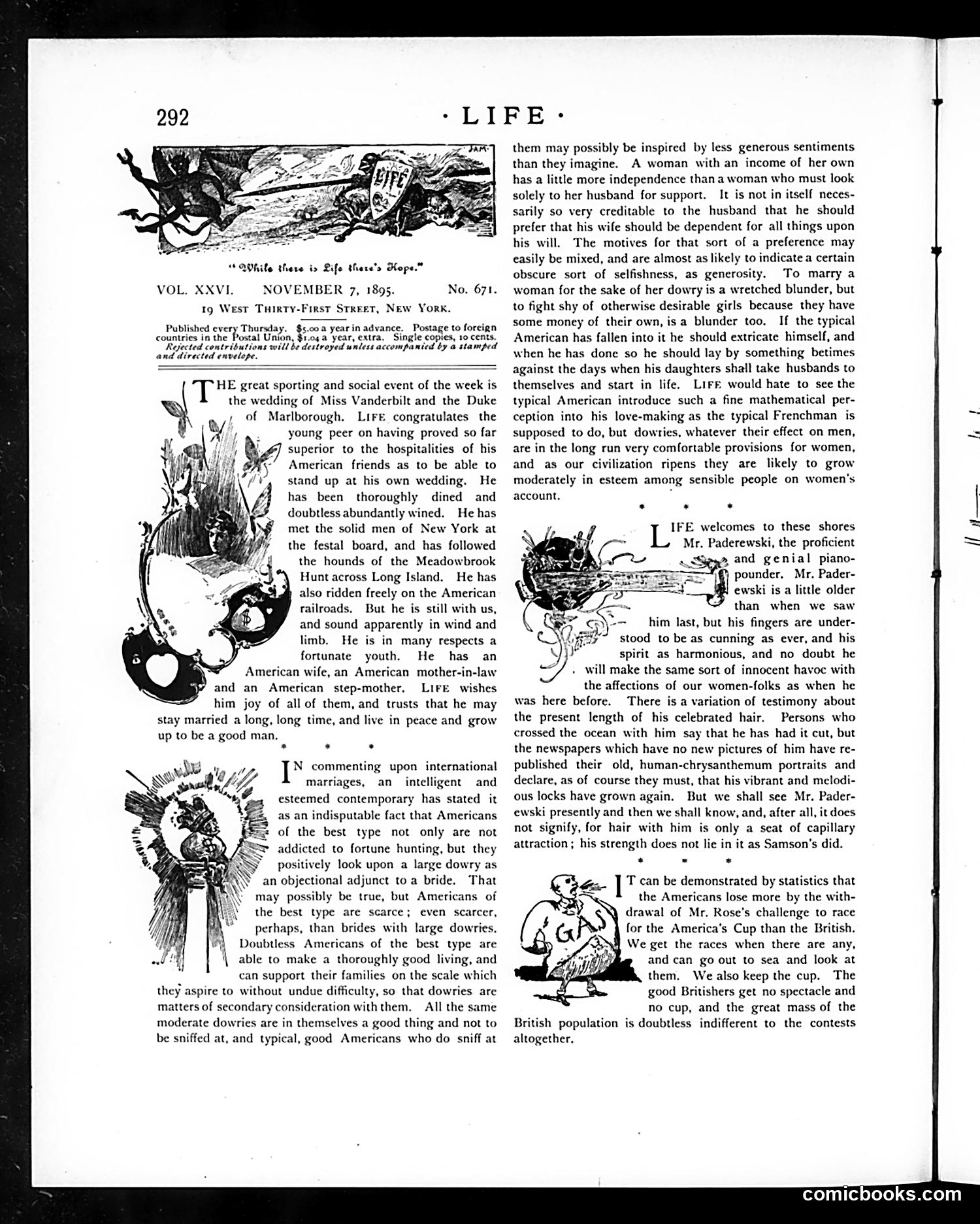
This page discusses the wedding of Miss Vanderbilt and the Duke of Marlborough—a major society event combining American wealth with British nobility. The text praises the groom for maintaining independence and American values despite marrying an heiress. The satirical commentary critiques American attitudes toward dowries. The author argues that Americans obsess less about dowries than Europeans, yet still view them as necessary marriage adjustments. The piece mocks the assumption that American women need financial inducements to marry. A secondary section welcomes pianist Mr. Paderewski to America, joking that his hair will remain recognizably wild despite ocean travel. The final cartoon (unclear detail) apparently references America's America's Cup yacht racing competition, contrasting British indifference with American competitive enthusiasm.
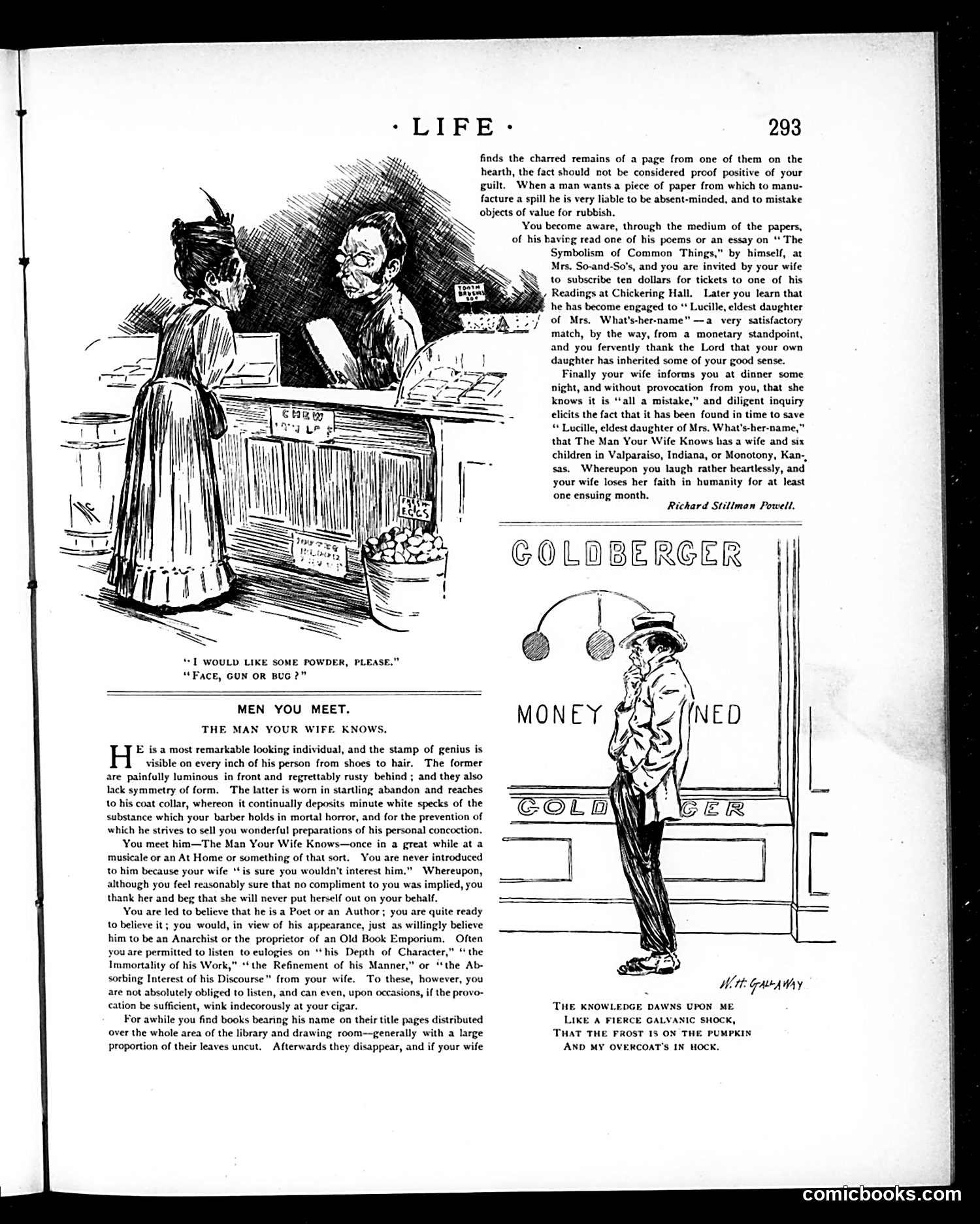
The main article "Men You Meet: The Man Your Wife Knows" is a satirical piece about a recognizable social type—apparently a literary or intellectual figure whom the writer's wife admires, though the husband finds him pretentious. The text suggests this man is a poet or author whose books appear in libraries, and the husband feels inadequate by comparison, fearing his wife prefers this intellectual to him. The "Goldberger" cartoon below appears to be financial satire, depicting a figure juggling money, with text about "gold" and financial knowledge. The specific target is unclear without additional context, but it likely satirizes financial speculation or economic anxiety of the era. Both pieces mock social pretension and masculine insecurity.
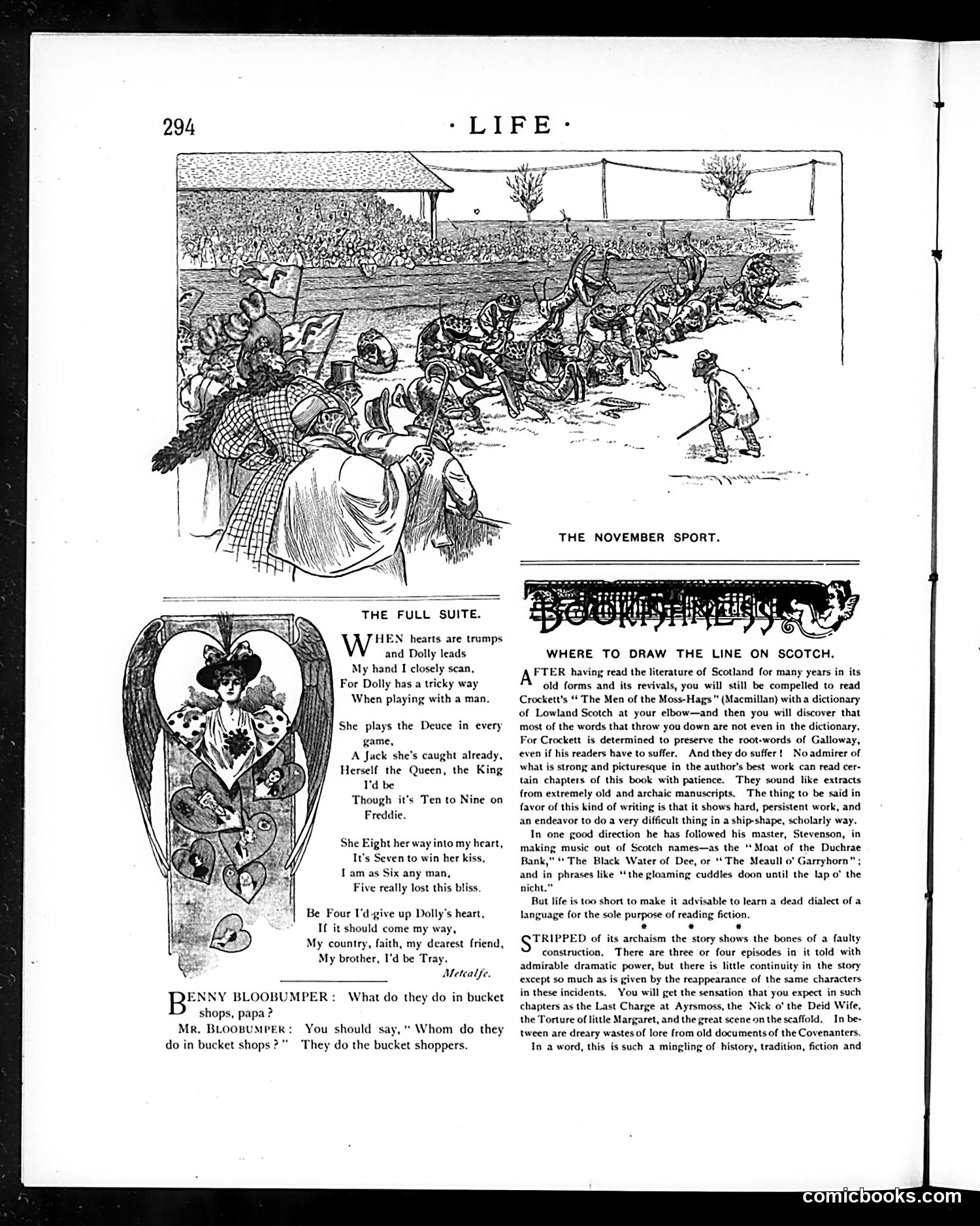
**"The November Sport"** (top illustration) depicts a crowded sporting event—likely football or baseball given the period—with spectators in the stands and players on field. The satire targets the spectacle and chaos of popular American sports entertainment. **"The Full Suite"** features card-game related verse about "Dolly," a woman who plays cards skillfully ("tricky way / When playing with a man"). The heart-shaped poem mocks romantic entanglement with a card player, suggesting women's cunning in games of chance and romance. **"Where to Draw the Line on Scotch"** is a literary piece recommending Scottish dialect fiction, specifically Crockett's works. **The Benny Bloodbumper joke** is wordplay: "bucket shops" (illegal betting establishments) pun on literal bucket-shop work. The page blends sports satire, gambling humor, and literary commentary typical of Life's satirical style.
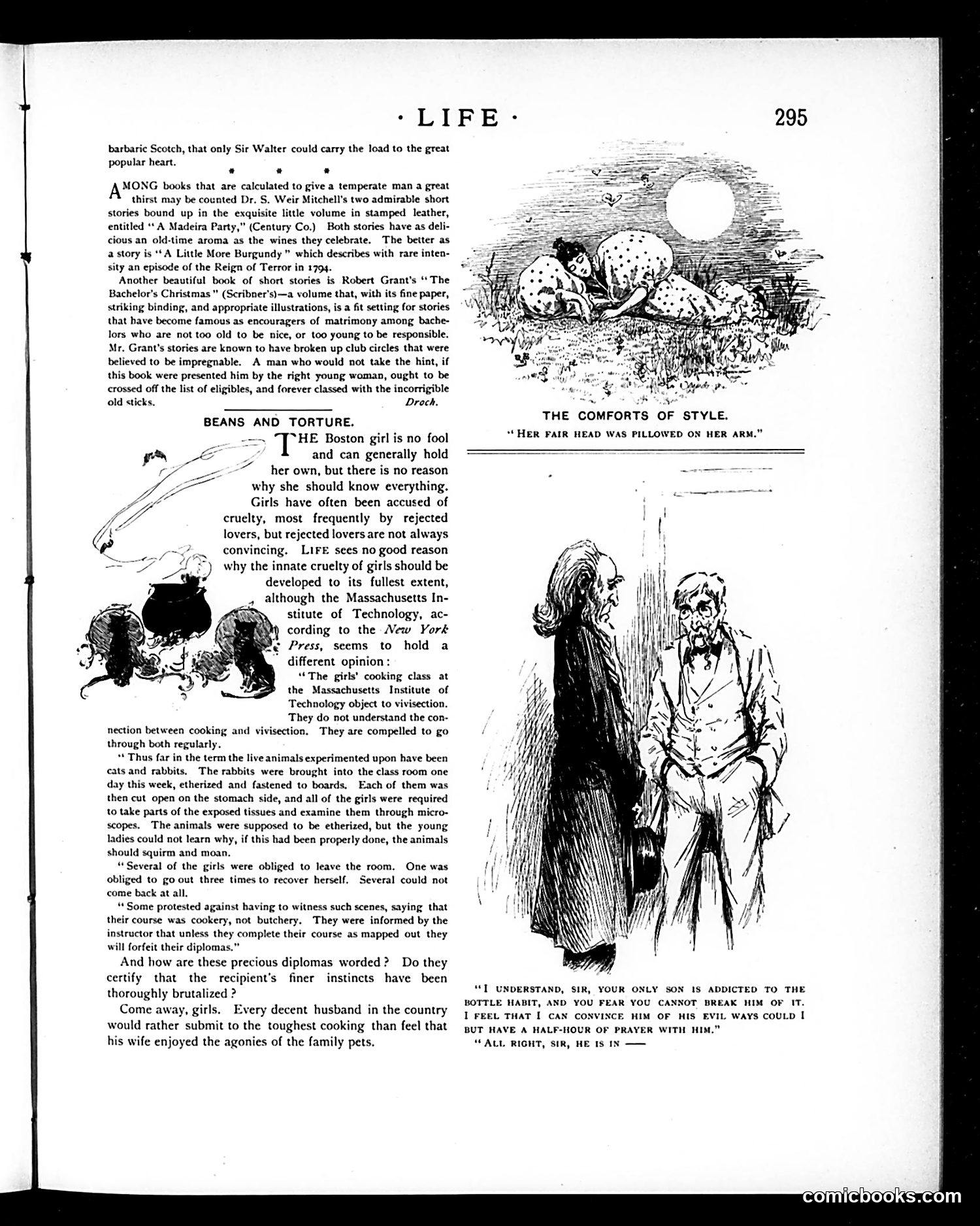
This page critiques the Massachusetts Institute of Technology's cooking class curriculum. The text reports that female students were required to witness vivisection (live animal dissection) as part of their culinary education, with rabbits and cats used as specimens. The satirical point is clear: Life questions the logic of forcing cooking students to observe animal torture to learn cooking skills. The article mocks the institute's claim this teaches the "connection between cooking and vivisection," arguing instead it merely brutalized young women unnecessarily. The cartoon illustrations show domestic scenes—a woman with a man discussing his drinking habits—highlighting the absurdity: the magazine suggests husbands would prefer wives who simply cooked well, without requiring them to endure traumatic vivisection training.
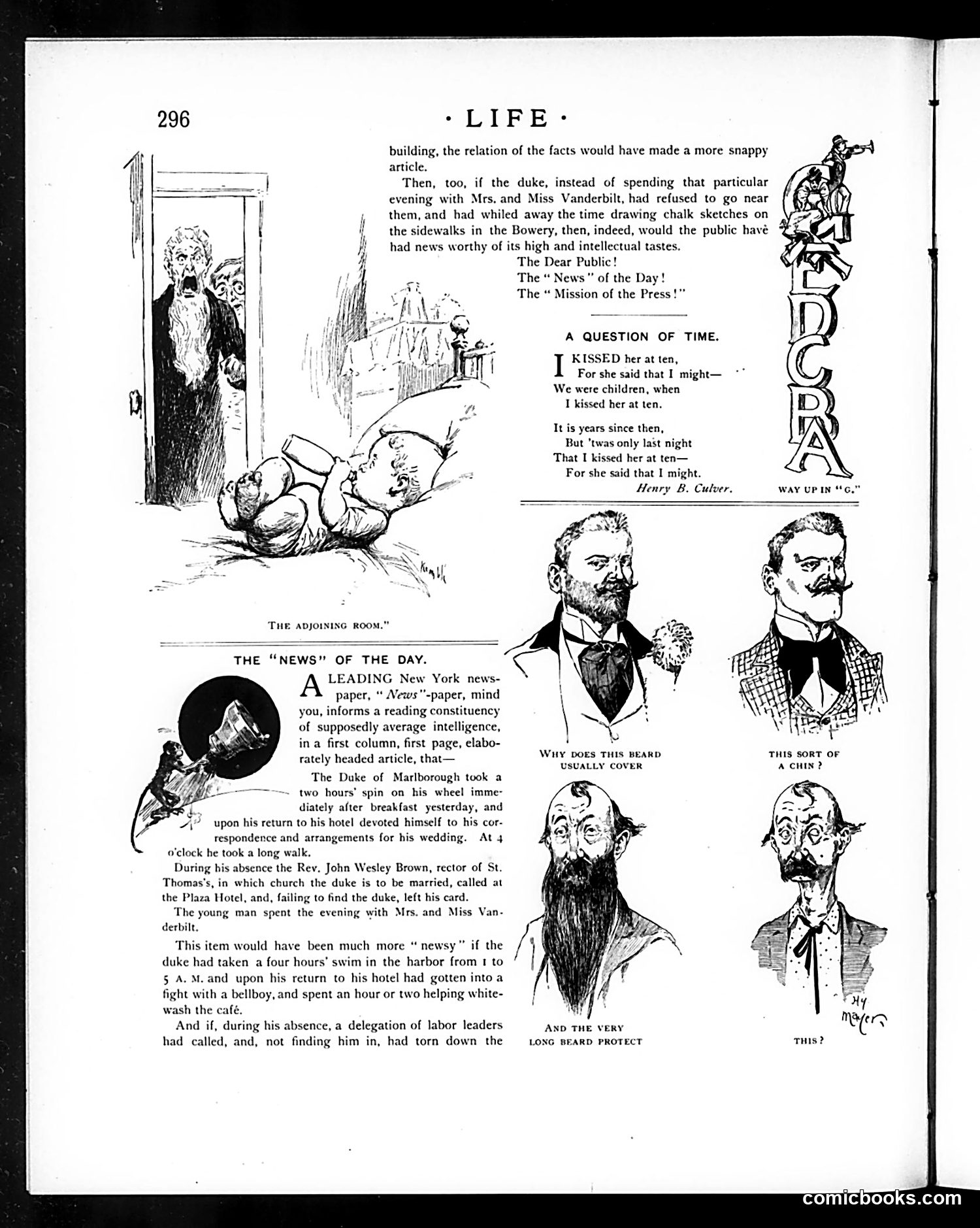
This satirical piece mocks sensationalist newspaper journalism. A leading New York newspaper's front-page story breathlessly covered a duke's two-hour carriage ride and wedding preparations—treating trivial aristocratic activities as major news. The satire escalates with hypothetical scenarios: if the duke had instead gone swimming, gotten in a café fight, or been visited by labor leaders, these would constitute "real" news. The cartoon critiques how newspapers prioritize wealthy elites' mundane activities over substantive public events. The accompanying illustrations of "beards" appear to mock the period's facial hair fashions among gentlemen—possibly suggesting vanity among the privileged classes the article skewers. The overall message: serious journalism has been replaced by celebrity gossip about the idle rich.
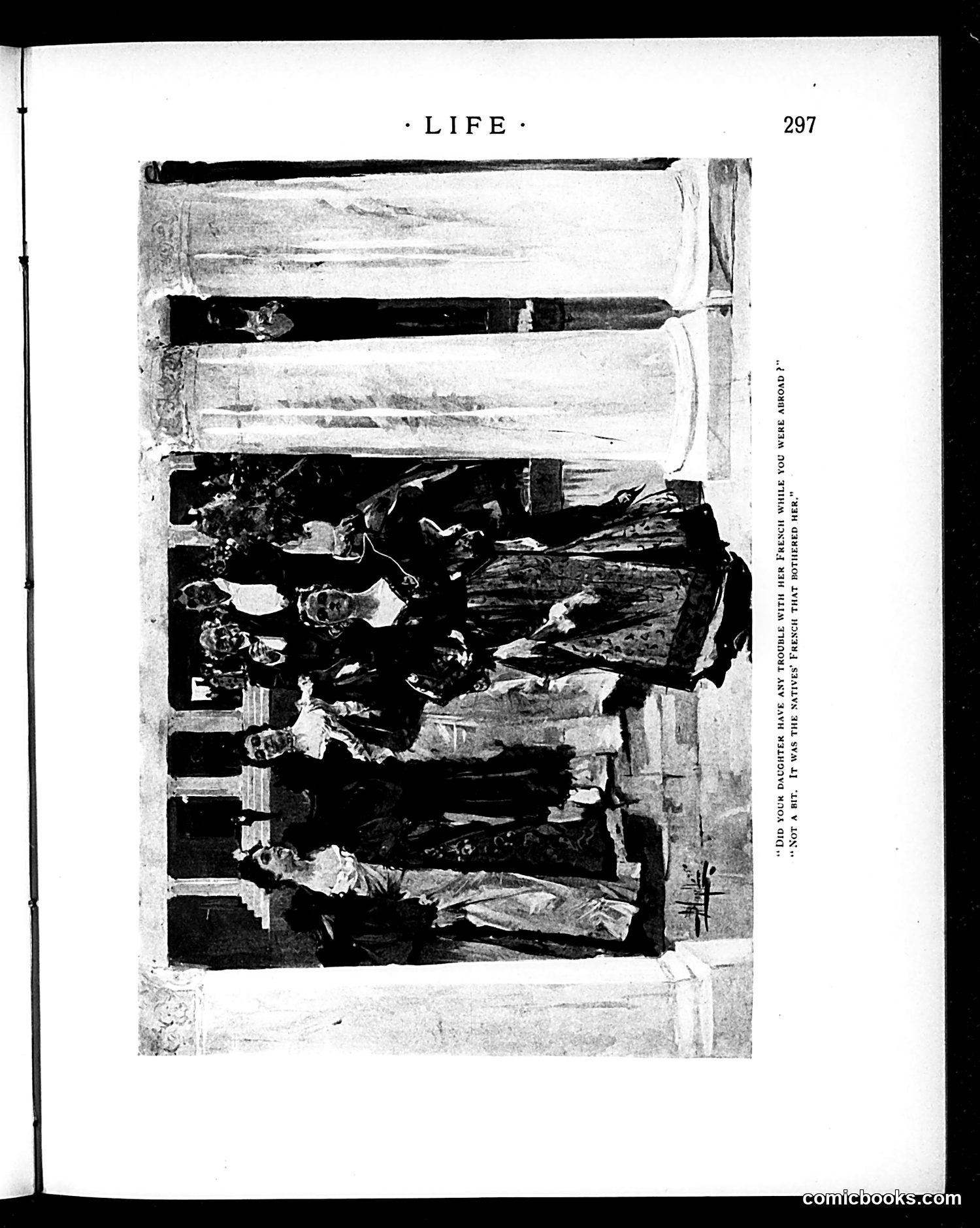
This page from *Life* magazine (page 297) contains a black-and-white photograph that appears to be rotated 90 degrees. The caption reads: "Did we collaborate any trouble back in March?" and "Note: It is the newest fashion the buttoned back." The image shows what appears to be a social or theatrical scene with multiple figures in formal dress arranged in an interior space. However, the rotation makes specific identification of individuals difficult, and without additional context about the publication date or clearer visibility of details, I cannot confidently identify which historical figures or political references are intended. The caption's reference to "March" and "collaborated" suggests this may comment on political alliances or scandals, but the specific satire remains unclear from this page alone.
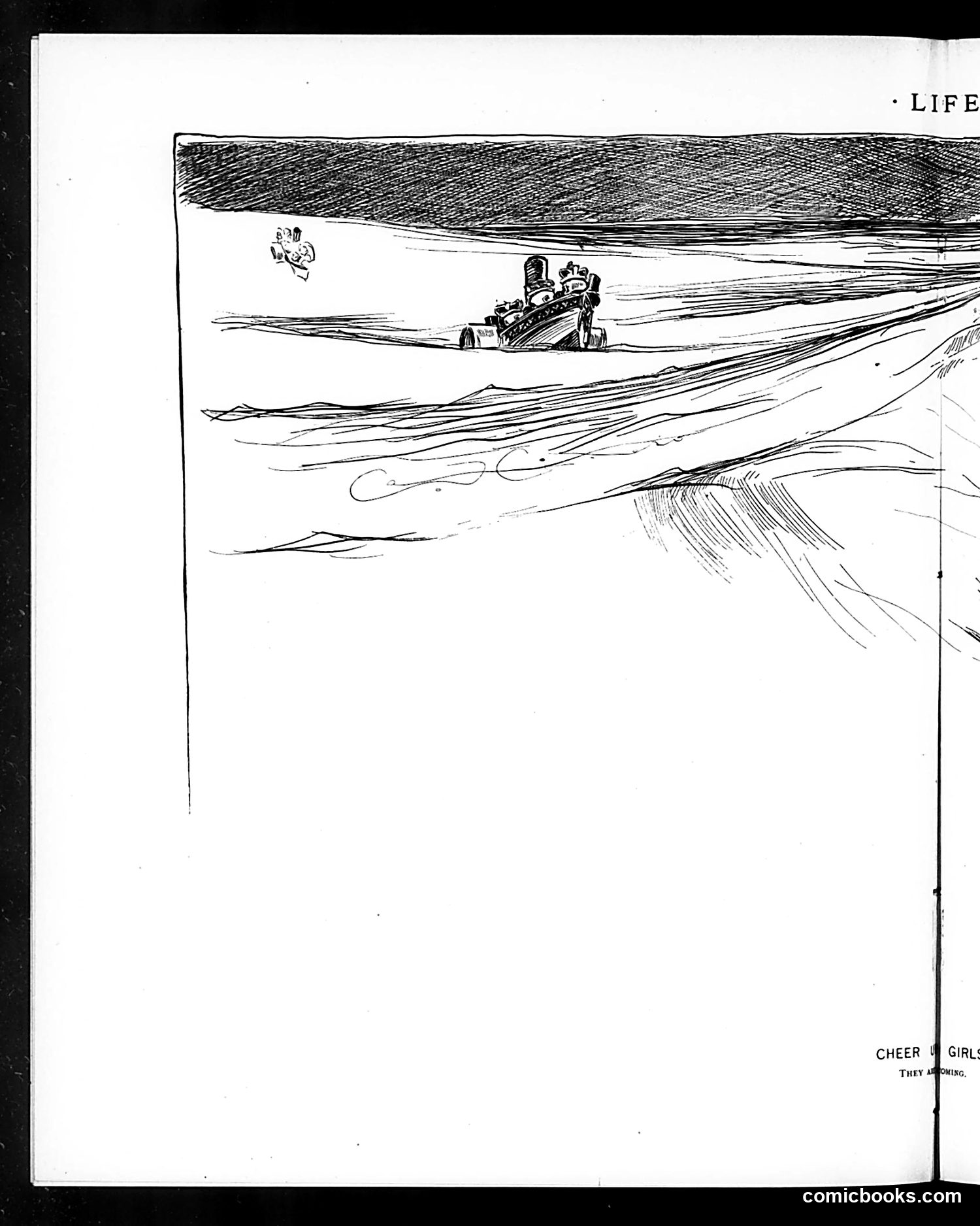
This page from *Life* magazine shows a satirical sketch of a locomotive traveling across a desert landscape. The drawing depicts a steam engine with smoke billowing from its smokestack, moving across arid terrain with sparse vegetation visible on the right side. The partial text at bottom reads "CHEER O GIRLS THEY'RE COMING," suggesting the cartoon comments on the arrival or approach of something or someone, likely military-related given the context of *Life's* satirical humor. However, without a visible date, caption, or clearer context, I cannot definitively identify which specific historical event, military operation, or social situation this references. The locomotive's arrival appears celebratory or ironic, but the precise satirical target remains unclear from this image alone.
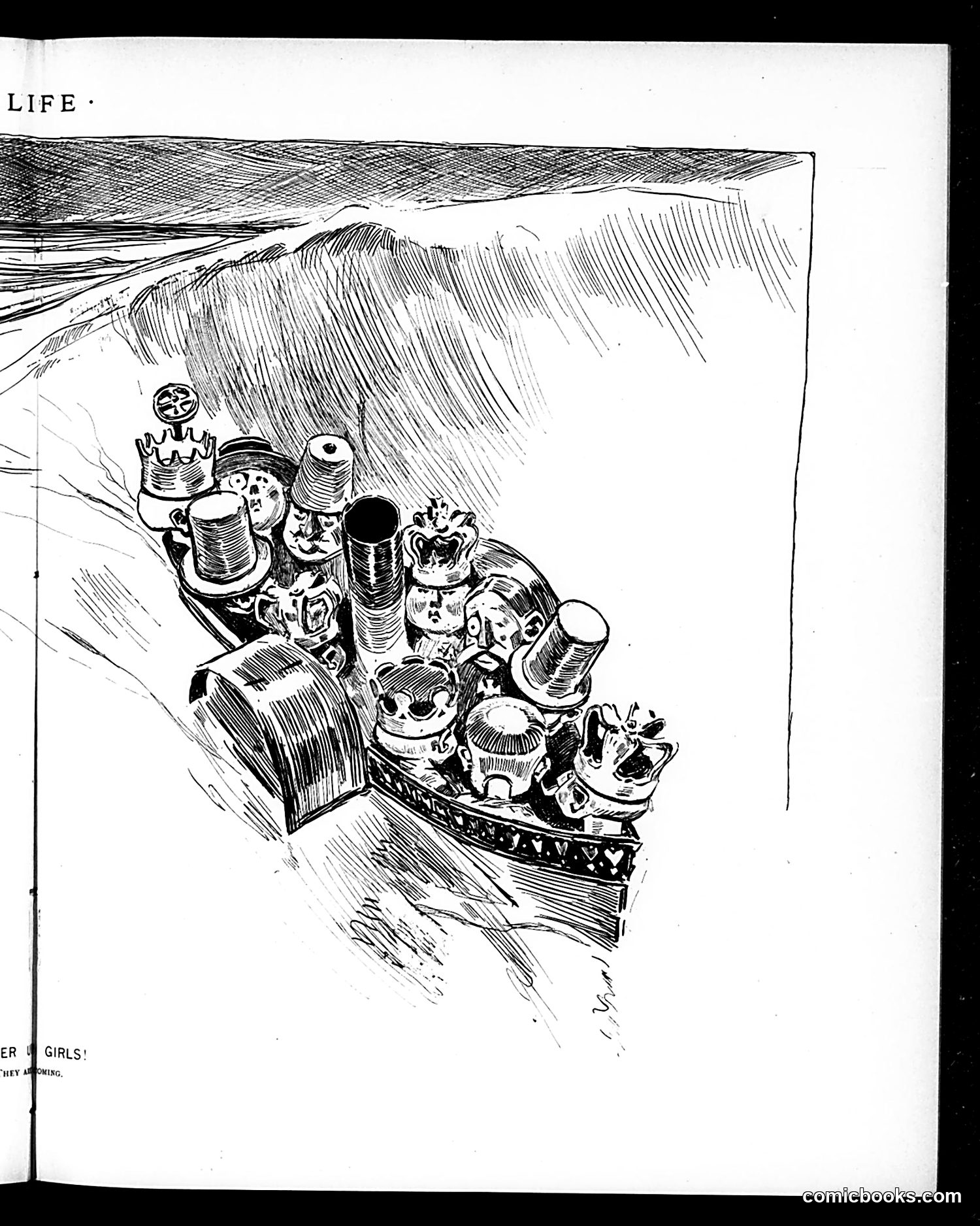
This page from *Life* magazine features a satirical illustration showing a chaotic pile of anthropomorphized figures stacked precariously in what appears to be a boat or vessel. The characters wear various crowns, hats, and formal attire, suggesting they represent royalty, nobility, or political leaders. The composition emphasizes instability and disorder—figures tumble and overlap awkwardly, with the vessel tilting dangerously. The satire likely critiques European political turmoil or international instability, possibly depicting competing monarchies or political powers in precarious balance. The crowded, unstable arrangement suggests the satire comments on how these "leaders" or powers cannot coexist peacefully and are destined for collapse. Without a visible caption or date, the specific historical event remains unclear, but the imagery conveys chaos among the powerful.
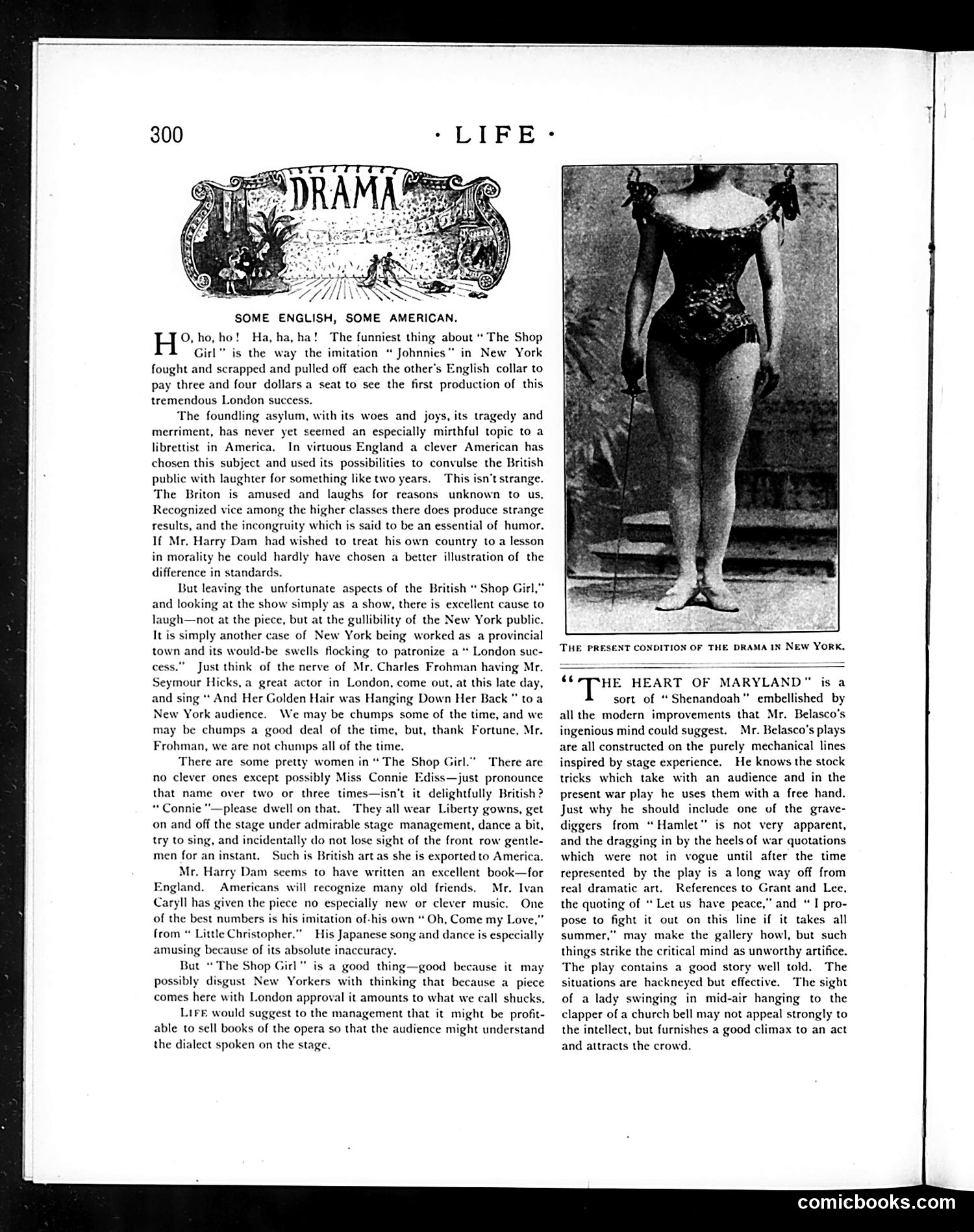
This page critiques two theatrical productions being performed in New York. **"The Shop Girl"**: Life satirizes New York audiences' snobbish worship of London theater. The magazine mocks wealthy New Yorkers ("would-be swells") who paid premium prices to see this British musical, calling them gullible "chumps" worked by impresario Charles Frohman. The piece attacks the show's shallow entertainment and the performers' mediocrity, particularly actress Connie Ediss. Life suggests Americans foolishly assume anything "London approved" has merit—a pointed jab at transatlantic cultural pretension. **"The Heart of Maryland"**: Life praises producer David Belasco's technically sophisticated Civil War drama while questioning his artistic choices—particularly his unexplained inclusion of a gravedigger character and anachronistic Civil War quotations. The photograph shows a female performer in period costume, illustrating the theatrical subject matter.
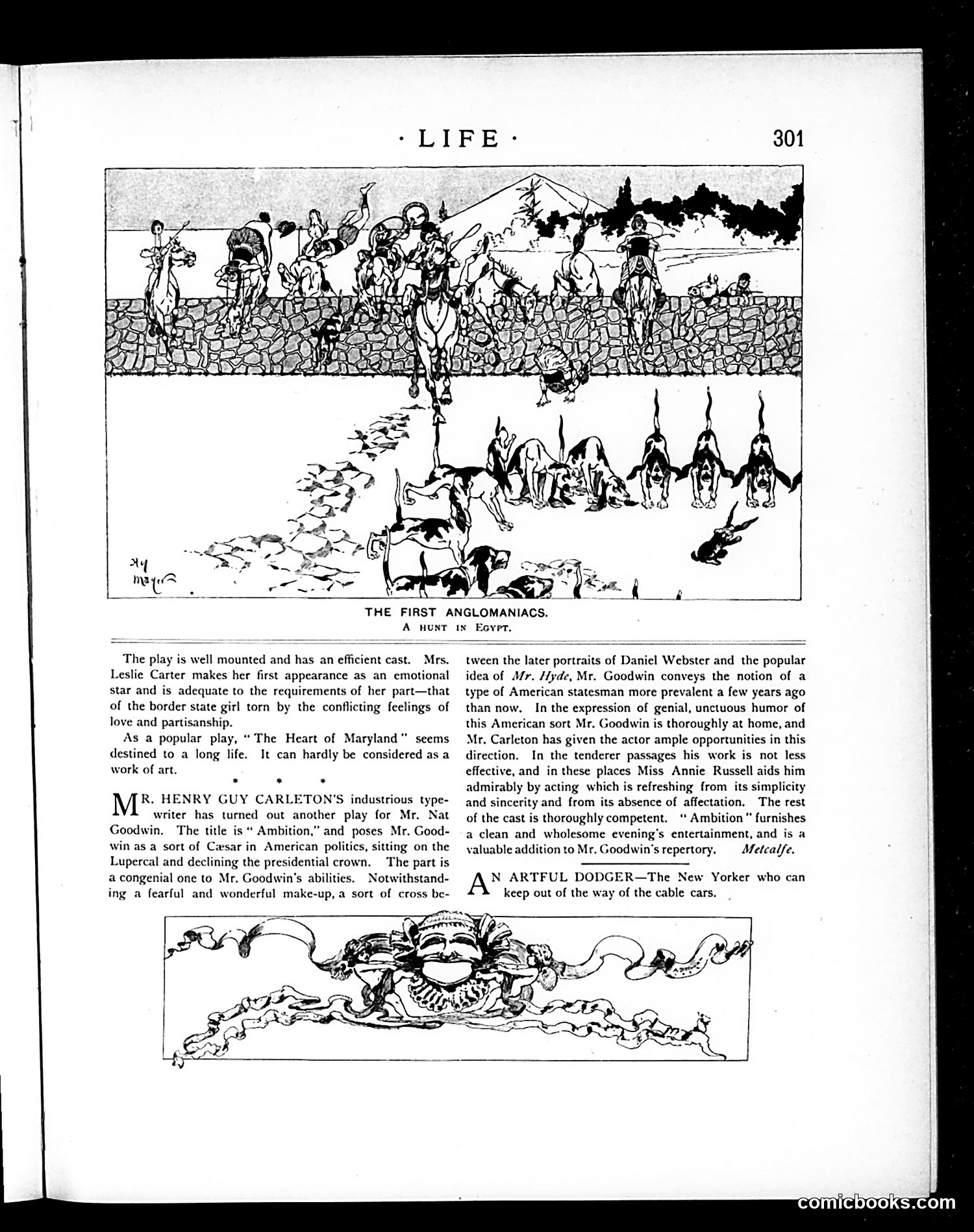
**Top Cartoon - "The First Anglomaniacs: A Hunt in Egypt"** This satirical illustration mocks wealthy Americans imitating British aristocratic hunting traditions. The drawing shows American tourists (identifiable by their exaggerated dress and posturing) conducting an elaborate Egyptian hunt while spectators watch from stone walls. The title's joke: these "Anglomaniacs" are Americans obsessed with copying English upper-class customs, here transplanted absurdly to Egypt. It satirizes the Gilded Age phenomenon of wealthy Americans adopting European mannerisms and pursuits as status markers. **Theater Reviews Below** The page contains professional reviews of two contemporary plays: "The Heart of Maryland" (featuring Leslie Carter) and "Ambition" (starring Nat Goodwin as a Caesar-like American politician). The reviews discuss casting, performances, and plot quality—standard theatrical criticism. **Bottom Caption - "An Artful Dodger"** This brief joke references New Yorkers navigating cable cars—comparing city dwellers' dangerous street-crossing skills to Dickens's famous pickpocket character.
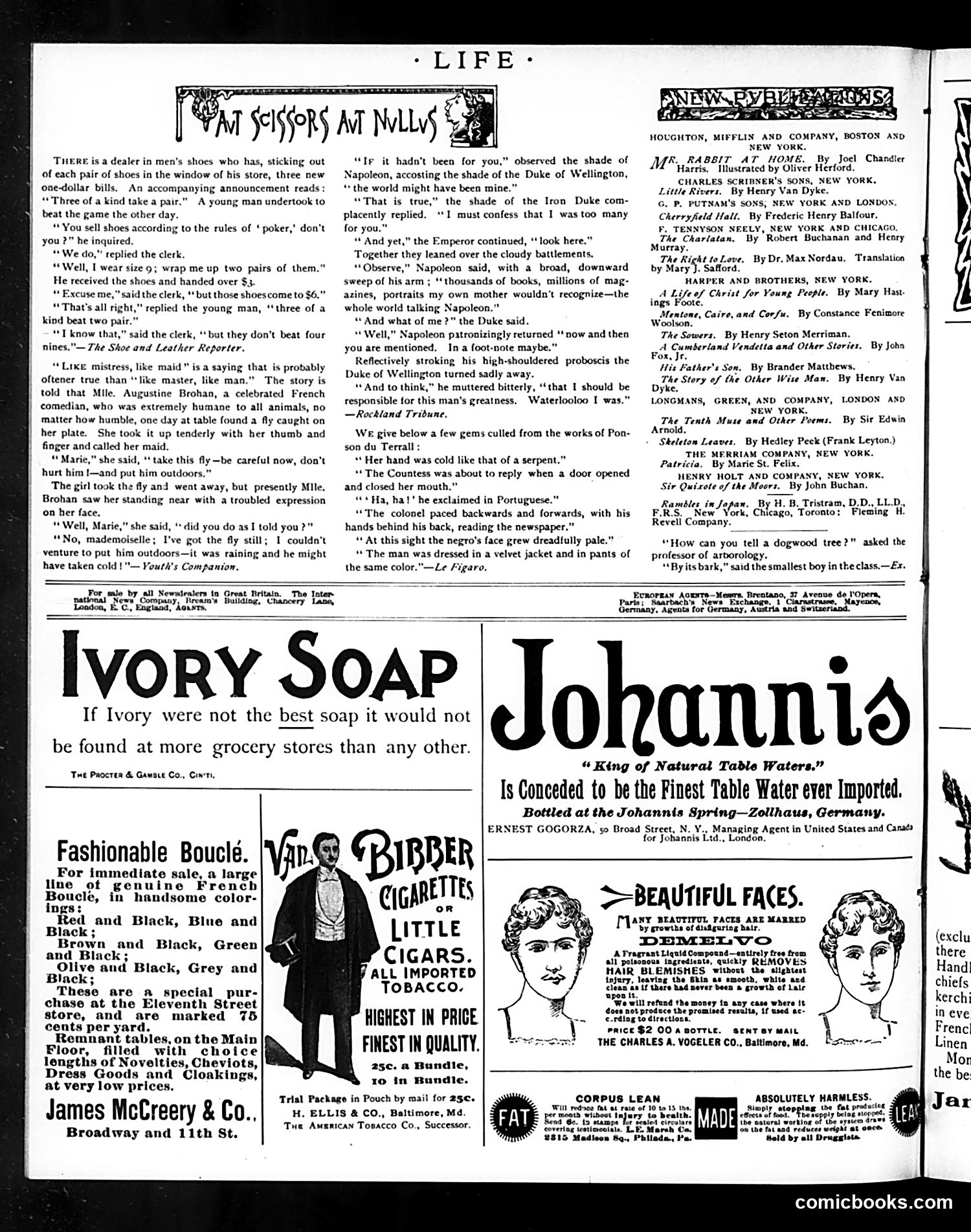
This Life magazine page (late 19th century) contains three humorous anecdotes, followed by book advertisements and commercial ads. The cartoons/jokes satirize human nature and logic: 1. **"Three of a Kind"**: A shoe dealer's poker-themed promotion backfires when a customer cleverly argues that "three of a kind" (his requirement) loses to "four nines" (the actual shoe price). It's a joke about salesmen being outwitted by their own gimmicks. 2. **"Like Mistress, Like Maid"**: A maid misunderstands her kind employer's instruction to release a fly outdoors during rain, afraid it will get wet. It mocks servant stupidity and well-intentioned cruelty. 3. **Napoleon and Wellington in the Afterlife**: The deceased Napoleon boasts that the world still discusses him constantly while Wellington receives only footnotes—despite Wellington defeating Napoleon at Waterloo. Wellington ruefully realizes he ensured Napoleon's lasting fame by being his opponent. This satirizes how historical villains often receive more attention than their victors. The page is primarily literary/humorous content with period advertisements below.
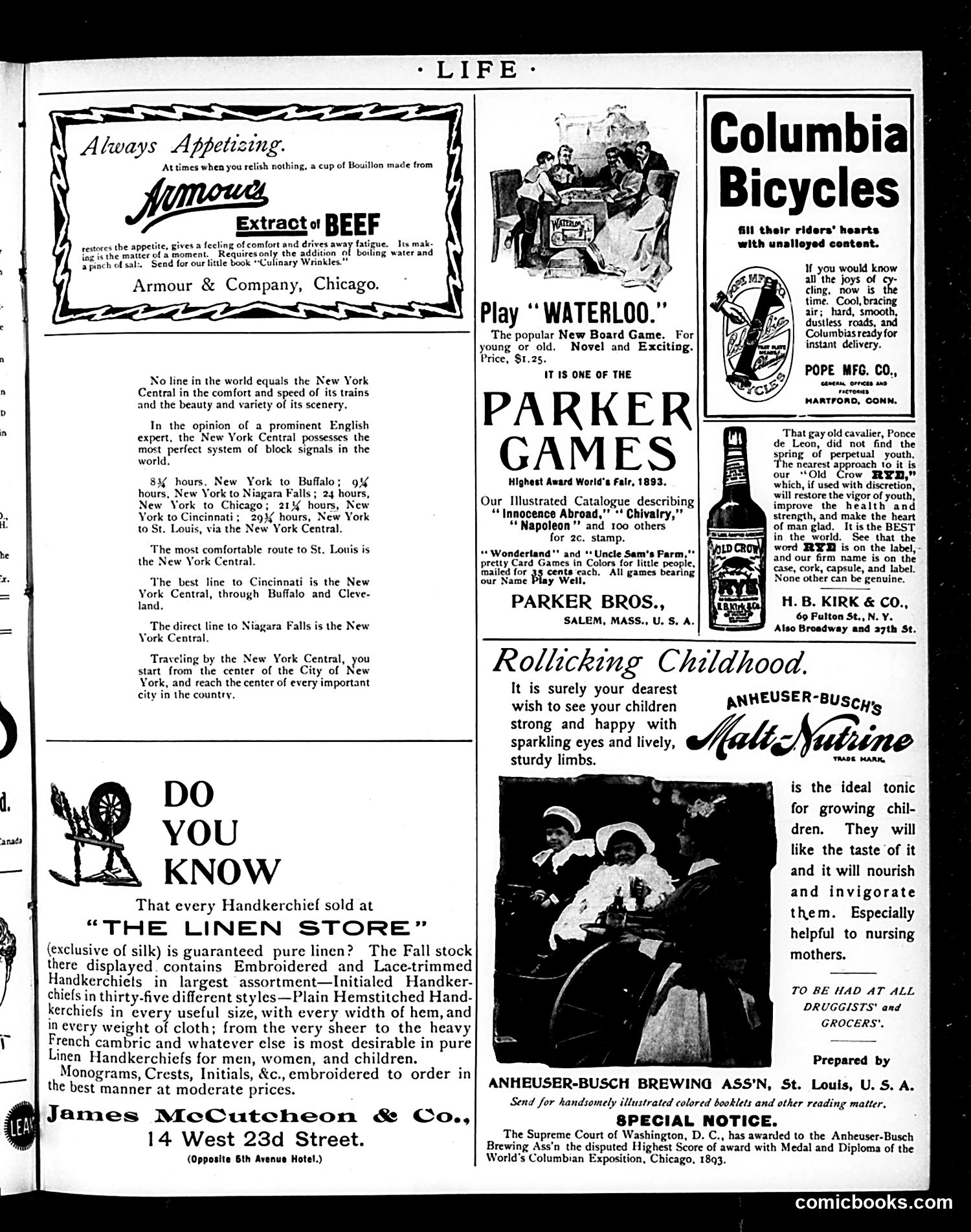
This is primarily an **advertising page** from Life magazine, not a political cartoon. It contains multiple commercial advertisements typical of the 1890s era, including: - **Food/beverage products**: Armour's beef extract, Anheuser-Busch's Malt-Nutrine (a tonic marketed for children), and Old Crow Rye whiskey - **Transportation**: New York Central Railroad promoting travel times and comfort - **Consumer goods**: Columbia Bicycles, Parker board games, and handkerchiefs from a department store The only illustration approaching satire is a small image accompanying the "Waterloo" board game advertisement, showing figures around a table—likely depicting gameplay rather than political commentary. The page reflects **late 19th-century consumer culture** and marketing strategies, including health claims (malt tonics for children), leisure activities (bicycles, games), and luxury goods marketed to middle and upper-class readers. No specific political figures or events are referenced or satirized on this page.
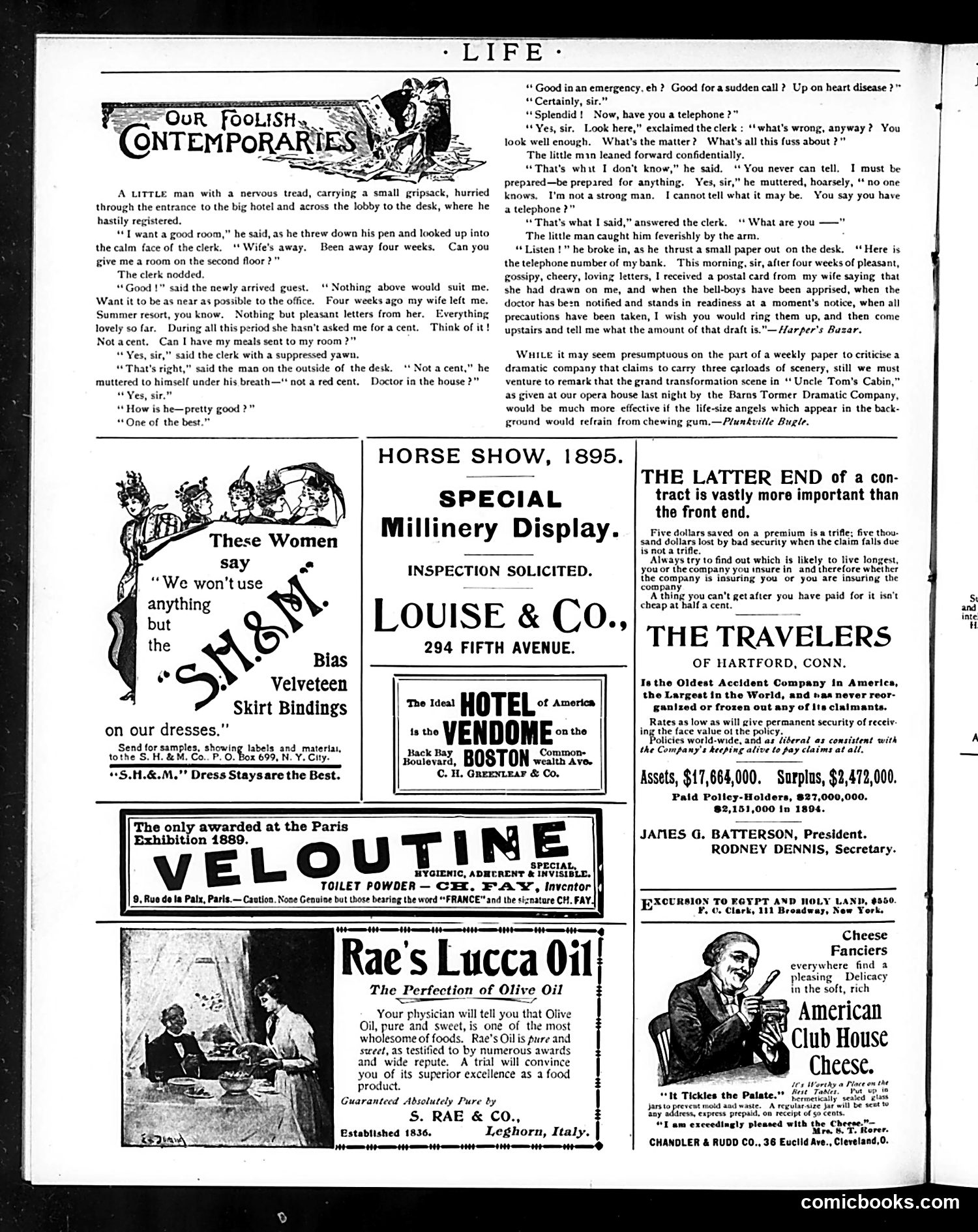
The main cartoon satirizes a neurotic husband's anxiety while his wife is away. A nervous man checks into a hotel, obsessively demanding a room away from the office, requesting meals in his room, and interrogating the clerk about available doctors and telephones. His anxiety escalates when he reveals his wife—absent four weeks—has suddenly drawn a large sum from their bank account. The joke: he's catastrophizing about her spending, imagining medical emergencies he might need to handle while simultaneously contacting his bank. The satire targets male anxieties about wives' financial independence and spending habits—a common theme in turn-of-the-century humor. His elaborate precautions (doctor on standby, phone ready) mock masculine paranoia about losing control of household finances to women. The page is otherwise filled with period advertisements (hotel, insurance, olive oil, cheese, millinery).
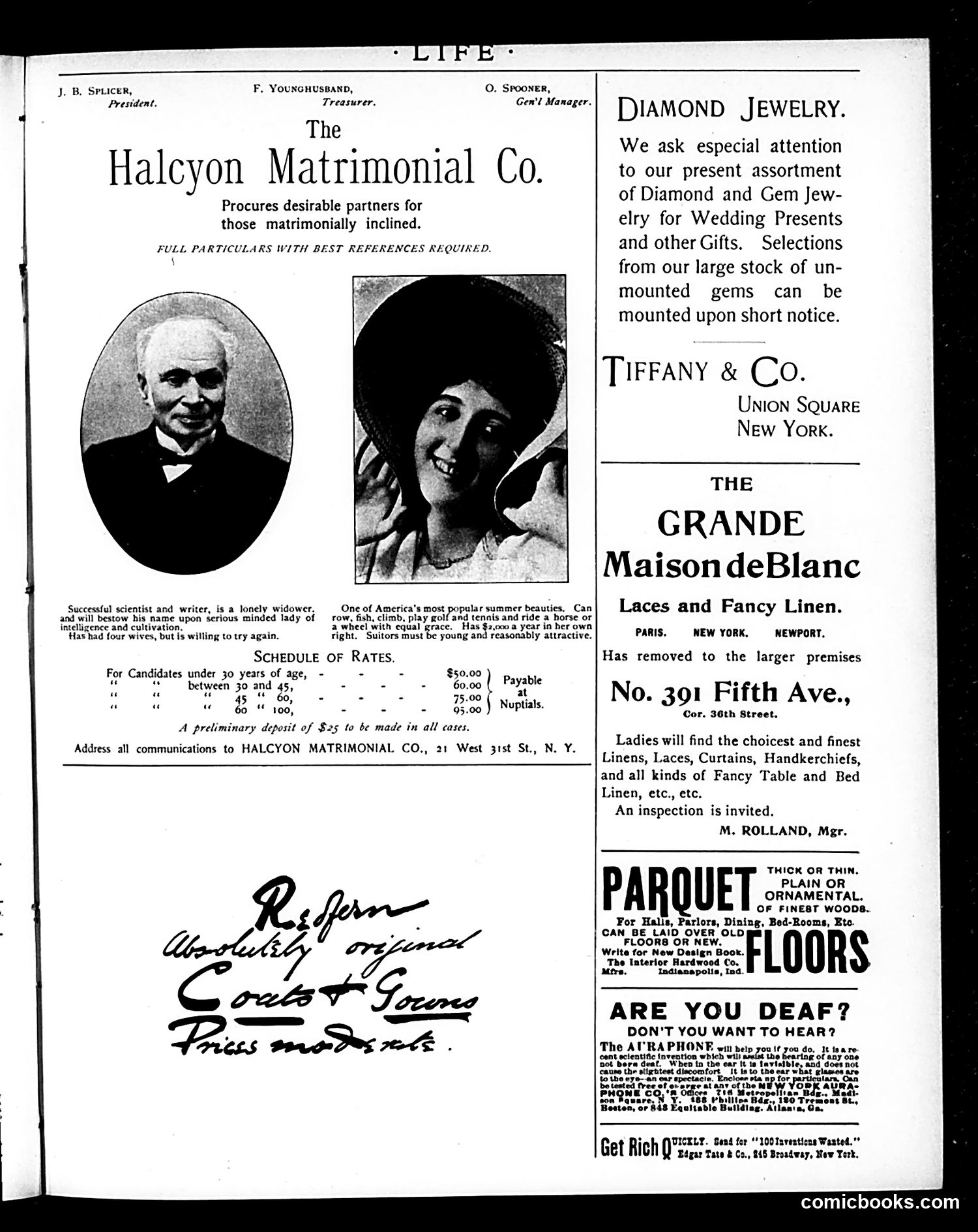
This page satirizes a fictional "matrimonial company" offering matchmaking services with a fee schedule. The humor targets two character types through contrasting portraits: **Left figure**: A successful but lonely older widower-scientist willing to remarry despite four previous marriages. The satire mocks aging men seeking young wives while advertising their credentials as if selling themselves. **Right figure**: Described as "one of America's most popular summer beauties" — physically accomplished (rowing, golf, tennis, horseback riding) but presented as a commodity for purchase, with the joke being she comes with a $2,000 annual income requirement. The schedule charges increasing fees based on the bride's age, treating matrimony as a transactional business. The satire critiques the commodification of marriage, the desperate remarriage market for widowers, and the reduction of women to physical and financial assets. This reflects turn-of-the-century anxieties about marriage as a financial arrangement rather than romantic partnership.
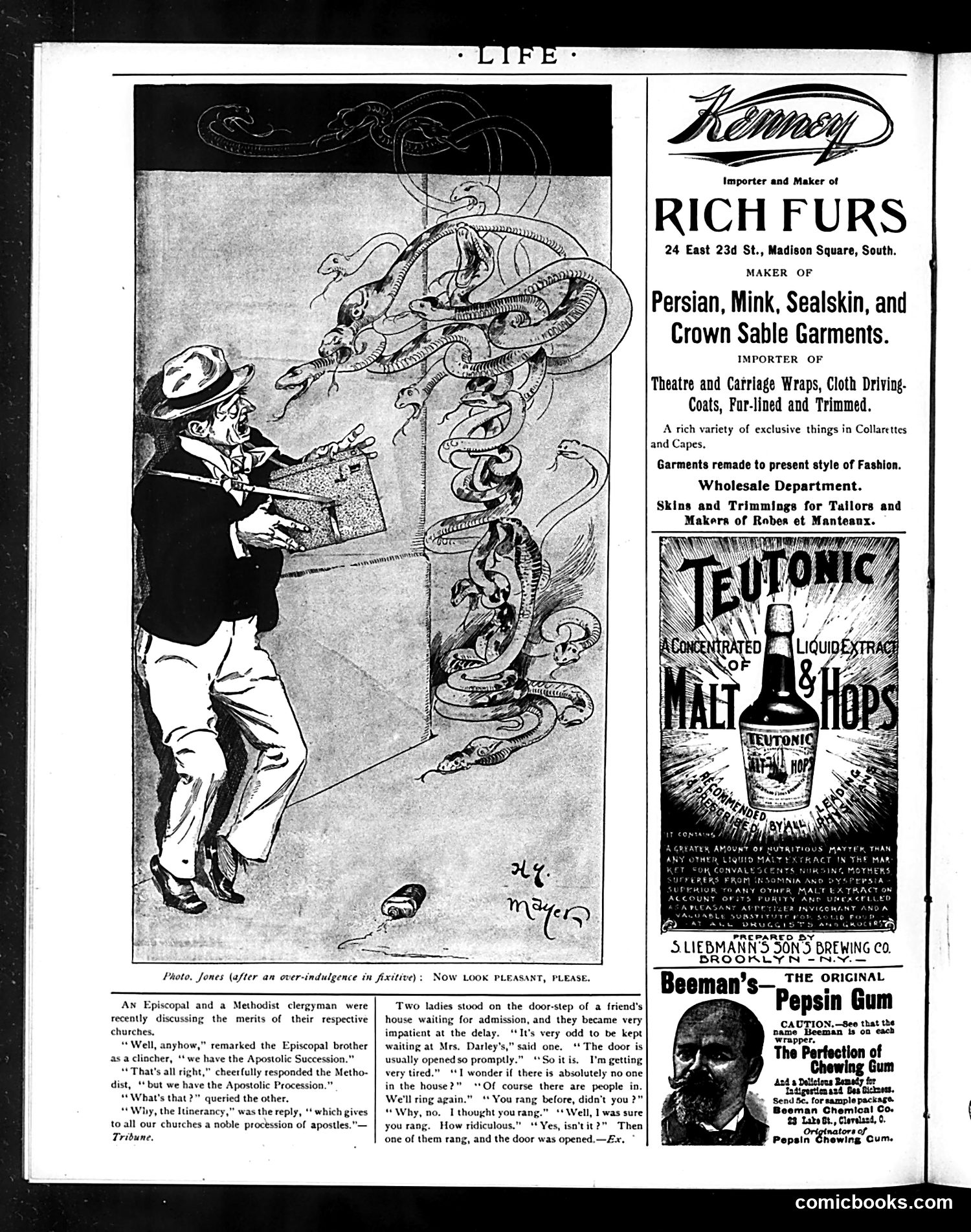
This page contains two brief humorous anecdotes typical of early 20th-century Life magazine, plus period advertisements. **Main Cartoon/Text:** The large illustration shows a man (identified as "Jones") who appears intoxicated from using "fixitive" (a chemical used in art/photography), battling a mass of snakes. This illustrates a religious joke below about Episcopal versus Methodist churches. The Methodist clergyman jokes that while Episcopalians claim "Apostolic Succession" (spiritual authority traced to the apostles), Methodists have "Apostolic Procession"—referring to the Methodist practice of "Itinerancy," where clergy regularly move between churches. The satire mocks Methodist clergy as perpetually wandering. **Second Anecdote:** A brief, mild joke about two impatient ladies waiting at a friend's door, unable to determine if anyone is home despite ringing the bell multiple times. **Context:** Both pieces represent the gentle, domesticated humor typical of Life's satirical content of this era—poking fun at social conventions and religious denominations through wordplay rather than sharp social critique.