
Life, 1895-11-07 · page 4 of 18
Life — November 7, 1895 — page 4: what you’re looking at
What you’re looking at
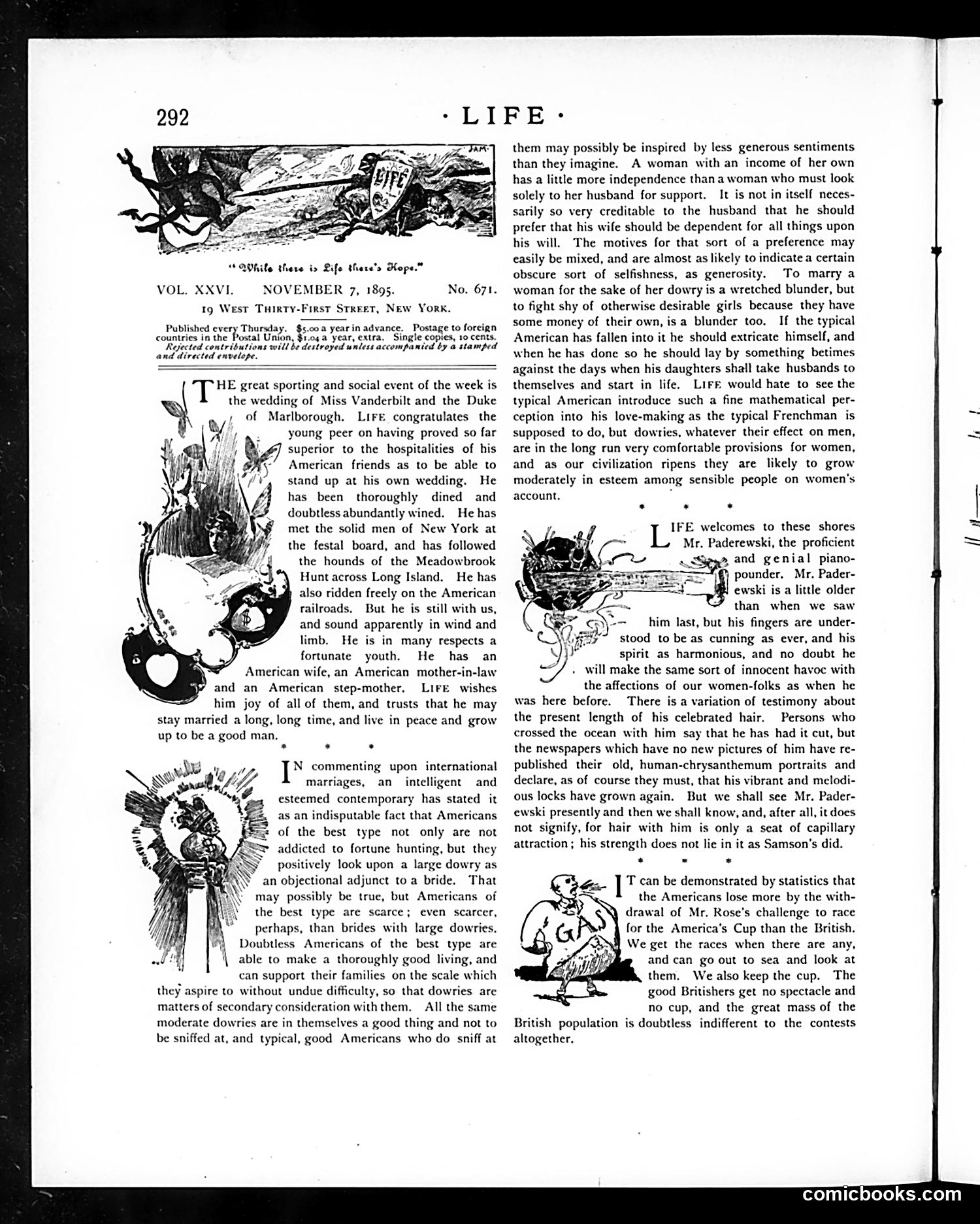
This page discusses the wedding of Miss Vanderbilt and the Duke of Marlborough—a major society event combining American wealth with British nobility. The text praises the groom for maintaining independence and American values despite marrying an heiress. The satirical commentary critiques American attitudes toward dowries. The author argues that Americans obsess less about dowries than Europeans, yet still view them as necessary marriage adjustments. The piece mocks the assumption that American women need financial inducements to marry. A secondary section welcomes pianist Mr. Paderewski to America, joking that his hair will remain recognizably wild despite ocean travel. The final cartoon (unclear detail) apparently references America's America's Cup yacht racing competition, contrasting British indifference with American competitive enthusiasm.
📄 Transcribed text from this page (OCR, searchable)
Machine-transcribed from the original scan — historical spelling and the odd misread are preserved.
LIFE “While there is Life th VOL. XXVI. NOVEMBER 7, 1895. 1g West Tuirty-First STREET, New York. Published every Thursday. $s.coa year in advance. Postage to foreign countries in the Postal Union, $1.04 year, extra. Single copies, 10 cents, Rejected contributions will be destroyed unless accompanied by @ stamped and directed envelope. HE great sporting and social event of the week is the wedding of Miss Vanderbilt and the Duke , of Marlborough, Lire congratulates the young peer on having proved so far ft superior to the hospitalities of his American friends as to be able to stand up at his own wedding. He has been thoroughly dined and doubtless abundantly wined. He has met the solid men of New York at the festal board, and has followed the hounds of the Meadowbrook Hunt across Long Island. He has also ridden freely on the American railroads. But he is still with us, and sound apparently in wind and limb. He is in many respects a fortunate youth, He has an American wife, an American mother-in-law Lire wishes him joy of all of them, and trusts that he may stay married a long, long time, and live in peace and grow up to be a good man. . . wow y N commenting upon international soe Ay marriages, an intelligent and S ¢ esteemed contemporary has stated it as an indisputable fact that Americans of the best type not only are not addicted to fortune hunting, but they positively look upon a large dowry as an objectional adjunct to a bride. That may possibly be true, but Americans of the best type are scarce; even scarcer, perhaps, than brides with large dowries, Doubtless Americans of the best type are able to make a thoroughly good living, and can support their families on the scale which they aspire to without undue difficulty, so that dowries are matters of secondary consideration with them. All the same moderate dowries are in themselves a good thing and not to be sniffed at, and typical, good Americans who do sniff at v0 them may possibly be inspired by less generous sentiments than they imagine. A woman with an income of her own has a little more independence than a woman who must look solely to her husband for support. It is not in itself neces- sarily so very creditable to the husband that he should prefer that his wife should be dependent for all things upon his will. The motives for that sort of a preference may easily be mixed, and are almost as likely to indicate a certain obscure sort of selfishness, as generosity. To marry a woman for the sake of her dowry is a wretched blunder, but to fight shy of otherwise desirable girls because they have some money of their own, isa blunder too. If the typical American has fallen into it he should extricate himself, and when he has done so he should lay by something betimes against the days when his daughters shall take husbands to themselves and start in life. LiF would hate to see the typical American introduce such a fine mathematical per- ception into his love-making as the typical Frenchman is supposed to do, but dowries, whatever their effect on men, are in the long run very comfortable provisions for women, and as our civilization ripens they are likely to grow moderately in esteem among sensible people on women’s account. : . . . IFE welcomes to these shores Mr. Paderewski, the proficient a, and genial piano- pounder. Mr. Pader- ewski is a little older than when we saw him last, but his fingers are under- stood to be as cunning as ever, and his spirit as harmonious, and no doubt he + will make the same sort of innocent havoc with the affections of our women-folks as when he was here before. There is a variation of testimony about the present length of his celebrated hair. Persons who crossed the ocean with him say that he has had it cut, but the newspapers which have no new pictures of him have re- published their old, human-chrysanthemum portraits and declare, as of course they must, that his vibrant and melodi- ous locks have grown again. But we shall see Mr. Pader- ewski presently and then we shall know, and, after all, it does not signify, for hair with him is only a seat of capillary attraction; his strength does not lie in it as Samson's did. . . * iin l T can be demonstrated by statistics that SN the Americans lose more by the with- drawal of Mr. Rose's challenge to race for the America’s Cup than the British. We get the races when there are any, and can go out to sea and look at them. We also keep the cup. The good Britishers get no spectacle and no cup, and the great mass of the British population is doubtless indifferent to the contests altogether, comicbooks.com Il gy