
Life, 1895-11-07 · page 6 of 18
Life — November 7, 1895 — page 6: what you’re looking at
What you’re looking at
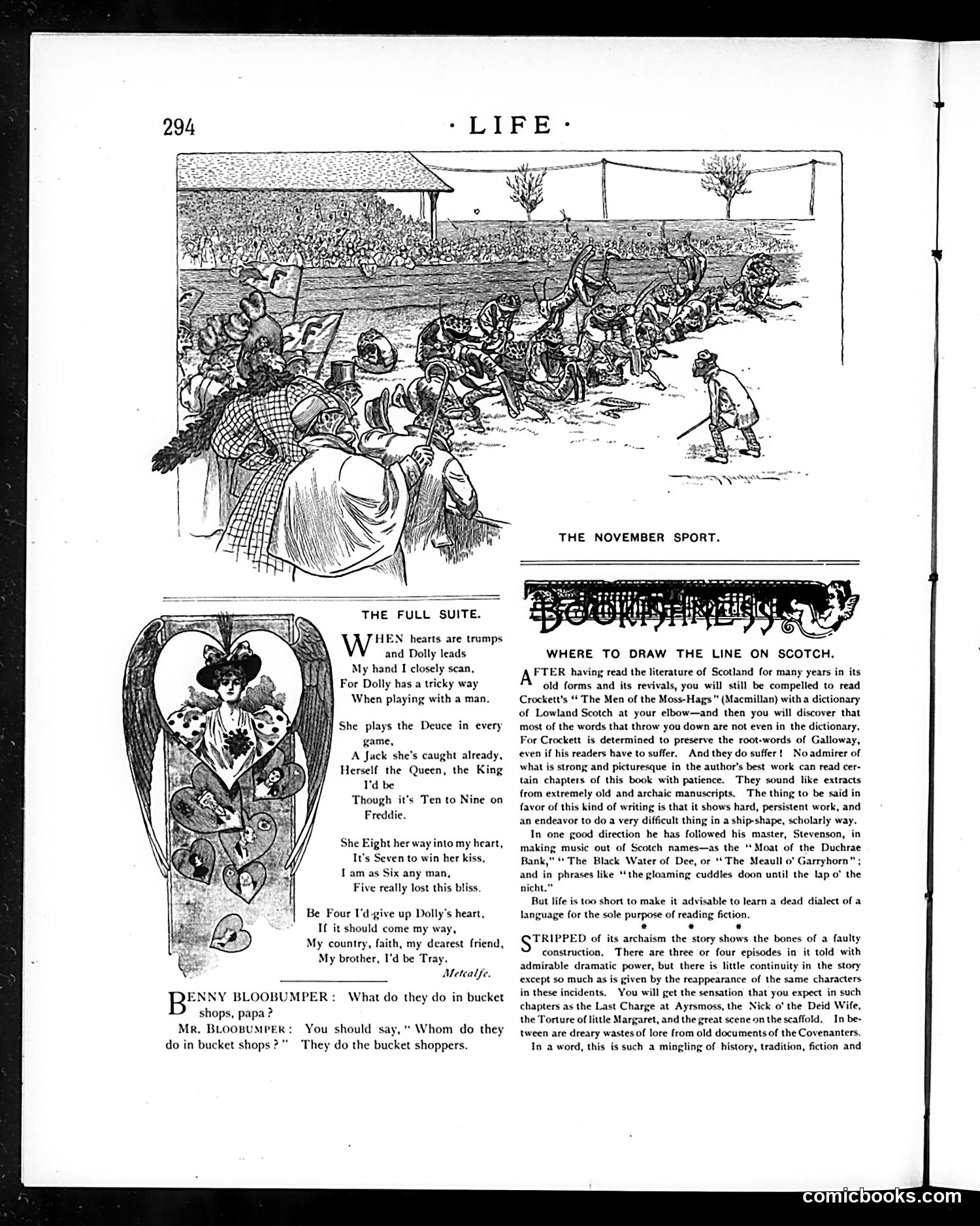
**"The November Sport"** (top illustration) depicts a crowded sporting event—likely football or baseball given the period—with spectators in the stands and players on field. The satire targets the spectacle and chaos of popular American sports entertainment. **"The Full Suite"** features card-game related verse about "Dolly," a woman who plays cards skillfully ("tricky way / When playing with a man"). The heart-shaped poem mocks romantic entanglement with a card player, suggesting women's cunning in games of chance and romance. **"Where to Draw the Line on Scotch"** is a literary piece recommending Scottish dialect fiction, specifically Crockett's works. **The Benny Bloodbumper joke** is wordplay: "bucket shops" (illegal betting establishments) pun on literal bucket-shop work. The page blends sports satire, gambling humor, and literary commentary typical of Life's satirical style.
📄 Transcribed text from this page (OCR, searchable)
Machine-transcribed from the original scan — historical spelling and the odd misread are preserved.
THE Wes hearts are trumps and Dolly leads My hand I closely scan, For Dolly has a tricky way When playing with a man, FULL SUITE. | She plays the Deuce in every game, A Jack she’s caught already, Herself the Queen, the King I'd be Though it's Ten to Nine on Freddie. She Eight her way into my heart, It’s Seven to win her kiss, Tam as Six any man, Five really lost this bliss Be Four I'd-give up Dolly's heart, If it should come my way, My country, faith, my dearest friend, My brother, I'd be Tray. Metcalfe. ‘NY BLOOBUMPER: shops, papa ? MR. BLOOBUMPER : do in bucket shops ? ” What do they do in bucket You should say,“ Whom do they They do the bucket shoppers. THE NOVEMBER SPORT. WHERE TO DRAW THE LINE ON SCOTCH. AFTER having read the literature of Scotland for many years in its old forms and its revivals, you will still be compelled to read Crockett’s “‘ The Men of the Moss-Hags" (Macmillan) with a dictionary of Lowland Scotch at your elbow—and then you will discover that most of the words that throw you down are not even in the dictionary. For Crockett is determined to preserve the root-words of Galloway, even if his readers have to suffer. And they do suffer! No admirer of what is strong and picturesque in the author's best work can read cer- tain chapters of this book with patience. They sound like extracts from extremely old and archaic manuscripts. The thing to be said in favor of this kind of writing is that it shows hard, persistent work, and an endeavor to do a very difficult thing in a ship-shape, scholarly way. In one good direction he has followed his master, Stevenson, in making music out of Scotch names—as the ‘Moat of the Duchrae Bank,” “The Black Water of Dee, or ‘The Meaull o' Garryhorn” ; and in phrases like ‘tthe gloaming cuddles doon until the lap o’ the nicht.” But life is too short to make it advisable to learn a dead dialect of a language for the sole purpose of reading fiction. * * * TRIPPED of its archaism the story shows the bones of a faulty construction, There are three or four episodes in it told with admirable dramatic power, but there is little continuity in the story except so much as is given by the reappearance of the same characters in these incidents. You will get the sensation that you expect in such chapters as the Last Charge at Ayrsmoss, the Nick o' the Deid Wife, the Torture of little Margaret, and the great scene on the scaffold, In be- tween are dreary wastes of lore from old documents of the Covenanters. In a word, this is such a mingling of history, tradition, fiction and comicbooks.com