
Life, 1895-11-07 · page 12 of 18
Life — November 7, 1895 — page 12: what you’re looking at
What you’re looking at
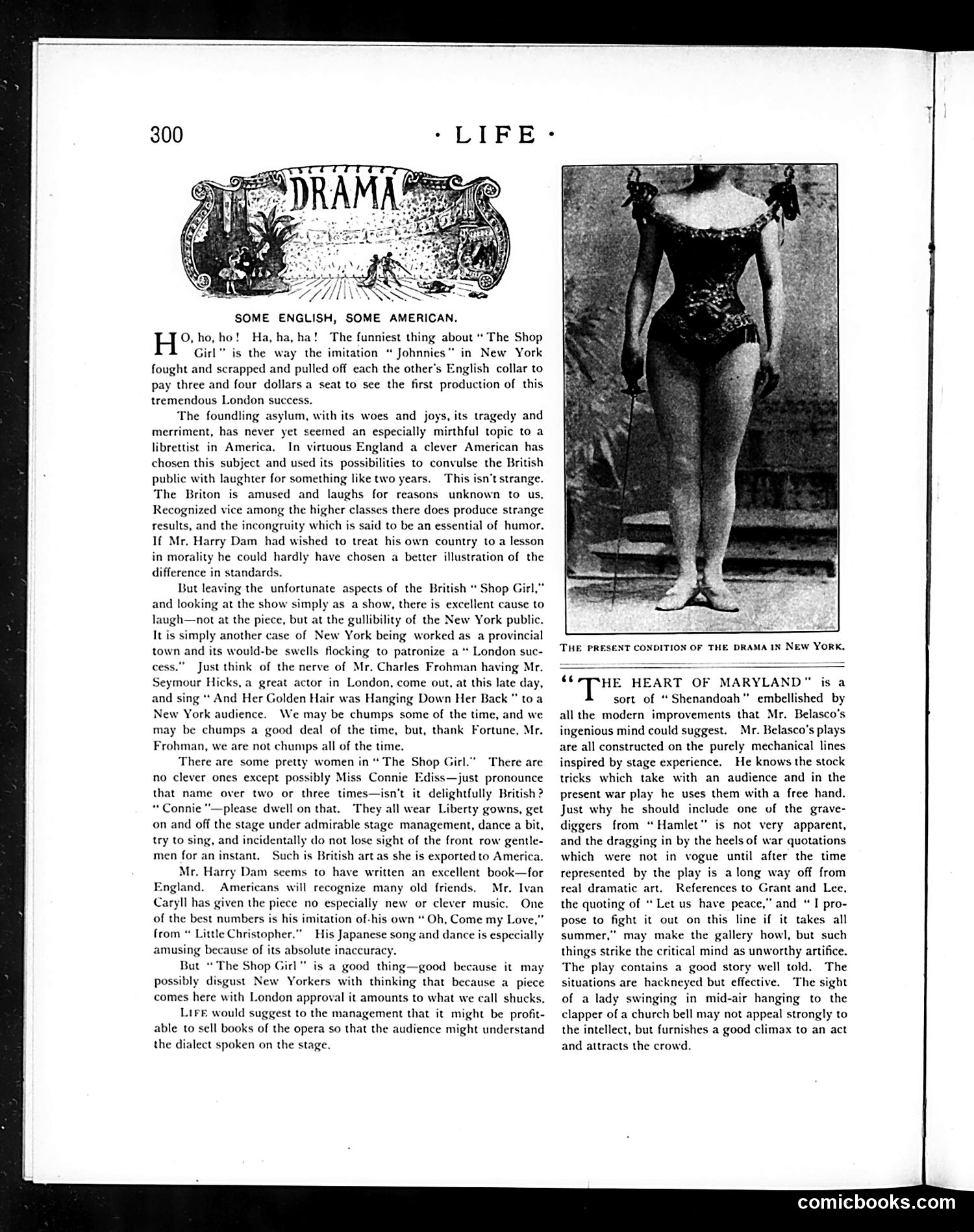
This page critiques two theatrical productions being performed in New York. **"The Shop Girl"**: Life satirizes New York audiences' snobbish worship of London theater. The magazine mocks wealthy New Yorkers ("would-be swells") who paid premium prices to see this British musical, calling them gullible "chumps" worked by impresario Charles Frohman. The piece attacks the show's shallow entertainment and the performers' mediocrity, particularly actress Connie Ediss. Life suggests Americans foolishly assume anything "London approved" has merit—a pointed jab at transatlantic cultural pretension. **"The Heart of Maryland"**: Life praises producer David Belasco's technically sophisticated Civil War drama while questioning his artistic choices—particularly his unexplained inclusion of a gravedigger character and anachronistic Civil War quotations. The photograph shows a female performer in period costume, illustrating the theatrical subject matter.
📄 Transcribed text from this page (OCR, searchable)
Machine-transcribed from the original scan — historical spelling and the odd misread are preserved.
SOME ENGLISH, SOME AMERICAN. O, ho, ho! Ha, ha, ha! The funniest thing about * The Shop Girl" is the way the imitation “ Johnnies" in New York fought and scrapped and pulled off each the other's English collar to pay three and four dollars a seat to see the first production of this tremendous London success. The foundling asylum, with its woes and joys, its wagedy and merriment, has never yet seemed an especially mirthful topic to a librettist in America, In virtuous England a clever American has chosen this subject and used its possibilities to convulse the British public with laughter for something like two years. This isn’t strange. The Briton is amused and laughs for reasons unknown to us, Recognized vice among the higher classes there does produce strange results, and the incongruity which is said to be an essential of humor. If Mr. Harry Dam had wished to treat his own country to a lesson in morality he could hardly have chosen a better illustration of the difference in standards. But leaving the unfortunate aspects of the British * Shop Girl,” and looking at the show simply as a show, there is excellent cause to laugh—not at the piece, but at the gullibility of the New York public. It is simply another case of New York being worked as a provincial town and its would-be swells flocking to patronize a“ London suc- cess.” Just think of the nerve of Mr. Charles Frohman having Mr. Seymour Hicks, a great actor in London, come out, at this late day, and sing “ And Her Golden Hair was Hanging Down Her Back" toa New York audience. We may be chumps some of the time, and we may be chumps a good deal of the time, but, thank Fortune, Mr. Frohman, we are not chumps all of the time. There are some pretty women in * The Shop Girl.” There are no clever ones except possibly Miss Connie Ediss—just pronounce that name over two or three times—isn’t it delightfully British ? “Connie "—please dwell on that. They all wear Liberty gowns, get on and off the stage under admirable stage management, dance a bit, try to sing, and incidentally do not lose sight of the front row gentle- men for an instant, Such is British art as she is exported to America, Mr. Harry Dam seems to have written an excellent book—for England. Americans will recognize many old friends. Mr. Ivan Caryll has given the piece no especially new or clever music. One of the best numbers is his imitation of-his own “ Oh, Come my Love,” from “ Little Chri His Japanese song and dance is especially amusing because of its absolute inaccuracy. But “The Shop Girl" is a good thing—good because it may possibly disgust New Yorkers with thinking that because a piece comes here with London approval it amounts to what we call shucks. LiFe would suggest to the management that it might be profit- able to sell books of the opera so that the audience might understand the dialect spoken on the stage. T CONDITION OF THE DRAMA IN New YORK, $6 HE HEART OF MARYLAND” is a sort of “Shenandoah” embellished by all the modern improvements that Mr. Belasco’s ingenious mind could suggest. Mr. Belasco’s plays are all constructed on the purely mechanical lines inspired by stage experience. He knows the stock tricks which take with an audience and in the present war play he uses them with a free hand. Just why he should include one of the grave- diggers from “Hamlet” is not very apparent, and the dragging in by the heels of war quotations which were not in vogue until after the time represented by the play is along way off from real dramatic art. References to Grant and Lee, the quoting of “ Let us have peace,” and “I pro- pose to fight it out on this line if it takes all summer,” may make the gallery howl, but such things strike the critical mind as unworthy artifice. The play contains a good story well told. The situations are hackneyed but effective. The sight of a lady swinging in mid-air hanging to the clapper of a church bell may not appeal strongly to the intellect, but furnishes a good climax to an act and attracts the crowd. comicbooks.com