
A complete issue · 20 pages · 1895
Life — October 24, 1895
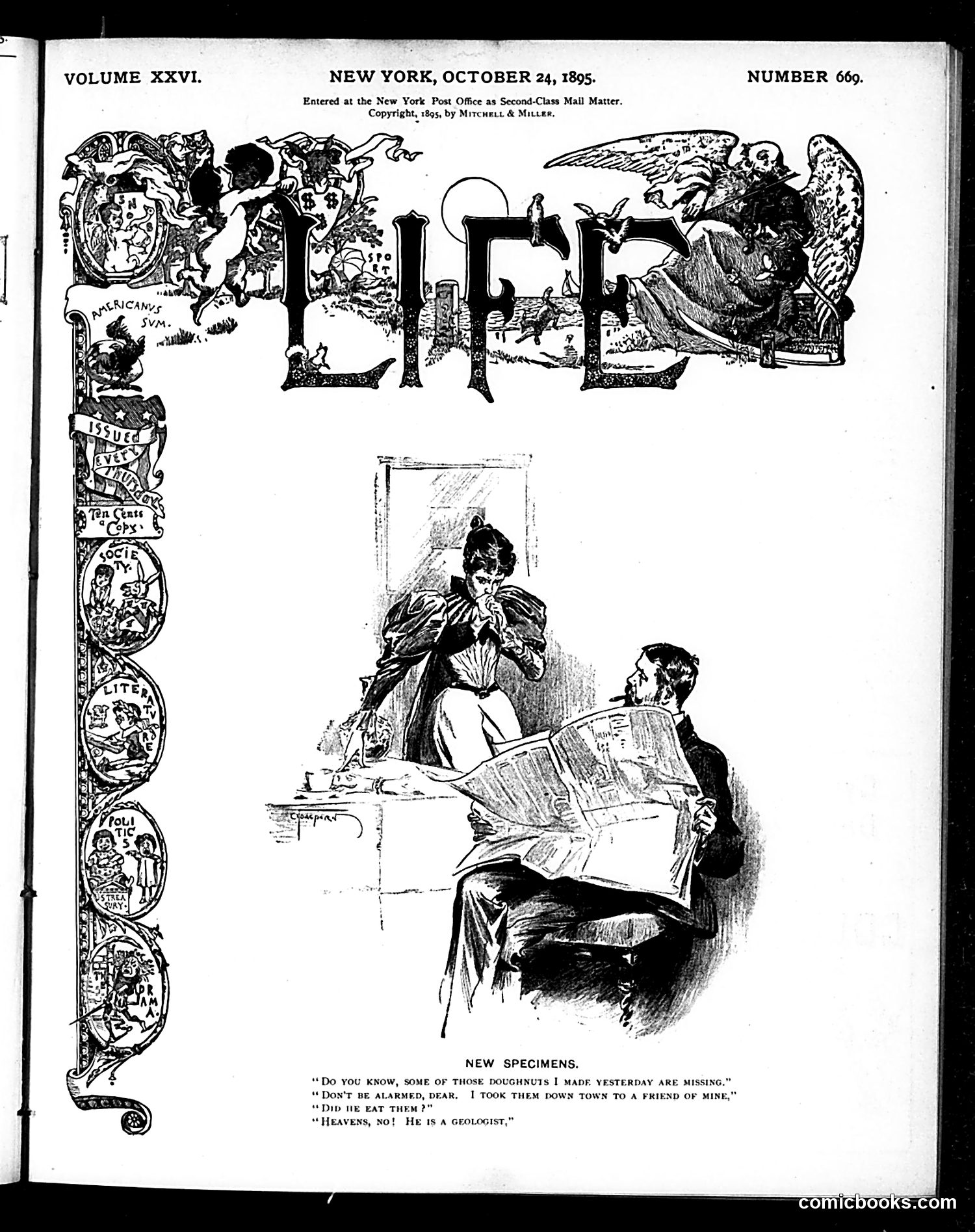
This cartoon satirizes an upper-class couple's social pretensions. The woman shows concern about missing doughnuts she made yesterday, worried a guest ate them. The man reassures her they're safe—he gave them to "a friend of mine." The punchline reveals the friend is "a geologist," implying the doughnuts are so hard and stale they resemble rock specimens worthy of geological study. The joke mocks both the woman's poor baking skills and the couple's attempt to maintain polite appearances about domestic failure. It's a domestic humor piece typical of *Life*'s satirical commentary on middle and upper-class manners and mishaps of the 1890s.
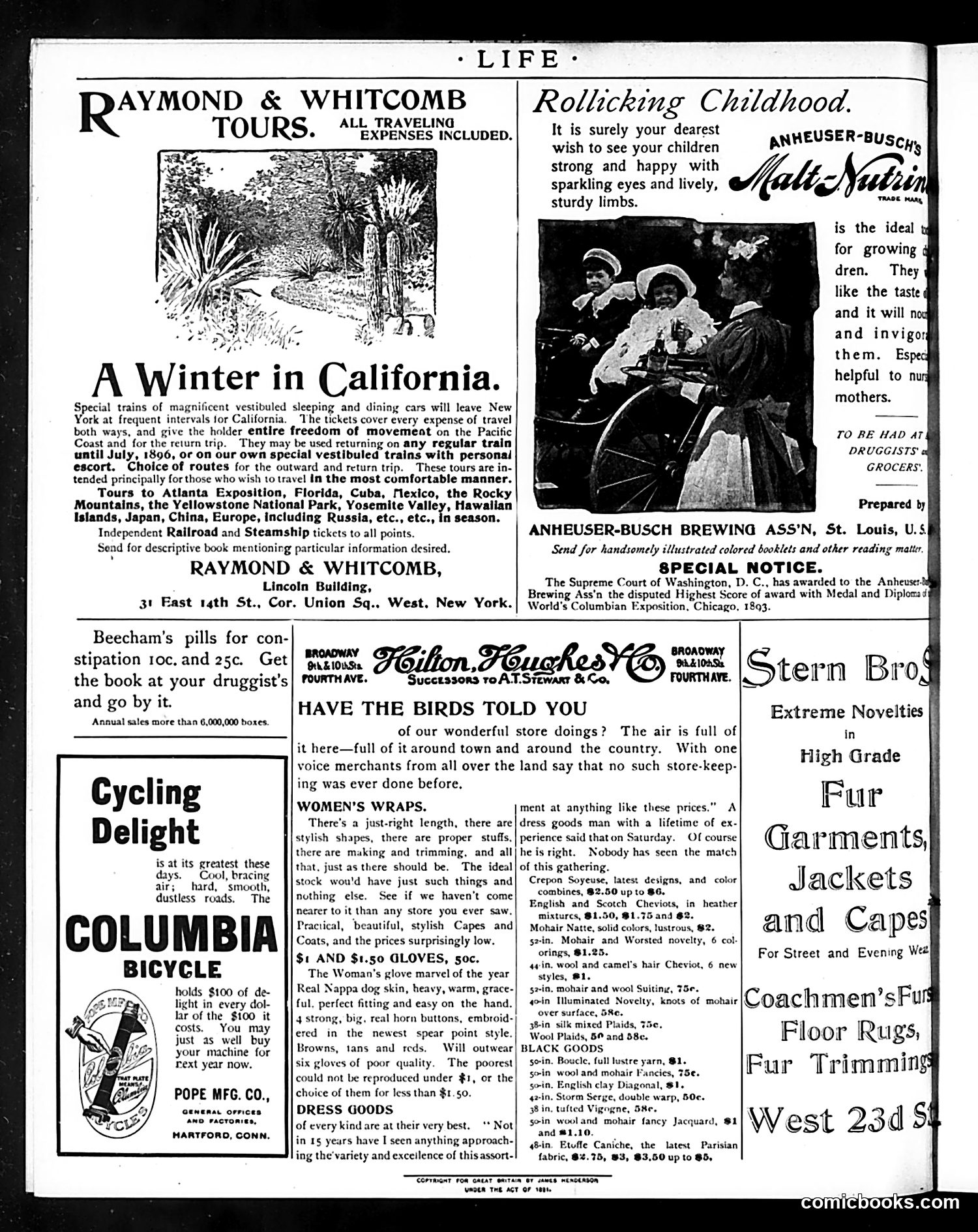
This page is **primarily advertisements** with no political cartoons or satire. The content includes: - **Raymond & Whitcomb Tours**: promoting luxury California winter travel with transcontinental trains - **Anheuser-Busch Malt Nutrin**: a beverage marketed for children's health and vigor - **Beecham's Pills**: a constipation remedy - **Columbia Bicycle**: highlighting women's fashion-appropriate cycling wear - **Stern Bros**: fur garments and accessories - **Hilton, Hawkes & Co.**: department store merchandise (women's wraps, gloves, dress goods, Black Goods) The only potentially satirical element is **"Have the Birds Told You,"** a Hilton, Hawkes & Co. advertisement using flowery language about store merchandise quality, though it reads more as period marketing hyperbole than sharp satire. This is a commercial page typical of early 1890s Life magazine, reflecting era-specific products and consumer culture rather than political commentary.
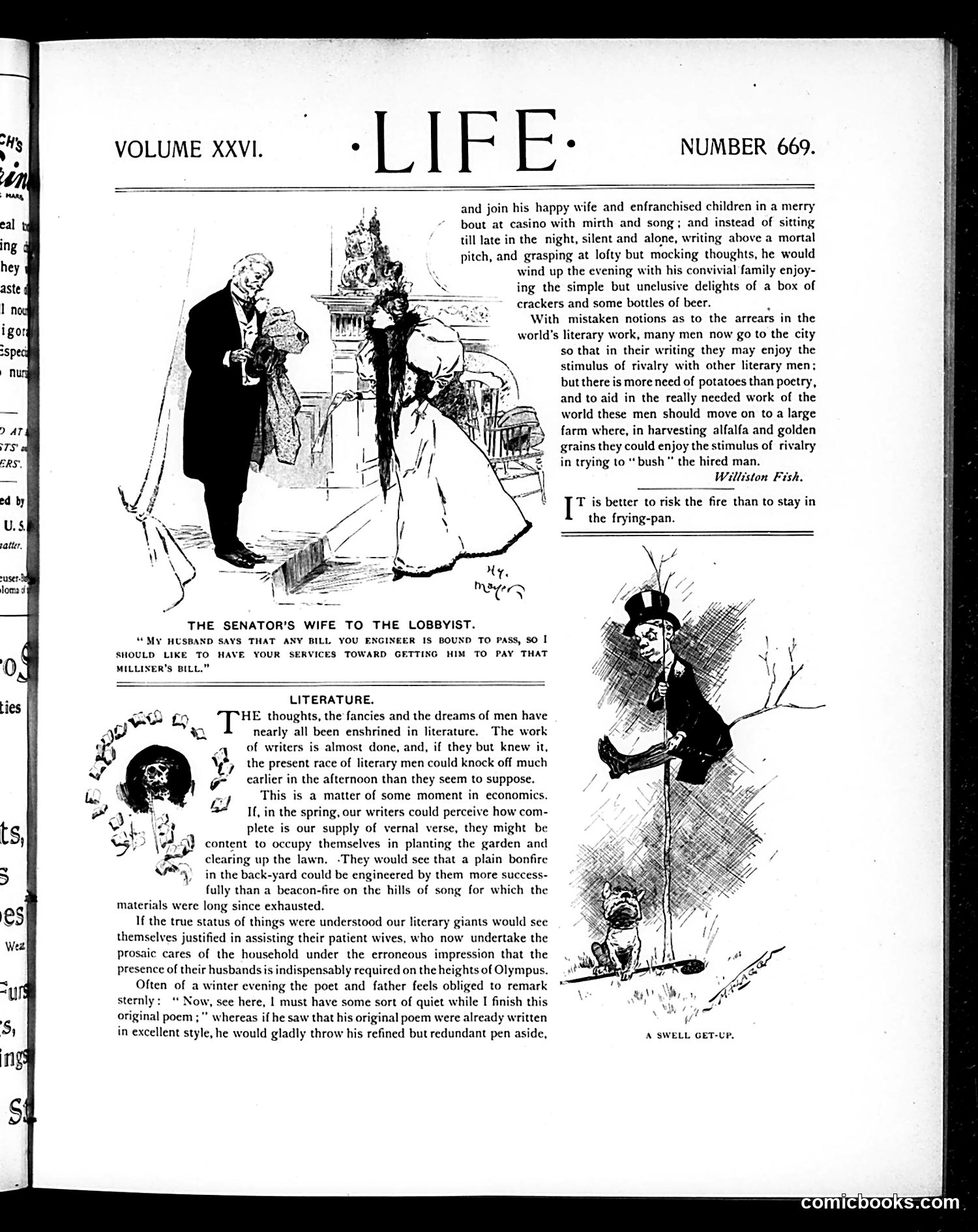
**"The Senator's Wife to the Lobbyist"** (top cartoon): A well-dressed woman approaches a man, saying she wants his help getting her husband's engineer friend paid for a public works bill. This satirizes the corrupt practice of using personal connections and lobbyists to secure government contracts—a common Progressive Era critique of political favoritism and "special interests" circumventing legitimate process. **"Literature" section**: The essay by William Fitch mocks literary men who neglect productive work (farming, business) to pursue writing, claiming they waste time on unremunerative poetry while their wives manage households. The satire critiques impractical intellectualism and argues writers should contribute economically rather than pursuing artistic vanity. **"A Swell Get-Up"** (right cartoon): Appears to depict a poorly-dressed man, likely mocking lower-class pretension or failed social aspiration.
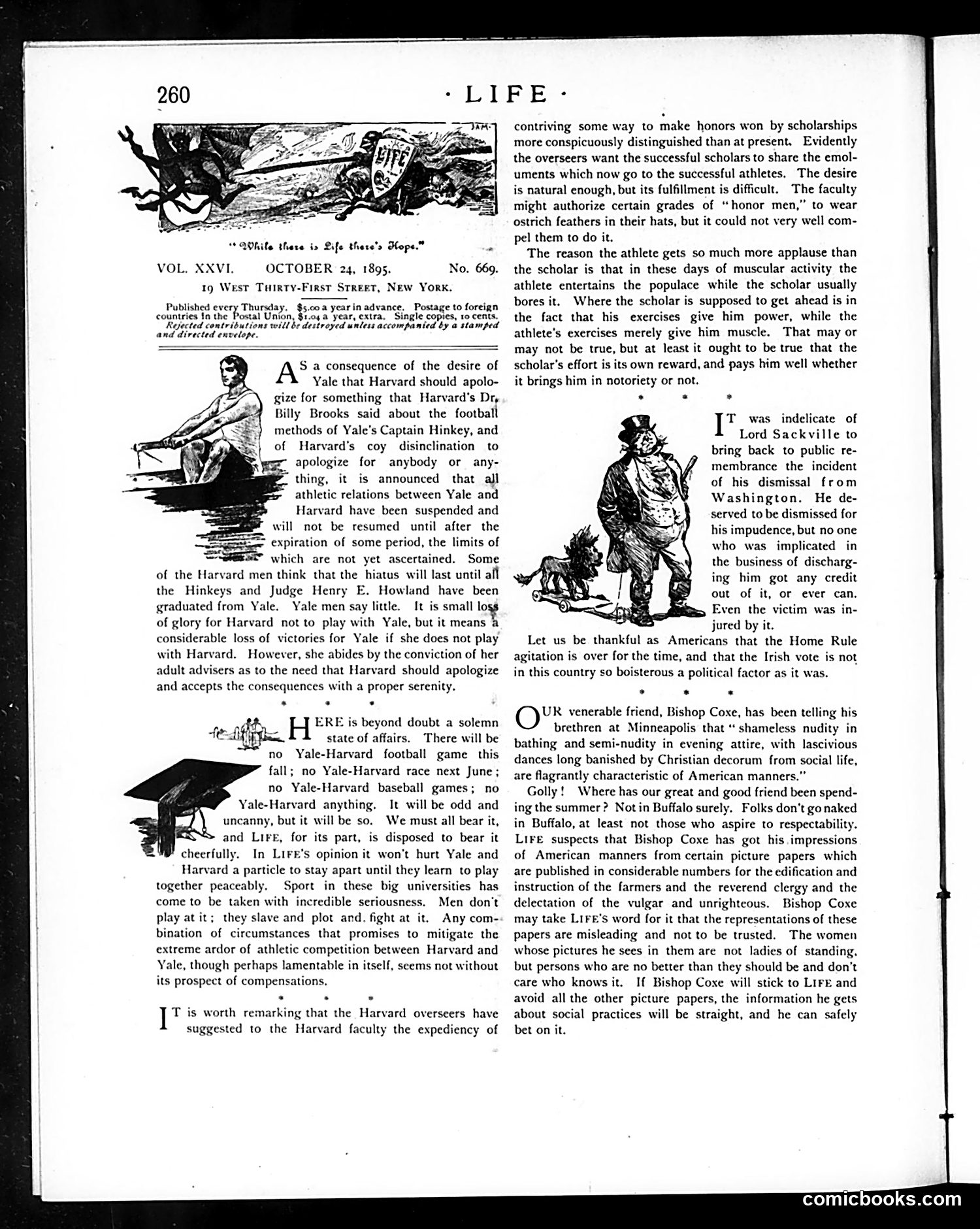
This page discusses a Yale-Harvard athletic dispute. The main text criticizes the disproportionate public acclaim athletes receive compared to scholars, arguing that athletes "entertain the populace" while scholars are overlooked—despite scholars' work being equally valuable. The page also addresses Lord Sackville's dismissal from Washington, suggesting his removal was politically motivated and questioning whether those responsible for his discharge deserve credit. A third section satirizes Bishop Coxe's comments about "shameless nudity" in American bathing attire and social dancing, suggesting he's been influenced by prejudicial European pictures of American women. Life defends American social practices and questions the bishop's reliability as a cultural commentator. The cartoons (illustrations visible but details unclear in reproduction) appear to accompany these satirical critiques.
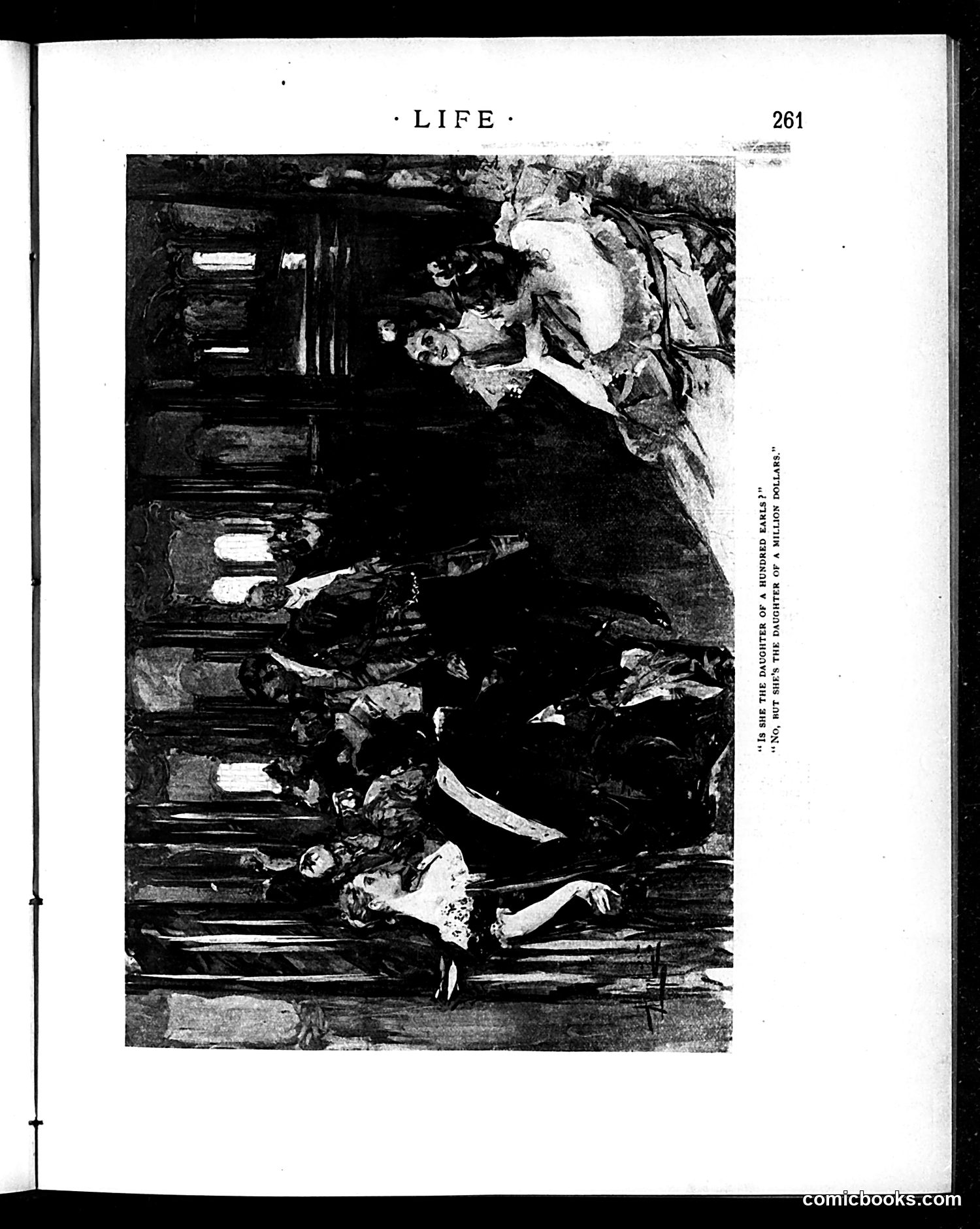
This page appears to contain a satirical illustration, though the image quality and rotation make detailed interpretation challenging. The caption indicates the work is "IS THE POWER OF A DISROBED BALLET?" with text referencing "No. It's the power of the number 'Follies'"—likely a reference to theatrical productions like the Ziegfeld Follies, which were famous American entertainment spectacles. The illustration depicts multiple figures in what appears to be a theatrical or performance setting, with dramatic poses and clothing suggesting entertainment or burlesque-style performance. The satire likely comments on the appeal and social influence of popular theatrical entertainment of the early 20th century, though without clearer resolution, the specific political or social critique remains partially obscured.
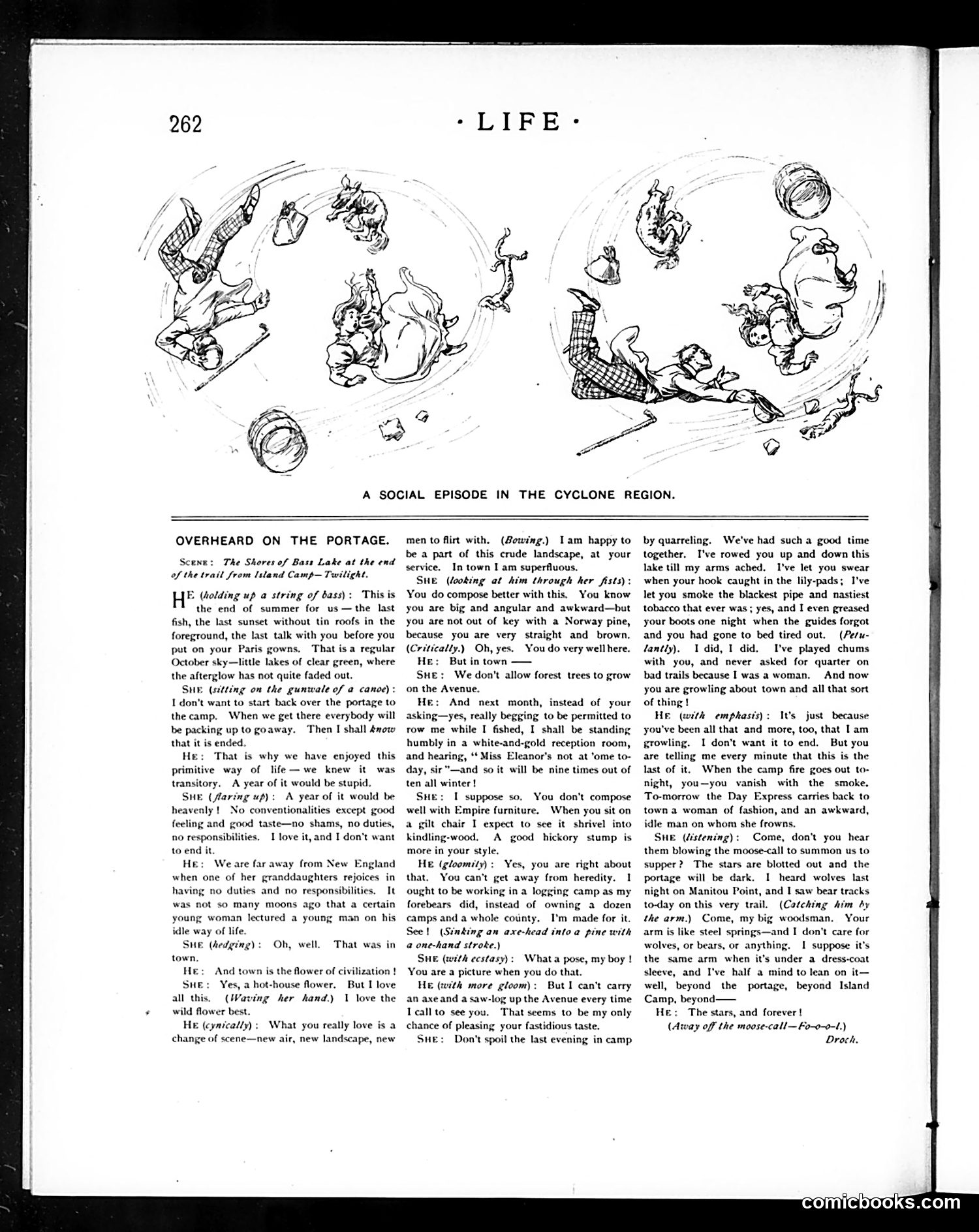
This page contains a humorous dialogue and illustrations depicting people in chaotic weather conditions. The scene shows figures being blown about by a cyclone/tornado at Bass Lake, with people tumbling through the air and clinging to objects. The satire centers on social pretension versus natural disaster. Characters discuss maintaining civility and proper behavior ("composing" oneself, proper furniture, social etiquette) while literally being caught in a violent storm. The irony is that social conventions become absurd when facing nature's overwhelming force—one character insists on proper dress and decorum even as cyclonic winds make survival the only real concern. The joke satirizes how people cling to artificial social rules and class distinctions that become meaningless in genuinely dangerous circumstances. It's commentary on misplaced priorities and the comedy of maintaining propriety during chaos.
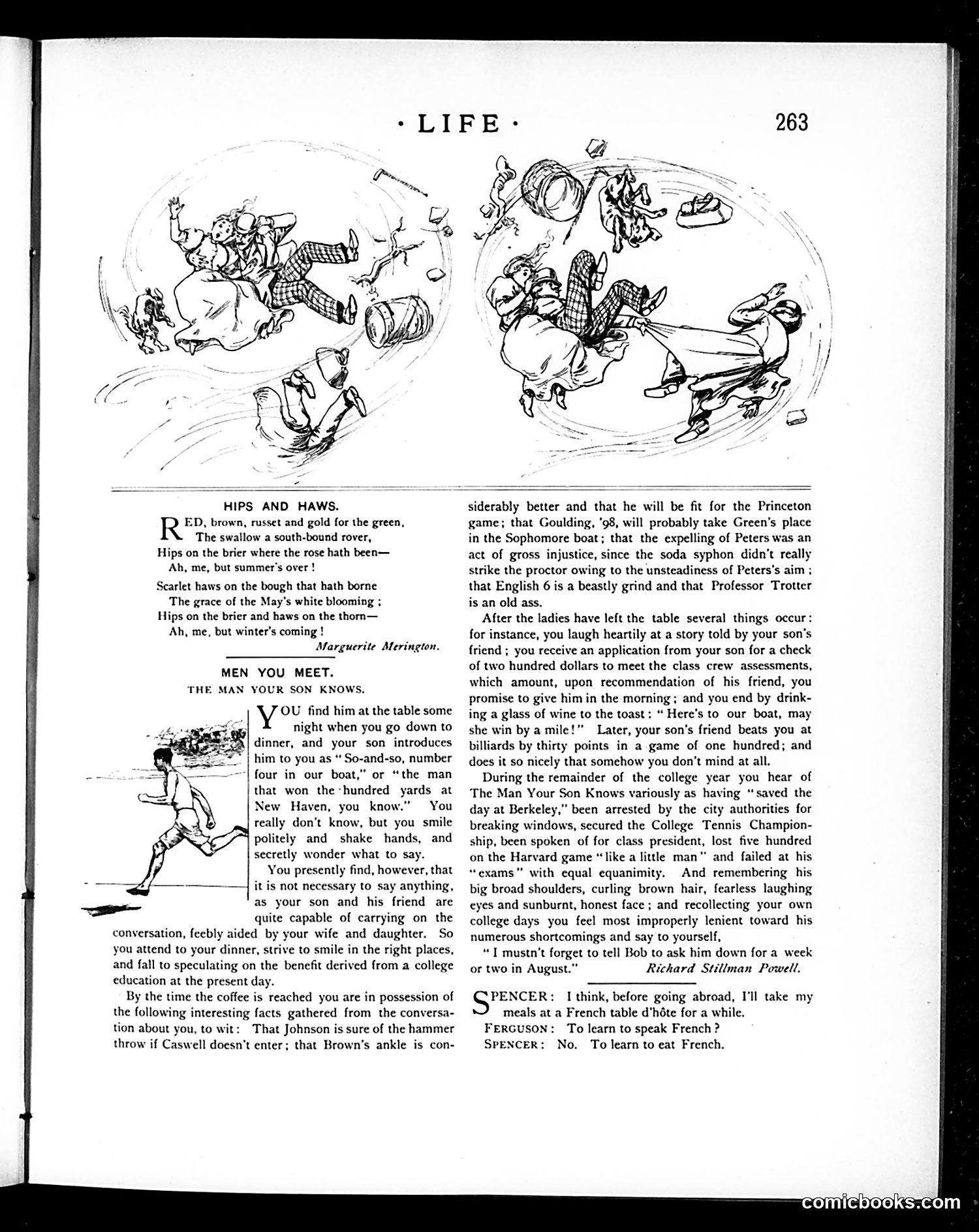
This page from *Life* magazine contains two satirical sections about college life, circa early 1900s. **"Hips and Haws"** is a poem (by Marguerite Merington) mocking romantic collegiate behavior—references to "hips on the brier" and flirtation suggest humor about young people's social awkwardness. **"Men You Meet"** satirizes the stereotypical college man, specifically the athlete-type who boasts about sports achievements (winning races at New Haven) but lacks substance. The text mocks how parents indulge and excuse such men's shortcomings—breaking windows, academic failures—because of athletic prowess. The closing dialogue between Spencer and Ferguson jokes about learning French versus eating French food, continuing the theme of superficial college pursuits. The overall satire targets both pretentious undergraduates and parents' misplaced pride in them.
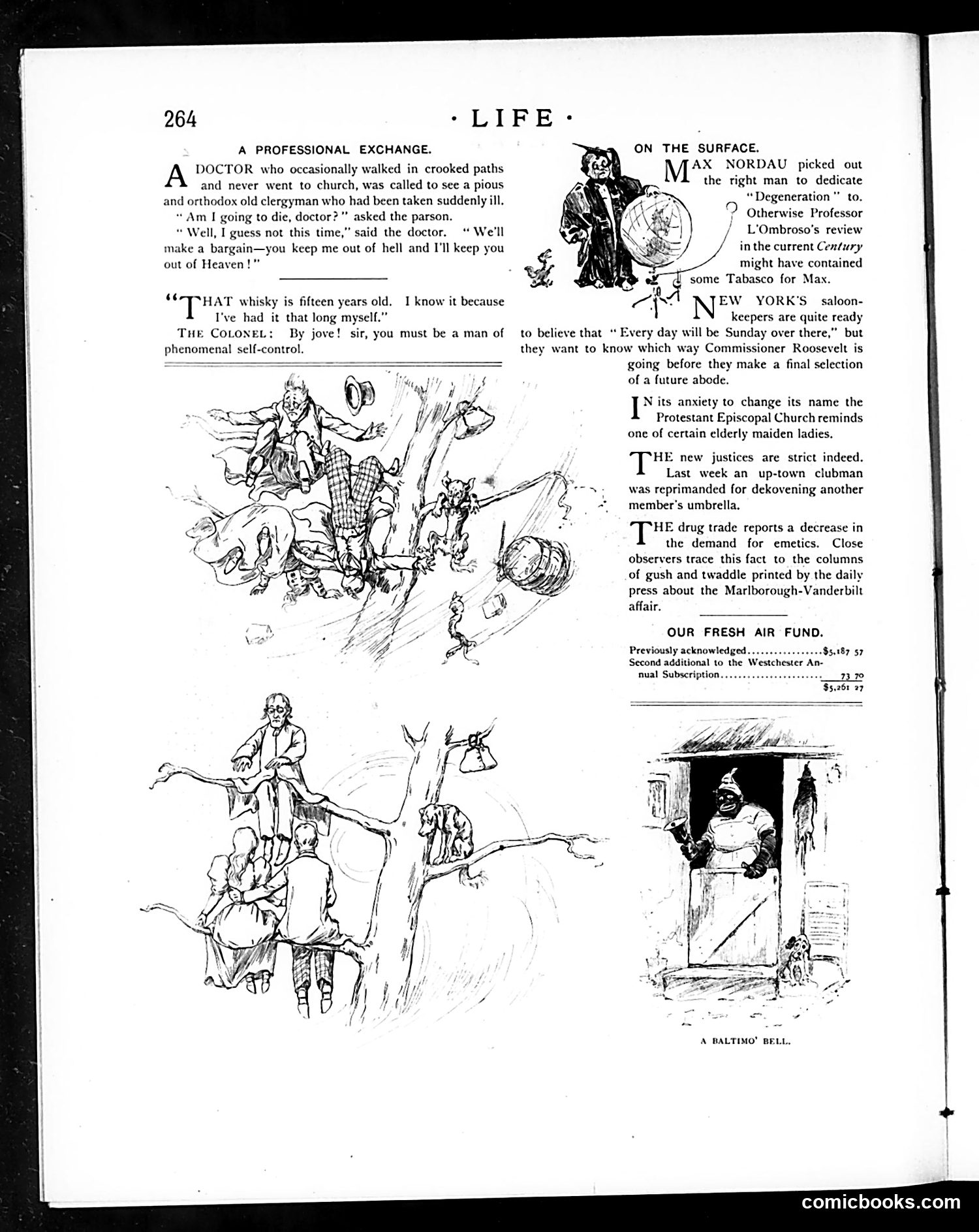
This page contains two distinct sections: **Left side:** A humorous anecdote titled "A Professional Exchange" depicts a doctor and clergyman discussing whiskey's age and medicinal value—a joke about self-control and the clergy's relationship with alcohol. **Right side:** Brief satirical items including: - Commentary on selecting a name for "Degeneration" (unclear reference) - A note about New York saloon-keepers' uncertainty regarding Commissioner Roosevelt's future - A jab at the Protestant Episcopal Church for anxiety over name-changes - A report on decreased demand for emetics, attributed to newspaper coverage of the "Marlborough-Vanderbilt affair" The cartoons illustrate these anecdotes with satirical drawings of chaotic scenes and social types. The "Fresh Air Fund" section tracks charitable donations. Overall, this represents typical early-20th-century *Life* magazine content: light social satire targeting contemporary figures, institutions, and scandals.
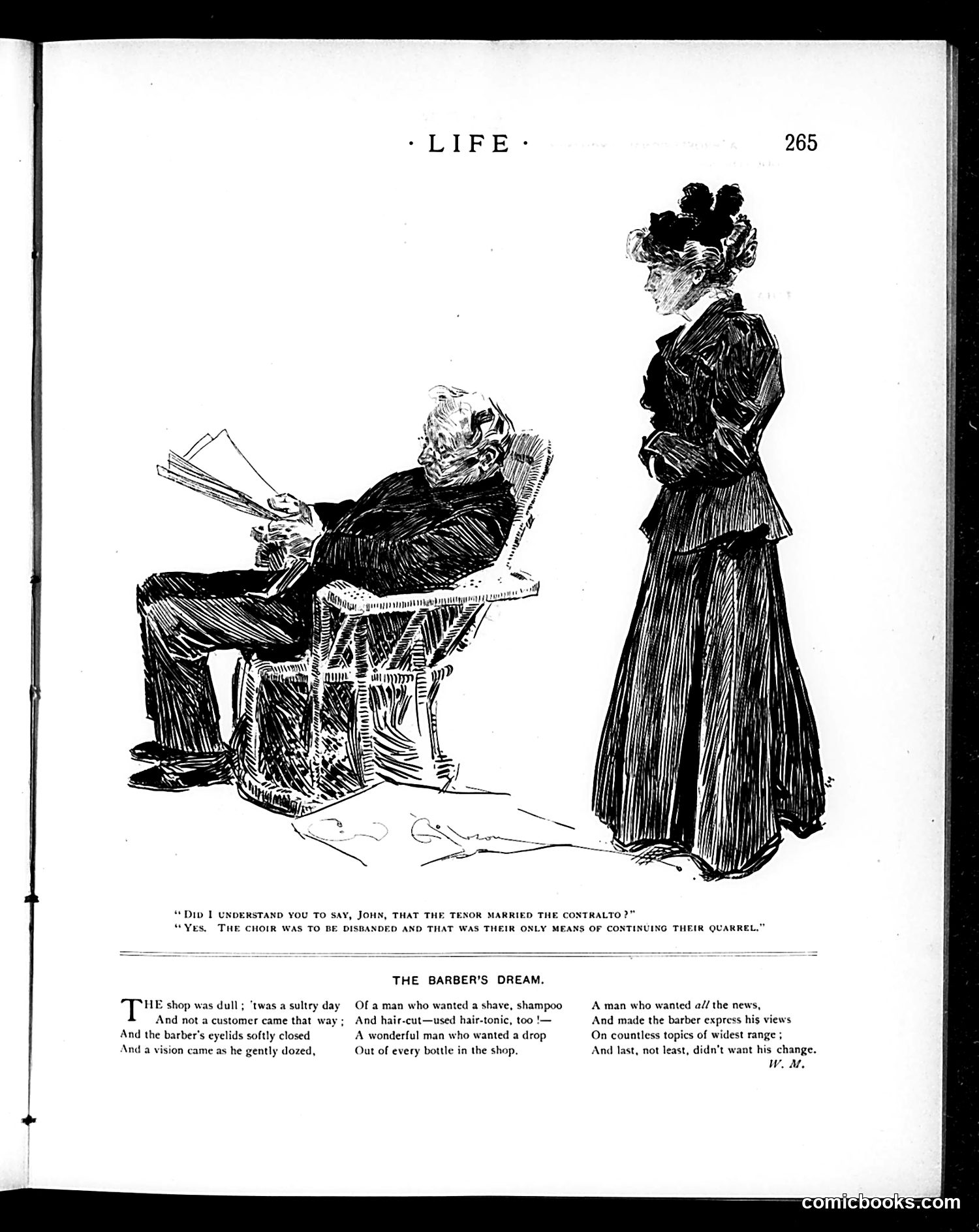
This is a humorous sketch showing a barber dozing in his chair during a slow business day. While he sleeps, he daydreams of an ideal customer—a man demanding elaborate services: a shave, shampoo, hair-cut, hair-tonic, and "a drop of every bottle in the shop." The joke contrasts the barber's actual situation (a quiet day with no customers) against his fantasy of a high-maintenance, talkative client who wants endless treatments and has strong opinions on every topic. The accompanying dialogue above the image appears to reference a separate operatic or theatrical incident involving a tenor and a dissolved choir, unrelated to the barber sketch itself.
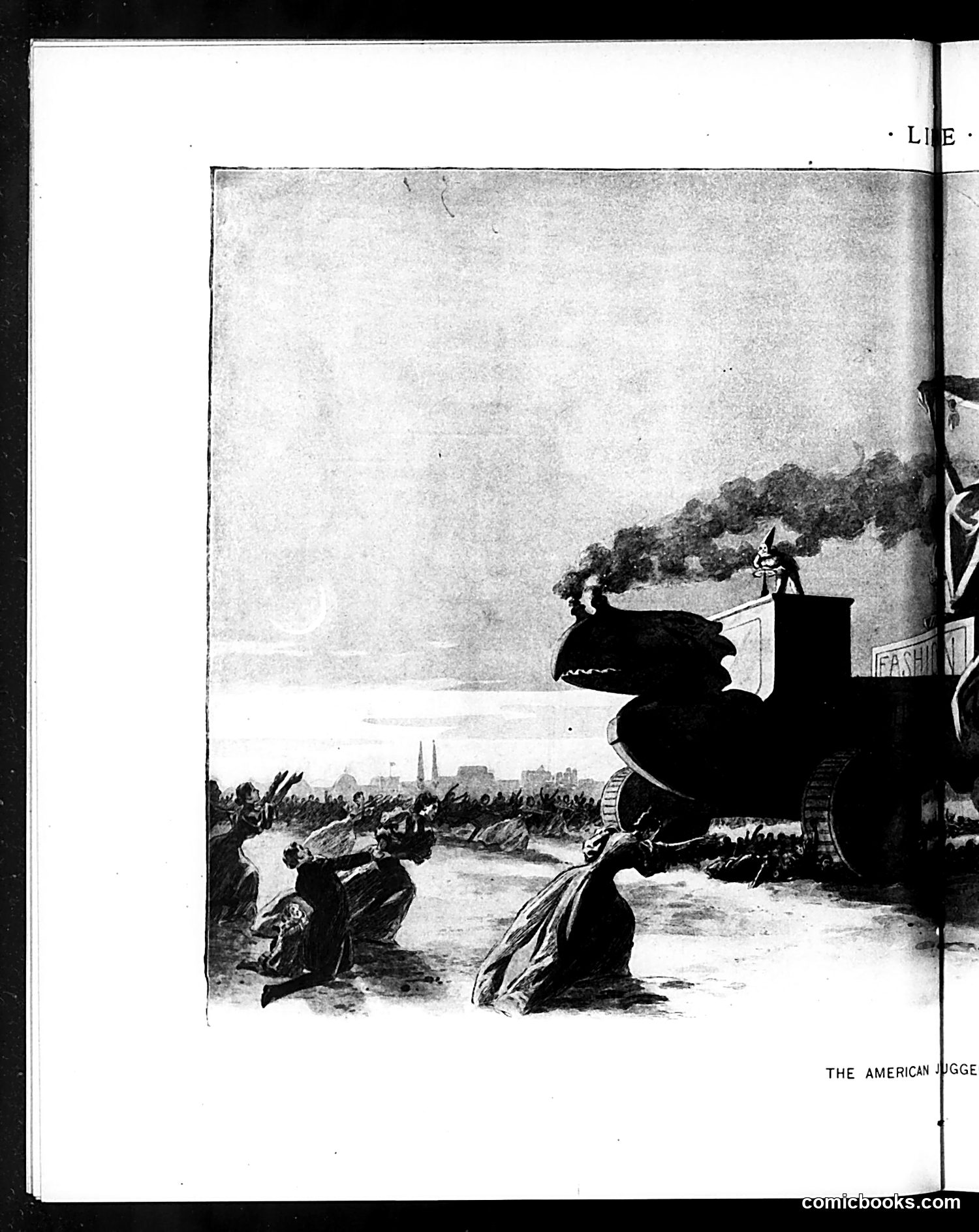
This political cartoon depicts a large, menacing figure (likely representing American judicial authority or a specific judge) looming over a battlefield scene. The figure stands atop what appears to be a tank or military vehicle, with smoke rising from artillery in the background. Below, soldiers and civilians are scattered across the ground in distress. The satire critiques American judicial power during wartime, suggesting the courts function as an instrument of war rather than justice. The "judge" literally oversees military operations, implying courts enable or sanction warfare. The contrast between the imposing authority figure and the suffering masses below emphasizes the disconnect between those wielding power and those experiencing its consequences. Without a visible date, the specific conflict referenced remains unclear, though the tank suggests early-to-mid 20th century context.
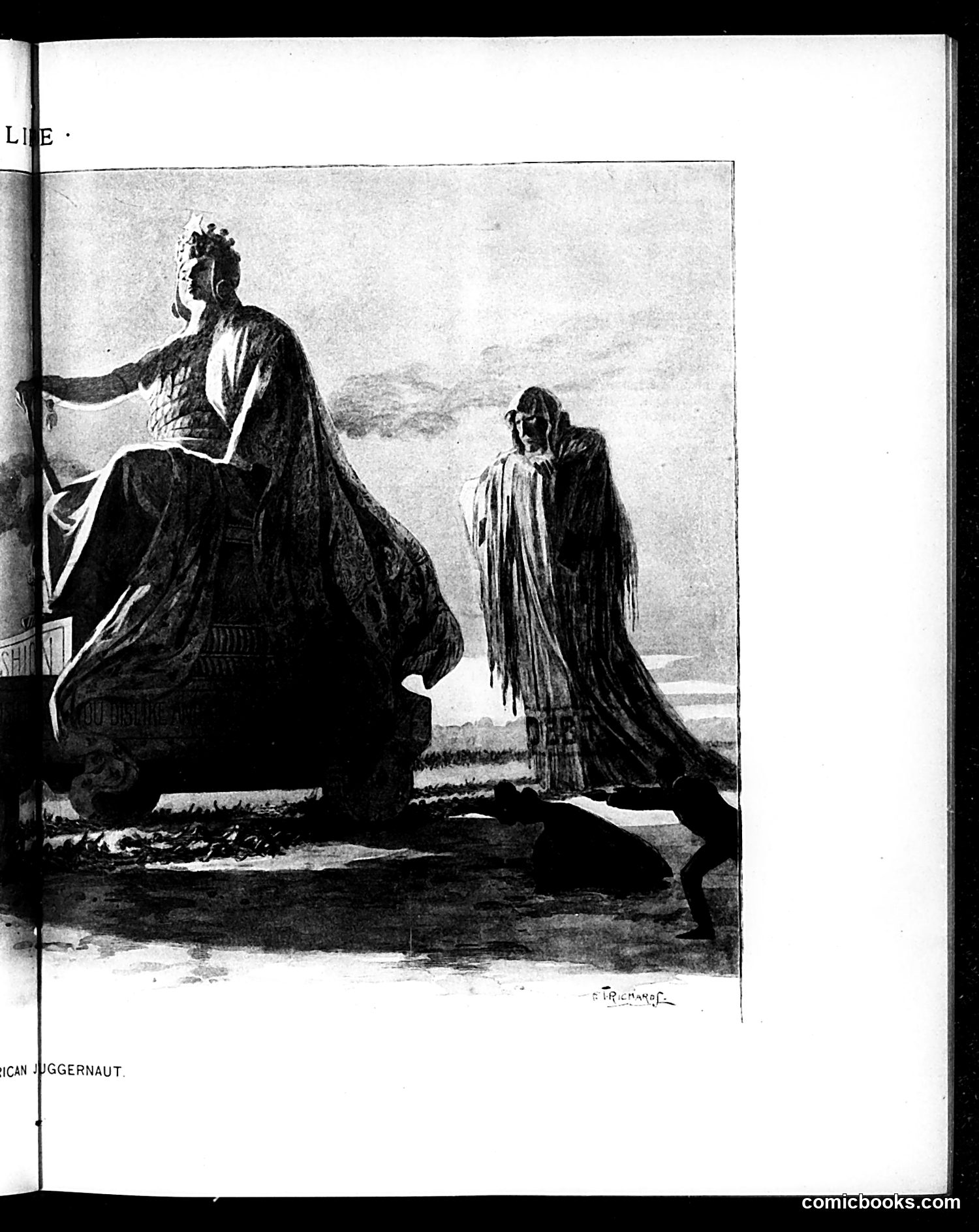
This appears to be an illustration from *Life* magazine depicting a scene of supplication or judgment. The image shows a standing figure in ornate, regal clothing on the left—possibly representing authority, deity, or allegorical power—gesturing toward a kneeling or bowing figure on the right in simpler robes. The dramatic chiaroscuro and formal composition suggest this illustrates a narrative of deference, divine judgment, or political submission. Without visible text on the page or clear historical context markers, the specific political reference remains unclear. The artist's signature appears to read "Prichard." The work likely satirizes a contemporary power dynamic or political relationship, but identifying the particular figures, historical moment, or satirical point requires additional contextual information not fully legible in this reproduction.
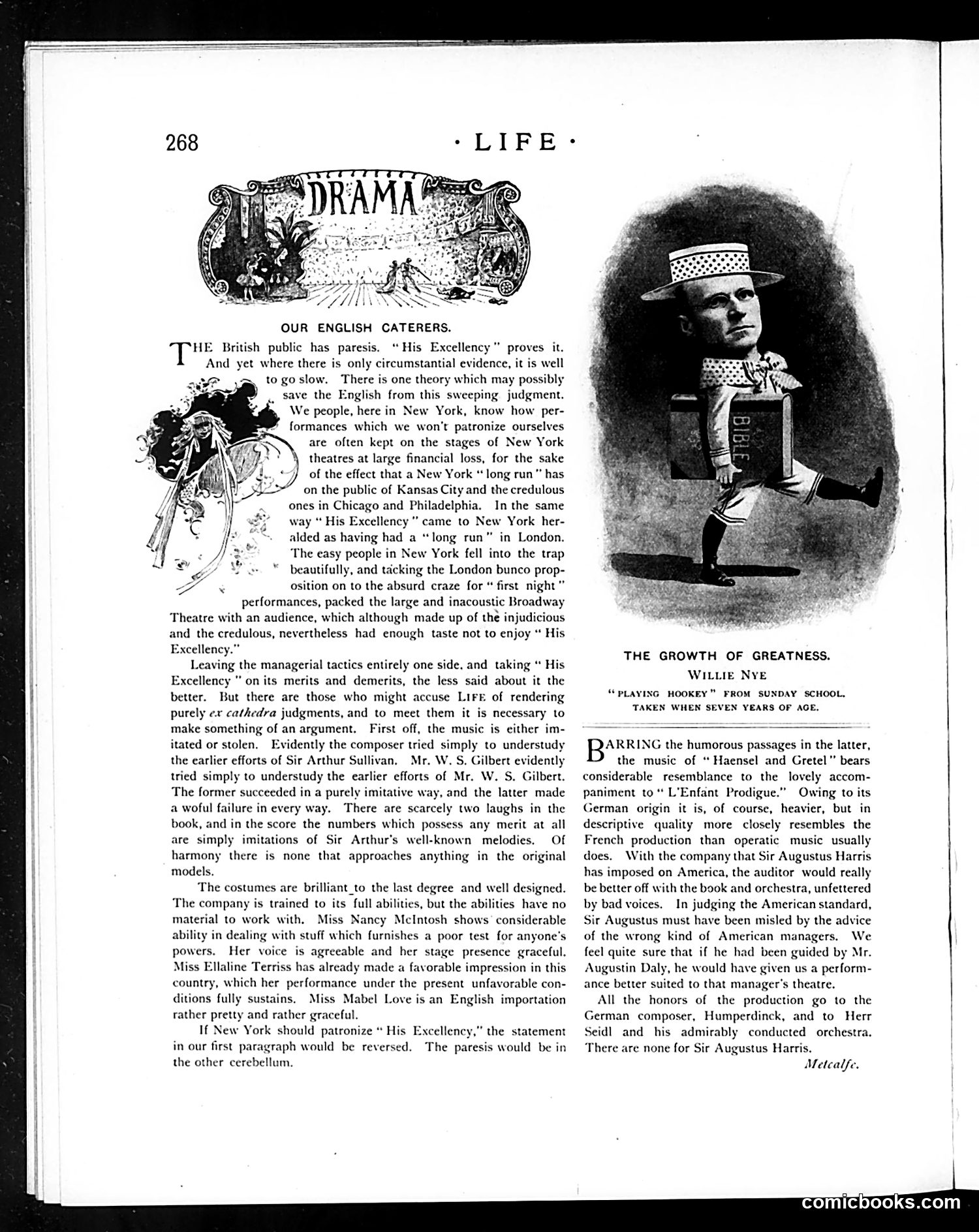
This page contains two separate pieces of dramatic criticism from Life magazine (circa late 1800s). **"Our English Caterers"** attacks the play "His Excellency," which had a successful London run but flopped in New York. Life argues New Yorkers were duped by London's prestige into attending a poorly-written show. The critic accuses the composer of imitating Sir Arthur Sullivan and the librettist of copying W.S. Gilbert—essentially calling it derivative Gilbert & Sullivan knockoff work. While praising the costumes and some cast members (Nancy McIntosh, Mabel Love), Life concludes the material itself is fundamentally weak, with minimal humor and unoriginal music. **"The Growth of Greatness"** presents a photograph of Willie Nye, apparently a child performer who played "hookey" from Sunday school at age seven. The accompanying review praises a production of "Hansel and Gretel" (with German composer Humperdinck), crediting its success to the composer and conductor Herr Seidl rather than Sir Augustus Harris's American cast. Both pieces exemplify Life's satirical cultural criticism, mocking pretension and imported British theatre while championing artistic merit.
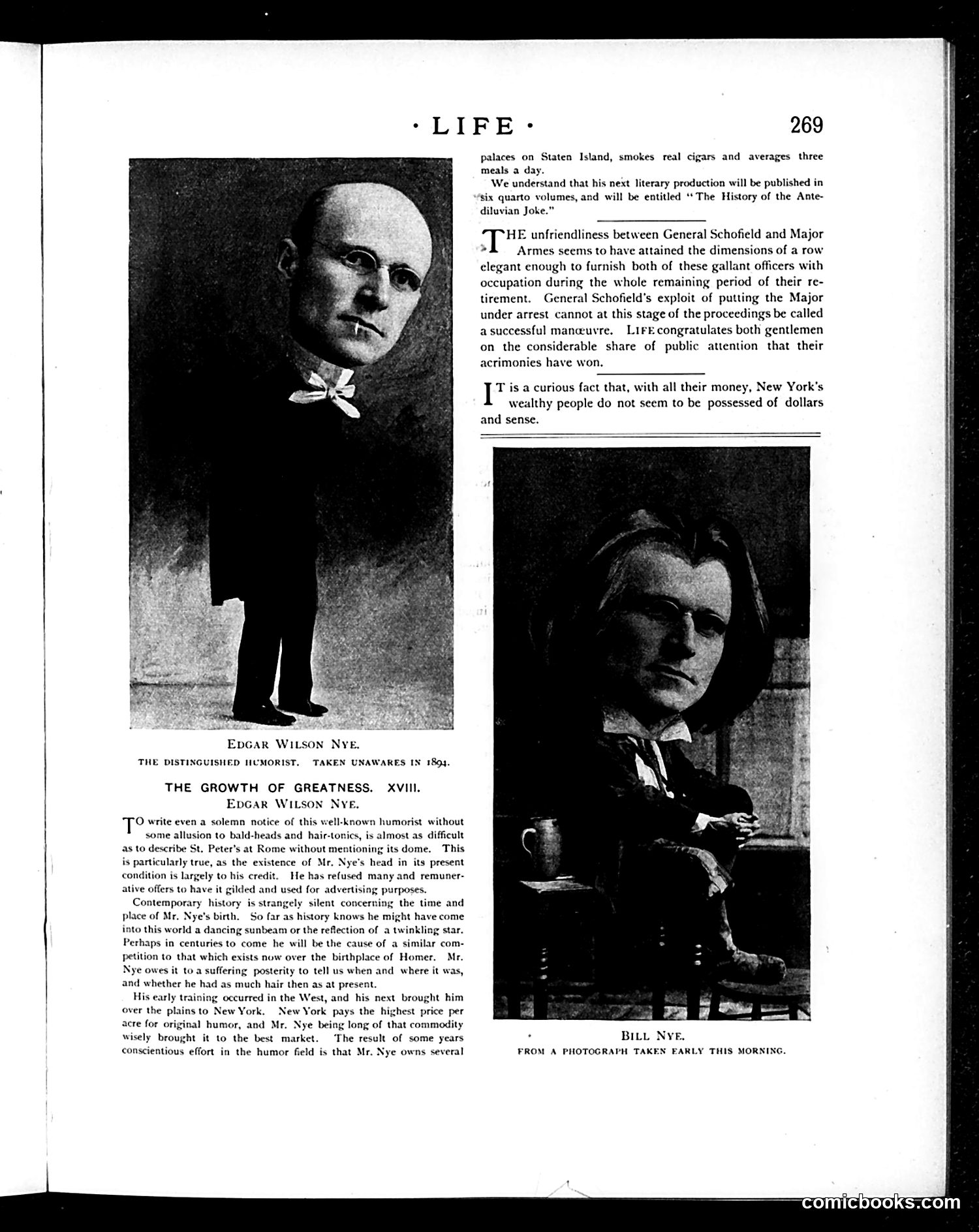
This page profiles Edgar Wilson Nye, a prominent American humorist of the 1890s. The two photographs show Nye at different times—one formal portrait from 1893, another candid shot taken that morning. The text is satirical biographical commentary in Life's signature style. It mocks Nye's bald head (which he refused to use for hair-tonic advertising despite lucrative offers), makes playful jokes about the unknown circumstances of his birth, and notes his success bringing "original humor" to New York's market, where he now owns "several palaces on Staten Island." A secondary note mentions a quarrel between General Schofield and Major Armes that has become publicly entertaining. The final quip—that wealthy New Yorkers lack "dollars and sense"—is a pun criticizing the city's rich for poor judgment. Overall, this celebrates Nye as a successful humorist while affectionately ribbing his appearance and persona.
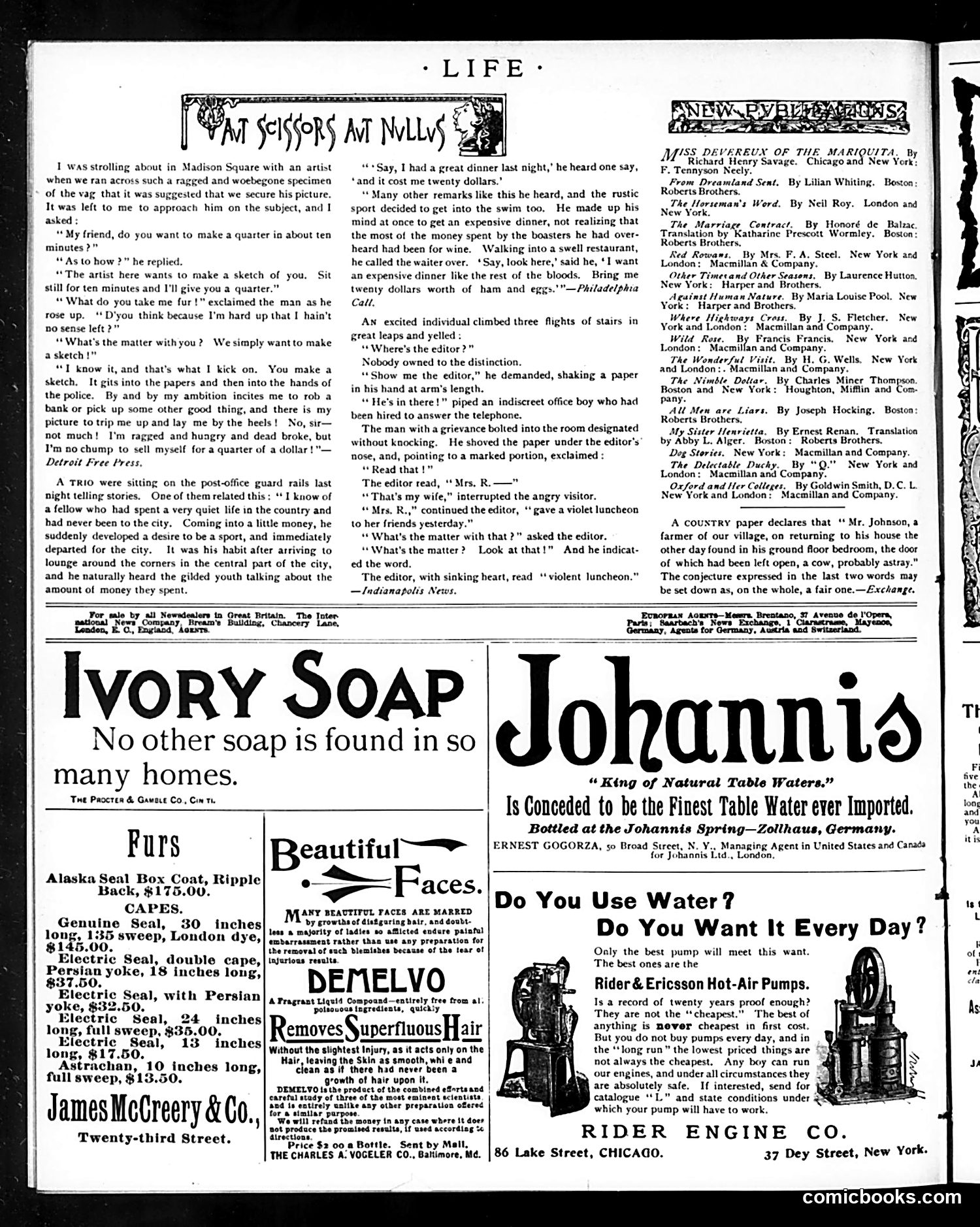
This page contains a humorous short story (not a political cartoon) about class aspiration and social pretension in late 19th-century America. **The Setup:** A ragged vagrant in Madison Square agrees to sit for an artist's sketch in exchange for a quarter. **The Joke:** The vagrant refuses, explaining that if his image appears in newspapers, it could later be used against him if he commits crimes—revealing he's unemployed and desperate enough to consider theft. **The Satire:** The humor mocks both the vagrant's criminal aspirations and broader social commentary: the story also includes anecdotes about working-class men trying to imitate wealthy diners by ordering expensive meals they can barely afford, highlighting the gap between rich and poor and the desperation of those seeking upward mobility. **Social Context:** This reflects Gilded Age anxieties about poverty, crime, and the visible presence of "ragamuffins" in public spaces—a tension between civilization and urban decay that fascinated contemporary readers.
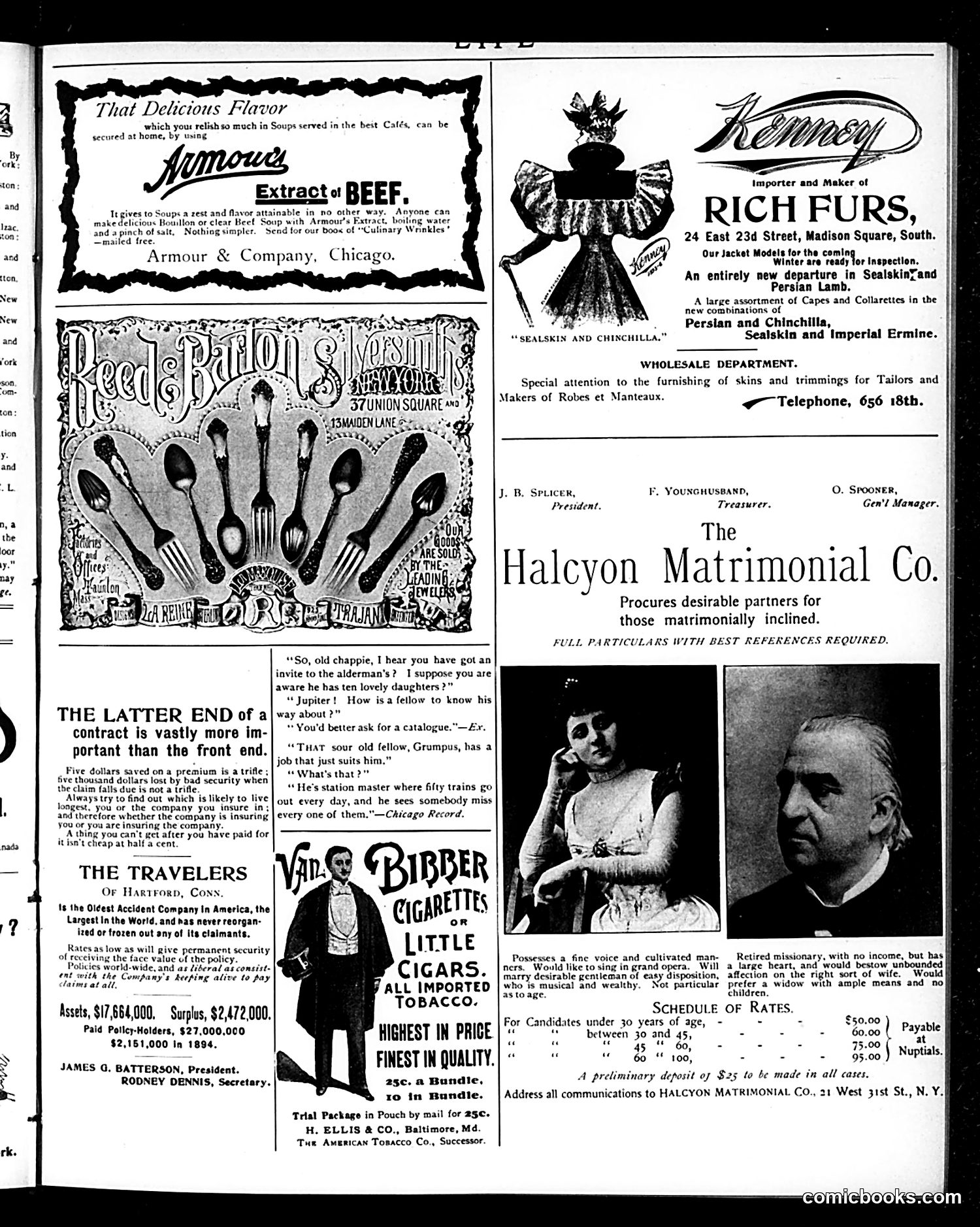
This page is primarily **advertisements** from a late-19th-century American magazine. The main content includes: **Notable Ads:** - **Armour's Beef Extract**: A soup flavoring product - **Reed & Barton silverware**: Ornate spoon/fork display - **Bibber Cigarettes**: Imported tobacco - **Travelers Insurance**: Company promoting accident insurance with financial details - **Halcyon Matrimonial Co.**: A **matchmaking service**—the most striking to modern eyes **The Satire:** Two brief jokes appear: 1. A man invited to an alderman's house with "ten lovely daughters" needs a catalogue to navigate them 2. A grumpy station master enjoys seeing people miss trains daily **What's Dated:** The Halcyon ad treats marriage-brokering as a legitimate business with fee schedules and client profiles seeking wealthy spouses—reflecting pre-modern dating conventions where matrimony was openly transactional. The insurance ad's lengthy financial claims emphasize company stability during an era of frequent corporate failures.
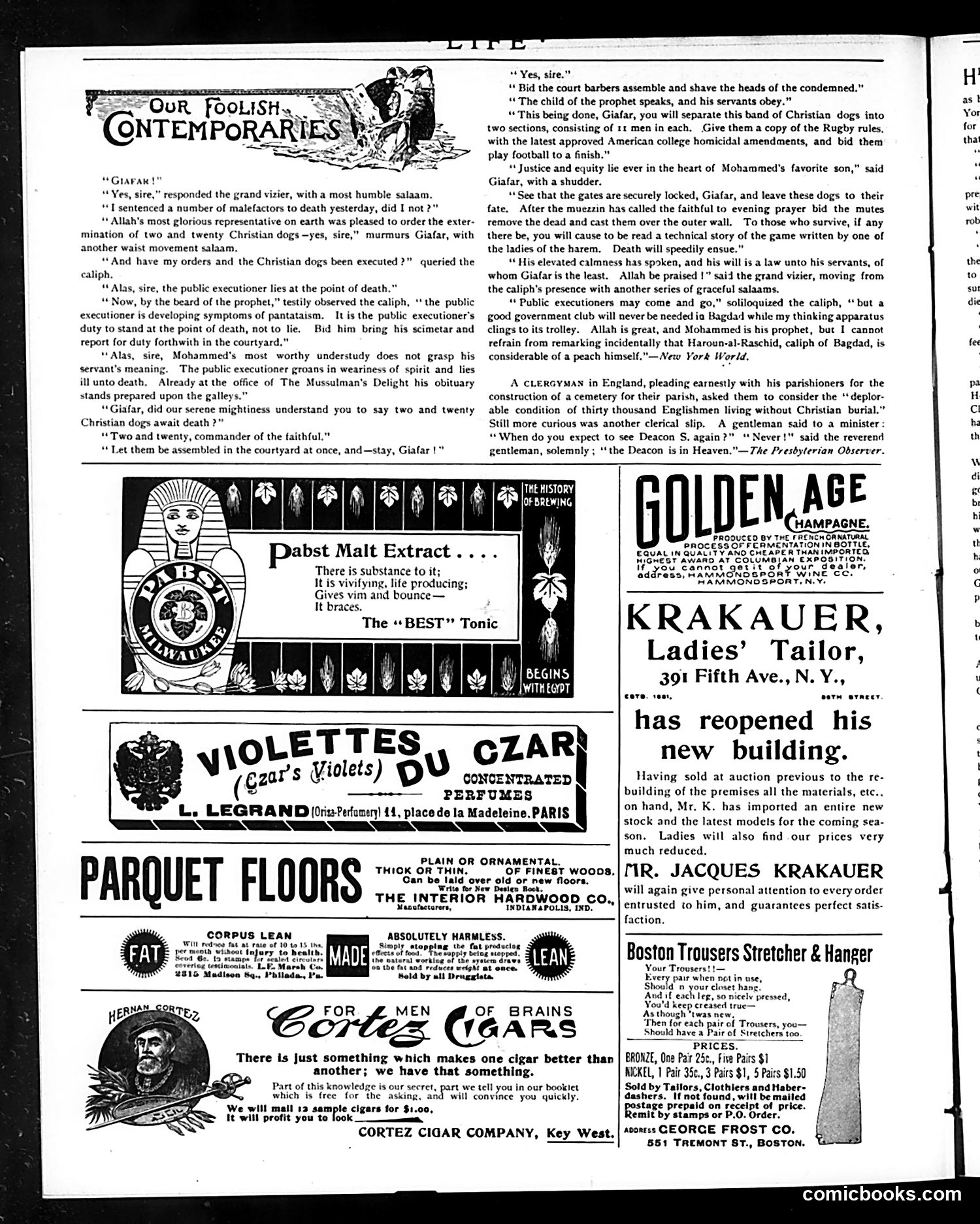
This is a satirical story-cartoon mocking American college football as brutally violent. The narrative presents a fictional Islamic caliph ordering Christian prisoners executed via "football to a finish" with "American college homicidal amendments" to the Rugby rules. The satire targets college football's reputation for dangerous, often fatal injuries during the early 1900s. By framing the sport as an instrument of execution in an "Oriental despot" tale, the author attacks American institutions for permitting such violence. The dark humor—that a tyrannical ruler would choose football as a method of execution—suggests the sport was genuinely seen as life-threatening. This reflects real historical concern: early American football was so violent that presidents and reformers debated banning it. The story uses exoticized "Oriental" fiction as a vehicle to critique American society's casual acceptance of football casualties.
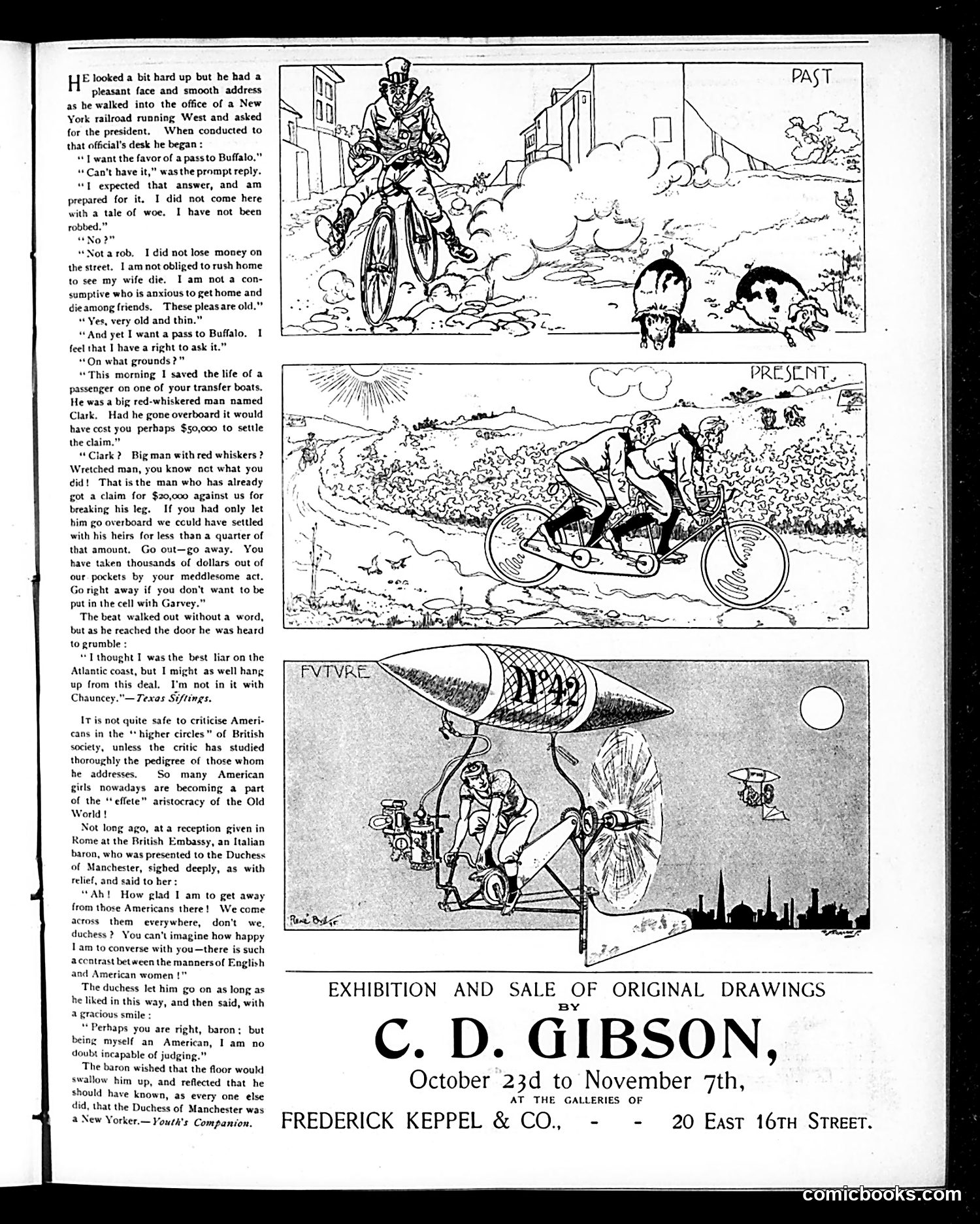
This page contains two satirical anecdotes mocking American social pretension and railroad bureaucracy, plus an advertisement. **First story**: A man saves a railroad passenger's life only to be rejected for a pass to Buffalo. The punchline: the "rescued" man (Clark) is a chronic litigant who previously sued the railroad for a broken leg. The railroad president ironically thanks him for *not* letting Clark drown, since his death would have cost less in settlements than the man's living lawsuits. The satire targets corporate indifference and the absurdity of injury litigation. **Second story**: An Italian baron insults Americans at a British Embassy reception in Rome, praising English manners over American ones—only to learn his conversation partner, the Duchess of Manchester, is herself a New York woman. The satire mocks British snobbery toward Americans and the irony that wealthy American heiresses were marrying into British aristocracy, making such condescension foolish. Both stories exemplify *Life*'s satirical humor about American social climbing and institutional hypocrisy. The bottom advertises C.D. Gibson's exhibition of original drawings.
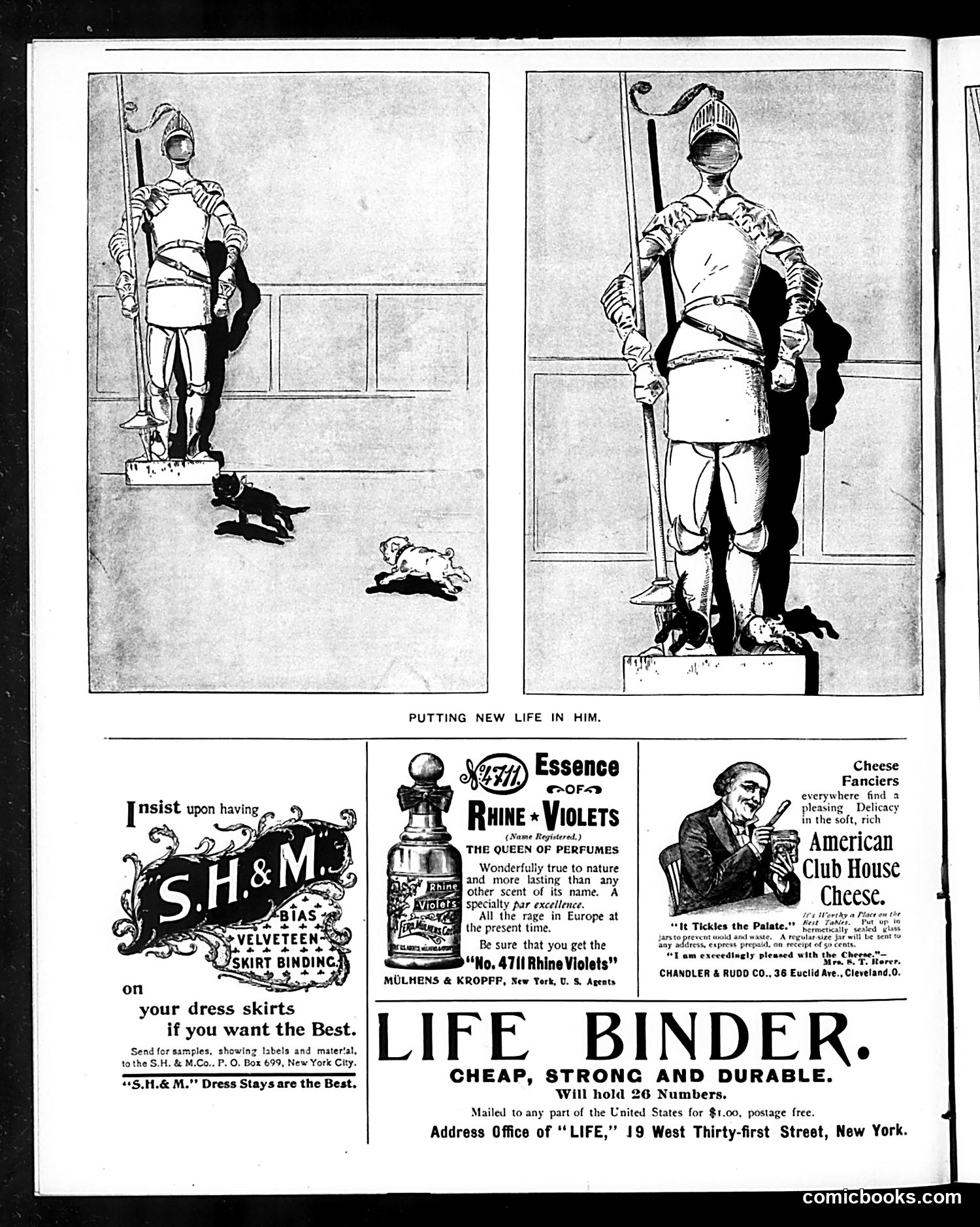
This two-panel cartoon depicts a knight in armor being revived or restored to vitality. The first panel shows the armored figure appearing lifeless or exhausted; the second shows him reinvigorated and standing upright with renewed vigor. The satire appears to reference **revitalizing something old or defunct**—likely a political institution, historical ideal, or cultural practice. The knight imagery suggests appeals to chivalry, nobility, or medieval romanticism popular in late 19th/early 20th-century discourse. The page is primarily **advertisements** (dress skirts, perfume, cheese, binders) with the cartoon at top. Without additional context about the specific issue's date or political climate, the exact target remains unclear—it could reference military renewal, aristocratic values, or political restoration movements of that era. The joke: whatever this "knight" represents is being artificially revived rather than organically sustained.
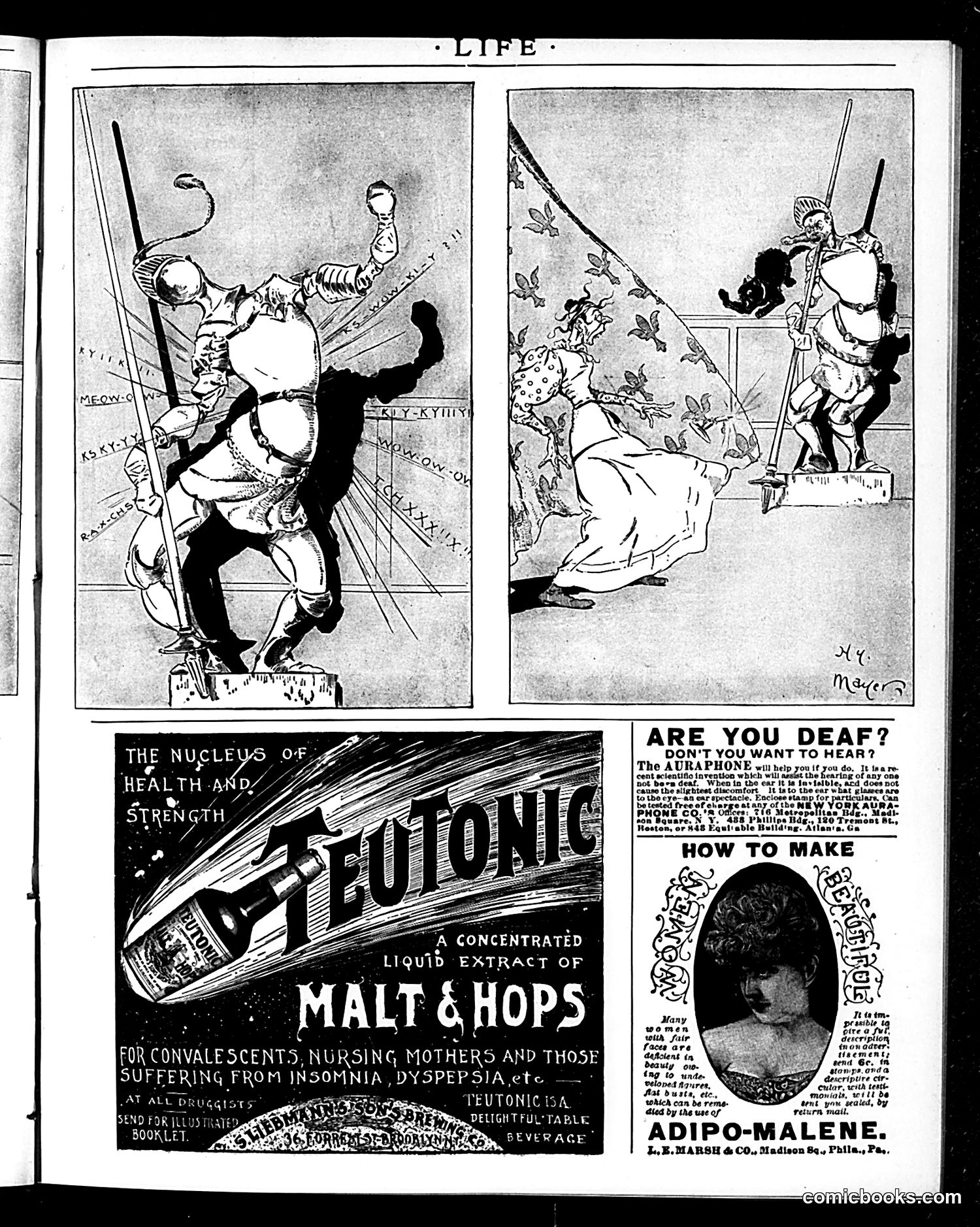
**The Cartoons (top):** Two parallel panels satirize female domesticity—showing women juggling household duties amid chaos (children, animals, jumping figures). The humor appears to mock the impossible demands on women's time and sanity, with cat-like creatures labeled with sound effects adding absurdist elements. **The Advertisements (bottom):** Three period remedies illustrate early 20th-century medical quackery: - **Teutonic**: A "malt & hops" tonic marketed for nursing mothers and insomnia—suggesting alcohol-based "health" products - **Auraphone**: A hearing device advertisement - **Adipo-Malene**: A beauty/weight-loss product Together, the page satirizes women's anxieties while simultaneously exploiting them through dubious commercial "solutions." The cartoons show the stress; the ads promise relief—a critique of how marketing preys on overworked women.
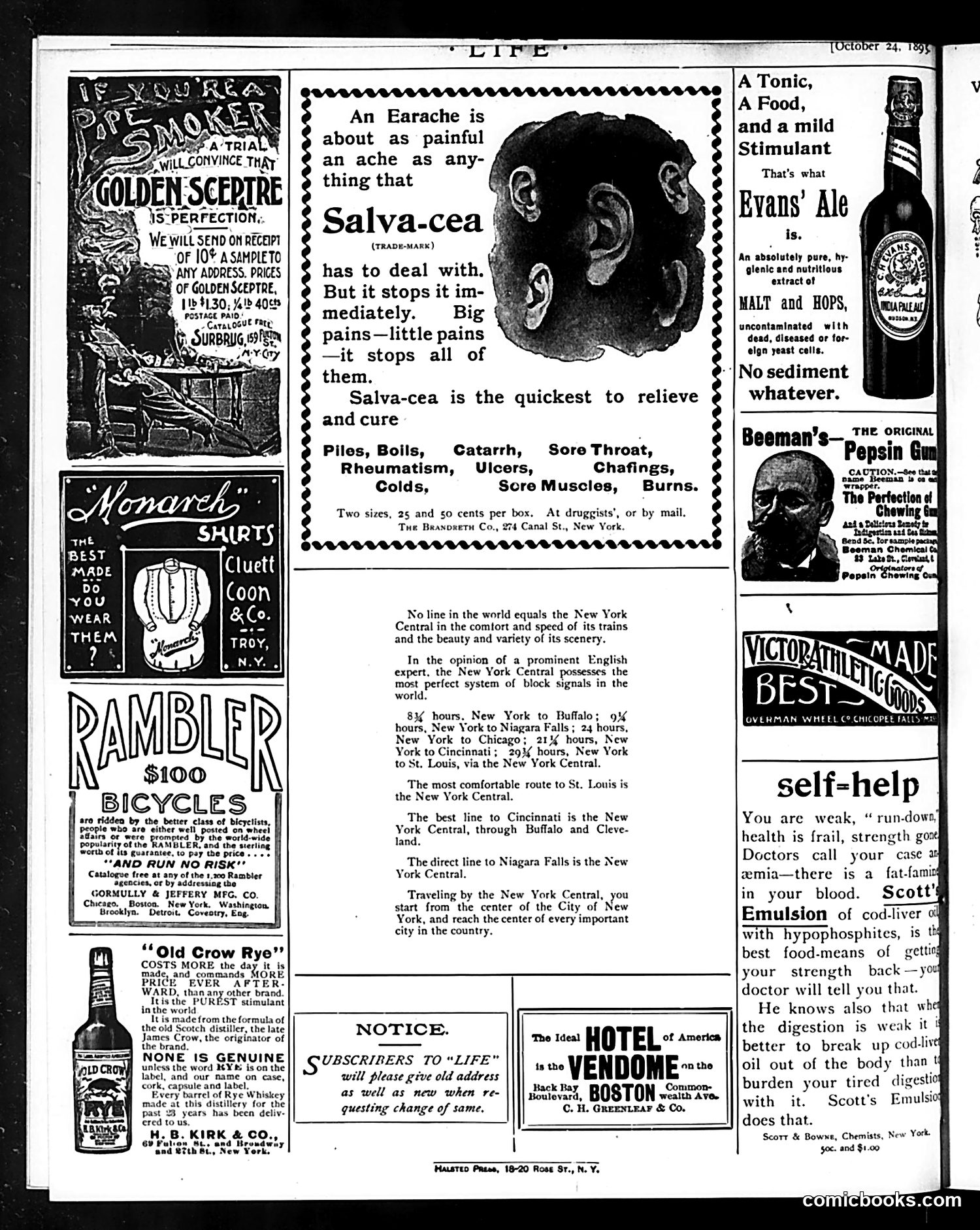
This is primarily an **advertising page** from Life magazine's satirical heyday. The central content is a large advertisement for "Salva-cea," a patent medicine claiming to cure earaches, piles, boils, catarrh, and various other ailments—typical of the era's unregulated medical marketplace. Surrounding this are period advertisements for: - **Evans' Ale** (marketed as a pure tonic) - **Beeman's Pepsin Gum** - **Rambler Bicycles** (a popular consumer good) - **Scott's Emulsion** (cod-liver oil supplement for weakness/anemia) - **Old Crow Rye whiskey** (claimed as "purest stimulant") - **New York Central Railroad** (luxury travel) **The satirical context**: While Life was known for sharp social commentary, this page reflects the magazine's business model—advertising revenue from patent medicines, tonics, and dubious health products that preyed on consumers' fears. Modern readers should note these ads represent medical claims that would be illegal today, reflecting the pre-FDA regulation era when such products required no proven efficacy.