
Life, 1895-10-24 · page 4 of 20
Life — October 24, 1895 — page 4: what you’re looking at
What you’re looking at
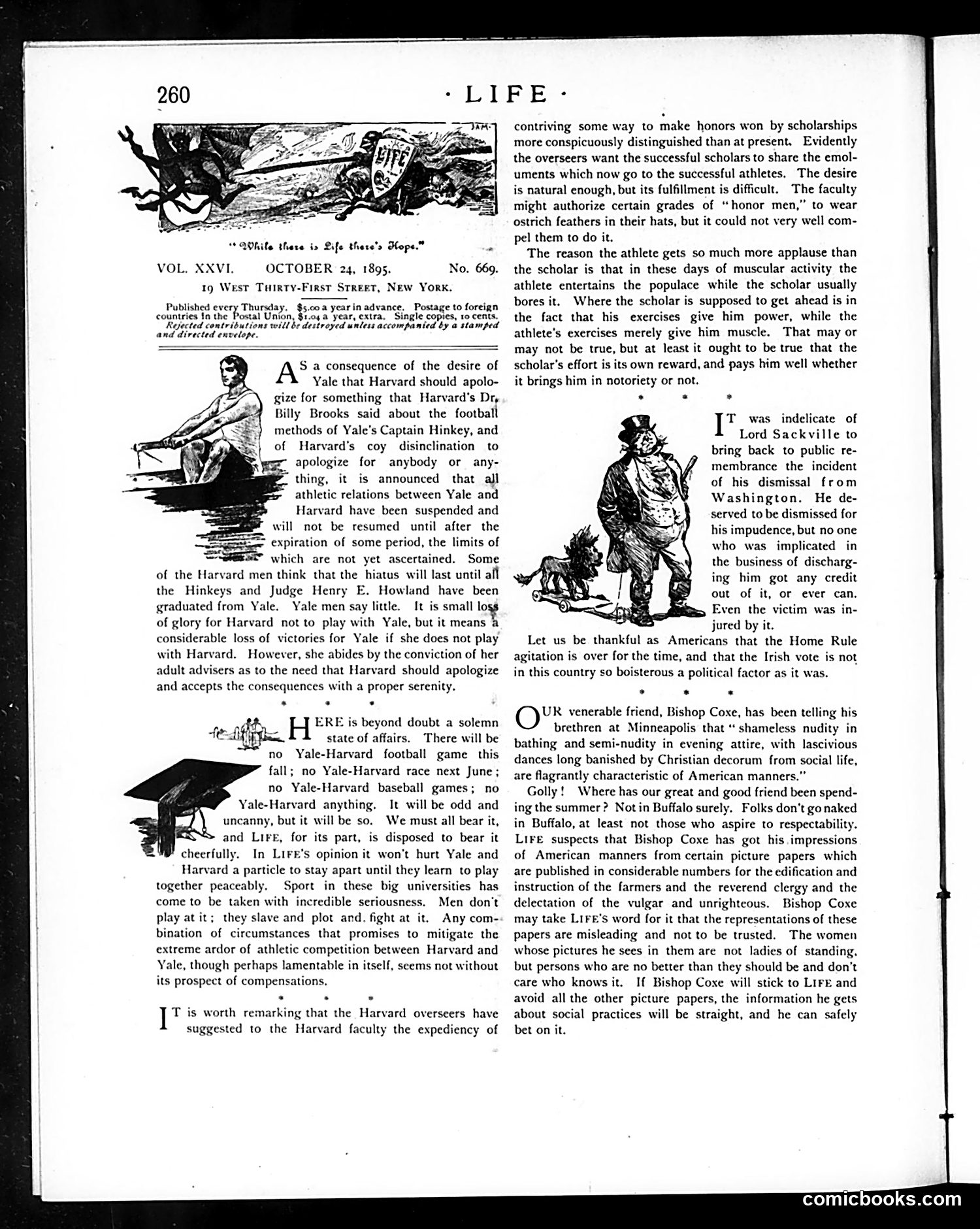
This page discusses a Yale-Harvard athletic dispute. The main text criticizes the disproportionate public acclaim athletes receive compared to scholars, arguing that athletes "entertain the populace" while scholars are overlooked—despite scholars' work being equally valuable. The page also addresses Lord Sackville's dismissal from Washington, suggesting his removal was politically motivated and questioning whether those responsible for his discharge deserve credit. A third section satirizes Bishop Coxe's comments about "shameless nudity" in American bathing attire and social dancing, suggesting he's been influenced by prejudicial European pictures of American women. Life defends American social practices and questions the bishop's reliability as a cultural commentator. The cartoons (illustrations visible but details unclear in reproduction) appear to accompany these satirical critiques.
📄 Transcribed text from this page (OCR, searchable)
Machine-transcribed from the original scan — historical spelling and the odd misread are preserved.
->LIFE- *QWhile there is Life there's Hope.” ba VOL. XXVI. OCTOBER 24, 1895. No. 669. 1g West Tuirty-First Street, New York. Published every Thursday, $5.coa yearin advance. Postag countries tn the Postal Union, $1.04 a year, extra, Single cop! Rejected contributions will be destroyed unless accompanied & and directed envelope. foreign 0 cents. stamped S a consequence of the desire of Yale that Harvard should apolo- gize for something that Harvard's Dr, Billy Brooks said about the football -) methods of Yale's Captain Hinkey, and | of Harvard’s coy disinclination to apologize for anybody or any- thing, it is announced that all athletic relations between Yale and Harvard have been suspended and will not be resumed until after the = expiration of some period, the limits of which are not yet ascertained. Some of the Harvard men think that the hiatus will last until afl the Hinkeys and Judge Henry E. Howland have been graduated from Yale. Yale men say little. It is small lo: of glory for Harvard not to play with Yale, but it means a considerable loss of victories for Yale if she does not play with Harvard. However, she abides by the conviction of her adult advisers as to the need that Harvard should apologize and accepts the consequences with a proper serenity. agit is beyond doubt a solemn e-<iff H state of affairs. There will be no Yale-Harvard football game this fall; no Yale-Harvard race next June; no Yale-Harvard baseball games; no Yale-Harvard anything. It will be odd and uncanny, but it will be so, We must all bear it, and LiFe, for its part, is disposed to bear it cheerfully. In LiFE’s opinion it won't hurt Yale and Harvard a particle to stay apart until they learn to play together peaceably, Sport in these big universities has come to be taken with incredible seriousness. Men don't play at it; they slave and plot and. fight at it. Any com- bination of circumstances that promises to mitigate the extreme ardor of athletic competition between Harvard and Yale, though perhaps lamentable in itself, seems not without its prospect of compensations. T is worth remarking that the Harvard overseers have suggested to the Harvard faculty the expediency of contriving some way to make honors won by scholarships more conspicuously distinguished than at present, Evidently the overseers want the successful scholars to share the emol- uments which now go to the successful athletes. The desire is natural enough, but its fulfillment is difficult, The faculty might authorize certain grades of “honor men,” to wear ostrich feathers in their hats, but it could not very well com- pel them to do it. The reason the athlete gets so much more applause than the scholar is that in these days of muscular activity the athlete entertains the populace while the scholar usually bores it. Where the scholar is supposed to get ahead is in the fact that his exercises give him power, while the athlete's exercises merely give him muscle. That may or may not be true, but at least it ought to be true that the scholar's effort is its own reward, and pays him well whether it brings him in notoriety or not. . * I" was indelicate of Lord Sackville to bring back to public re- membrance the incident of his dismissal from Washington. He de- served to be dismissed for his impudence, but no one who was implicated in the business of discharg- ing him got any credit out of it, or ever can. Even the victim was in- jured by it. Let us be thankful as Americans that the Home Rule agitation is over for the time, and that the Irish vote is not in this country so boisterous a political factor as it was. UR venerable friend, Bishop Coxe, has been telling his brethren at Minneapolis that “ shameless nudity in bathing and semi-nudity in evening attire, with lascivious dances long banished by Christian decorum from social life, are flagrantly characteristic of American manners.” Golly! Where has our great and good friend been spend- ing the summer ? Notin Buffalo surely. Folks don’t gonaked in Buffalo, at least not those who aspire to respectability. LiFe suspects that Bishop Coxe has got his.impressions of American manners from certain picture papers which are published in considerable numbers for the edification and instruction of the farmers and the reverend clergy and the delectation of the vulgar and unrighteous. Bishop Coxe may take LIFE's word for it that the representations of these papers are misleading and not to be trusted. The women whose pictures he sees in them are not ladies of standing, but persons who are no better than they should be and don’t care who knows it. If Bishop Coxe will stick to Lire and avoid all the other picture papers, the information he gets about social practices will be straight, and he can safely bet on it. comicbooks.com