
Life, 1895-10-24 · page 7 of 20
Life — October 24, 1895 — page 7: what you’re looking at
What you’re looking at
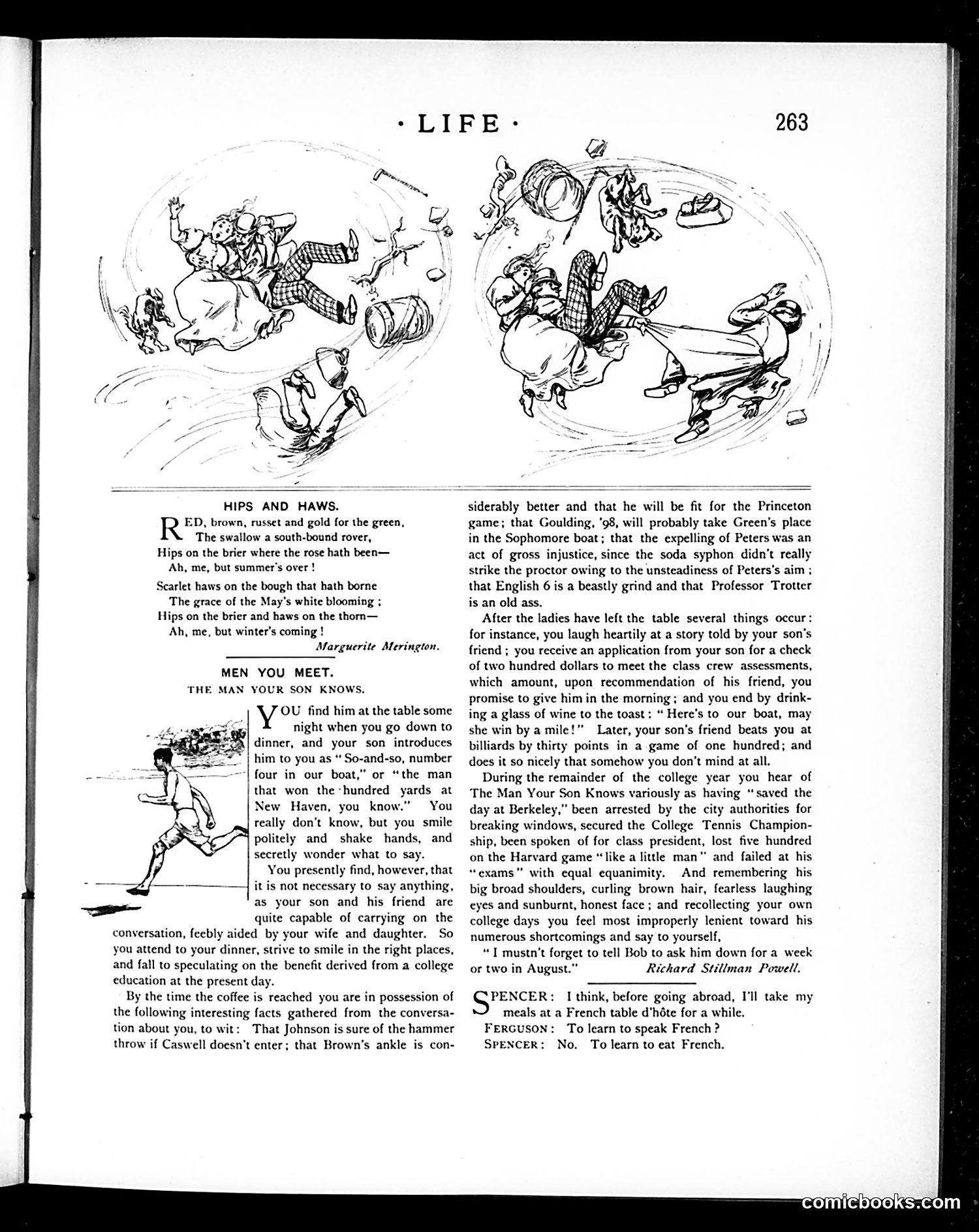
This page from *Life* magazine contains two satirical sections about college life, circa early 1900s. **"Hips and Haws"** is a poem (by Marguerite Merington) mocking romantic collegiate behavior—references to "hips on the brier" and flirtation suggest humor about young people's social awkwardness. **"Men You Meet"** satirizes the stereotypical college man, specifically the athlete-type who boasts about sports achievements (winning races at New Haven) but lacks substance. The text mocks how parents indulge and excuse such men's shortcomings—breaking windows, academic failures—because of athletic prowess. The closing dialogue between Spencer and Ferguson jokes about learning French versus eating French food, continuing the theme of superficial college pursuits. The overall satire targets both pretentious undergraduates and parents' misplaced pride in them.
📄 Transcribed text from this page (OCR, searchable)
Machine-transcribed from the original scan — historical spelling and the odd misread are preserved.
HIPS AND HAWS. ED, brown, russet and gold for the green, The swallow a south-bound rover, Hips on the brier where the rose hath been— Ah, me, but summer's over ! Scarlet haws on the bough that hath borne The grace of the May's white blooming ; Hips on the brier and haws on the thorn— Ah, me, but winter's coming ! Marguerite Merington. MEN YOU MEET. THE MAN YOUR SON KNOWS. OU find him at the table some night when you go down to dinner, and your son introduces him to you as “ So-and-so, number four in our boat,” or “the man that won the hundred yards at New Haven, you know.” You really don’t know, but you smile politely and shake hands, and secretly wonder what to say. You presently find, however, that it is not necessary to say anything, as your son and his friend are quite capable of carrying on the conversation, feebly aided by your wife and daughter. So you attend to your dinner, strive to smile in the right places, and fall to speculating on the benefit derived from a college education at the present day. By the time the coffee is reached you are in possession of the following interesting facts gathered from the conversa- tion about you, to wit: That Johnson is sure of the hammer throw if Caswell doesn’t enter; that Brown's ankle is con- game; that Goulding, ‘98, will probably take Green's place in the Sophomore boat; that the expelling of Peters was an act of gross injustice, since the soda syphon didn’t really strike the proctor owing to the unsteadiness of Peters’s aim ; that English 6 is a beastly grind and that Professor Trotter is an old ass. After the ladies have left the table several things occur: for instance, you laugh heartily at a story told by your son’s friend ; you receive an application from your son for a check of two hundred dollars to meet the class crew assessments, which amount, upon recommendation of his friend, you promise to give him in the morning ; and you end by drink- ing a glass of wine to the toast: “ Here’s to our boat, may she win by a mile!” Later, your son's friend beats you at billiards by thirty points in a game of one hundred; and does it so nicely that somehow you don’t mind at all. During the remainder of the college year you hear of The Man Your Son Knows variously as having “saved the day at Berkeley,” been arrested by the city authorities for breaking windows, secured the College Tennis Champion- ship, been spoken of for class president, lost five hundred on the Harvard game “like a little man” and failed at his “exams” with equal equanimity. And remembering his big broad shoulders, curling brown hair, fearless laughing eyes and sunburnt, honest face ; and recollecting your own college days you feel most improperly lenient toward his numerous shortcomings and say to yourself, “T mustn't forget to tell Bob to ask him down for a week or two in August.” Richard Stillman Powell. ener I think, before going abroad, I'll take my meals at a French table d'héte for a while. FERGUSON: To learn to speak French ? SPENCE! No. To learn to eat French.