
Life, 1895-10-24 · page 6 of 20
Life — October 24, 1895 — page 6: what you’re looking at
What you’re looking at
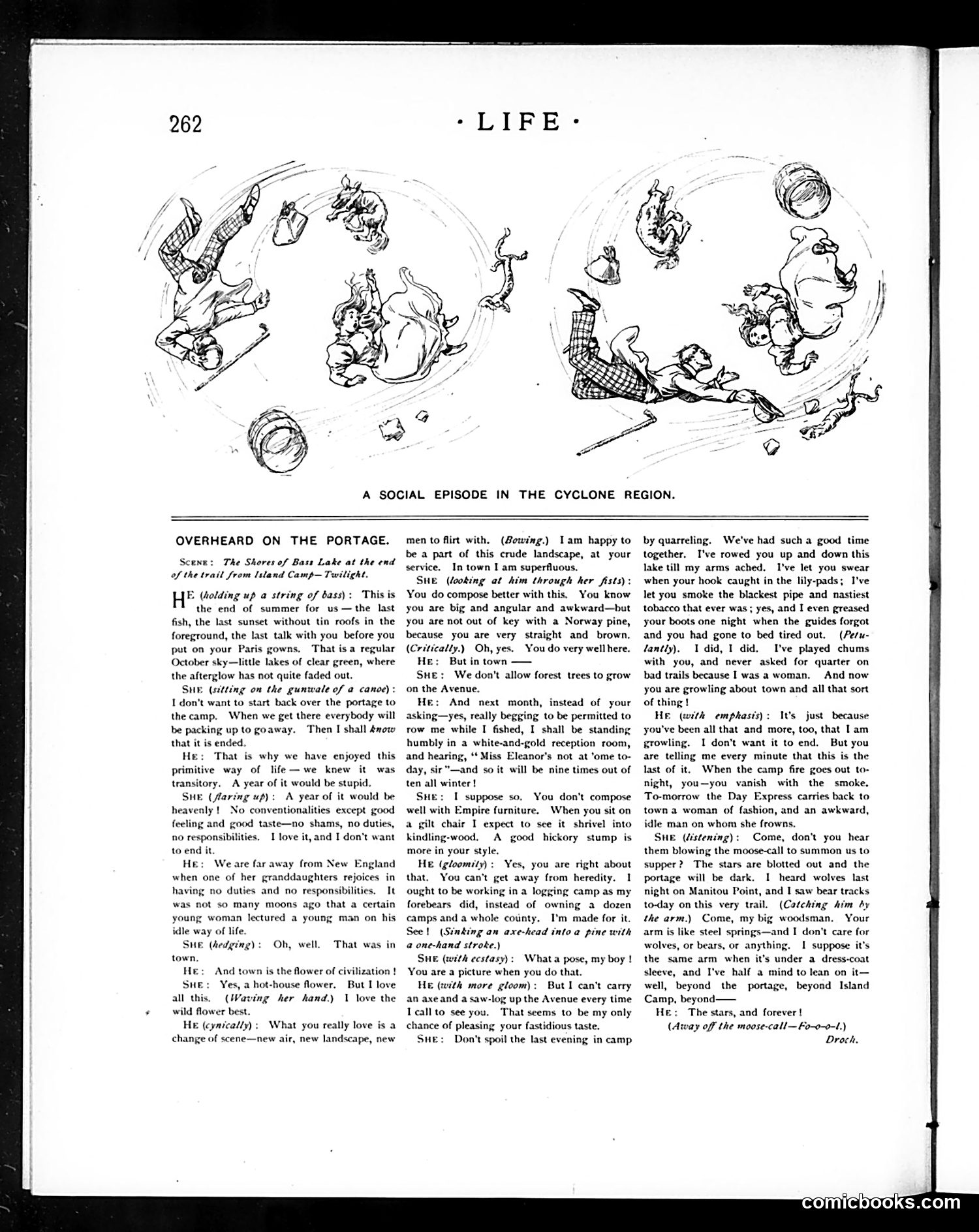
This page contains a humorous dialogue and illustrations depicting people in chaotic weather conditions. The scene shows figures being blown about by a cyclone/tornado at Bass Lake, with people tumbling through the air and clinging to objects. The satire centers on social pretension versus natural disaster. Characters discuss maintaining civility and proper behavior ("composing" oneself, proper furniture, social etiquette) while literally being caught in a violent storm. The irony is that social conventions become absurd when facing nature's overwhelming force—one character insists on proper dress and decorum even as cyclonic winds make survival the only real concern. The joke satirizes how people cling to artificial social rules and class distinctions that become meaningless in genuinely dangerous circumstances. It's commentary on misplaced priorities and the comedy of maintaining propriety during chaos.
📄 Transcribed text from this page (OCR, searchable)
Machine-transcribed from the original scan — historical spelling and the odd misread are preserved.
A SOCIAL EPISODE IN THE CYCLONE REGION. OVERHEARD ON THE PORTAGE. Scent: The Shores of Bass Lake at the end of the trail from Island Camp— Twilight. HE Wielding up a string of bass): This is the end of summer for us — the last fish, the last sunset without tin roofs in the foreground, the last talk with you before you put on your Paris gowns, That isa regular October sky—little lakes of clear green, where the afterglow has not quite faded out. SUE (sitting on the gunwale of a canoe): I don’t want to start back over the portage to the camp. When we get there everybody will be packing up to goaway. Then I shall Anow that it is ended. He: That is why we have enjoyed this primitive way of life—we knew it transitory. A year of it would be stupid. Sue (flaring up): A year of it would be heavenly | No conventionalities except good feeling and good taste—no shams, no duties, no responsibilities. I love it, and I don’t want to end it. He: Weare faraway from New England when one of her granddaughters rejoices in having no duties and no responsibilities. It was not so many moons ago that a certain young woman lectured a young man on his idle way of life. SUE. (hedging) : town. He was Oh, well, That was in And town is the flower of civilization ! Sue: Yes, a hot-house flower, But I love all this, (Waving her hand.) 1 love the wild flower best. He (cynically): What you really love is a change of scene—new air, new landscape, new men to flirt with, (Bowing.) Iam happy to be a part of this crude landscape, at your service. In town I am superfluous. Sue (looking at him through her fists): You do compose better with this. You know you are big and angular and awkward—but you are not out of key with a Norway pine, because you are very straight and brown. (Critically.) Oh, yes. You do very well here. He: But in town — SHE: We don't allow forest trees to grow on the Avenue. He: And next month, instead of your asking—yes, really begging to be permitted to row me while I fished, I shall be standing humbly in a white-and-gold reception room, and hearing, Miss Eleanor's not at ‘ome to- day, sir"—and so it will be nine times out of ten all winter! SHE: I suppose so. You don't compose well with Empire furniture. When you sit on a gilt chair I expect to see it shrivel into kindling-wood. A good hickory stump is more in your style, He (gloomily): Yes, you are right about You can't get away from heredity. 1 ought to be working in a logging camp as my forebears did, instead of owning a dozen camps and a whole county, I'm made for it. See! (Sinking an axe-head intoa pine with @ one-hand stroke.) SHE (with ecstasy): Whata pose, my boy | You are a picture when you do that. ith more gloom): But can't carry an axeand a saw-log up the Avenue every time Teall to see you. That seems to be my only chance of pleasing your fastidious taste. Don't spoil the last evening in camp by quarreling. We've had such a good time together. I've rowed you up and down this lake till my arms ached, I've let you swear when your hook caught in the lily-pads; I've let you smoke the blackest pipe and nastiest tobacco that ever was; yes, and I even greased your boots one night when the guides forgot and you had gone to bed tired out. (Peru- tantly). 1 did, 1 did, I've played chums with you, and never asked for quarter on bad trails because I was a woman. And now you are growling about town and all that sort of thing! He (with emphasis): W's just because you've been all that and more, too, that Iam growling. I don't want it to end. But you are telling me every minute that this is the last of it. When the camp fire gocs out to- night, you—you vanish with the smoke. To-morrow the Day Express carries back to town a woman of fashion, and an awkward, idle man on whom she frowns. SHE (listening): Come, don't you hear them blowing the moose-call to summon us to supper? The stars are blotted out and the portage will be dark. I heard wolves last night on Manitou Point, and I saw bear tracks to-day on this very trail. (Catching him by the arm.) Come, my big woodsman. Your arm is like steel springs—and I don't care for wolves, or bears, or anything. I suppose it's the same arm when it's under a dress-coat sleeve, and I've half a mind to lean on it— well, beyond the portage, beyond Island Camp, beyond — He: The stars, and forever! (Atway off the moose-call—Fo-0-0-l.) Droch. Comicbooks.com