
Life, 1895-10-24 · page 3 of 20
Life — October 24, 1895 — page 3: what you’re looking at
What you’re looking at
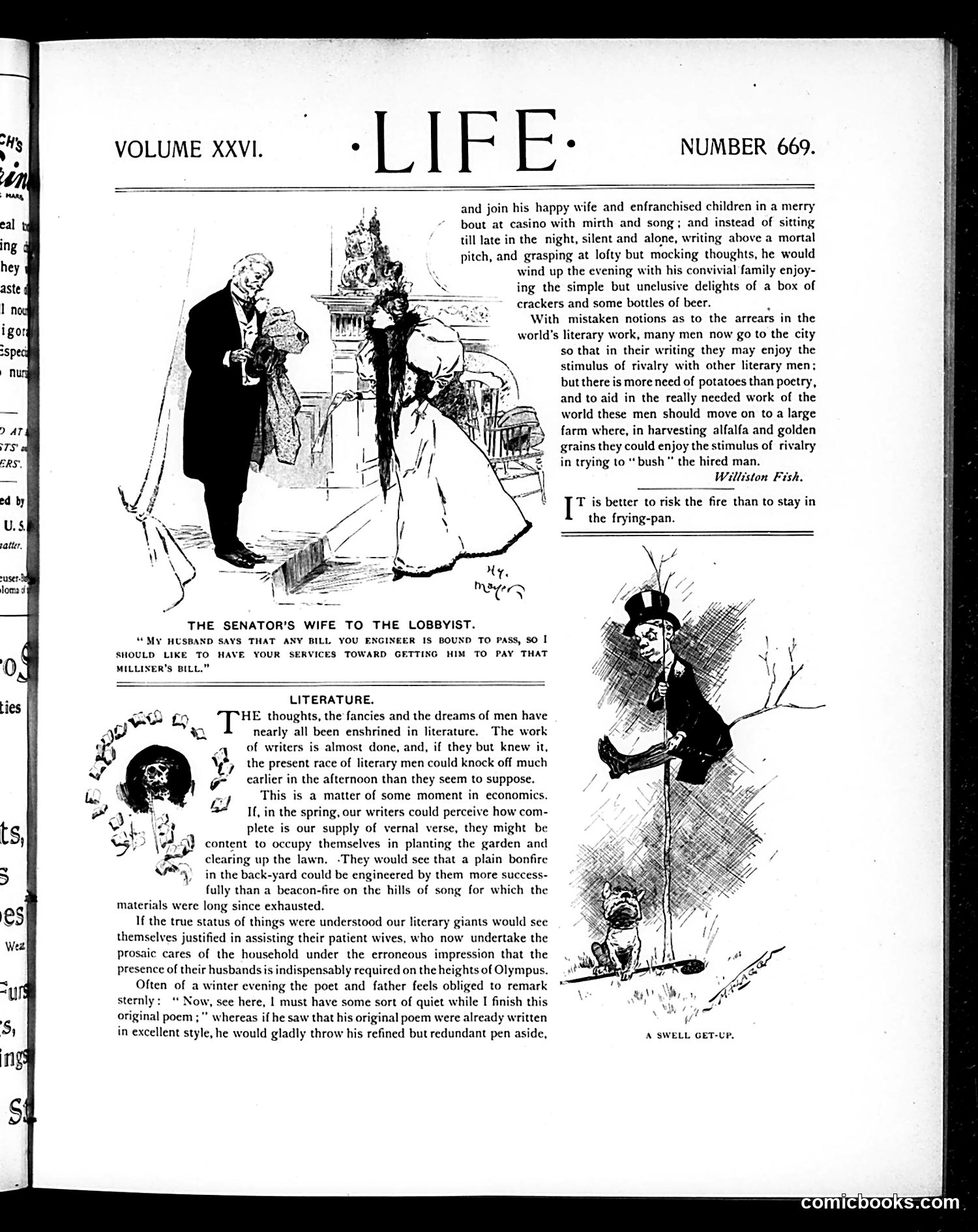
**"The Senator's Wife to the Lobbyist"** (top cartoon): A well-dressed woman approaches a man, saying she wants his help getting her husband's engineer friend paid for a public works bill. This satirizes the corrupt practice of using personal connections and lobbyists to secure government contracts—a common Progressive Era critique of political favoritism and "special interests" circumventing legitimate process. **"Literature" section**: The essay by William Fitch mocks literary men who neglect productive work (farming, business) to pursue writing, claiming they waste time on unremunerative poetry while their wives manage households. The satire critiques impractical intellectualism and argues writers should contribute economically rather than pursuing artistic vanity. **"A Swell Get-Up"** (right cartoon): Appears to depict a poorly-dressed man, likely mocking lower-class pretension or failed social aspiration.
📄 Transcribed text from this page (OCR, searchable)
Machine-transcribed from the original scan — historical spelling and the odd misread are preserved.
VOLUME XXVI. : |. | FE E : NUMBER 669. and join his happy wife and enfranchised children in a merry bout at casino with mirth and song; and instead of sitting till late in the night, silent and alone, writing above a mortal pitch, and grasping at lofty but mocking thoughts, he would wind up the evening with his convivial family enjoy- ing the simple but unelusive delights of a box of crackers and some bottles of beer. : With mistaken notions as to the arrears in the world’s literary work, many men now go to the city so that in their writing they may enjoy the stimulus of rivalry with other literary men; but there is more need of potatoes than poetry, and to aid in the really needed work of the world these men should move on to a large farm where, in harvesting alfalfa and golden grains they could enjoy the stimulus of rivalry in trying to “bush” the hired man. Williston Fish. T is better to risk the fire than to stay in the frying-pan. THE SENATOR'S WIFE TO THE LOBBYIST. “(My HUSBAND SAYS THAT ANY BILL YOU ENGINEER IS BOUND TO Pass, 8o I SHOULD LIKE TO HAVE YOUR SERVICES TOWARD GETTING HIM TO PAY THAT LITERATURE. HE thoughts, the fancies and the dreams of men have nearly all been enshrined in literature. The work of writers is almost done, and, if they but knew it, the present race of literary men could knock off much earlier in the afternoon than they seem to suppose. This is a matter of some moment in economics. If, in the spring, our writers could perceive how com- plete is our supply of vernal verse, they might be content to occupy themselves in planting the garden and clearing up the lawn. -They would see that a plain bonfire in the back-yard could be engineered by them more success- fully than a beacon-fire on the hills of song for which the materials were long since exhausted. If the true status of things were understood our literary giants would see themselves justified in assisting their patient wives, who now undertake the prosaic cares of the household under the erroneous impression that the presence of their husbands is indispensably required on the heights of Olympus. Often of a winter evening the poet and father feels obliged to remark sternly: ‘* Now, see here, | must have some sort of quiet while I finish this original poem ;" whereas if he saw that his original poem were already written in excellent style, he would gladly throw his refined but redundant pen aside, A SWELL GET-UP,