
A complete issue · 18 pages · 1895
Life — October 10, 1895
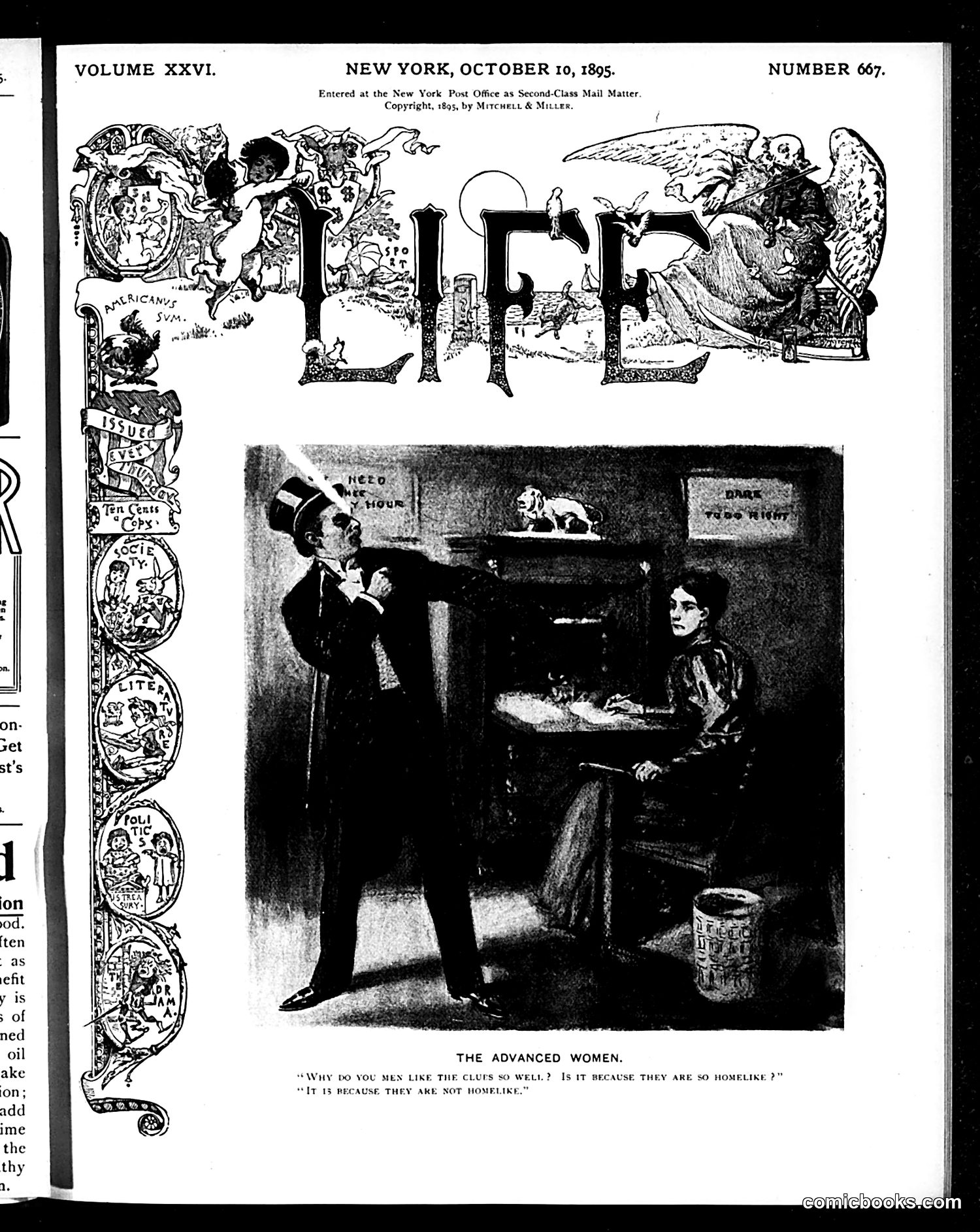
This satirical cartoon mocks the "New Woman" movement of the 1890s. The scene depicts a woman sitting comfortably in a club while a man serves her, inverting traditional gender roles. The caption's dialogue—"Why do you men like the clubs so well? Is it because they are so homelike?" / "It is because they are not homelike"—presents the joke: men escape clubs *precisely* to avoid domestic responsibilities and female company. The satire targets women seeking access to traditionally male-exclusive clubs and spaces, suggesting this represents an absurd "advancement." The cartoon ridicules both the aspiration and imagines a future where women dominate leisure spaces, forcing men into servile positions. This reflects 1890s anxieties about women's increasing independence and social mobility.
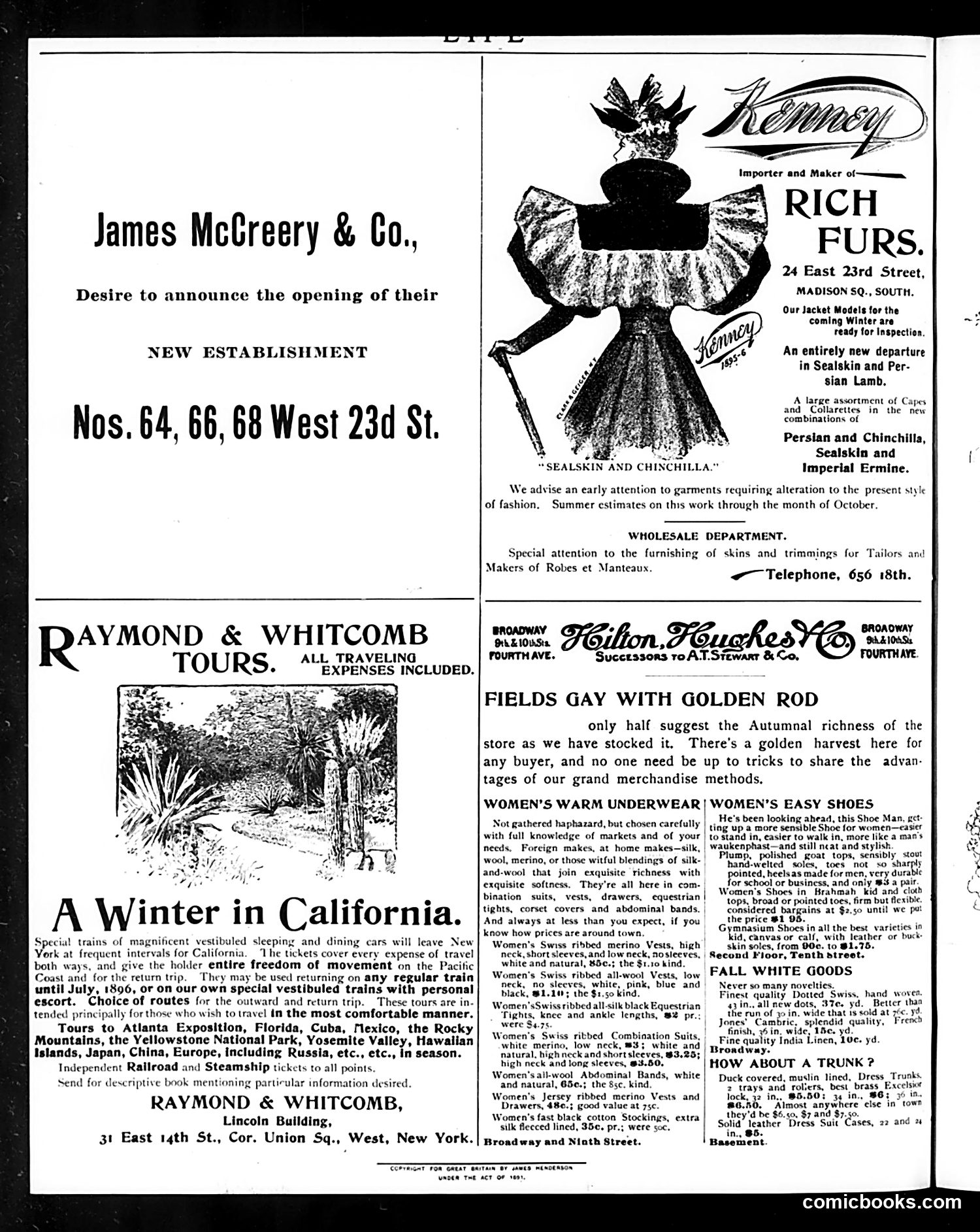
This page is primarily **advertising content** rather than editorial satire or political commentary. It contains: 1. **James McCreery & Co.** — announcement of a new clothing establishment opening on West 23rd Street 2. **Kennon Rich Furs** — advertisement for fur garments (sealskin, chinchilla, Persian) with an illustration of a fashionably dressed woman 3. **Raymond & Whitcomb Tours** — travel agency promoting winter trips to California and other destinations 4. **Hilton, Hawkes & Co.** — department store ads for women's clothing and shoes 5. **Fields Gay with Golden Rod** — general merchandise store promotion The page reflects early 20th-century consumer culture and advertising conventions in *Life* magazine, which mixed satirical editorial content with paid advertisements. There is no discernible political cartoon or social satire present on this particular page.
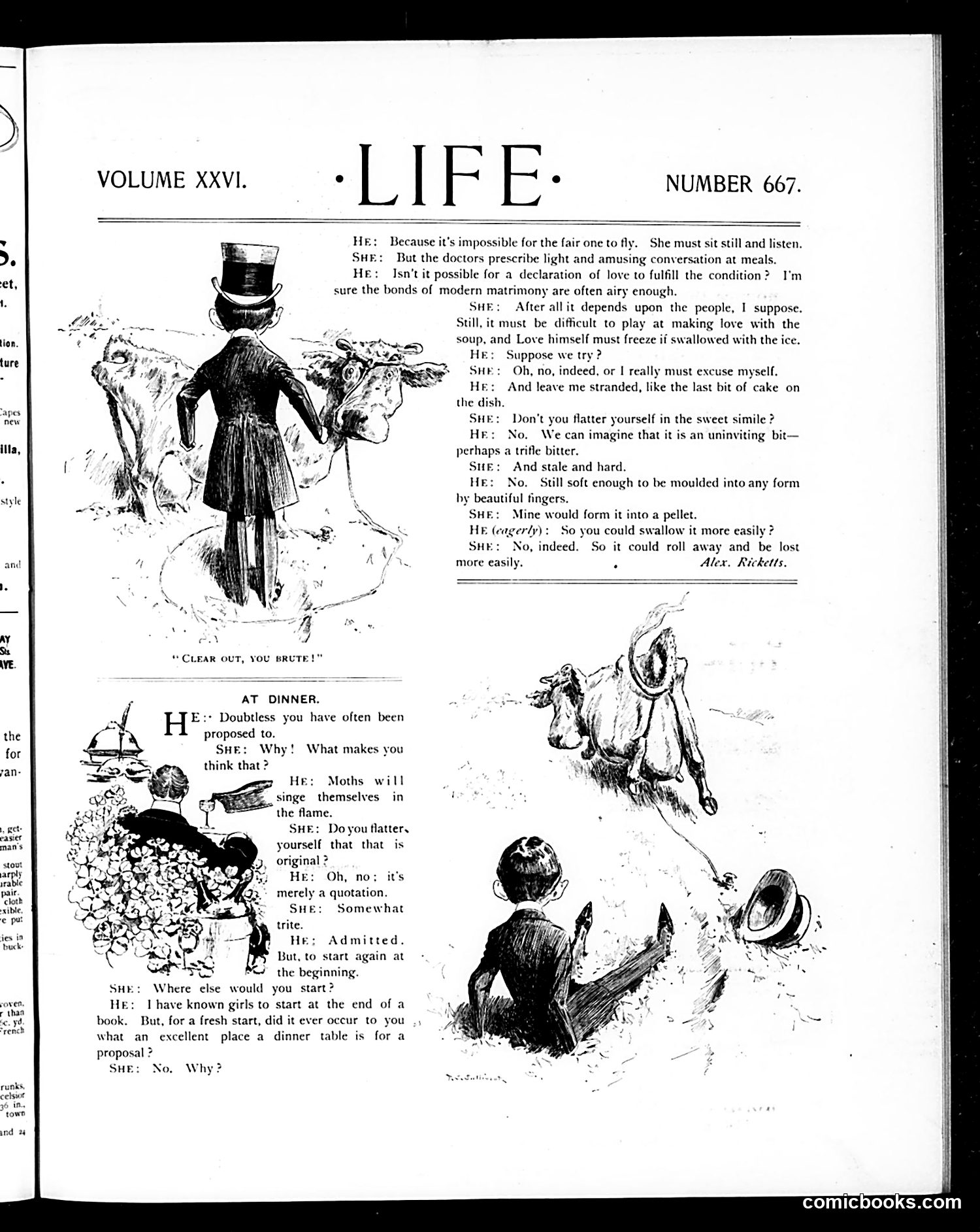
This page contains a humorous dialogue between a man and woman debating whether love can survive modern marriage's practical demands. The top illustration shows a fashionably dressed woman with a top-hatted man, captioned "Clear out, you brute!" The "At Dinner" section below features witty banter about romantic proposals at the dinner table. The couple playfully argue about whether a dinner table is an appropriate setting for a proposal, with the man claiming he "knew girls to start at the end of a book" for proposals—a literary reference to romantic conventions. The dialogue satirizes early-20th-century courtship rituals and the tension between romantic idealism and practical married life, a recurring theme in Life's satirical commentary on modern relationships and domestic arrangements.
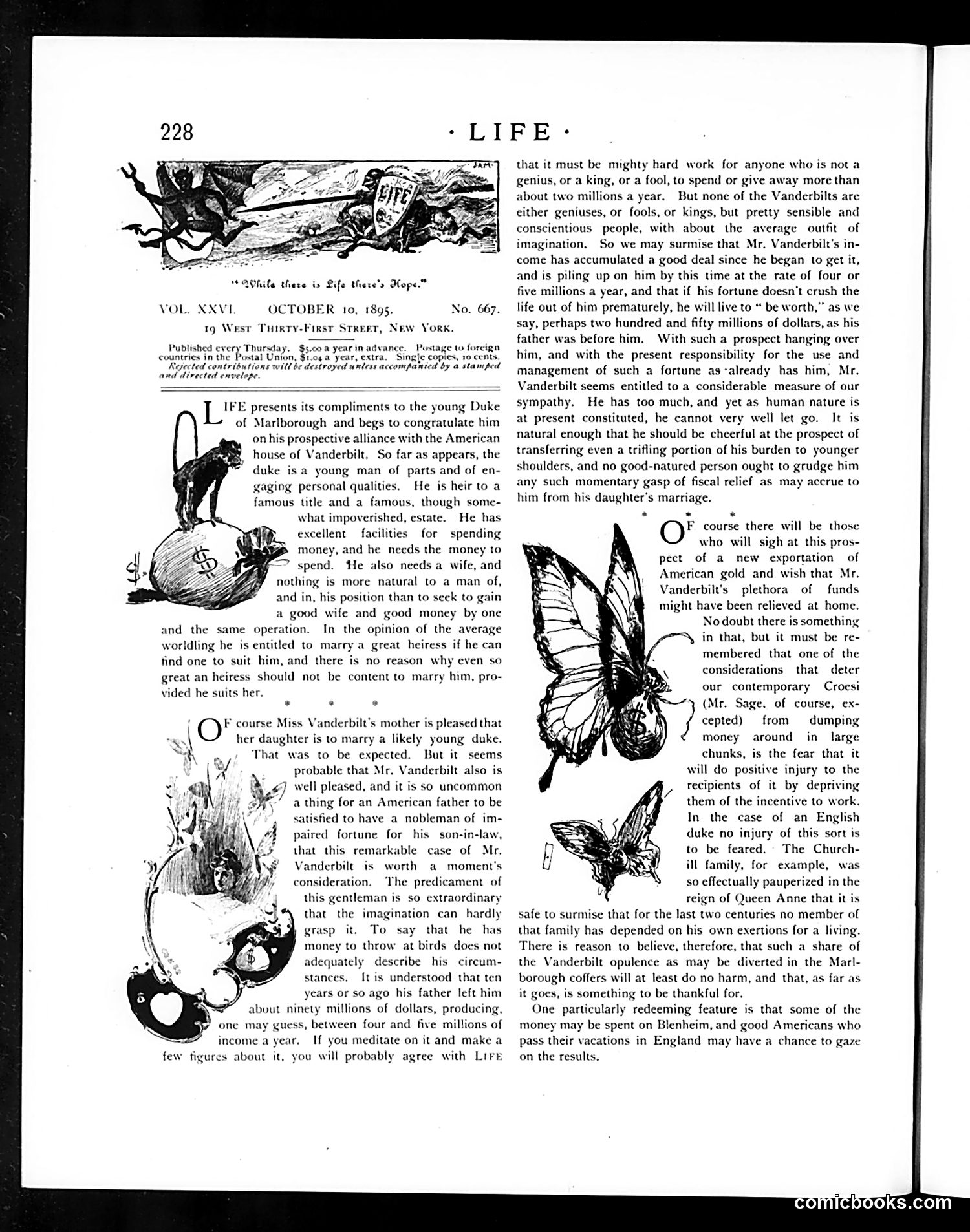
This page congratulates the young Duke of Marlborough on his upcoming marriage to an American heiress (identified in text as Miss Vanderbilt). The satirical illustrations mock the financial aspects of this Anglo-American union. The left illustrations show money bags and coins, emphasizing wealth transfer. The butterfly illustration appears symbolic of the bride's delicate status. The satire targets two concerns: First, that wealthy American heiresses were marrying impoverished European nobility for titles. Second, anxieties about whether large cash infusions to English aristocrats would corrupt them or strip them of their work ethic. The text expresses both congratulations and concern about the implications of such marriages for traditional values.
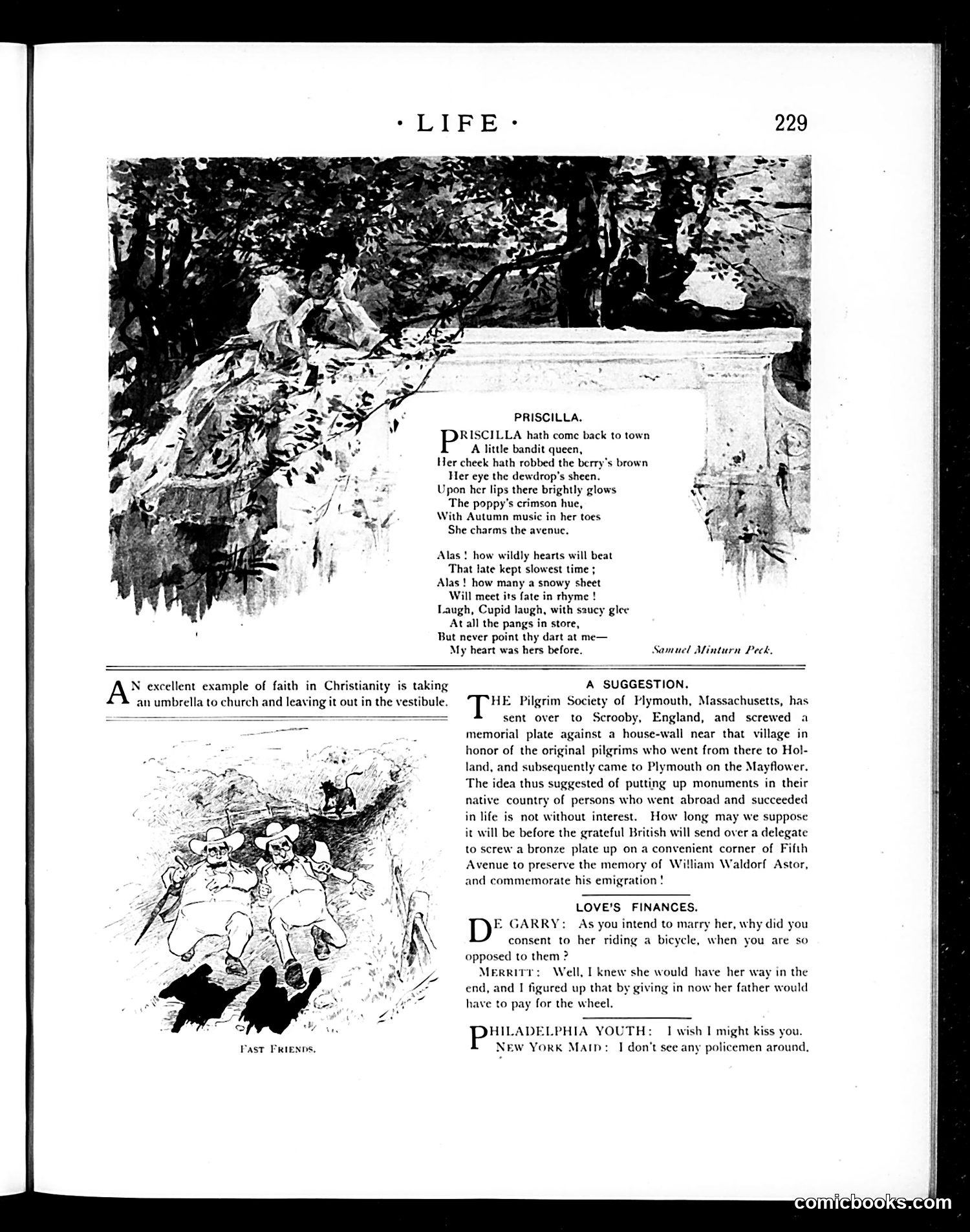
This page from *Life* magazine contains three distinct pieces: 1. **"Priscilla"** — A romantic poem by Samuel Minsturn Peck about a young woman returning to town, illustrated with an Art Nouveau-style drawing of a woman among foliage. 2. **"Fast Friends"** — A sketch showing what appears to be a group of people huddled together, illustrating a quip about taking an umbrella to church and leaving it in the vestibule—a mild joke about faith and social hypocrisy. 3. **"A Suggestion"** — Proposes commemorating British emigrants to America with bronze memorial plaques, referencing the Pilgrim Society's efforts. 4. **"Love's Finances"** and **"Philadelphia Youth"** — Brief comedic dialogues about marriage finances and flirtation. The page is primarily humorous light content rather than political satire, typical of *Life*'s mix of poetry, illustration, and social comedy.
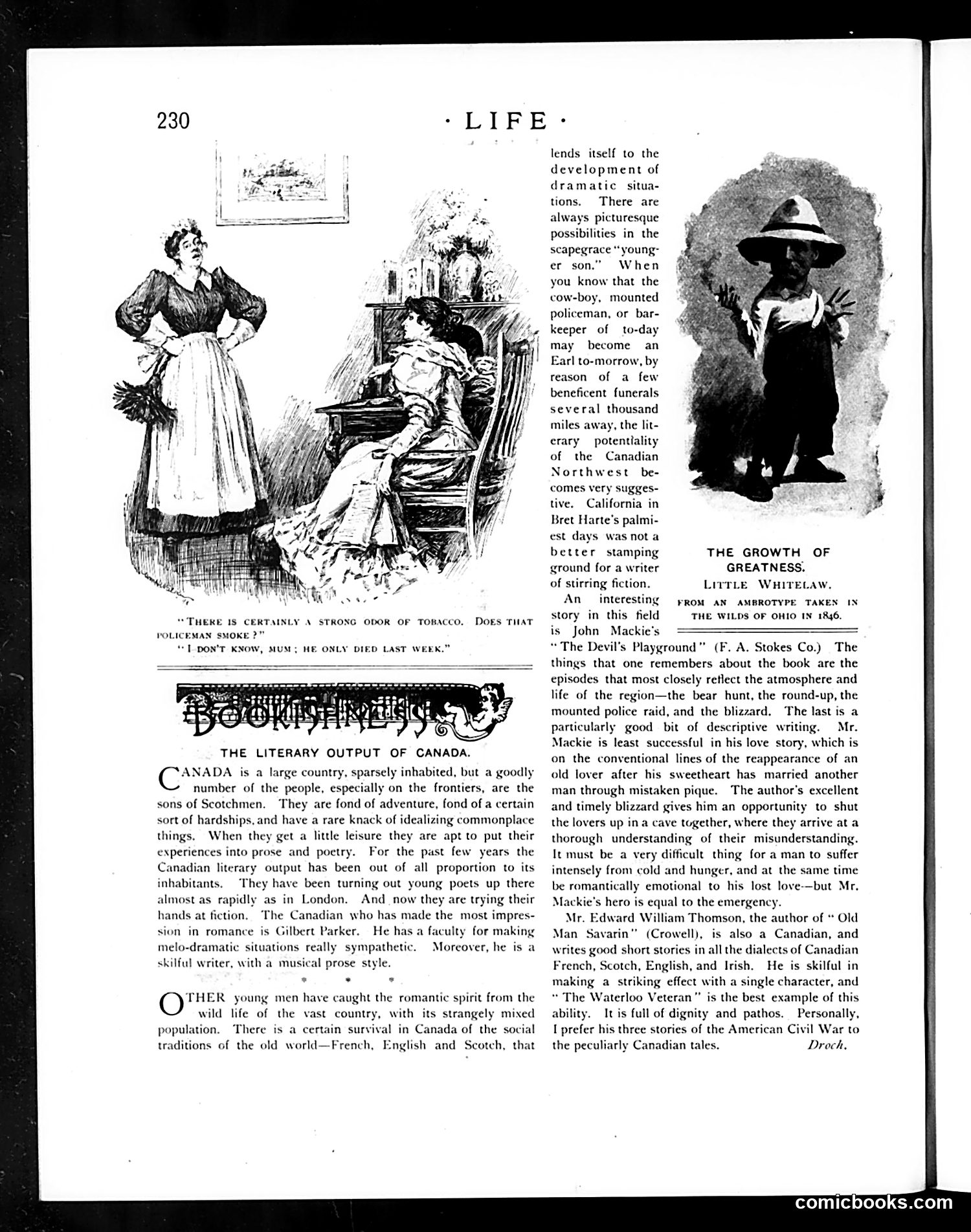
This page discusses Canadian literature, not political satire. The main cartoon shows a domestic scene where a woman standing beside a man in a chair remarks, "There is certainly a strong odor of tobacco. Does that policeman—'I don't know, mum; he only died last week.'" The joke is a dark Victorian humor setup: the woman mistakes the smell of tobacco for the odor of a dead body, but the servant reveals the "policeman" (apparently present) only recently died. It's a morbid punchline typical of late 19th/early 20th-century magazine humor. The text discusses Canadian writers like Gilbert Parker and John Mackie, praising their literary contributions. The right sidebar reviews Mackie's novel "The Devil's Playground," set in Ohio's frontier wilderness, noting its realistic depiction of frontier life and romance.
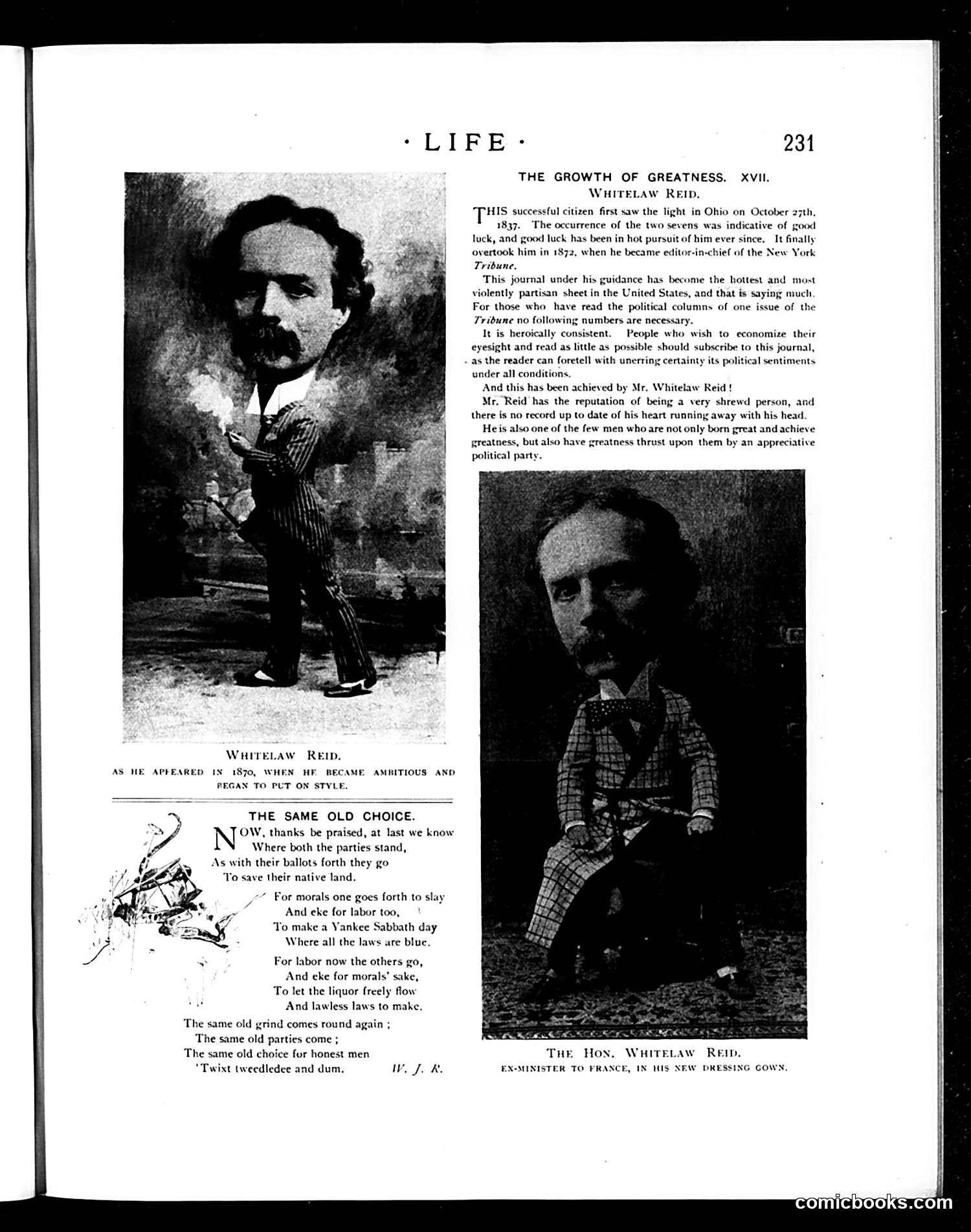
This page celebrates **Whitelaw Reid**, a prominent newspaper editor who became editor-in-chief of the *New York Tribune* in 1872. The text praises him as shrewd and successful, noting he's "one of the few men who are not only born great" but also achieved greatness through political party support. The poem "**The Same Old Choice**" appears satirical, contrasting ideals (saving native land, moral principles) with cynical reality (labor exploitation, liquor flowing freely, "lawless laws"). The refrain "The same old grind comes round again" suggests corruption and hypocrisy persist despite rhetoric about honest governance. The two portraits show Reid at different life stages—the left image "**as he appeared in 1878**" and the right as "ex-minister to France, in his new dressing gown," likely mocking his pretensions to high society.
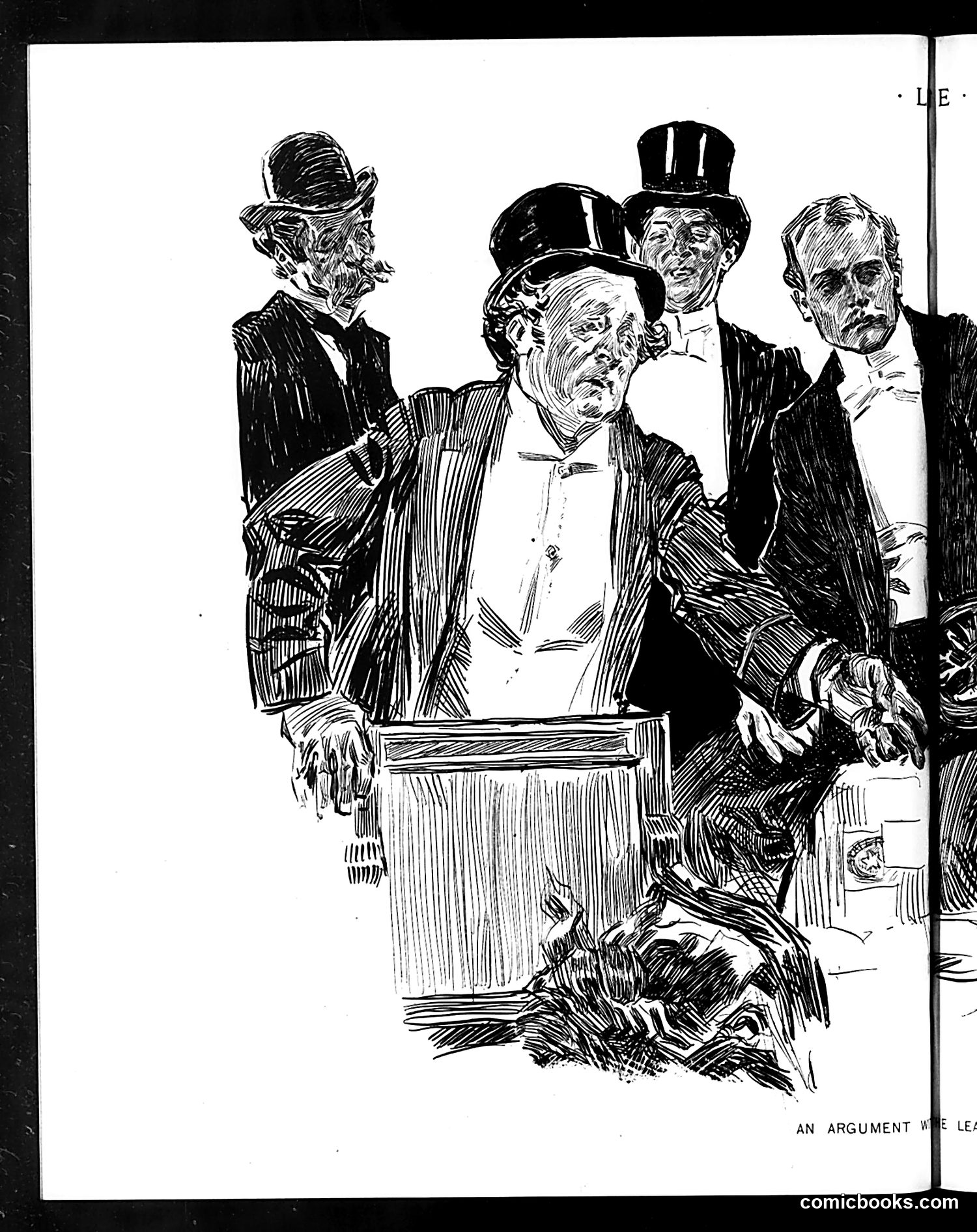
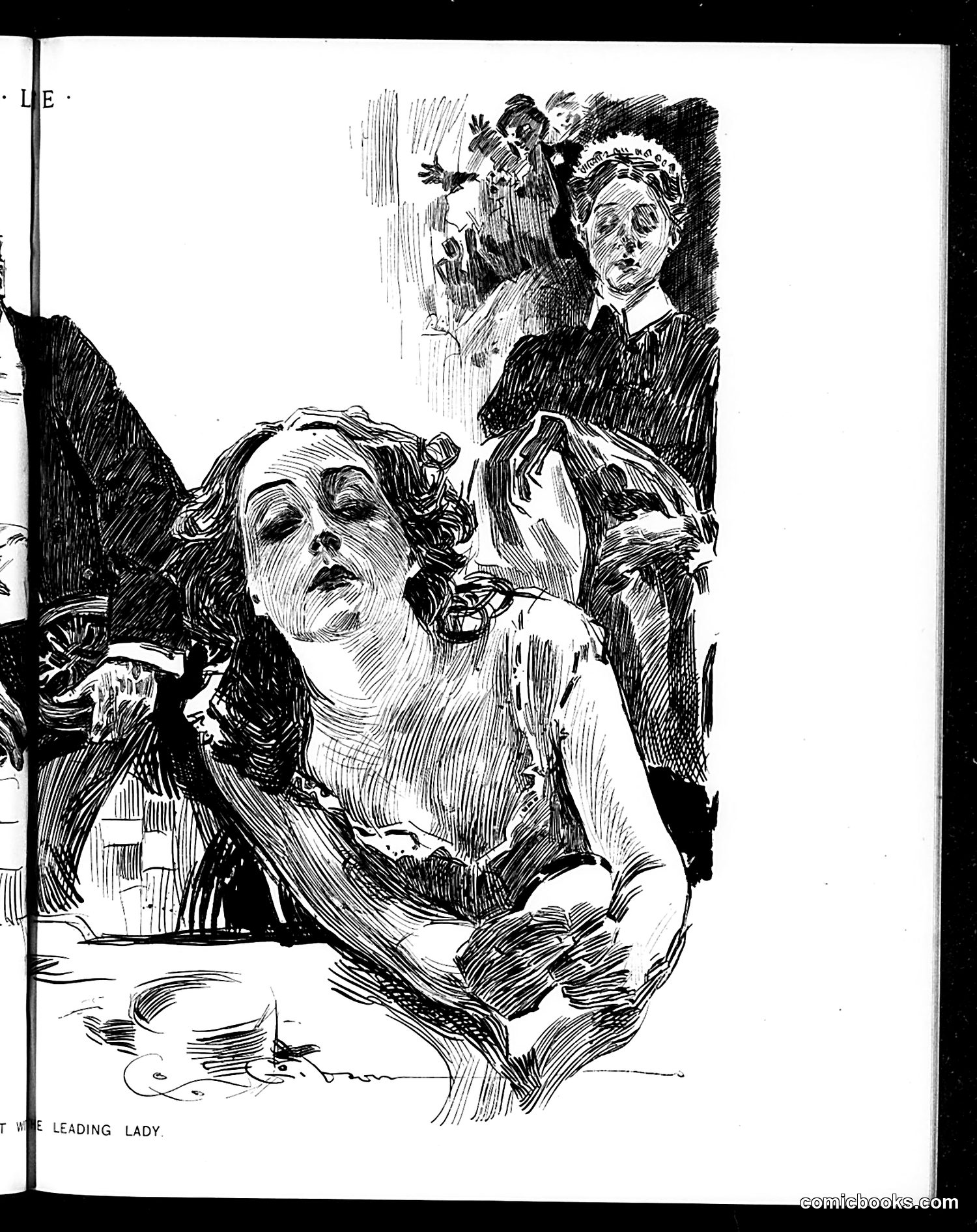
This ink sketch depicts a woman in the foreground with her eyes closed, appearing distressed or fatigued. Behind her stand several figures observing her condition. The caption "THE LEADING LADY" suggests this is theatrical satire. The work likely critiques the demands placed on prominent actresses or female performers of the era. The woman's exhausted expression and the watching figures behind her imply commentary on the pressure, scrutiny, and physical/emotional toll experienced by women in leading theatrical roles—a common satirical theme in *Life* magazine. The expressionistic style emphasizes her vulnerability and the drain of maintaining a public persona. Without additional context, the specific actress or production referenced remains unclear, though the piece appears to comment on the sacrifices required of women in entertainment.
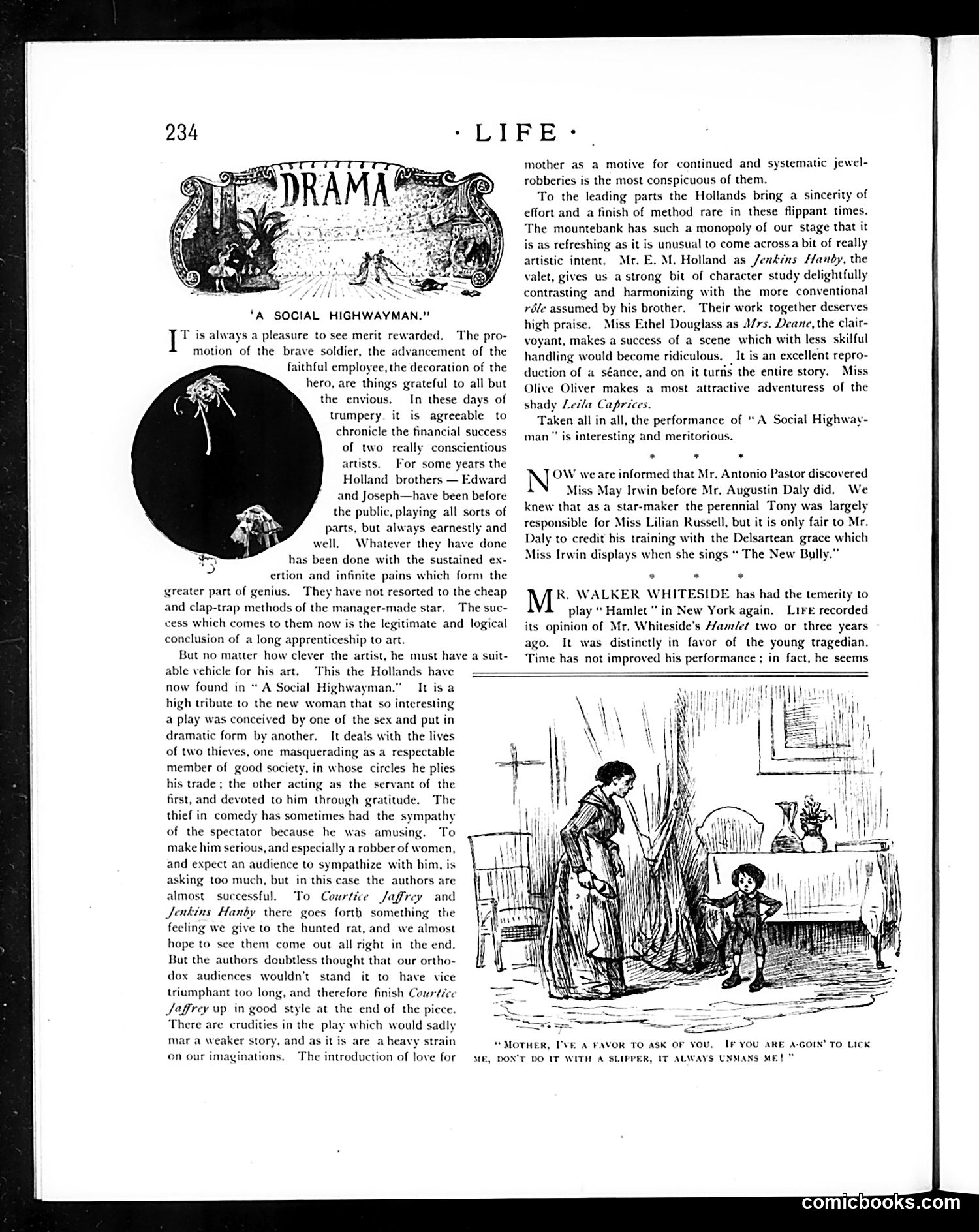
This page reviews theatrical productions, specifically "A Social Highwayman." The main illustration shows a domestic scene where a woman appears to be asking a child for a favor involving a slipper—likely a humorous moment from the play. The text discusses the Holland brothers (Edward and Joseph) as conscientious artists who avoid cheap theatrical methods. It praises their production as a suitable vehicle for performing talent, though notes some plot weaknesses. Additional paragraphs mention actor Antonio Pastor's discovery of May Irwin, and critique of Walker Whiteside's performance in "Hamlet." This is theater criticism rather than political satire—a typical Life magazine drama review from the late 19th or early 20th century, focusing on acting quality and artistic merit of stage productions.
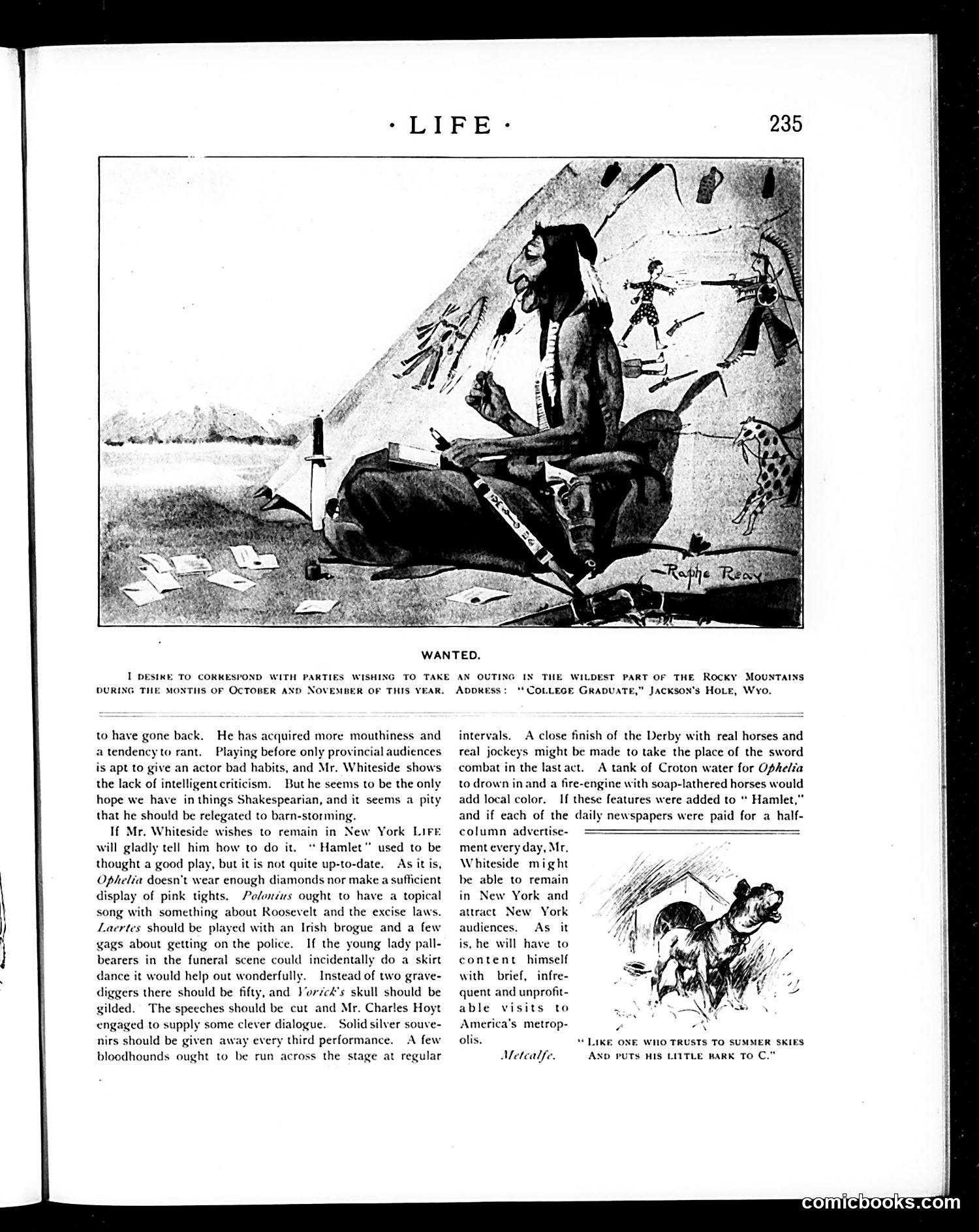
This page contains a satirical illustration and accompanying theater criticism. The main cartoon, credited to Raffle Raux, depicts a Native American figure sitting against a teepee, sketching or writing plans for theatrical productions. Scattered papers and implements surround him. The text below critiques actor Mr. Whiteside's Broadway performances, suggesting various improvements to his productions. The "Wanted" notice sarcastically requests correspondents interested in organizing a mountain outing in the Rocky Mountains during October-November, with the address humorously listed as "College Graduate, Jackson's Hole, Wyo." The cartoon appears to mock theatrical pretension by contrasting high-brow artistic ambition with frontier simplicity, though the exact satirical point requires knowledge of contemporary theater debates.
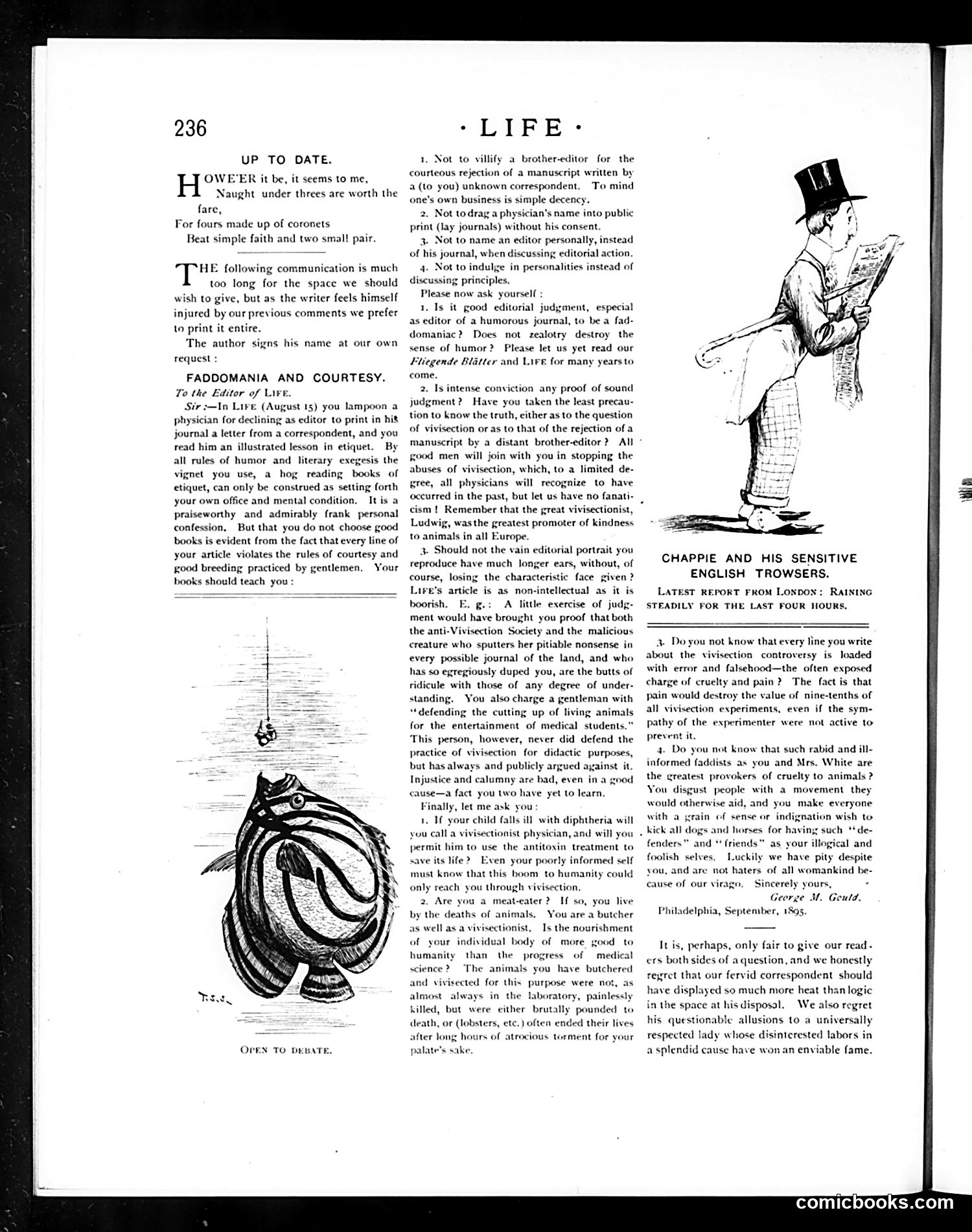
This page presents a heated editorial debate about vivisection (animal experimentation). A physician had rejected a manuscript from a Life correspondent, and Life criticized him editorially. A reader (signed "E.G.") now responds with an angry letter defending the physician and attacking Life's hypocrisy. The cartoons illustrate the debate: one shows a pig reading etiquette books (mocking Life's own manners), another depicts a human heart (referencing medical science). The satire targets Life magazine's self-righteousness. The letter writer argues Life violated basic courtesy by naming the physician publicly, then lectures *them* on ethics—while Life editors themselves eat meat and would use vivisection-derived medicine (antitoxin for diphtheria). The piece exposes the inconsistency of animal-rights activism among people who benefit from medical advances requiring animal testing.
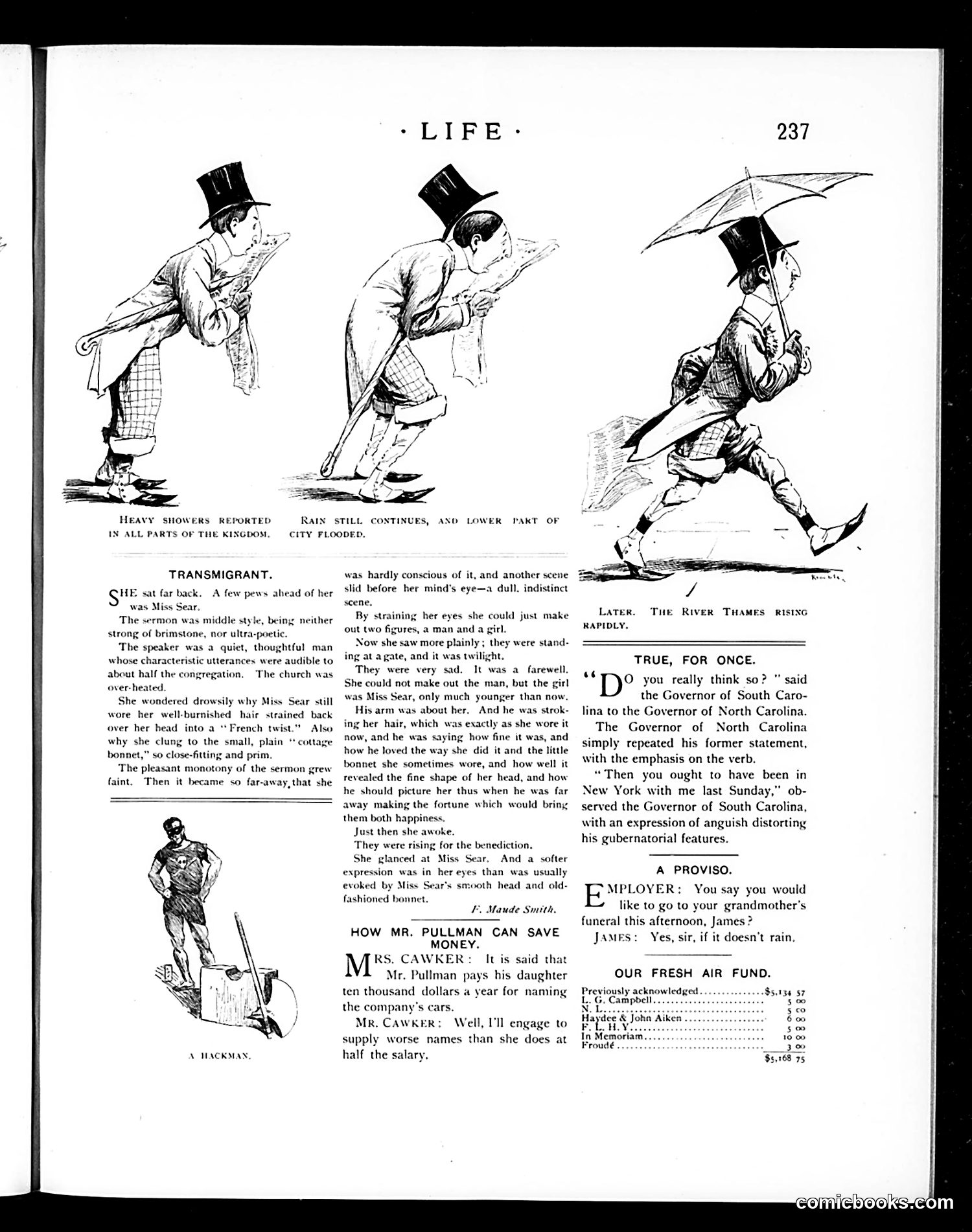
This page contains several satirical pieces typical of early 20th-century American humor: **"Transmigrant"**: A sentimental story about a woman daydreaming during church, remembering a lost love who admired her distinctive hairstyle and bonnet. The irony is that she still wears the same old-fashioned style years later, frozen in the past. **Weather cartoons** (top): Three illustrations of gentlemen in top hats struggling with rain and flooding—visual humor about English weather and the formal dress code's impracticality. **"How Mr. Pullman Can Save Money"**: A joke about George Pullman (railroad magnate) paying his daughter lavishly just to name train cars, with a rival claiming he could supply worse names cheaper—mocking nepotism and corporate excess. **"True, For Once"**: A brief dialogue between Southern governors about a trip to New York, with an unclear political point. **"A Proviso"**: Employer-employee humor about an excuse for missing work (grandmother's funeral) with the condition "if it doesn't rain." The page reflects Life's mix of sentimental fiction, visual gags, and brief satirical pieces targeting contemporary social figures and situations.
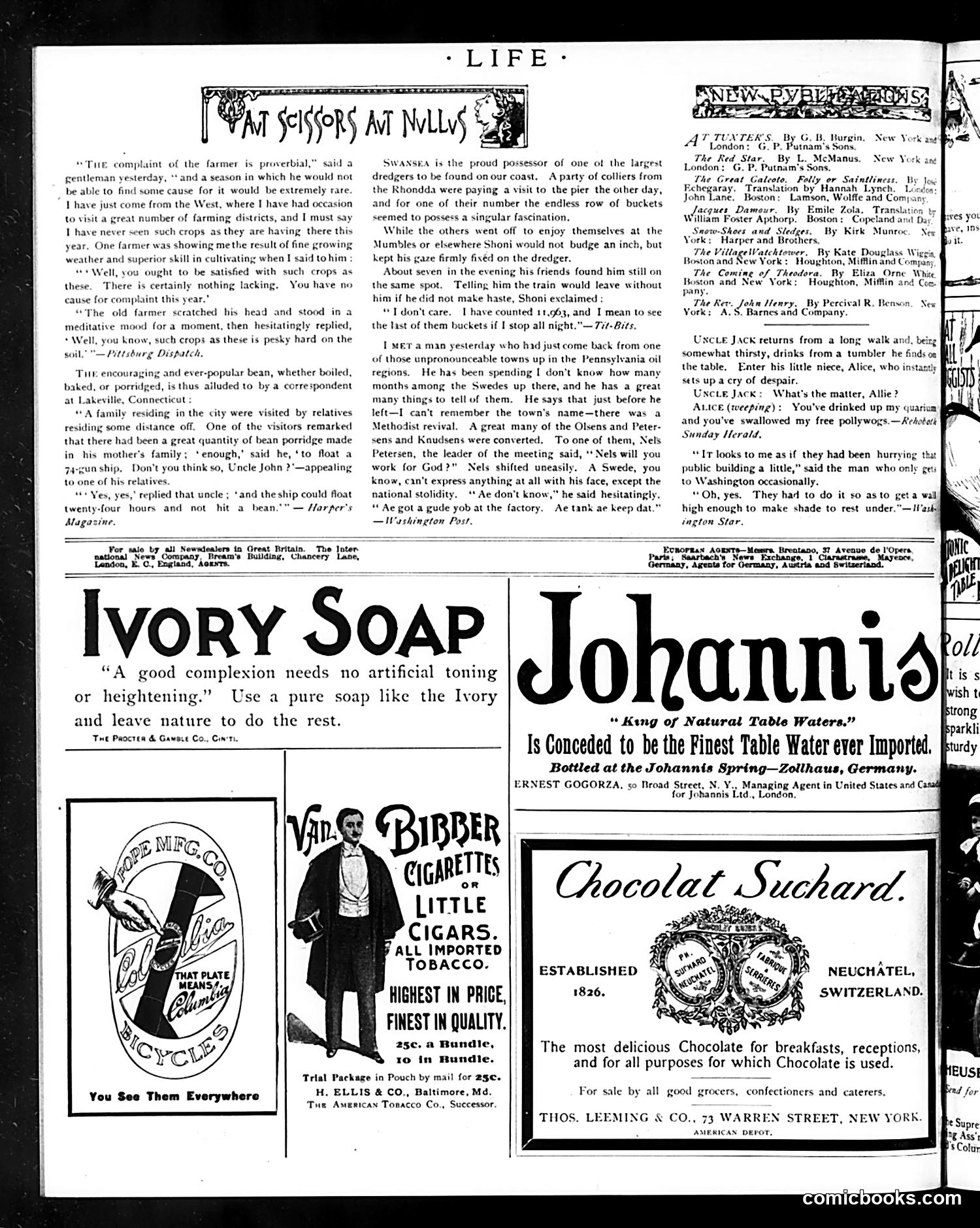
This page contains **primarily humorous anecdotes and advertisements** rather than political cartoons. The main content features three brief comic stories illustrating rural/working-class perspectives: 1. **"At Scissors at Nullys"** — A farmer's complaint: despite excellent crops, he finds something to gripe about, exemplifying the stereotype of farmers as perpetually dissatisfied. 2. **Bean porridge anecdote** — A family joke about bean dishes so abundant they could float a warship, playing on exaggeration humor. 3. **Swansea dredger story** — A Welsh worker (Shoni) becomes obsessed counting bucket-loads from a mechanical dredger, missing his train—satirizing the monotony of industrial labor and working-class stoicism. 4. **Pennsylvania oil region conversion** — A Swedish immigrant (Petersen) remains emotionally unexpressive even during religious revival, stereotyping Northern European reserve. These are gentle, class-based humor pieces typical of *Life* magazine's satirical but non-confrontational approach—poking fun at rural/immigrant stereotypes rather than addressing serious politics. The page is otherwise filled with period product advertisements.
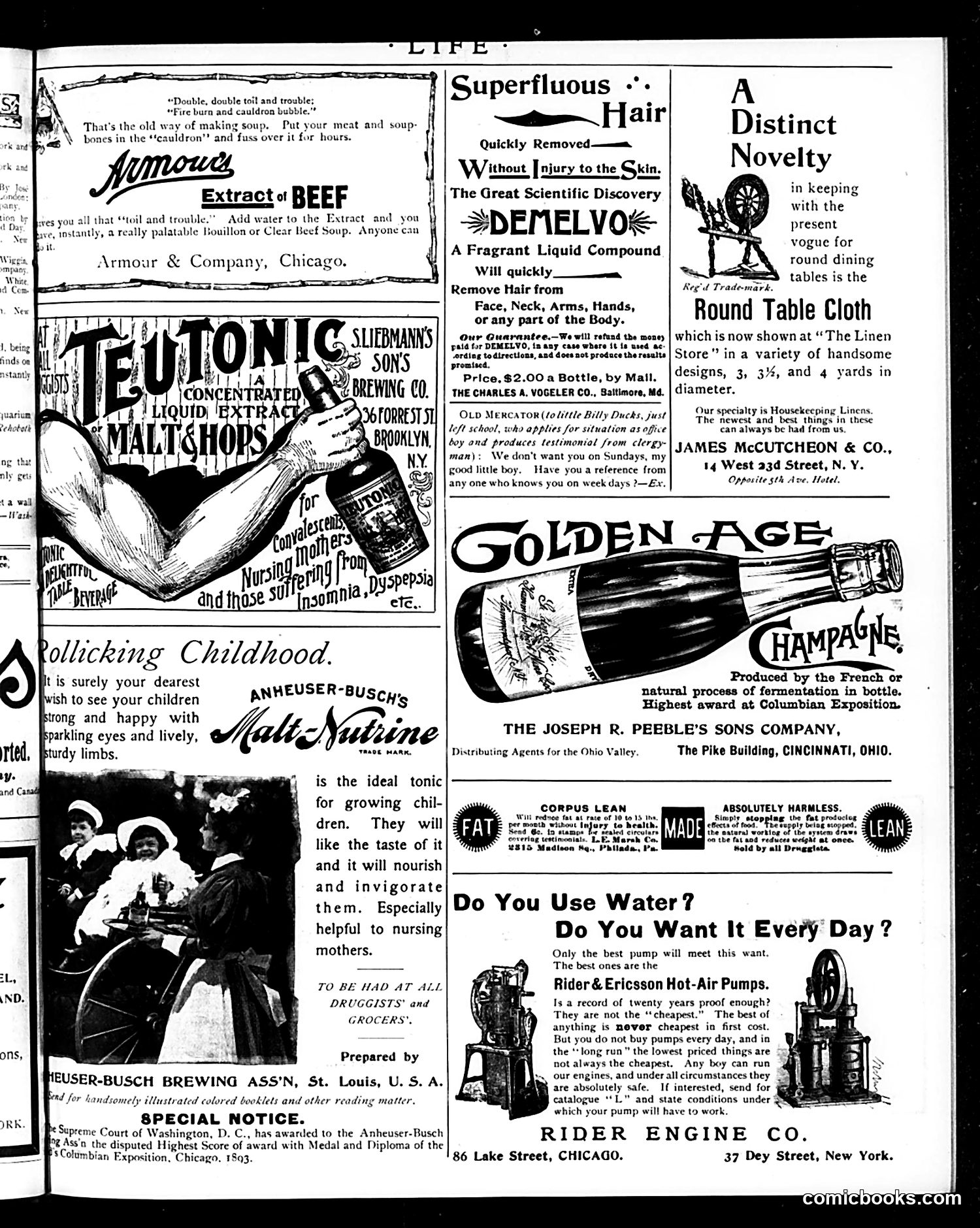
This is primarily a **advertisements page** from Life magazine, circa 1893 (based on the Columbian Exposition reference). The only satirical content is the **Armour Extract of Beef advertisement** at top left, which opens with Shakespeare's witches' incantation ("Double, double toil and trouble / Fire burn and cauldron bubble"). The joke: traditional soup-making requires hours of tedious work ("toil and trouble"), but Armour's extract eliminates this drudgery—you simply add water for instant bouillon. The satire mocks outdated domestic labor while promoting modern convenience. The remaining content consists of genuine product advertisements: Teutonic Malt Schnapps (as a children's tonic), Anheuser-Busch's "Malt Nutrine" beverage, Demelvo hair remover, table linens, champagne, and water pumps. The **Anheuser-Busch ad notably markets alcohol as a health tonic for growing children and nursing mothers**—a practice that would horrify modern readers but was apparently unremarkable in the 1890s. This reveals more about historical attitudes toward alcohol and patent medicines than satire.
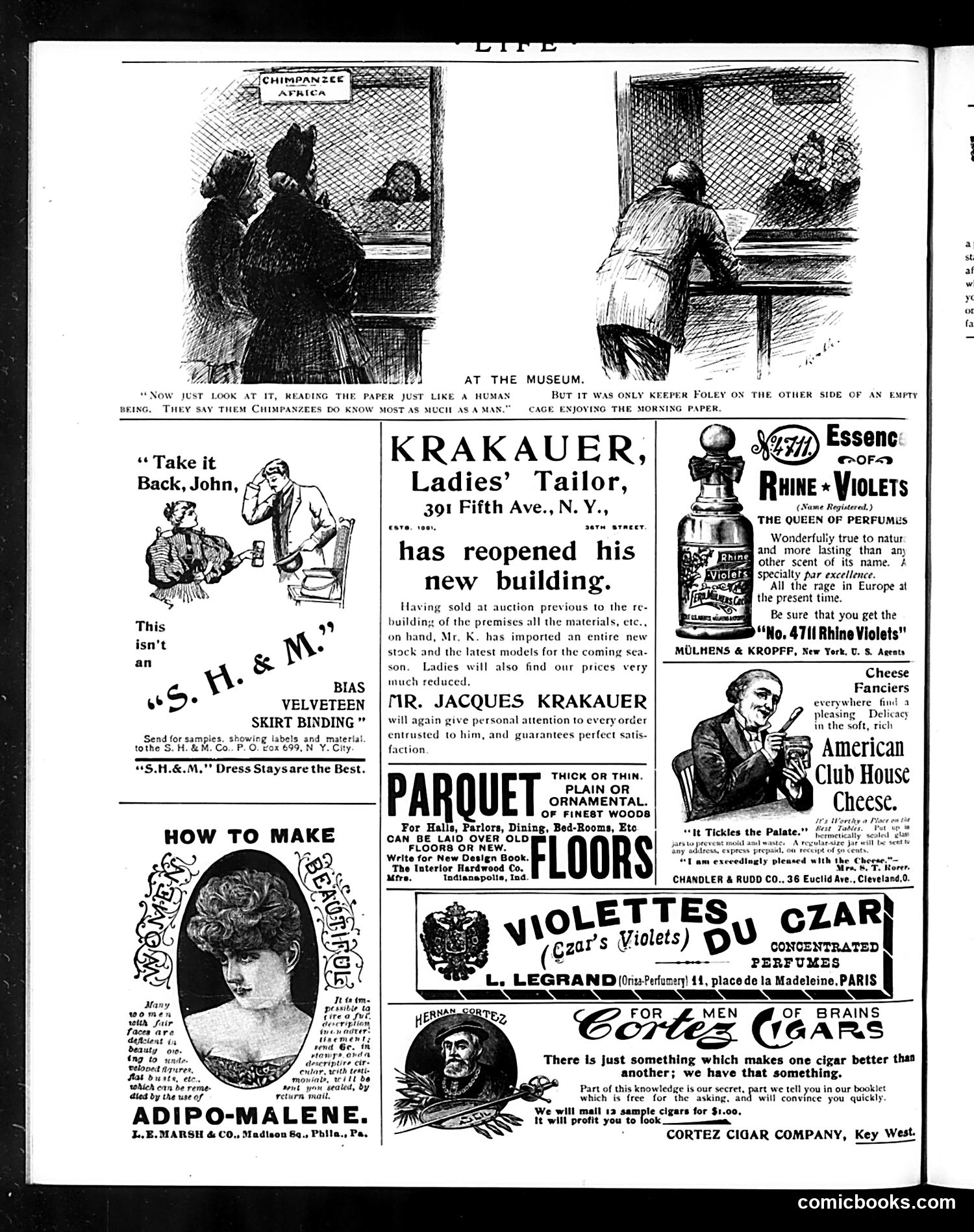
This page primarily consists of **advertisements** rather than editorial cartoons, though two small illustrated vignettes appear at the top. ## The Cartoons The upper sketches satirize early-20th-century attitudes about animal intelligence. The left panel shows visitors at a museum zoo reading a newspaper to a chimpanzee, with text claiming chimps "know as much as a man." The right panel reveals the joke: the keeper (Foley) was actually on the other side of an empty cage—the chimp wasn't reading at all. This mocks pseudo-scientific claims about animal cognition popular in the era. Below, an unrelated "Take it Back, John" cartoon depicts a domestic dispute over dress stays (corset components), advertising "S.H. & M." bias velveteen skirt binding. ## The Advertisements The page contains typical period ads: a ladies' tailor (Krakauer), perfumes (Rhine Violets, Czar's Violets), parquet flooring, cheese products, Adipo-Malene (a beauty/weight-loss product), and Cortez cigars. These reflect consumer goods marketed to middle-class readers in this era.
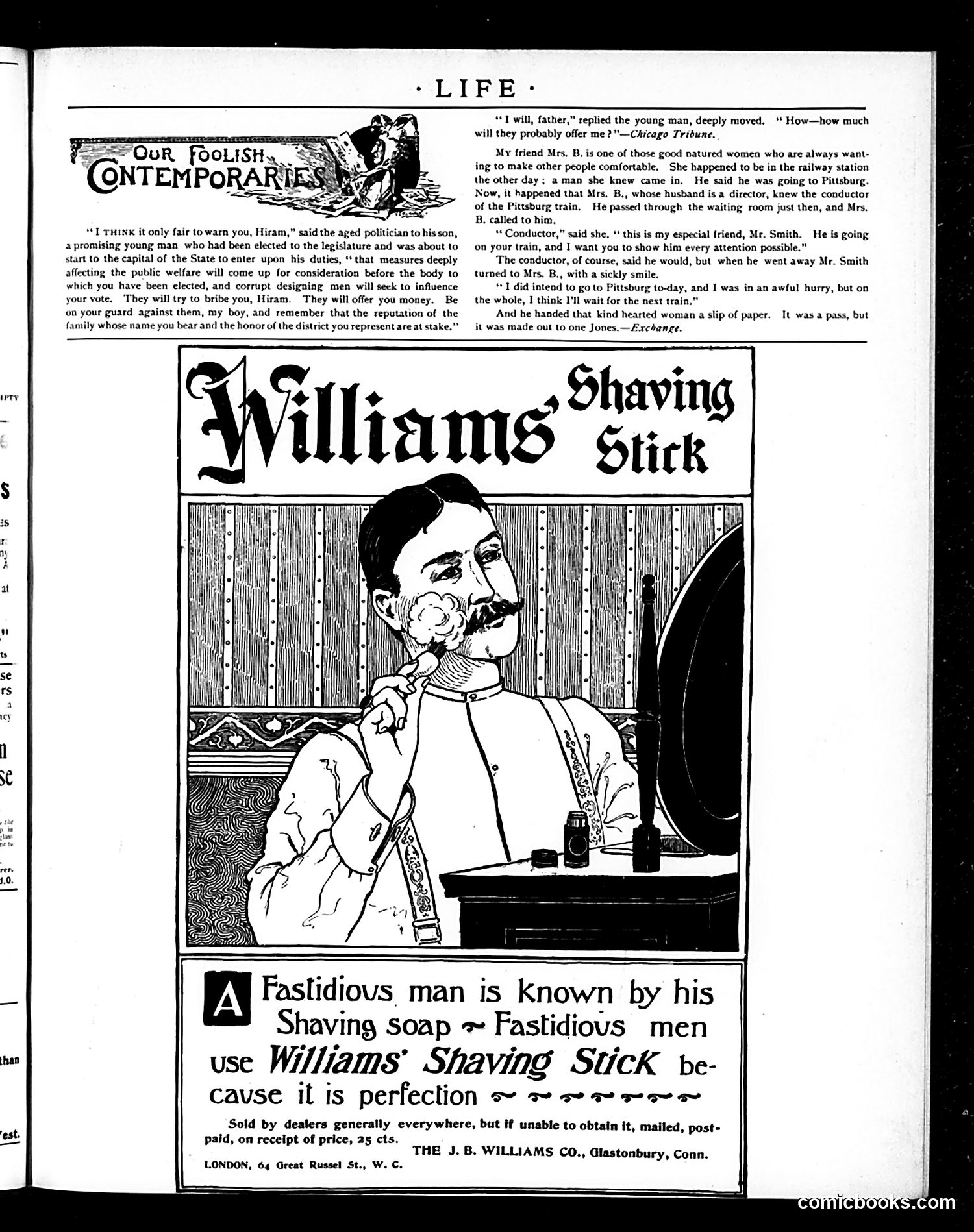
This *Life* magazine page contains satirical commentary and advertising. **"Our Foolish Contemporaries"** section features two brief humorous anecdotes: 1. A young man elected to the legislature asks his father how much bribes he'll receive—satirizing political corruption as an expected, routine part of governance. 2. A woman tries to help a male acquaintance by recommending him to a train conductor, but the conductor mistakenly gives him a pass made out to someone else (Jones). The man awkwardly declines the train ride rather than correct the error—mocking social awkwardness and politeness taken to absurd extremes. **The advertisement** promotes Williams' Shaving Stick, featuring a well-groomed man at his mirror. The tagline claims fastidious men use this product because it achieves "perfection," reflecting early 20th-century consumer advertising linking products to personal character and sophistication.
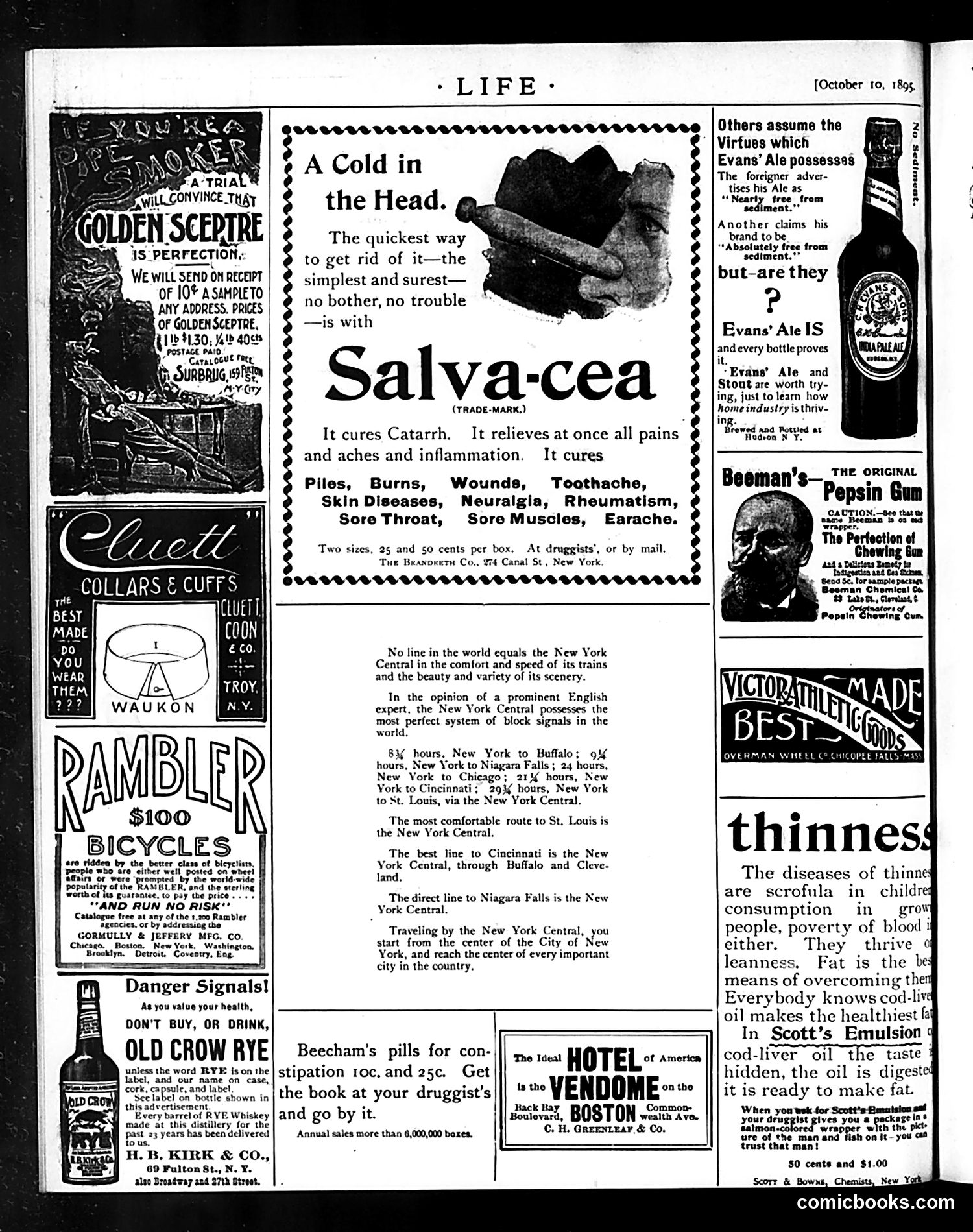
This page is primarily **advertising**, not satire or political commentary. It's from *Life* magazine (October 10, 1895) and showcases patent medicines and consumer products typical of the era. **Key content:** The central advertisement for **Salva-cea** exemplifies the era's unregulated medical claims—promising to cure catarrh, piles, burns, wounds, toothache, skin diseases, neuralgia, rheumatism, and more with a single product. This represents the widespread snake-oil medicine industry that existed before FDA regulation. Other notable ads include: - **Evans' Ale** (competing on purity claims) - **Beecham's Pills** (laxatives) - **Scott's Emulsion** (cod-liver oil marketed for weight gain—then considered desirable) - **Rambler Bicycles** and **Collars & Cuffs** (consumer goods) The small boxed warning about **Old Crow Rye** whiskey—cautioning against counterfeit bottles—ironically appears amid medical ads, reflecting the era's contradictions about "health" products. This page documents pre-modern consumer culture and unscrupulous medical marketing practices now illegal.