
Life, 1895-10-10 · page 6 of 18
Life — October 10, 1895 — page 6: what you’re looking at
What you’re looking at
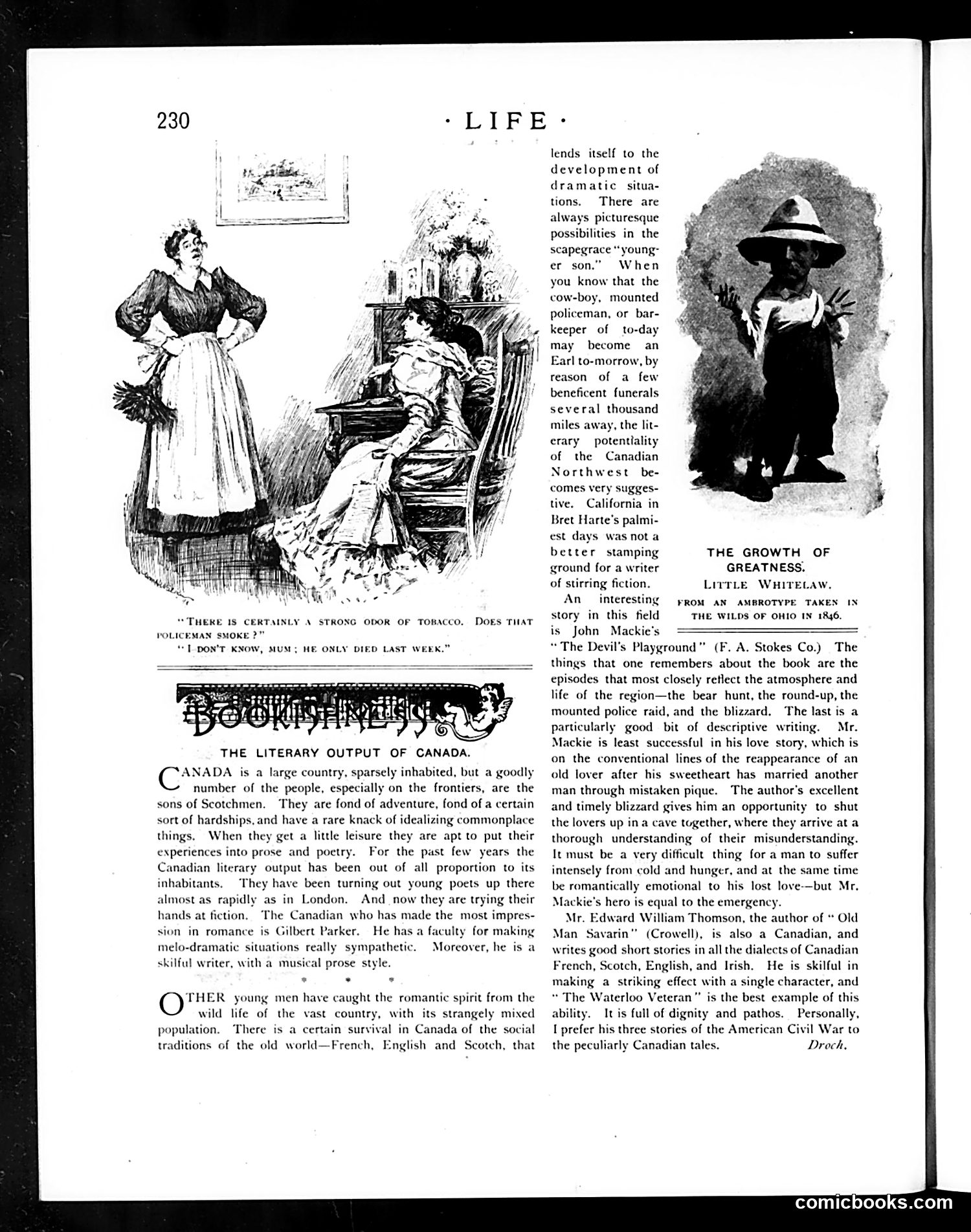
This page discusses Canadian literature, not political satire. The main cartoon shows a domestic scene where a woman standing beside a man in a chair remarks, "There is certainly a strong odor of tobacco. Does that policeman—'I don't know, mum; he only died last week.'" The joke is a dark Victorian humor setup: the woman mistakes the smell of tobacco for the odor of a dead body, but the servant reveals the "policeman" (apparently present) only recently died. It's a morbid punchline typical of late 19th/early 20th-century magazine humor. The text discusses Canadian writers like Gilbert Parker and John Mackie, praising their literary contributions. The right sidebar reviews Mackie's novel "The Devil's Playground," set in Ohio's frontier wilderness, noting its realistic depiction of frontier life and romance.
📄 Transcribed text from this page (OCR, searchable)
Machine-transcribed from the original scan — historical spelling and the odd misread are preserved.
-LIFE: “THERE IS CERTAINLY A STRONG ODOR OF TOBACCO, DOES THAT “TL DON'T KNOW, MUM; HE ONLY DIED LAST WEEK.” THE LITERARY OUTPUT OF CANADA. CANADA is a large country, sparsely inhabited, but a goodly number of the people, especially on the frontiers, are the sons of Scotchmen. They are fond of adventure, fond of a certain sort of hardships, and have a rare knack of idealizing commonplace things. When they get a little leisure they are apt to put their experiences into prose and poetry. For the past few years the Canadian literary output has been out of all proportion to its inhabitants. They have been turning out young poets up there almost as rapidly as in London. And_now they are trying their hands at fiction, The Canadian who has made the most impres- sion in romance is Gilbert Parker. He has a faculty for making melo-dramatic situations really sympathetic. Moreover, he is a skilful writer, with a musical prose style. . . . O HER young men have caught the romantic spirit from the wild life of the vast country, with its strangely mixed population. There is a certain survival in Canada of the social traditions of the old world—French, English and Scotch, that lends itself to the development of dramatic. situa- tion: There are alw picturesque possibilities in the scapegrace “young: er son.” When you know that the cow-boy, mounted policeman, or bar- keeper of to-day may become an Earl to-morrow, by reason of a few beneficent funerals several thousand miles away, the lit- erary potentiality of the Canadian Northy t be- comes very sugges- tive. California in Bret Harte’s palmi- est days was not a better stamping ground for a writer of stirring fiction, An __ interesting story in this field is John Mackie’s = “The Devil's Playground” (F. A. Stokes Co.) The things that one remembers about the book are the episodes that most closely reflect the atmosphere and life of the region—the bear hunt, the round-up, the mounted police raid, and the blizzard. The last is a particularly good bit of descriptive writing. Mr. Mackie is least successful in his love story, which is on the conventional lines of the reappearance of an old lover after his sweetheart has married another man through mistaken pique. The author's excellent and timely blizzard gives him an opportunity to shut the lovers up ina cave together, where they arrive at a thorough understanding of their misunderstanding. It must be a very difficult thing for a man to suffer inten: from cold and hunger, and at the same time be romantically emotional to his lost love—but Mr. Mackie’s hero is equal to the emergency. Mr. Edward William Thomson, the author of * Old Man Savarin"” (Crowell), is also a Canadian, and writes good short stories in all the dialects of Canadian French, Scotch, English, and Irish. He is skilful in making a striking effect with a single character, and * The Waterloo Veteran” is the best example of this ability. It is full of dignity and pathos. Personally, I prefer his three stories of the American Civil War to the peculiarly Canadian tales. Droch. THE GROWTH OF GREATNESS, Livre WHITELAW, FROM AN AMBROTYPE TAKEN IN THE WILDS OF OHIO IN 1846. comicbooks.com