
Life, 1895-10-10 · page 4 of 18
Life — October 10, 1895 — page 4: what you’re looking at
What you’re looking at
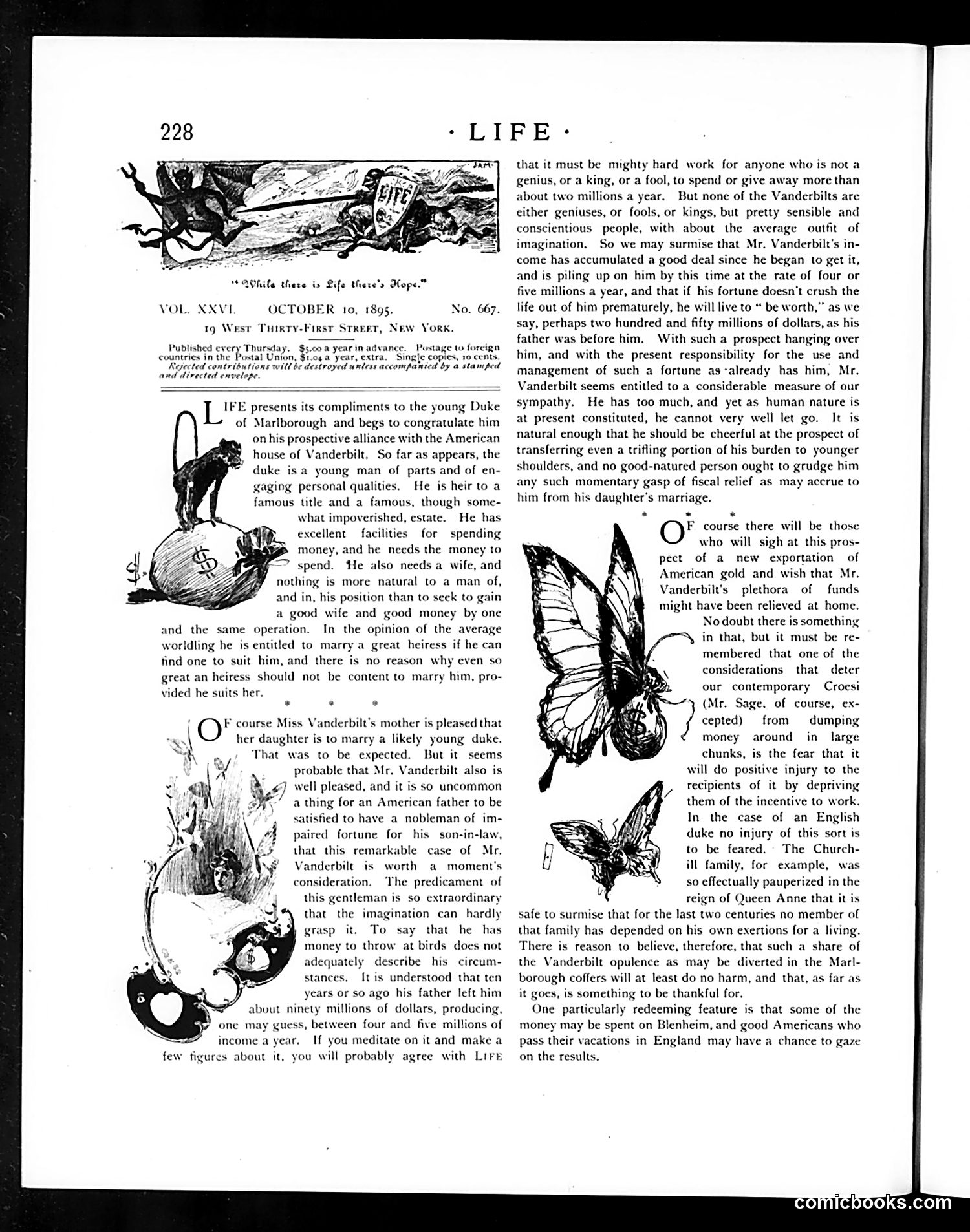
This page congratulates the young Duke of Marlborough on his upcoming marriage to an American heiress (identified in text as Miss Vanderbilt). The satirical illustrations mock the financial aspects of this Anglo-American union. The left illustrations show money bags and coins, emphasizing wealth transfer. The butterfly illustration appears symbolic of the bride's delicate status. The satire targets two concerns: First, that wealthy American heiresses were marrying impoverished European nobility for titles. Second, anxieties about whether large cash infusions to English aristocrats would corrupt them or strip them of their work ethic. The text expresses both congratulations and concern about the implications of such marriages for traditional values.
📄 Transcribed text from this page (OCR, searchable)
Machine-transcribed from the original scan — historical spelling and the odd misread are preserved.
-LIFE: “QWs there is Life there's Hope.” VOL. XXVI 19 West OCTOBER 10, 1895. No. 667. THirty-First Street, New York. Published every Thursday. $5.00 a year in advanc countries in the Postal Union, $1.04 a year, extra Kejected contributions will be destroyed untess accom, and directed enveli Postage tw foreign copies, 10 cents. nied by a stamped IFE presents its compliments to the young Du of Marlborough and begs to congratulate him on his prospective alliance with the American house of Vanderbilt. So far as appears, the duke is a young man of parts and of en- gaging personal qualities. He is heir to a famous title and a famous, though some- what impoverished, estate. He has excellent facilities for spending money, and he needs the money to spend. He also needs a wife, and nothing is more natural to a man of, and in, his position than to seek to gain a good wife and good money by one and the same operation. In the opinion of the average worldling he is entitled to marry a great heiress if he can find one to suit him, and there is no reason why even so great an heiress should not be content to marry him, pro- vided he suits her. F course Miss Vanderbilt's mother is pleased that her daughter is to marry a likely young duke. That was to be expected. But it seems probable that Mr. Vanderbilt also is well pleased, and it is so uncommon a thing for an American father to be satisfied to have a nobleman of im- paired fortune for his son-in-law, that this remarkable ce of Mr. Vanderbilt is worth a moment's consideration. The predicament of this gentleman is so extraordinary that the imagination can hardly grasp it. To say that he has money to throw at birds does not adequately describe his circum- stances. [tis understood that ten years or so ago his father left him about ninety millions of dollars, producing, one may guess, between four and five millions of income a year. If you meditate on it and make a few figures about it, you will probably agree with LiFe that it must be mighty hard work for anyone who is not a genius, or a king, or a fool, to spend or give away more than about two millions a year. But none of the Vanderbilts are either geniuses, or fools, or kings, but pretty sensible and conscientious people, with about the average outfit of imagination. So we may surmise that Mr. Vanderbilt's in- come has accumulated a good deal since he began to get it, and is piling up on him by this time at the rate of four or five millions a year, and that if his fortune doesn’t crush the life out of him prematurely, he will live to “* be worth,” as we say, perhaps two hundred and fifty millions of dollars, as his father was before him. With such a prospect hanging over him, and with the present responsibility for the use and management of such a fortune as:already has him, Mr. Vanderbilt seems entitled to a considerable measure of our sympathy. He has too much, and yet as human nature is at present constituted, he cannot very well let go. It is natural enough that he should be cheerful at the prospect of transferring even a trifling portion of his burden to younger shoulders, and no good-natured person ought to grudge him any such momentary gasp of fiscal relief as may accrue to him from his daughter's marriage. F course there will be those who will sigh at this pros- pect of a new exportation of American gold and wish that Mr. Vanderbilt's plethora of funds might have been relieved at home. No doubt there is something in that, but it must be re- membered that one of the considerations that deter our contemporary Croesi (Mr. Sage. of course, ex- cepted) from dumping money around in large chunks, is the fear that it will do positive injury to the recipients of it by depriving them of the incentive to work. In the case of an English duke no injury of this sort is to be feared. The Church- ill family, for example, was so effectually pauperized in the reign of Queen Anne that it is safe to surmise that for the last two centuries no member of that family has depended on his own exertions for a living. There is reason to believe, therefore, that such a share of the Vanderbilt opulence as may be diverted in the Marl- borough coffers will at least do no harm, and that, as far as it goes, is something to be thankful for. One particularly redeeming feature is that some of the money may be spent on Blenheim, and good Americans who pass their vacations in England may have a chance to gaze on the results, comicbooks.com