
Life, 1895-10-10 · page 10 of 18
Life — October 10, 1895 — page 10: what you’re looking at
What you’re looking at
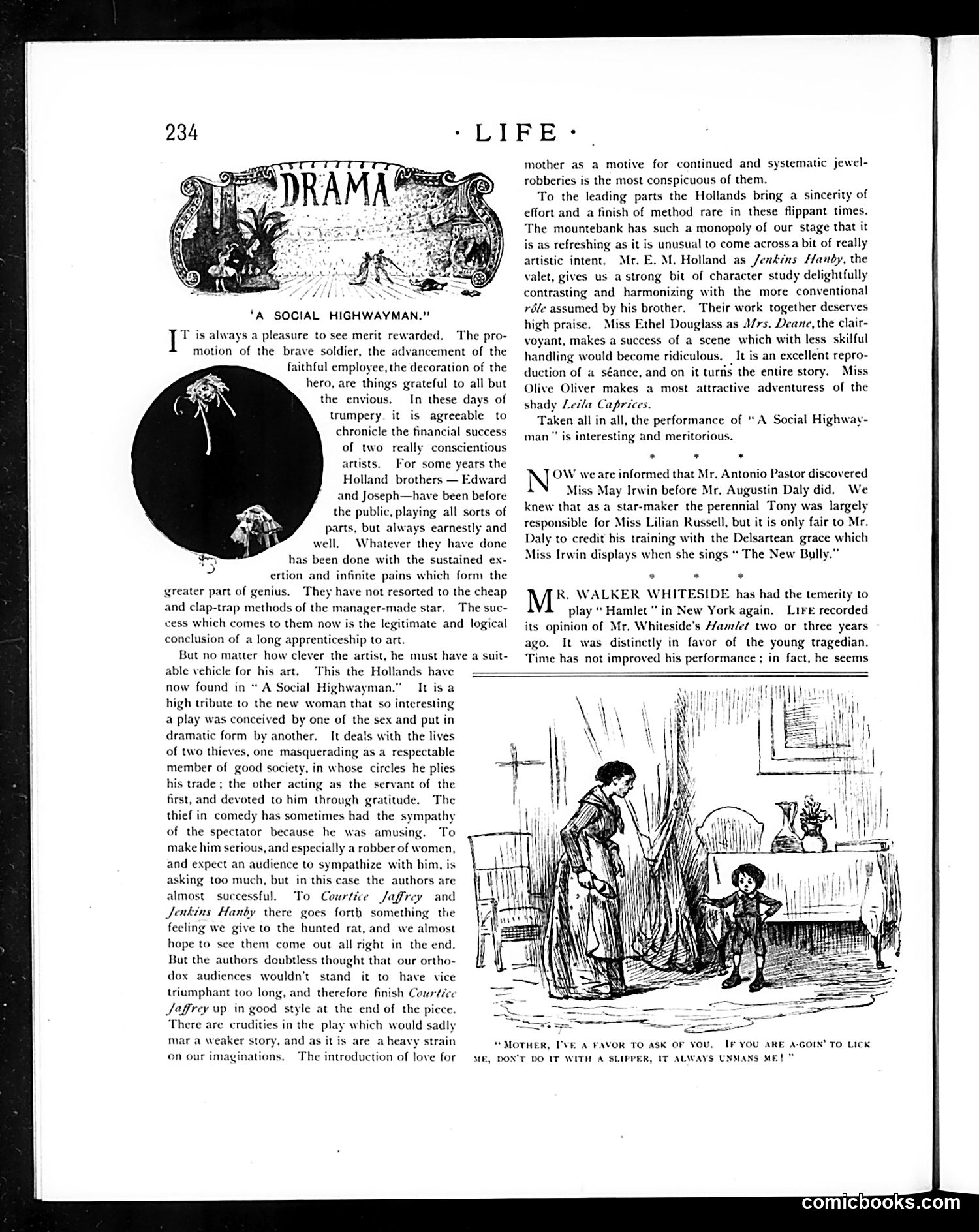
This page reviews theatrical productions, specifically "A Social Highwayman." The main illustration shows a domestic scene where a woman appears to be asking a child for a favor involving a slipper—likely a humorous moment from the play. The text discusses the Holland brothers (Edward and Joseph) as conscientious artists who avoid cheap theatrical methods. It praises their production as a suitable vehicle for performing talent, though notes some plot weaknesses. Additional paragraphs mention actor Antonio Pastor's discovery of May Irwin, and critique of Walker Whiteside's performance in "Hamlet." This is theater criticism rather than political satire—a typical Life magazine drama review from the late 19th or early 20th century, focusing on acting quality and artistic merit of stage productions.
📄 Transcribed text from this page (OCR, searchable)
Machine-transcribed from the original scan — historical spelling and the odd misread are preserved.
-LIFE:. ‘A SOCIAL HIGHWAYMAN.”* is always a pleasure to see merit rewarded. The pro- motion of the brave soldier, the advancement of the faithful employee, the decoration of the hero, are things grateful to all but the envious. In these days of trumpery. it is agreeable to chronicle the financial success of two really conscientious artists. For some years the Holland brothers — Edward and Joseph—have been before the public, playing all sorts of parts, but always earnestly and well. Whatever they have done has been done with the sustained ex- ertion and infinite pains which form the greater part of genius. They have not resorted to the cheap id clap-trap methods of the manager-made star. The suc- cess which comes to them now is the legitimate and logical conclusion of a long apprenticeship to art. But no matter how clever the artist, he must have a suit- able vehicle for his art, This the Hollands have mother as a motive for continued and systematic jewel- robberies is the most conspicuous of them. To the leading parts the Hollands bring a sincerity of effort and a finish of method rare in these flippant times The mountebank has such a monopoly of our stage that it is as refreshing as it is unusual to come across a bit of really artistic intent. Mr. 1. Holland as Jenkins Hanby, the valet, gives us a strong bit of character study delightfully contrasting and harmonizing with the more conventional réle assumed by his brother. Their work together deserves high praise. Miss Ethel Douglass as A/rs. Deane, the clair- voyant, makes a success of a scene which with less skilful handling would become ridiculous. _ It is an excellent repro- duction of a séance, and on it turns the entire story. Miss Olive Oliver makes a most attractive adventuress of the shady Leéla Caprices. ‘aken all in all, the performance of * A Social Highway- interesting and meritorious. * . . N OW we are informed that Mr. Antonio Pastor discovered Miss May Irwin before Mr. Augustin Daly did. We knew that as a star-maker the perennial Tony was largely responsible for M an Russell, but it is only fair to Mr. Daly to credit his training with the Delsartean grace which Miss Irwin displays when she sings “ The New Bully.” * * * R. WALKER WHITESIDE has had the temerity to play “ Hamlet ” in New York again. Lire recorded its opinion of Mr. Whiteside’s Ham/et two or three years ago. It was distinctly in favor of the young tragedian. ‘Time has not improved his performance ; in fact, he seems now found in * A Social Highwayman.” It is a high tribute to the new woman that so interesting a play was conceived by one of the sex and put in dramatic form by another. It dea!s with the lives of two thieves, one masquerading as a respectable member of good society, in whose circles he plies his trade; the other acting as the servant of the first, and devoted to him through gratitude. The thief in comedy has sometimes had the sympathy of the spectator because he was amusing. To make him serious, and especially a robber of women, and expect an audience to sympathize with him, is asking too much, but in this case the authors are almost successful. To Courtice Jaffrey and Jenkins Hanby there goes forth something the fecling we give to the hunted rat, and we almost hope to see them come out all right in the end. But the authors doubtless thought that our ortho- dox audiences wouldn't stand it to have vice triumphant too long, and therefore finish Courtice Jaffrey wp in good style at the end of the piece. ‘There are crudities in the play which would sadly mar a weaker story, and as it is are ahea on our imaginations. y strain The introduction of love for “MOTHER, I'VE A FAVOR TO ASK OF YOU. ME, DON'T DO IT WITH A SLIPPER, IT ALW. IF YOU ARE A-GOIN' TO LICK 'S UNMANS ME!” comicbooks.com