
Life, 1895-10-10 · page 13 of 18
Life — October 10, 1895 — page 13: what you’re looking at
What you’re looking at
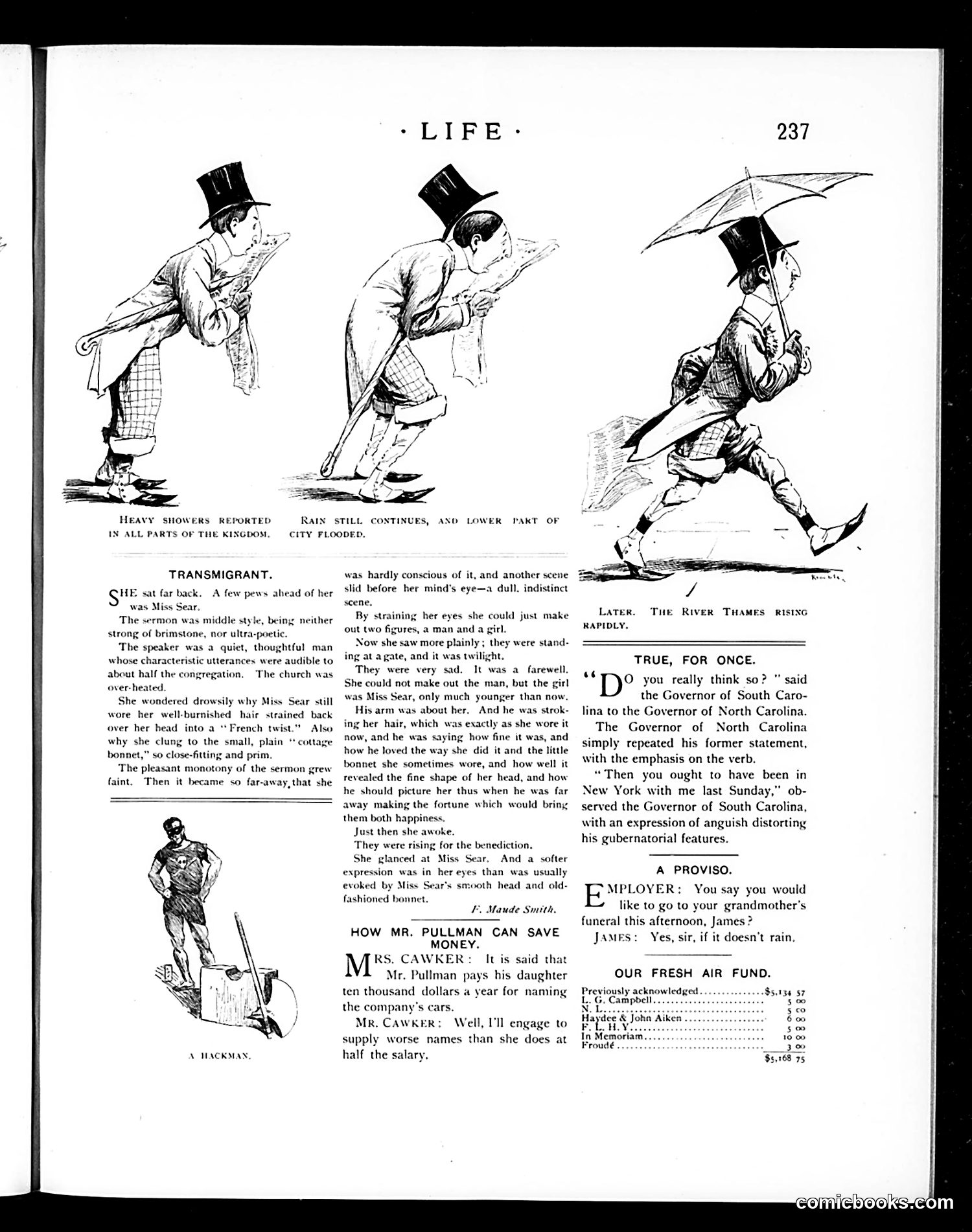
This page contains several satirical pieces typical of early 20th-century American humor: **"Transmigrant"**: A sentimental story about a woman daydreaming during church, remembering a lost love who admired her distinctive hairstyle and bonnet. The irony is that she still wears the same old-fashioned style years later, frozen in the past. **Weather cartoons** (top): Three illustrations of gentlemen in top hats struggling with rain and flooding—visual humor about English weather and the formal dress code's impracticality. **"How Mr. Pullman Can Save Money"**: A joke about George Pullman (railroad magnate) paying his daughter lavishly just to name train cars, with a rival claiming he could supply worse names cheaper—mocking nepotism and corporate excess. **"True, For Once"**: A brief dialogue between Southern governors about a trip to New York, with an unclear political point. **"A Proviso"**: Employer-employee humor about an excuse for missing work (grandmother's funeral) with the condition "if it doesn't rain." The page reflects Life's mix of sentimental fiction, visual gags, and brief satirical pieces targeting contemporary social figures and situations.
📄 Transcribed text from this page (OCR, searchable)
Machine-transcribed from the original scan — historical spelling and the odd misread are preserved.
HEAVY SHOWERS REPORTED IN ALL PARTS OF THE KINGDOM, TRANSMIGRANT. HE sat far back. was Miss Sear. The sermon was middle sty strong of brimstone, ‘The speaker was a quiet, thoughtful man ces were audible to The church was A few pews ahead of her , being neither nor ultra-poetic. whose characteristic uttera about half the congregation. over-heated She wondered drowsily why Miss Sear still wore her well-burnished hair strained back over her bead into a “French twist.” Also why she clung to the small, plain * cottage bonnet,” so close-fitting and prim. The pleasant monotony of the sermon grew faint. Then it became so far-away,that she A MACKMAN RAIN STILL CITY FLOODED, CONTINUES, AND LOWER PAKT OF was hardly conscious of it, and another scene slid before her mind's eye—a dull, indistinct scene, By straining her eyes she could just make out two figures, a man and a girl. Now she saw more plainly ; they were stand- ing at agate, and it was twilight They were very sad. It was a farewell, She could not make out the man, but the girl was Miss Sear, only much younger than now. His arm was about her, And he was strok- ing her hair, which was exactly as she wore it now, and he was saying how fine it was, and how he loved the way she did it and the little bonnet she sometimes wore, and how well it revealed the fine shape of her head, and how he should picture her thus when he was far away making the fortune which would bring them both happiness. Just then she awoke. They were rising for the benediction, She glanced at Miss Sear. And a softer expression was in her eyes than was usually evoked by Miss Sear's smooth head and old- fashioned bonn F. Maude Smith. HOW MR. PULLMAN CAN SAVE Y. RS. CAWKER: It is said that Mr. Pullman pays his daughter ten thousand dollars a year for naming the company’s cars. Mr. CAWKER: Well, I'll engage to supply worse names than she does at half the sala Later. Tie River Tuas RAPIDLY. RISING TRUE, FOR ONCE. O you really think so? " said the Governor of South Caro- lina to the Governor of North Carolina. The Governor of North Carolina mply repeated his former statement, with the emphasis on the verb. “Then you ought to have been in New York with me last Sunday," ob- served the Governor of South Carolina, with an expression of anguish distorting his gubernatorial features. A PROVISO. MPLOYER: You say you would like to go to your grandmother's funeral this afternoon, James ? JAME Yes, sir, if it doesn’t rain. OUR FRESH AIR FUND. Previqusly acknowledged 2850136 57 L. G. Campbell Pens oo NOL $0. 600 $00 10 00. 30 $5,168 75, Haydce' Joho ‘Aiken | HY