
A complete issue · 16 pages · 1895
Life — July 18, 1895
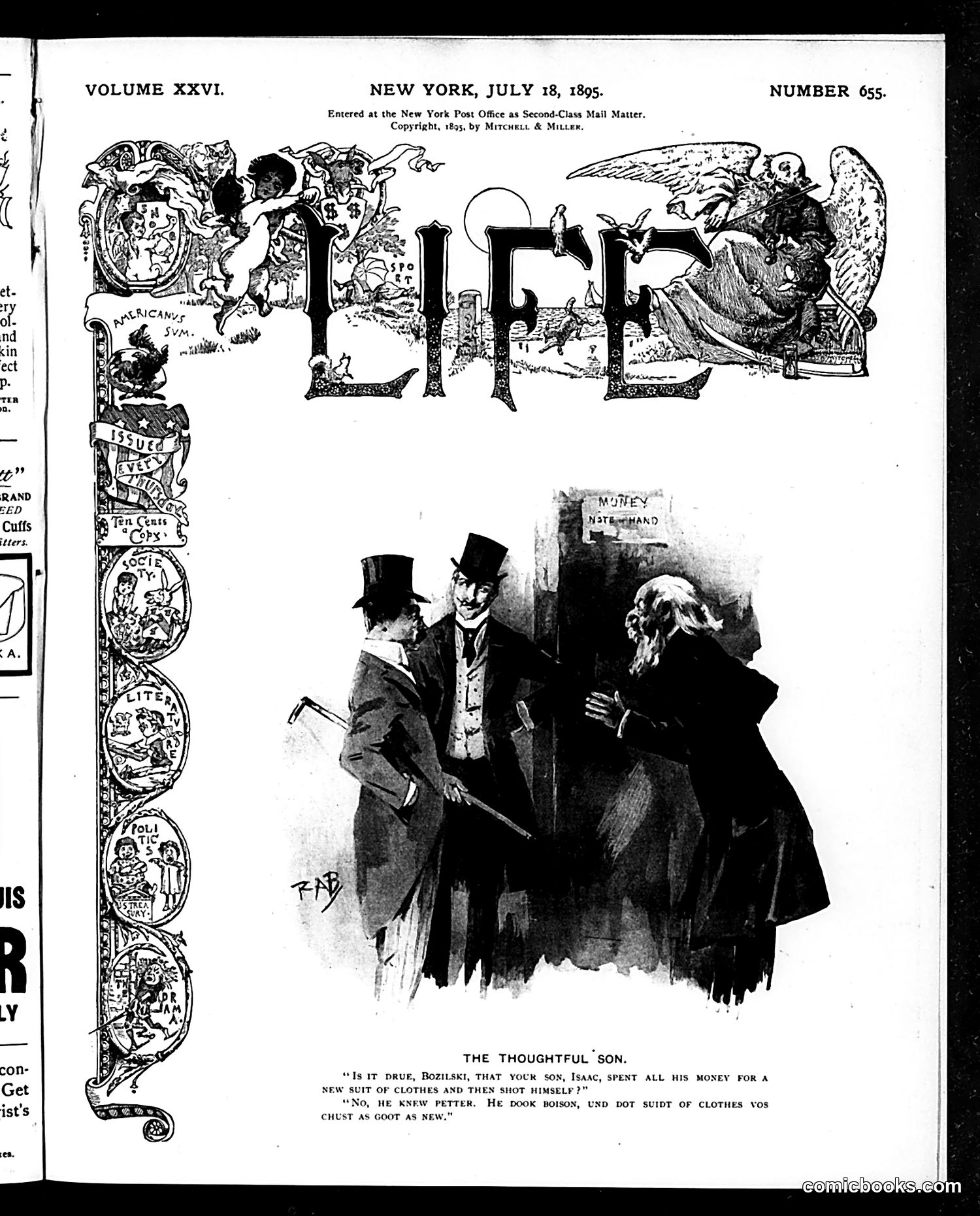
The main cartoon, titled "The Thoughtful Son," depicts three men in top hats and formal dress. The caption presents a dialogue where one character (Boziski) defends his son Isaac's spending: the boy spent all his money on a new suit and shot himself, but this wasn't wasteful—he dressed well because "he took boisoiv, und dot suidt of clothes vos chust as goot as new." This appears to be dark humor about suicide, likely satirizing both immigrant speech patterns (the Yiddish-inflected English) and attitudes toward materialism and death. The "thoughtful son" title suggests ironic commentary on priorities—that dressing well for one's own suicide demonstrates misplaced values. The ornate left margin contains decorative elements typical of Life's period design.
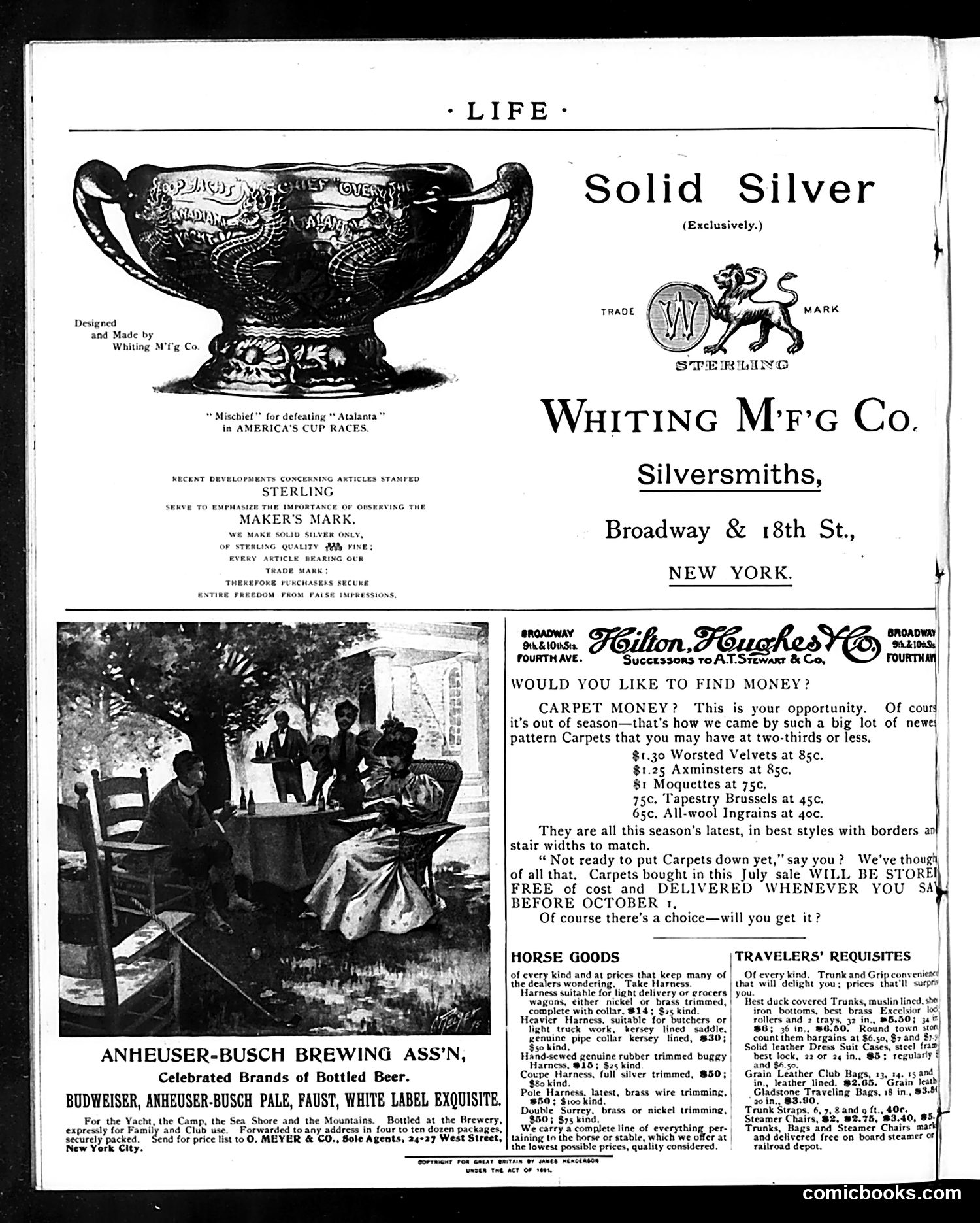
This page is primarily **advertising rather than satire or editorial content**. The main illustration shows a decorative silver bowl, promoting Whiting Manufacturing Company's sterling silver products for New York silversmiths. The text emphasizes their exclusive use of solid silver and the importance of checking maker's marks to avoid counterfeits. Below are period advertisements for Anheuser-Busch beer, Hilton-Hughes carpet sales, and various merchant goods (harnesses, travelers' trunks, etc.). The only possible satirical element is the silver bowl's caption mentioning "Mischief" for defeating "Atlanta" in America's Cup races—likely a historical sailing reference—but this appears to be straightforward product description rather than political commentary.
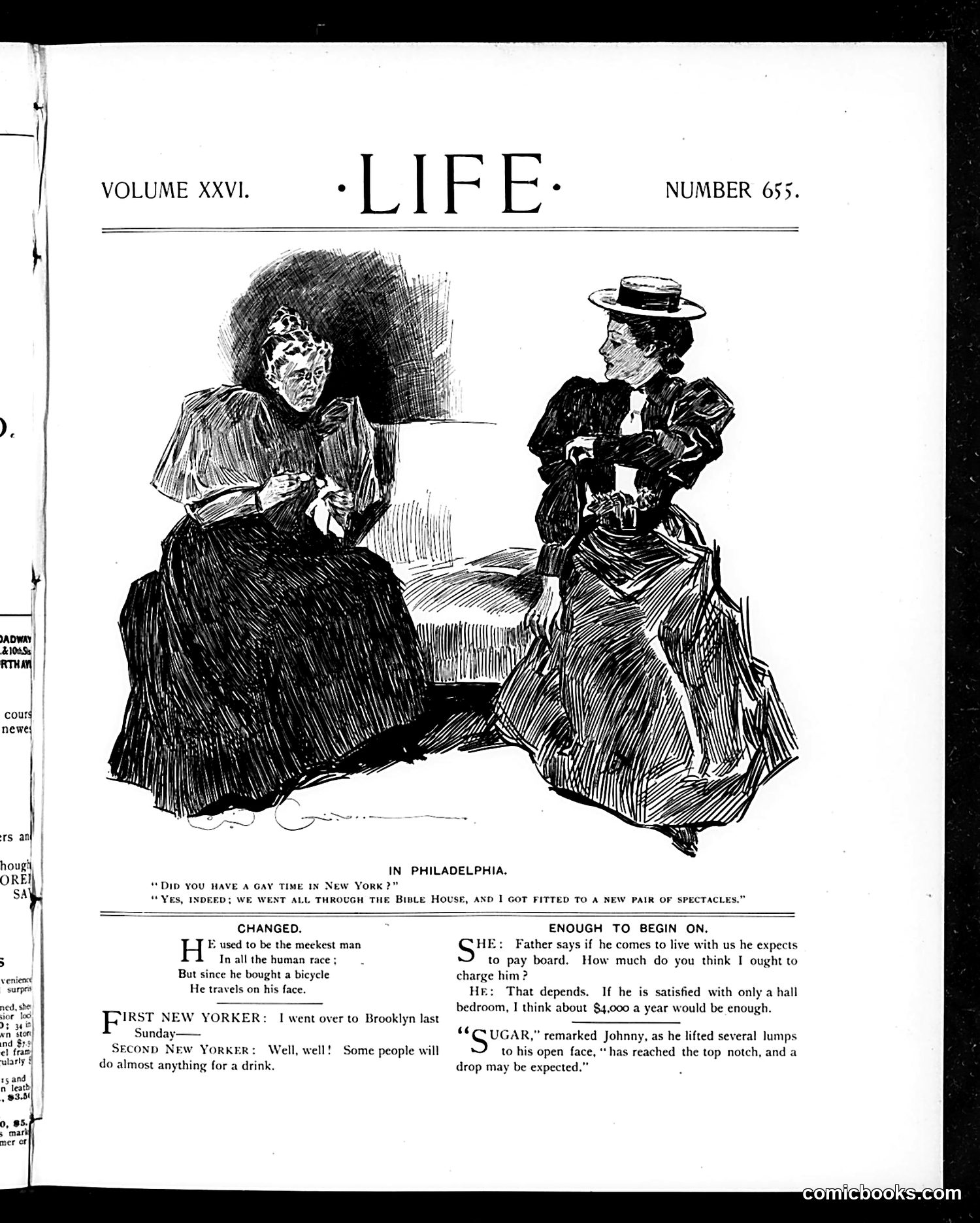
This page contains satirical sketches and jokes typical of early 20th-century American humor. The main illustration depicts two women in conversation titled "In Philadelphia," discussing New York experiences. The woman on the right mentions visiting "the Bible House" and getting new spectacles—likely referencing a specific Philadelphia landmark. The accompanying jokes mock working-class life and social pretension. "Changed" comments on human ambition through travel. The "First New Worker" dialogue satirizes Brooklyn residents' willingness to compromise morals for drinks. "Enough to Begin On" jokes about boarding costs and romantic expectations. The humor relies on contemporary social observations about regional differences, class aspiration, and urban life—details that require period knowledge to fully appreciate.
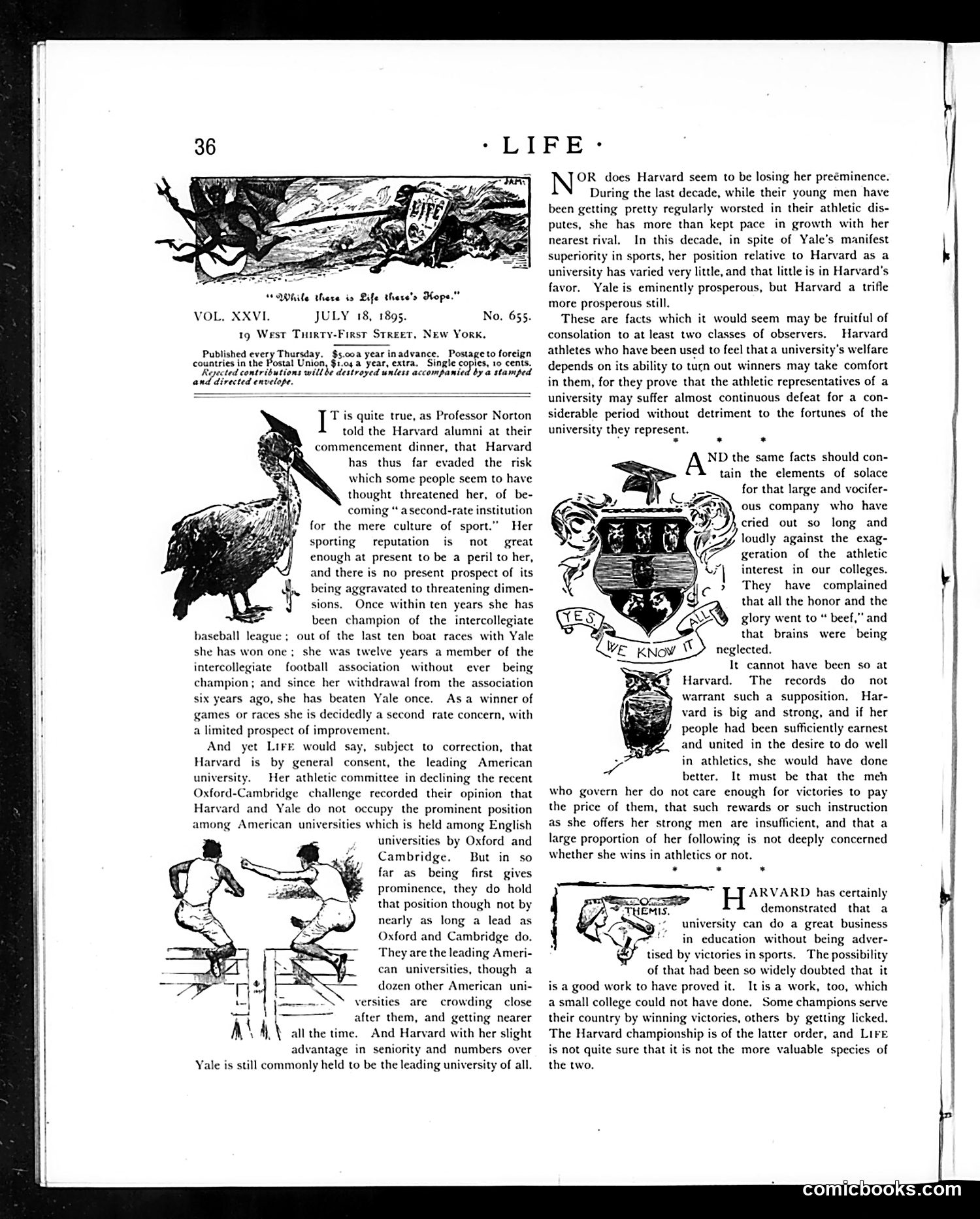
This page critiques Harvard University's athletic program and its administration's lack of commitment to winning. The text argues that Harvard, despite being America's leading university, has underperformed in sports compared to Yale, which is "still commonly held to be the leading university of all." The article satirizes Harvard's defensive position: the university's leaders claim athletics aren't crucial to institutional prestige, yet they simultaneously suffer embarrassment from athletic losses. The cartoons depicting athletes (a baseball player and runners) illustrate the disconnect between Harvard's academic status and its athletic mediocrity. The central irony: Harvard administration refuses to seriously invest in athletics, then complains about losing. The author suggests Harvard could excel at both academics and sports if it actually prioritized winning.
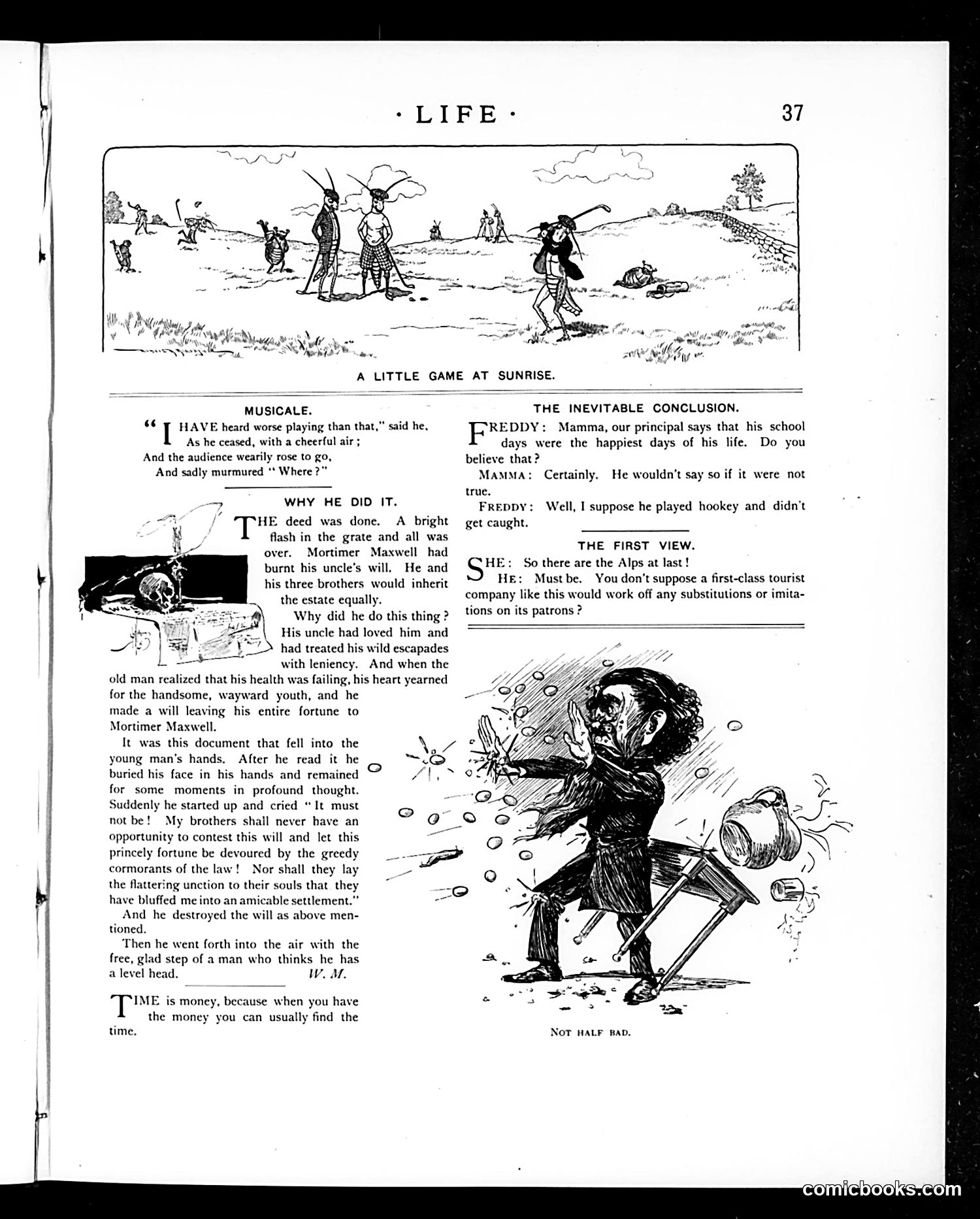
**Top Illustration:** "A Little Game at Sunrise" depicts casual outdoor recreation, likely golf or a similar sport being played at dawn. **Middle Section ("Musicale"):** A joke about someone's poor musical performance, with the punchline that the performer "did it" (burned his uncle's will to inherit the estate) to stop the music. **"Why He Did It":** Explains the uncle left his fortune to Mortimer Maxwell, who destroyed the will to prevent greedy relatives from contesting it—a satirical commentary on inheritance disputes and family greed. **"The First View":** A dialogue about Alpine tourism, suggesting high-end travel companies shouldn't use cheap substitutes for their reputation. **Bottom Right:** "Not Half Bad" shows someone mining or digging, illustration without accompanying text. The page combines humor about social pretension, family conflict, and leisure activities typical of early 20th-century American satire.
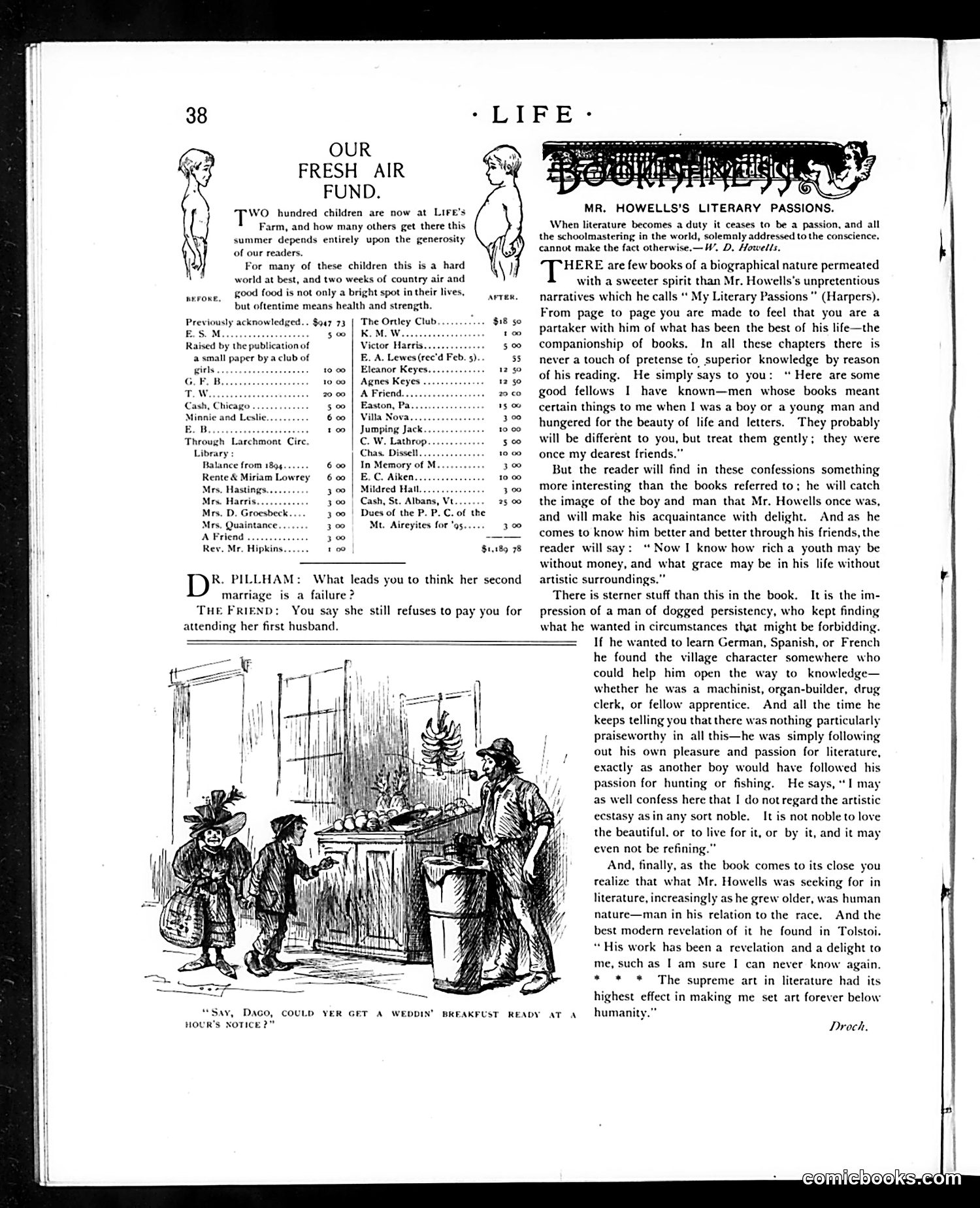
This page contains two distinct elements: **"Our Fresh Air Fund"** (left): A satirical piece about children's charitable donations, listing books and publications with their costs. It appears to mock the gap between charitable intentions and actual funding—suggesting wealthy donors contribute minimal amounts despite claiming generosity. **"Mr. Howells's Literary Passions"** (right): A literary critique praising William Dean Howells's biographical work "My Literary Passions," portraying him as an unpretentious mentor-figure who guided readers through literature without pretense or snobbery. The piece celebrates his humble approach to books and human nature, contrasting his philosophy with artificial intellectualism. **The cartoon** (center-bottom) shows a domestic scene with the caption "Say, Dago, could yer get a weddin' breakfast ready at a hour's notice?" It appears to mock working-class immigrant life and employment dynamics, using period-appropriate but now offensive terminology.
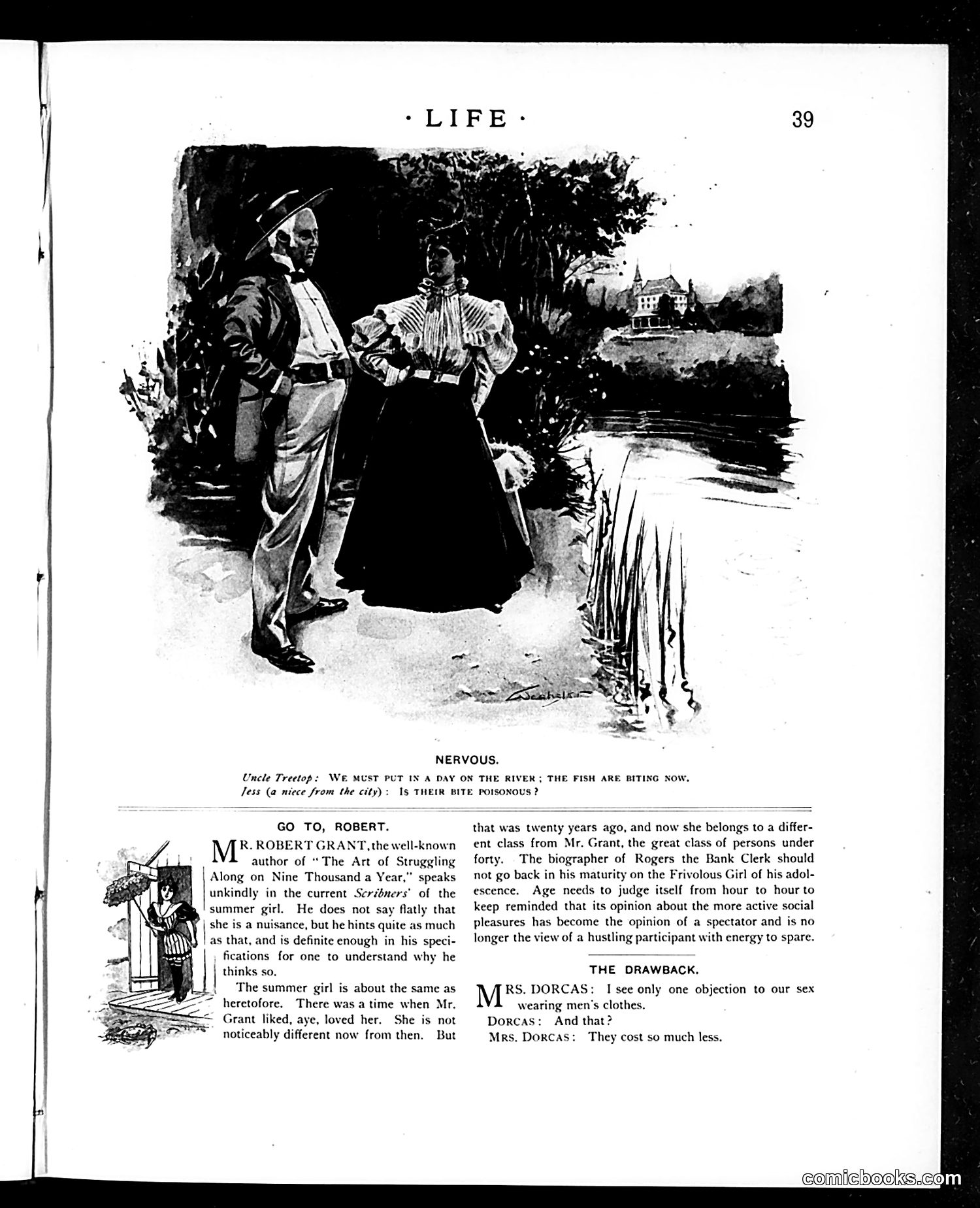
**Top Illustration ("Nervous"):** Shows a woman in elegant dress with two men by a river, with a mansion visible. Uncle Treetop warns about putting "in a day on the river" while "the fish are biting now," asking if their bite is poisonous—likely satirizing concerns about food safety or the summer social season's hazards. **"Go To, Robert" Section:** Robert Grant, a well-known author, is criticized for his outdated views on "summer girls." The text suggests Grant's opinions about women's social behavior and morality are twenty years behind current times, mocking his failure to recognize that women's social status and independence have evolved. **"The Drawback":** Mrs. Dorcas jokingly justifies women wearing men's clothes solely because they're cheaper—satirizing feminist dress reform arguments by reducing them to economic self-interest rather than principle.
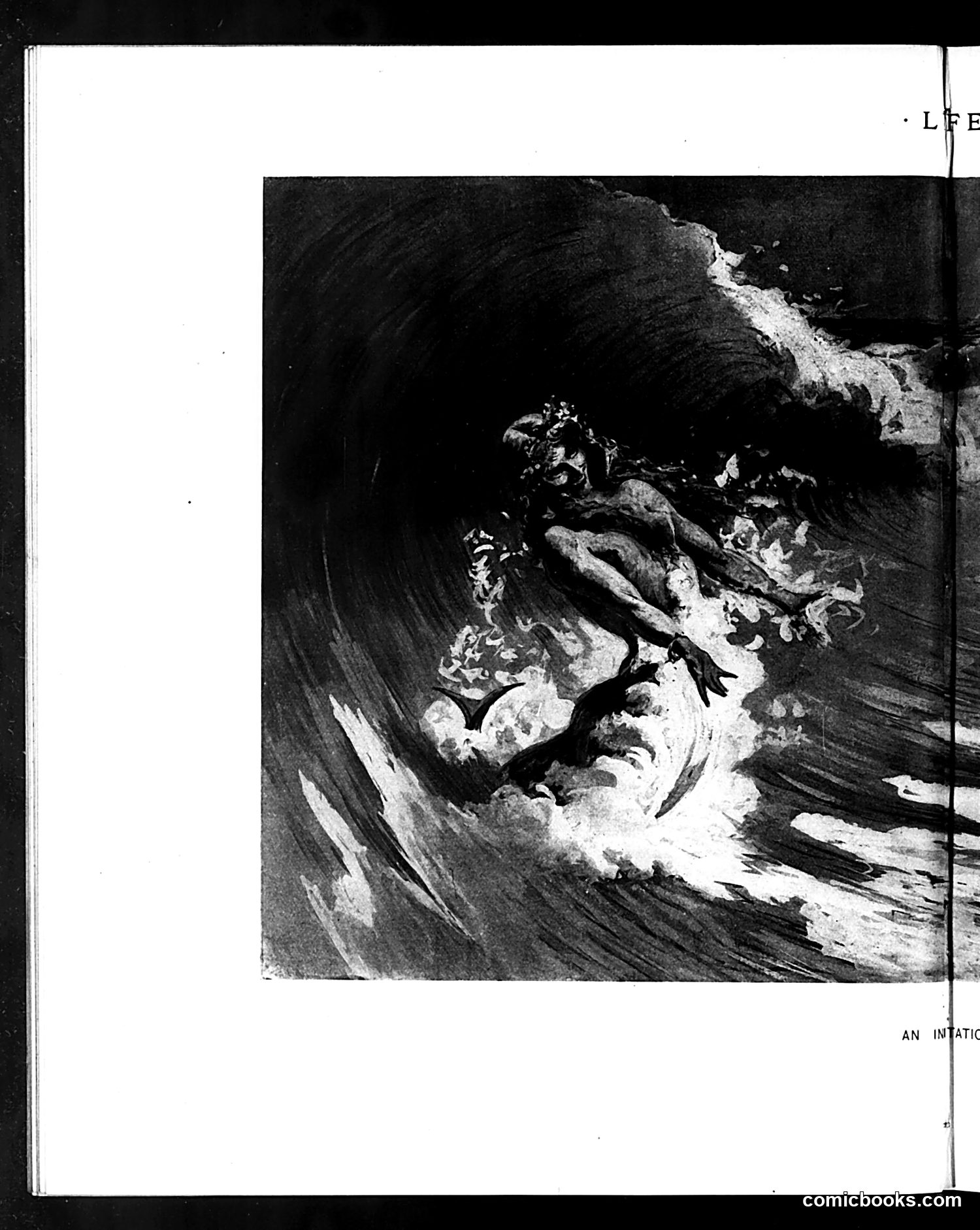
This appears to be a satirical illustration from Life magazine showing a grotesquely caricatured human head in profile. The figure displays exaggerated features rendered in dramatic black and white contrast, with swirling, expressive brushwork characteristic of early 20th-century editorial cartooning. The text fragment "AN IMATIO" (likely "AN IMITATION" or similar) at the bottom suggests this is mocking or critiquing something—possibly an artistic movement, political figure, or social trend. The grotesque style itself may be the satire's target. However, without complete caption text or additional context visible on this page, I cannot definitively identify which specific person, movement, or event is being satirized. The artistic technique and grotesque treatment suggest social or political commentary typical of Life magazine's satirical content, but the precise meaning requires the full caption.
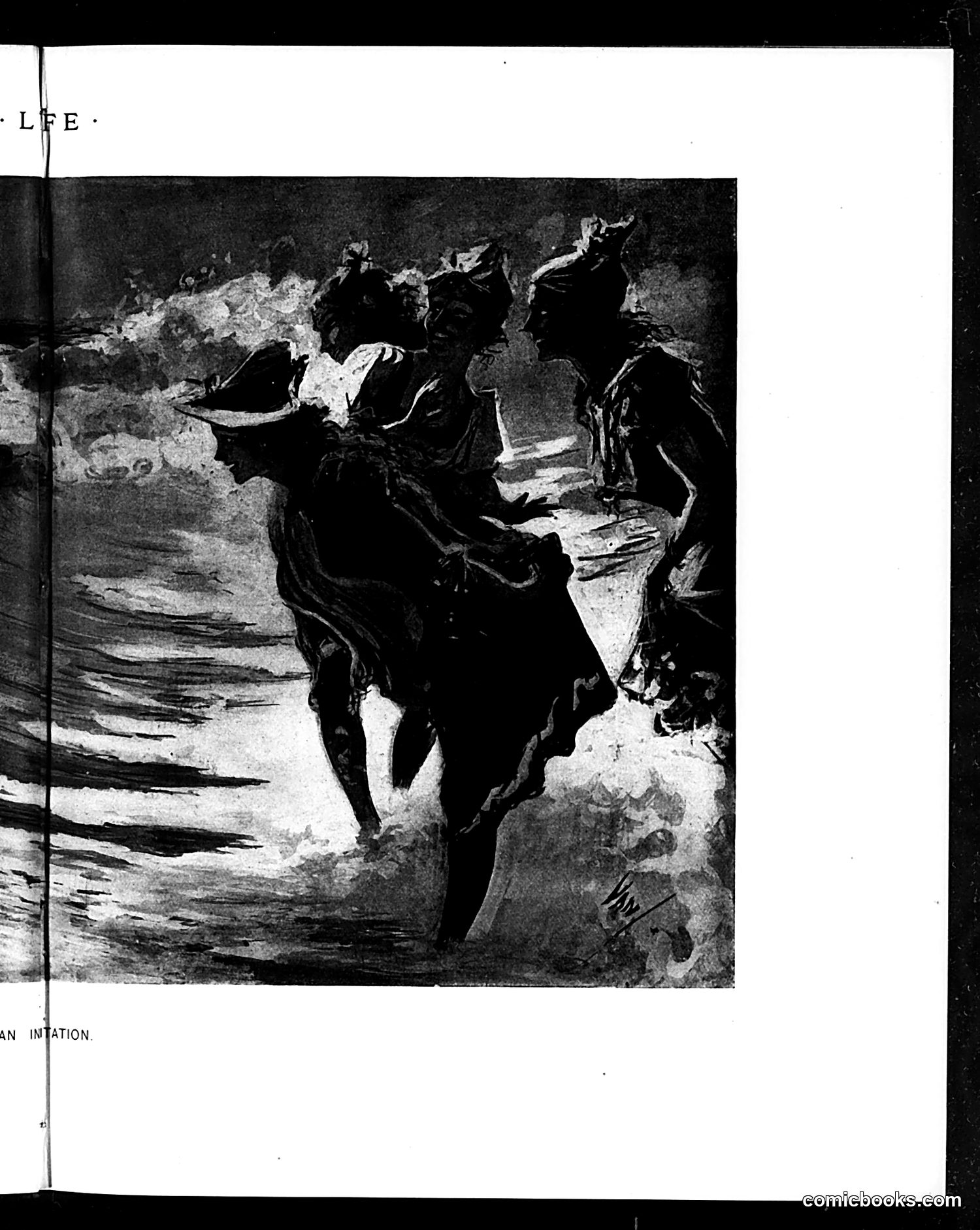
This appears to be a satirical illustration from *Life* magazine, though the image quality and partial OCR text ("AN INITIATION" at bottom) limit full interpretation. The dark, dramatic artwork depicts what seems to be a formal or ritualistic scene with multiple figures in dark clothing gathered around a central figure. The style and composition suggest this is political or social satire, possibly depicting an initiation ceremony or secretive gathering. Without clearer text or additional context, I cannot confidently identify the specific figures, the particular political event referenced, or the intended satirical point. The dramatic chiaroscuro technique and formal grouping suggest commentary on exclusionary practices or hidden institutional rituals, but the specific target remains unclear from this image alone.
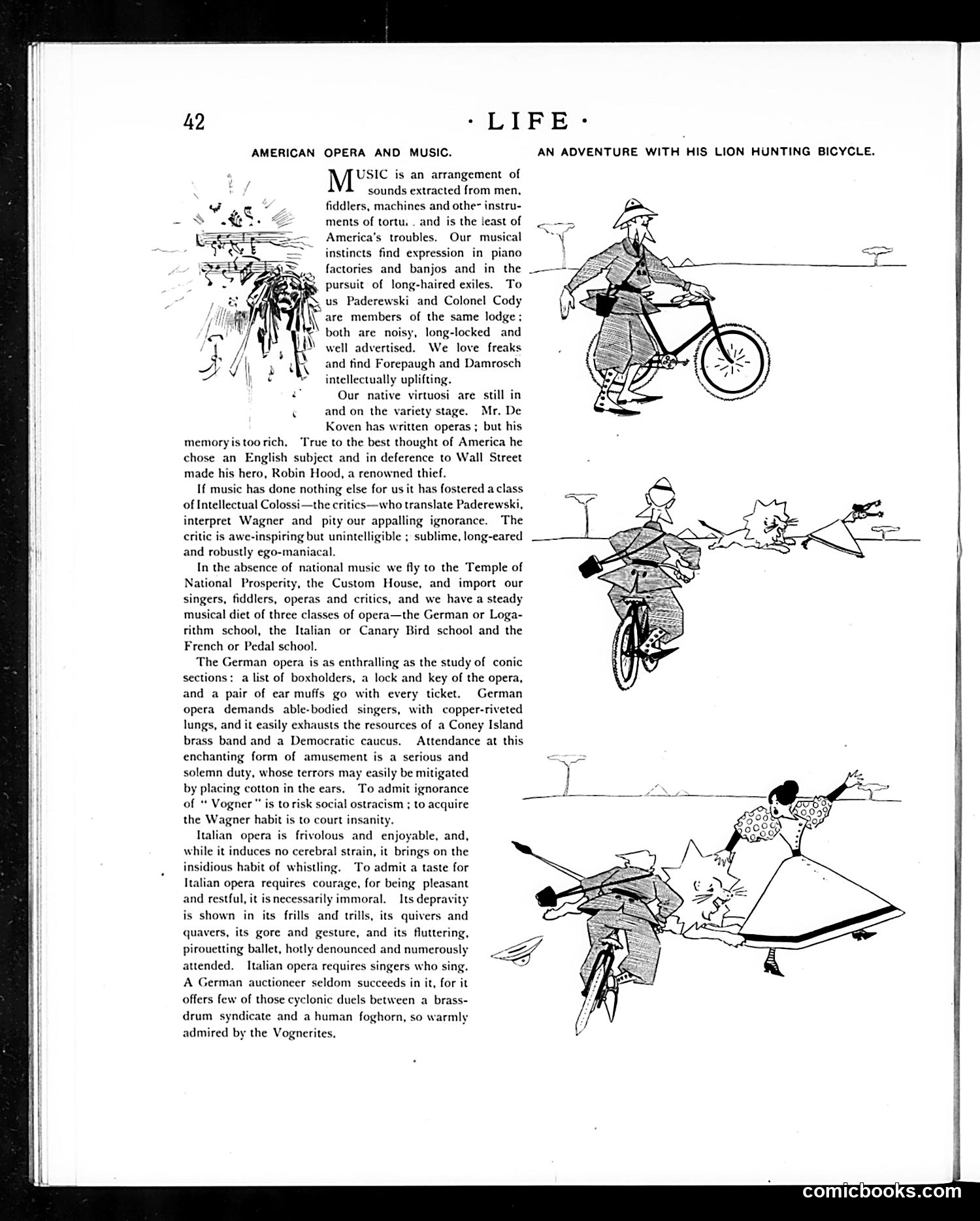
This page satirizes American opera and classical music pretensions. The left column mocks imported European opera traditions—German, Italian, and French styles—as intellectually exhausting and culturally snobbish. The author attacks critics who translate complex European composers like Paderewski while ignoring American composers. The right side features cartoons of a figure on a bicycle performing increasingly absurd stunts (hunting lions, acrobatic tricks). This "lion hunting bicycle" adventure appears to mock the disconnect between highbrow cultural pursuits and practical American entertainment—suggesting that circuses or vaudeville spectacle might be more honest expressions of American culture than pretentious opera imports. The satire argues Americans should develop authentic native music rather than imitating European forms.
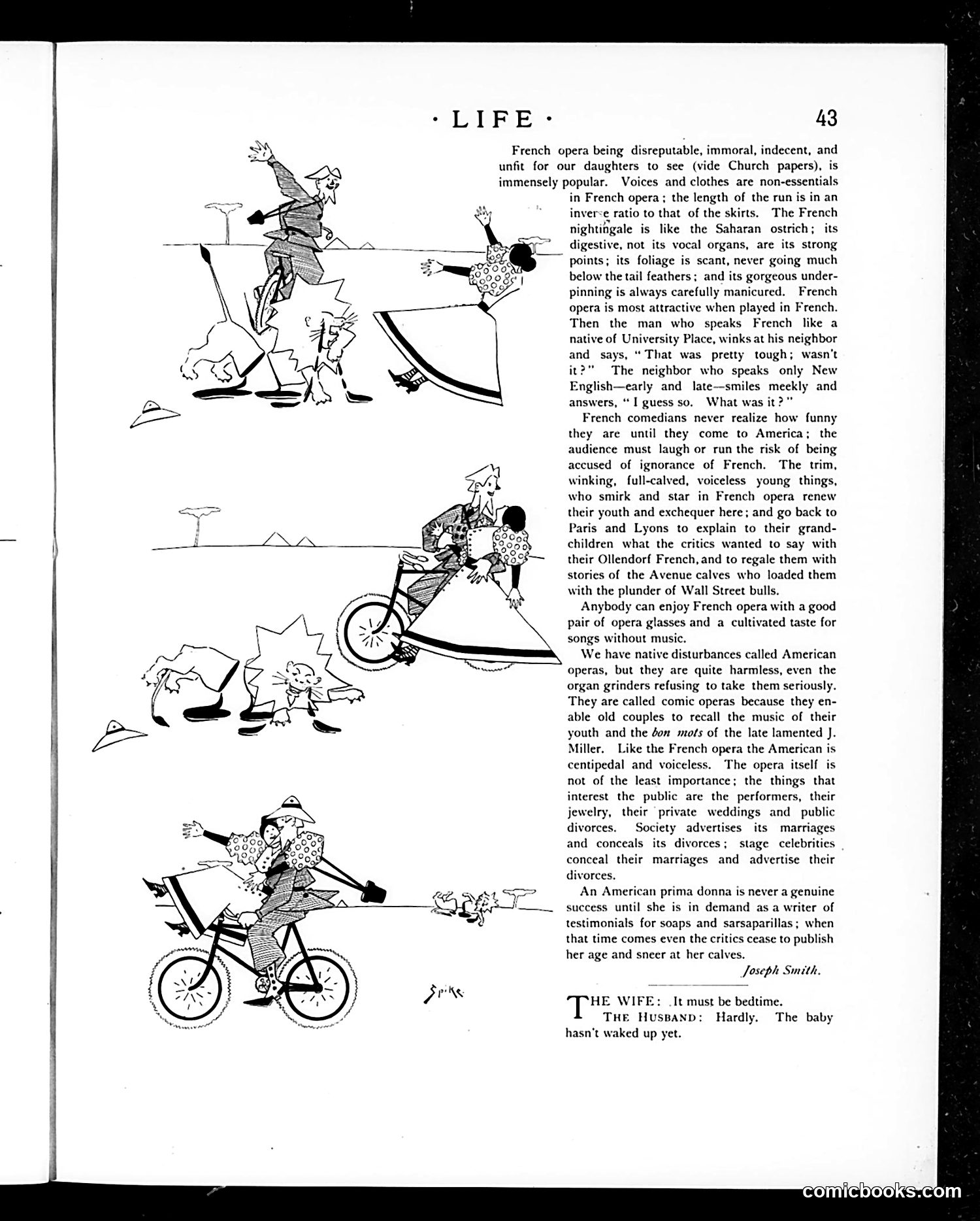
This page from *Life* magazine satirizes French opera and American attitudes toward it. The text criticizes French opera as "disreputable, immoral, indecent" while mocking American audiences who pretend to appreciate it despite not understanding French. The cartoons (credited to artist "Spark") show absurd, exaggerated figures engaged in ridiculous physical antics—appearing to dance or perform chaotically on bicycles and in acrobatic poses. These illustrations mock the supposedly sophisticated European art form by depicting it as nonsensical spectacle rather than refined entertainment. The satire targets American social pretension: wealthy New Yorkers attending French opera to appear cultured while remaining ignorant of the language and content. The piece concludes with a brief comedic dialogue between a husband and wife, maintaining the humorous tone throughout.
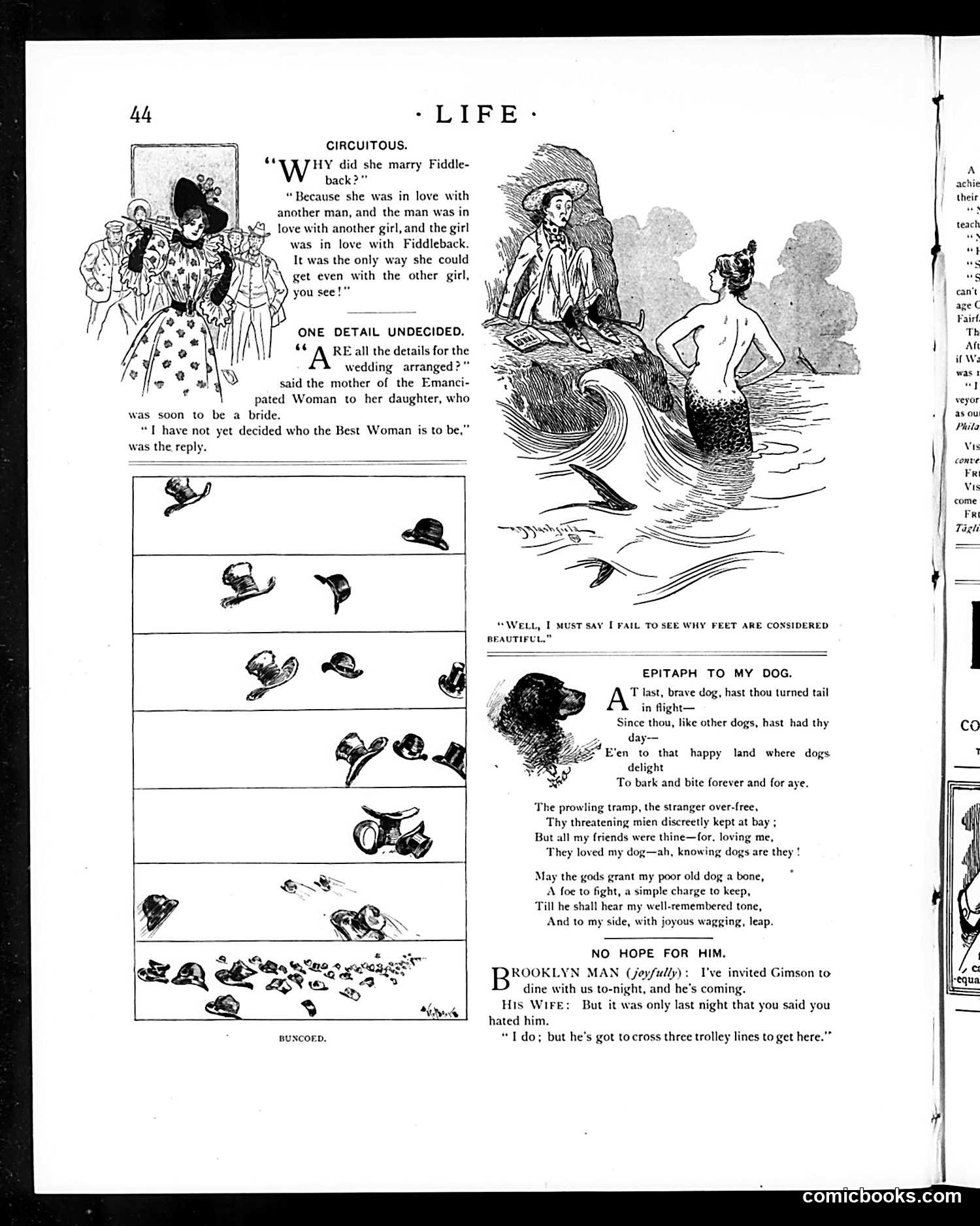
This page contains several satirical pieces typical of early 20th-century American humor: **"Circuitous"** mocks romantic entanglement through a circular love chain—a woman marries Fiddleback only to hurt a rival, illustrating absurd relationship logic. **"One Detail Undecided"** satirizes the "Emancipated Woman"—a contemporary social figure advocating women's rights and independence. The joke: she's breaking tradition by having a "Best Woman" instead of a "Best Man" at her wedding, suggesting feminist progress creates new social uncertainties. **"Well, I Must Say..."** is a visual gag about feet and beauty standards, likely mocking Victorian fetishization. **"Epitaph to My Dog"** is sentimental verse about a faithful pet. **"No Hope for Him"** jokes about a Brooklyn man inviting someone he hates to dinner, hoping the difficult trolley commute will prevent him from arriving—dark humor about urban inconvenience. The page reflects Progressive Era sensibilities: modern courtship complications, women's changing social roles, and urban life anxieties.
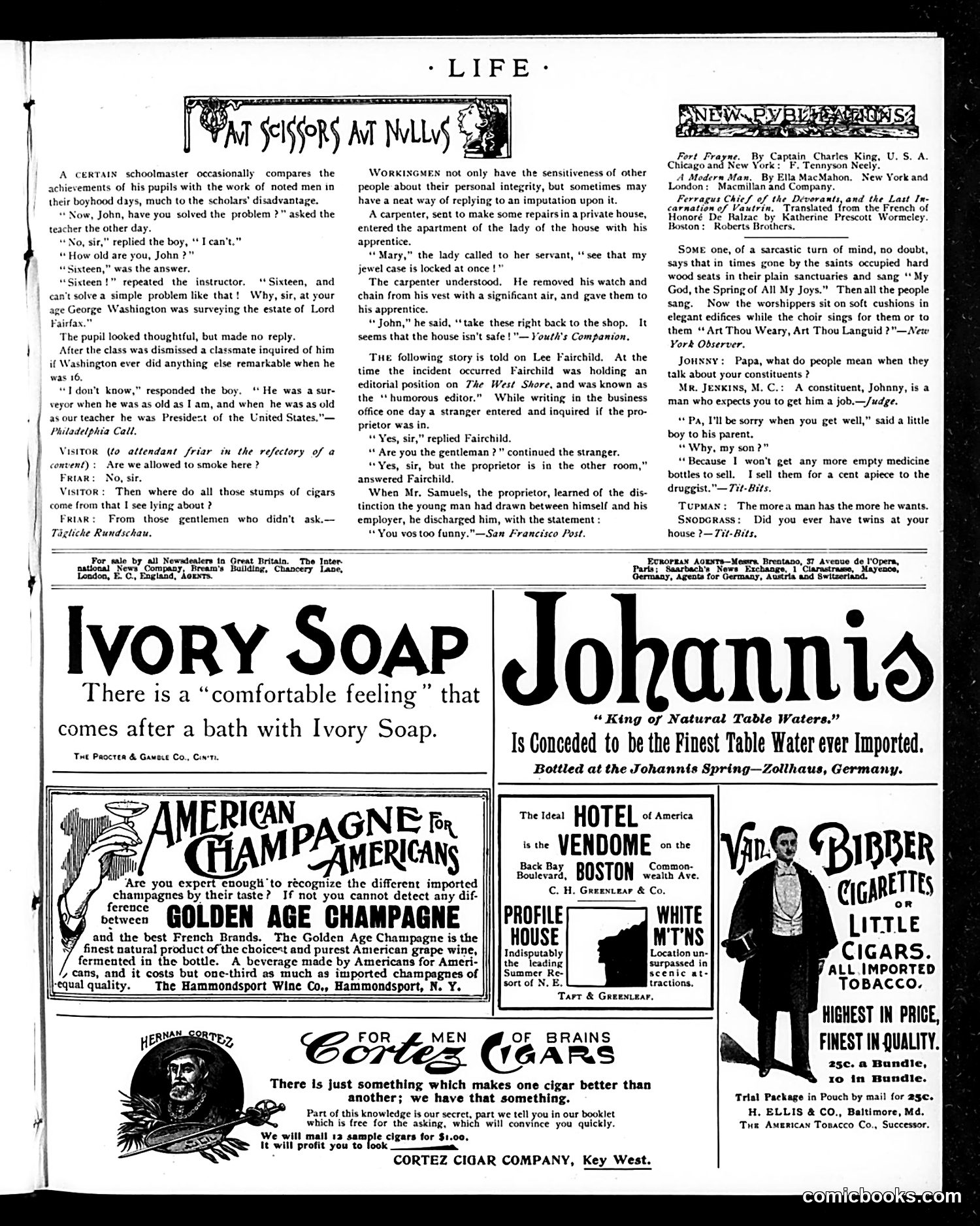
This page from *Life* magazine consists primarily of **humorous anecdotes and advertisements** rather than political cartoons. The main content includes several brief satirical stories: 1. **"At Scissors at Nulls"** — A schoolmaster compares students unfavorably to young George Washington, prompting a student to quip that Washington was also a surveyor before becoming president—implying the comparison is unfair. 2. **"Lee Fairchild" story** — A carpenter tactfully suggests a house is unsafe by removing his valuables, prompting the editor (Fairchild) to make a clever distinction between himself and his boss to the visitor. 3. **Q&A jokes** about constituents, medicine bottles, and monastery cigars—light humor about class distinctions and human nature. The page is dominated by period **product advertisements** (Ivory Soap, Johannis water, cigars, champagne) rather than satirical commentary. The humor targets everyday social pretension and minor ironies rather than specific political figures or events.
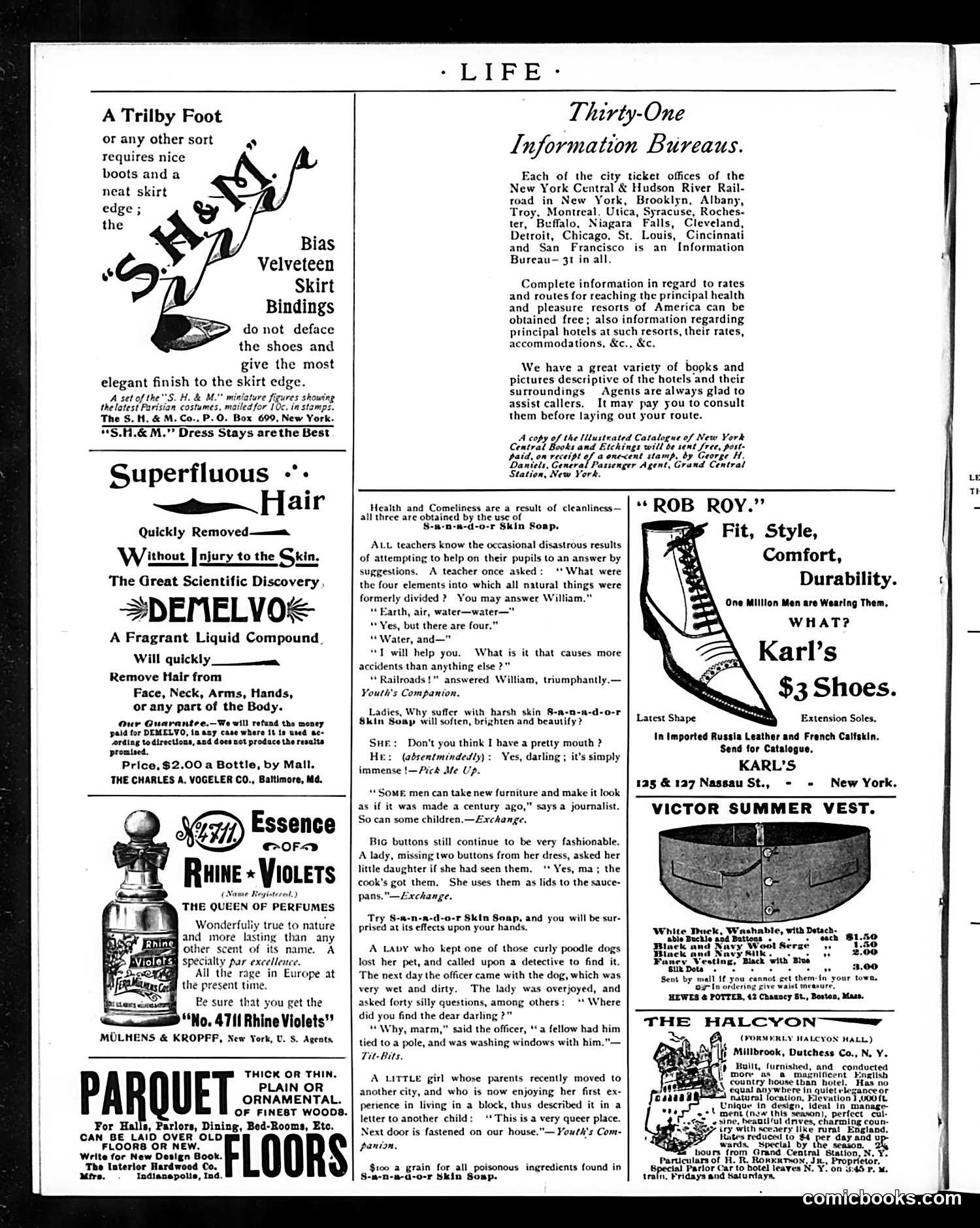
This page is primarily **advertising with some satirical humor pieces**, typical of Life magazine's format. The main satirical content includes brief anecdotes mocking social pretension and naïveté: - A **teacher's dialogue** where student "William" answers a question about what causes accidents with "Railroads!"—satirizing how leading questions can produce absurd answers. - A **flirtation joke** where a woman compliments her own mouth and a distracted man agrees it's "immense," mocking shallow romantic banter. - **Observational humor** about furniture and children mimicking age, poking fun at affectation and parental indulgence. The rest is **straightforward advertising** for period products: corset stays, hair removal cream (Demelvo), perfume, shoes, vests, and flooring. These ads reflect early 1900s consumer goods and fashion concerns (tight corseting, facial hair removal, elaborate dress codes). The "Information Bureaus" section is **practical travel content**, not satire—describing New York Central Railroad's ticket office services for tourists. Overall: a typical Life magazine page mixing light social satire with commercial advertisements.
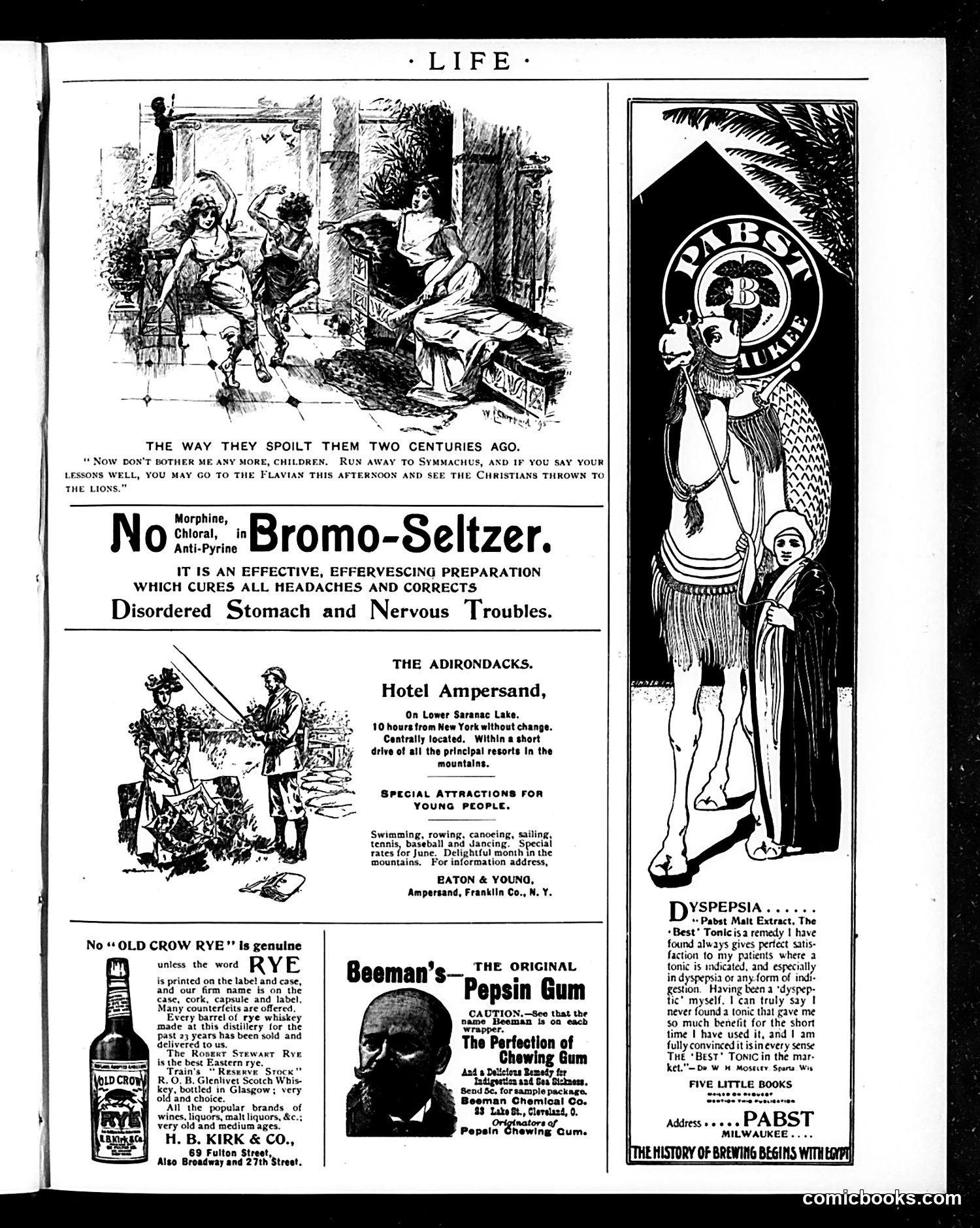
The top cartoon satirizes child-rearing practices by drawing a parallel between ancient Rome and the present day. A Roman parent dismisses children to attend lessons with a tutor (Symmachus) and promises them a treat—watching Christians thrown to lions at the Flavian Amphitheater—as a reward for good behavior. The satire's point: modern parents similarly use entertainment and indulgence as substitutes for proper discipline and education. By equating contemporary child-spoiling with brutal Roman excess, the cartoonist critiques what he sees as permissive parenting trends. The rest of the page consists entirely of period advertisements for patent medicines (Bromo-Seltzer, Beeman's Pepsin Gum, Pabst Malt Extract), whiskey, and the Hotel Ampersand—typical commercial content filler for *Life* magazine during this era.
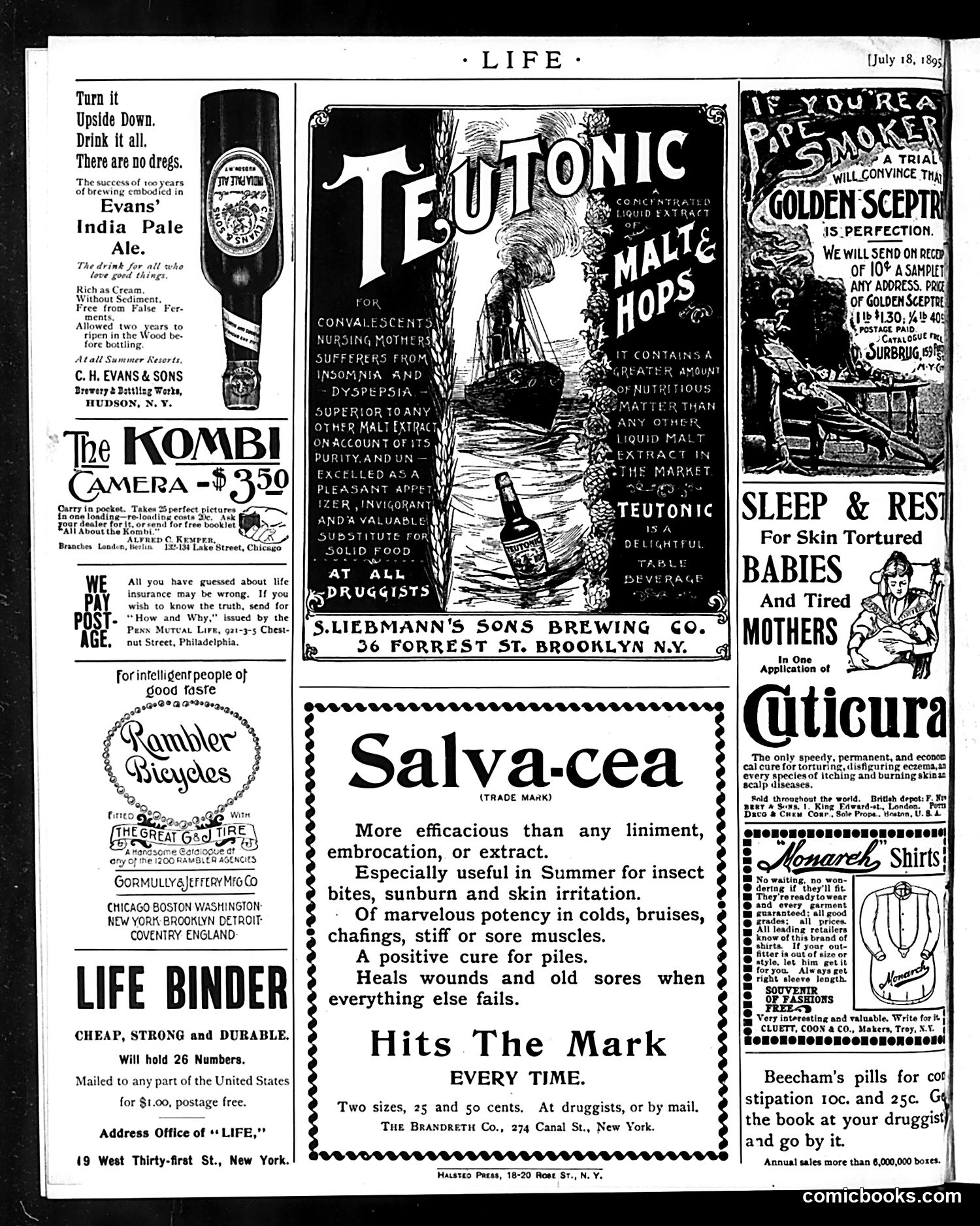
This is primarily an **advertising page** with no political cartoons or satire. It showcases patent medicines and consumer products typical of the 1890s. Notable ads include: - **Evans' India Pale Ale**: Beer marketed as medicinal, claiming 100 years of brewing success - **Teutonic Malt & Hops**: A malt extract for "convalescents, nursing mothers" and other ailments - **Salva-cea**: A cure-all liniment claiming to treat piles, wounds, insect bites, and "every species of itching" - **Cuticura**: A skin treatment for eczema and scalp diseases - **Beecham's Pills**: For constipation The page reflects the era's **unregulated patent medicine market**, where products made sweeping medical claims without modern FDA oversight. These advertisements reveal what ailments concerned 1890s consumers and how brazenly manufacturers marketed dubious remedies as cure-alls.