
Life, 1895-07-18 · page 11 of 16
Life — July 18, 1895 — page 11: what you’re looking at
What you’re looking at
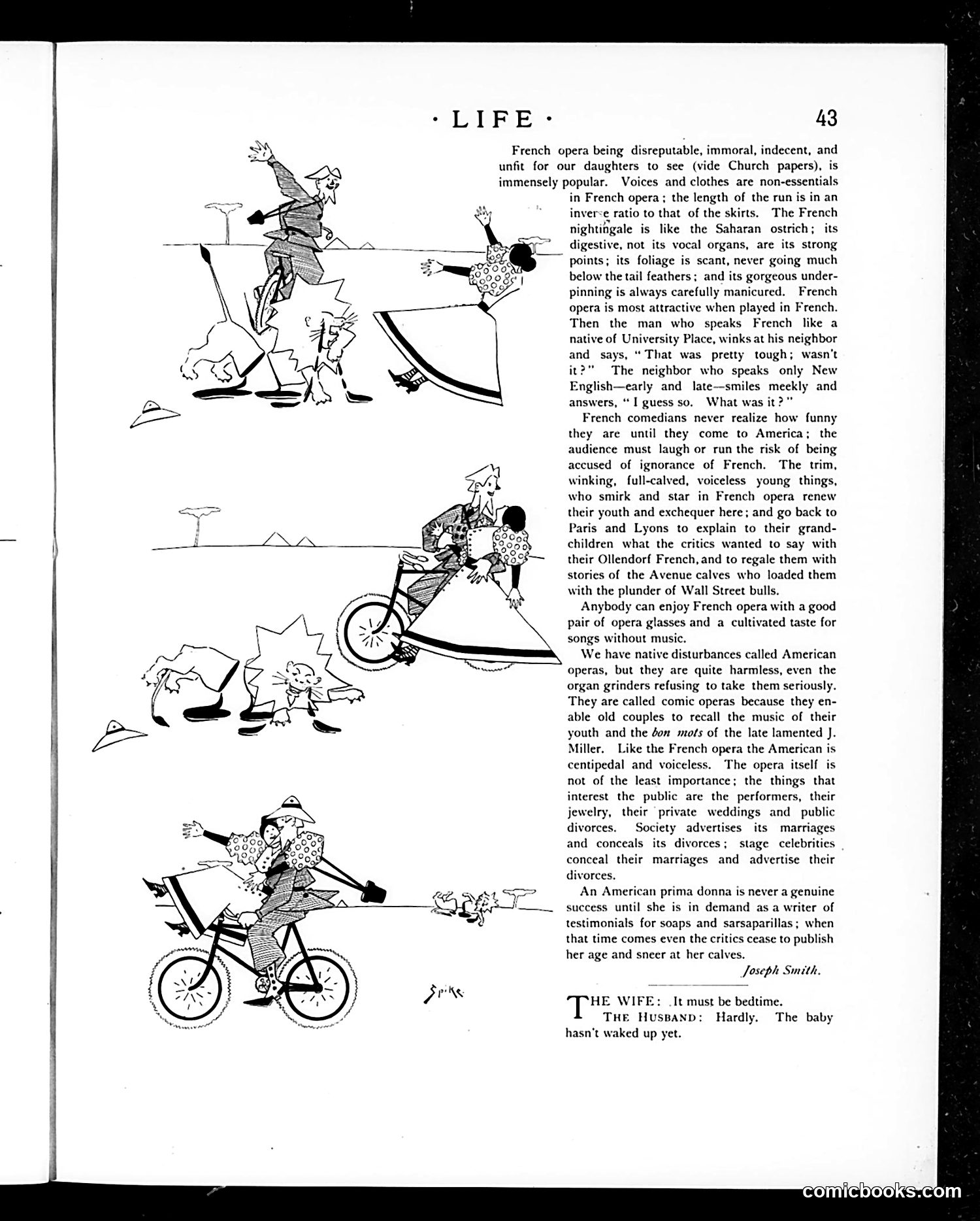
This page from *Life* magazine satirizes French opera and American attitudes toward it. The text criticizes French opera as "disreputable, immoral, indecent" while mocking American audiences who pretend to appreciate it despite not understanding French. The cartoons (credited to artist "Spark") show absurd, exaggerated figures engaged in ridiculous physical antics—appearing to dance or perform chaotically on bicycles and in acrobatic poses. These illustrations mock the supposedly sophisticated European art form by depicting it as nonsensical spectacle rather than refined entertainment. The satire targets American social pretension: wealthy New Yorkers attending French opera to appear cultured while remaining ignorant of the language and content. The piece concludes with a brief comedic dialogue between a husband and wife, maintaining the humorous tone throughout.
📄 Transcribed text from this page (OCR, searchable)
Machine-transcribed from the original scan — historical spelling and the odd misread are preserved.
“ORES: 43 French opera being disreputable, immoral, indecent, and unfit for our daughters to see (vide Church papers), is immensely popular. Voices and clothes are non-essentials in French opera; the length of the run is in an inverse ratio to that of the skirts. The French nightingale is like the Saharan ostrich; its digestive, not its vocal organs, are its strong points; its foliage is scant, never going much below the tail feathers; and its gorgeous under- pinning is always carefully manicured. French opera is most attractive when played in French. Then the man who speaks French like a native of University Place, winks at his neighbor and says, “ That was pretty tough; wasn’t it?" The neighbor who speaks only New English—early and late—smiles meekly and answers, “I guess so, What was it?" French comedians never realize how funny they are until they come to America; the audience must laugh or run the risk of being accused of ignorance of French. The trim, winking, full-calved, voiceless young things, who smirk and star in French opera renew their youth and exchequer here; and go back to Paris and Lyons to explain to their grand- children what the critics wanted to say with their Ollendorf French, and to regale them with stories of the Avenue calves who loaded them with the plunder of Wall Street bulls. Anybody can enjoy French opera with a good pair of opera glasses and a cultivated taste for songs without music. We have native disturbances called American operas, but they are quite harmless, even the organ grinders refusing to take them seriously. They are called comic operas because they en- able old couples to recall the music of their youth and the don mots of the late lamented J. Miller. Like the French opera the American is centipedal and voiceless. The opera itself is not of the least importance; the things that interest the public are the performers, their jewelry, their “private weddings and public divorces. Society advertises its marriages and conceals its divorces; stage celebrities conceal their marriages and advertise their divorces. An American prima donna is never a genuine success until she is in demand as a writer of testimonials for soaps and sarsaparillas; when that time comes even the critics cease to publish her age and sneer at her calves. Joseph Smith. HE WIFE: It must be bedtime. THE HusBaND: Hardly. The baby hasn‘t waked up yet.