
Life, 1895-07-18 · page 6 of 16
Life — July 18, 1895 — page 6: what you’re looking at
What you’re looking at
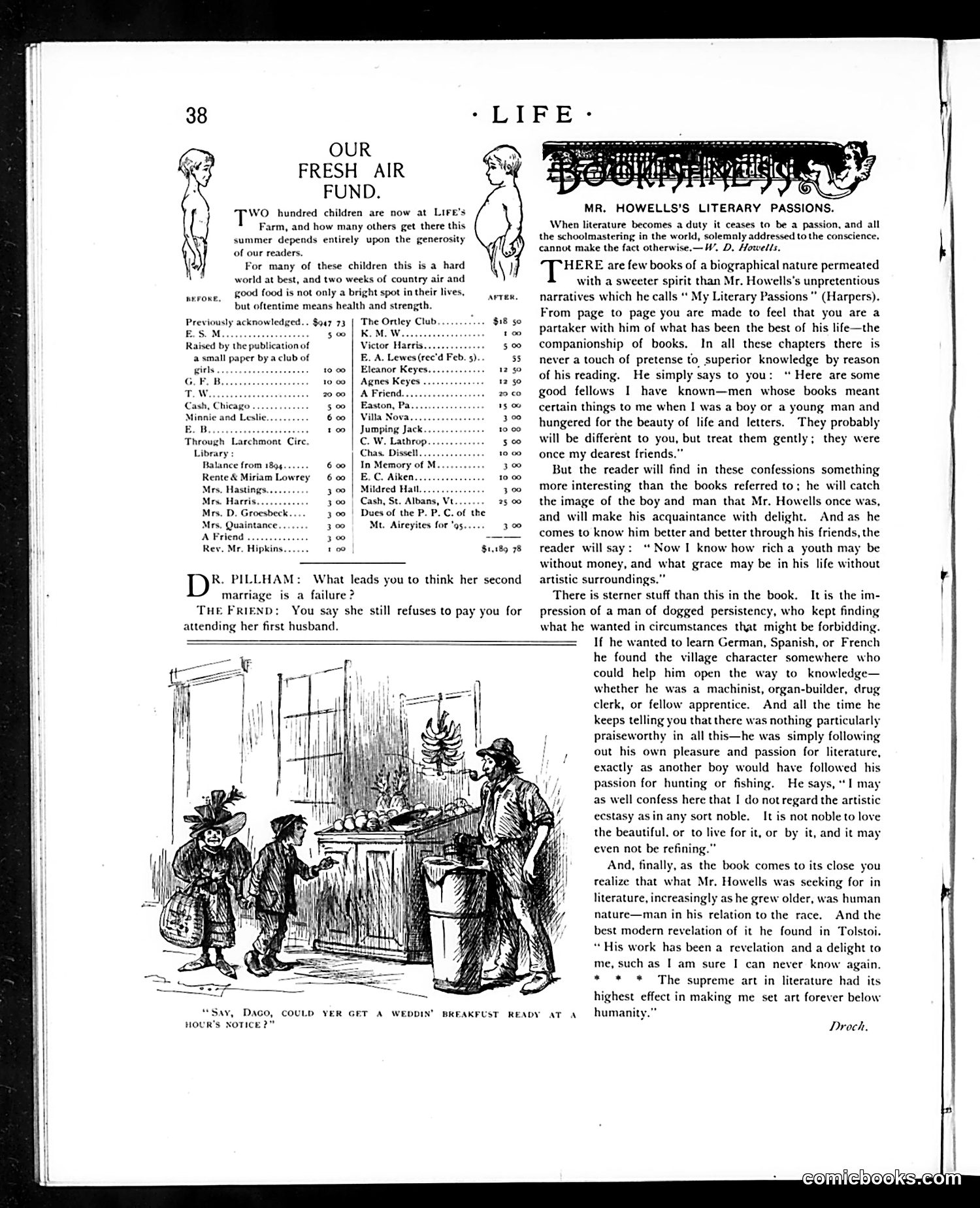
This page contains two distinct elements: **"Our Fresh Air Fund"** (left): A satirical piece about children's charitable donations, listing books and publications with their costs. It appears to mock the gap between charitable intentions and actual funding—suggesting wealthy donors contribute minimal amounts despite claiming generosity. **"Mr. Howells's Literary Passions"** (right): A literary critique praising William Dean Howells's biographical work "My Literary Passions," portraying him as an unpretentious mentor-figure who guided readers through literature without pretense or snobbery. The piece celebrates his humble approach to books and human nature, contrasting his philosophy with artificial intellectualism. **The cartoon** (center-bottom) shows a domestic scene with the caption "Say, Dago, could yer get a weddin' breakfast ready at a hour's notice?" It appears to mock working-class immigrant life and employment dynamics, using period-appropriate but now offensive terminology.
📄 Transcribed text from this page (OCR, searchable)
Machine-transcribed from the original scan — historical spelling and the odd misread are preserved.
OUR FRESH AIR FUND. WO hundred children are now at LiFE’s MR. HOWELLS’S LITERARY PASSIONS. Farm, and how many others get there this When literature becomes a duty it ceases to be a passion, and all summer depends entirely upon the generosity the schoolmastering in the world, solemnly addressed to the conscience, of our readers. cannot make the fact otherwise,—W, D. Howells. For many of these children this is a hard OLPBERE are few books of a biographical nature permeated world at best, and two weeks of country air and with a sweeter spirit than Mr. Howells’s unpretentious good food is not only a bright spot intheir lives, Aryee. narratives which he calls “ My Literary Passions " (Harpers). but oftentime means health and strength. _ & : From page to page you are made to feel that you are a Er acknowledged.- Soar 73.) he Oeey Clade $4 partaker with him of what has been the best of his life—the Raised by the publication of Victor Harris. « companionship of books. In all these chapters there is a small paper by a club of E. A. Lewes (rec'd Feb. 5).. never a touch of pretense to. superior knowledge by reason wanenes east : of his reading. He simply says to you: “Here are some . weo good fellows I have known—men whose books meant Cash, Chicago ...... 3 i $ ‘se certain things to me when | was a boy or a young man and Biome Heh EaNerenenssse jump an © 32 hungered for the beauty of life and letters. They probably Through Larchmont Circ. C. W, Lathrop... . soo Will be different to you, but treat them gently; they were Library : Chas. Dissell. toco once my dearest friends.” Balance from 1894....-. In Memory of M... sd But the reader will find in these confessions something Rente & Miriam Lowrey E.C. Aiken. + 10.00 : : n Mrs. Hastings... Mildred Hall. . 300 More interesting than the books referred to; he will catch Mrs. Harris, ‘ Cash, St. Albans, Vt the image of the boy and man that Mr. Howells once was, Mrs. D. Groesbeck... Ducs'of the PuP..C. and will make his acquaintance with delight. And as he Mrs. Quaintane Mt. Aireyites for ‘95.0... 3.00 fi tgs A Friend .... : comes to know him better and better through his friends, the reader will say: ‘“ Now I know how rich a youth may be without money, and what grace may be in his life without What artistic surroundings.” iage is a failure There is sterner stuff than this in the book. It is the im- THE FRIEND: You say she still refuses to pay you for _ pression of a man of dogged persistency, who kept finding attending her first husband. yhat he wanted in circumstances that might be forbidding. If he wanted to learn German, Spanish, or French he found the village character somewhere who could help him open the way to knowledge— whether he was a machinist, organ-builder, drug clerk, or fellow apprentice. And all the time he keeps telling you that there was nothing particularly praiseworthy in all this—he was simply following out his own pleasure and passion for literature, exactly as another boy would have followed his passion for hunting or fishing. He says, “I may as well confess here that I do not regard the artistic ecstasy asin any sort noble. It is not noble to love the beautiful. or to live for it, or by it, and it may even not be refining.” And, finally, as the book comes to its close you realize that what Mr. Howells was seeking for in literature, increasingly as he grew older, was human nature—man in his relation to the race. And the best modern revelation of it he found in Tolstoi. “His work has been a revelation and a delight to me, such as I am sure I can never know se 8 BEFORE, The supreme art in literature had its highest effect in making me set art forever below “Say, Daco, COULD YER GET A WEDDIN' BREAKFUST READY 4 humanity. HOUR'S NOTICE?” Droch.